
Measurement and Analysis of Link Quality in Wireless

- Slides: 27
Measurement and Analysis of Link Quality in Wireless Networks: An Application Perspective V. Kolar, Saquib Razak, P. Mahonen, N. Abu-Ghazaleh Carnegie Mellon, Qatar RWTH Aachen, Germany
Motivation Designing protocols in Wireless Networks is challenging • Wireless propagation, link errors, MAC effects, . . . • Small changes in topology and environment -> drastic effects Wireless Link Quality: A critical property for many higher layer protocols and applications
Motivation - Link quality Most efficient protocols are link-quality aware • Even higher layer apps! • Rate-adaptation, routing, video encoding, . . . Common Methodology: • Measure link-quality and act on it Common metrics: • Received Signal Strength (RSS) • Error Rate (PER, BER, . . . )
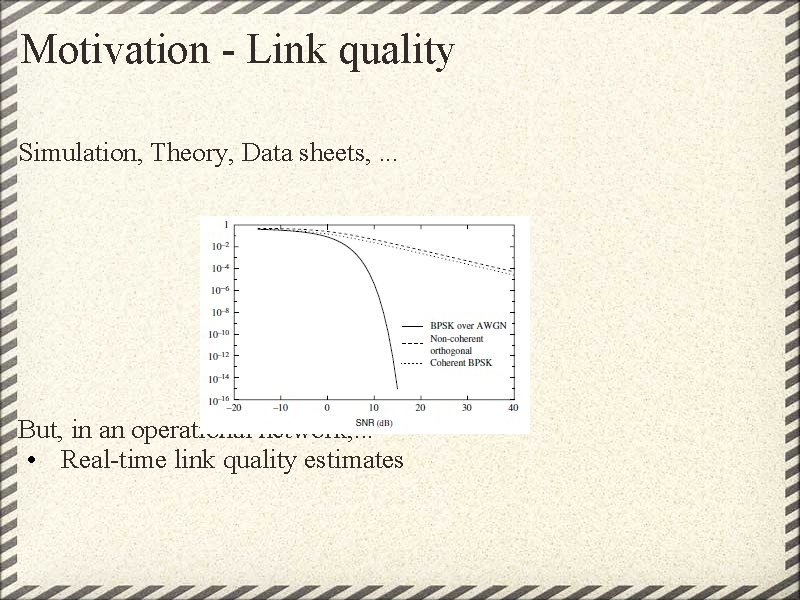
Motivation - Link quality Simulation, Theory, Data sheets, . . . But, in an operational network, . . . • Real-time link quality estimates
Motivation Many open questions about link-quality • Statistical properties: o Distribution: Constant, normal, log-normal? o Temporal properties: Independent, memory? • How often should we measure?
Contribution Statistical analysis of RSS and error-rates • Distribution and temporal properties Specific focus on protocols that measure and use link-quality • Is it feasible to measure these parameters in real-time? • If so, how often should we measure? (Stale) • What distribution should we assume in real-time? Real-time link-quality monitoring framework and applications
Overview • • Motivation Contributions Testbed and background Statistical analysis of link-quality o Signal Strength o Error-rate • Real-time measurement framework o Example applications • Conclusions
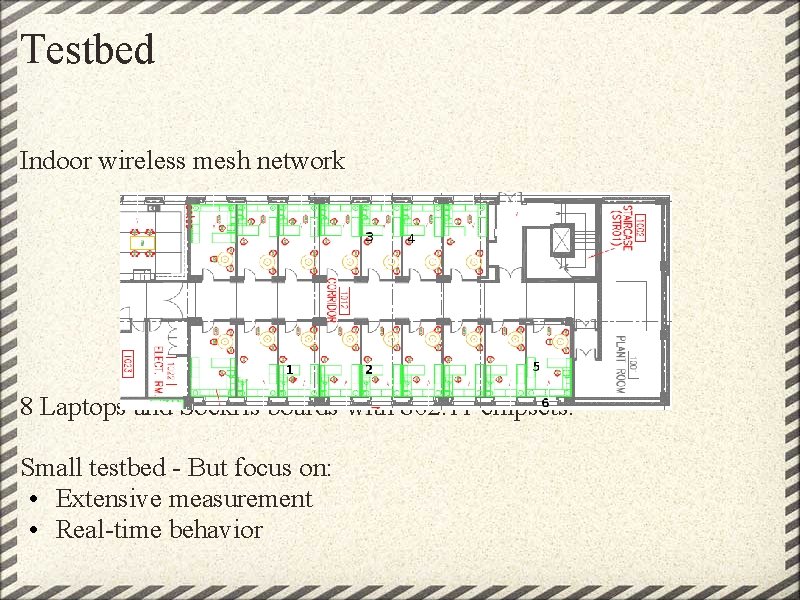
Testbed Indoor wireless mesh network 8 Laptops and Soekris boards with 802. 11 chipsets. Small testbed - But focus on: • Extensive measurement • Real-time behavior
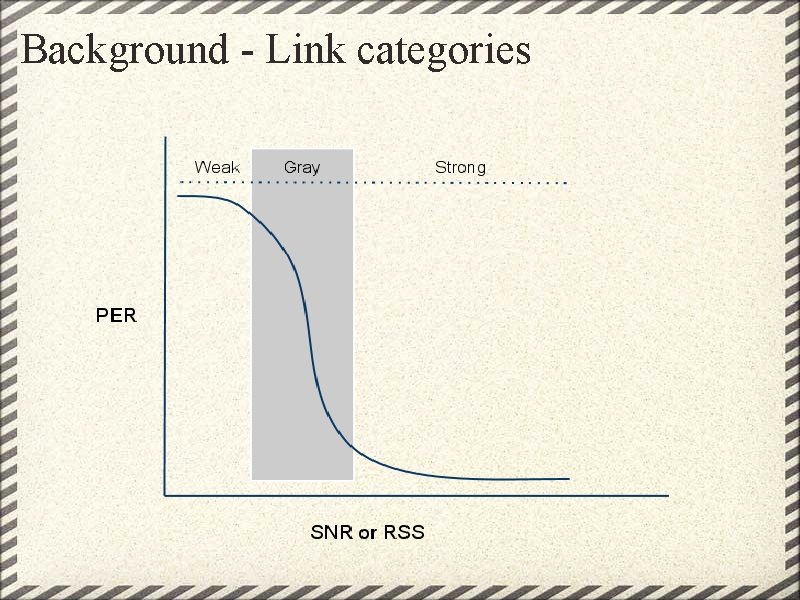
Background - Link categories
Overview • • Motivation Contributions Testbed and background Statistical analysis of link-quality o Signal Strength o Error-rate • Real-time measurement framework o Example applications • Conclusions
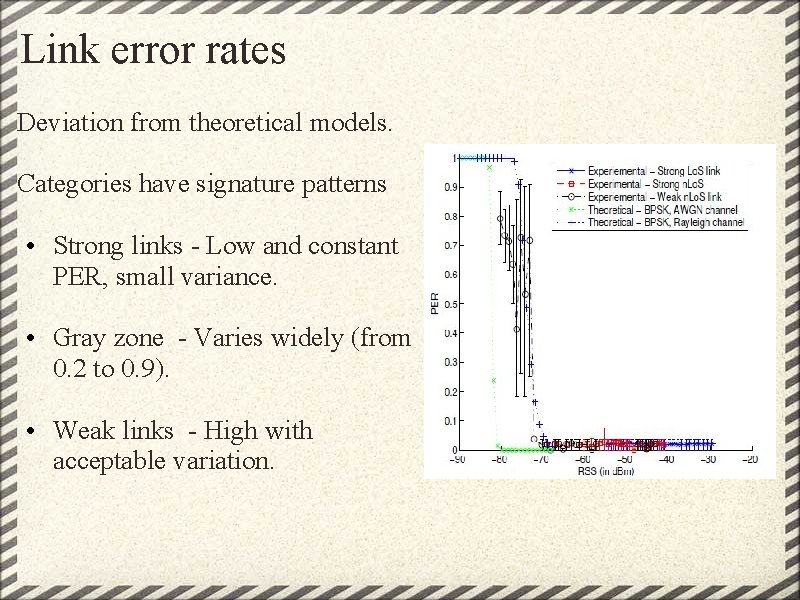
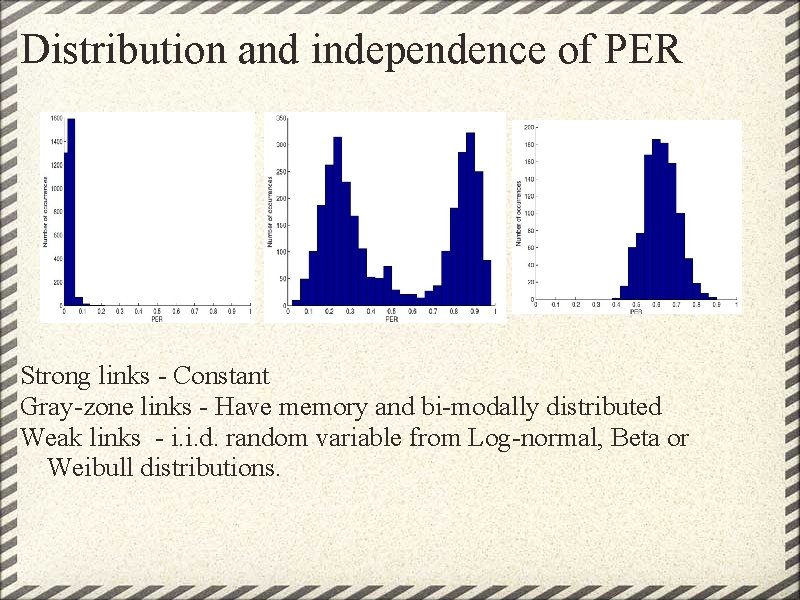
Link error rates Deviation from theoretical models. Categories have signature patterns • Strong links - Low and constant PER, small variance. • Gray zone - Varies widely (from 0. 2 to 0. 9). • Weak links - High with acceptable variation.
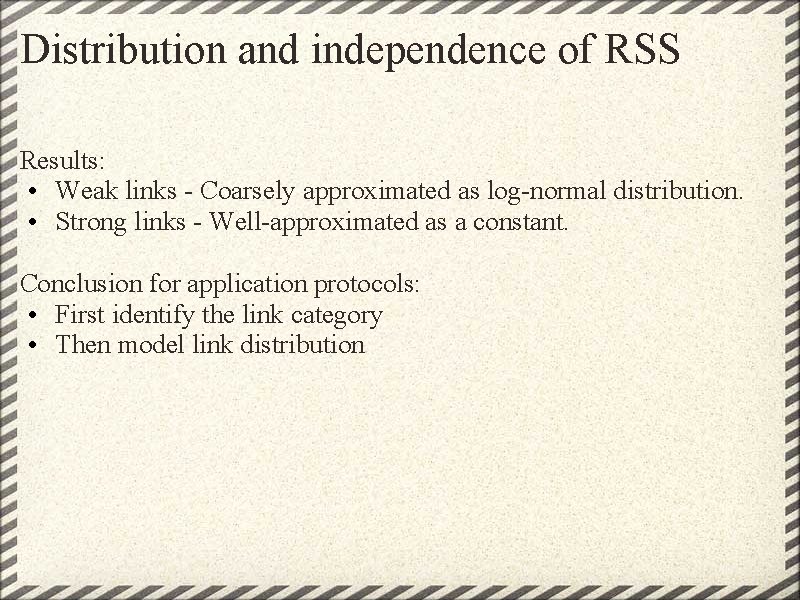
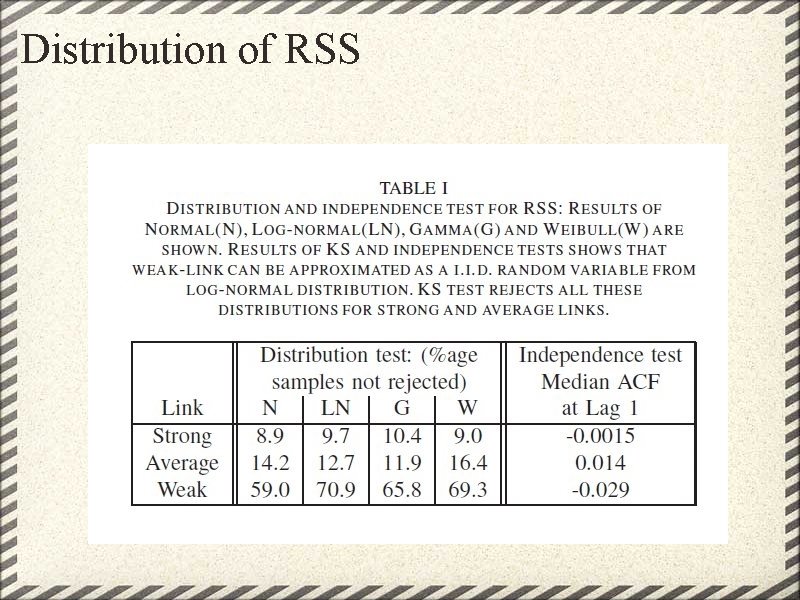
Distribution and independence of RSS General methodology in models and protocols: • RSS is constant or follows a statistical distribution Needs verification • Which distribution does it follow? • Does link category affect these statistical properties? Analysis methodology: • Record RSS values for various links (with different tx powers) • Collect in 1. 5 second interval • Perform distribution tests (KS-test, Log-likelihood, . . . ) • Perform independence tests (Auto-correlation Function)
Distribution and independence of RSS Results: • Weak links - Coarsely approximated as log-normal distribution. • Strong links - Well-approximated as a constant. Conclusion for application protocols: • First identify the link category • Then model link distribution
Distribution of RSS
Distribution and independence of PER Strong links - Constant Gray-zone links - Have memory and bi-modally distributed Weak links - i. i. d. random variable from Log-normal, Beta or Weibull distributions.
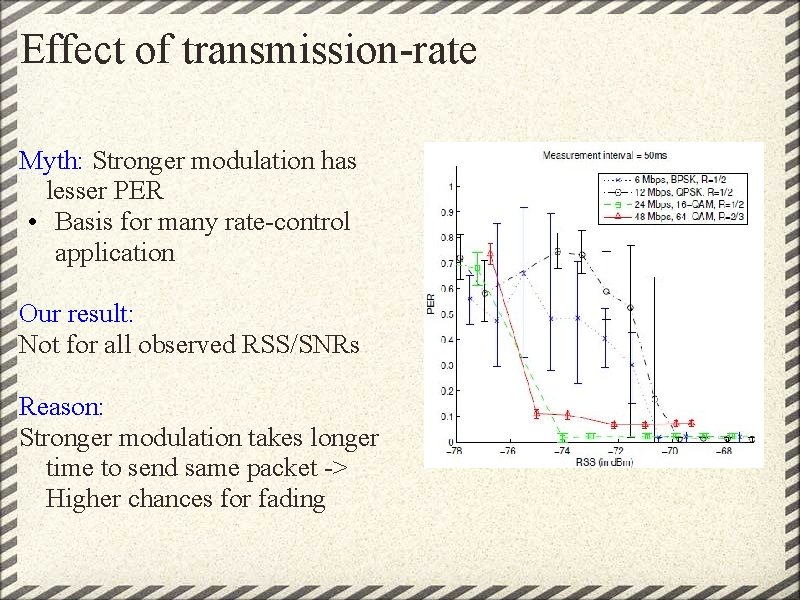
Effect of transmission-rate Myth: Stronger modulation has lesser PER • Basis for many rate-control application Our result: Not for all observed RSS/SNRs Reason: Stronger modulation takes longer time to send same packet -> Higher chances for fading
Overview • • Motivation Contributions Testbed and background Statistical analysis of link-quality o Signal Strength o Error-rate • Real-time measurement framework o Example applications • Conclusions
Real-time monitoring framework Real-time measurement and estimation poses practical challenges • Coordination between the nodes • Measurement overheads. Contribution: System Architecture and Applications in our testbed
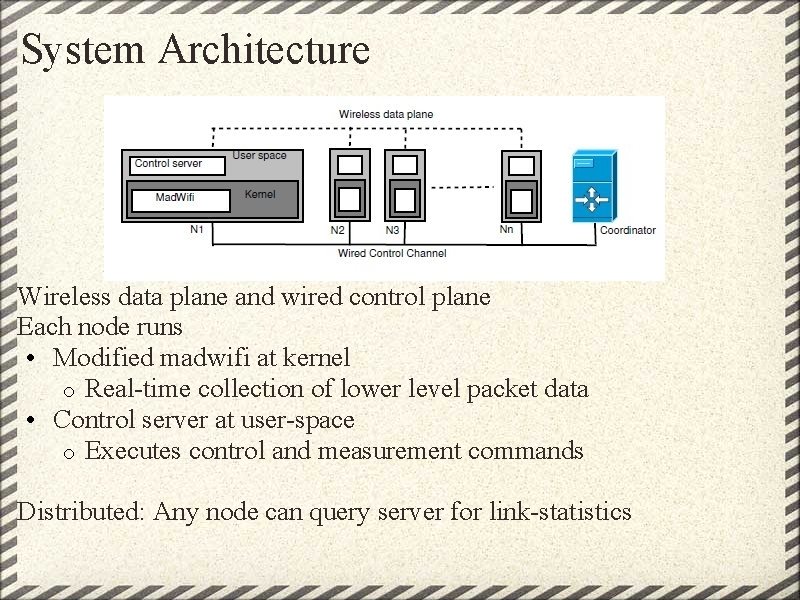
System Architecture Wireless data plane and wired control plane Each node runs • Modified madwifi at kernel o Real-time collection of lower level packet data • Control server at user-space o Executes control and measurement commands Distributed: Any node can query server for link-statistics
System Architecture Coordinator • Polls receiver traces o Non-intrusive, light-weight. o Statistical summary of RSS, PER, traffic, etc. • PER measurement o Complex and intrusive (night-times, traffic is lesser) o Broadcast based (and not unicast) o Lots of room for optimization
Applications Measurement framework is useful for building many applications • • • Power-control Network monitoring Rate control Routing, Cross-layer video-MAC, etc. . .
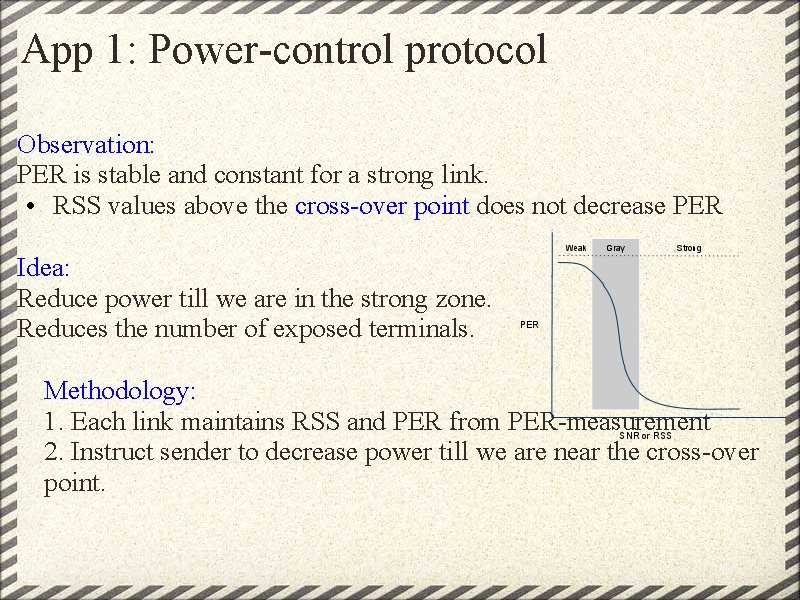
App 1: Power-control protocol Observation: PER is stable and constant for a strong link. • RSS values above the cross-over point does not decrease PER Idea: Reduce power till we are in the strong zone. Reduces the number of exposed terminals. Methodology: 1. Each link maintains RSS and PER from PER-measurement 2. Instruct sender to decrease power till we are near the cross-over point.
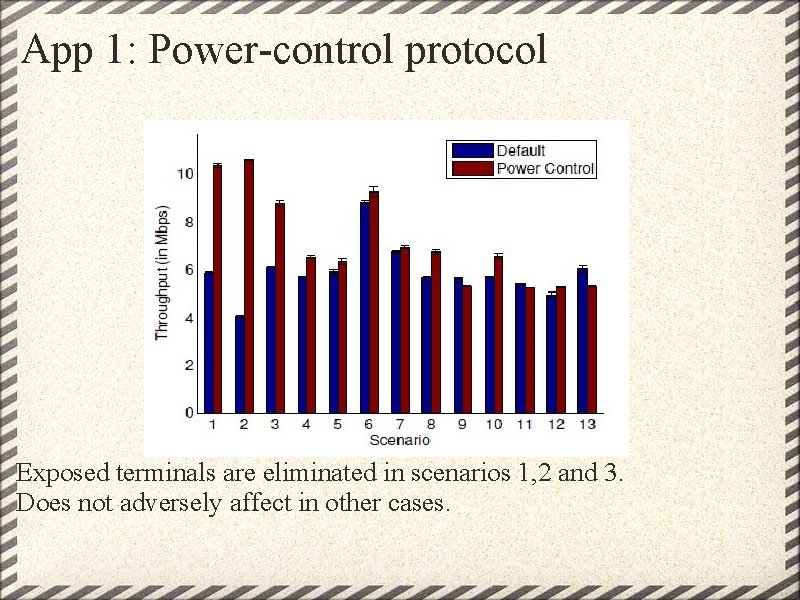
App 1: Power-control protocol Exposed terminals are eliminated in scenarios 1, 2 and 3. Does not adversely affect in other cases.
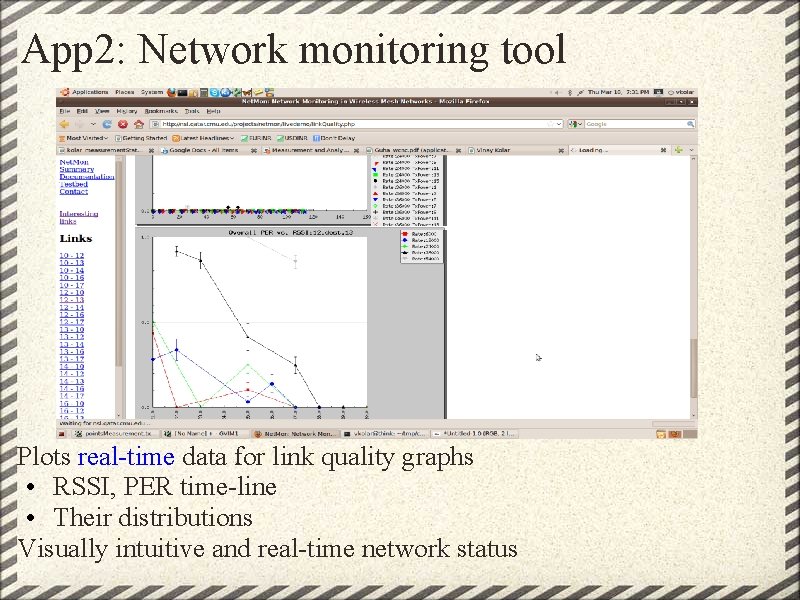
App 2: Network monitoring tool Plots real-time data for link quality graphs • RSSI, PER time-line • Their distributions Visually intuitive and real-time network status
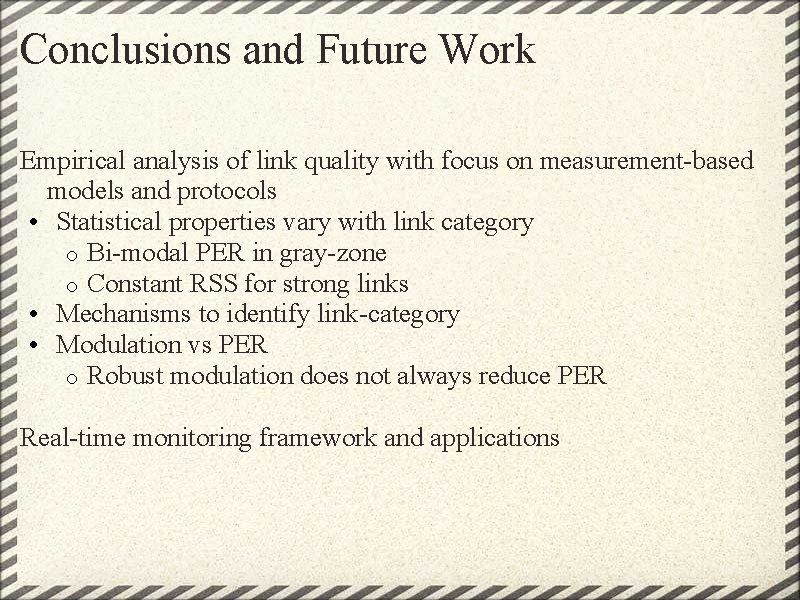
Conclusions and Future Work Empirical analysis of link quality with focus on measurement-based models and protocols • Statistical properties vary with link category o Bi-modal PER in gray-zone o Constant RSS for strong links • Mechanisms to identify link-category • Modulation vs PER o Robust modulation does not always reduce PER Real-time monitoring framework and applications
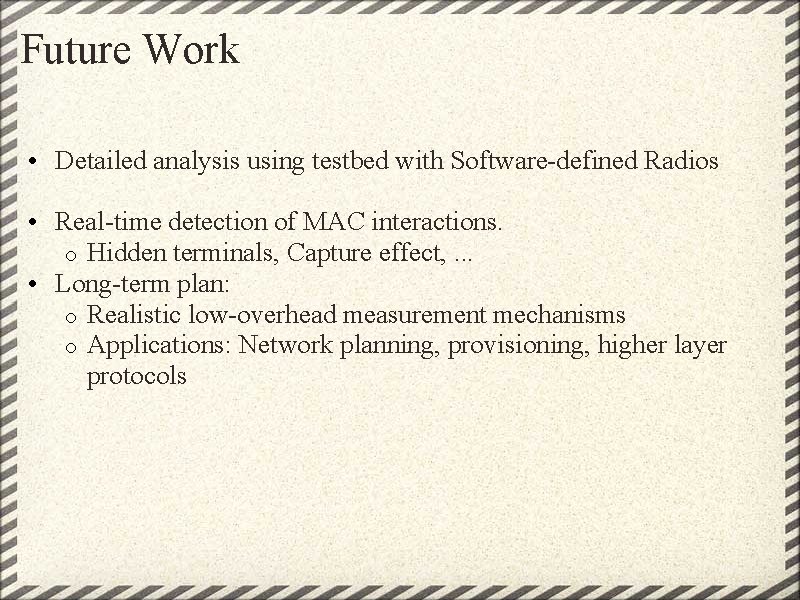
Future Work • Detailed analysis using testbed with Software-defined Radios • Real-time detection of MAC interactions. o Hidden terminals, Capture effect, . . . • Long-term plan: o Realistic low-overhead measurement mechanisms o Applications: Network planning, provisioning, higher layer protocols