
Measure Tools Approaches LEAN SIX SIGMA TRAINING Data



- Slides: 39
Measure Tools & Approaches LEAN SIX SIGMA TRAINING
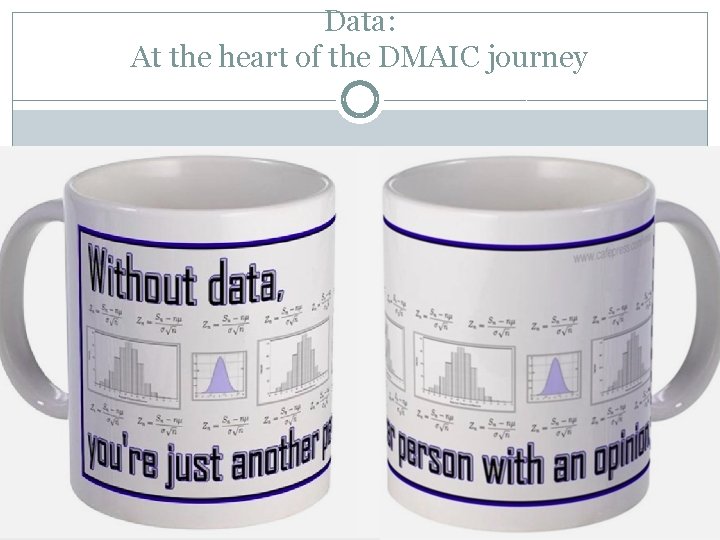
Data: At the heart of the DMAIC journey Because without data…
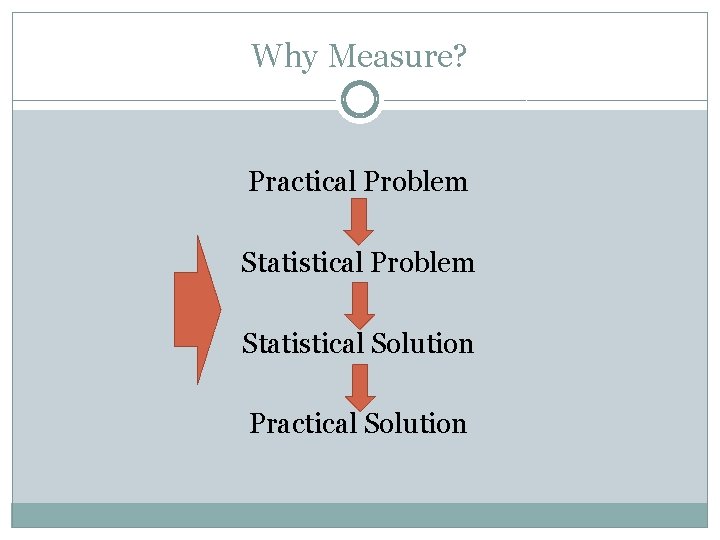
Why Measure? Practical Problem Statistical Solution Practical Solution
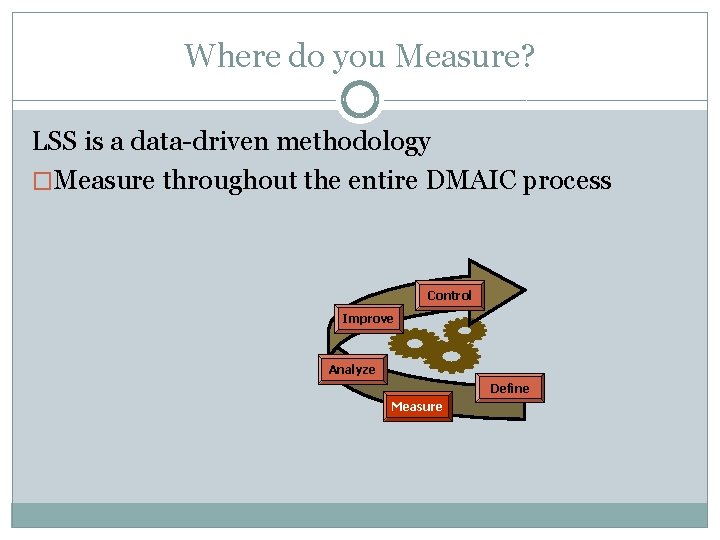
Where do you Measure? LSS is a data-driven methodology �Measure throughout the entire DMAIC process Control Improve Analyze Define Measure
Measure Phase Outcomes �Collect Data (Select CTQ) �Understand the Voice of the Process (VOP) �Identify sources of variation �Measure current state process capability
Select CTQs (Kano Analysis) �Wikipedia says: The Kano model is a theory for product development and customer satisfaction developed in the 1980 s by Professor Noriaki Kano, which classifies customer preferences into five categories.
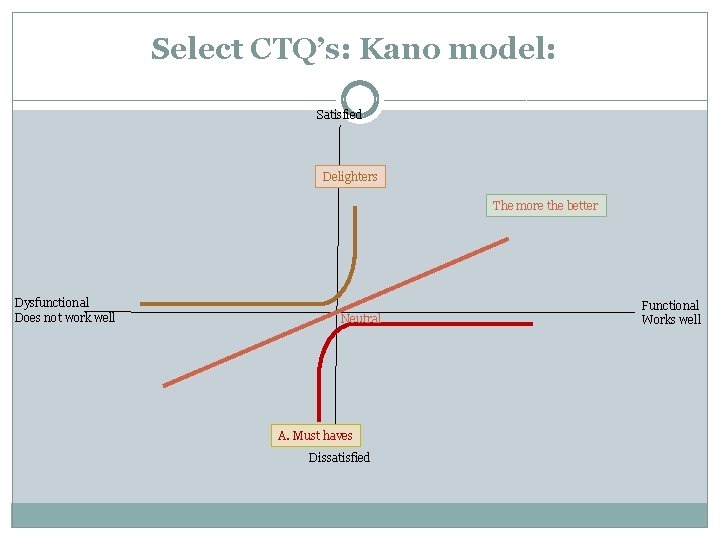
Select CTQ’s: Kano model: Satisfied Delighters The more the better Dysfunctional Does not work well Neutral A. Must haves Dissatisfied Functional Works well
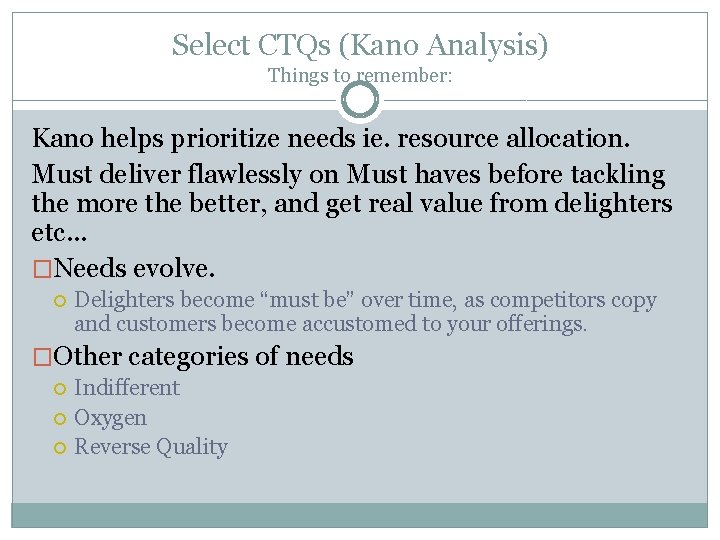
Select CTQs (Kano Analysis) Things to remember: Kano helps prioritize needs ie. resource allocation. Must deliver flawlessly on Must haves before tackling the more the better, and get real value from delighters etc. . . �Needs evolve. Delighters become “must be” over time, as competitors copy and customers become accustomed to your offerings. �Other categories of needs Indifferent Oxygen Reverse Quality
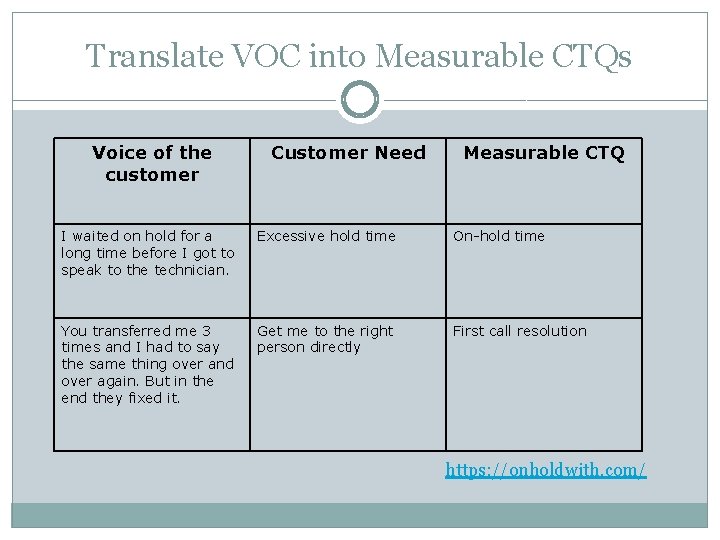
Translate VOC into Measurable CTQs Voice of the customer Customer Need Measurable CTQ I waited on hold for a long time before I got to speak to the technician. Excessive hold time On-hold time You transferred me 3 times and I had to say the same thing over and over again. But in the end they fixed it. Get me to the right person directly First call resolution https: //onholdwith. com/
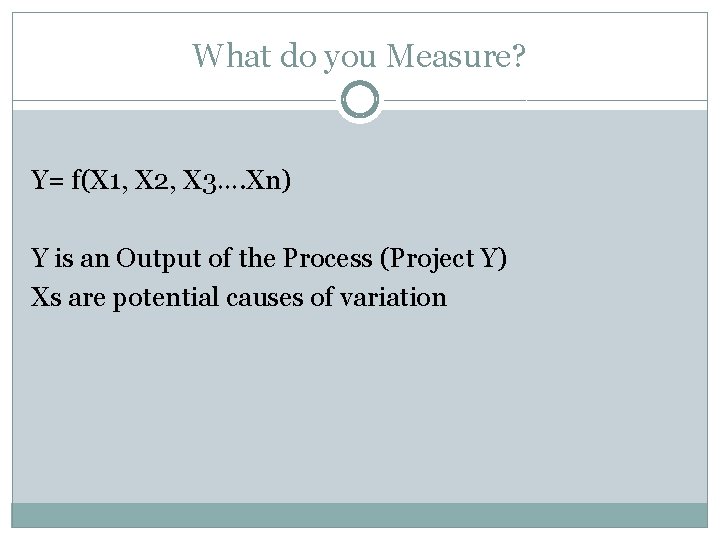
What do you Measure? Y= f(X 1, X 2, X 3…. Xn) Y is an Output of the Process (Project Y) Xs are potential causes of variation
The Lincoln Memorial
Five Whys, Spiders and Flies? Problem Statement: The stone on the Jefferson Memorial was deteriorating at a faster rate than the same stone on the Lincoln Memorial. Repairs would be expensive - Why was this happening? After research it was determined that the Jefferson washed more frequently - Why? After further investigation it was determined that birds defecated on the Jefferson Memorial more than on the Lincoln Memorial. A solution was proposed that a net be placed over the monument to keep the birds away. But before acting on the solution, it was decided to dig deeper. Why were there more birds on the Jefferson than on the Lincoln? Digging deeper, researchers found that there was a particular spider on the Jefferson that was not on the Lincoln. The birds liked to eat this particular spider. Why was this particular spider more plentiful on the Jefferson Memorial? After researching further, it was discovered that there was a parasite on the Jefferson monument that the spider liked which caused the disproportionate number of spiders to grow there. This parasite was not on the Lincoln - Why? It was discovered the parasite liked the type of lights on the Jefferson. The Lincoln employed a different type of light bulb.
The Jefferson Memorial
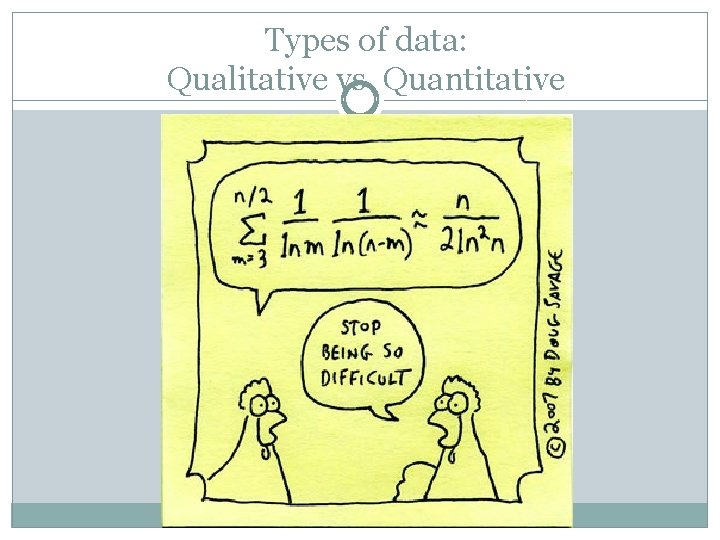
Types of data: Qualitative vs. Quantitative
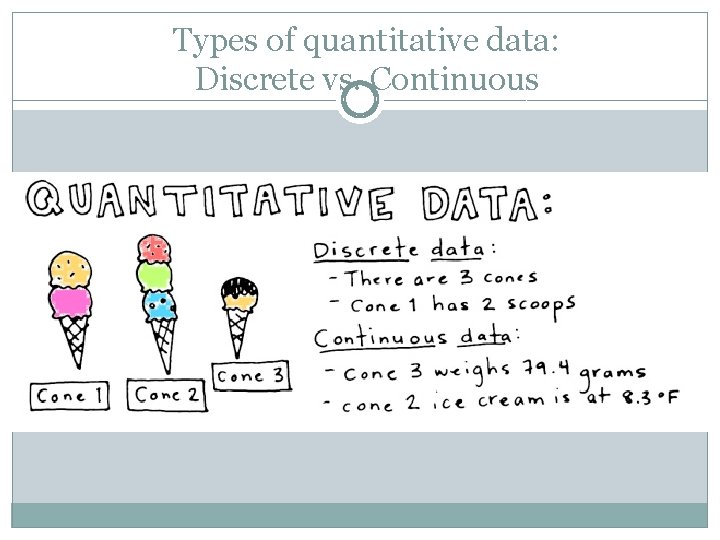
Types of quantitative data: Discrete vs. Continuous
Types of data: Examples from your processes � 1. Name the process � 2. Select 2 -3 CTQs � 3. Share the project Y Tell us why � 4. Brainstorm 3 ways to measure your project Y � 5. What type of data is it?
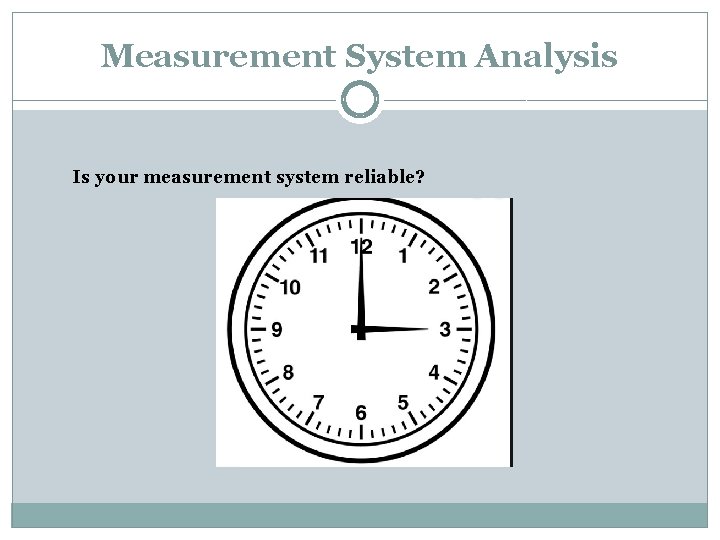
Measurement System Analysis Is your measurement system reliable?
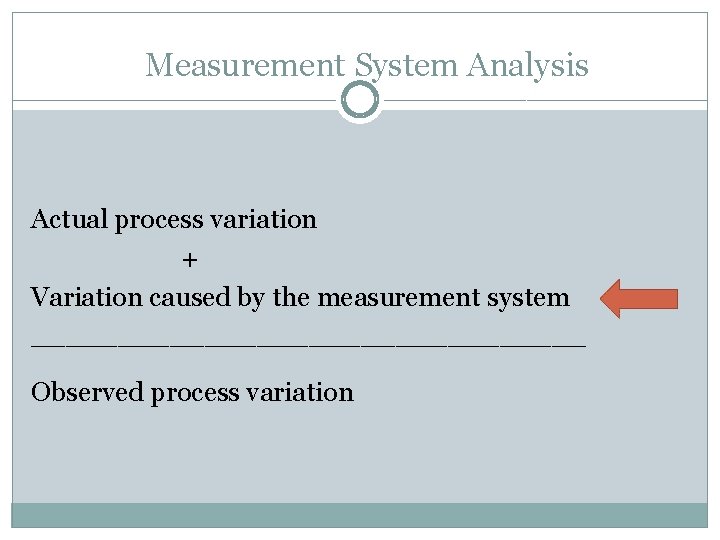
Measurement System Analysis Actual process variation + Variation caused by the measurement system ________________ Observed process variation
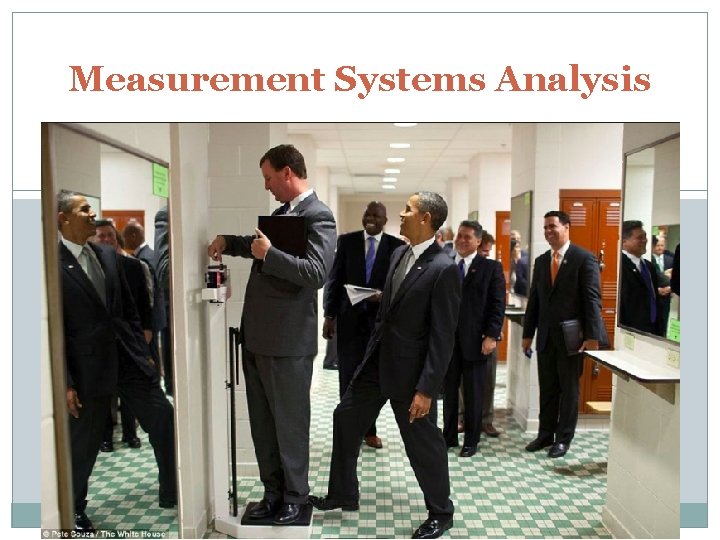
Measurement Systems Analysis
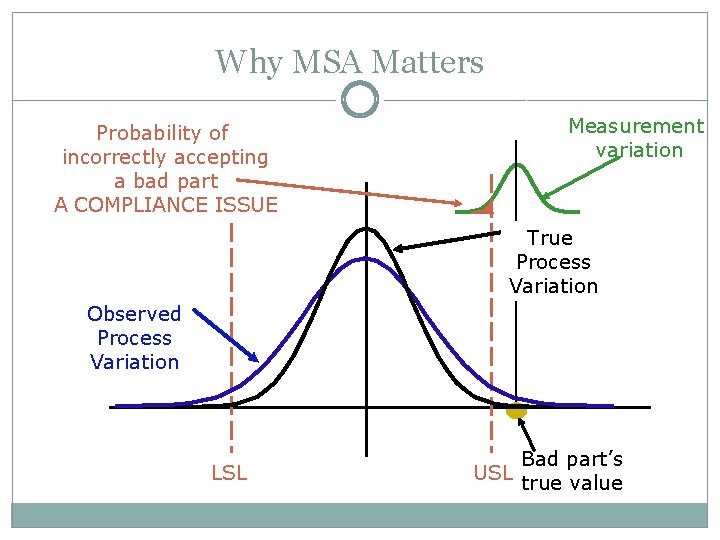
Why MSA Matters Probability of incorrectly accepting a bad part A COMPLIANCE ISSUE Measurement variation True Process Variation Observed Process Variation LSL Bad part’s USL true value
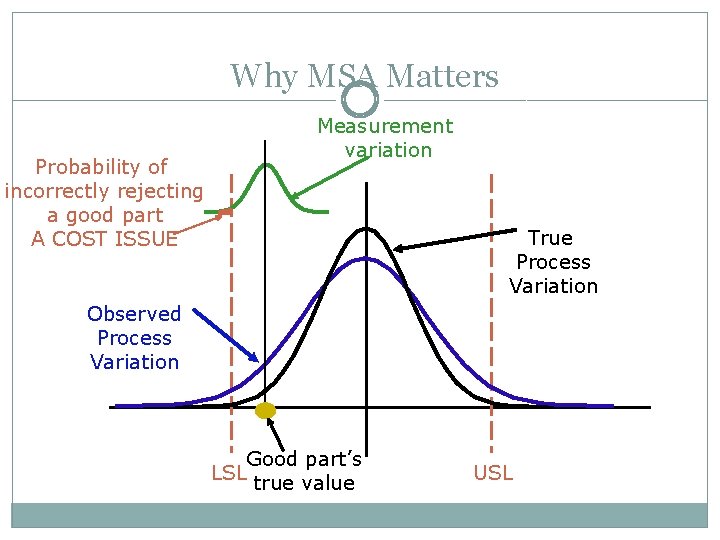
Why MSA Matters Probability of incorrectly rejecting a good part A COST ISSUE Measurement variation True Process Variation Observed Process Variation Good part’s LSL true value USL
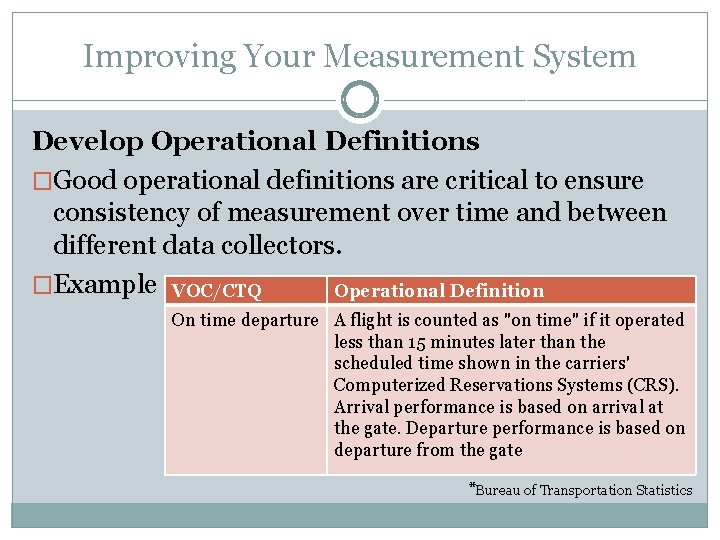
Improving Your Measurement System Develop Operational Definitions �Good operational definitions are critical to ensure consistency of measurement over time and between different data collectors. �Example VOC/CTQ Operational Definition On time departure A flight is counted as "on time" if it operated less than 15 minutes later than the scheduled time shown in the carriers' Computerized Reservations Systems (CRS). Arrival performance is based on arrival at the gate. Departure performance is based on departure from the gate *Bureau of Transportation Statistics
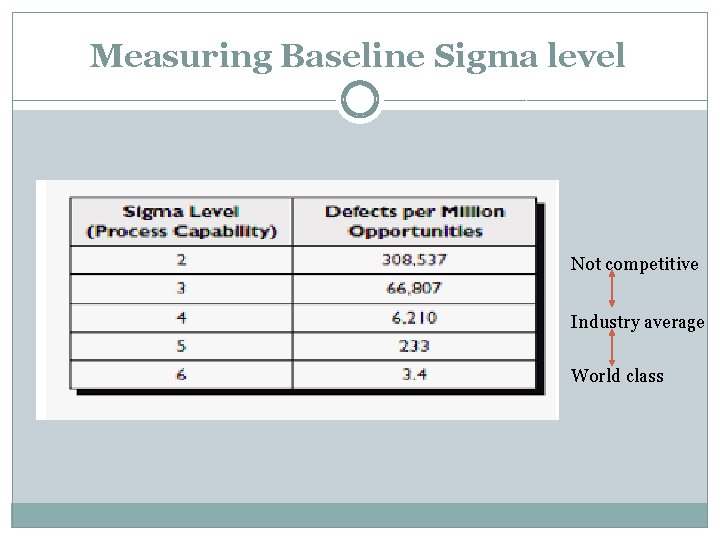
Evaluating Current State Performance �DPMO �Sigma Level
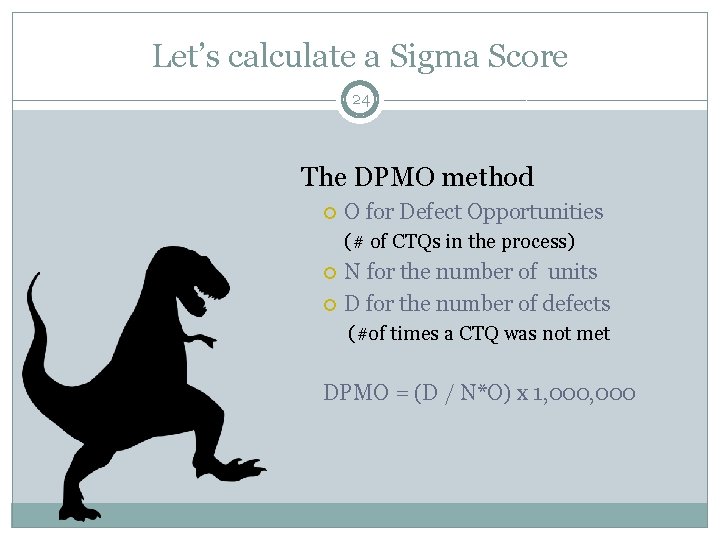
Let’s calculate a Sigma Score 24 The DPMO method O for Defect Opportunities (# of CTQs in the process) N for the number of units D for the number of defects (#of times a CTQ was not met DPMO = (D / N*O) x 1, 000
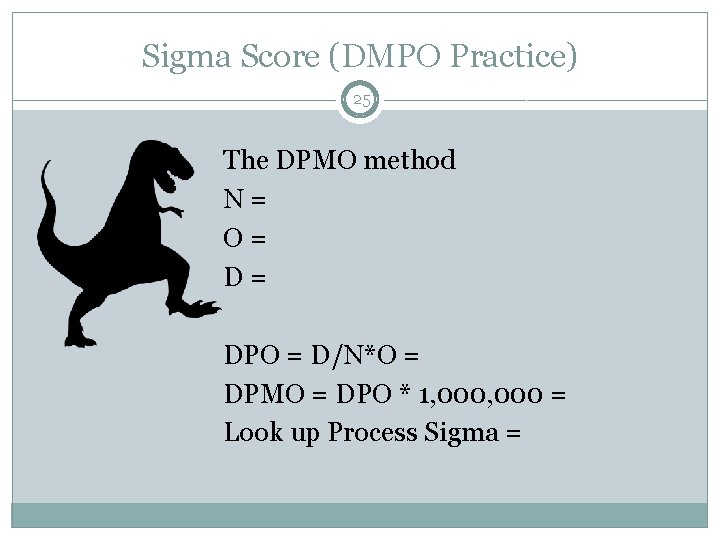
Sigma Score (DMPO Practice) 25 The DPMO method N= O= D= DPO = D/N*O = DPMO = DPO * 1, 000 = Look up Process Sigma =
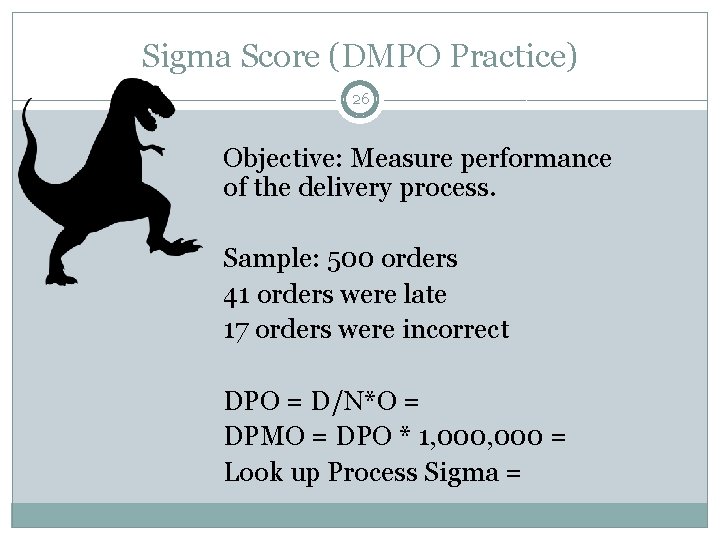
Sigma Score (DMPO Practice) 26 Objective: Measure performance of the delivery process. Sample: 500 orders 41 orders were late 17 orders were incorrect DPO = D/N*O = DPMO = DPO * 1, 000 = Look up Process Sigma =
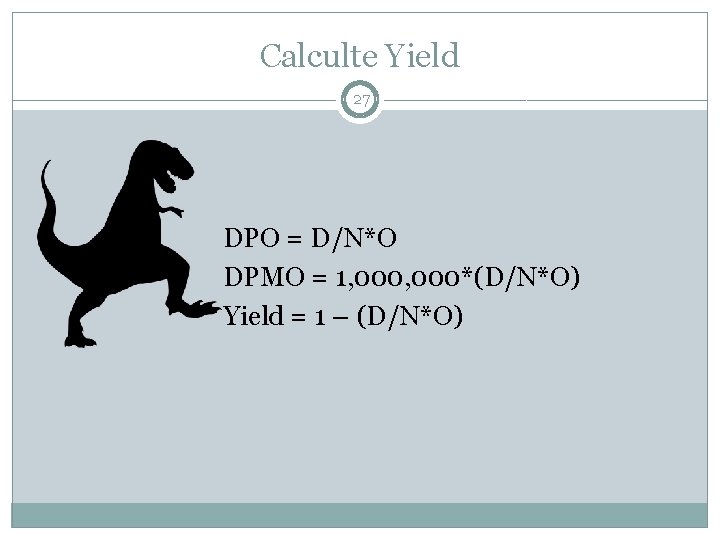
Calculte Yield 27 DPO = D/N*O DPMO = 1, 000*(D/N*O) Yield = 1 – (D/N*O)
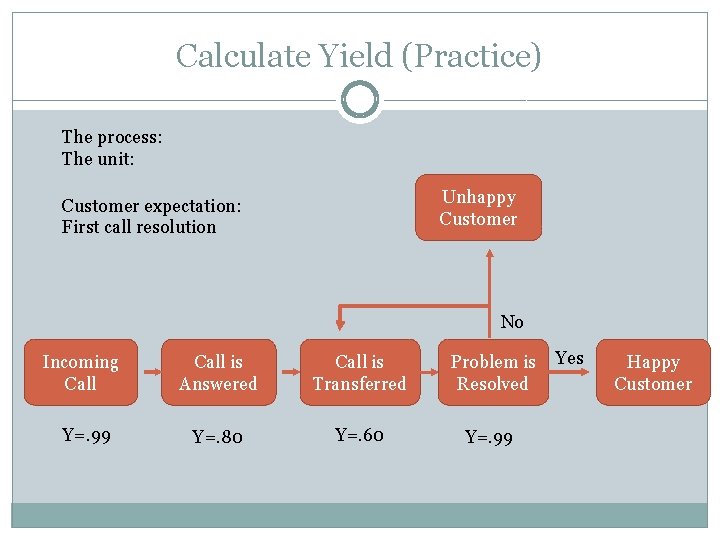
Calculate Yield (Practice) The process: The unit: Unhappy Customer expectation: First call resolution No Incoming Call Y=. 99 Call is Answered Call is Transferred Problem is Resolved Y=. 80 Y=. 60 Y=. 99 Yes Happy Customer
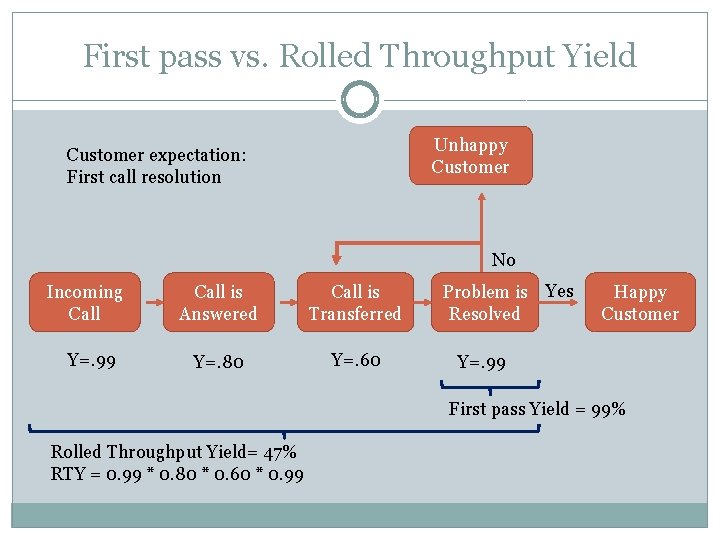
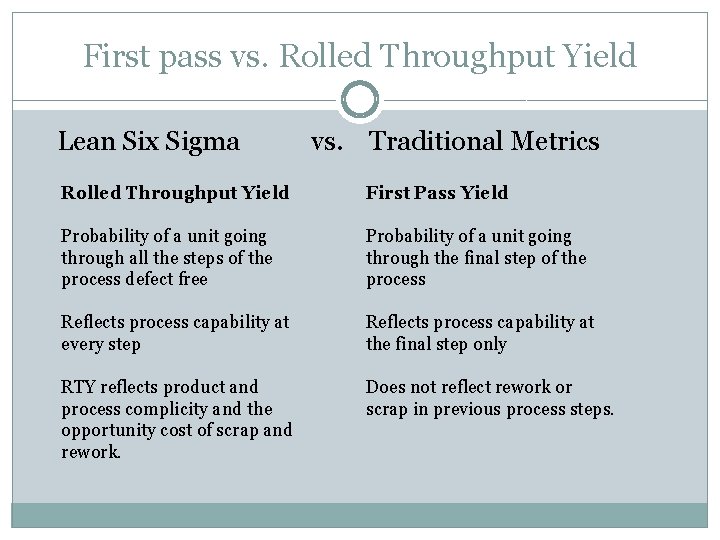
First pass vs. Rolled Throughput Yield Unhappy Customer expectation: First call resolution No Incoming Call Y=. 99 Call is Answered Call is Transferred Problem is Resolved Y=. 80 Y=. 60 Y=. 99 Yes Happy Customer First pass Yield = 99% Rolled Throughput Yield= 47% RTY = 0. 99 * 0. 80 * 0. 60 * 0. 99
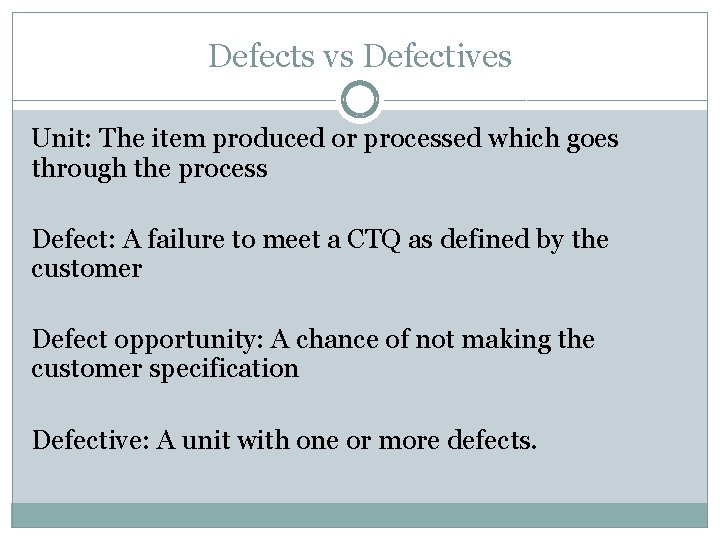
Defects vs Defectives Unit: The item produced or processed which goes through the process Defect: A failure to meet a CTQ as defined by the customer Defect opportunity: A chance of not making the customer specification Defective: A unit with one or more defects.
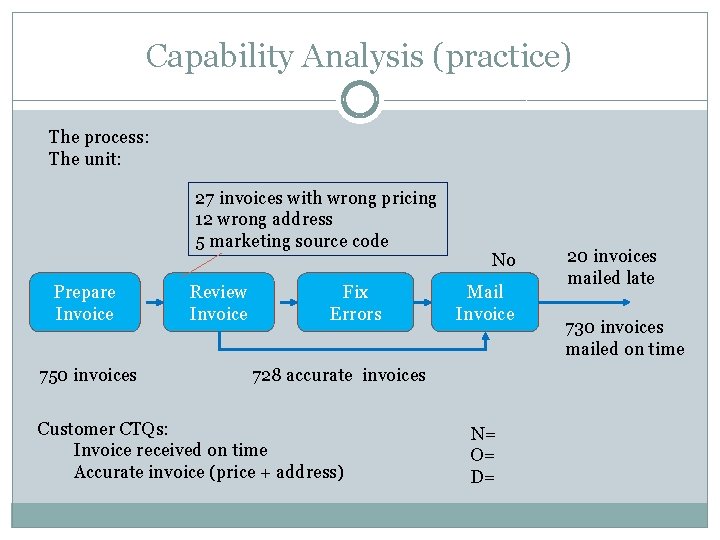
Capability Analysis (practice) The process: The unit: 27 invoices with wrong pricing 12 wrong address 5 marketing source code Prepare Invoice 750 invoices Review Invoice Fix Errors No Mail Invoice 728 accurate invoices Customer CTQs: Invoice received on time Accurate invoice (price + address) N= O= D= 20 invoices mailed late 730 invoices mailed on time
First pass vs. Rolled Throughput Yield Lean Six Sigma vs. Traditional Metrics Rolled Throughput Yield First Pass Yield Probability of a unit going through all the steps of the process defect free Probability of a unit going through the final step of the process Reflects process capability at every step Reflects process capability at the final step only RTY reflects product and process complicity and the opportunity cost of scrap and rework. Does not reflect rework or scrap in previous process steps.
Measuring Baseline Sigma level Not competitive Industry average World class
Lean Six Sigma 34
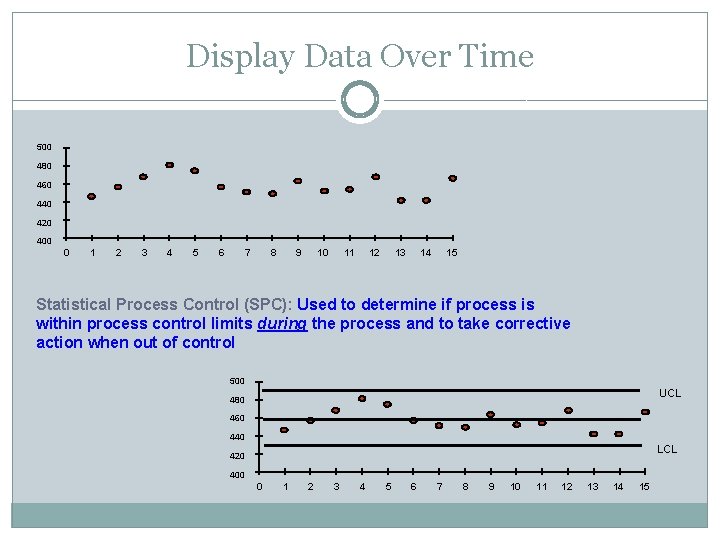
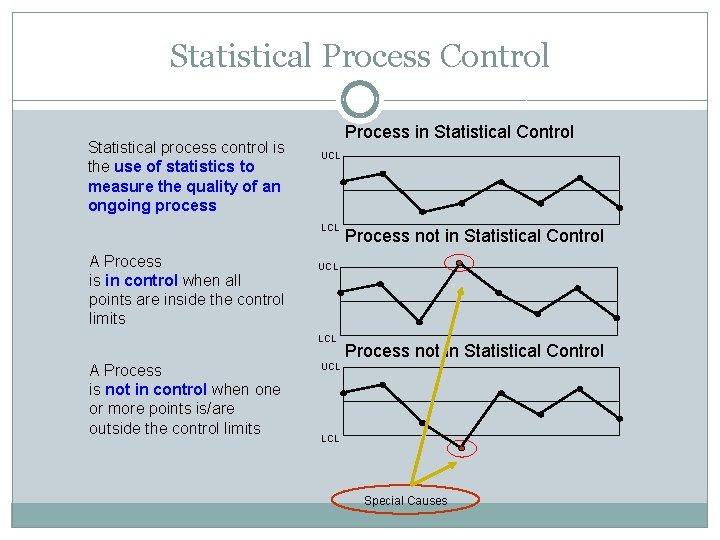
Display Data Over Time 500 480 460 440 420 400 0 1 2 3 4 5 6 7 8 9 10 11 12 13 14 15 Statistical Process Control (SPC): Used to determine if process is within process control limits during the process and to take corrective action when out of control 500 UCL 480 460 440 LCL 420 400 0 1 2 3 4 5 6 7 8 9 10 11 12 13 14 15
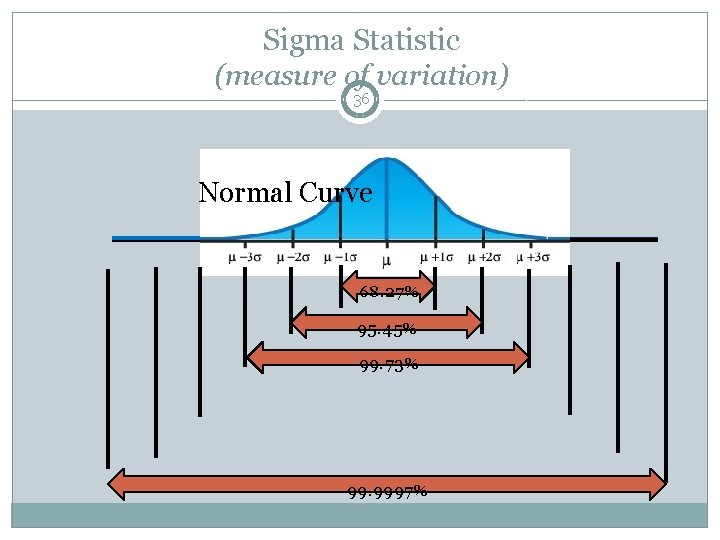
Sigma Statistic (measure of variation) 36 Normal Curve 68. 27% 95. 45% 99. 73% 99. 9997%
Statistical Process Control Statistical process control is the use of statistics to measure the quality of an ongoing process Process in Statistical Control UCL LCL A Process is in control when all points are inside the control limits UCL LCL A Process is not in control when one or more points is/are outside the control limits Process not in Statistical Control UCL LCL Special Causes
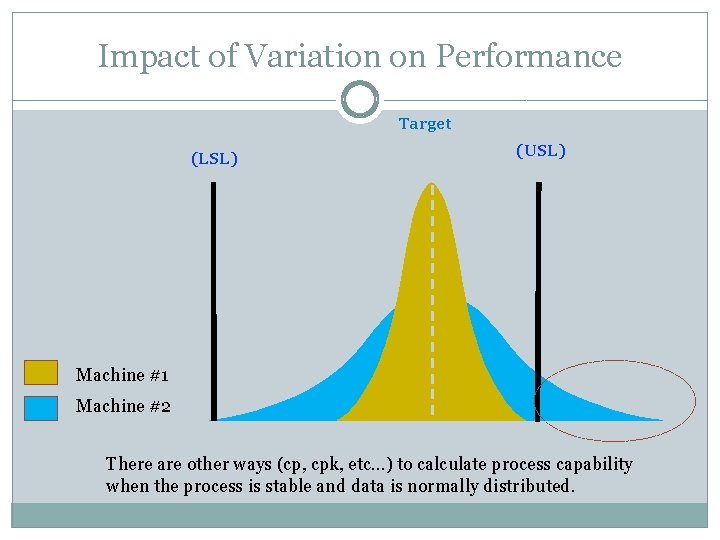
Impact of Variation on Performance Target (LSL) (USL) Machine #1 Machine #2 There are other ways (cp, cpk, etc…) to calculate process capability when the process is stable and data is normally distributed.
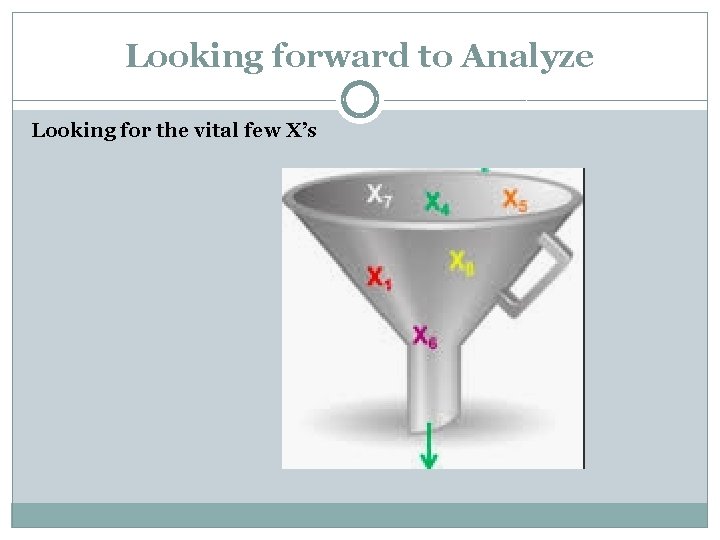
Looking forward to Analyze Looking for the vital few X’s