
Measurable Organizational Value and the Business Case Chapter
Measurable Organizational Value and the Business Case Chapter 3 2 -1
Phase 1 Deliverable: The Business Case Attributes of a Good Business Case § § 2 -2
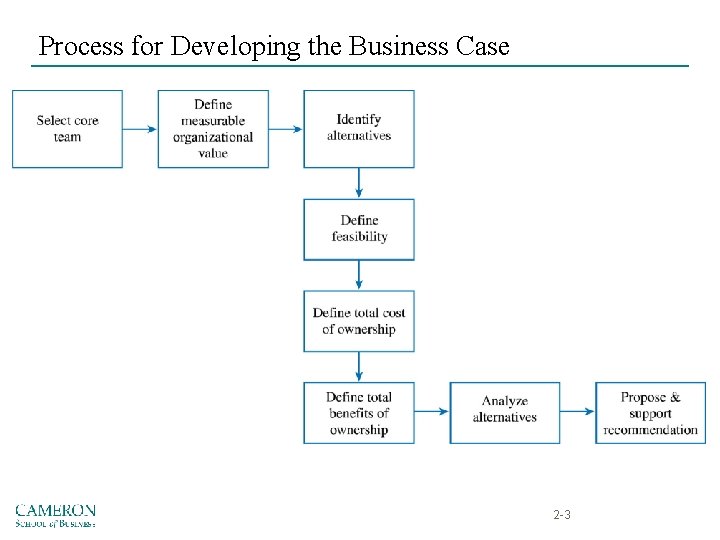
Process for Developing the Business Case 2 -3
Developing the Business Case Step 1: Select the Core Team Advantages:
Developing the Business Case Step 2: Define Measurable Organizational Value (MOV) the project’s overall goal A Measurable Organizational Value must: • • 2 -5
The IT Value Chain 2 -6 John Wiley & Copyright 2012
Process for Developing the MOV 1. Identify the desired area of impact Potential Areas: 2 -7
Process for Developing the MOV 2. Identify the desired value of the IT project Organizational Value: • • 2 -8
Process for Developing the MOV 3. Develop an Appropriate Metrics: • • • 2 -9
Process for Developing the MOV 4. Set a time frame for achieving the MOV 5. Verify and get agreement from the project stakeholders 2 -10
Process for Developing the MOV 6. Summarize the MOV in a clear, concise statement or table This project will be successful if _________. 2 -11
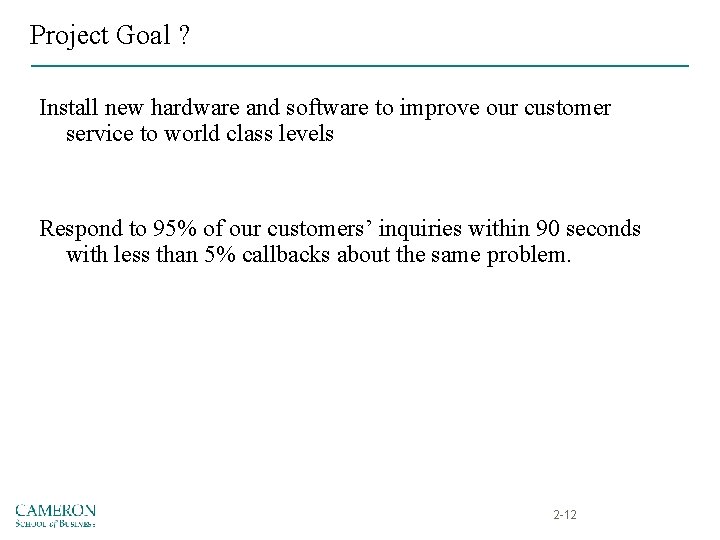
Project Goal ? Install new hardware and software to improve our customer service to world class levels Respond to 95% of our customers’ inquiries within 90 seconds with less than 5% callbacks about the same problem. 2 -12
Measuring the Immeasurable Intangible: How can you measure the concept of user friendliness? Increasing customer support? Adopting a social media package? 2 -13
Husky Air – Angel Pilots Develop a MOV table based upon the case description. • Organizational Impact? • Value? • Metric? • Time Frame? • Summarize the MOV 2 -14
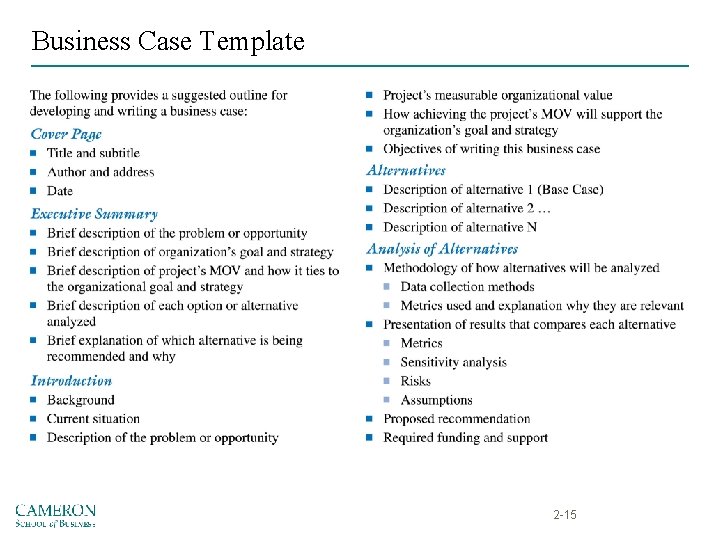
Business Case Template 2 -15
Developing the Business Case Step 3: Identify Alternatives § Base Case Alternative § Possible Alternative Strategies: 2 -16
Husky Air – Angel Pilots What are the potential alternatives to developing the system to track pilots? 2 -17
Developing the Business Case Step 4: Define Feasibility and Assess Risk focus on:
Developing the Business Case Step 5: Define Total Cost of Ownership Step 6: Define Total Benefits of Ownership 2 -19
Husky Air – Angel Pilots What are the TCO for both the proposed project and potential alternatives? 2 -20
Developing the Business Case Step 7: Analyze alternatives using financial models and scoring models § § Payback Period Break Even ROI NPV 2 -21
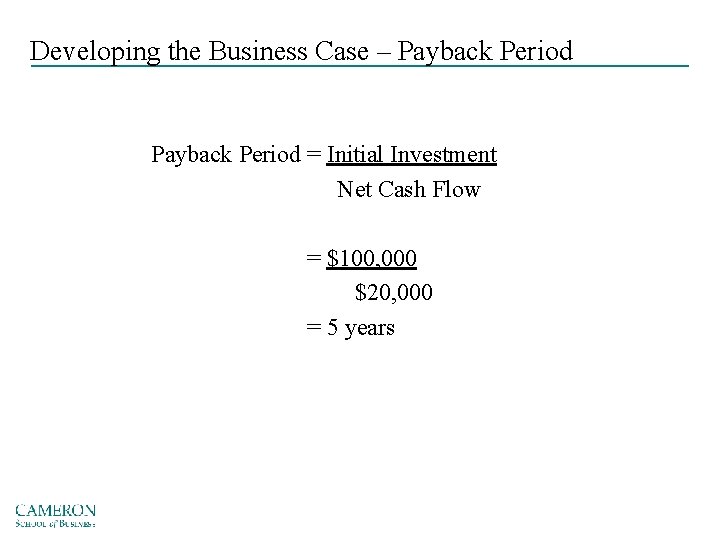
Developing the Business Case – Payback Period = Initial Investment Net Cash Flow = $100, 000 $20, 000 = 5 years
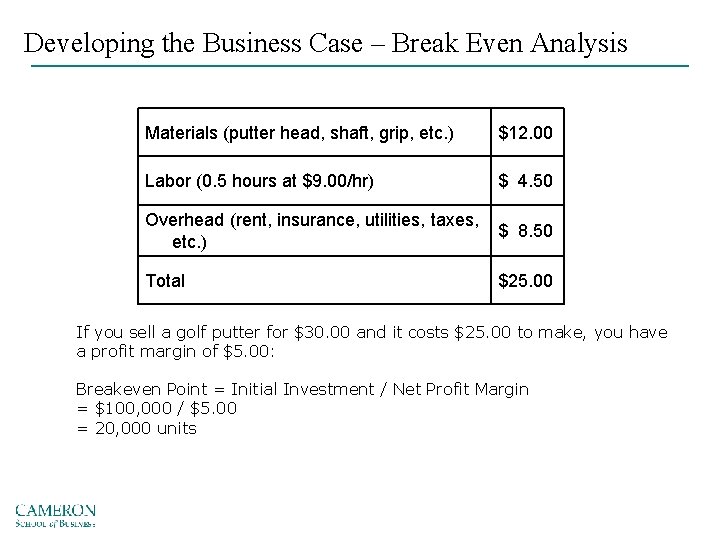
Developing the Business Case – Break Even Analysis Materials (putter head, shaft, grip, etc. ) $12. 00 Labor (0. 5 hours at $9. 00/hr) $ 4. 50 Overhead (rent, insurance, utilities, taxes, etc. ) $ 8. 50 Total $25. 00 If you sell a golf putter for $30. 00 and it costs $25. 00 to make, you have a profit margin of $5. 00: Breakeven Point = Initial Investment / Net Profit Margin = $100, 000 / $5. 00 = 20, 000 units
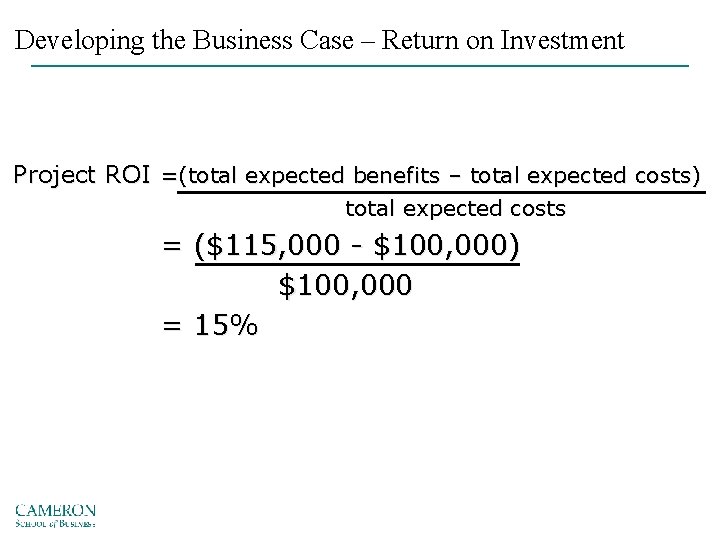
Developing the Business Case – Return on Investment Project ROI =(total expected benefits – total expected costs) total expected costs = ($115, 000 - $100, 000) $100, 000 = 15%
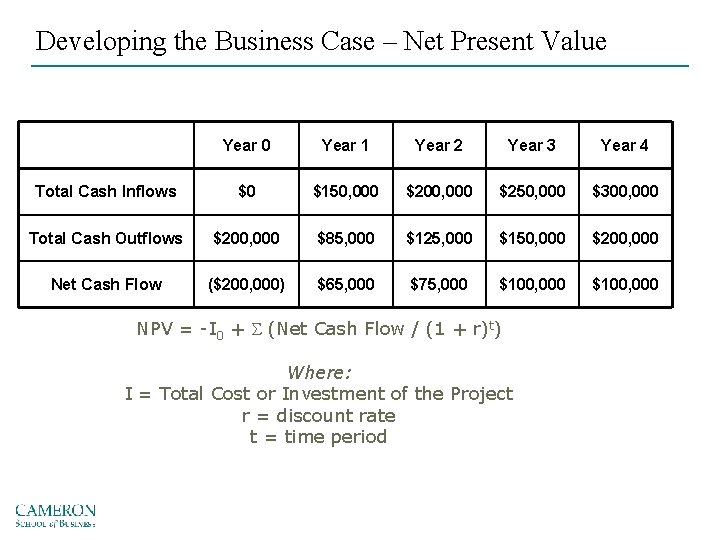
Developing the Business Case – Net Present Value Year 0 Year 1 Year 2 Year 3 Year 4 Total Cash Inflows $0 $150, 000 $200, 000 $250, 000 $300, 000 Total Cash Outflows $200, 000 $85, 000 $125, 000 $150, 000 $200, 000 Net Cash Flow ($200, 000) $65, 000 $75, 000 $100, 000 NPV = -I 0 + (Net Cash Flow / (1 + r)t) Where: I = Total Cost or Investment of the Project r = discount rate t = time period
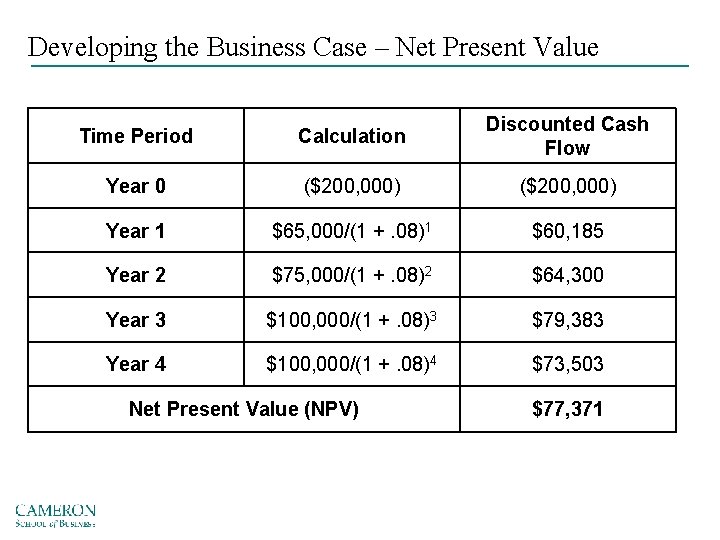
Developing the Business Case – Net Present Value Time Period Calculation Discounted Cash Flow Year 0 ($200, 000) Year 1 $65, 000/(1 +. 08)1 $60, 185 Year 2 $75, 000/(1 +. 08)2 $64, 300 Year 3 $100, 000/(1 +. 08)3 $79, 383 Year 4 $100, 000/(1 +. 08)4 $73, 503 Net Present Value (NPV) $77, 371
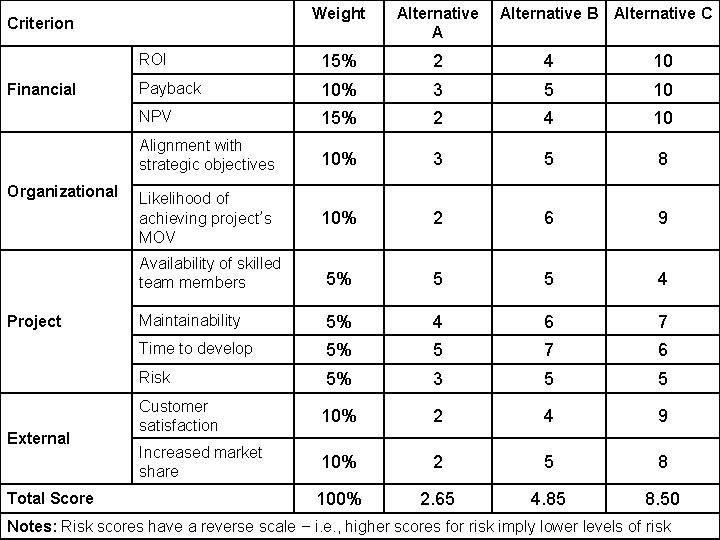
Weight Alternative A ROI 15% 2 4 10 Payback 10% 3 5 10 NPV 15% 2 4 10 Alignment with strategic objectives 10% 3 5 8 Likelihood of achieving project’s MOV 10% 2 6 9 Availability of skilled team members 5% 5 5 4 Maintainability 5% 4 6 7 Time to develop 5% 5 7 6 Risk 5% 3 5 5 Customer satisfaction 10% 2 4 9 Increased market share 10% 2 5 8 100% 2. 65 4. 85 8. 50 Criterion Financial Organizational Project External Total Score Alternative B Alternative C Notes: Risk scores have a reverse scale – i. e. , higher scores for risk imply lower levels of risk
- Slides: 27