
MEASLES RUBEOLA OR MORBILLI Department of infectious disease
MEASLES RUBEOLA OR MORBILLI Department of infectious disease WANG JINGYAN
DEFINITION • Measles is an acute highly contagious viral disease caused by measles virus. It is characterized by fever, URT catarrhal inflamation, koplik’s spots and maculopapules. • The disease may complicated with branchpneumonia, encepholitis, hepatitis. • The lived attenuated measles virus • vaccine has been utilized wildly since 1965 , the incidence of the disease has declined in china.

ETIOLOGY • 1. Pathogen is measles virus. it has been classed as a paramyxovirus. it is spherical in appearance , measuring about 100~150 nm in diameter. It has an outer envelope composed of M-protein, H-protein, F-protein, and internal core is RNA. • 2. Site of the measles virus exists measles can be detected from blood and nasal, pharyngeal secretions.
• • 3. Three kinds of antibodies are produced after infection, that is 3. 1 complement combining antibody; ` 3. 2 hemagglutinin inhibiting antibody 3. 3 neutralizing antibody 4. Only one antigenic type of measles virus is known. 5. Resistance: measles virus is sensitive to heat or disinfectant , it is also inactivated by ultraviolet light easily. not strong
EPIDEMIOLOGY • 1. Source of infection The patients are the only source of infection. • 2. Routes of transmission air-borne • 3. Susceptibility of population 3. 1 All age person is susceptible; 90% of contact people acquire the disease. 3. 2 The permanent immunity acquire after disease. • 4. Epidemic features season: winter and spiring age: 6 months to 5 years old
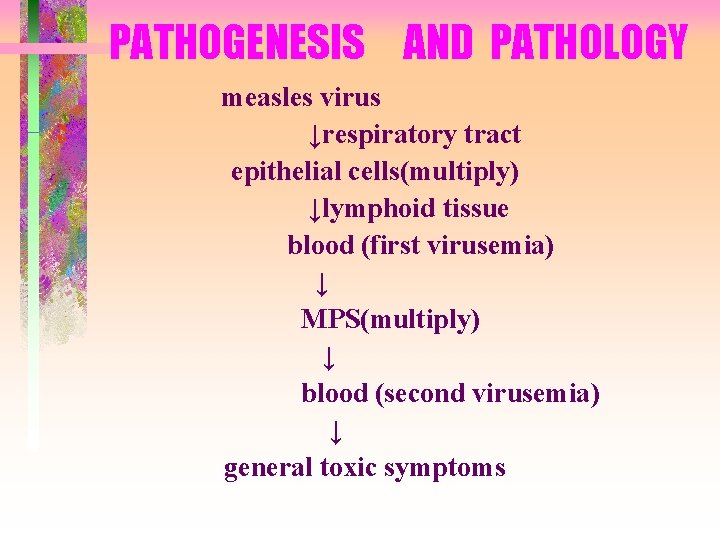
PATHOGENESIS AND PATHOLOGY measles virus ↓respiratory tract epithelial cells(multiply) ↓lymphoid tissue blood (first virusemia) ↓ MPS(multiply) ↓ blood (second virusemia) ↓ general toxic symptoms

PATHOLOGY • • Rash: corium superficial blood vessel Pigmentation: Desquamation: Koplik’s spots
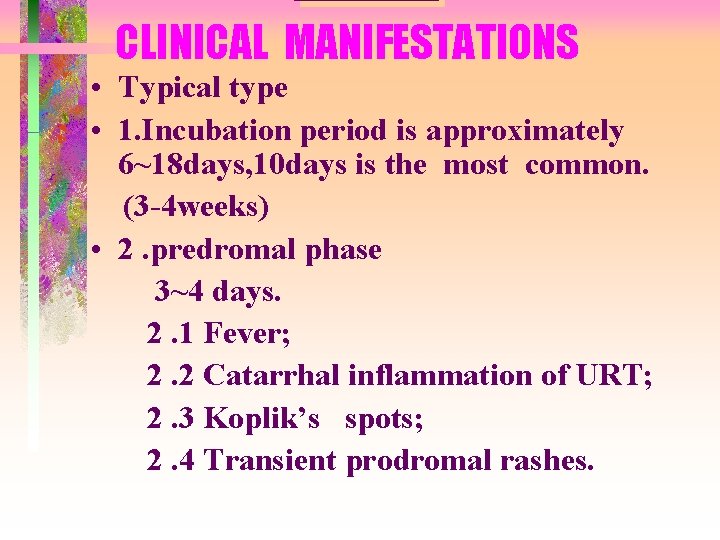
CLINICAL MANIFESTATIONS • Typical type • 1. Incubation period is approximately 6~18 days, 10 days is the most common. (3 -4 weeks) • 2. predromal phase 3~4 days. 2. 1 Fever; 2. 2 Catarrhal inflammation of URT; 2. 3 Koplik’s spots; 2. 4 Transient prodromal rashes.

• 3. Eruption stage 3. 1. Time: the 3~5 days after fever; but the 4 th day is most common; 3. 2. Shape: maculopapular 3. 3. Seuence: behind the ear→along the hairline→face→neck→chest→back→abdome n→limbs→hand feet(palm, sole) 3. 4. The temperature rise continously and companied with the toxic symptoms exaggerate • 4. Convalescent stage brown staining. fine branny desquamation. course: 10 -14 days

• Atypical measles 1. mild measles; 2. severe measles (toxic and shock type measles); 3. hemorrhagic measles; 4. variant measles.
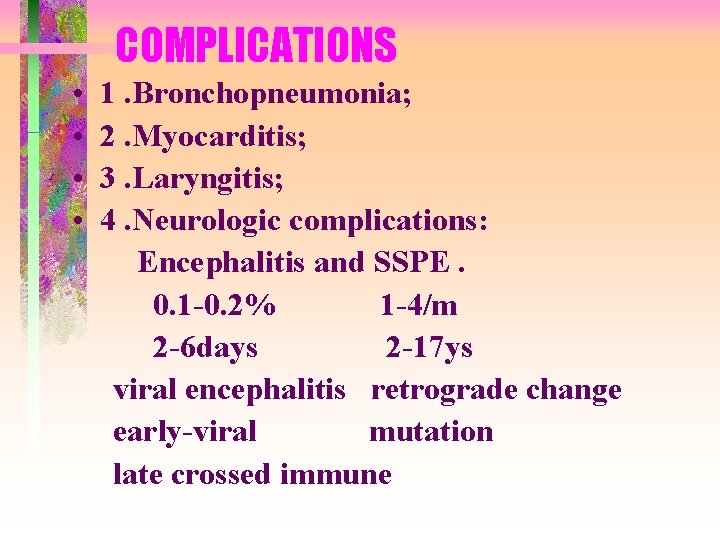
COMPLICATIONS • • 1. Bronchopneumonia; 2. Myocarditis; 3. Laryngitis; 4. Neurologic complications: Encephalitis and SSPE. 0. 1 -0. 2% 1 -4/m 2 -6 days 2 -17 ys viral encephalitis retrograde change early-viral mutation late crossed immune

LABORATORY FINDINGS • Blood routine • Serum Ab measurement complement combining antibody; hemagglutinin inhibiting antibody; neutralizing antibody; specific antibody Ig. M. • Other Ag and multinucleated giant cells • The separation of virus
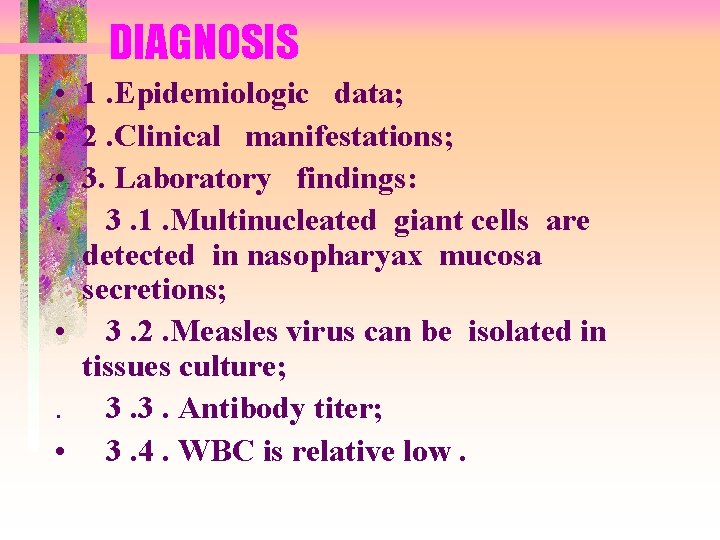
DIAGNOSIS • 1. Epidemiologic data; • 2. Clinical manifestations; • 3. Laboratory findings: . 3. 1. Multinucleated giant cells are detected in nasopharyax mucosa secretions; • 3. 2. Measles virus can be isolated in tissues culture; . 3. 3. Antibody titer; • 3. 4. WBC is relative low.
DIFFERENTIAL DIAGNOSIS • 1. Rubella (German measles) ; • 2. Roseola infantum (infant subitum, exanthem subitum) • 3. Drug rashes. *the early stage definite diagnosis is: *the early stage clinical diagnosis is: *the clinical diagnosis is:
treatment • 1. General therapy: rest, nursing and diet • 2. Symptomatic therapy: fever and cough, • 3. Support threapy: r-globulin traditional chinese herbs may be used ; • 4. complications of treatment
PREVENTION • 1. Control source of infection; • 2. Interruption of transmissions ; • 3. Protection of the susceptible person: 3. 1. Active immunization Lived attenuated measles vaccine. plan immune: 8 m, 7 j epidemic stage: before 2 m contactor: with in 2 days Contraindications: pregnancy et al 3. 2. Passive immunization placenta globulin or gamma globulin. <5 days prevent onset >5 days relieve symptoms
- Slides: 16