
Means of Egress and Fire Protection OSHA Office




- Slides: 44
Means of Egress and Fire Protection OSHA Office of Training and Education 1
Introduction • Fires and explosions kill more than 200 and injure more than 5, 000 workers each year • There is a long and tragic history of workplace fires in this country caused by problems with fire exits and extinguishing systems • OSHA requires employers to provide proper exits, fire fighting equipment, and employee training to prevent fire deaths and injuries in the workplace OSHA Office of Training and Education 2
Escape Route • A continuous and unobstructed way of exit travel from any point in a building or structure to a public way (a street, yard, court or other open space leading to the street) • Three parts to an escape route: Ø the way of exit access; Ø the exit; and Ø the way of exit discharge. OSHA Office of Training and Education 3
OSHA OCCUPATIONAL SAFETY AND HEALTH ADMINISTRATION Subpart E-Exit Routes, Emergency Action Plans, And Fire Prevention Plans 1910. 34 Coverage and definitions Exit “means that portion of an exit route that is generally separated from other areas to provide a protected way of travel to the exit discharge. An example of an exit is a two-hour fire resistance-rated enclosed stairway that leads from the fifth floor of an office building to the outside of the building. ”
OSHA OCCUPATIONAL SAFETY AND HEALTH ADMINISTRATION Subpart E-Exit Routes, Emergency Action Plans, And Fire Prevention Plans 1910. 34 Coverage and definitions Exit access “means that portion of an exit route that leads to an exit. An example of an exit access is a corridor on the fifth floor of an office building that leads to a two-hour fire resistance-rated enclosed stairway (the Exit). ”
OSHA OCCUPATIONAL SAFETY AND HEALTH ADMINISTRATION Subpart E-Exit Routes, Emergency Action Plans, And Fire Prevention Plans 1910. 34 Coverage and definitions Exit discharge “means the part of the exit route that leads directly outside or to a street, walkway, a refuge area, public way, or open space with access to the outside. An example of an exit discharge is a door at the bottom of a two-hour fire resistance-rated enclosed stairway that discharges to a place of safety outside the building. ”
Exit Discharge
OSHA OCCUPATIONAL SAFETY AND HEALTH ADMINISTRATION Subpart E-Exit Routes, Emergency Action Plans, And Fire Prevention Plans 1910. 34 Coverage and definitions Exit route “means a continuous and unobstructed path of travel from any point within a workplace to a place of safety (including refuge areas). An exit route consists of three parts: the exit access; the exit; and, the exit discharge. (An exit route includes all vertical and horizontal areas along the route. )”
1. List the three parts to an escape route. 2. Where does room 18 in South Salem high meet during a fire drill? 3. An evacuation? 4. List four characteristics of an adequate escape route. 5. What are the minimum dimensions for an escape route? OSHA Office of Training and Education 9
Escape Routes General Requirements • Fire alarms are required if a fire could start without providing adequate warning to occupants • There must be enough exits in the proper arrangement for quick escape • Adequate and reliable illumination must be provided for all exit facilities • Escape Routes: Ø Minimum width = 28 inches Ø Minimum ceiling height = 7 -½ feet OSHA Office of Training and Education 10
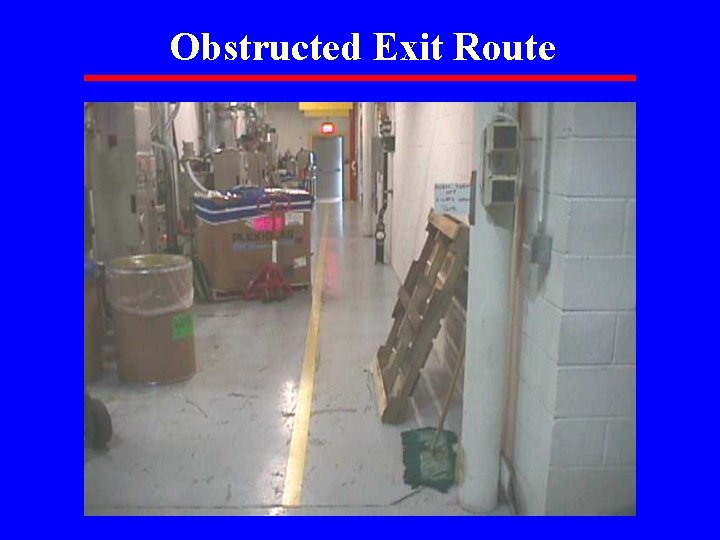
Obstructed Exit Route
Escape Routes 4. List four characteristics of an adequate escape route. 5. What are the minimum dimensions for an escape route? 6. Can exits be locked or blocked? 7. Give an example of a blocked exit. OSHA Office of Training and Education 12
Locking Exits Must not install any lock or fastening that impedes or prevents escape from the inside of any building. Locked and blocked exit OSHA Office of Training and Education 13
6. Can exits be locked or blocked? 7. Give an example of a blocked exit. 8. Which way should an escape route door swing. Into the room or out of the room? 9. How should an escape route door be hinged? OSHA Office of Training and Education 14
Access to Exits • Exits must be readily accessible at all times • A door from a room to an exit or escape route must be a side-hinged swinging type, and swing in the direction of exit travel when the room is occupied by more than 50 people or contains high hazard contents OSHA Office of Training and Education 15
8. Which way should an escape route door swing. Into the room or out of the room? 9. How should an escape route door be hinged? 10. Give an example of a blocked escape route. 11. Should exits be identified as exits? OSHA Office of Training and Education 16
Maintaining Escape Routes Escape routes from all parts of the building must be continuously maintained free of all obstructions in case of emergency. Obstructed exit OSHA Office of Training and Education 17
Exit Marking Exits must be marked by a readily visible sign when the exit or way to reach it is not immediately visible to occupants. OSHA Office of Training and Education 18
Exit Marking (cont’d) If a door, passage, or stairway is not an exit or a way of exit access, but may be mistaken for one, it must be identified by a sign reading “Not an Exit”, “Storeroom”, “To Basement”, etc. OSHA Office of Training and Education 19
Exit Marking (cont’d) A sign reading “Exit” with an arrow indicating the directions must be placed in every location where the direction of travel to the nearest exit is not immediately apparent. OSHA Office of Training and Education 20
10. Give an example of a blocked escape route. 11. Should exits be identified as exits? 12. Why? OSHA Office of Training and Education 21
OSHA OCCUPATIONAL SAFETY AND HEALTH ADMINISTRATION Subpart E-Exit Routes, Emergency Action Plans, And Fire Prevention Plans 1910. 37 Maintenance, safeguards, and operational features for exit routes 1910. 37(b) “Lighting and marking must be adequate and appropriate. (1) Each exit route must be adequately lighted so that an employee with normal vision can see along the exit route. ”
Emergency Lighting
• 13. Does and escape route need to be illuminated? • 14. List four reasons for developing an emergency action plan. OSHA Office of Training and Education 24
OSHA OCCUPATIONAL SAFETY AND HEALTH ADMINISTRATION Subpart E-Exit Routes, Emergency Action Plans, And Fire Prevention Plans 1910. 38 Emergency action plans 1910. 38(a) Application. “An employer must have an emergency action plan whenever an OSHA standard in this part requires one. ” 1910. 38(b) “Written and oral emergency action plans. An emergency action plan must be in writing, kept in the workplace, and available to employees for review. However, an employer with 10 or fewer employees may communicate the plan orally to employees. ”
Emergency Action Plan • Describes actions that must be taken to ensure employee safety in emergencies • Includes floor plans or maps which show emergency escape routes • Tells employees what actions to take in emergency situations • Covers emergencies the employer may reasonably expect, such as fires, explosions, toxic chemical releases, hurricanes, tornadoes, blizzards, and floods OSHA Office of Training and Education 26
• 14. List four reasons for developing an emergency action plan. • 15. List 5 requirements for a fire prevention plan OSHA Office of Training and Education 27
Fire Prevention Plan The plan must include: • A list of the major fire hazards and handling, storage, and control procedures • Names or job titles of persons responsible for maintenance of equipment and systems to prevent or control ignitions or fires • Names or job titles of persons responsible for control of fuel source hazards • Training for all employees who have responsibilities in the plan OSHA Office of Training and Education 28
• 15. List 5 requirements for a fire prevention plan • 16. Portable fire extinguishers must be readily accessible to employees. OSHA Office of Training and Education 29
Portable Fire Extinguishers If portable fire extinguishers are provided for employee use, the employer must mount, locate and identify them so workers can access them without subjecting themselves to possible injury. Blocked extinguisher OSHA Office of Training and Education 30
• 16. Portable fire extinguishers must be readily accessible to employees. • 17. List the combustibles which can be extinguished utilizing: extinguishers. Ø Class A Ø Class B Ø Class C Ø Class D Ø Class K OSHA Office of Training and Education 32
New York City Fire Department http: //www. nyc. gov/html/fdny/html/safety/extinguisher/classes. shtml • Fire SAFETY / PORTABLE FIRE EXTINGUISHERS / CLASSES OF EXTINGUISHERS Fires are classified into five (5) classes. They are described below: • Class A A fire extinguisher labeled with letter "A" is for use on Class A fires are fires that involve ordinary combustible materials such as cloth, wood, paper, rubber, and many plastics. New York City Fire Department http: //www. nyc. gov/html/fdny/html/safety/extinguisher/classes. shtml 33
New York City Fire Department http: //www. nyc. gov/html/fdny/html/safety/extinguisher/classes. shtml • Class B A fire extinguisher labeled with letter "B" is for use on Class B fires are fires that involve flammable and combustible liquids such as gasoline, alcohol, diesel oil, oil-based paints, lacquers, etc. , and flammable gases. • Class C A fire extinguisher labeled with letter "C" is for use on Class C fires are fires that involve energized electrical equipment. New York City Fire Department http: //www. nyc. gov/html/fdny/html/safety/extinguisher/classes. shtml 34
New York City Fire Department http: //www. nyc. gov/html/fdny/html/safety/extinguisher/classes. shtml • Class D A fire extinguisher labeled with letter "D" is for use on Class D fires are fires that involve combustible metals such as magnesium, titanium and sodium. • Class K A fire extinguisher labeled with letter "K" is for use on Class K fires are fires that involve vegetable oils, animal oils, or fats in cooking appliances. This is for commercial kitchens, including those found in restaurants, cafeterias, and caterers. New York City Fire Department • 35 http: //www. nyc. gov/html/fdny/html/safety/extinguisher/classes. shtml
Extinguisher Classification Letter classification given an extinguisher to designate the class or classes of fire on which it will be effective. • • Class A – ordinary combustibles (wood, cloth, paper) Class B – flammable liquids, gases, greases Class C – energized electrical equipment Class D – combustible metals Ordinary A Combustibles Flammable B Liquids Electrical C Equipment OSHA Office of Training and Education Combustible D Metals 36
• 17. List the combustibles which can be extinguished utilizing: extinguishers. Ø Class A Ø Class B Ø Class C Ø Class D Ø Class K 18. T or F A 2 -A extinguisher can extinguish a larger fire than a 4 -A extinguisher. OSHA Office of Training and Education 37
Extinguisher Rating • Numerical rating given to Class A and B extinguishers which indicate how large a fire an experienced person can put out with the extinguisher • Ratings are based on tests conducted at Underwriters’ Laboratories, Inc. Ø Class A: 1 -A, 2 -A, . . . 40 -A Ø Class B: 1 -B, 2 -B, . . . 640 -B • A 4 -A extinguisher, for example, should extinguish about twice as much fire as a 2 -A extinguisher OSHA Office of Training and Education 38
• 18. T or F A 2 -A extinguisher can extinguish a larger fire than a 4 -A extinguisher. • 19. List four requirements for proper maintenance of portable fire extinguishers. OSHA Office of Training and Education 39
Maintaining Portable Fire Extinguishers • Must maintain in a fully charged and operable condition • Must keep in their designated places at all times except during use • Must conduct an annual maintenance check • Must record the annual maintenance date and retain this record for one year after the last entry or the life of the shell, whichever is less OSHA Office of Training and Education 40
• 19. List four requirements for proper maintenance of portable fire extinguishers. • 20. What must employees be trained for concerning portable fire extinguishers? OSHA Office of Training and Education 41
Portable Fire Extinguisher Training and Education • Where portable fire extinguishers have been provided for employee use in the workplace, employees must be provided with an educational program on the: Ø General principles of fire extinguisher use Ø Hazards of incipient (beginning) stage fire fighting • Employees designated to use extinguishers must receive instruction and hands-on practice in the operation of equipment OSHA Office of Training and Education 42
• 20. What must employees be trained for concerning portable fire extinguishers? OSHA Office of Training and Education 43
Summary • There must be enough exits in the proper arrangement for quick escape • Escape routes must be marked, lighted, free of obstructions, and locks must not be used to impede or prevent escape • An emergency action plan and a fire prevention plan must be in place • Fire extinguisher classes and numerical ratings help a user understand its capabilities • Fire extinguishers must be inspected, maintained and employees must be trained in how to use them OSHA Office of Training and Education 44