
Meaning what is the extract about what happens
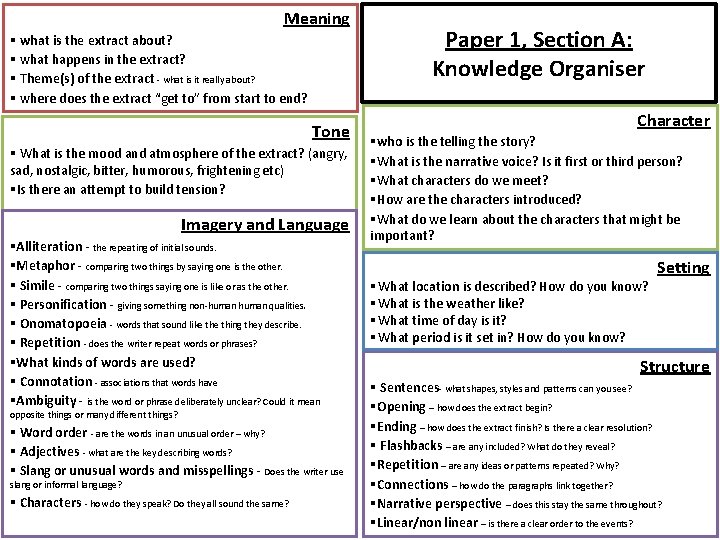
Meaning § what is the extract about? § what happens in the extract? § Theme(s) of the extract - what is it really about? § where does the extract “get to” from start to end? Tone § What is the mood and atmosphere of the extract? (angry, sad, nostalgic, bitter, humorous, frightening etc) §Is there an attempt to build tension? Imagery and Language §Alliteration - the repeating of initial sounds. §Metaphor - comparing two things by saying one is the other. § Simile - comparing two things saying one is like or as the other. § Personification - giving something non-human qualities. § Onomatopoeia - words that sound like thing they describe. § Repetition - does the writer repeat words or phrases? §What kinds of words are used? § Connotation - associations that words have §Ambiguity - is the word or phrase deliberately unclear? Could it mean opposite things or many different things? § Word order - are the words in an unusual order – why? § Adjectives - what are the key describing words? § Slang or unusual words and misspellings - Does the writer use slang or informal language? § Characters - how do they speak? Do they all sound the same? Paper 1, Section A: Knowledge Organiser Character §who is the telling the story? §What is the narrative voice? Is it first or third person? §What characters do we meet? §How are the characters introduced? §What do we learn about the characters that might be important? § What location is described? How do you know? § What is the weather like? § What time of day is it? § What period is it set in? How do you know? Setting Structure § Sentences- what shapes, styles and patterns can you see? §Opening – how does the extract begin? §Ending – how does the extract finish? Is there a clear resolution? § Flashbacks – are any included? What do they reveal? §Repetition – are any ideas or patterns repeated? Why? §Connections – how do the paragraphs link together? §Narrative perspective – does this stay the same throughout? §Linear/non linear – is there a clear order to the events?
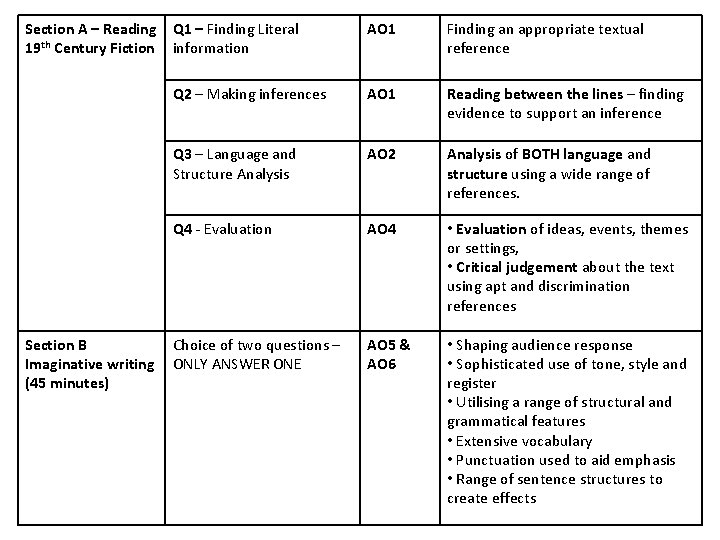
Section A – Reading 19 th Century Fiction Section B Imaginative writing (45 minutes) Q 1 – Finding Literal information AO 1 Finding an appropriate textual reference Q 2 – Making inferences AO 1 Reading between the lines – finding evidence to support an inference Q 3 – Language and Structure Analysis AO 2 Analysis of BOTH language and structure using a wide range of references. Q 4 - Evaluation AO 4 • Evaluation of ideas, events, themes or settings, • Critical judgement about the text using apt and discrimination references Choice of two questions – ONLY ANSWER ONE AO 5 & AO 6 • Shaping audience response • Sophisticated use of tone, style and register • Utilising a range of structural and grammatical features • Extensive vocabulary • Punctuation used to aid emphasis • Range of sentence structures to create effects
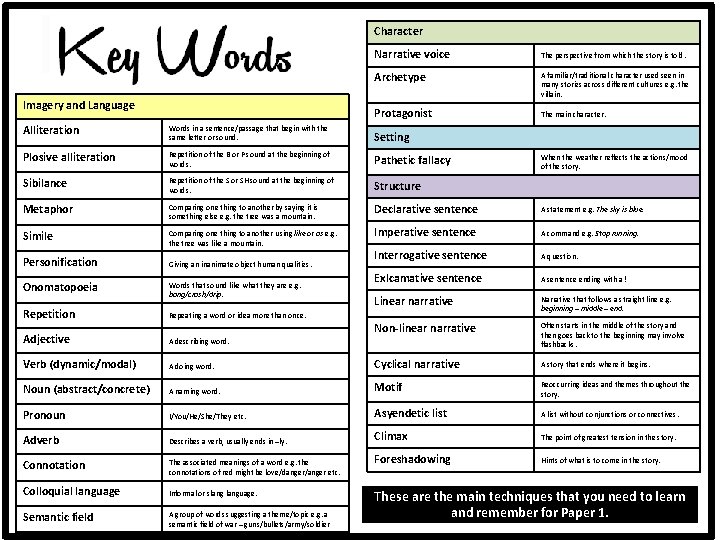
Character Imagery and Language Narrative voice The perspective from which the story is told. Archetype A familiar/traditional character used seen in many stories across different cultures e. g. the villain. Protagonist The main character. Alliteration Words in a sentence/passage that begin with the same letter or sound. Setting Plosive alliteration Repetition of the B or P sound at the beginning of words. Pathetic fallacy Sibilance Repetition of the S or SH sound at the beginning of words. Structure Metaphor Comparing one thing to another by saying it is something else e. g. the tree was a mountain. Declarative sentence A statement e. g. The sky is blue. Simile Comparing one thing to another using like or as e. g. the tree was like a mountain. Imperative sentence A command e. g. Stop running. Personification Giving an inanimate object human qualities. Interrogative sentence A question. Onomatopoeia Words that sound like what they are e. g. bang/crash/drip. Exlcamative sentence A sentence ending with a ! Repetition Linear narrative Repeating a word or idea more than once. Narrative that follows a straight line e. g. beginning – middle – end. Adjective Non-linear narrative A describing word. Often starts in the middle of the story and then goes back to the beginning may involve flashbacks. Verb (dynamic/modal) A doing word. Cyclical narrative A story that ends where it begins. Noun (abstract/concrete) A naming word. Motif Reoccurring ideas and themes throughout the story. Pronoun I/You/He/She/They etc. Asyendetic list A list without conjunctions or connectives. Adverb Describes a verb, usually ends in –ly. Climax The point of greatest tension in the story. Connotation The associated meanings of a word e. g. the connotations of red might be love/danger/anger etc. Foreshadowing Hints of what is to come in the story. Colloquial language Informal or slanguage. Semantic field A group of words suggesting a theme/topic e. g. a semantic field of war – guns/bullets/army/soldier When the weather reflects the actions/mood of the story. These are the main techniques that you need to learn and remember for Paper 1.
- Slides: 3