
Mean Variance Moments and Characteristic Functions Mean and
- Slides: 34
Mean, Variance, Moments and Characteristic Functions
Mean and Variance § p. d. f of a r. v represents complete information about it. § quite often it is desirable to characterize the r. v in terms of its average behavior. § We introduce two parameters - Mean - Variance § represent the overall properties of the r. v and its p. d. f. 2
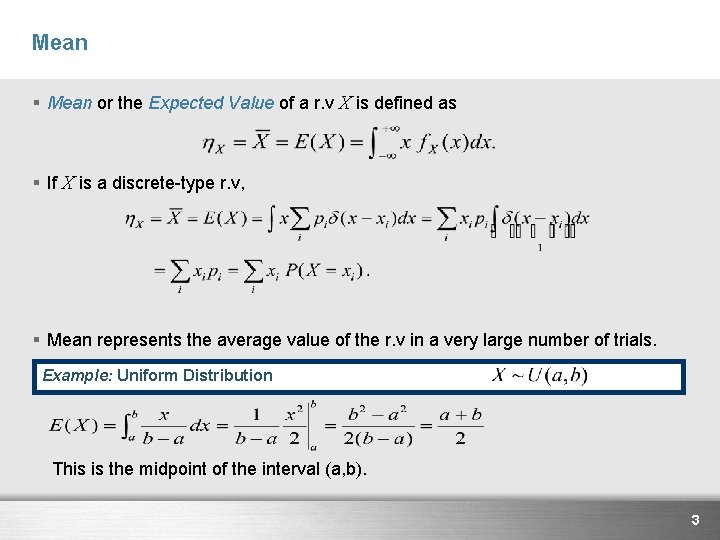
Mean § Mean or the Expected Value of a r. v X is defined as § If X is a discrete-type r. v, § Mean represents the average value of the r. v in a very large number of trials. Example: Uniform Distribution This is the midpoint of the interval (a, b). 3
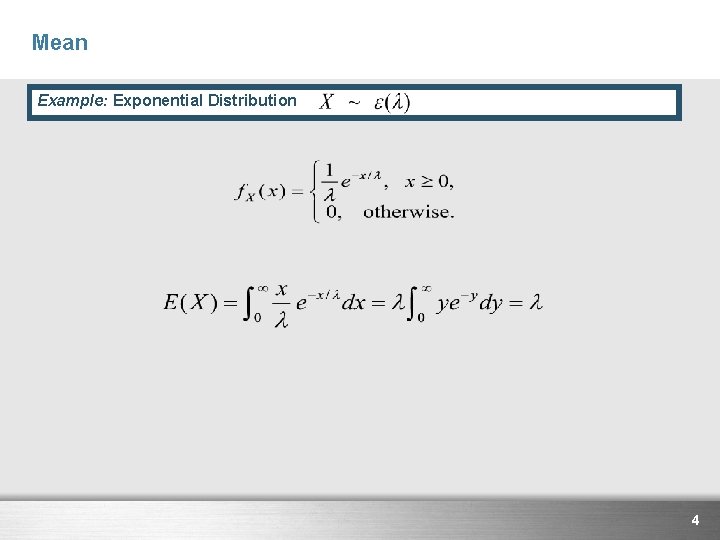
Mean Example: Exponential Distribution 4
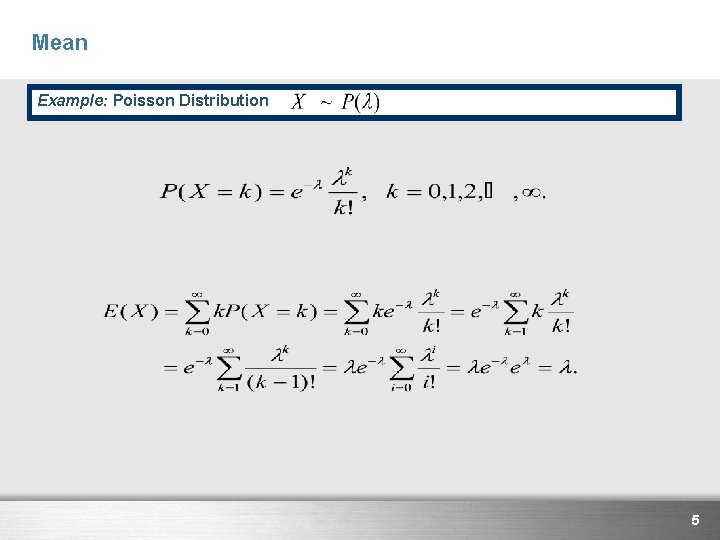
Mean Example: Poisson Distribution 5
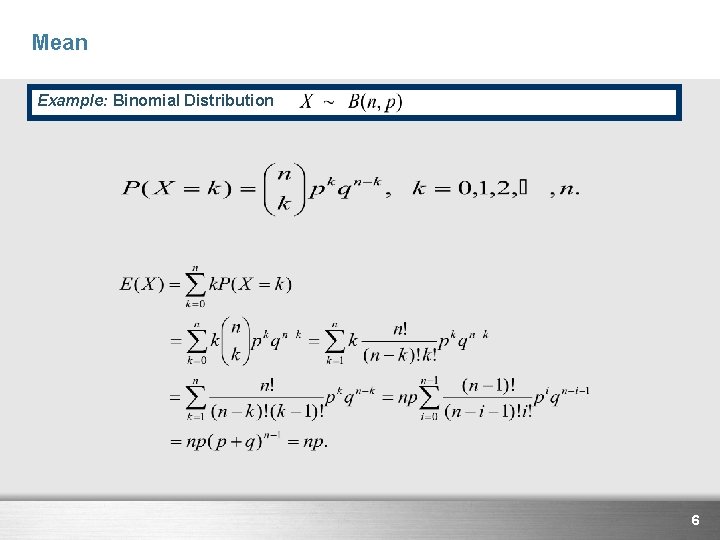
Mean Example: Binomial Distribution 6
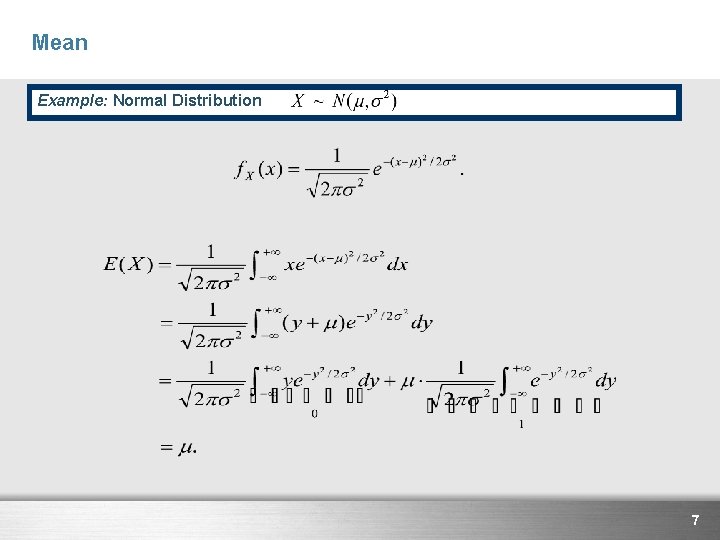
Mean Example: Normal Distribution 7
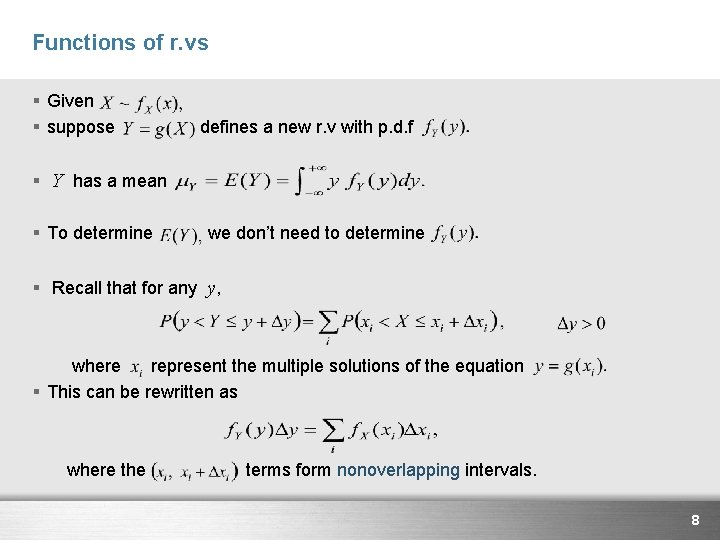
Functions of r. vs § Given § suppose defines a new r. v with p. d. f § Y has a mean § To determine we don’t need to determine § Recall that for any y, where represent the multiple solutions of the equation § This can be rewritten as where the terms form nonoverlapping intervals. 8
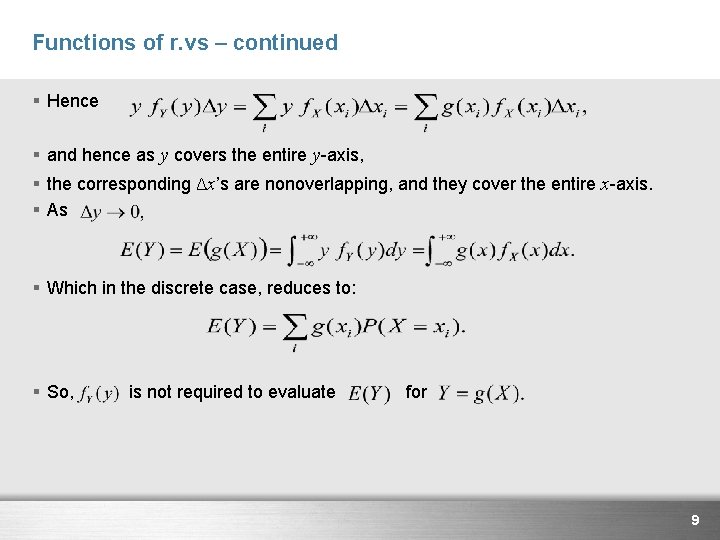
Functions of r. vs – continued § Hence § and hence as y covers the entire y-axis, § the corresponding Δx’s are nonoverlapping, and they cover the entire x-axis. § As § Which in the discrete case, reduces to: § So, is not required to evaluate for 9
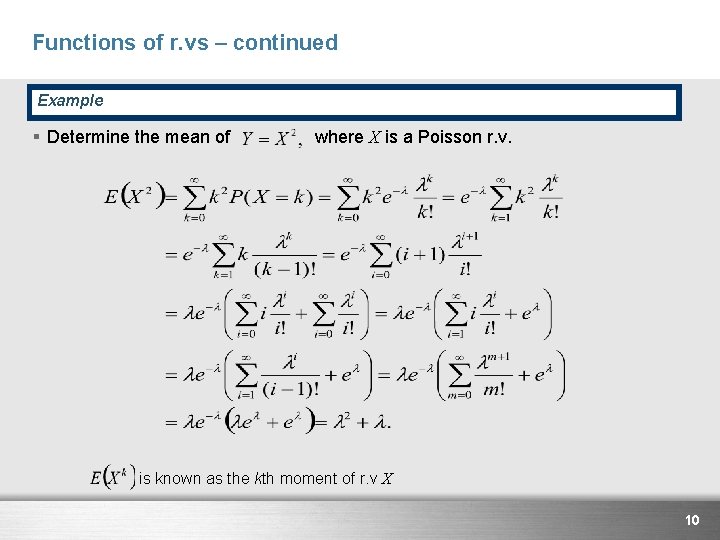
Functions of r. vs – continued Example § Determine the mean of where X is a Poisson r. v. is known as the kth moment of r. v X 10
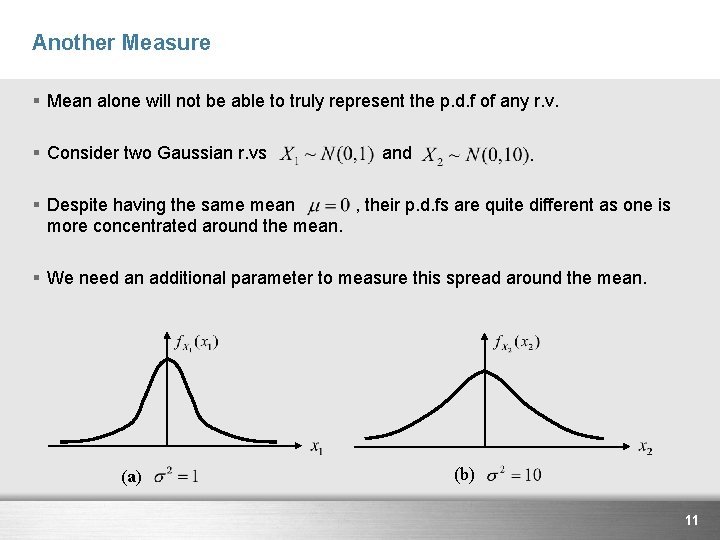
Another Measure § Mean alone will not be able to truly represent the p. d. f of any r. v. § Consider two Gaussian r. vs and § Despite having the same mean , their p. d. fs are quite different as one is more concentrated around the mean. § We need an additional parameter to measure this spread around the mean. (a) (b) 11
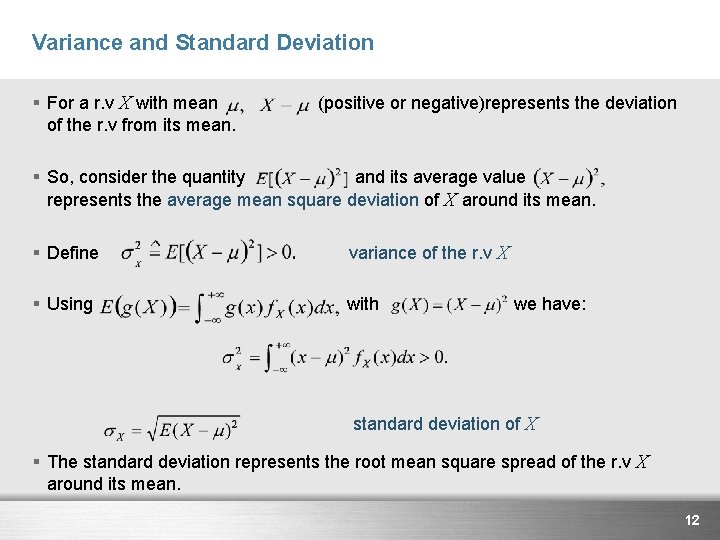
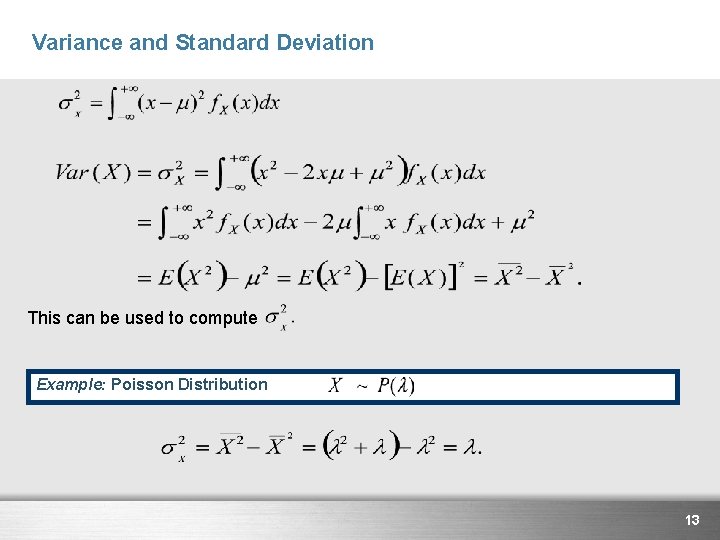
Variance and Standard Deviation § For a r. v X with mean of the r. v from its mean. (positive or negative)represents the deviation § So, consider the quantity and its average value represents the average mean square deviation of X around its mean. § Define variance of the r. v X § Using with we have: standard deviation of X § The standard deviation represents the root mean square spread of the r. v X around its mean. 12
Variance and Standard Deviation This can be used to compute Example: Poisson Distribution 13
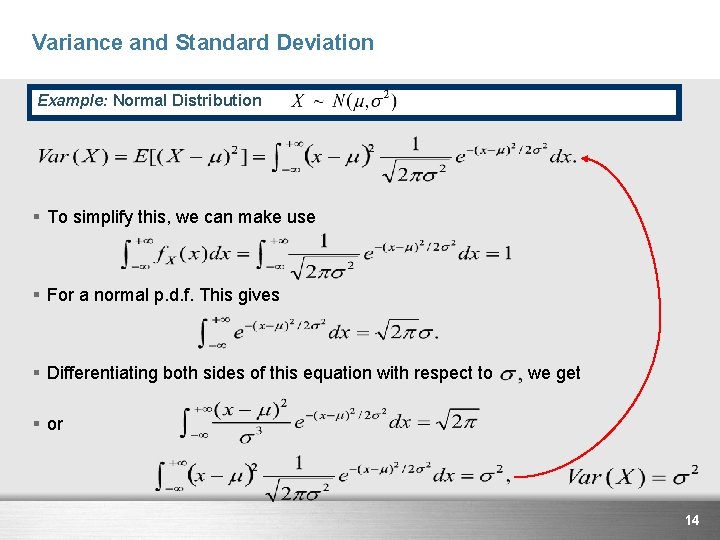
Variance and Standard Deviation Example: Normal Distribution § To simplify this, we can make use § For a normal p. d. f. This gives § Differentiating both sides of this equation with respect to we get § or 14
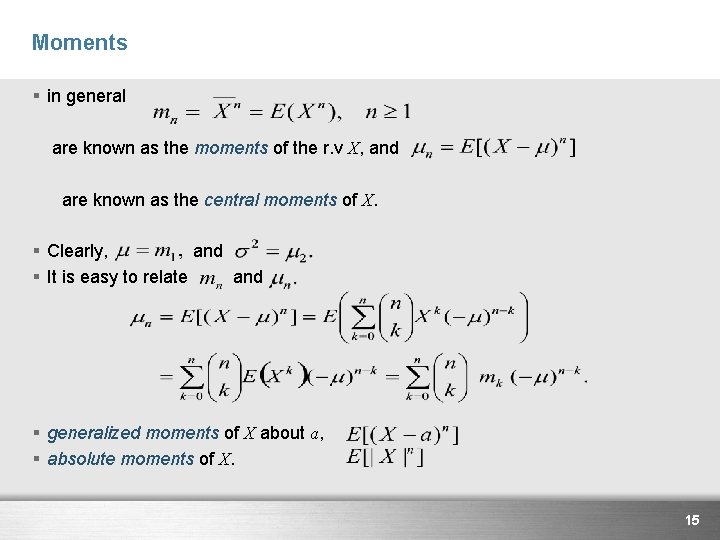
Moments § in general are known as the moments of the r. v X, and are known as the central moments of X. § Clearly, and § It is easy to relate and § generalized moments of X about a, § absolute moments of X. 15
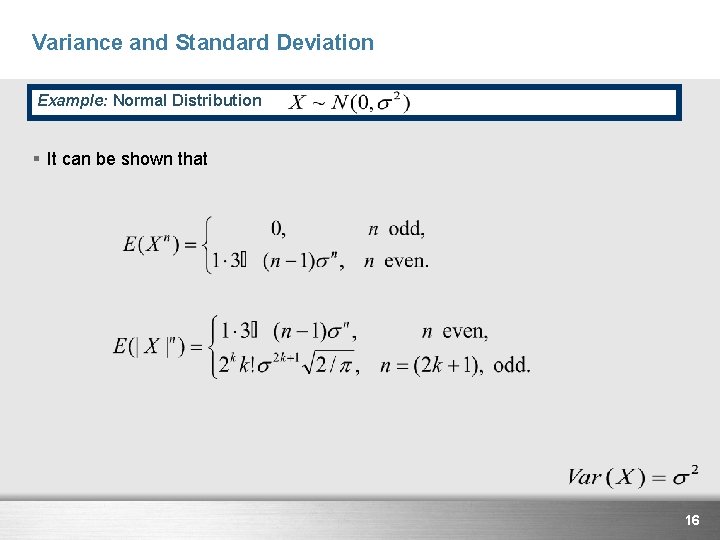
Variance and Standard Deviation Example: Normal Distribution § It can be shown that 16
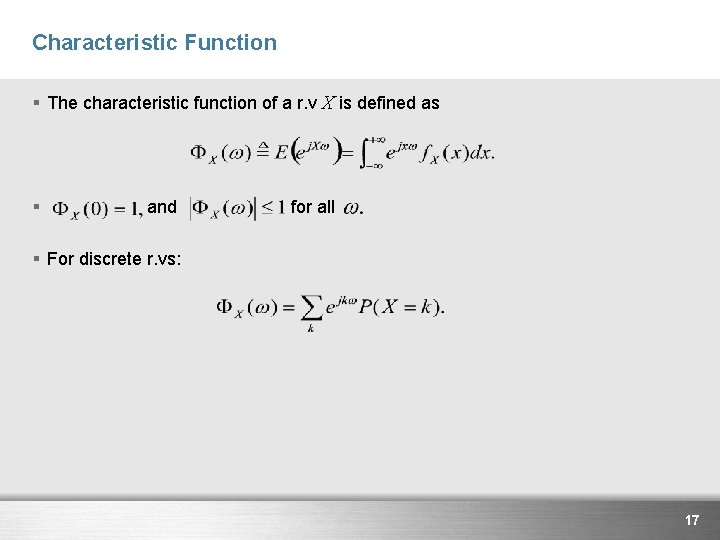
Characteristic Function § The characteristic function of a r. v X is defined as § and for all § For discrete r. vs: 17
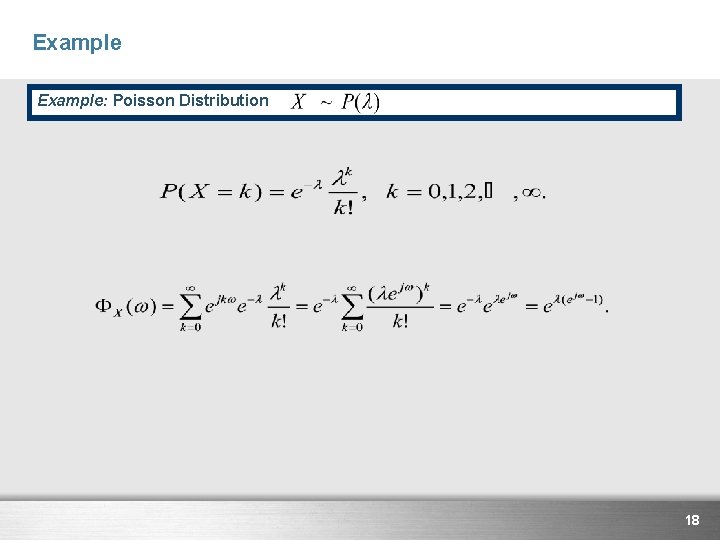
Example: Poisson Distribution 18
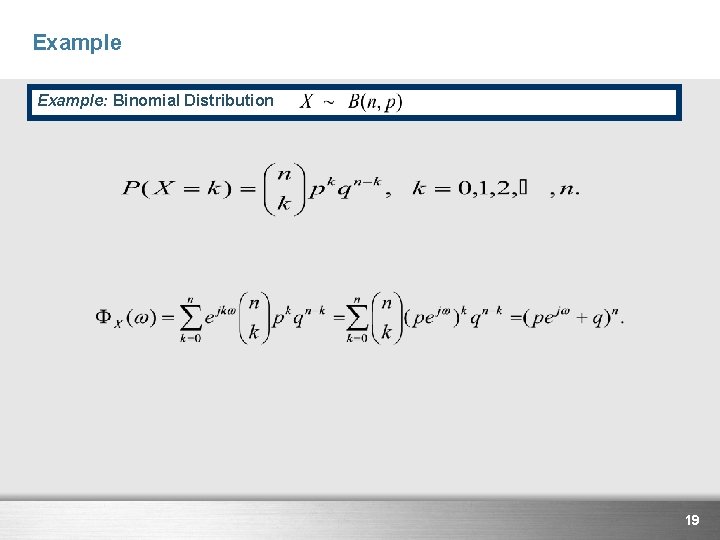
Example: Binomial Distribution 19
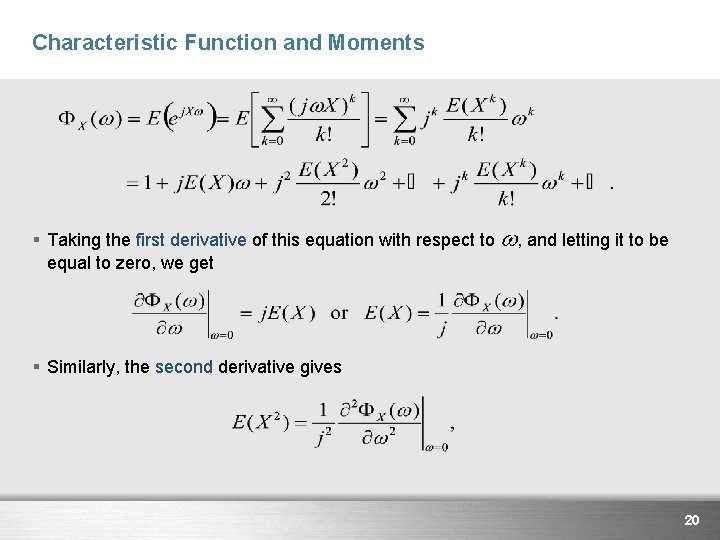
Characteristic Function and Moments § Taking the first derivative of this equation with respect to , and letting it to be equal to zero, we get § Similarly, the second derivative gives 20
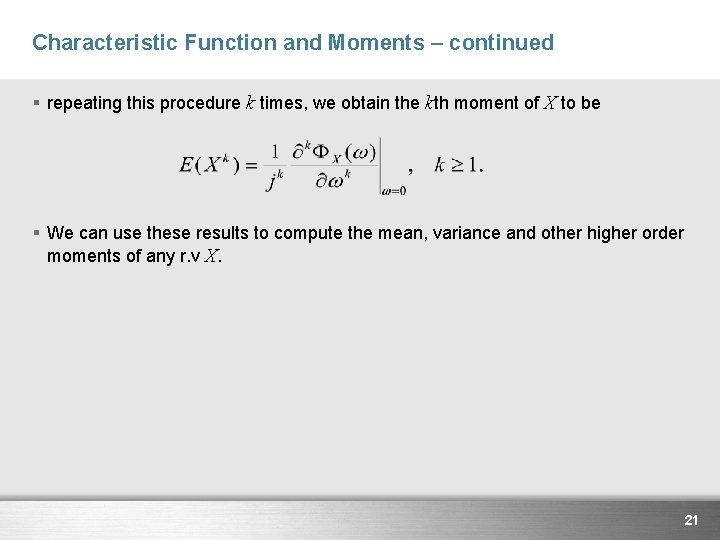
Characteristic Function and Moments – continued § repeating this procedure k times, we obtain the kth moment of X to be § We can use these results to compute the mean, variance and other higher order moments of any r. v X. 21
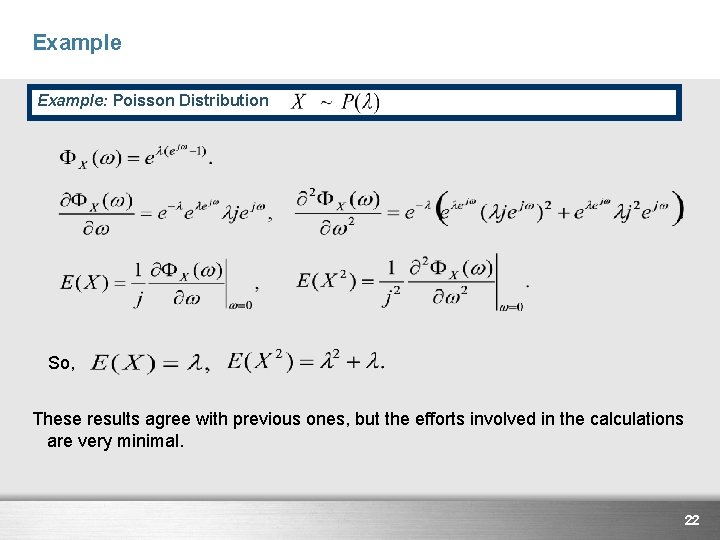
Example: Poisson Distribution So, These results agree with previous ones, but the efforts involved in the calculations are very minimal. 22
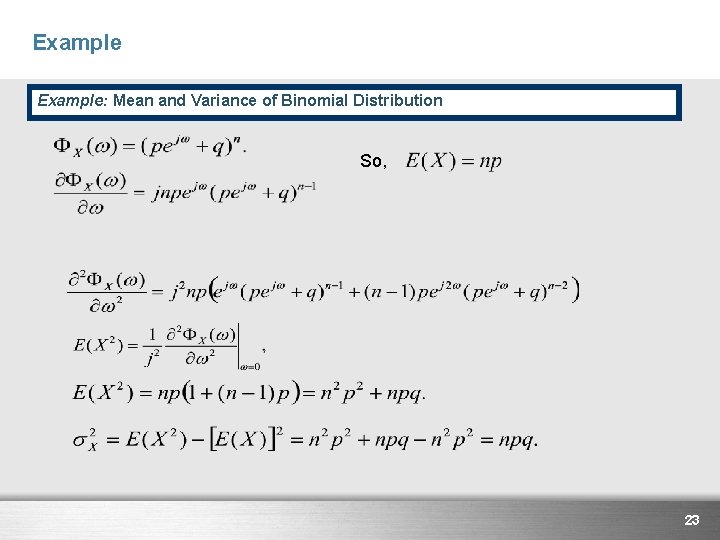
Example: Mean and Variance of Binomial Distribution So, 23
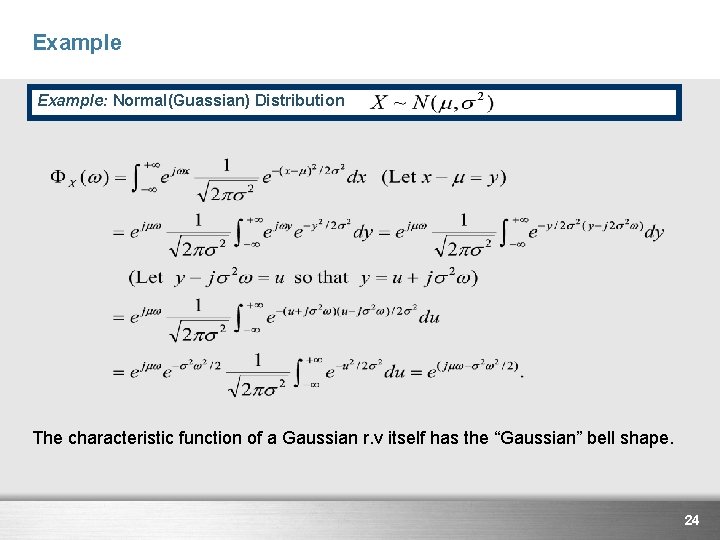
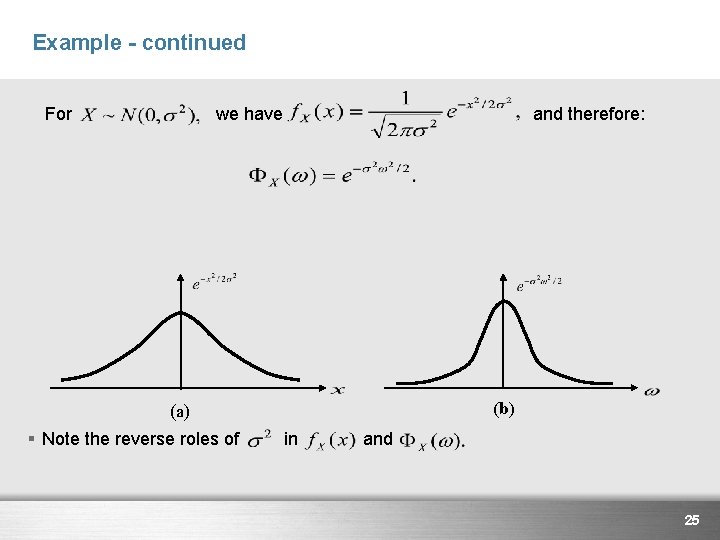
Example: Normal(Guassian) Distribution The characteristic function of a Gaussian r. v itself has the “Gaussian” bell shape. 24
Example - continued For we have and therefore: (b) (a) § Note the reverse roles of in and 25
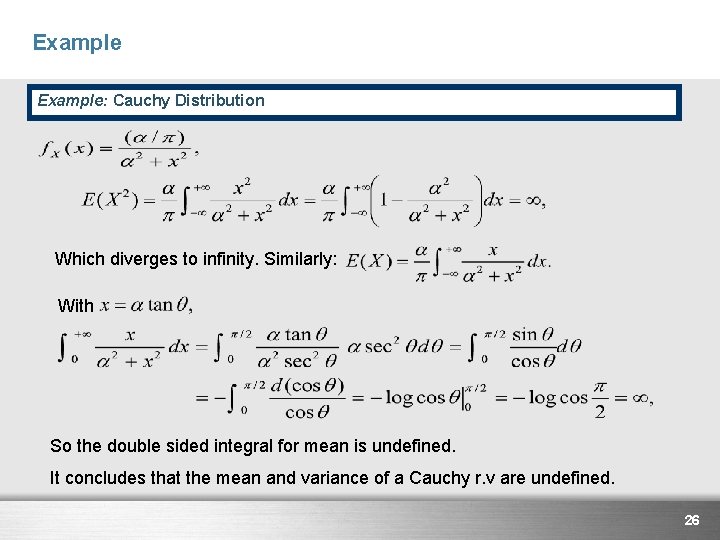
Example: Cauchy Distribution Which diverges to infinity. Similarly: With So the double sided integral for mean is undefined. It concludes that the mean and variance of a Cauchy r. v are undefined. 26
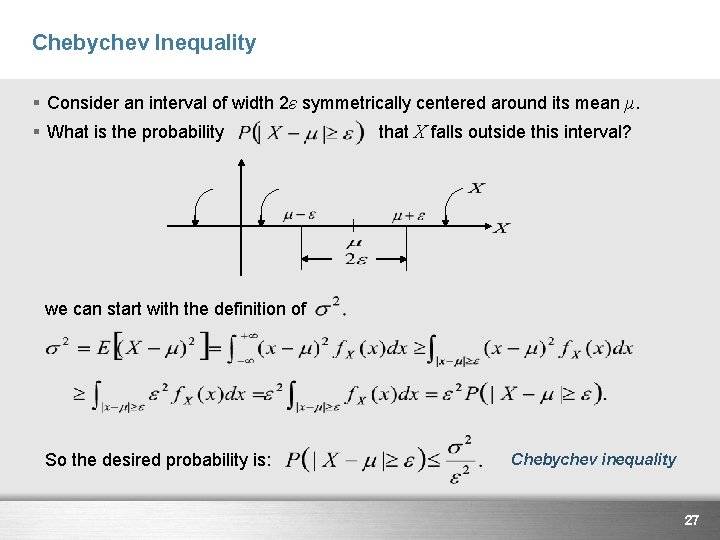
Chebychev Inequality § Consider an interval of width 2ε symmetrically centered around its mean μ. § What is the probability that X falls outside this interval? we can start with the definition of So the desired probability is: Chebychev inequality 27
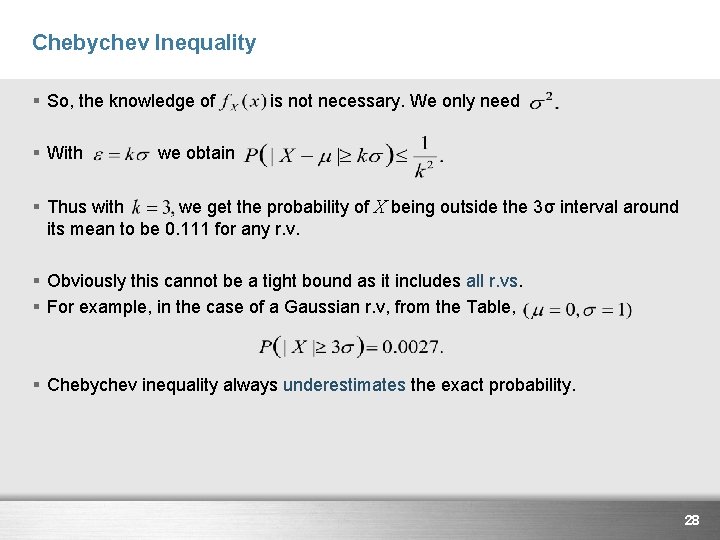
Chebychev Inequality § So, the knowledge of § With is not necessary. We only need we obtain § Thus with we get the probability of X being outside the 3σ interval around its mean to be 0. 111 for any r. v. § Obviously this cannot be a tight bound as it includes all r. vs. § For example, in the case of a Gaussian r. v, from the Table, § Chebychev inequality always underestimates the exact probability. 28
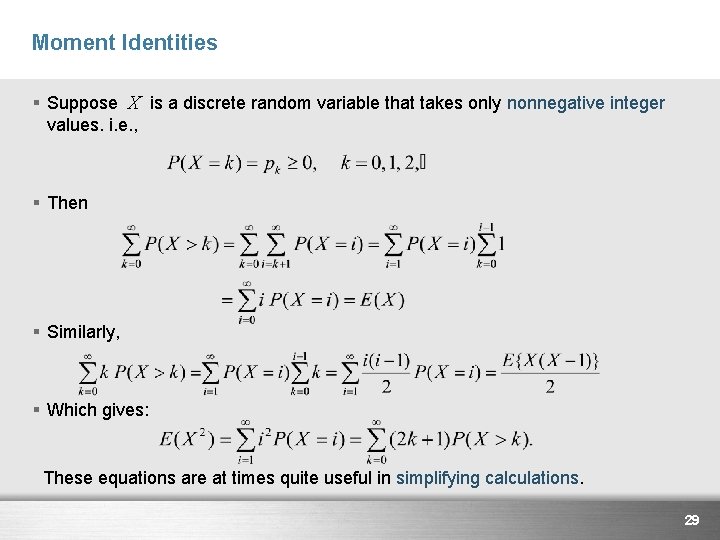
Moment Identities § Suppose X is a discrete random variable that takes only nonnegative integer values. i. e. , § Then § Similarly, § Which gives: These equations are at times quite useful in simplifying calculations. 29
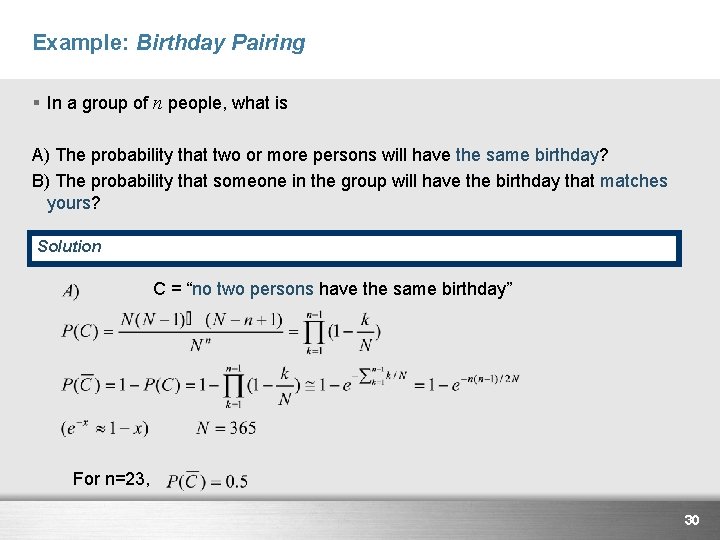
Example: Birthday Pairing § In a group of n people, what is A) The probability that two or more persons will have the same birthday? B) The probability that someone in the group will have the birthday that matches yours? Solution C = “no two persons have the same birthday” For n=23, 30
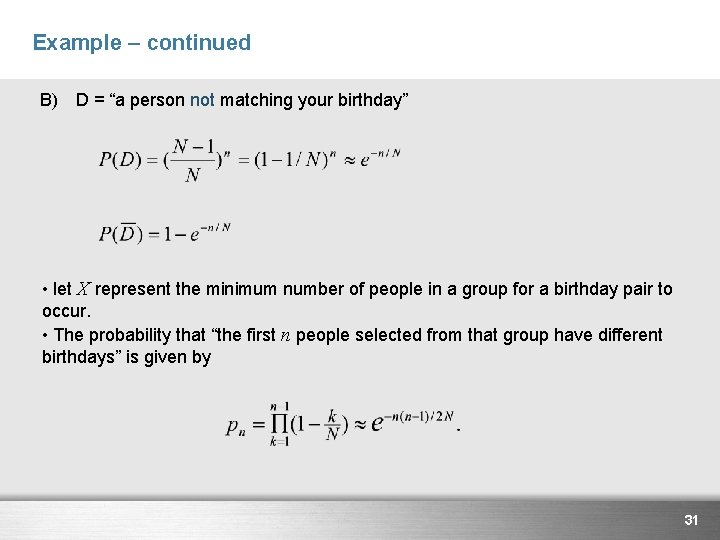
Example – continued B) D = “a person not matching your birthday” • let X represent the minimum number of people in a group for a birthday pair to occur. • The probability that “the first n people selected from that group have different birthdays” is given by 31
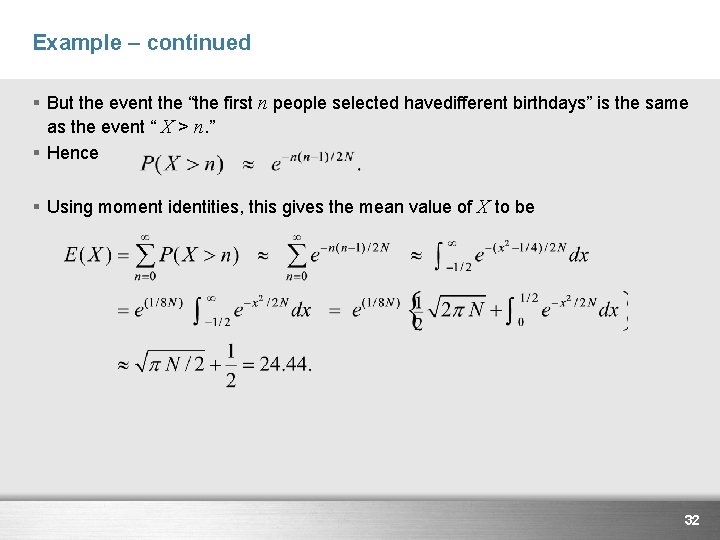
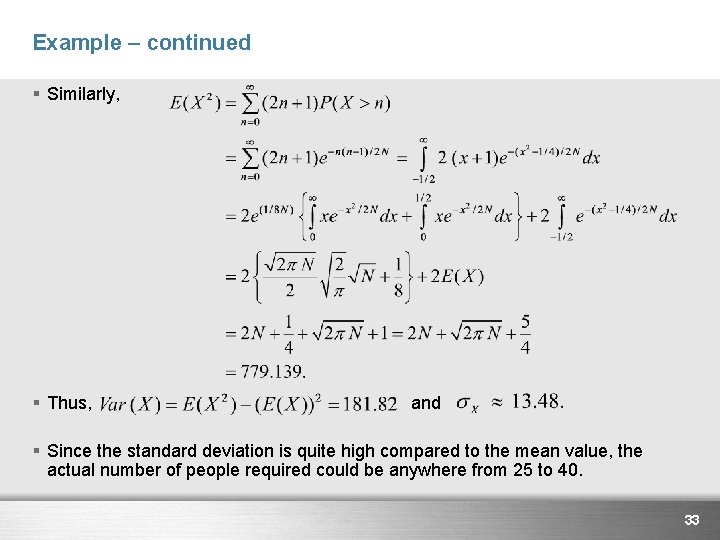
Example – continued § But the event the “the first n people selected havedifferent birthdays” is the same as the event “ X > n. ” § Hence § Using moment identities, this gives the mean value of X to be 32
Example – continued § Similarly, § Thus, and § Since the standard deviation is quite high compared to the mean value, the actual number of people required could be anywhere from 25 to 40. 33
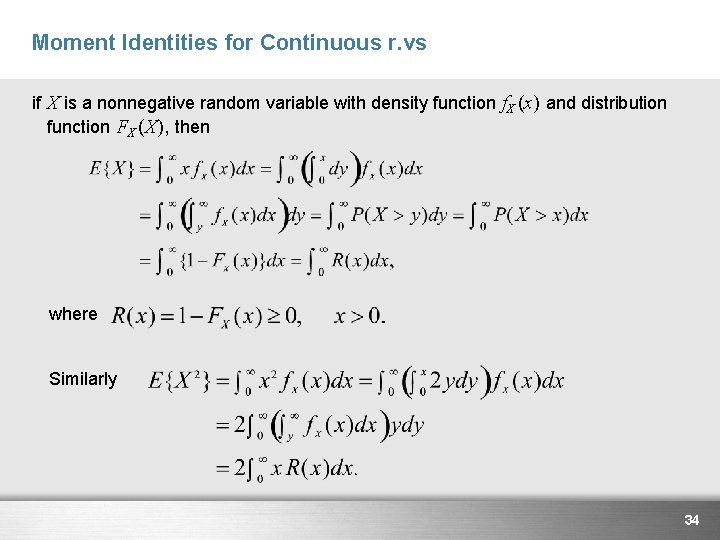
Moment Identities for Continuous r. vs if X is a nonnegative random variable with density function f. X (x) and distribution function FX (X), then where Similarly 34