
Mean Field Game Tutorial Zhu Han John and
- Slides: 51
Mean Field Game Tutorial Zhu Han, John and Rebecca Moores Professor Electrical and Computer Engineering Department Computer Science Department, University of Houston Thanks for MURI funding and Reginald Banez 1
Overview • Introduction • Mean Field Game Framework • Analytic Methods • Probabilistic Method • Applications • Conclusion 2
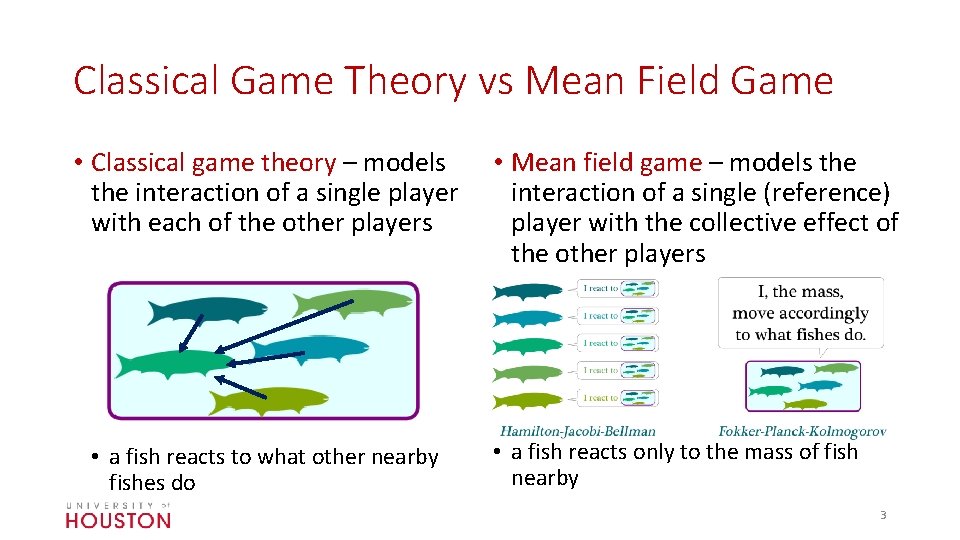
Classical Game Theory vs Mean Field Game • Classical game theory – models the interaction of a single player with each of the other players • a fish reacts to what other nearby fishes do • Mean field game – models the interaction of a single (reference) player with the collective effect of the other players • a fish reacts only to the mass of fish nearby 3
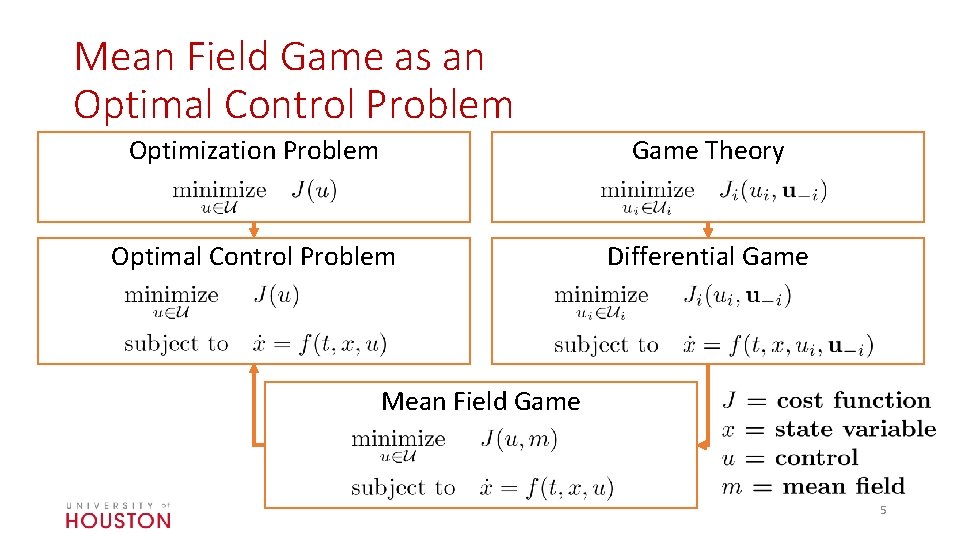
Mean Field Games • Mean field games (MFGs) study the existence of Nash equilibria in games involving a large number of asymptotically negligible players modeled by controlled stochastic dynamical systems. • MFGs refer to methods and techniques that study differential games with large population of indistinguishable, rational, and heterogeneous agents • Indistinguishable – players share common structures of the model • Rationality – players act optimally (maximize utility / minimize cost) • Heterogeneity – players can have heterogeneous states • MFGs reduce to a standard control problem and an equilibrium. 4
Mean Field Game as an Optimal Control Problem Optimization Problem Game Theory Optimal Control Problem Differential Game Mean Field Game 5
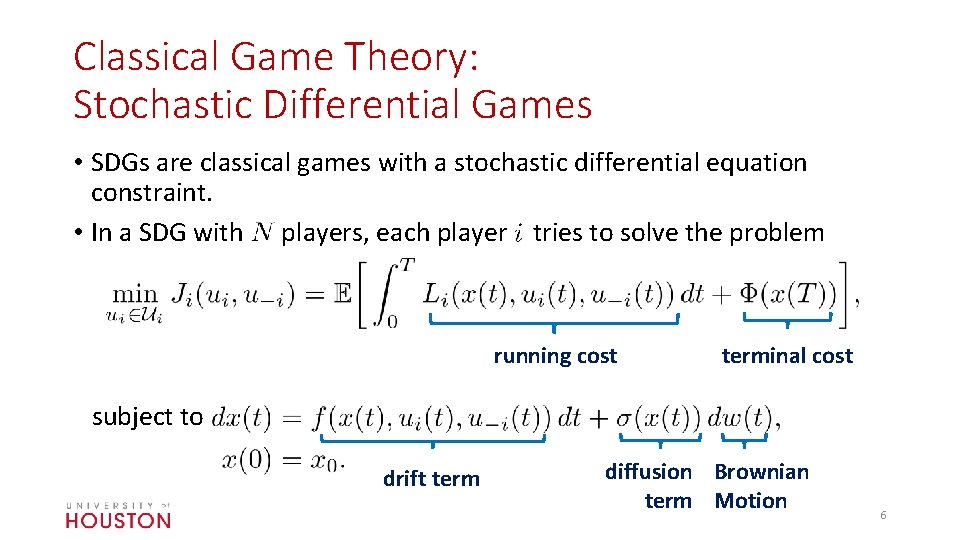
Classical Game Theory: Stochastic Differential Games • SDGs are classical games with a stochastic differential equation constraint. • In a SDG with players, each player tries to solve the problem running cost terminal cost subject to drift term diffusion Brownian term Motion 6
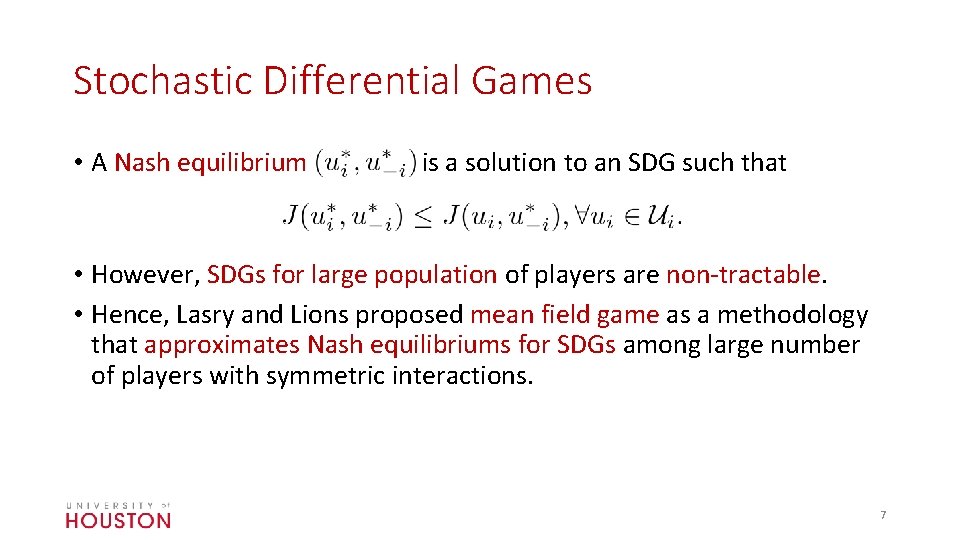
Stochastic Differential Games • A Nash equilibrium is a solution to an SDG such that • However, SDGs for large population of players are non-tractable. • Hence, Lasry and Lions proposed mean field game as a methodology that approximates Nash equilibriums for SDGs among large number of players with symmetric interactions. 7
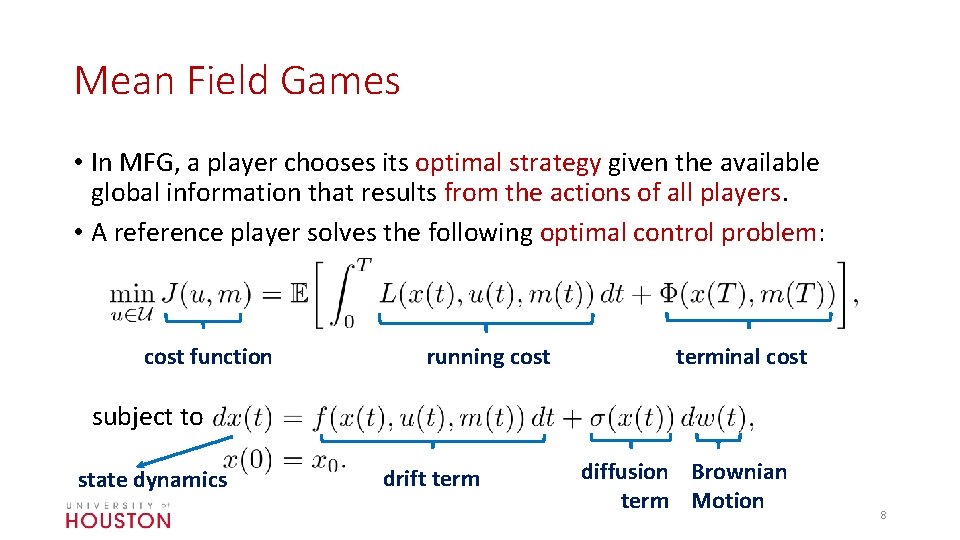
Mean Field Games • In MFG, a player chooses its optimal strategy given the available global information that results from the actions of all players. • A reference player solves the following optimal control problem: cost function running cost terminal cost subject to state dynamics drift term diffusion Brownian term Motion 8
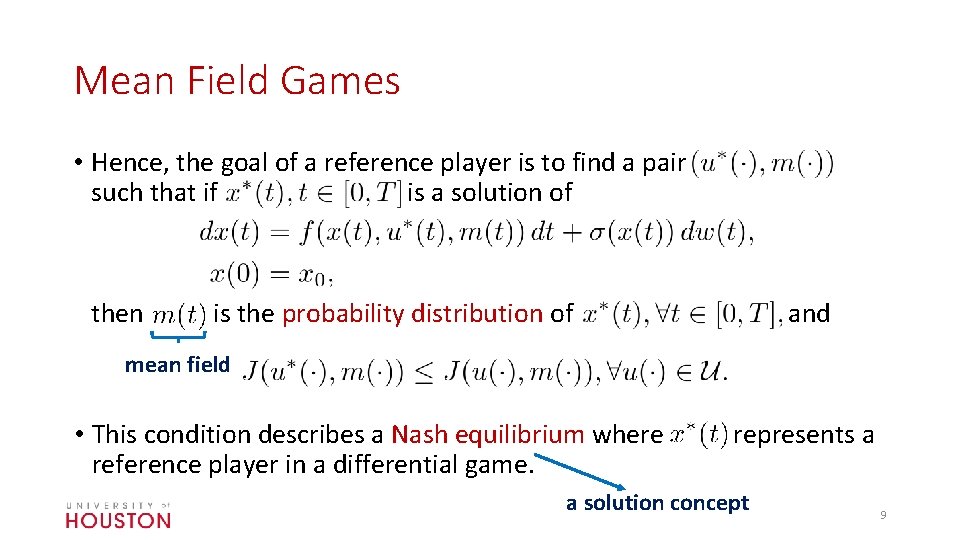
Mean Field Games • Hence, the goal of a reference player is to find a pair such that if is a solution of then is the probability distribution of and mean field • This condition describes a Nash equilibrium where reference player in a differential game. represents a a solution concept 9
Overview • Introduction • Mean Field Game Framework • State Dynamics • Cost Functions • Solution Concept • Analytic Methods • Probabilistic Method • Applications • Conclusion 10
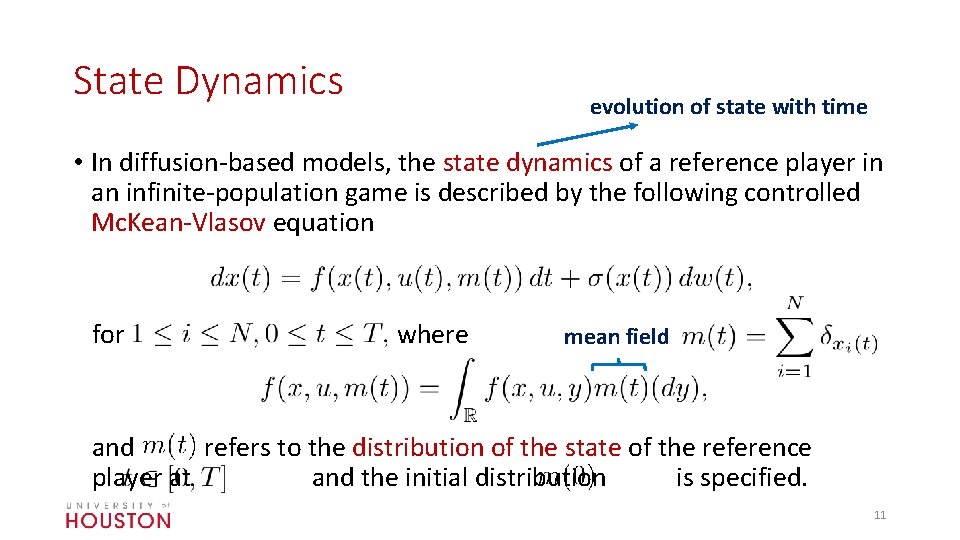
State Dynamics evolution of state with time • In diffusion-based models, the state dynamics of a reference player in an infinite-population game is described by the following controlled Mc. Kean-Vlasov equation for where mean field and refers to the distribution of the state of the reference player at and the initial distribution is specified. 11
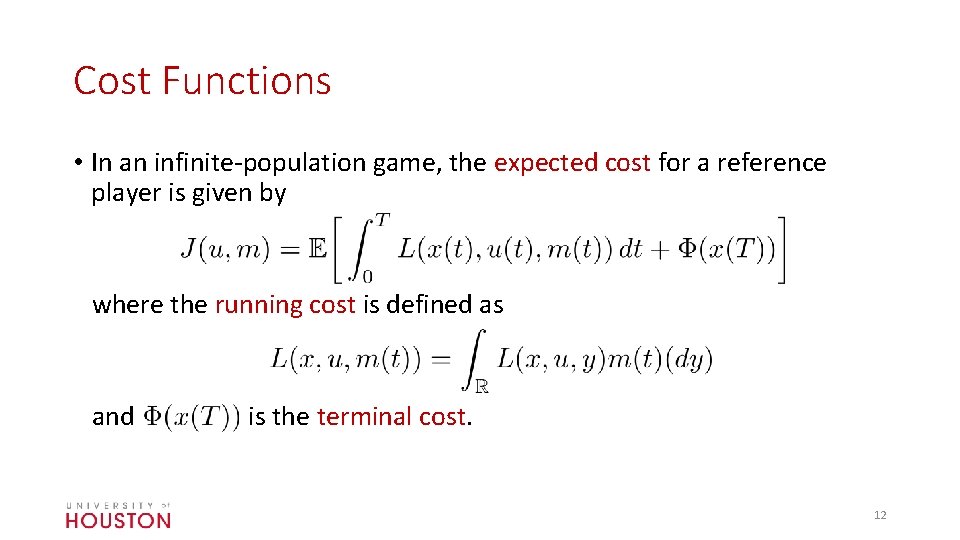
Cost Functions • In an infinite-population game, the expected cost for a reference player is given by where the running cost is defined as and is the terminal cost. 12
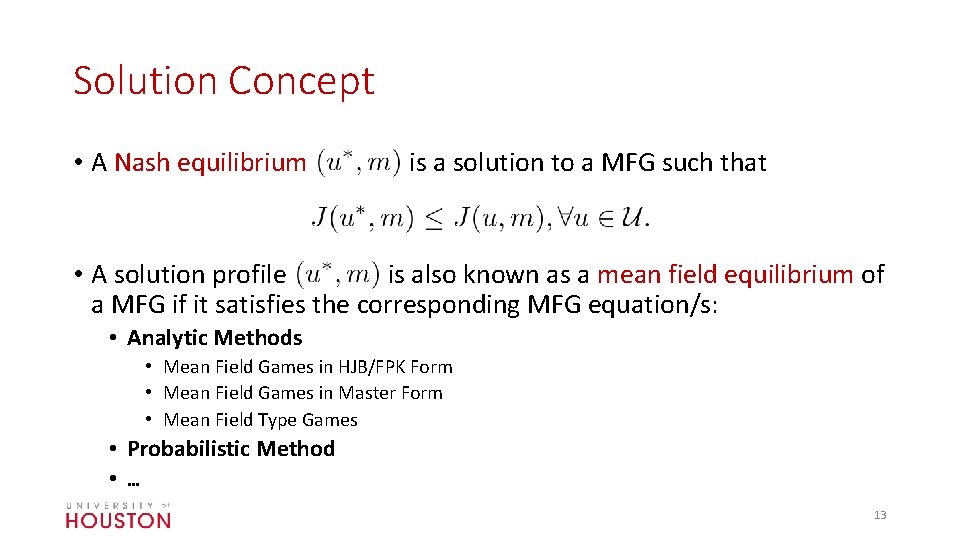
Solution Concept • A Nash equilibrium is a solution to a MFG such that • A solution profile is also known as a mean field equilibrium of a MFG if it satisfies the corresponding MFG equation/s: • Analytic Methods • Mean Field Games in HJB/FPK Form • Mean Field Games in Master Form • Mean Field Type Games • Probabilistic Method • … 13
Overview • Introduction • Mean Field Game Framework • Analytic Methods • Mean Field Games in HJB/FPK Form • Mean Field Games in Master Form • Mean Field Type Games • Probabilistic Method • Applications • Conclusion 14
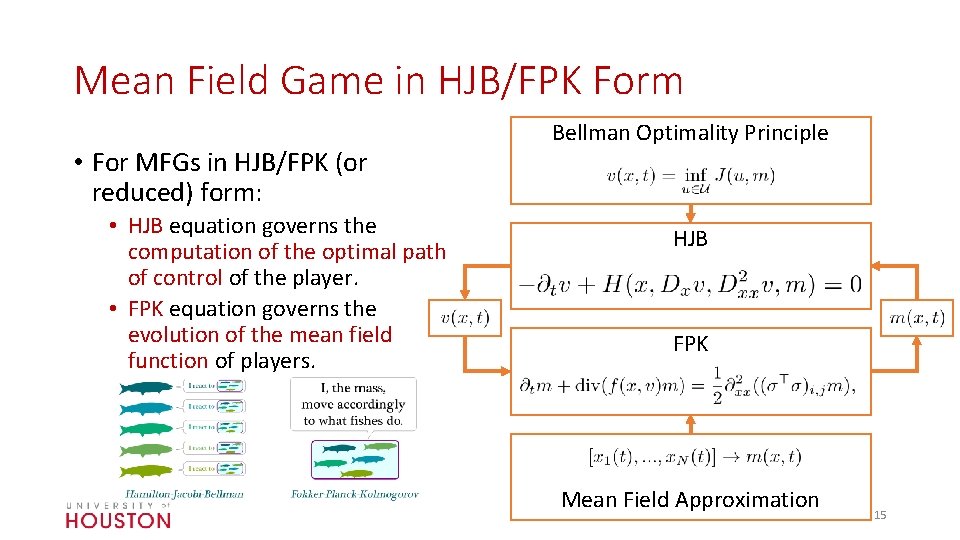
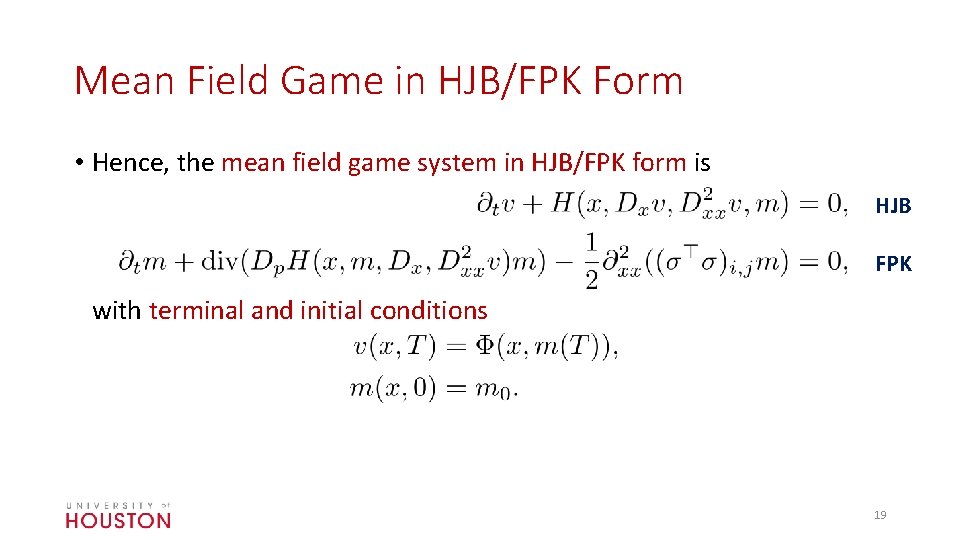
Mean Field Game in HJB/FPK Form • For MFGs in HJB/FPK (or reduced) form: • HJB equation governs the computation of the optimal path of control of the player. • FPK equation governs the evolution of the mean field function of players. Bellman Optimality Principle HJB FPK Mean Field Approximation 15
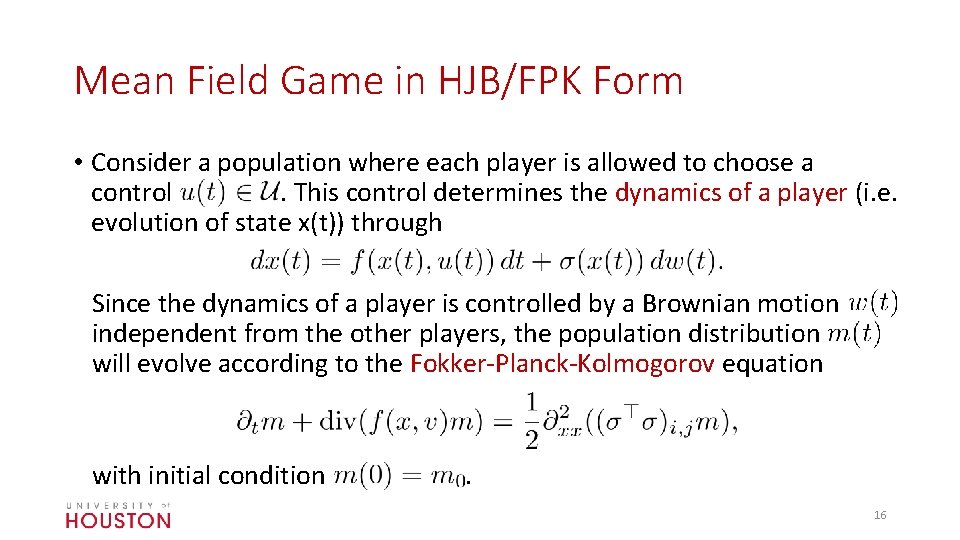
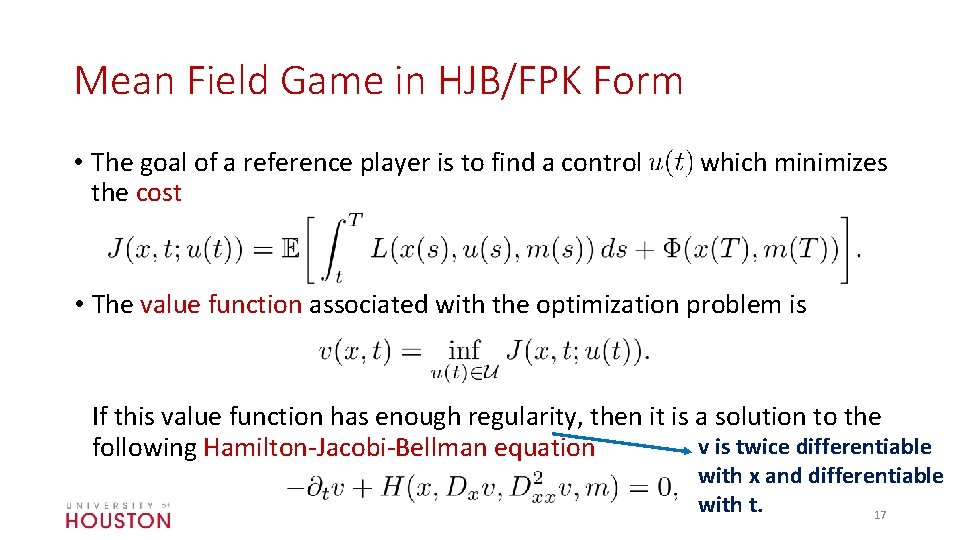
Mean Field Game in HJB/FPK Form • Consider a population where each player is allowed to choose a control. This control determines the dynamics of a player (i. e. evolution of state x(t)) through Since the dynamics of a player is controlled by a Brownian motion independent from the other players, the population distribution will evolve according to the Fokker-Planck-Kolmogorov equation with initial condition . 16
Mean Field Game in HJB/FPK Form • The goal of a reference player is to find a control the cost which minimizes • The value function associated with the optimization problem is If this value function has enough regularity, then it is a solution to the v is twice differentiable following Hamilton-Jacobi-Bellman equation with x and differentiable with t. 17
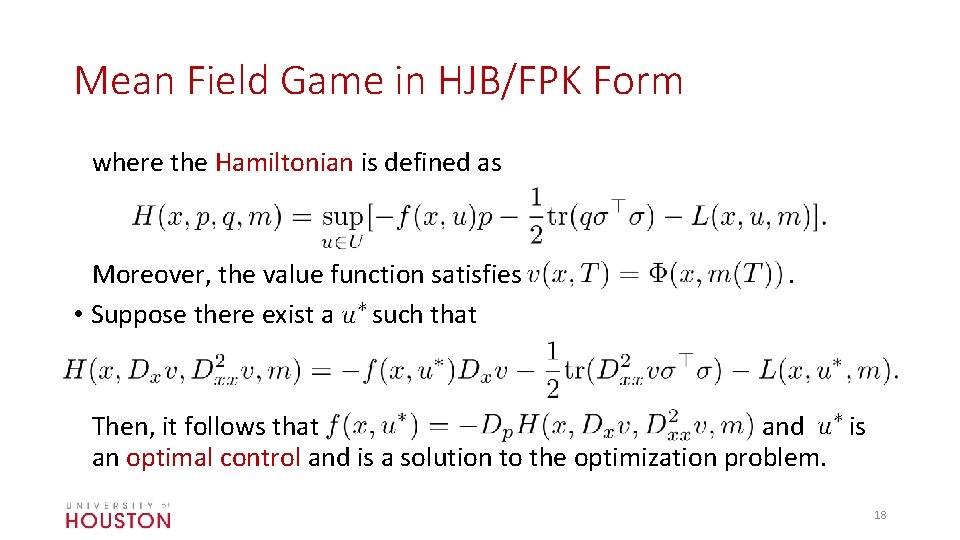
Mean Field Game in HJB/FPK Form where the Hamiltonian is defined as Moreover, the value function satisfies • Suppose there exist a such that . Then, it follows that and is an optimal control and is a solution to the optimization problem. 18
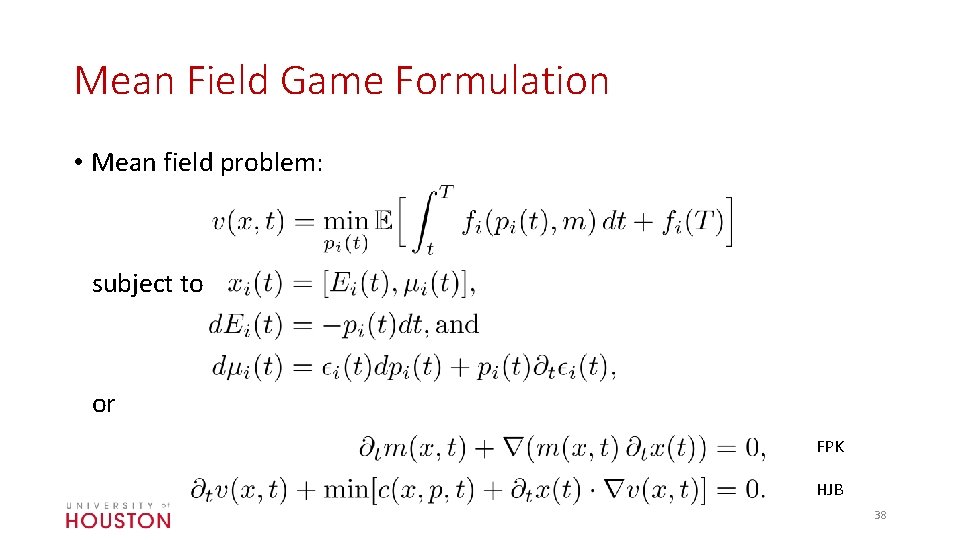
Mean Field Game in HJB/FPK Form • Hence, the mean field game system in HJB/FPK form is HJB FPK with terminal and initial conditions 19
Mean Field Game in Master Form • The master equation is a more general formulation for MFG involving • the optimization problem faced by the players and • the evolution of the population’s states. • Instead of mean field term, we replace the formulation with a random variable that refers to the trajectory of the population of the players. • The master form of MFG is useful for the study of problems where players share common noise (i. e. , Brownian motion). 20
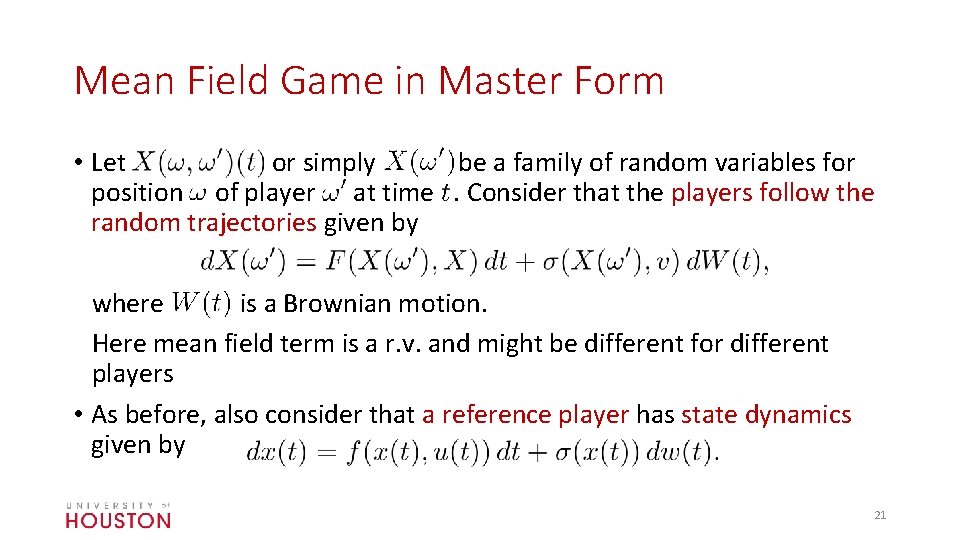
Mean Field Game in Master Form • Let or simply be a family of random variables for position of player at time. Consider that the players follow the random trajectories given by where is a Brownian motion. Here mean field term is a r. v. and might be different for different players • As before, also consider that a reference player has state dynamics given by 21
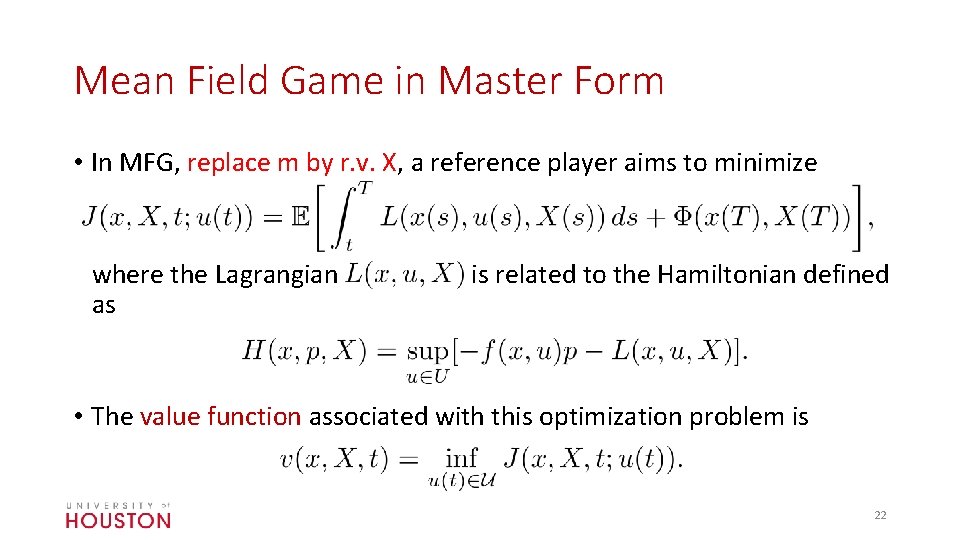
Mean Field Game in Master Form • In MFG, replace m by r. v. X, a reference player aims to minimize where the Lagrangian as is related to the Hamiltonian defined • The value function associated with this optimization problem is 22
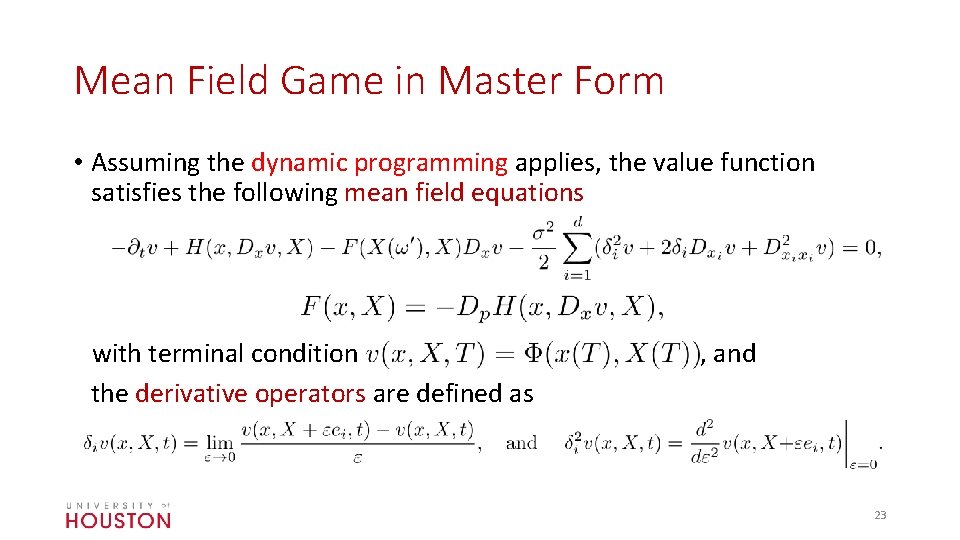
Mean Field Game in Master Form • Assuming the dynamic programming applies, the value function satisfies the following mean field equations with terminal condition the derivative operators are defined as , and 23
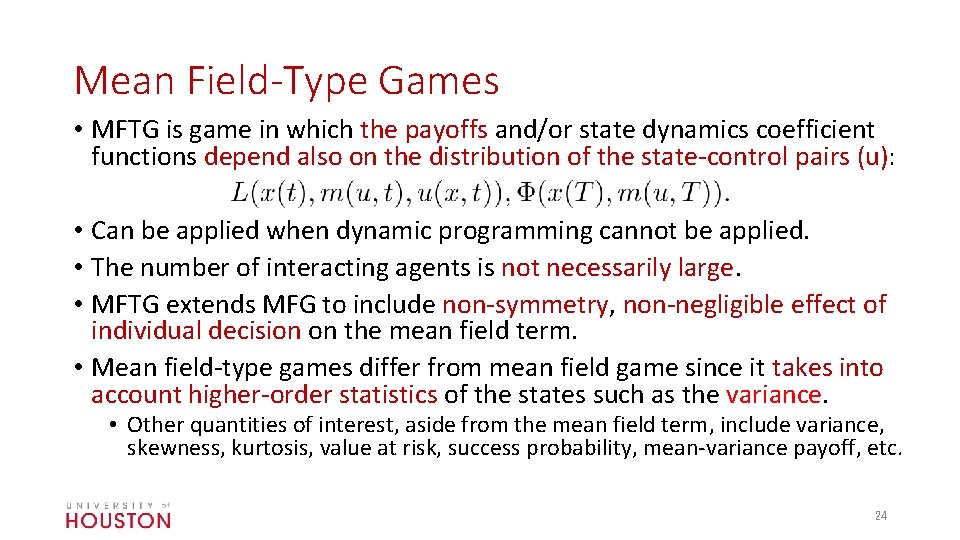
Mean Field-Type Games • MFTG is game in which the payoffs and/or state dynamics coefficient functions depend also on the distribution of the state-control pairs (u): • Can be applied when dynamic programming cannot be applied. • The number of interacting agents is not necessarily large. • MFTG extends MFG to include non-symmetry, non-negligible effect of individual decision on the mean field term. • Mean field-type games differ from mean field game since it takes into account higher-order statistics of the states such as the variance. • Other quantities of interest, aside from the mean field term, include variance, skewness, kurtosis, value at risk, success probability, mean-variance payoff, etc. 24
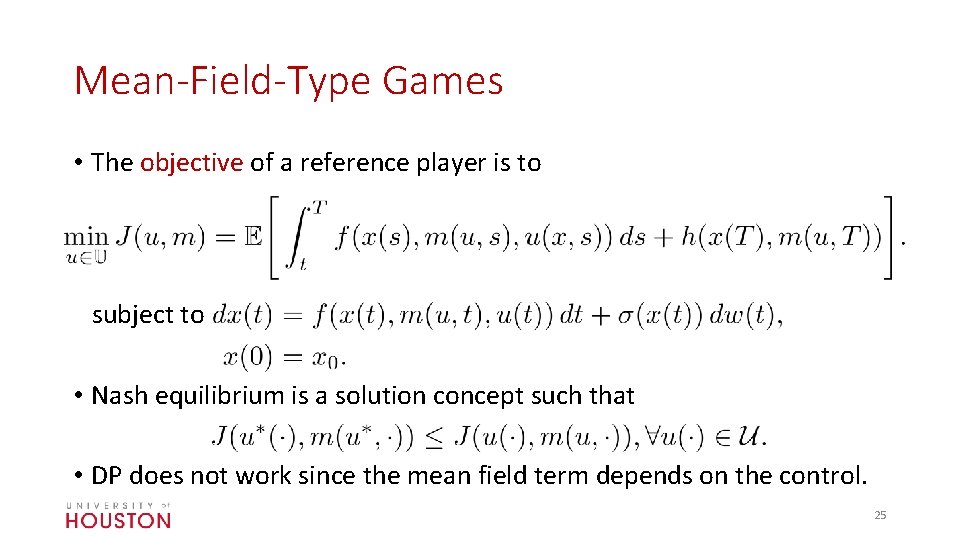
Mean-Field-Type Games • The objective of a reference player is to subject to • Nash equilibrium is a solution concept such that • DP does not work since the mean field term depends on the control. 25
Overview • Introduction • Mean Field Game Framework • Analytic Methods • Probabilistic Method • Stochastic Maximum Principle • Applications • Conclusion 26
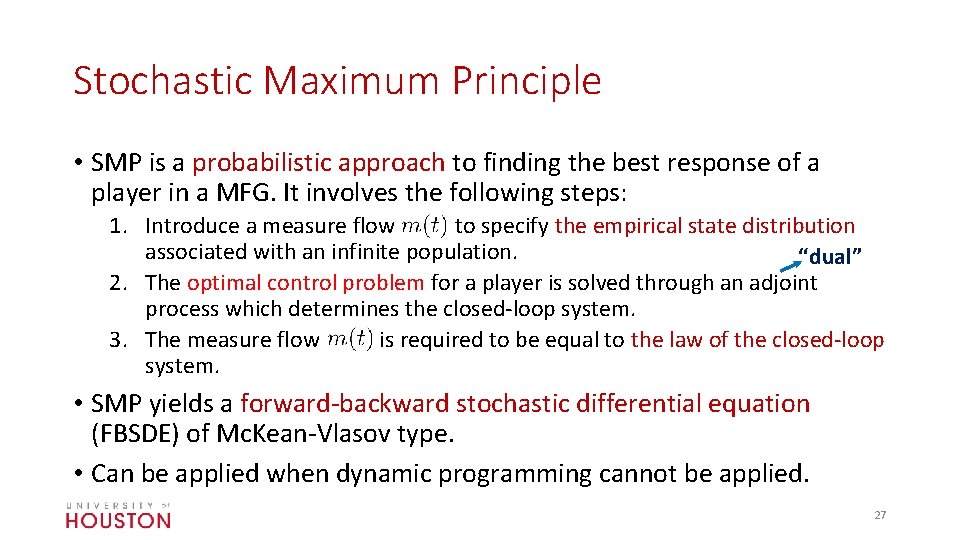
Stochastic Maximum Principle • SMP is a probabilistic approach to finding the best response of a player in a MFG. It involves the following steps: 1. Introduce a measure flow to specify the empirical state distribution associated with an infinite population. “dual” 2. The optimal control problem for a player is solved through an adjoint process which determines the closed-loop system. 3. The measure flow is required to be equal to the law of the closed-loop system. • SMP yields a forward-backward stochastic differential equation (FBSDE) of Mc. Kean-Vlasov type. • Can be applied when dynamic programming cannot be applied. 27
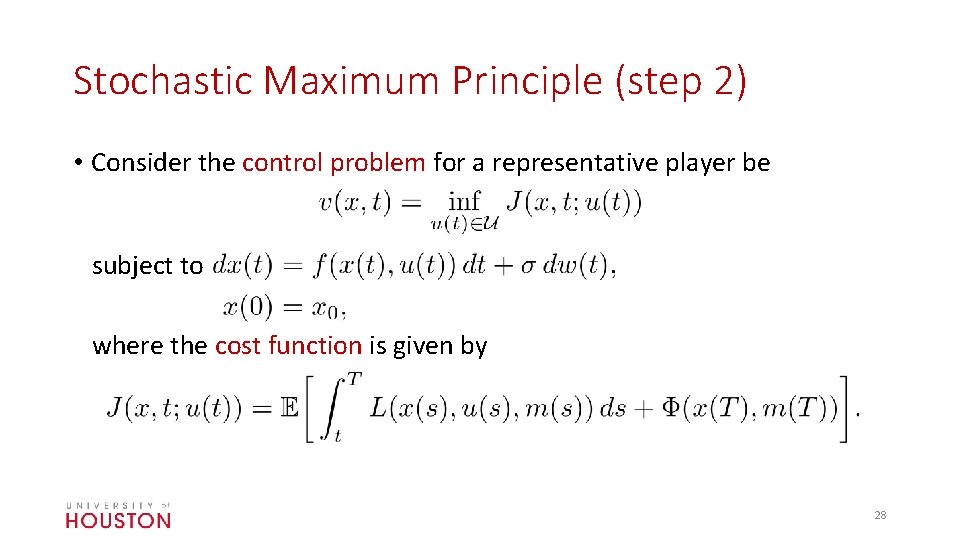
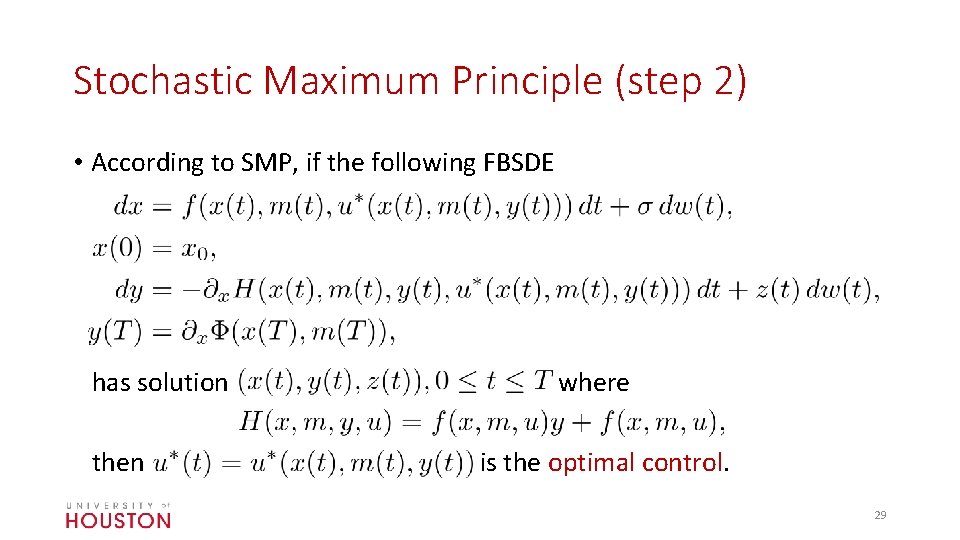
Stochastic Maximum Principle (step 2) • Consider the control problem for a representative player be subject to where the cost function is given by 28
Stochastic Maximum Principle (step 2) • According to SMP, if the following FBSDE has solution then where is the optimal control. 29
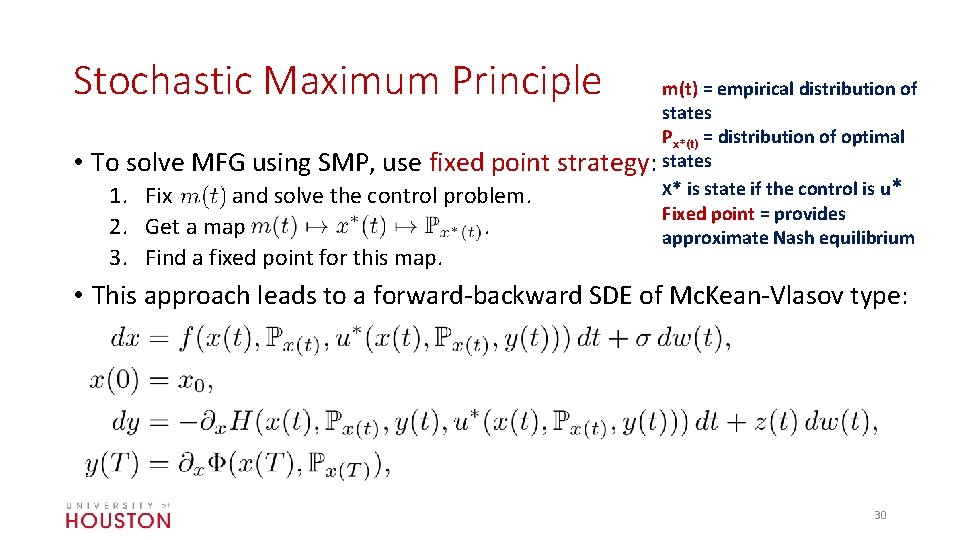
Stochastic Maximum Principle • To solve MFG using SMP, use fixed point 1. Fix and solve the control problem. 2. Get a map. 3. Find a fixed point for this map. m(t) = empirical distribution of states Px*(t) = distribution of optimal strategy: states X* is state if the control is u* Fixed point = provides approximate Nash equilibrium • This approach leads to a forward-backward SDE of Mc. Kean-Vlasov type: 30
Overview • Introduction • Mean Field Game Framework • Analytic Methods • Probabilistic Method • Applications • Conclusion 31
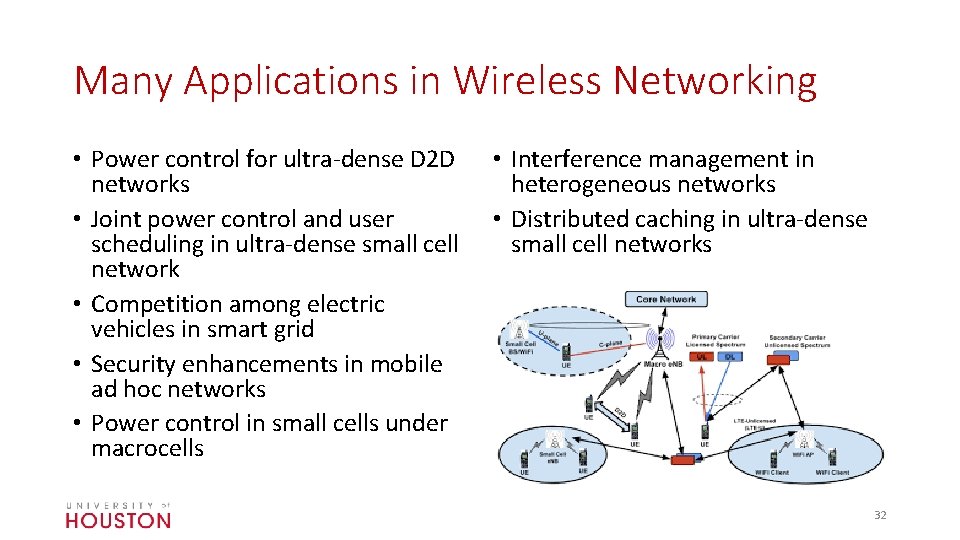
Many Applications in Wireless Networking • Power control for ultra-dense D 2 D networks • Joint power control and user scheduling in ultra-dense small cell network • Competition among electric vehicles in smart grid • Security enhancements in mobile ad hoc networks • Power control in small cells under macrocells • Interference management in heterogeneous networks • Distributed caching in ultra-dense small cell networks 32
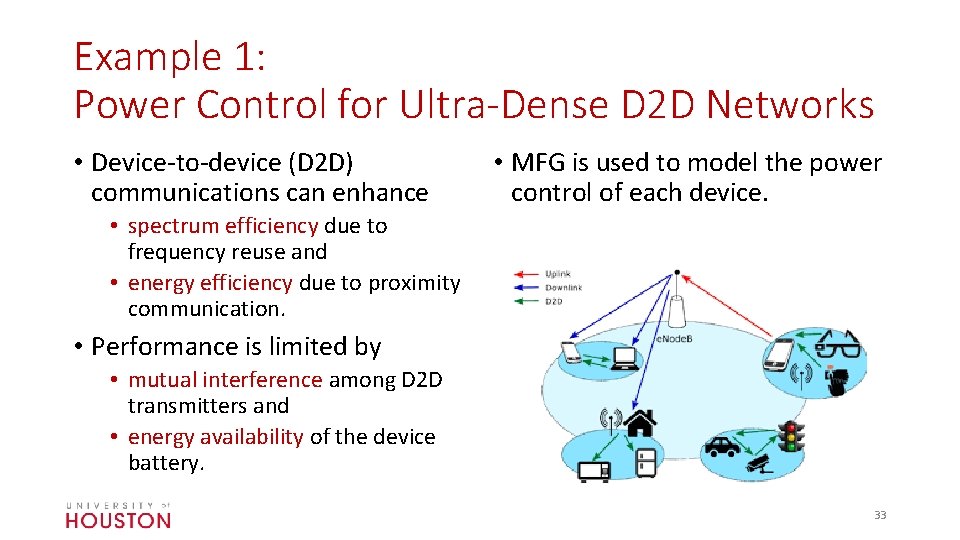
Example 1: Power Control for Ultra-Dense D 2 D Networks • Device-to-device (D 2 D) communications can enhance • MFG is used to model the power control of each device. • spectrum efficiency due to frequency reuse and • energy efficiency due to proximity communication. • Performance is limited by • mutual interference among D 2 D transmitters and • energy availability of the device battery. 33
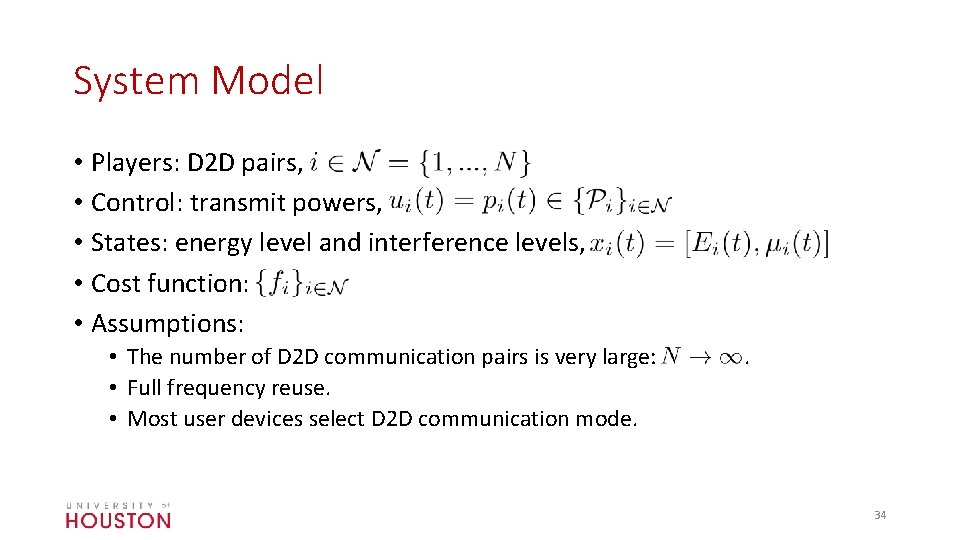
System Model • Players: D 2 D pairs, • Control: transmit powers, • States: energy level and interference levels, • Cost function: • Assumptions: • The number of D 2 D communication pairs is very large: • Full frequency reuse. • Most user devices select D 2 D communication mode. . 34
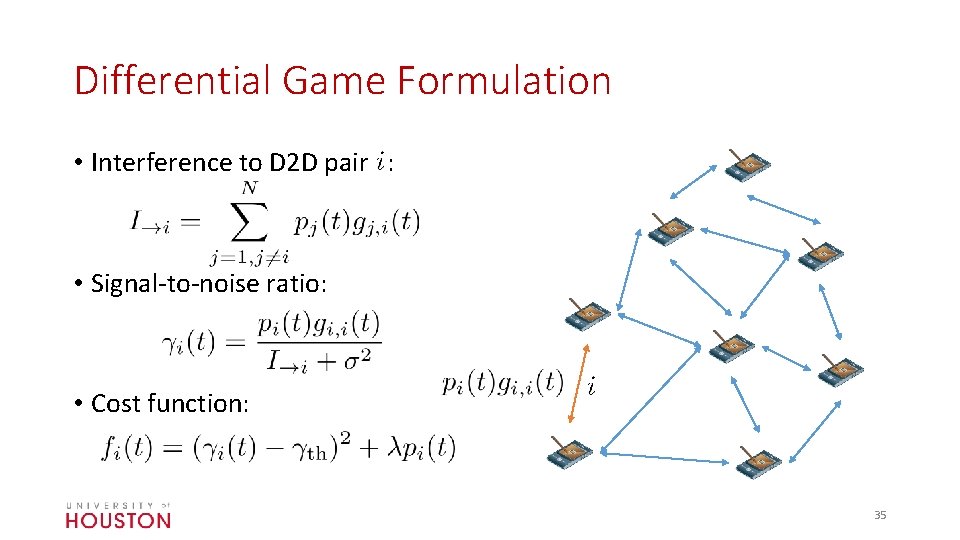
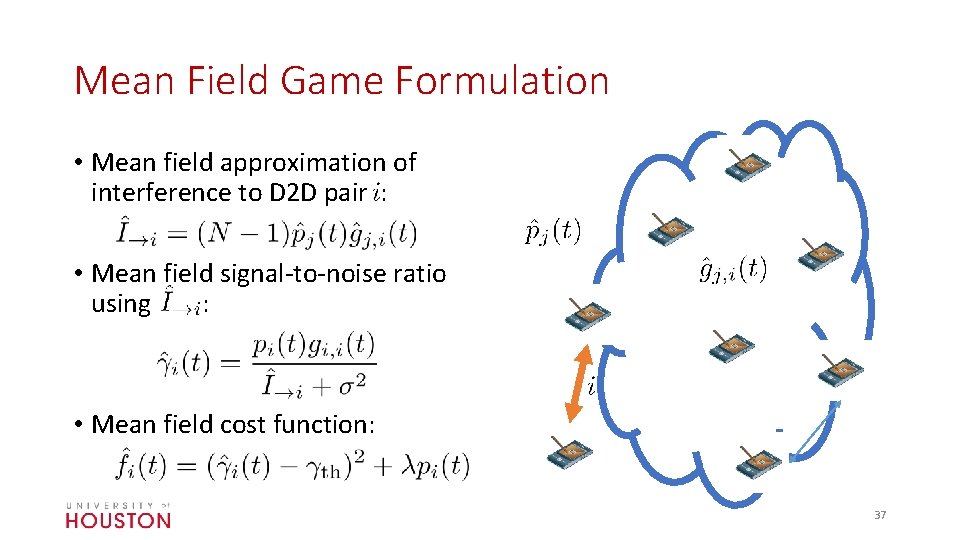
Differential Game Formulation • Interference to D 2 D pair : • Signal-to-noise ratio: • Cost function: 35
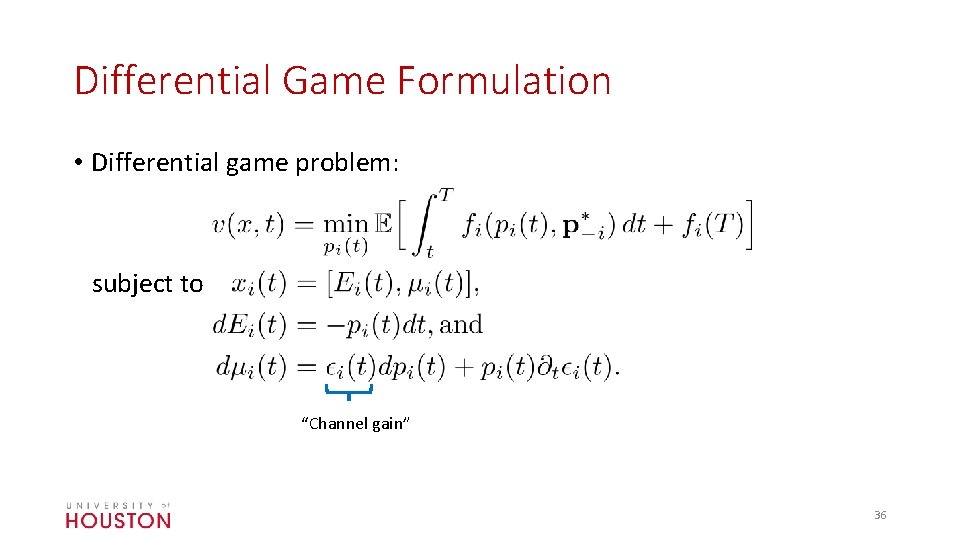
Differential Game Formulation • Differential game problem: subject to “Channel gain” 36
Mean Field Game Formulation • Mean field approximation of interference to D 2 D pair : • Mean field signal-to-noise ratio using : • Mean field cost function: 37
Mean Field Game Formulation • Mean field problem: subject to or FPK HJB 38
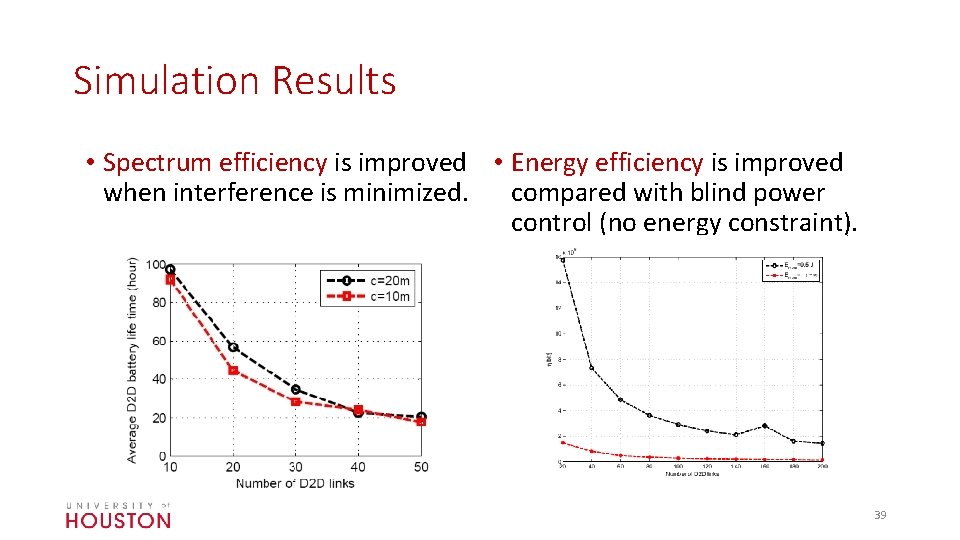
Simulation Results • Spectrum efficiency is improved • Energy efficiency is improved when interference is minimized. compared with blind power control (no energy constraint). 39
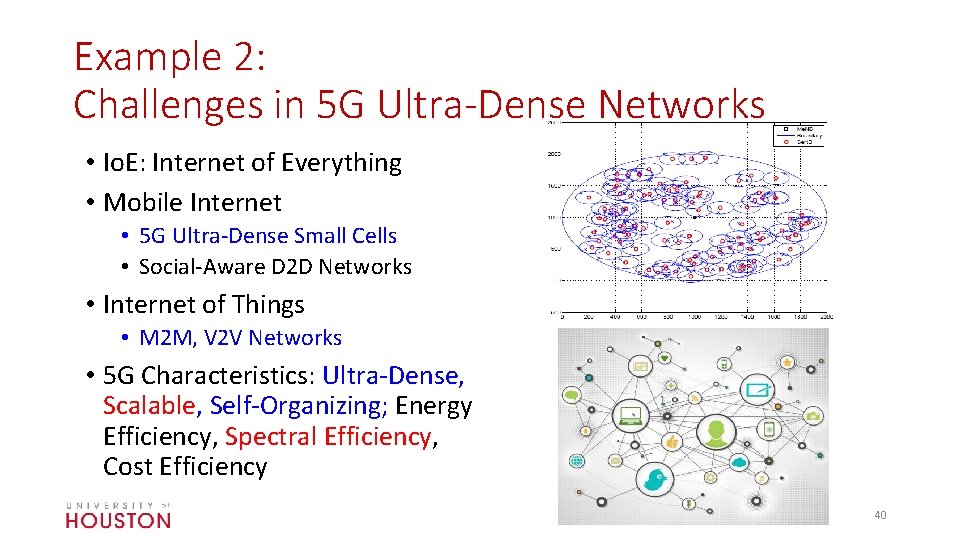
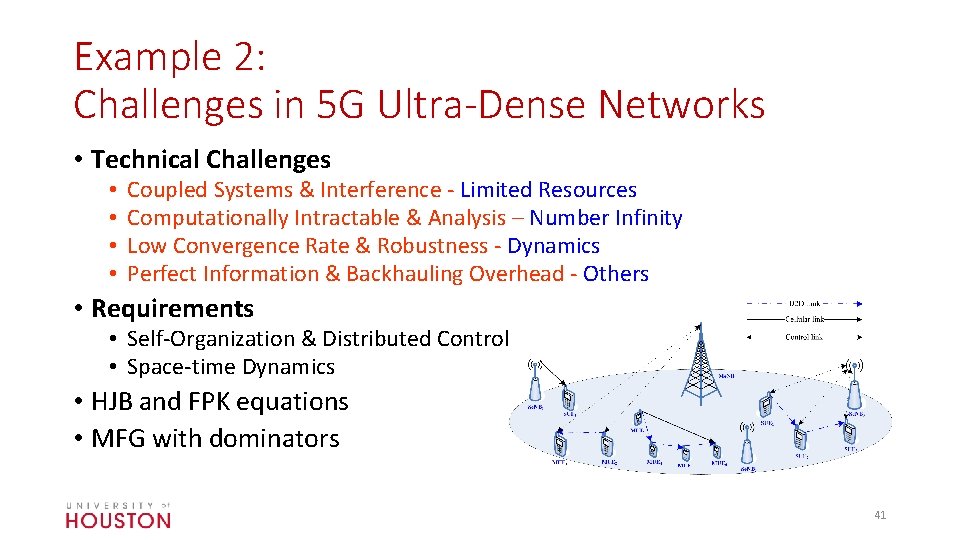
Example 2: Challenges in 5 G Ultra-Dense Networks • Io. E: Internet of Everything • Mobile Internet • 5 G Ultra-Dense Small Cells • Social-Aware D 2 D Networks • Internet of Things • M 2 M, V 2 V Networks • 5 G Characteristics: Ultra-Dense, Scalable, Self-Organizing; Energy Efficiency, Spectral Efficiency, Cost Efficiency 40
Example 2: Challenges in 5 G Ultra-Dense Networks • Technical Challenges • • Coupled Systems & Interference - Limited Resources Computationally Intractable & Analysis – Number Infinity Low Convergence Rate & Robustness - Dynamics Perfect Information & Backhauling Overhead - Others • Requirements • Self-Organization & Distributed Control • Space-time Dynamics • HJB and FPK equations • MFG with dominators 41
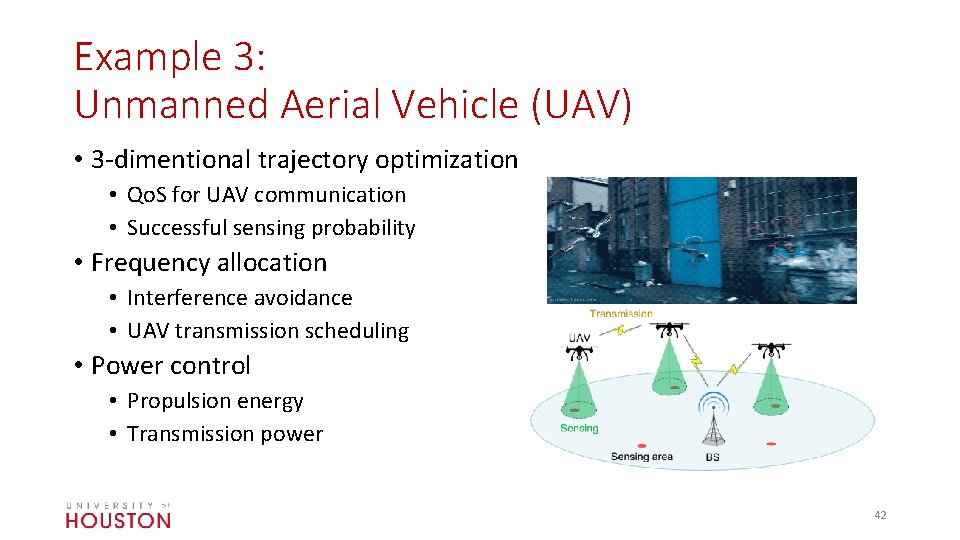
Example 3: Unmanned Aerial Vehicle (UAV) • 3 -dimentional trajectory optimization • Qo. S for UAV communication • Successful sensing probability • Frequency allocation • Interference avoidance • UAV transmission scheduling • Power control • Propulsion energy • Transmission power 42
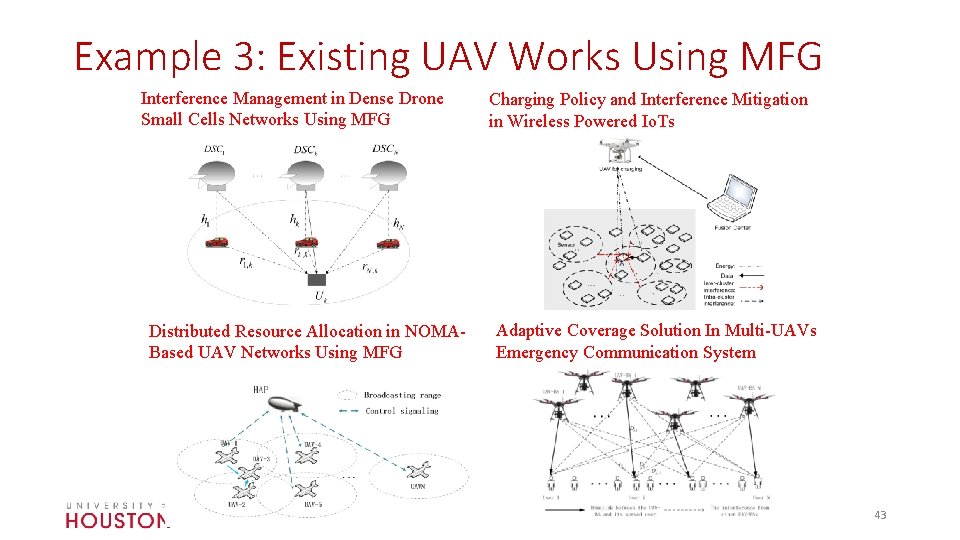
Example 3: Existing UAV Works Using MFG Interference Management in Dense Drone Small Cells Networks Using MFG Distributed Resource Allocation in NOMABased UAV Networks Using MFG Charging Policy and Interference Mitigation in Wireless Powered Io. Ts Adaptive Coverage Solution In Multi-UAVs Emergency Communication System 43
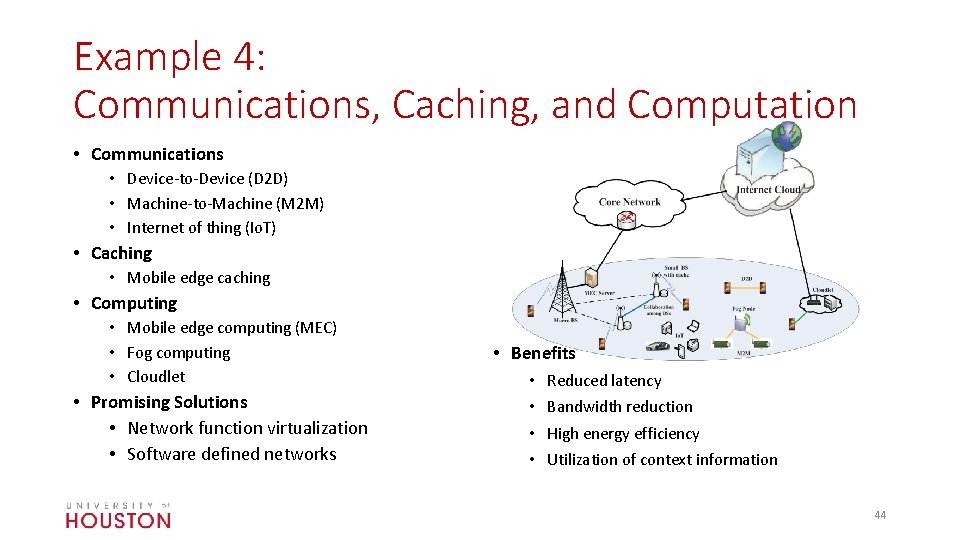
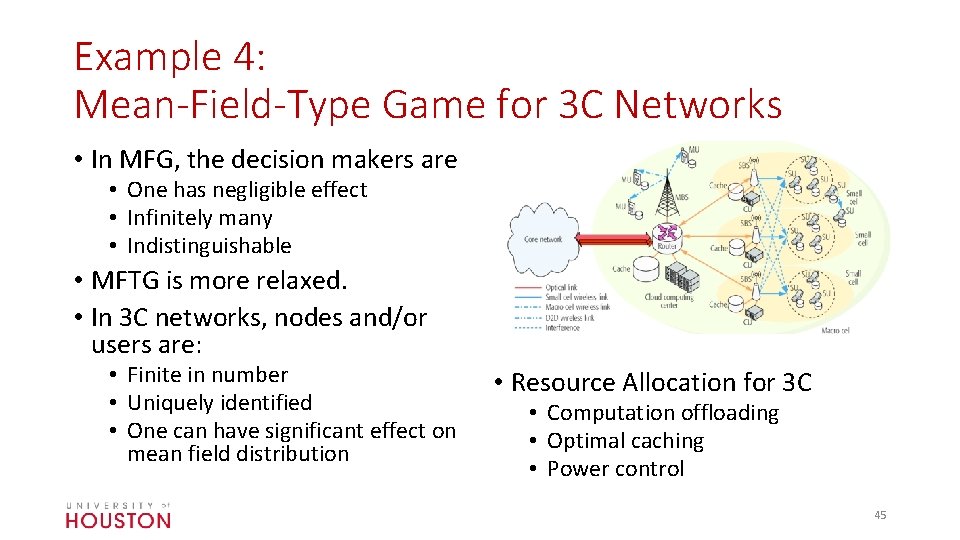
Example 4: Communications, Caching, and Computation • Communications • Device-to-Device (D 2 D) • Machine-to-Machine (M 2 M) • Internet of thing (Io. T) • Caching • Mobile edge caching • Computing • Mobile edge computing (MEC) • Fog computing • Cloudlet • Promising Solutions • Network function virtualization • Software defined networks • Benefits • Reduced latency • Bandwidth reduction • High energy efficiency • Utilization of context information 44
Example 4: Mean-Field-Type Game for 3 C Networks • In MFG, the decision makers are • One has negligible effect • Infinitely many • Indistinguishable • MFTG is more relaxed. • In 3 C networks, nodes and/or users are: • Finite in number • Uniquely identified • One can have significant effect on mean field distribution • Resource Allocation for 3 C • Computation offloading • Optimal caching • Power control 45
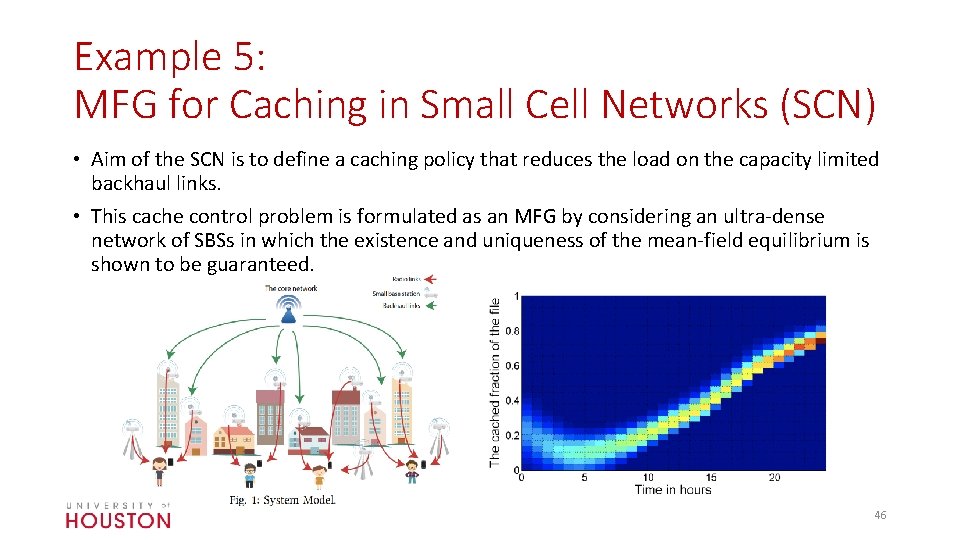
Example 5: MFG for Caching in Small Cell Networks (SCN) • Aim of the SCN is to define a caching policy that reduces the load on the capacity limited backhaul links. • This cache control problem is formulated as an MFG by considering an ultra-dense network of SBSs in which the existence and uniqueness of the mean-field equilibrium is shown to be guaranteed. 46
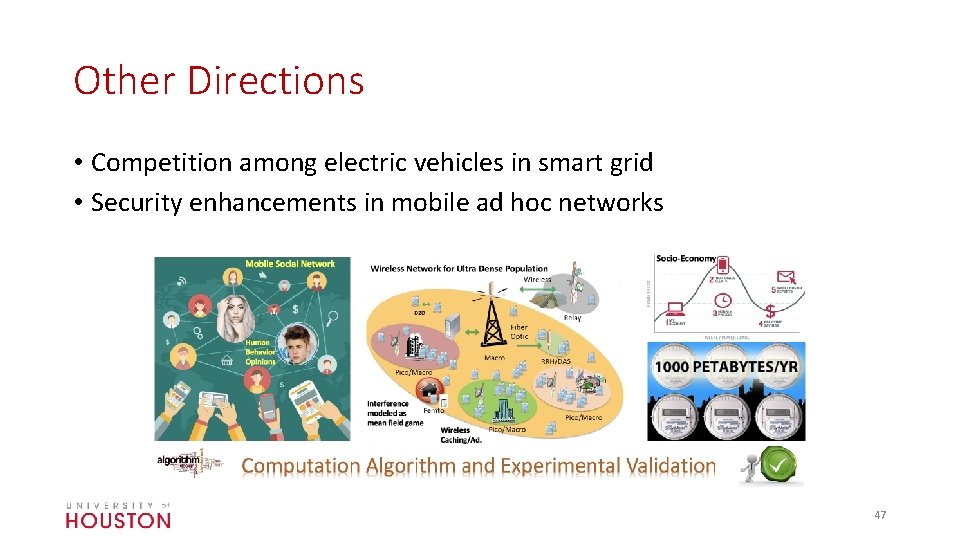
Other Directions • Competition among electric vehicles in smart grid • Security enhancements in mobile ad hoc networks 47
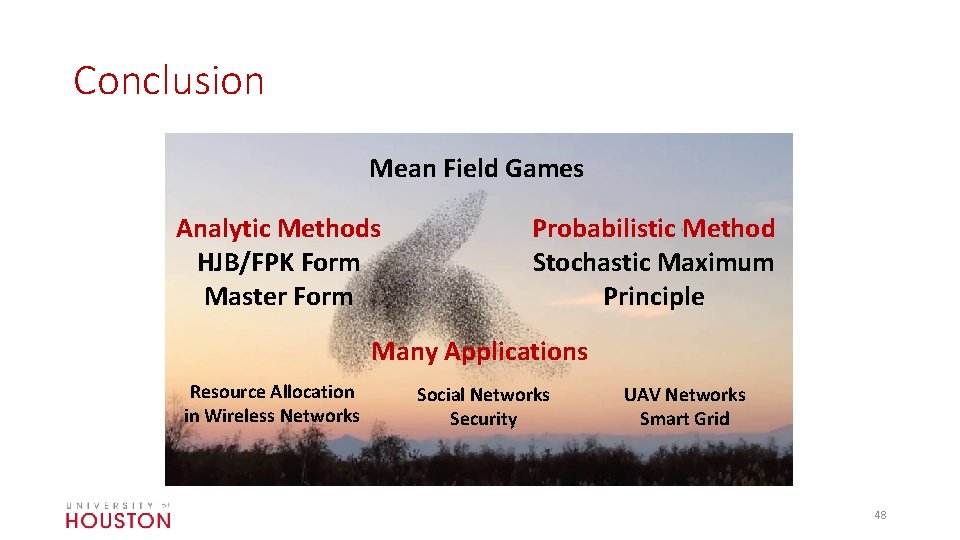
Conclusion Mean Field Games Analytic Methods HJB/FPK Form Master Form Probabilistic Method Stochastic Maximum Principle Many Applications Resource Allocation in Wireless Networks Social Networks Security UAV Networks Smart Grid 48
References • UCLA summer workshop on mean field game, each year • J. -M. Lasry, and P. -L. Lions, “Mean field games, ” Japanese Journal of Mathematics, vol. 2, no. 1, pp. 229 -260, 2007. • O. Gueant, J. -M. Lasry, and P. -L. Lions, “Mean field games and application, ” 2015. • P. E. Caines, M. Huang, and R. Malhame, “Mean Field Games, ” Springer, 2017. • A. Bensoussan, J. Frehse, and P. Yam, “Mean Field Games and Mean Field Type Control Theory, ” Aug. 2013. • D. Gomes and J. Saude, “Mean Field Game Models – A Brief Survey, ” Dynamic Games and Applications, June 2014. • D. Gomes, L. Nurbekyan, E. Pimentel, “Economic Models and Mean-field Games Theory, ” IMPA, 2015. • C. Yang, J. Li, P. Semasinghe, E. Hossain, S. Perlaza, and Z. Han, “Distributed Interference, and Energy-Aware Power Control for Ultra-Dense D 2 D Networks: A Mean Field Game, ” IEEE Transactions on Wireless Communications, vol. 16, no. 2, pp. 1205 -1217, Feb. 2017. 49
References • K. Hamidouche, W. Saad, M. Debbah, and H. V. Poor, ``Mean-Field Games for Distributed Caching in Ultra-Dense Small Cell Networks, ” ACC 2016. • C. Yang and Z. Han, “Distributed Interference-Aware Power Control in Ultra-Dense Small Cell Networks: A Robust Mean Field Game, " IEEE Access, vol. 6, pp. 12608 -12619, January 2018. • Zihe Zhang, Lixin Li, Xiaomin Liu, Wei Liang, Zhu Han, “Matching-Based Resource Allocation and Distributed Power Control Using Mean Field Game in the NOMA-Based UAV Networks, " Asia-Pacic Signal and Information Processing 2018. • Z. Zhang, L. Li, W. Liang, X. Li, A. Gao, W. Chen, and Z. Han, Downlink Interference Management in Dense Drone Small Cells Networks Using Mean-Field Game Theory, ” WCSP, 2018. • Y. Xu, L. Li, Z. Zhang, K. Xue, and Z. Han, “A Discrete-Time Mean Field Game in Multi-UAV Wireless Communication System, " ICCC, 2018 • C. Yang, Y. Zhang, J. Li, and Z. Han, “Power Control Mean Field Game With Dominator in Ultra-Dense Small Cell Networks, " IEEE Globecom, 2017. 50
THANK YOU! 51