
Mean field description of the nucleusnucleus optical potential
- Slides: 18
Mean field description of the nucleus-nucleus optical potential Dao Tien Khoa, Do Cong Cuong and Hoang Sy Than Institute for Nuclear Science & Technique Vietnam Atomic Energy Commission (VAEC) INPC 07 Conference, Tokyo, June 4, 2007
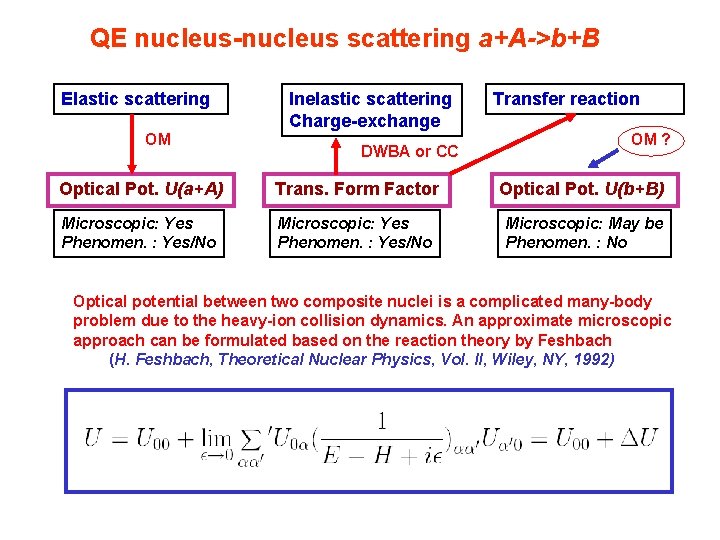
QE nucleus-nucleus scattering a+A->b+B Elastic scattering OM Inelastic scattering Charge-exchange DWBA or CC Transfer reaction OM ? Optical Pot. U(a+A) Trans. Form Factor Optical Pot. U(b+B) Microscopic: Yes Phenomen. : Yes/No Microscopic: May be Phenomen. : No Optical potential between two composite nuclei is a complicated many-body problem due to the heavy-ion collision dynamics. An approximate microscopic approach can be formulated based on the reaction theory by Feshbach (H. Feshbach, Theoretical Nuclear Physics, Vol. II, Wiley, NY, 1992)
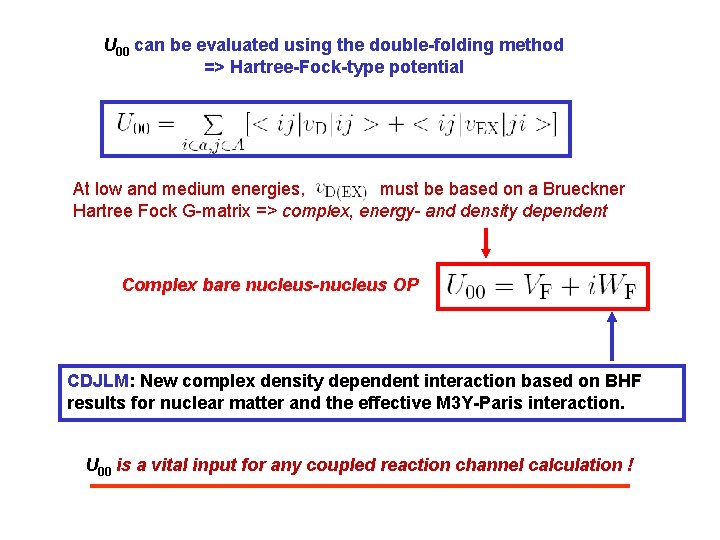
U 00 can be evaluated using the double-folding method => Hartree-Fock-type potential At low and medium energies, must be based on a Brueckner Hartree Fock G-matrix => complex, energy- and density dependent Complex bare nucleus-nucleus OP CDJLM: New complex density dependent interaction based on BHF results for nuclear matter and the effective M 3 Y-Paris interaction. U 00 is a vital input for any coupled reaction channel calculation !
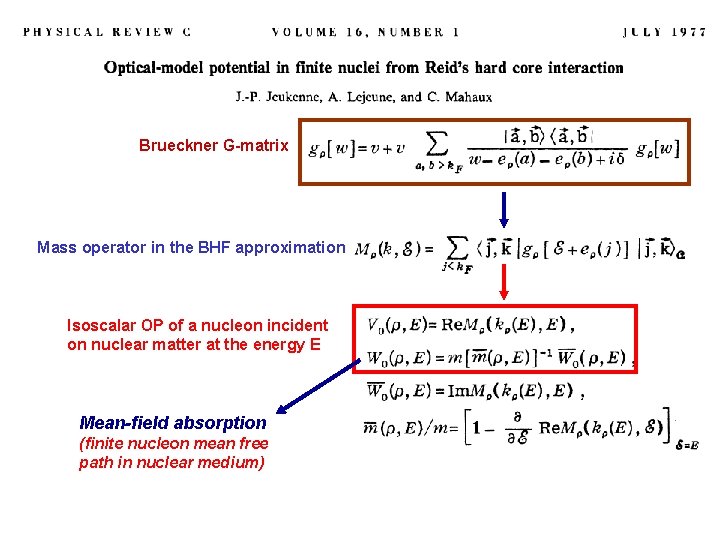
Brueckner G-matrix Mass operator in the BHF approximation Isoscalar OP of a nucleon incident on nuclear matter at the energy E Mean-field absorption (finite nucleon mean free path in nuclear medium)
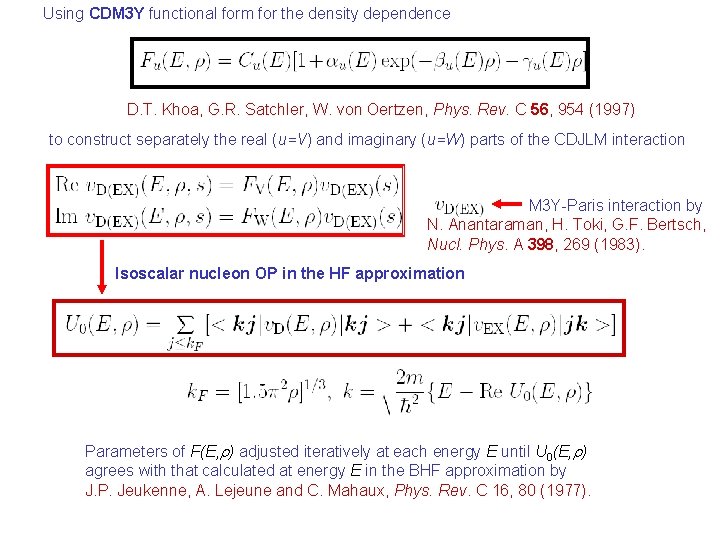
Using CDM 3 Y functional form for the density dependence D. T. Khoa, G. R. Satchler, W. von Oertzen, Phys. Rev. C 56, 954 (1997) to construct separately the real (u=V) and imaginary (u=W) parts of the CDJLM interaction M 3 Y-Paris interaction by N. Anantaraman, H. Toki, G. F. Bertsch, Nucl. Phys. A 398, 269 (1983). Isoscalar nucleon OP in the HF approximation Parameters of F(E, r) adjusted iteratively at each energy E until U 0(E, r) agrees with that calculated at energy E in the BHF approximation by J. P. Jeukenne, A. Lejeune and C. Mahaux, Phys. Rev. C 16, 80 (1977).
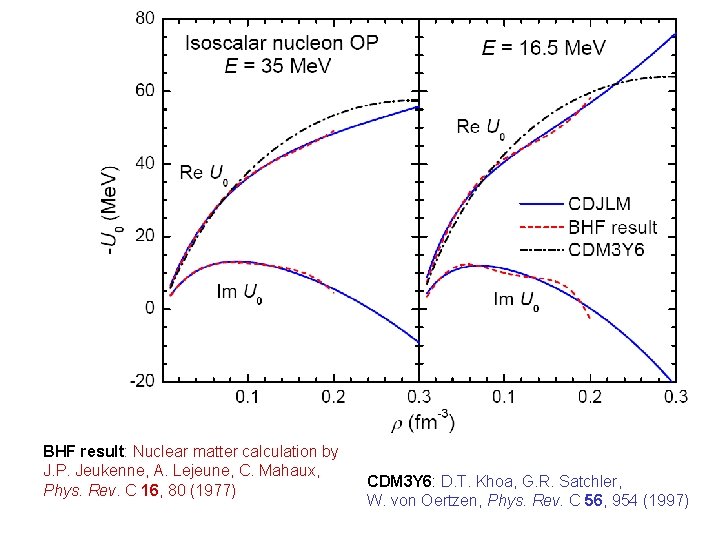
BHF result: Nuclear matter calculation by J. P. Jeukenne, A. Lejeune, C. Mahaux, Phys. Rev. C 16, 80 (1977) CDM 3 Y 6: D. T. Khoa, G. R. Satchler, W. von Oertzen, Phys. Rev. C 56, 954 (1997)
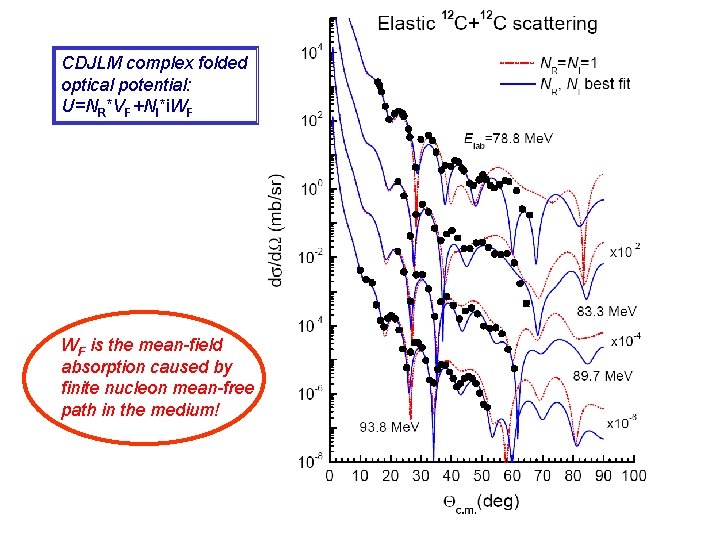
CDJLM complex folded optical potential: U=NR*VF+NI*i. WF WF is the mean-field absorption caused by finite nucleon mean-free path in the medium!
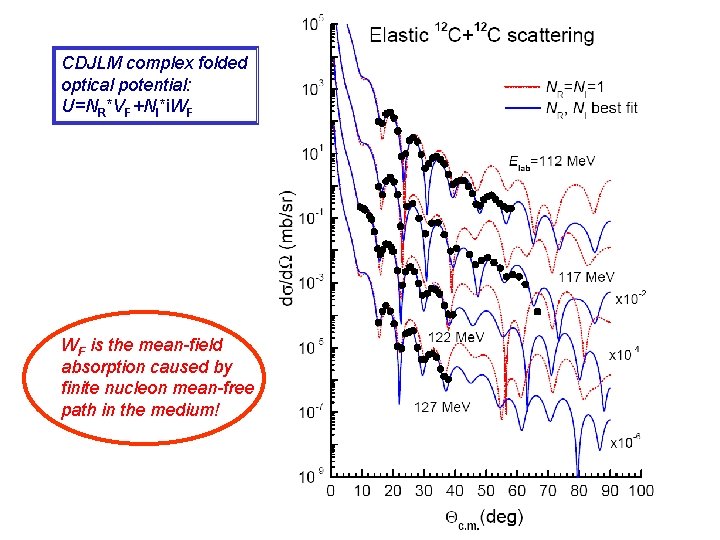
CDJLM complex folded optical potential: U=NR*VF+NI*i. WF WF is the mean-field absorption caused by finite nucleon mean-free path in the medium!
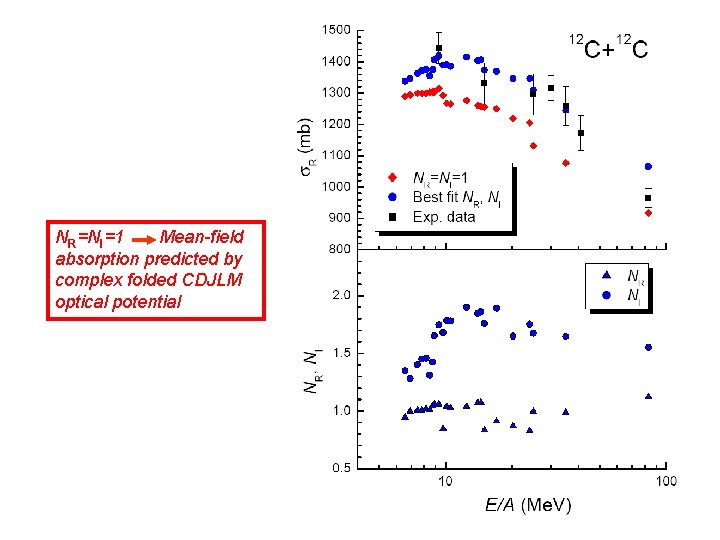
NR=NI=1 Mean-field absorption predicted by complex folded CDJLM optical potential
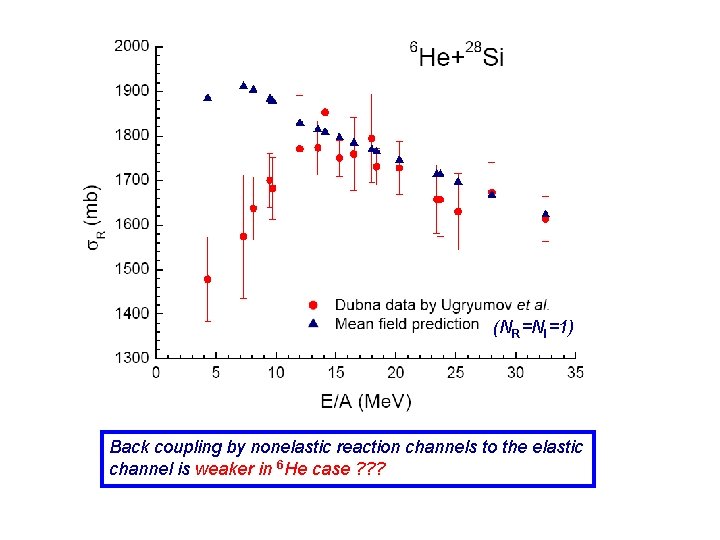
(NR=NI=1) Back coupling by nonelastic reaction channels to the elastic channel is weaker in 6 He case ? ? ?
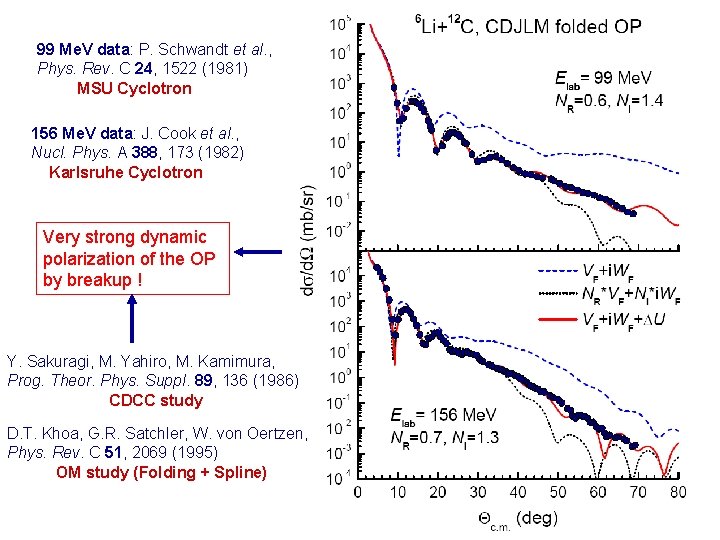
99 Me. V data: P. Schwandt et al. , Phys. Rev. C 24, 1522 (1981) MSU Cyclotron 156 Me. V data: J. Cook et al. , Nucl. Phys. A 388, 173 (1982) Karlsruhe Cyclotron Very strong dynamic polarization of the OP by breakup ! Y. Sakuragi, M. Yahiro, M. Kamimura, Prog. Theor. Phys. Suppl. 89, 136 (1986) CDCC study D. T. Khoa, G. R. Satchler, W. von Oertzen, Phys. Rev. C 51, 2069 (1995) OM study (Folding + Spline)
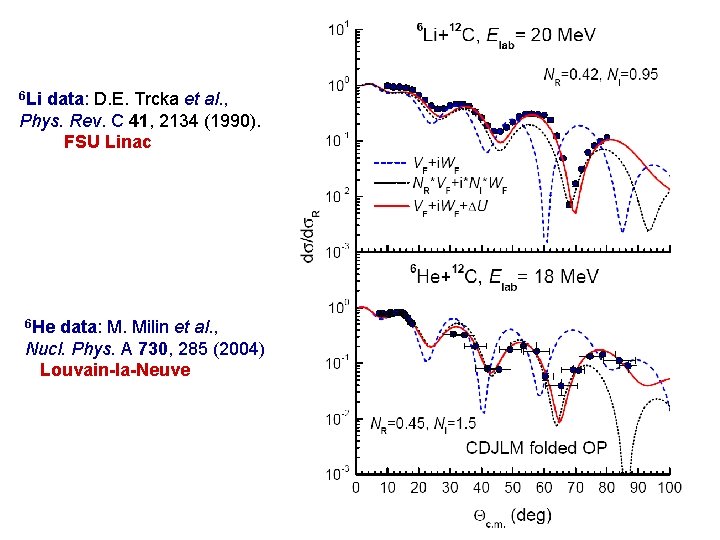
6 Li data: D. E. Trcka et al. , Phys. Rev. C 41, 2134 (1990). FSU Linac 6 He data: M. Milin et al. , Nucl. Phys. A 730, 285 (2004) Louvain-la-Neuve
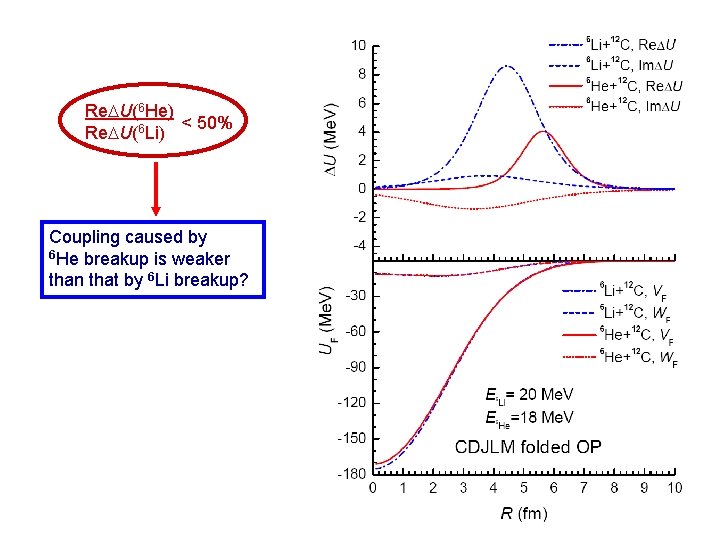
Re. DU(6 He) < 50% Re. DU(6 Li) Coupling caused by 6 He breakup is weaker than that by 6 Li breakup?
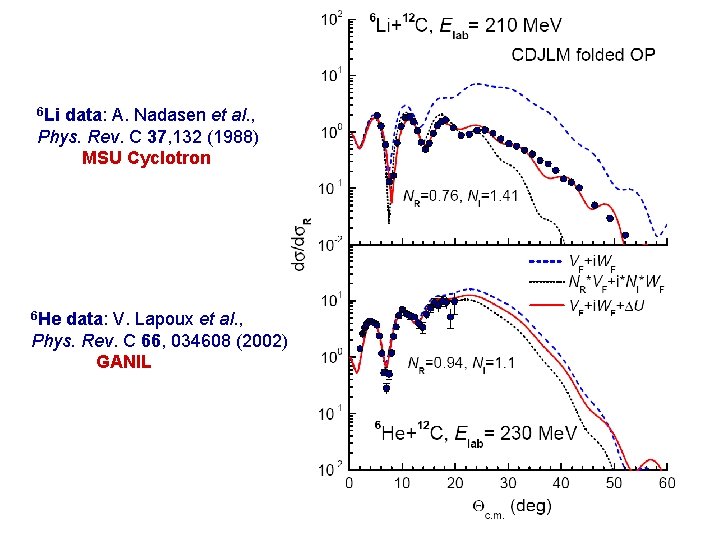
6 Li data: A. Nadasen et al. , Phys. Rev. C 37, 132 (1988) MSU Cyclotron 6 He data: V. Lapoux et al. , Phys. Rev. C 66, 034608 (2002) GANIL
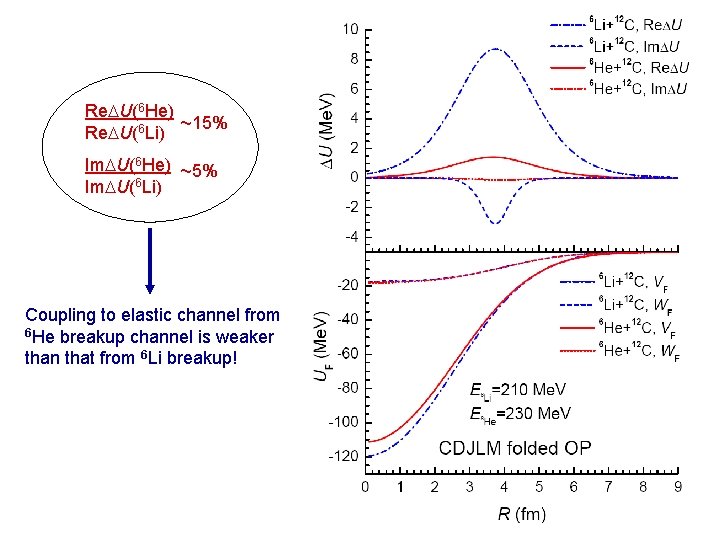
Re. DU(6 He) ~15% Re. DU(6 Li) Im. DU(6 He) ~5% Im. DU(6 Li) Coupling to elastic channel from 6 He breakup channel is weaker than that from 6 Li breakup!
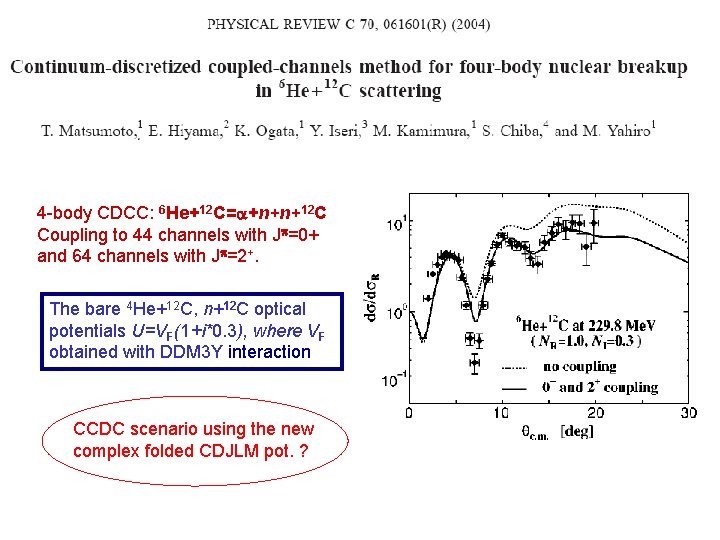
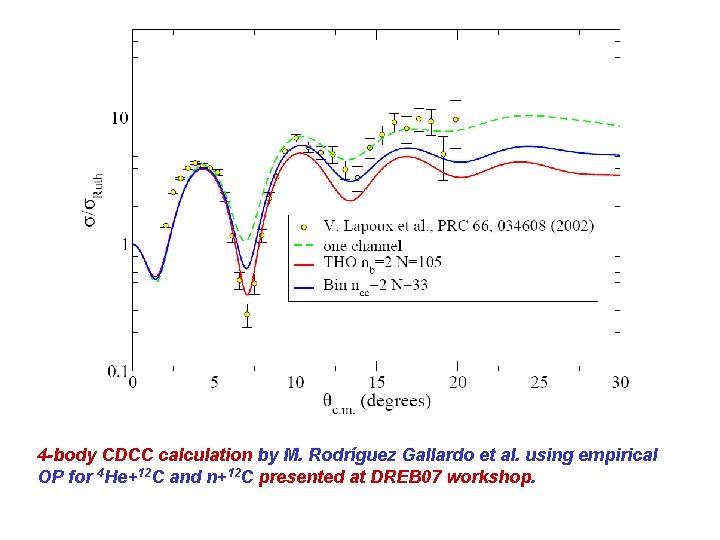
4 -body CDCC: 6 He+12 C=a+n+n+12 C Coupling to 44 channels with Jp=0+ and 64 channels with Jp=2+. The bare 4 He+12 C, n+12 C optical potentials U=VF(1+i*0. 3), where VF obtained with DDM 3 Y interaction CCDC scenario using the new complex folded CDJLM pot. ?
4 -body CDCC calculation by M. Rodríguez Gallardo et al. using empirical OP for 4 He+12 C and n+12 C presented at DREB 07 workshop.
Summary • New representation of the complex G-matrix interaction constructed for the folding calculation of the nucleon-nucleus and nucleus OP. • This bare OP can be used as realistic input in the coupled channels calculation to probe subtle structure effects in a quasi-elastic scattering reaction. • Consistent study of 6 Li and 6 He elastic scattering shows that the back coupling to elastic channel from the 6 He breakup channel is significantly weaker than that caused by 6 Li breakup!