
Meal Service Basic Table Setting Setting the table
Meal Service Basic Table Setting
Setting the table influences: n Appearance of the food served n Sets the tone/feeling of the meal n Makes people feel important
The three components of a place setting are: n Dinnerware - plates, cups, bowls, saucers, platters, and other serving pieces n Flatware – butter, dinner and steak knives; salad/dessert, dinner forks; soup, dessert and teaspoons n Glassware – water goblet, milk and wine glasses, and sherbet glass
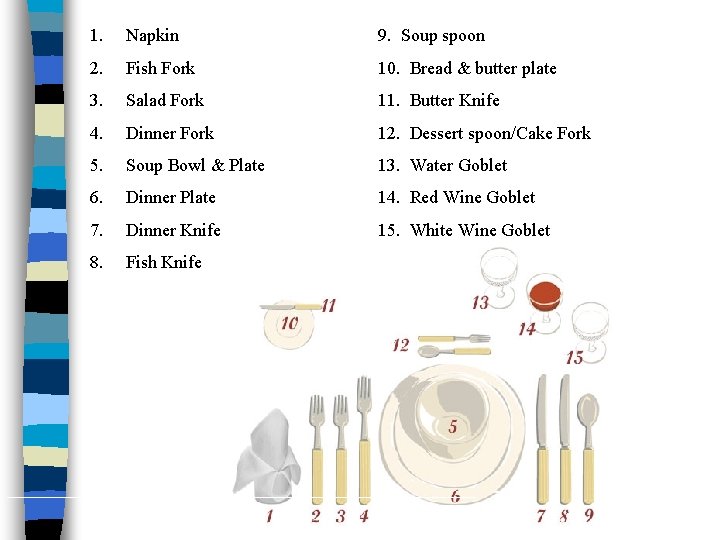
1. Napkin 9. Soup spoon 2. Fish Fork 10. Bread & butter plate 3. Salad Fork 11. Butter Knife 4. Dinner Fork 12. Dessert spoon/Cake Fork 5. Soup Bowl & Plate 13. Water Goblet 6. Dinner Plate 14. Red Wine Goblet 7. Dinner Knife 15. White Wine Goblet 8. Fish Knife
Four Rules in proper flatware placement: n Place items 1 to 1 ½” from the table edge so that handles are lined up and the utensils are even with the plate. n Forks – to the left of the plate n Knives, spoons – to the right of the plate n Arrange flatware in order of use, from outside toward plate
Glassware placement: n Water goblet at the tip of the knife blade n Other beverage glasses at right of goblet and slightly forward in a diagonal. n If glassware contents are cold, serve with saucer to catch moisture condensation.
Placement of Napkin: n Left of the forks n Center of the dinner plate or cover n In the water goblet
Table Etiquette Courtesy shown by good manners at meals. Table manners reflect part of your personality to others; makes eating a pleasant experience for everyone, and shows respect for others.
Common Rules of Etiquette n n n Sit down from the left side of your chair Assist with passing of foods when appropriate, pass to the RIGHT Use flatware from the outside in Place napkin on your lap before starting to eat, use it to cover your mouth and nose if you sneeze If you leave the table and return during a meal, place the napkin on your chair Place your napkin to the left of the plate when finished with the meal
Common Rules of Etiquette n Wait until everyone is served n Follow actions of host/hostess as a guide when dining in someone’s home n Avoid talking with food in your mouth; chew with your mouth closed n Cut food into pieces as you eat n Sit up straight; avoid leaning on elbows while eating
Common Rules of Etiquette Place spoon on soup plate rather than the bowl/cup when finished eating n Place the knife and fork on the plate with the handles parallel to the edge of the table when finished eating n Break one piece of bread/roll and butter one piece at a time n Place butter on your own plate before buttering your bread/roll n
Tipping n n n Average: 15 percent (more if service was exceptionally good) Fancy restaurants: 20 percent Coffee shops: no less than 25 cents if just a beverage was ordered; if food is ordered, 15 percent of the bill Buffet – type restaurant: 10 percent if a server filled water glasses, brought beverages, and cleared table Fast – food restaurants: no tip required
Tipping n When paying for a meal in cash, leave the money, including the tip, on the table or in the tray on which the check was presented. n If you use a credit card, the server will process the card and hand you the credit card slip
Figure out these tips: 1. $13. 00 at a fancy restaurant 2. $9. 50 at an average restaurant 3. A $3. 00 large coffee at a coffee shop 4. $12. 59 at a buffet – type restaurant 5. $5. 75 at a fast food restaurant 6. $14. 47 at a fancy restaurant 7. A $4. 50 sandwich at a coffee shop 8. $10. 28 at an average restaurant 9. $25. 44 at a fancy restaurant 10. $11. 68 at an average restaurant
- Slides: 14