
MEAL PLANNING FOR DIFFERENT CATEGORIES Meal Planning Definition


- Slides: 37
MEAL PLANNING FOR DIFFERENT CATEGORIES
Meal Planning Definition: Meal planning or menu planning is defined as a simple process which involves application of knowledge of food, nutrients, food habits and like and dislike to plan wholesome and attractive meals
Aims of menu planning To fasten the recovery of the patient To plan meals within the food cost To provide variety of the food To save money, time and energy To improve the quality of food To improve the appetite so that maximum diet is consumed and wastage is minimized
Principles of menu planning It should be based on disease condition of the patient It should meet the nutritional requirement It must full feel the family needs Planning should save the time and energy Economic consideration Menu planning should give maximum nutrients Consideration of individual likes and dislikes Menu planning should provide variety Food habits Seasonal avaibility Psychological aspect
The meal schedule It should be recommended that the daily requirement of all nutrients should be arranged in three meals It is essential that a combination of three meals provide a selection of food which will most nearly suit the needs, preference, habits and activity of all family members Breakfast: Basic breakfast should provide more than 25% of the daily requirment It consist of fruits, cereals, milk, bread, eggs
Continue……. Lunch: Lunch is lighter meal than dinner, although food include are same as for dinner Dinner: The dinner menu should be made after plan for breakfast and lunch are complete This is an excellent opportunity to include foods needed in used in the other two meals. This meal should be satisfying and nutrition
Budgeting of food Expenditure on food is an important and often largest part of the family’s budget. Higher budget on will go on protective foods like milk, vegetables and fruits One must plan the expenditure of food and buy wisely so maximum nutrition can be achieved by money spent For example as a source of protein pulses are cheaper than animal food The fruits and vegetables are relatively cheater in season and available in bulk Economy in food purchasing can be exercised in good measure by bulk purchase of foods, especially staples like cereals and pulses
Factors to be considered while budgeting of food Number of family members Family’s income The location of market Alternative marketing choice Home prepared and convenient food Snacks items and beverages Availability of supplementary programs where income is limited
Nutrition requirement for different categories of people Infants- up to 1 year Toddler- 1 -3 years Preschoolers- 4 -6 years School age children- 6 -12 years Adolescents- 13 -18 years Adults Old age- 60 and above 60 years
NUTRITION REQUIREMENT FOR INFANTS
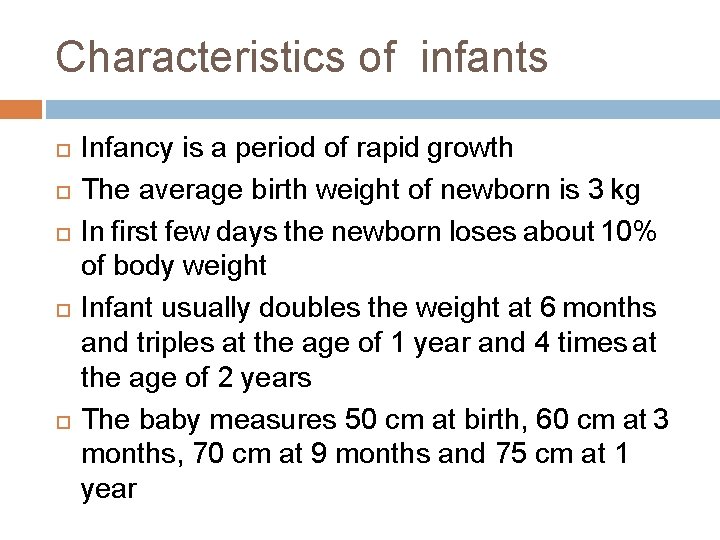
Characteristics of infants Infancy is a period of rapid growth The average birth weight of newborn is 3 kg In first few days the newborn loses about 10% of body weight Infant usually doubles the weight at 6 months and triples at the age of 1 year and 4 times at the age of 2 years The baby measures 50 cm at birth, 60 cm at 3 months, 70 cm at 9 months and 75 cm at 1 year
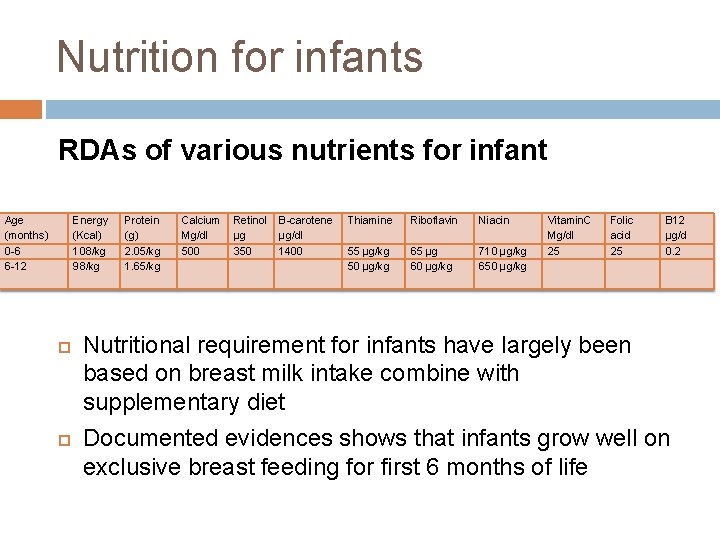
Nutrition for infants RDAs of various nutrients for infant Age (months) 0 -6 6 -12 Energy (Kcal) 108/kg 98/kg Protein (g) 2. 05/kg 1. 65/kg Calcium Mg/dl 500 Retinol µg 350 Β-carotene µg/dl 1400 Thiamine Riboflavin Niacin 55 µg/kg 50 µg/kg 65 µg 60 µg/kg 710 µg/kg 650 µg/kg Vitamin. C Mg/dl 25 Folic acid 25 B 12 µg/d 0. 2 Nutritional requirement for infants have largely been based on breast milk intake combine with supplementary diet Documented evidences shows that infants grow well on exclusive breast feeding for first 6 months of life
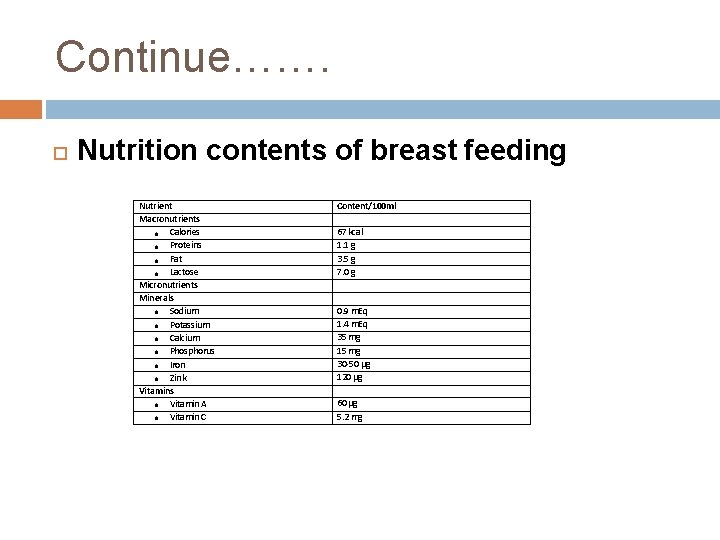
Continue……. Nutrition contents of breast feeding Nutrient Macronutrients Calories Proteins Fat Lactose Micronutrients Minerals Sodium Potassium Calcium Phosphorus Iron Zink Vitamins Vitamin A Vitamin C Content/100 ml 67 kcal 1. 1 g 3. 5 g 7. 0 g 0. 9 m. Eq 1. 4 m. Eq 35 mg 15 mg 30 -50 µg 120 µg 60 µg 5. 2 mg
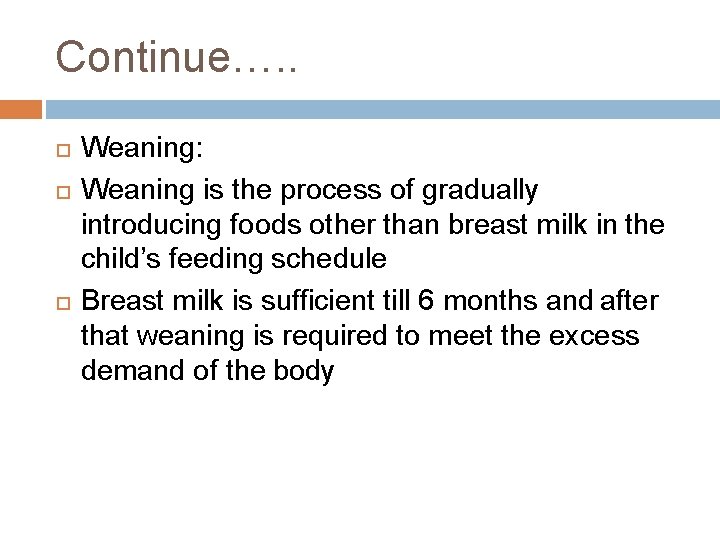
Continue…. . Weaning: Weaning is the process of gradually introducing foods other than breast milk in the child’s feeding schedule Breast milk is sufficient till 6 months and after that weaning is required to meet the excess demand of the body
NUTRITION REQUIREMENT FOR TODDLER AND PRESCHOOL GOING CHILDREN
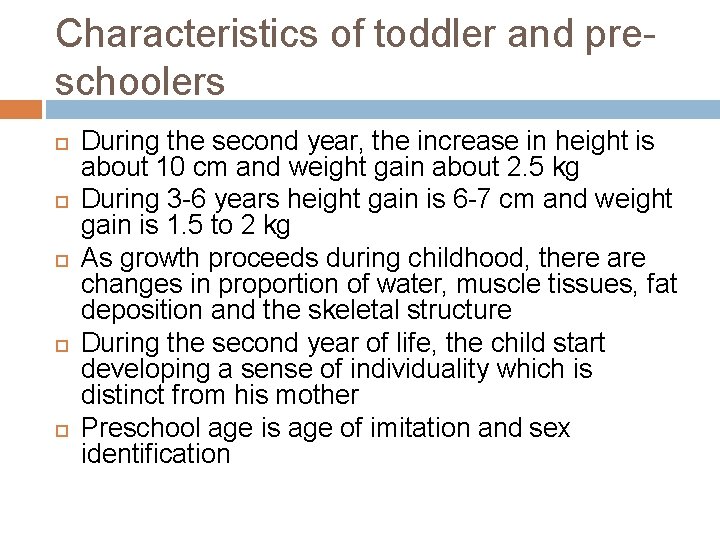
Characteristics of toddler and preschoolers During the second year, the increase in height is about 10 cm and weight gain about 2. 5 kg During 3 -6 years height gain is 6 -7 cm and weight gain is 1. 5 to 2 kg As growth proceeds during childhood, there are changes in proportion of water, muscle tissues, fat deposition and the skeletal structure During the second year of life, the child start developing a sense of individuality which is distinct from his mother Preschool age is age of imitation and sex identification
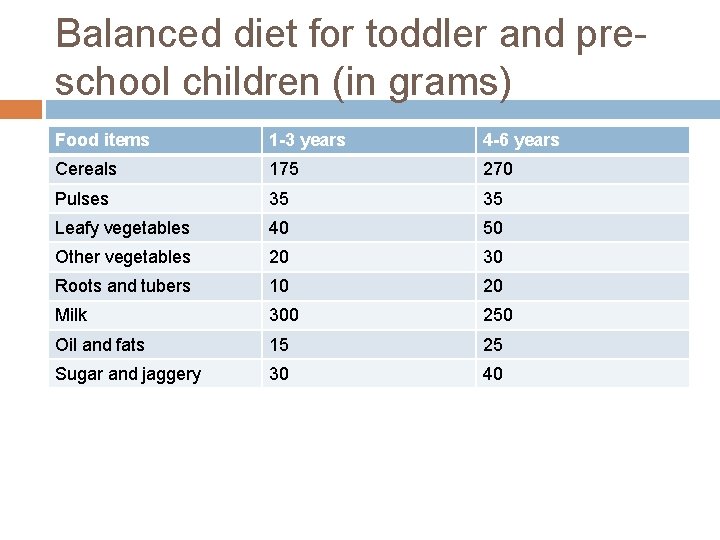
Balanced diet for toddler and preschool children (in grams) Food items 1 -3 years 4 -6 years Cereals 175 270 Pulses 35 35 Leafy vegetables 40 50 Other vegetables 20 30 Roots and tubers 10 20 Milk 300 250 Oil and fats 15 25 Sugar and jaggery 30 40
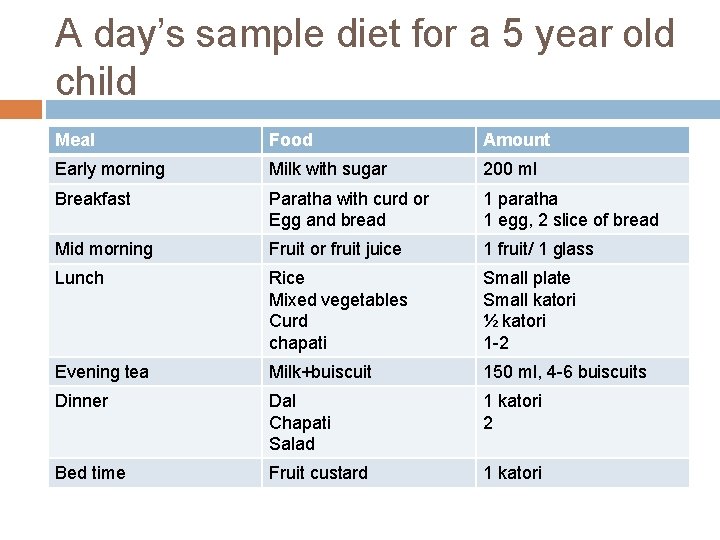
A day’s sample diet for a 5 year old child Meal Food Amount Early morning Milk with sugar 200 ml Breakfast Paratha with curd or Egg and bread 1 paratha 1 egg, 2 slice of bread Mid morning Fruit or fruit juice 1 fruit/ 1 glass Lunch Rice Mixed vegetables Curd chapati Small plate Small katori ½ katori 1 -2 Evening tea Milk+buiscuit 150 ml, 4 -6 buiscuits Dinner Dal Chapati Salad 1 katori 2 Bed time Fruit custard 1 katori
NUTRITIONAL REQUIREMENT FOR SCHOOL GOING CHILDREN
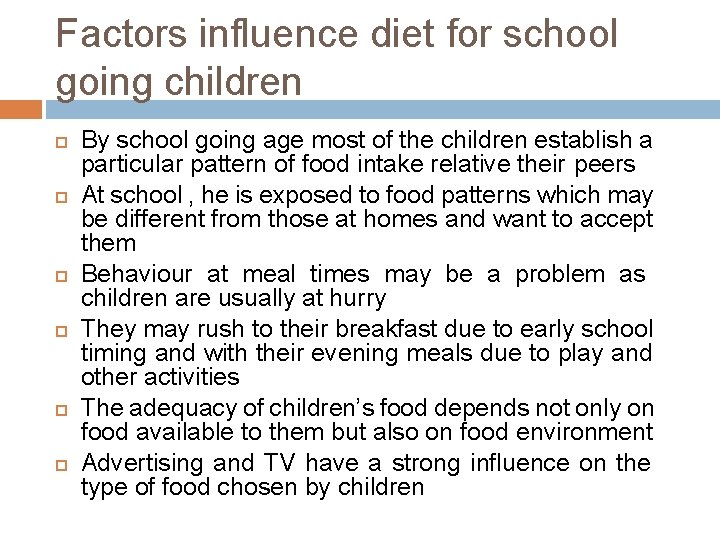
Factors influence diet for school going children By school going age most of the children establish a particular pattern of food intake relative their peers At school , he is exposed to food patterns which may be different from those at homes and want to accept them Behaviour at meal times may be a problem as children are usually at hurry They may rush to their breakfast due to early school timing and with their evening meals due to play and other activities The adequacy of children’s food depends not only on food available to them but also on food environment Advertising and TV have a strong influence on the type of food chosen by children
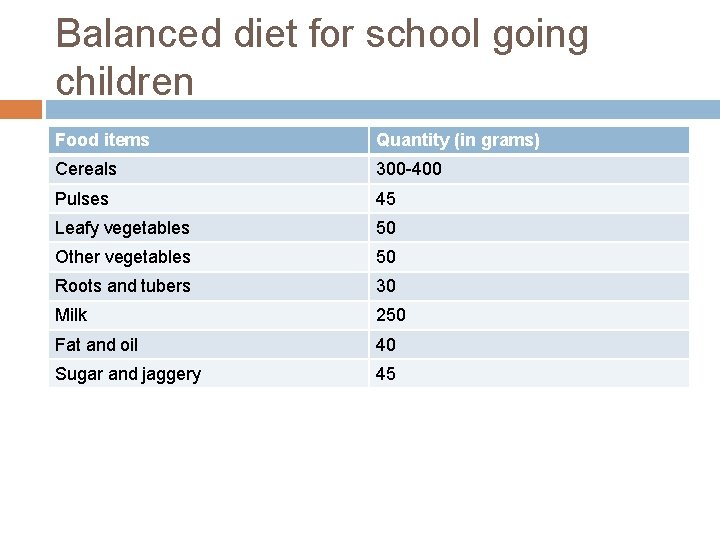
Balanced diet for school going children Food items Quantity (in grams) Cereals 300 -400 Pulses 45 Leafy vegetables 50 Other vegetables 50 Roots and tubers 30 Milk 250 Fat and oil 40 Sugar and jaggery 45
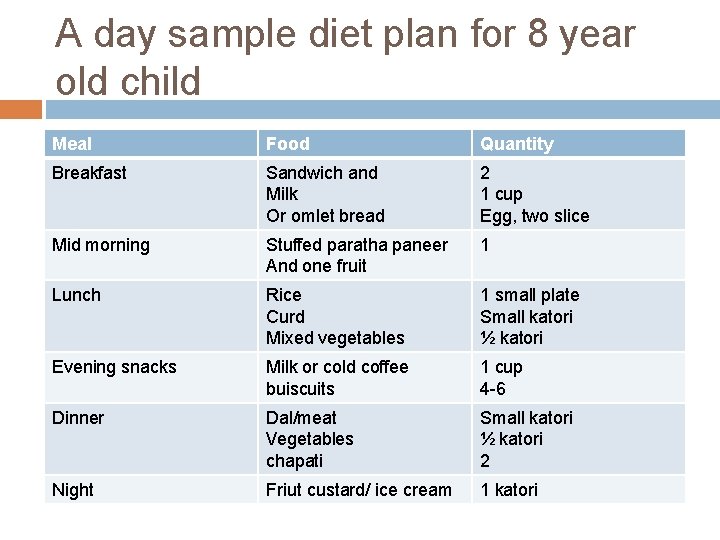
A day sample diet plan for 8 year old child Meal Food Quantity Breakfast Sandwich and Milk Or omlet bread 2 1 cup Egg, two slice Mid morning Stuffed paratha paneer And one fruit 1 Lunch Rice Curd Mixed vegetables 1 small plate Small katori ½ katori Evening snacks Milk or cold coffee buiscuits 1 cup 4 -6 Dinner Dal/meat Vegetables chapati Small katori ½ katori 2 Night Friut custard/ ice cream 1 katori
NUTRITIONAL REQUIREMENT FOR ADOLESCENCE
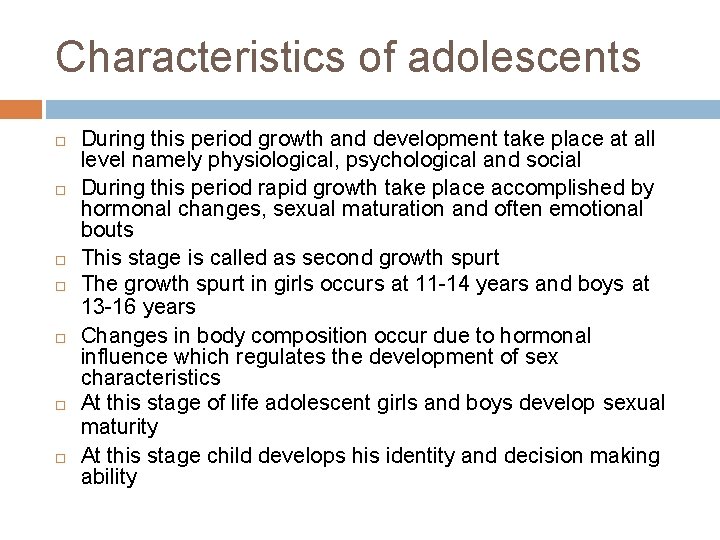
Characteristics of adolescents During this period growth and development take place at all level namely physiological, psychological and social During this period rapid growth take place accomplished by hormonal changes, sexual maturation and often emotional bouts This stage is called as second growth spurt The growth spurt in girls occurs at 11 -14 years and boys at 13 -16 years Changes in body composition occur due to hormonal influence which regulates the development of sex characteristics At this stage of life adolescent girls and boys develop sexual maturity At this stage child develops his identity and decision making ability
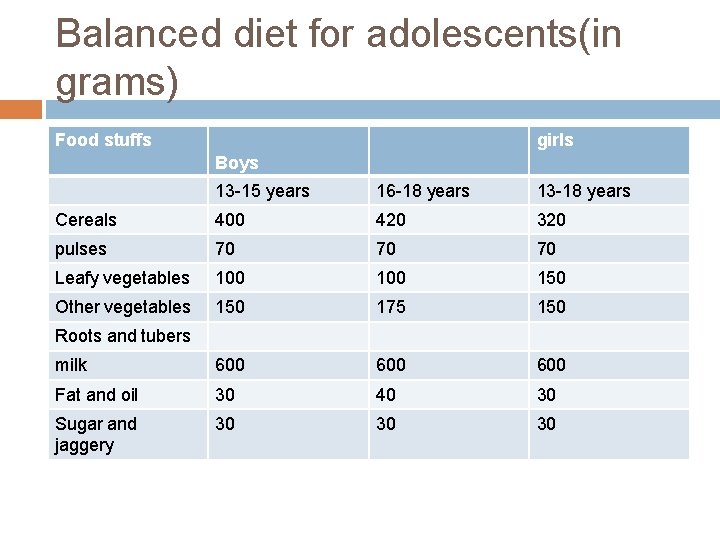
Balanced diet for adolescents(in grams) Food stuffs girls Boys 13 -15 years 16 -18 years 13 -18 years Cereals 400 420 320 pulses 70 70 70 Leafy vegetables 100 150 Other vegetables 150 175 150 milk 600 600 Fat and oil 30 40 30 Sugar and jaggery 30 30 30 Roots and tubers
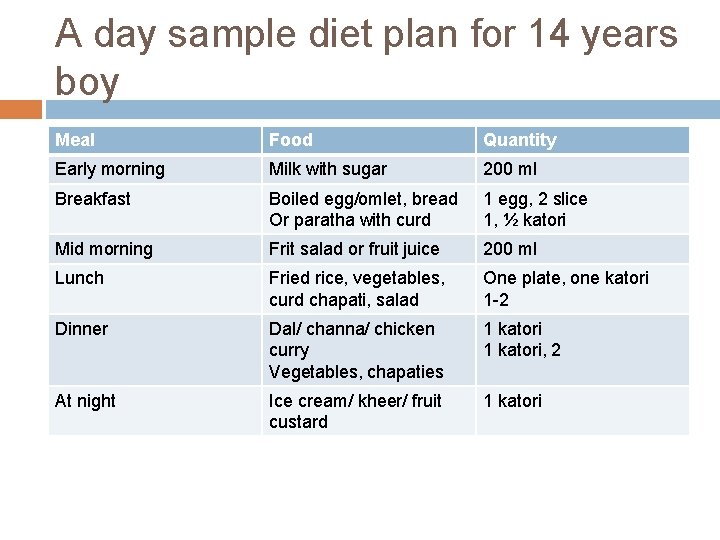
A day sample diet plan for 14 years boy Meal Food Quantity Early morning Milk with sugar 200 ml Breakfast Boiled egg/omlet, bread Or paratha with curd 1 egg, 2 slice 1, ½ katori Mid morning Frit salad or fruit juice 200 ml Lunch Fried rice, vegetables, curd chapati, salad One plate, one katori 1 -2 Dinner Dal/ channa/ chicken curry Vegetables, chapaties 1 katori, 2 At night Ice cream/ kheer/ fruit custard 1 katori
NUTRITION FOR ADULTHOOD
Characteristics of adulthood By this stage the body growth particularly in terms of height and weight stops to a certain extent but the breakdown and repair of body tissues goes on. Proper nutrition in adulthood ensures good health in old age Various factors like age, sex, climate, activity, body growth, stress affect our body need for different nutrients
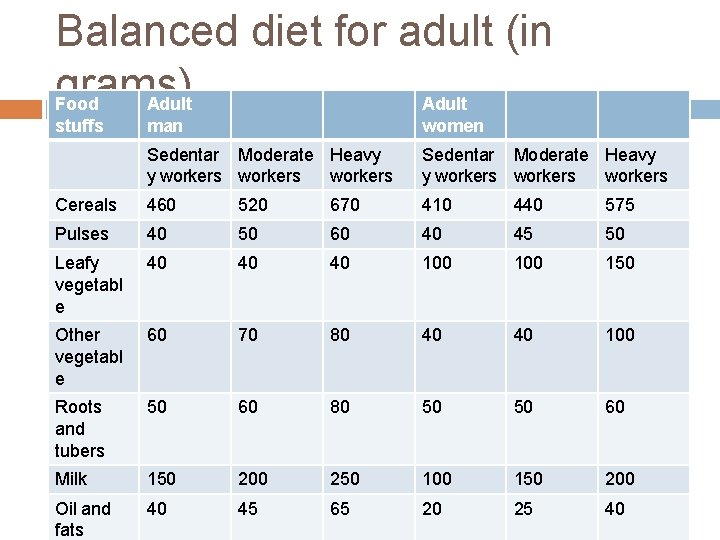
Balanced diet for adult (in grams) Food Adult stuffs man women Sedentar Moderate Heavy y workers workers Cereals 460 520 670 410 440 575 Pulses 40 50 60 40 45 50 Leafy vegetabl e 40 40 40 100 150 Other vegetabl e 60 70 80 40 40 100 Roots and tubers 50 60 80 50 50 60 Milk 150 200 250 100 150 200 Oil and fats 40 45 65 20 25 40
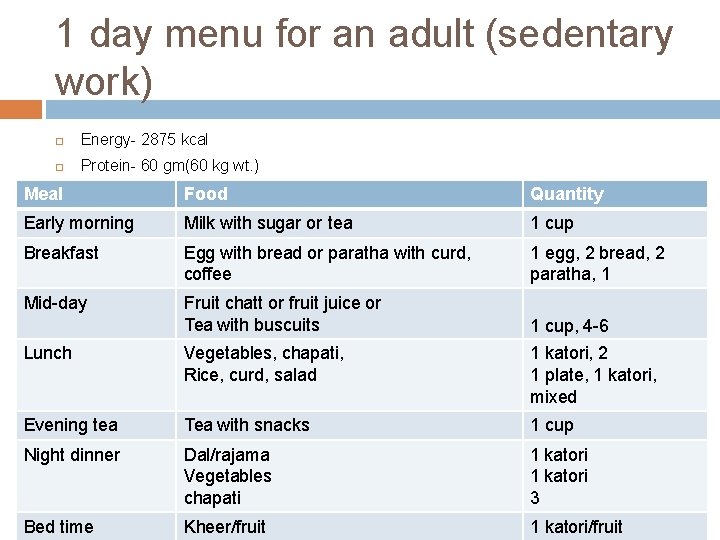
1 day menu for an adult (sedentary work) Energy- 2875 kcal Protein- 60 gm(60 kg wt. ) Meal Food Quantity Early morning Milk with sugar or tea 1 cup Breakfast Egg with bread or paratha with curd, coffee 1 egg, 2 bread, 2 paratha, 1 Mid-day Fruit chatt or fruit juice or Tea with buscuits 1 cup, 4 -6 Lunch Vegetables, chapati, Rice, curd, salad 1 katori, 2 1 plate, 1 katori, mixed Evening tea Tea with snacks 1 cup Night dinner Dal/rajama Vegetables chapati 1 katori 3 Bed time Kheer/fruit 1 katori/fruit
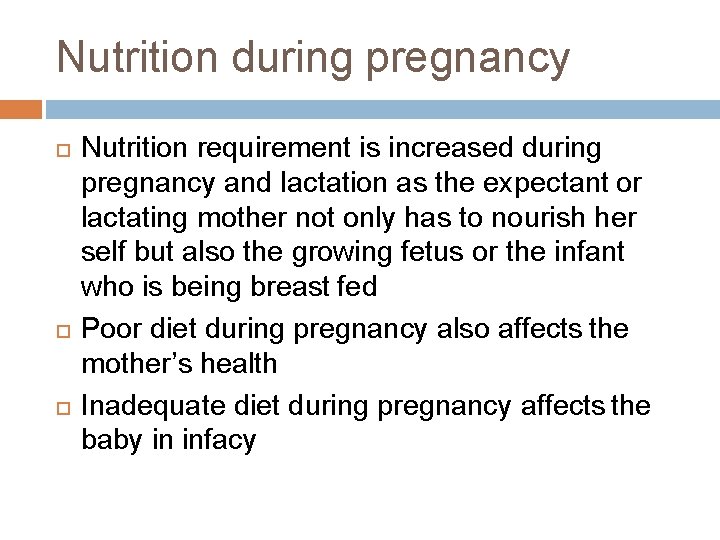
Nutrition during pregnancy Nutrition requirement is increased during pregnancy and lactation as the expectant or lactating mother not only has to nourish her self but also the growing fetus or the infant who is being breast fed Poor diet during pregnancy also affects the mother’s health Inadequate diet during pregnancy affects the baby in infacy
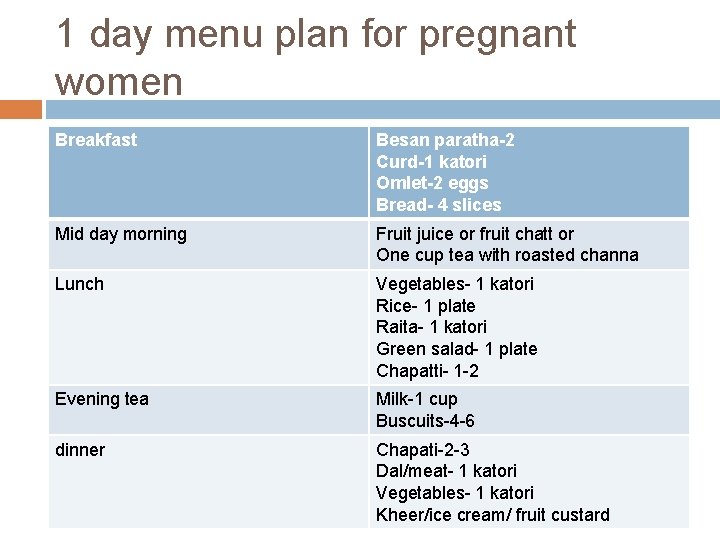
1 day menu plan for pregnant women Breakfast Besan paratha-2 Curd-1 katori Omlet-2 eggs Bread- 4 slices Mid day morning Fruit juice or fruit chatt or One cup tea with roasted channa Lunch Vegetables- 1 katori Rice- 1 plate Raita- 1 katori Green salad- 1 plate Chapatti- 1 -2 Evening tea Milk-1 cup Buscuits-4 -6 dinner Chapati-2 -3 Dal/meat- 1 katori Vegetables- 1 katori Kheer/ice cream/ fruit custard
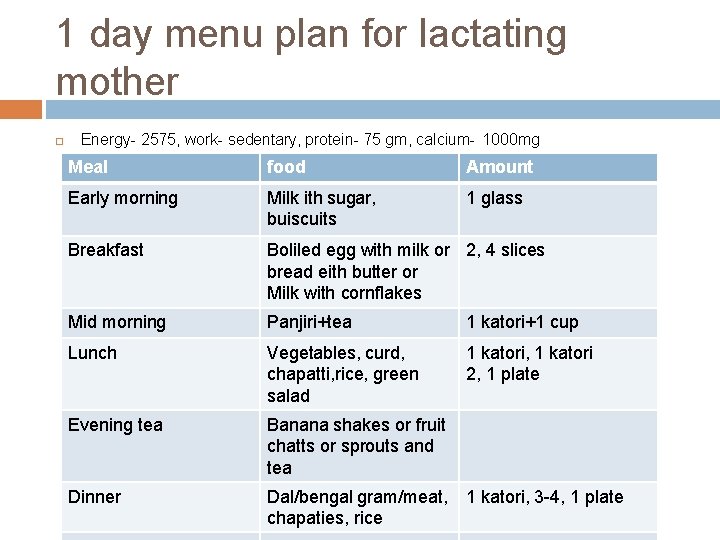
1 day menu plan for lactating mother Energy- 2575, work- sedentary, protein- 75 gm, calcium- 1000 mg Meal food Amount Early morning Milk ith sugar, buiscuits 1 glass Breakfast Boliled egg with milk or 2, 4 slices bread eith butter or Milk with cornflakes Mid morning Panjiri+tea 1 katori+1 cup Lunch Vegetables, curd, chapatti, rice, green salad 1 katori, 1 katori 2, 1 plate Evening tea Banana shakes or fruit chatts or sprouts and tea Dinner Dal/bengal gram/meat, chapaties, rice 1 katori, 3 -4, 1 plate
NUTRITION FOR AGED PEOPLE
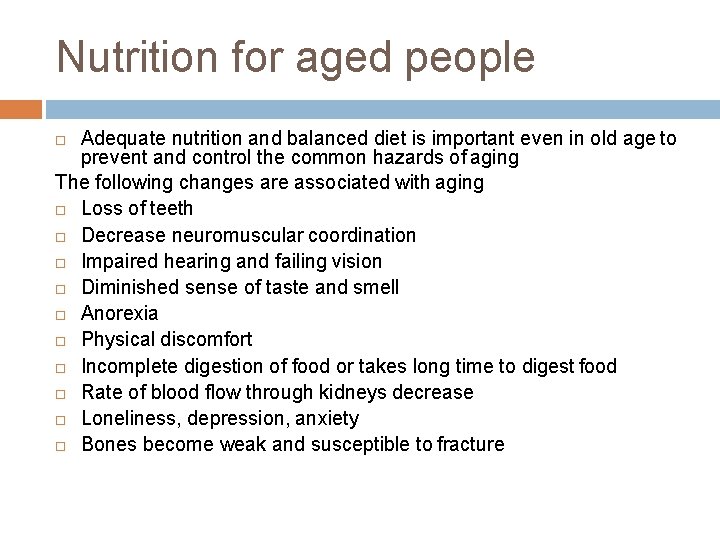
Nutrition for aged people Adequate nutrition and balanced diet is important even in old age to prevent and control the common hazards of aging The following changes are associated with aging Loss of teeth Decrease neuromuscular coordination Impaired hearing and failing vision Diminished sense of taste and smell Anorexia Physical discomfort Incomplete digestion of food or takes long time to digest food Rate of blood flow through kidneys decrease Loneliness, depression, anxiety Bones become weak and susceptible to fracture
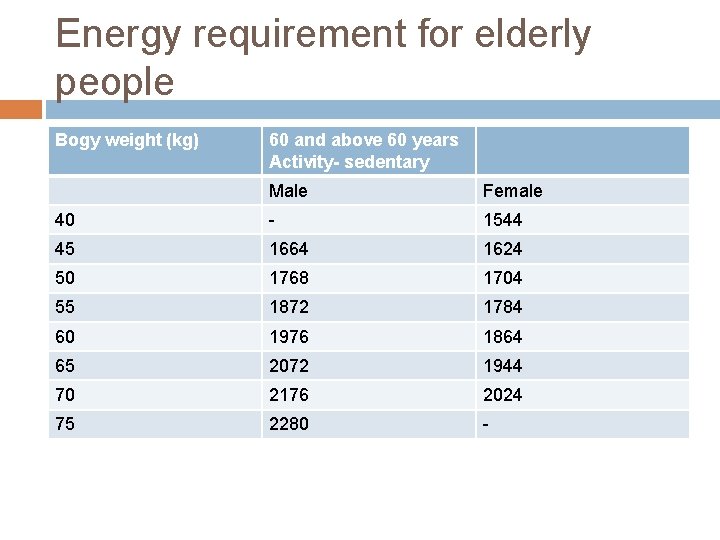
Energy requirement for elderly people Bogy weight (kg) 60 and above 60 years Activity- sedentary Male Female 40 - 1544 45 1664 1624 50 1768 1704 55 1872 1784 60 1976 1864 65 2072 1944 70 2176 2024 75 2280 -
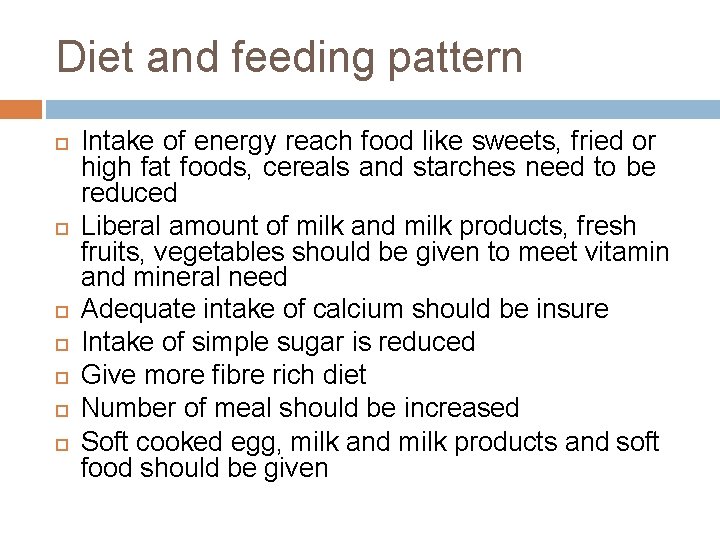
Diet and feeding pattern Intake of energy reach food like sweets, fried or high fat foods, cereals and starches need to be reduced Liberal amount of milk and milk products, fresh fruits, vegetables should be given to meet vitamin and mineral need Adequate intake of calcium should be insure Intake of simple sugar is reduced Give more fibre rich diet Number of meal should be increased Soft cooked egg, milk and milk products and soft food should be given