
Me tac ycl oge nes is The life
- Slides: 8
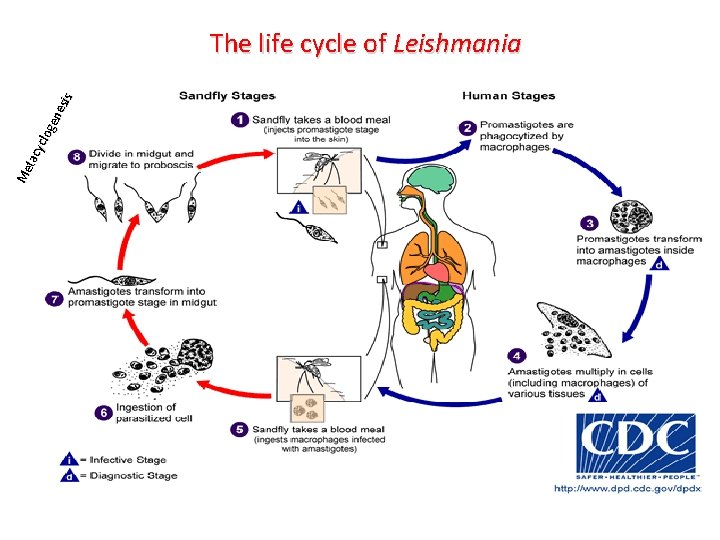
Me tac ycl oge nes is The life cycle of Leishmania
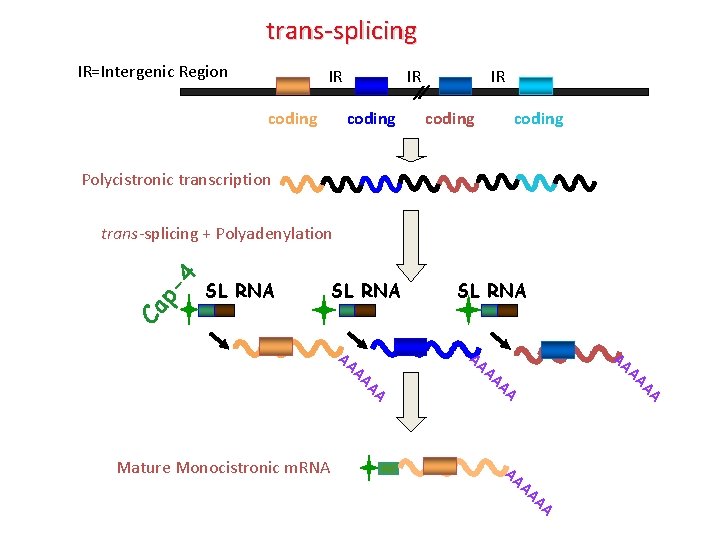
trans-splicing IR=Intergenic Region IR coding Polycistronic transcription SL RNA Ca p- 4 trans-splicing + Polyadenylation A A A A A Mature Monocistronic m. RNA A A
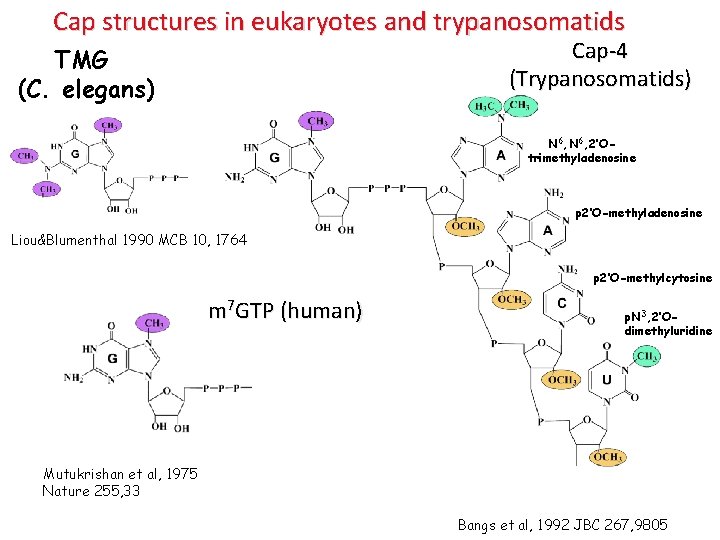
Cap structures in eukaryotes and trypanosomatids Cap-4 (Trypanosomatids) TMG (C. elegans) N 6, 2’Otrimethyladenosine p 2’O-methyladenosine Liou&Blumenthal 1990 MCB 10, 1764 p 2’O-methylcytosine m 7 GTP (human) p. N 3, 2’Odimethyluridine Mutukrishan et al, 1975 Nature 255, 33 Bangs et al, 1992 JBC 267, 9805
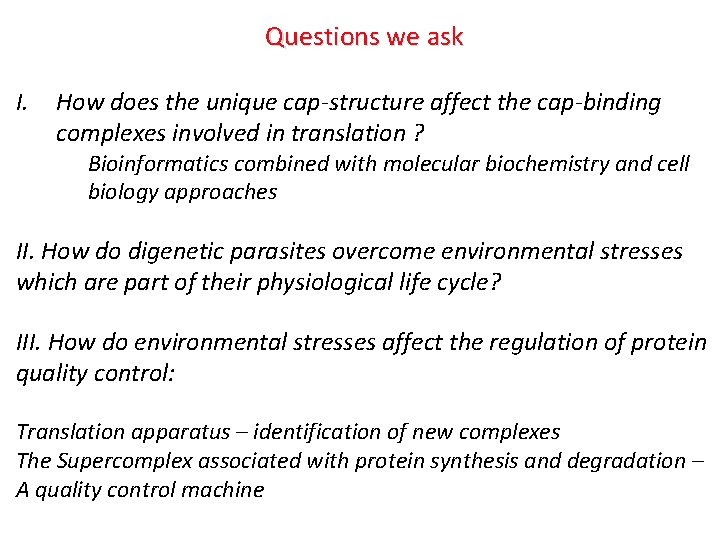
Questions we ask I. How does the unique cap-structure affect the cap-binding complexes involved in translation ? Bioinformatics combined with molecular biochemistry and cell biology approaches II. How do digenetic parasites overcome environmental stresses which are part of their physiological life cycle? III. How do environmental stresses affect the regulation of protein quality control: Translation apparatus – identification of new complexes The Supercomplex associated with protein synthesis and degradation – A quality control machine
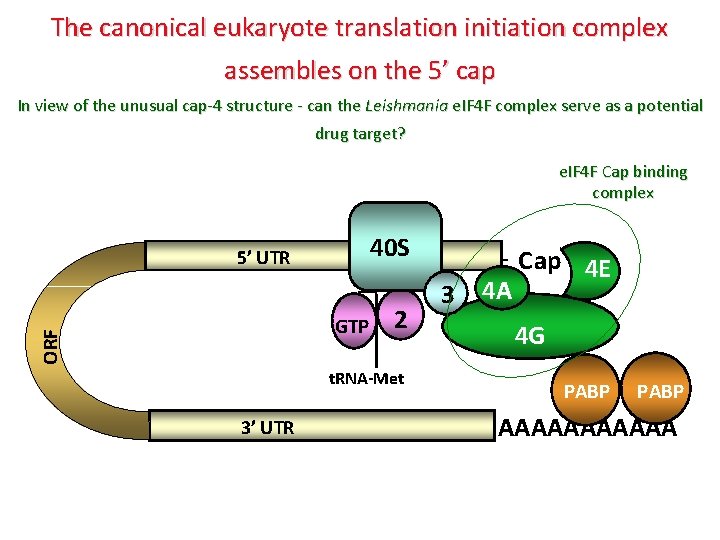
The canonical eukaryote translation initiation complex assembles on the 5’ cap In view of the unusual cap-4 structure - can the Leishmania e. IF 4 F complex serve as a potential drug target? e. IF 4 F Cap binding complex 40 S 5’ UTR ORF GTP 2 t. RNA-Met 3’ UTR - 3 4 A Cap 4 E 4 G PABP AAAAAA
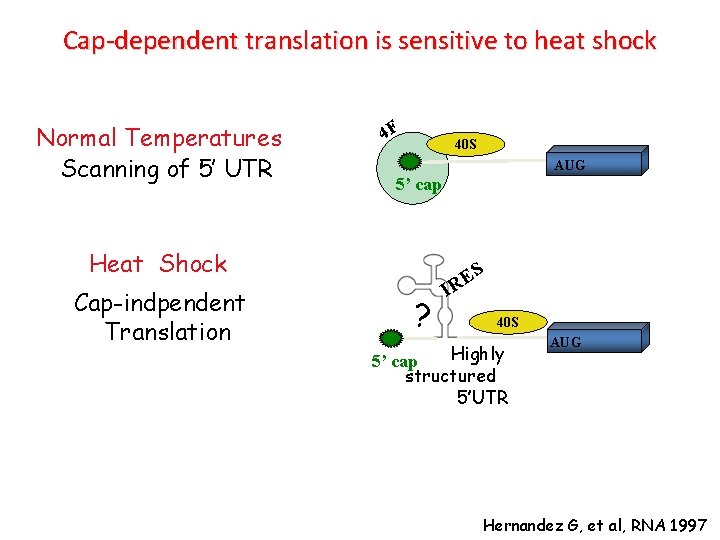
Cap-dependent translation is sensitive to heat shock Normal Temperatures Scanning of 5’ UTR 4 F 40 S AUG 5’ cap Heat Shock Cap-indpendent Translation ? S E IR 40 S Highly 5’ cap structured 5’UTR AUG Hernandez G, et al, RNA 1997
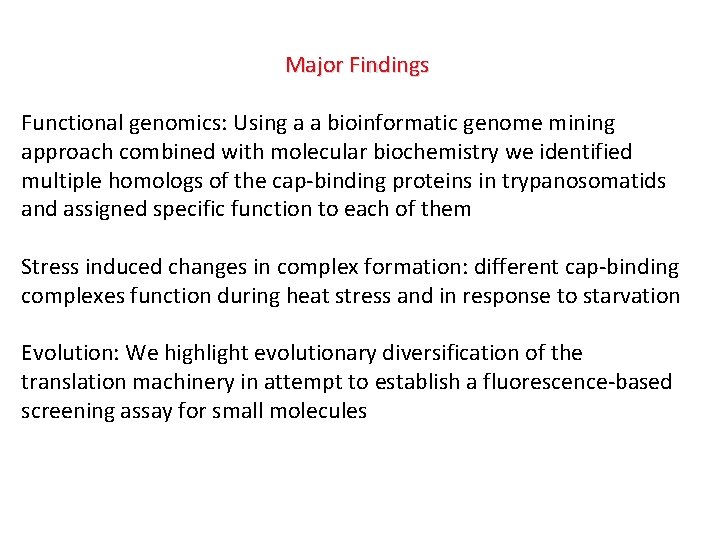
Major Findings Functional genomics: Using a a bioinformatic genome mining approach combined with molecular biochemistry we identified multiple homologs of the cap-binding proteins in trypanosomatids and assigned specific function to each of them Stress induced changes in complex formation: different cap-binding complexes function during heat stress and in response to starvation Evolution: We highlight evolutionary diversification of the translation machinery in attempt to establish a fluorescence-based screening assay for small molecules
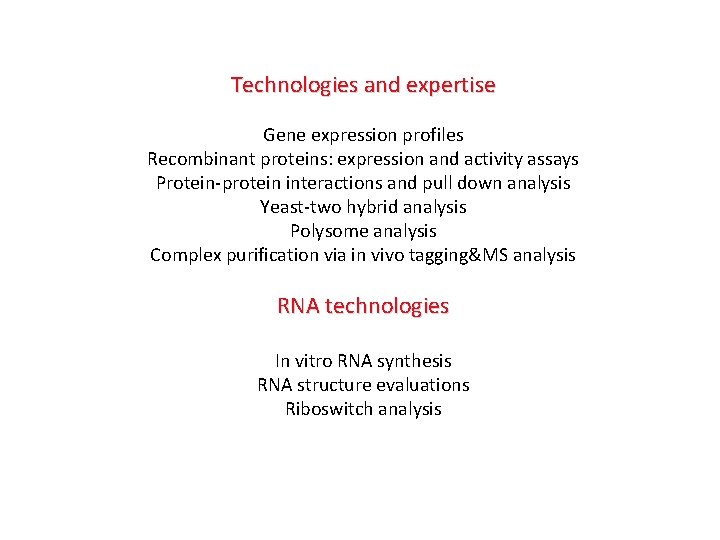
Technologies and expertise Gene expression profiles Recombinant proteins: expression and activity assays Protein-protein interactions and pull down analysis Yeast-two hybrid analysis Polysome analysis Complex purification via in vivo tagging&MS analysis RNA technologies In vitro RNA synthesis RNA structure evaluations Riboswitch analysis