
ME Grammar Noun pronoun adjective Noun n Case

- Slides: 21
ME Grammar Noun, pronoun, adjective
Noun n Case Gender Declension
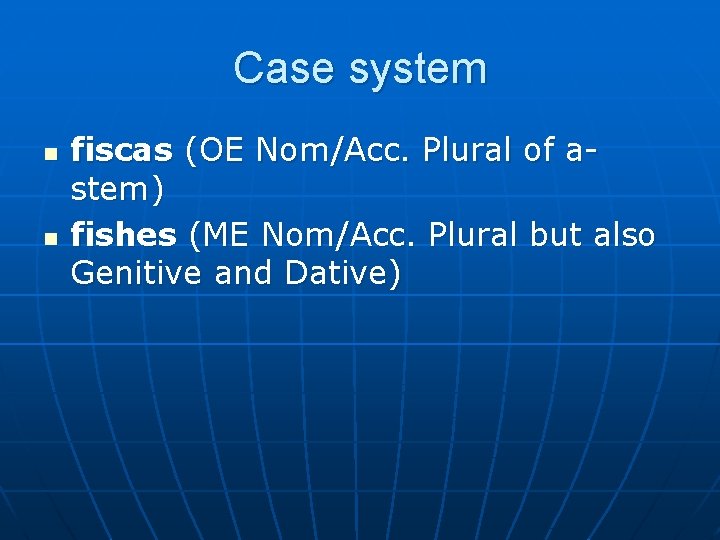
Case system n n fiscas (OE Nom/Acc. Plural of astem) fishes (ME Nom/Acc. Plural but also Genitive and Dative)
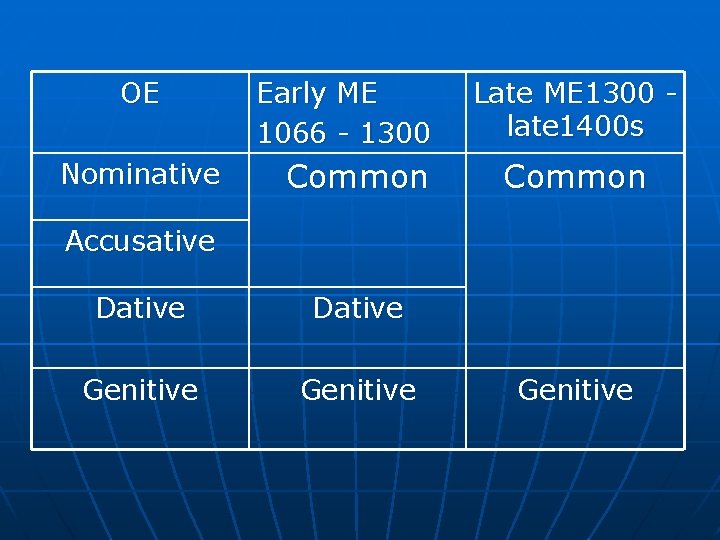
OE Nominative Early ME 1066 - 1300 Common Late ME 1300 late 1400 s Common Accusative Dative Genitive
OE –es ending (a-stem Sing. , Gen. , M/N) n Possessive case: Arthur his men – Arthur’s men n His→ is → - s n
Question on ME phonetics n n Variant 1 1) How did the pronunciation of the following stressed OE vowels change in ME: [ā], [æ: ], [æ], [ü]? Variant 2 1) Which new diphthongs appeared as the result of vocalization of [w, , ’]?
Question on ME phonetics n n Variant 1 2) What was the general tendency in the development of the OE diphthongs? Variant 2 2) How did the spelling of the OE words cēpan, cīld, cumen change?
n n Variant 1 3) In which position did the stressed OE vowels become long in ME? Variant 2 3) In which position did the stressed OE vowels become short in ME?
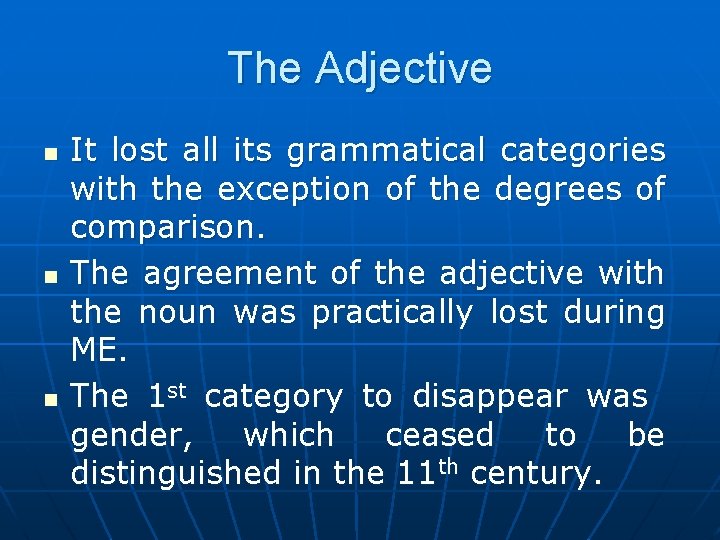
The Adjective n n n It lost all its grammatical categories with the exception of the degrees of comparison. The agreement of the adjective with the noun was practically lost during ME. The 1 st category to disappear was gender, which ceased to be distinguished in the 11 th century.
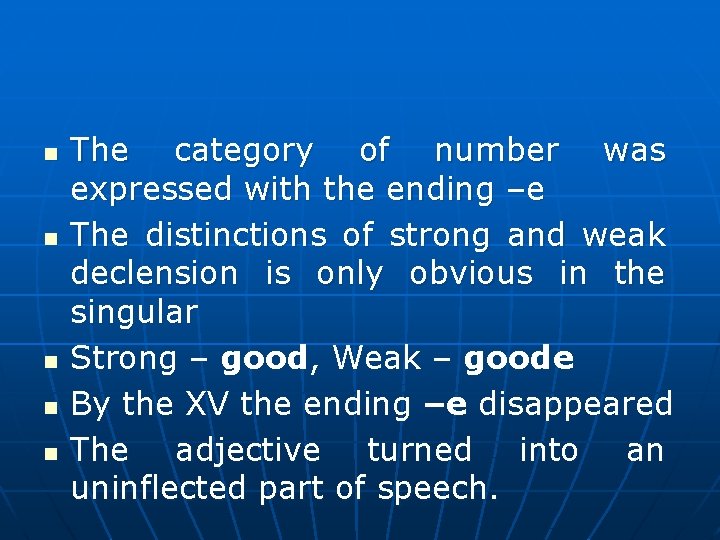
n n n The category of number was expressed with the ending –e The distinctions of strong and weak declension is only obvious in the singular Strong – good, Weak – goode By the XV the ending –e disappeared The adjective turned into an uninflected part of speech.
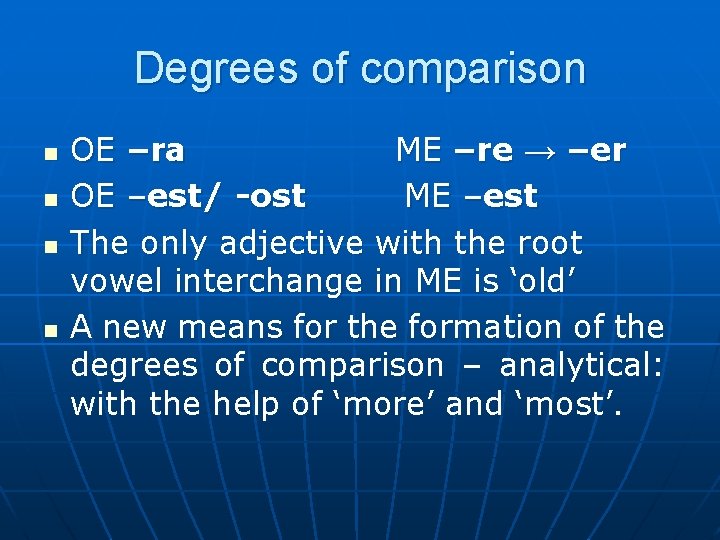
Degrees of comparison n n OE –ra ME –re → –er OE –est/ -ost ME –est The only adjective with the root vowel interchange in ME is ‘old’ A new means for the formation of the degrees of comparison – analytical: with the help of ‘more’ and ‘most’.
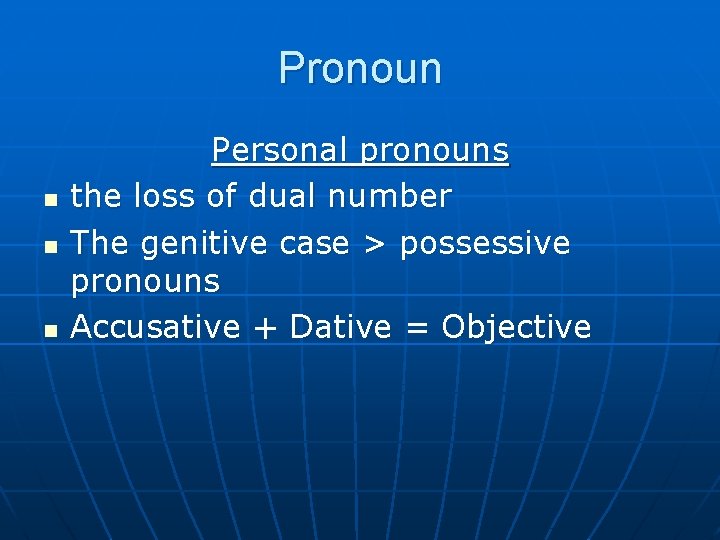
Pronoun n Personal pronouns the loss of dual number The genitive case > possessive pronouns Accusative + Dative = Objective
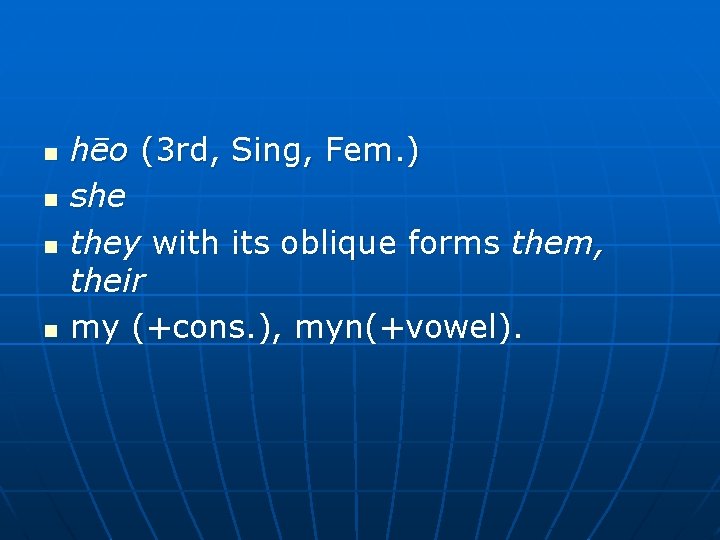
n n hēo (3 rd, Sing, Fem. ) she they with its oblique forms them, their my (+cons. ), myn(+vowel).
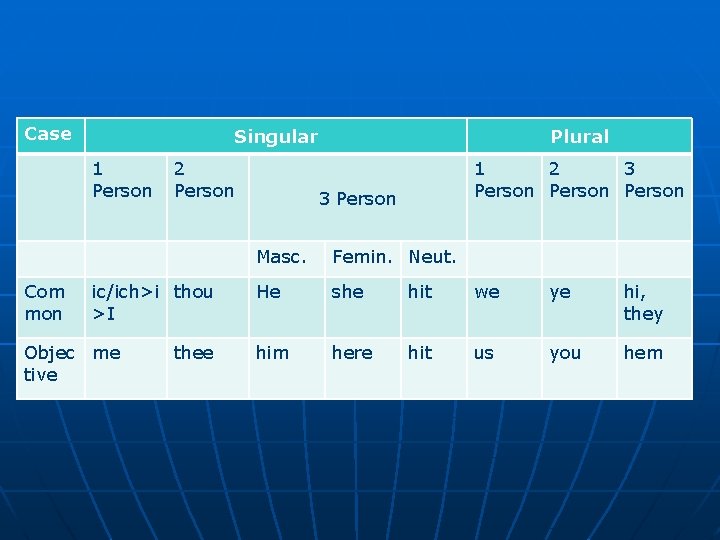
Case Singular 1 Person Com mon 2 Person ic/ich>i thou >I Objec me tive thee Plural 1 2 3 Person 3 Person Masc. Femin. Neut. He she hit we ye hi, they him here hit us you hem
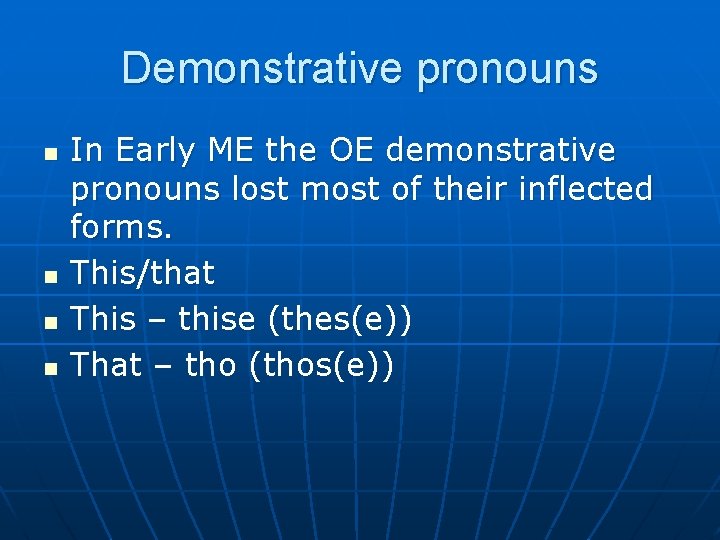
Demonstrative pronouns n n In Early ME the OE demonstrative pronouns lost most of their inflected forms. This/that This – thise (thes(e)) That – tho (thos(e))
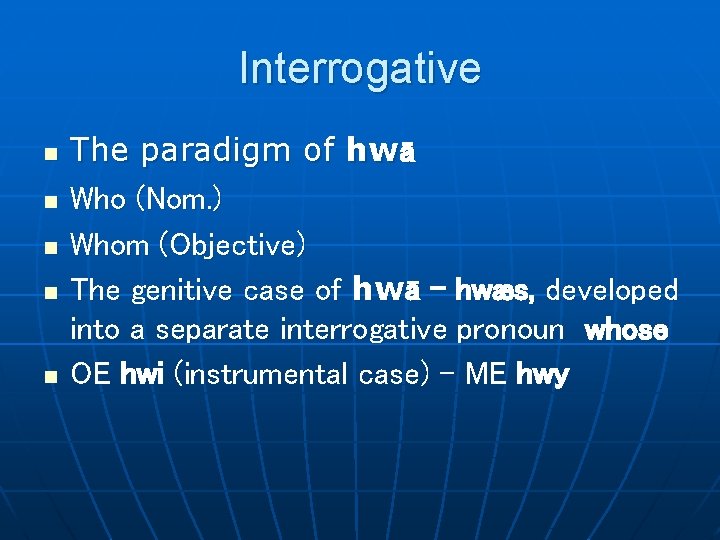
Interrogative n n n The paradigm of hwā Who (Nom. ) Whom (Objective) The genitive case of hwā – hwæs, developed into a separate interrogative pronoun whose OE hwi (instrumental case) – ME hwy
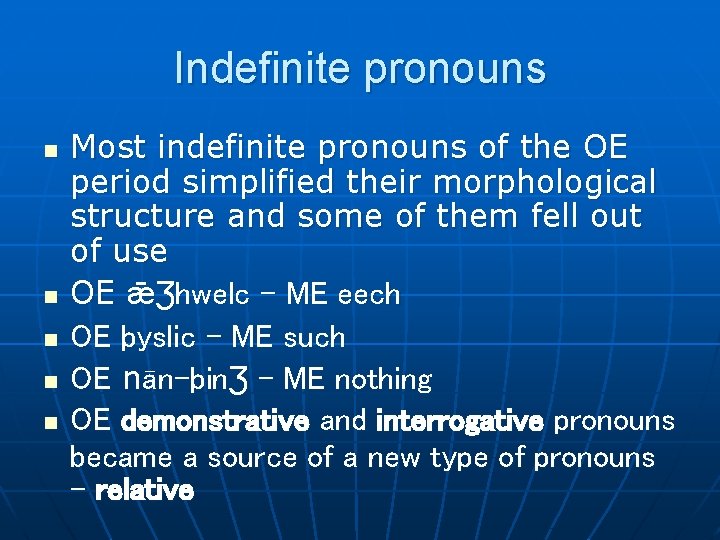
Indefinite pronouns n n n Most indefinite pronouns of the OE period simplified their morphological structure and some of them fell out of use OE ǣƷhwelc – ME eech OE þyslic – ME such OE nān-þinƷ – ME nothing OE demonstrative and interrogative pronouns became a source of a new type of pronouns - relative
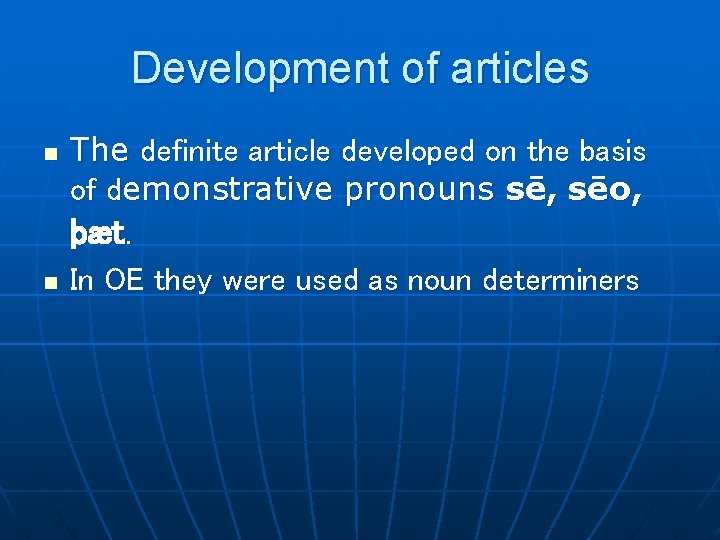
Development of articles n n The definite article developed on the basis of demonstrative pronouns sē, sēo, þæt. In OE they were used as noun determiners
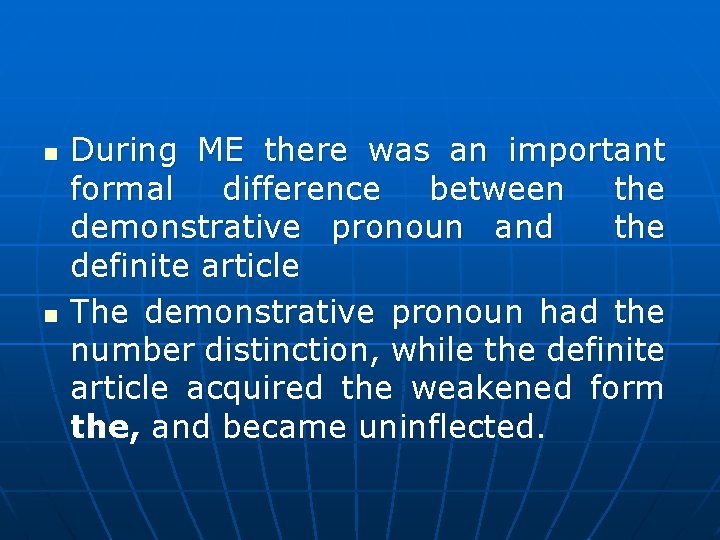
n n During ME there was an important formal difference between the demonstrative pronoun and the definite article The demonstrative pronoun had the number distinction, while the definite article acquired the weakened form the, and became uninflected.
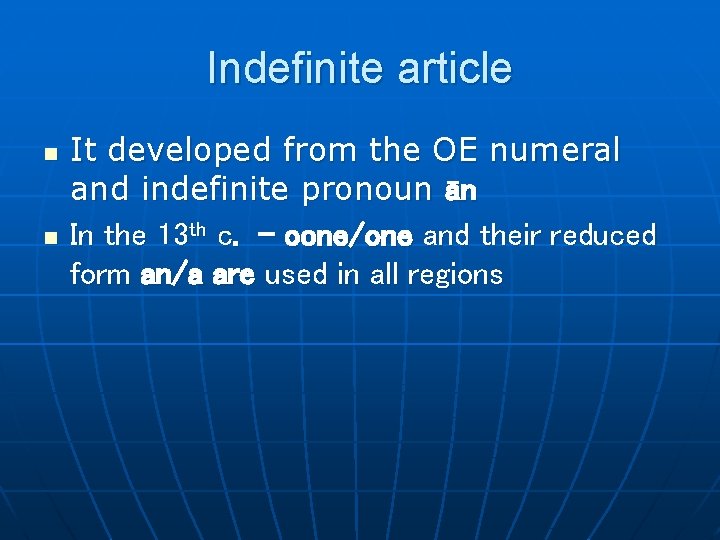
Indefinite article n n It developed from the OE numeral and indefinite pronoun ān In the 13 th c. - oone/one and their reduced form an/a are used in all regions