
ME 59700 Summer 2013 Systems Engineering Part II


- Slides: 98
ME 59700 Summer 2013 Systems Engineering, Part II Session 9 15 July 2013 Mr. Larry Hopp, CPL
Agenda • • Return Homework & Quiz Ch. 13 Task Allocation and Analysis (10 Minutes) Discuss System Safety (45 Minutes) Discuss System Safety (55 Minutes) 2
System Safety • Understand the role of System Safety Engineering within SE and the life cycle of a product. • Understand key principles, definitions, and concepts. • Identifies System Safety activities supporting each phase of a systems life- cycle. • Focus on Hazard Analysis 3
System Safety • MIL-STD 882 E – System Safety Dated 11 May 2012 – Significantly revised from D – Key Element of System Engineering providing a standard, generic method for the Identification, classification and mitigation of hazards. – Protect the environment – Identify hazards and manage risks – Integrate in to the overall system engineering process 4
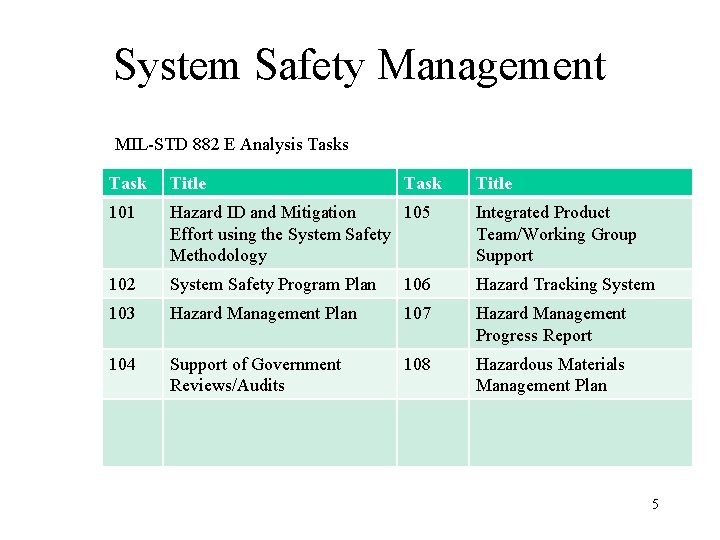
System Safety Management MIL-STD 882 E Analysis Task Title 101 Hazard ID and Mitigation 105 Effort using the System Safety Methodology Integrated Product Team/Working Group Support 102 System Safety Program Plan 106 Hazard Tracking System 103 Hazard Management Plan 107 Hazard Management Progress Report 104 Support of Government Reviews/Audits 108 Hazardous Materials Management Plan 5
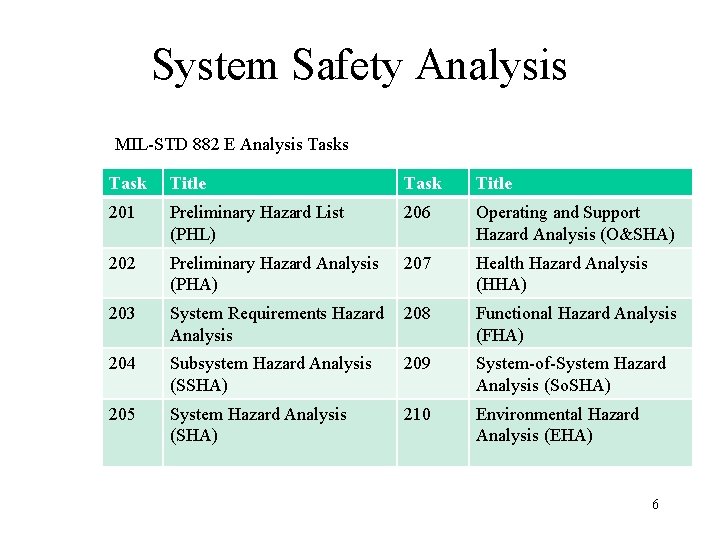
System Safety Analysis MIL-STD 882 E Analysis Task Title 201 Preliminary Hazard List (PHL) 206 Operating and Support Hazard Analysis (O&SHA) 202 Preliminary Hazard Analysis (PHA) 207 Health Hazard Analysis (HHA) 203 System Requirements Hazard Analysis 208 Functional Hazard Analysis (FHA) 204 Subsystem Hazard Analysis (SSHA) 209 System-of-System Hazard Analysis (So. SHA) 205 System Hazard Analysis (SHA) 210 Environmental Hazard Analysis (EHA) 6
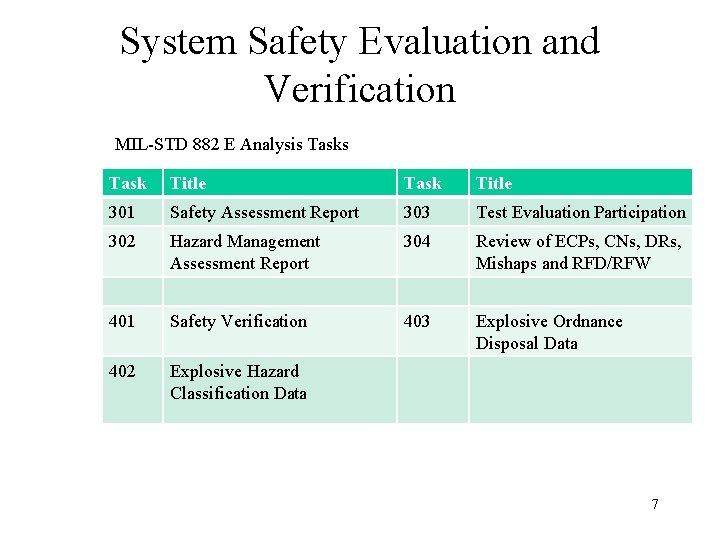
System Safety Evaluation and Verification MIL-STD 882 E Analysis Task Title 301 Safety Assessment Report 303 Test Evaluation Participation 302 Hazard Management Assessment Report 304 Review of ECPs, CNs, DRs, Mishaps and RFD/RFW 401 Safety Verification 403 Explosive Ordnance Disposal Data 402 Explosive Hazard Classification Data 7
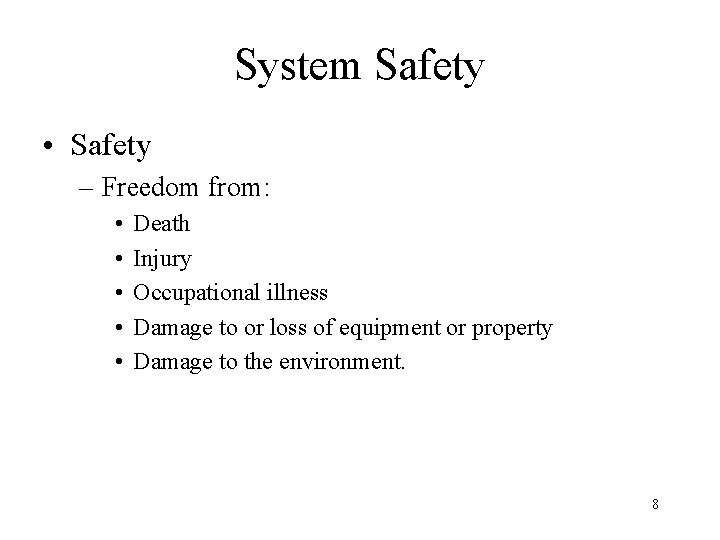
System Safety • Safety – Freedom from: • • • Death Injury Occupational illness Damage to or loss of equipment or property Damage to the environment. 8
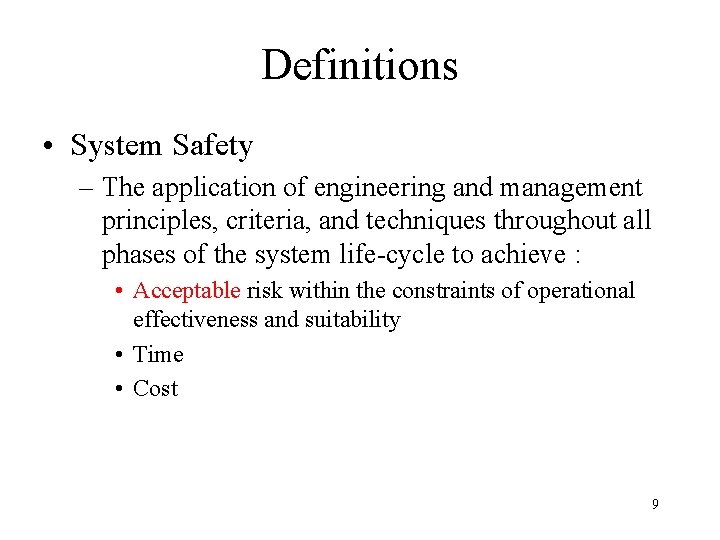
Definitions • System Safety – The application of engineering and management principles, criteria, and techniques throughout all phases of the system life-cycle to achieve : • Acceptable risk within the constraints of operational effectiveness and suitability • Time • Cost 9
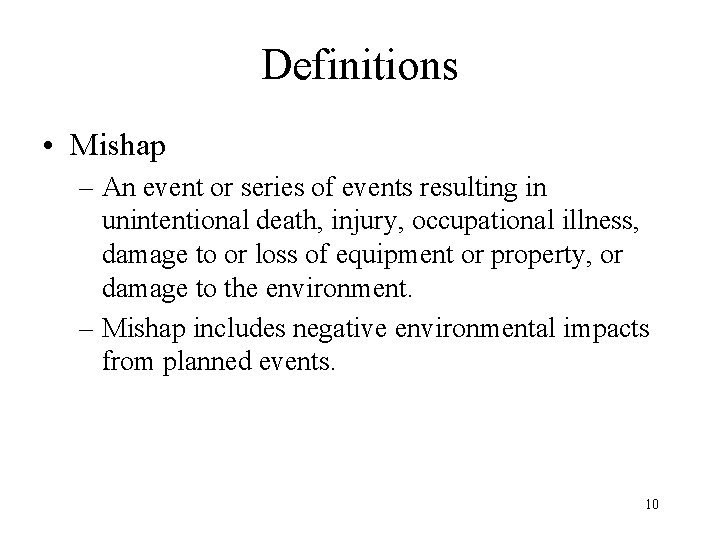
Definitions • Mishap – An event or series of events resulting in unintentional death, injury, occupational illness, damage to or loss of equipment or property, or damage to the environment. – Mishap includes negative environmental impacts from planned events. 10
Definitions • Hazard – A real or potential condition that could lead to an unplanned event of series of events (mishap) resulting in death, injury, occupational illness, damage to or loss of equipment or property, or damage to the environment. 11
Definitions • Severity – The magnitude of potential consequences of a mishap to include death, injury, occupational illness, damage to or loss of equipment or property, damage to the environment, or monetary loss. 12
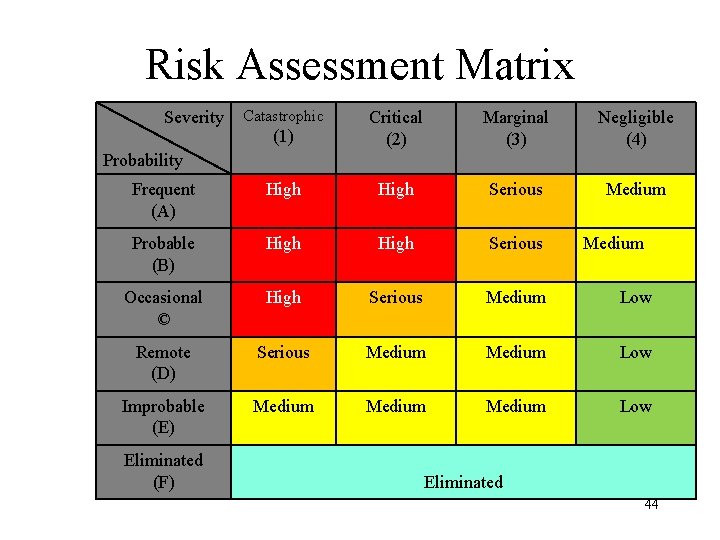
Definitions • Probability – An expression of the likelihood of occurrence of a mishap • Risk – A combination of the severity of the mishap and the probability that the mishap will occur. • Risk level – The characterization of risk as either High, Serious, Medium, or Low. 13
Definitions • Mitigation measure – Action required to eliminate the hazard or when a hazard cannot be eliminated, reduce the associated risk by lessening the severity of the resulting mishap or lowering the likelihood that a mishap will occur. • Acceptable Risk – Risk the appropriate acceptance authority is willing to accept without additional mitigation • Causal Factor – One or several mechanisms that trigger the hazard that may result in a mishap 14
Definitions • Initial Risk – The first assessment of the potential risk of an identified hazard. Initial risk establishes a fixed baseline for the hazard. • Event Risk – The risk associated with a hazard as it applies to a specified hardware/software configuration during an event. Typical events include Developmental Testing/Operational Testing (DT/OT), demonstrations, fielding, post-fielding tests. 15
Definitions • Target risk – The projected risk level to achieve by implementing mitigation measures consistent with the design order of precedence. • Safety-related – A condition, event, operation, process, or item whose mishap severity consequence is either Marginal or Negligible • Safety-significant – A condition, event, operation, process item that is identified as either safety-critical or safety related 16
Definitions • Safety-critical – A term applied to a condition, event, operation, process, or item whose mishap severity consequence is either Catastrophic or Critical. • Safety-critical function (SCF) – A function whose failure to operate or incorrect operation will directly result in a mishap or either Catastrophic or Critical severity. 17
Definitions • Safety-Critical item (SCI) – A hardware or software item that has been determined through analysis to potentially contribute to a hazard with Catastrophic or Critical mishap potential, or that may be implemented to mitigate a hazard with Catastrophic or Critical mishap potential. 18
Definitions • Re-use items – Items previously developed under another program or for a separate application that are used in a program. 19
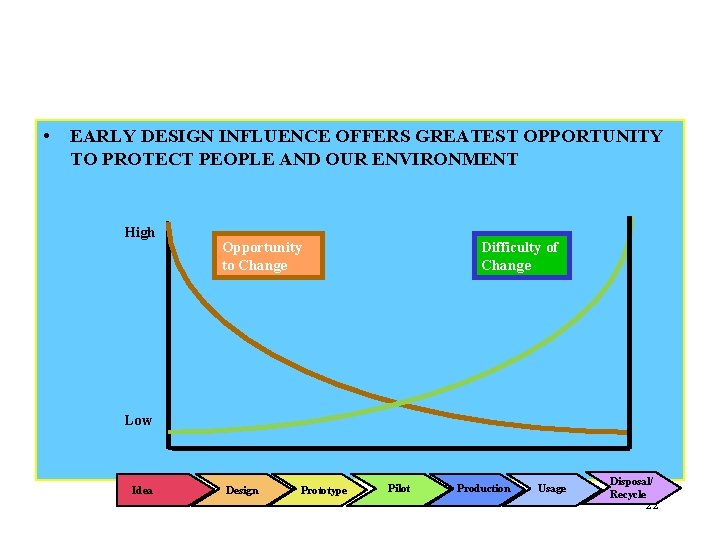
System Safety Objectives • Prevent accidents/mishaps • Designed into the system in a timely, cost effective manner – Very costly to redesign later • Hazards are identified, evaluated, and eliminated or the associated risk is reduced to a level acceptable throughout the entire life cycle of a system 20
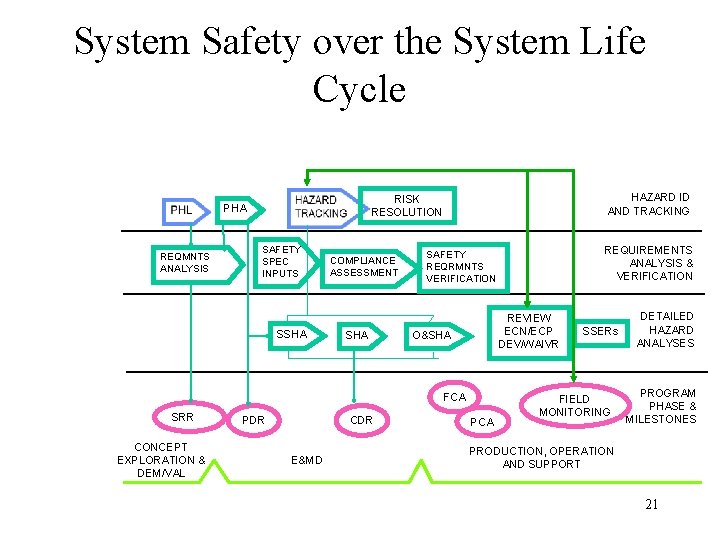
System Safety over the System Life Cycle REQMNTS ANALYSIS HAZARD ID AND TRACKING RISK RESOLUTION PHA SAFETY SPEC INPUTS SSHA COMPLIANCE ASSESSMENT SHA REVIEW ECN/ECP DEV/WAIVR O&SHA FCA SRR CONCEPT EXPLORATION & DEM/VAL CDR PDR E&MD REQUIREMENTS ANALYSIS & VERIFICATION SAFETY REQRMNTS VERIFICATION PCA SSERs FIELD MONITORING DETAILED HAZARD ANALYSES PROGRAM PHASE & MILESTONES PRODUCTION, OPERATION AND SUPPORT 21
• EARLY DESIGN INFLUENCE OFFERS GREATEST OPPORTUNITY TO PROTECT PEOPLE AND OUR ENVIRONMENT High Opportunity to Change Difficulty of Change Low Idea Design Prototype Pilot Production Usage Disposal/ Recycle 22
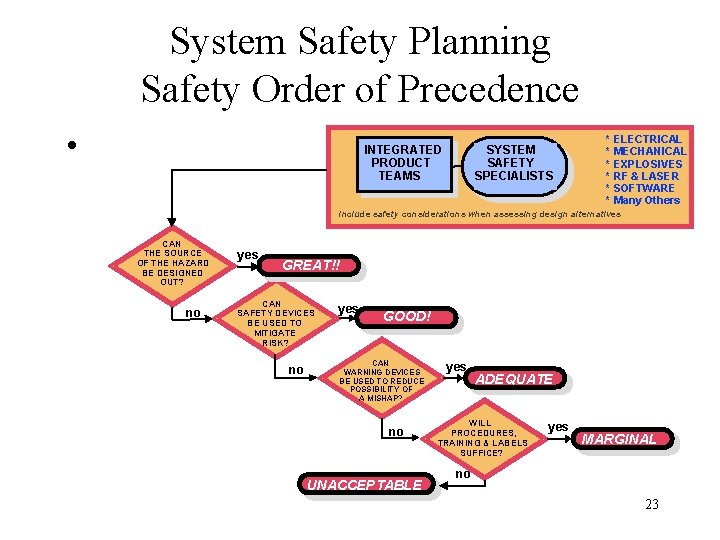
System Safety Planning Safety Order of Precedence • INTEGRATED PRODUCT TEAMS SYSTEM SAFETY SPECIALISTS * ELECTRICAL * MECHANICAL * EXPLOSIVES * RF & LASER * SOFTWARE * Many Others Include safety considerations when assessing design alternatives CAN THE SOURCE OF THE HAZARD BE DESIGNED OUT? no yes GREAT!! CAN SAFETY DEVICES BE USED TO MITIGATE RISK? no yes GOOD! CAN WARNING DEVICES BE USED TO REDUCE POSSIBILITY OF A MISHAP? no UNACCEPTABLE yes ADEQUATE WILL PROCEDURES, TRAINING & LABELS SUFFICE? yes MARGINAL no 23
System Safety Objectives • Use historical safety data, including lessons learned • Minimum risk is undertaken when using new designs, materials, and production and test techniques • Actions taken to eliminate hazards or reduce risk to an acceptable level are documented. • Retrofit actions are minimized 24
System Safety Objectives • Minimize hazardous materials. If required, evaluate for safety and ease of disposal • Save your lessons learned for the next project • Hazards identified after production are minimized 25
Benefits of Systems Safety • Help cause and ensure the safe design of products – Objective approach where both use and possible misuse is considered – Ensure compliance with Laws, requirements, and other contractual items pertaining to safe product design 26
Benefits of Systems Safety • To expensive not to have a program – Product Recall – Product Liability (Lawsuits) – Costly Retrofits – Accidents resulting in injury and death – Punitive damages – Negative Publicity 27
Actions for Systems Safety • • Document the Systems Safety Approach Identify and document hazards Assess and document risk Identify and document risk mitigation measures Reduce risk Verify, validate and document risk reductions Accept risk and document Manage life-cycle risk 28
Key Principles • A basic requirement of the total system • Must be planned – Integrated and comprehensive – Interrelated, sequential, and continuing – Affects facilities, equipment, procedures, and personnel – Applies to all phases (conceptual, design, production, deployment – Includes transportation and logistics support – Disposal – Includes off the shelf acquisitions 29
Key Principles • Inherent safety comes from the basic system design – Improvements to inherent safety are best achieved early • Management resolves conflicts between safety and other design requirements • Design Safety hierarchy – – Design to the minimum hazard Create Safety devices Include warning devices Create Special Procedures 30
Key Principles • System Safety requirements must be consistent with other program requirements and must be well defined. • Systems analysis are performed to – – Identify hazards and corrective actions Review safety considerations in tradeoffs Determine/evaluate safety design requirements Determine/evaluate operational, test , logistics requirements – Validate qualitative/quantitative requirements have been met 31
Key Principles • Nature and severity of hazards used to change design requirements – Called risk assessment – Hazard categories – Hazard probability – Risk Management 32
Key Principles • Degree of safety directly dependent upon management emphasis by customer and contractors. • Results of safety effort depend on procurement agency clearly stating objectives/requirements 33
Key Principles • Software hazard analysis – Begin early in development and may be updated – Is a flow down requirements process followed by an upward-flow verification process • Elements of an effective systems safety program – Planned approach to accomplish tasks – Qualified people – Authority to implement tasks through all levels of management – Appropriate manning/funding 34
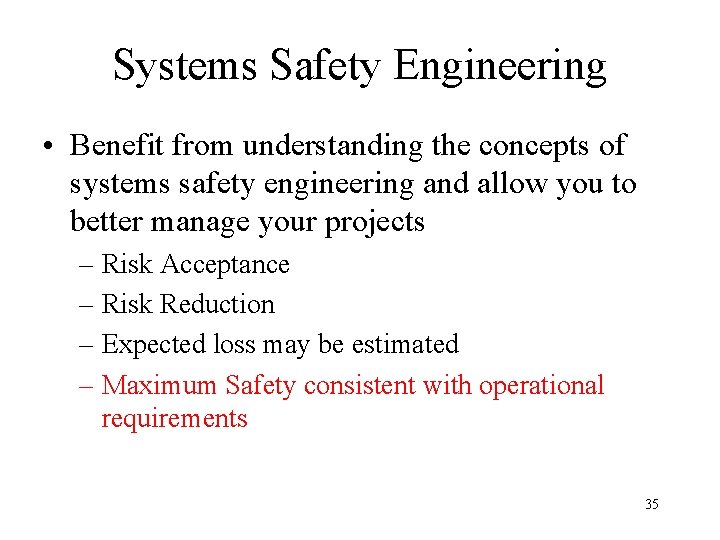
Systems Safety Engineering • Benefit from understanding the concepts of systems safety engineering and allow you to better manage your projects – Risk Acceptance – Risk Reduction – Expected loss may be estimated – Maximum Safety consistent with operational requirements 35
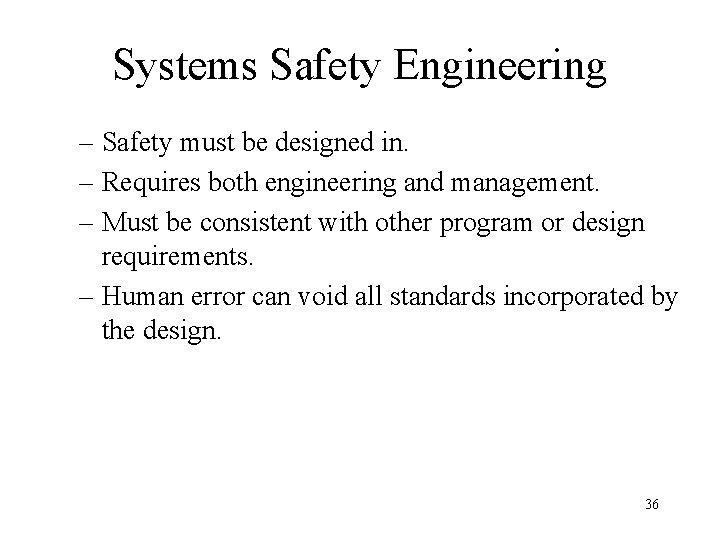
Systems Safety Engineering – Safety must be designed in. – Requires both engineering and management. – Must be consistent with other program or design requirements. – Human error can void all standards incorporated by the design. 36
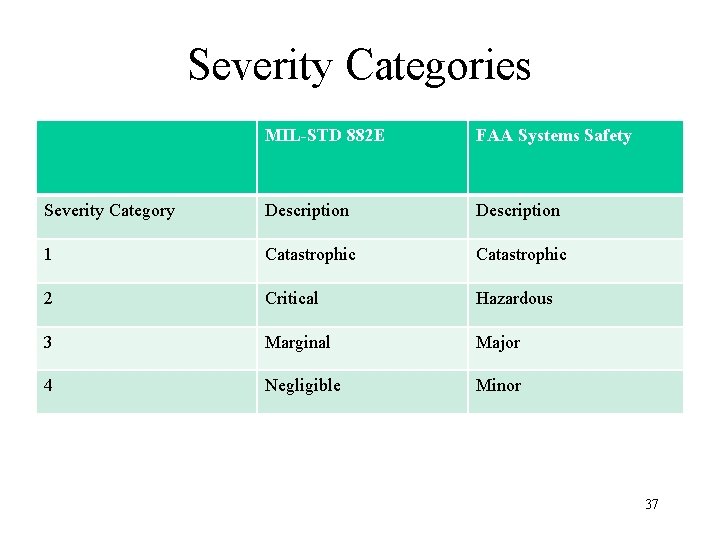
Severity Categories MIL-STD 882 E FAA Systems Safety Severity Category Description 1 Catastrophic 2 Critical Hazardous 3 Marginal Major 4 Negligible Minor 37
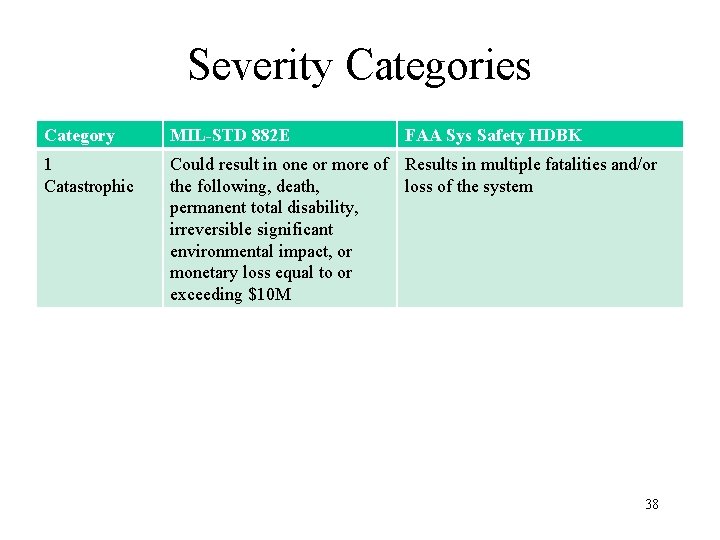
Severity Categories Category MIL-STD 882 E FAA Sys Safety HDBK 1 Catastrophic Could result in one or more of Results in multiple fatalities and/or the following, death, loss of the system permanent total disability, irreversible significant environmental impact, or monetary loss equal to or exceeding $10 M 38
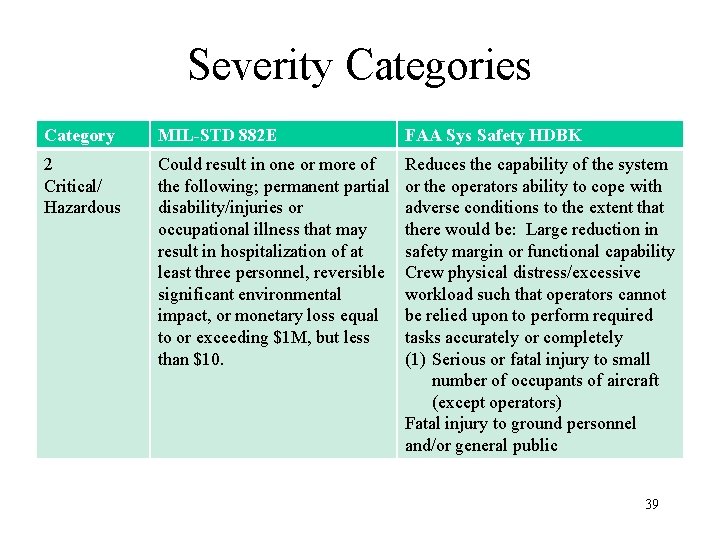
Severity Categories Category MIL-STD 882 E FAA Sys Safety HDBK 2 Critical/ Hazardous Could result in one or more of the following; permanent partial disability/injuries or occupational illness that may result in hospitalization of at least three personnel, reversible significant environmental impact, or monetary loss equal to or exceeding $1 M, but less than $10. Reduces the capability of the system or the operators ability to cope with adverse conditions to the extent that there would be: Large reduction in safety margin or functional capability Crew physical distress/excessive workload such that operators cannot be relied upon to perform required tasks accurately or completely (1) Serious or fatal injury to small number of occupants of aircraft (except operators) Fatal injury to ground personnel and/or general public 39
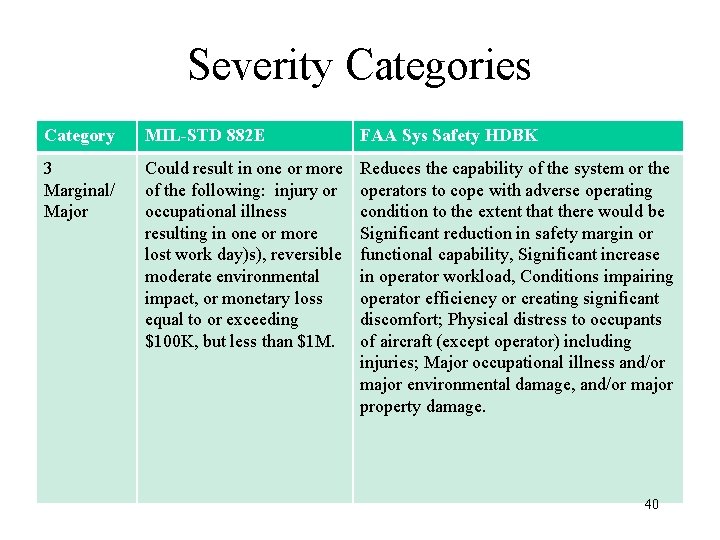
Severity Categories Category MIL-STD 882 E FAA Sys Safety HDBK 3 Marginal/ Major Could result in one or more of the following: injury or occupational illness resulting in one or more lost work day)s), reversible moderate environmental impact, or monetary loss equal to or exceeding $100 K, but less than $1 M. Reduces the capability of the system or the operators to cope with adverse operating condition to the extent that there would be Significant reduction in safety margin or functional capability, Significant increase in operator workload, Conditions impairing operator efficiency or creating significant discomfort; Physical distress to occupants of aircraft (except operator) including injuries; Major occupational illness and/or major environmental damage, and/or major property damage. 40
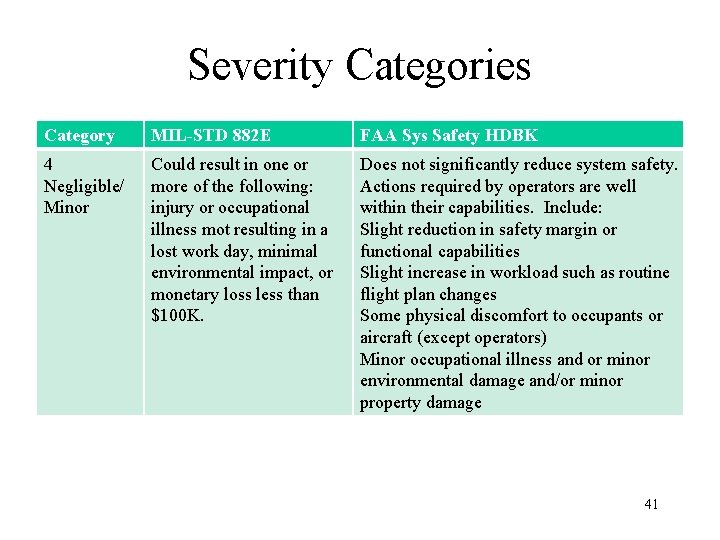
Severity Categories Category MIL-STD 882 E FAA Sys Safety HDBK 4 Negligible/ Minor Could result in one or more of the following: injury or occupational illness mot resulting in a lost work day, minimal environmental impact, or monetary loss less than $100 K. Does not significantly reduce system safety. Actions required by operators are well within their capabilities. Include: Slight reduction in safety margin or functional capabilities Slight increase in workload such as routine flight plan changes Some physical discomfort to occupants or aircraft (except operators) Minor occupational illness and or minor environmental damage and/or minor property damage 41
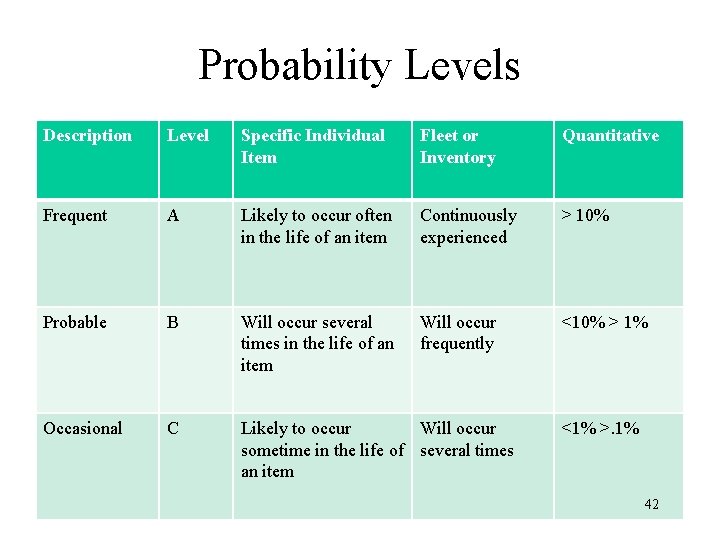
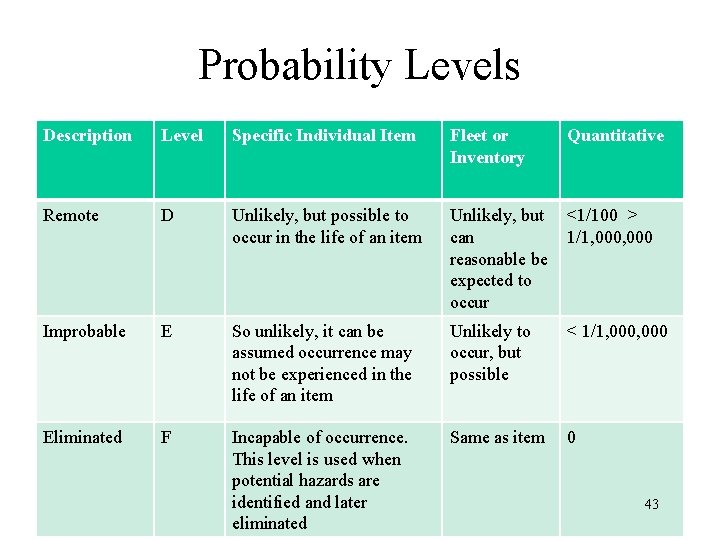
Probability Levels Description Level Specific Individual Item Fleet or Inventory Quantitative Frequent A Likely to occur often in the life of an item Continuously experienced > 10% Probable B Will occur several times in the life of an item Will occur frequently <10% > 1% Occasional C Likely to occur Will occur sometime in the life of several times an item <1% >. 1% 42
Probability Levels Description Level Specific Individual Item Fleet or Inventory Quantitative Remote D Unlikely, but possible to occur in the life of an item Unlikely, but can reasonable be expected to occur <1/100 > 1/1, 000 Improbable E So unlikely, it can be assumed occurrence may not be experienced in the life of an item Unlikely to occur, but possible < 1/1, 000 Eliminated F Incapable of occurrence. This level is used when potential hazards are identified and later eliminated Same as item 0 43
Risk Assessment Matrix Severity Catastrophic (1) Critical (2) Marginal (3) Negligible (4) Frequent (A) High Serious Medium Probable (B) High Serious Occasional © High Serious Medium Low Remote (D) Serious Medium Low Improbable (E) Medium Low Probability Eliminated (F) Medium Eliminated 44
Safety Hazard Analyses • Preliminary Hazard List (Task 201) – Purpose • Compile a list of potential hazards early in the development – Description • Examine the system and compile a list of potential hazards • Review other documentation from similar and legacy systems – – – – Mishap and incident reports, Hazard tracking system, Lessons learned, Safety Analyses and assessments Health hazard information Test documentation Environmental Issues Demil and disposal plans 45
Hazard Analysis Tree Preliminary Hazard List (PHL) 46
Safety Hazard Analyses • Preliminary Hazard List (Task 201) – Document the hazards in the hazard tracking system – No specific format, but what is agreed upon – Description of the hazard – Causal factor for each hazard 47
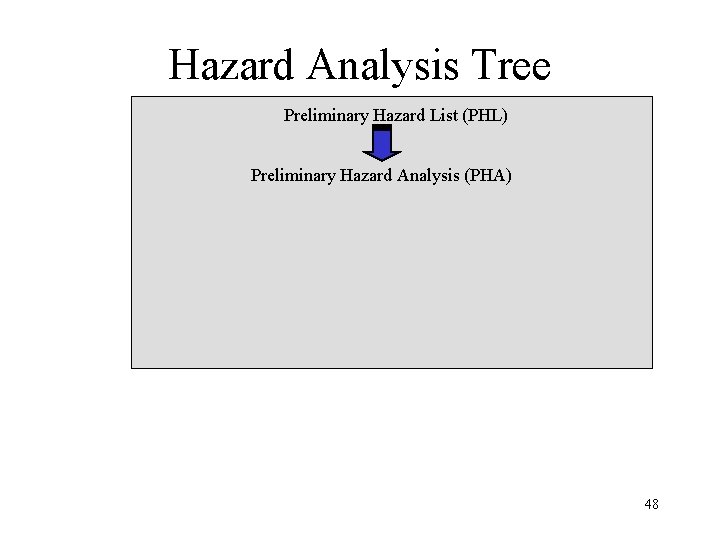
Hazard Analysis Tree Preliminary Hazard List (PHL) Preliminary Hazard Analysis (PHA) 48
Safety Hazard Analyses • Preliminary Hazard Analysis (PHA) (Task 202) – Purpose • Identify hazards • Assess the initial risks with a detailed review of the PHL results • Identify potential mitigation measures 49
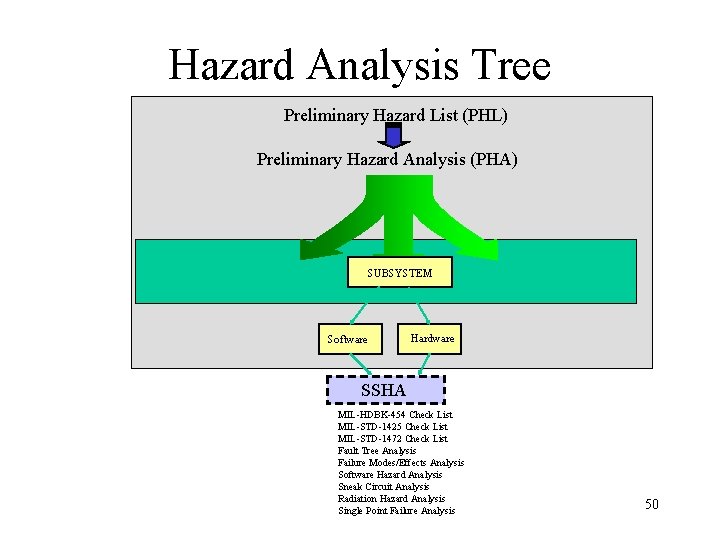
Hazard Analysis Tree Preliminary Hazard List (PHL) Preliminary Hazard Analysis (PHA) SUBSYSTEM Software Hardware SSHA MIL-HDBK-454 Check List MIL-STD-1425 Check List MIL-STD-1472 Check List Fault Tree Analysis Failure Modes/Effects Analysis Software Hazard Analysis Sneak Circuit Analysis Radiation Hazard Analysis Single Point Failure Analysis 50
Safety Hazard Analyses • PHA (Task 202) – Description • Initial risk assessment of identified hazards • Evaluate for severity and probability • Based on best available data. – Historical mishap data from similar systems and legacy systems – Mitigations measures to eliminate or reduce risk 51
Safety Hazard Analyses • PHA (Task 202) – Description • • • Document in the hazard tracking system System components Energy Sources Ordnance HAZMAT Identify safety critical interfaces and Controls 52
Safety Hazard Analyses • PHA (Task 202) – Description • • • Interfaces with other systems Material compatibilities Inadvertent activation COTS/NDI Software – Control Safety Significant software commands and responses • Operating Environment and Constraints • Procedures for operating, test, maintenance, BIT, diagnostics, emergencies 53
Safety Hazard Analyses • PHA (Task 202) – Description • • Health Hazards Environmental Impacts Human Factors Life support requirements Event unique hazards Infrastructure Malfunction 54
Safety Hazard Analyses • PHA (Task 202) – Description • Initial risk assessment • Identify potential risk mitigation measures 55
Safety Hazard Analyses • PHA (Task 202) • Advantages – Establishes framework for future hazard analyses – Applicable to all systems, subsystems, procedures, interfaces – Only a general knowledge of the system’s functions and major components is required – Covers a broad range of hazards – Relatively inexpensive 56
Safety Hazard Analyses • PHA (Task 202) • Limitations – Yields purely qualitative results – Only a high-level analysis using best available data 57
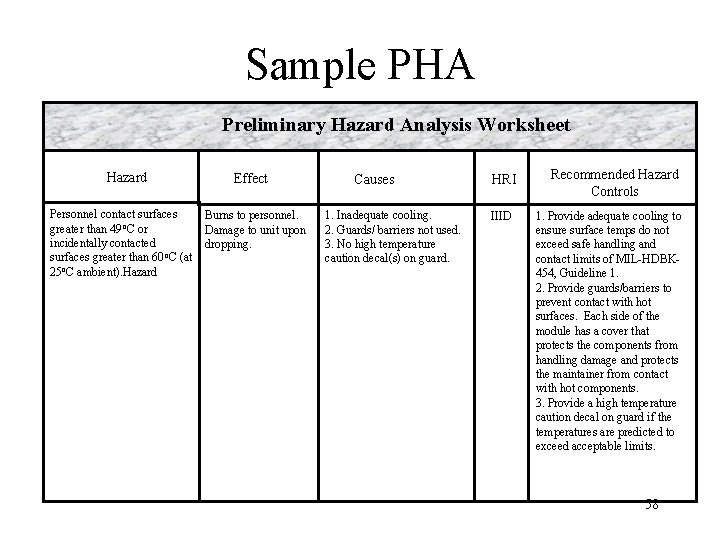
Sample PHA Preliminary Hazard Analysis Worksheet • Preliminary Hazard Analysis Worksheet Hazard Personnel contact surfaces greater than 49 o. C or incidentally contacted surfaces greater than 60 o. C (at 25 o. C ambient). Hazard Effect Burns to personnel. Damage to unit upon dropping. Causes 1. Inadequate cooling. 2. Guards/ barriers not used. 3. No high temperature caution decal(s) on guard. HRI IIID Recommended Hazard Controls 1. Provide adequate cooling to ensure surface temps do not exceed safe handling and contact limits of MIL-HDBK 454, Guideline 1. 2. Provide guards/barriers to prevent contact with hot surfaces. Each side of the module has a cover that protects the components from handling damage and protects the maintainer from contact with hot components. 3. Provide a high temperature caution decal on guard if the temperatures are predicted to exceed acceptable limits. 58
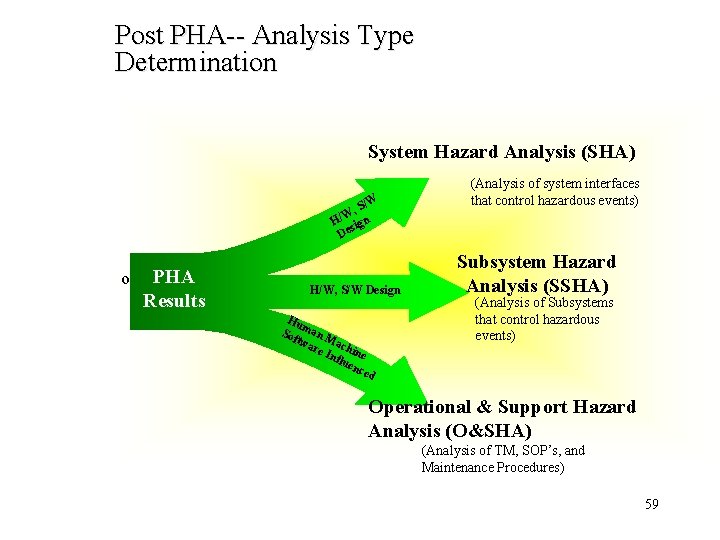
Post PHA-- Analysis Type Determination • System Hazard Analysis (SHA) /W , S /W W S H/ s. W ign, / e DH sign De PHA o PHA Results H/W, S/W Design Hu m Sof an M twa re I achin e nfl uen ce (Analysis of system interfaces that control hazardous events) Subsystem Hazard Analysis (SSHA) (Analysis of Subsystems that control hazardous events) d Operational & Support Hazard Analysis (O&SHA) (Analysis of TM, SOP’s, and Maintenance Procedures) 59
Safety Hazard Analysis • System Requirements Hazard Analysis (SRHA) Task 203 – Purpose • Determine the design requirements to eliminate hazards or reduce the associated risks for a system • Incorporate these requirements into the appropriate system documentation • Assess compliance of the system with these requirements • Addresses all life cycle phases and modes 60
Safety Hazard Analysis • SRHA Task 203 (continued) – Description • Identify applicable policies, regulations, standards and analyze identified hazards • Recommend appropriate design requirements to eliminate hazards • Define verification and validation approaches • Incorporate approved design requirements • Assess compliance with identified requirements 61
Safety Hazard Analyses • Subsystem Hazard Analysis (SSHA) (Task 204) – Purpose • Verify subsystem compliance with requirements to eliminate hazards or reduce the associated risks • Identify previously unidentified hazards • Recommend actions necessary to eliminate identified hazards or mitigate the associated risks. 62
Safety Hazard Analyses • SSHA (Task 204) (Continued) – Description • Identify hazards and mitigation efforts in components and equipment • Include COTS. GOTS, GFE, NDI and Software • Consider performance, performance degradation, functional failures, timing errors, design errors or defects and inadvertent functioning • Verify subsystem compliance with requirements to eliminate hazards or reduce associated risks 63
Safety Hazard Analyses • SSHA (Task 204) (Continued) – Description • Validate applicable flow down of design requirements from top level specifications to detailed design specification for the subsystem • Ensure design criteria in the subsystem specifications have been satisfied and that verification and validation of subsystem mitigation measures have been included in test plans and procedures. 64
Safety Hazard Analyses • SSHA (Task 204) (Continued) – Description • Identify previously unidentified hazards associated with the design of the subsystem • Ensure implementation of subsystem design requirements and mitigation measures have not introduce any new hazards • Determine modes of failure – – Component failure modes Human errors Single point and common mode failures Effects when failures occur in subsystem components and equipment 65
Safety. Hazard Analyses • SSHA (Task 204) (Continued) – Description • Recommend actions necessary to eliminate previously unidentified hazards or mitigate their associated risk • Ensure system-level hazards attributed to the subsystem are analyzed and adequate mitigation of the potential hazards are implemented in the design. 66
Safety Hazard Analyses • SSHA (Task 204) (Continued) – Description • Software will be monitored and evaluated for its potential risk • Identify hazards that require mitigation actions • Update the SSHA as the system design changes 67
Safety Hazard Analyses • SSHA (Task 204) (Continued) – Report • System Description – Physical and functional characteristics of the system – List of subsystems – Detailed description of the subsystems being analyzed • Hazard analysis methods and techniques – Assumptions made for each analysis and the qualitative or quantitative data used. – Often uses FMECA and source data from PHA • Results – Analysis and results should be captured in the HTS. 68
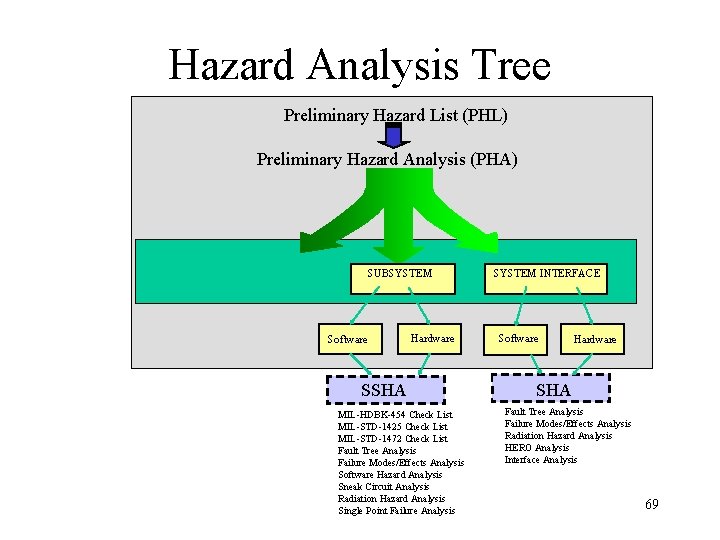
Hazard Analysis Tree Preliminary Hazard List (PHL) Preliminary Hazard Analysis (PHA) SUBSYSTEM Software Hardware SSHA MIL-HDBK-454 Check List MIL-STD-1425 Check List MIL-STD-1472 Check List Fault Tree Analysis Failure Modes/Effects Analysis Software Hazard Analysis Sneak Circuit Analysis Radiation Hazard Analysis Single Point Failure Analysis SYSTEM INTERFACE Software Hardware SHA Fault Tree Analysis Failure Modes/Effects Analysis Radiation Hazard Analysis HERO Analysis Interface Analysis 69
Safety Hazard Analyses • System Hazard Analysis (Task 205) – Purpose • Verify system compliance with requirements to eliminate hazards or reduce the associated risks • Identify previously unidentified hazards associated with the subsystem interfaces and faults • Identify hazards associated with the integrated systems design, including software and subsystems interfaces • Recommend actions necessary to eliminate identified hazards or mitigate their associated risks 70
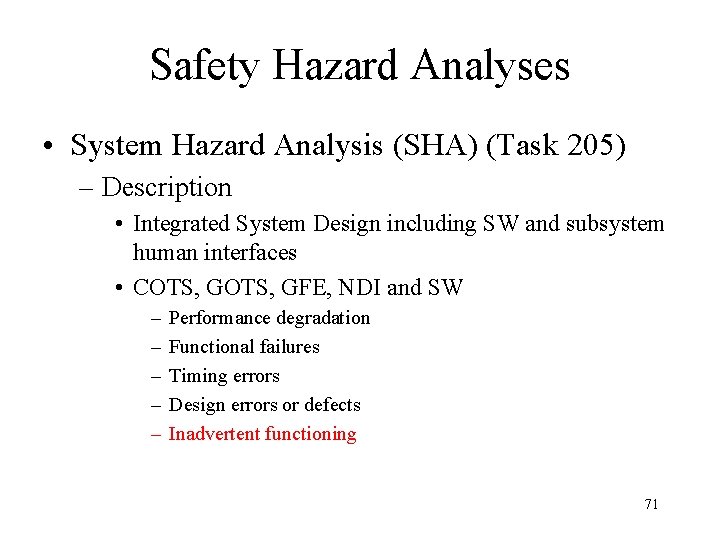
Safety Hazard Analyses • System Hazard Analysis (SHA) (Task 205) – Description • Integrated System Design including SW and subsystem human interfaces • COTS, GFE, NDI and SW – – – Performance degradation Functional failures Timing errors Design errors or defects Inadvertent functioning 71
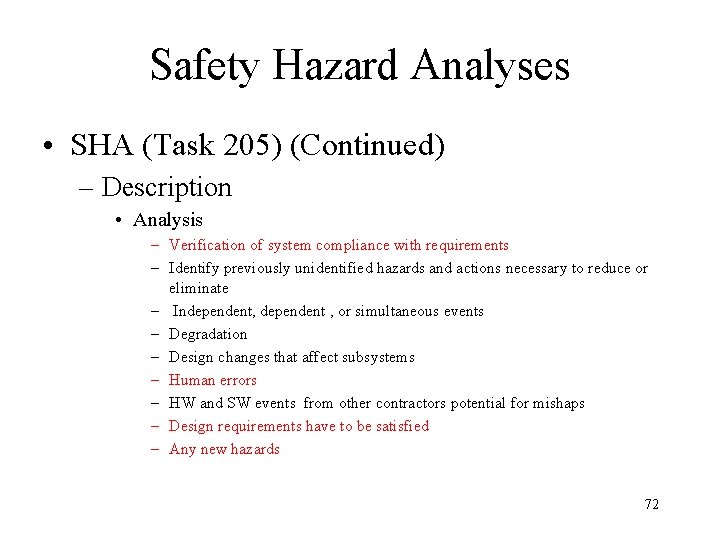
Safety Hazard Analyses • SHA (Task 205) (Continued) – Description • Analysis – Verification of system compliance with requirements – Identify previously unidentified hazards and actions necessary to reduce or eliminate – Independent, dependent , or simultaneous events – Degradation – Design changes that affect subsystems – Human errors – HW and SW events from other contractors potential for mishaps – Design requirements have to be satisfied – Any new hazards 72
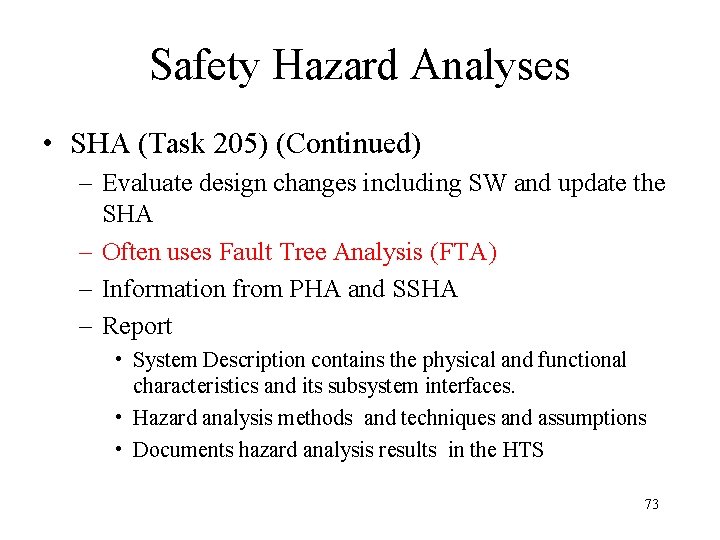
Safety Hazard Analyses • SHA (Task 205) (Continued) – Evaluate design changes including SW and update the SHA – Often uses Fault Tree Analysis (FTA) – Information from PHA and SSHA – Report • System Description contains the physical and functional characteristics and its subsystem interfaces. • Hazard analysis methods and techniques and assumptions • Documents hazard analysis results in the HTS 73
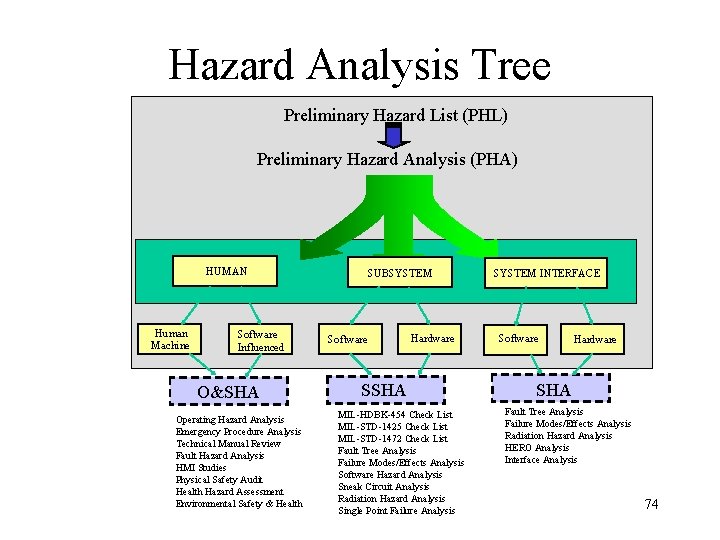
Hazard Analysis Tree Preliminary Hazard List (PHL) Preliminary Hazard Analysis (PHA) HUMAN Human Machine Software Influenced O&SHA Operating Hazard Analysis Emergency Procedure Analysis Technical Manual Review Fault Hazard Analysis HMI Studies Physical Safety Audit Health Hazard Assessment Environmental Safety & Health SUBSYSTEM Software Hardware SSHA MIL-HDBK-454 Check List MIL-STD-1425 Check List MIL-STD-1472 Check List Fault Tree Analysis Failure Modes/Effects Analysis Software Hazard Analysis Sneak Circuit Analysis Radiation Hazard Analysis Single Point Failure Analysis SYSTEM INTERFACE Software Hardware SHA Fault Tree Analysis Failure Modes/Effects Analysis Radiation Hazard Analysis HERO Analysis Interface Analysis 74
Safety Hazard Analyses • Operating and Support Hazard Analysis (O&SHA) Task 206 – Purpose • Identify hazards introduced by operational and support activities and procedures • Evaluate the adequacy of operational and support procedures, facilities, processes, and equipment used to mitigate risks associated with identified hazards 75
Safety Hazard Analyses • O&SHA Task 206 (Continued) – Task Description • EMD Phase and builds on system design hazard analysis • Planned System Configuration • Facility/installation interfaces • Planned operation and support environment • Supporting tools • Operating and support procedures 76
Safety Hazard Analyses • O&SHA Task 206 (Continued) – Task Description • Task sequence, concurrent task effects, and limitations • Human factors, regulatory or contractually specified personnel requirements • Potential for unplanned evens, including hazards introduced by human errors • Legacy systems 77
Safety Hazard Analyses • O&SHA Task 206 (Continued) – Task Description • Identify activities with known hazards, time period, frequency, number of personnel, and how to minimize the risk • Changes needed in functional or design requirements for hardware, software, facilities, tooling, or support/test equipment to eliminate hazards or mitigate risks • Requirements for PPE • Warnings, cautions and special emergency procedures • Requirements for PHS&T 78
Safety Hazard Analyses • O&SHA Task 206 (Continued) – Task Description • Training • Effects of COTS, GFE, and NDI HW and SE • Potentially hazardous system modes under operator control • Related legacy systems, facilities, and processes – Update as required to reflect the evolving systems design 79
Safety Hazard Analyses • O&SHA Task 206 (Continued) • Results – Physical and functional characteristics of the system – Describe the method and technique – Capture in HTS 80
Safety Hazard Analyses • Health Hazard Analysis (HHA) Task 207 – Purpose • Identify human health hazards • Evaluate proposed hazardous materials and processes • Propose measures to eliminate the hazards or reduce the associated risks when the hazards can’t be eliminated 81
Safety Hazard Analyses • HHA Task 207 (Continued) – Description • Evaluate potential effects resulting from exposure • Incorporate the identification, assessment, characterization, control, and communication • Consider the total health impact of all stressors contacting the human operator or maintainer. • Consider the synergistic impacts • Evaluate the hazards and costs of system components • Recommend other materials to reduce the associated risks • Consider waste and by-products 82
Safety Hazard Analyses • HHA Task 207 (Continued) • Description – Health Hazard • Inherent to operation, maintenance, storage, transport, use of material or disposal that can cause death, injury, acute or chronic illness, disability ore reduced job performance of personnel by exposure to physiological stresses 83
Safety Hazard Analyses • HHA Task 207 (Continued) • Description – Health Hazard • • • Chemical hazards Physical Hazards Biological hazards Ergonomic hazards Other Ionizing and non-ionizing radiation 84
Safety Hazard Analyses • HHA Task 207 (Continued) • Description • Hazard identification by name • Exposure Pathway • Exposure characterization – Severity and probability – Mitigation Strategy 85
Safety Hazard Analyses • HHA Task 207 (Continued) • Description – HAZMAT evaluation • Quantity, characteristics, and concentration of the system • Material hazards and hazardous waste • Describe how the HAZMAT is used • Usage rate • Disposition 86
Safety Hazard Analyses • Functional Hazard Analysis (FHA) Task 208 – Purpose • Identify and classify the systems functions and the safety consequence of functional failure or malfunction • Classified in terms of severity for the purpose of identifying the – – Safety-critical function (SCF) Safety-Critical Item (SCI) Safety-related function (SRF) Safety-related Item (SRI) 87
Safety Hazard Analyses • FHA Task 208 (Continued) – Task Description • Identify and Evaluate functions within a system. – – – – Decomposition Functional description of subsystem and component Functional description of interfaces Hazards Assessment of Risk Where function to be implemented Software Control Category Requirements and constraints 88
Safety Hazard Analyses • FHA Task 208 (continued) – Task Description • Update as Necessary • Update the results of the analysis – System Description – Hazard analysis methods and techniques – Hazard analysis results 89
Safety Hazard Analyses • System-of-System Hazard Analysis Task 209 – Purpose • Identify unique So. S hazards • Produce special requirements to eliminate or mitigate identified unique So. S hazards which otherwise would not exist. 90
Safety Hazard Analyses • System-of-System Hazard Analysis Task 209 – Description • • Traceability Assess the risk and recommend mitigation measures Verify and validate effectiveness of mitigation Document the results of the analysis – So. S description – Hazard Analysis methods and techniques – Hazard Analysis results 91
Safety Hazard Analyses • Environmental Hazard Analysis (EHA) Task 210 – Purpose • Identify hazards to the environment through all lifecycle phases and modes • Document the hazards in the HTS • Manage the hazards 92
Safety Hazard Analyses • EHA Task 210 – Task Description • Integrate Environmental Considerations • Start as early as possible • Informed and structured risk assessment and acceptance process • Make recommendations for elimination and risk reduction 93
Safety Hazard Analyses • EHA Task 210 – Task Description • Consider the entire life cycle – – – – Hazardous materials use and generation Demilitarization and disposal Chemical, biological and other hazards impacting public health Noise generation Pollution emissions Hazardous substances from maintenance and operation Inadvertent hazardous releases Environmental impacts on sea, air, space 94
Safety Hazard Analyses • EHA Task 210 – Task Description – System Description – Hazard analysis methods and techniques – Hazard analysis results • HAZMAT – Location – Quantity – Control and training required 95
Safety Hazard Analyses • EHA Task 210 – Task Description – Specific pollutants » Identify » Source » Quantity and magnitude » Special control, training, and handling measures 96
Wrap-up • System Safety is a key to designing a cost effective and safe system. • Be proactive. Get your safety engineer involved early in the design process. 97
Chapter 14 • Wednesday 17 July – Homework Chapter 14 • Problems 1, 2, 6 (3 considerations), 13, 17 – Quiz #4 Chapter 14 and System Safety 98