
ME 240107 S Product Dissection ME 240107 S
- Slides: 25
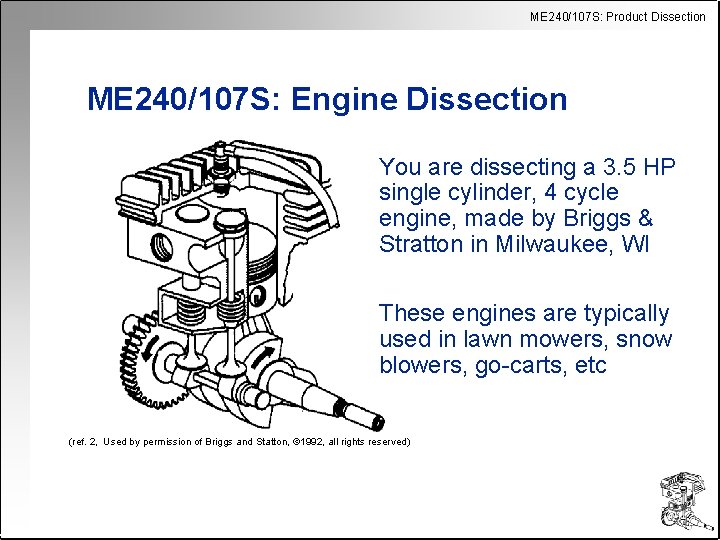
ME 240/107 S: Product Dissection ME 240/107 S: Engine Dissection You are dissecting a 3. 5 HP single cylinder, 4 cycle engine, made by Briggs & Stratton in Milwaukee, WI These engines are typically used in lawn mowers, snow blowers, go-carts, etc (ref. 2, Used by permission of Briggs and Statton, © 1992, all rights reserved)
ME 240/107 S: Product Dissection Lecture 1 n Engine Terminology n Engine Classifications n Carburetors
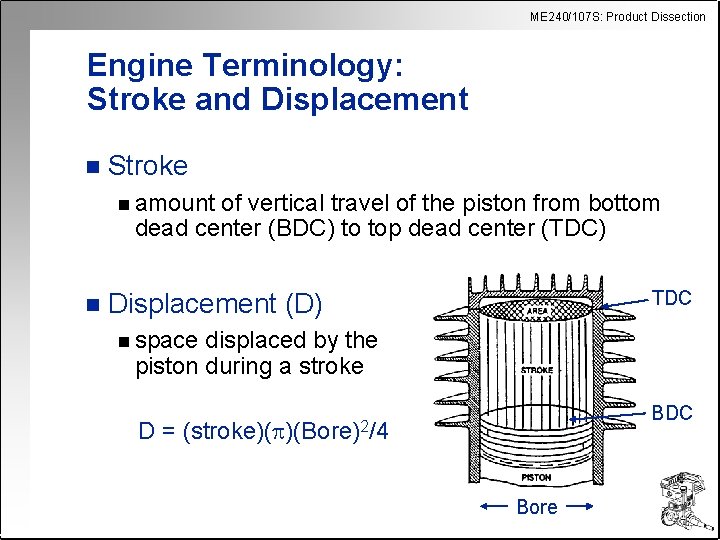
ME 240/107 S: Product Dissection Engine Terminology: Stroke and Displacement n Stroke n amount of vertical travel of the piston from bottom dead center (BDC) to top dead center (TDC) n TDC Displacement (D) n space displaced by the piston during a stroke D= BDC (stroke)(p)(Bore)2/4 Bore
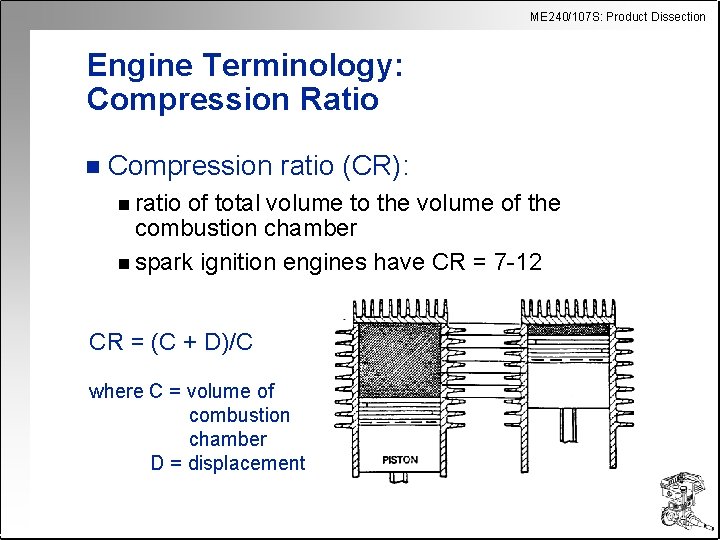
ME 240/107 S: Product Dissection Engine Terminology: Compression Ratio n Compression ratio (CR): n ratio of total volume to the volume of the combustion chamber n spark ignition engines have CR = 7 -12 CR = (C + D)/C where C = volume of combustion chamber D = displacement
ME 240/107 S: Product Dissection Classification of Engines n External vs. Internal Combustion n Spark Ignition vs. Compression Ignition n Cylinder Configuration n Valve Location n 2 Stroke or 4 Stroke
ME 240/107 S: Product Dissection Engine Classification: External vs. Internal Combustion n External combustion n combustion of an air-fuel mixture transfers heat to a second fluid which becomes the motive (working) fluid that produces power n E. g. , steam driven engine n Internal combustion n the products of combustion are the motive fluid
ME 240/107 S: Product Dissection Engine Classification: Spark vs. Compression Ignition n Spark ignition (SI) engines na compressed, homogeneous air-fuel mixture (15: 1 ratio of air to fuel by mass) is ignited using a spark n Compression ignition (CI) engines n rapid compression of air to a high pressure raises the temperature so that fuel, when delivered into combustion chamber, spontaneously ignites without need for a spark n often referred to as a Diesel engine
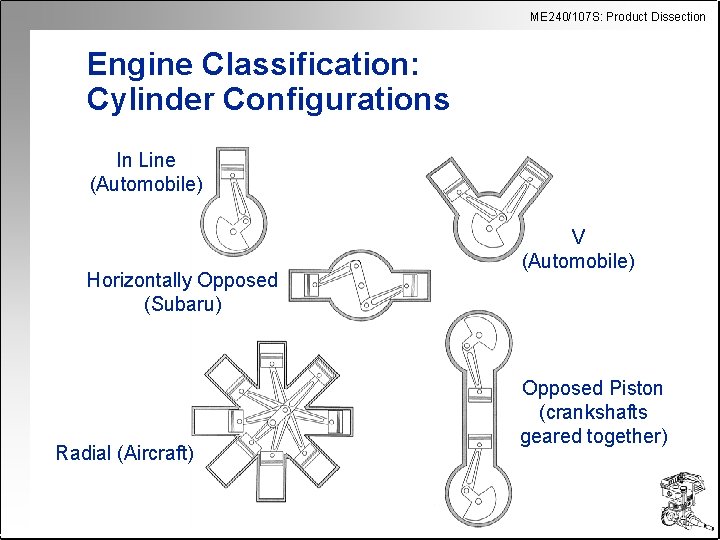
ME 240/107 S: Product Dissection Engine Classification: Cylinder Configurations In Line (Automobile) Horizontally Opposed (Subaru) Radial (Aircraft) V (Automobile) Opposed Piston (crankshafts geared together)
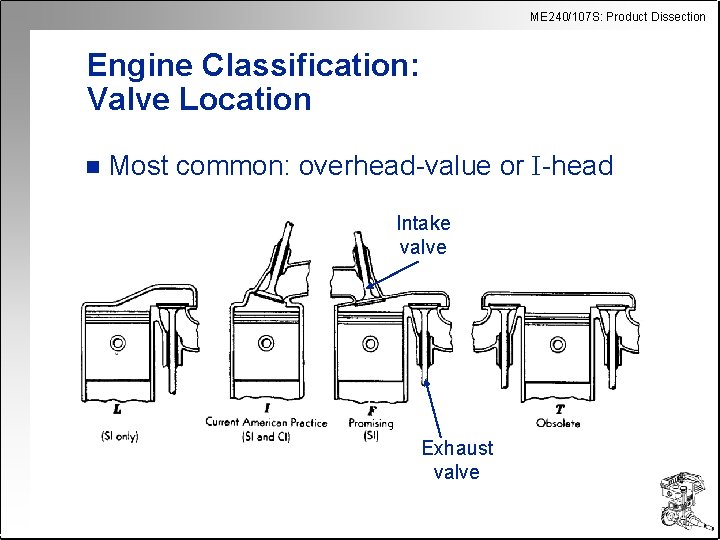
ME 240/107 S: Product Dissection Engine Classification: Valve Location n Most common: overhead-value or I-head Intake valve Exhaust valve
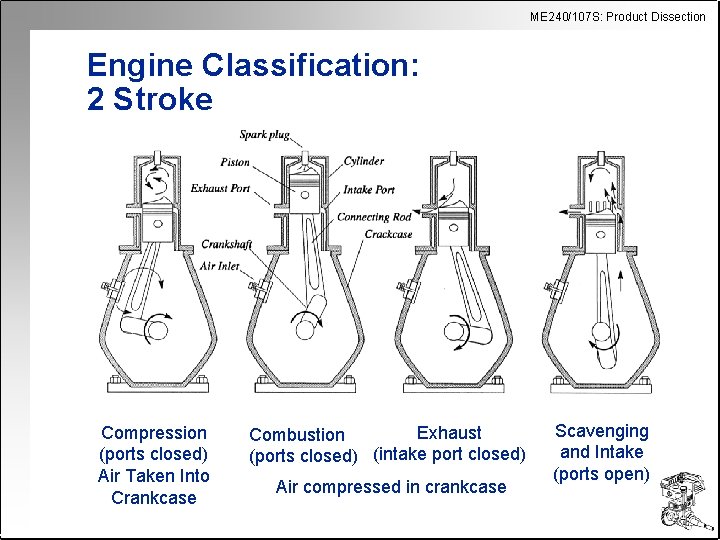
ME 240/107 S: Product Dissection Engine Classification: 2 Stroke Compression (ports closed) Air Taken Into Crankcase Exhaust Combustion (ports closed) (intake port closed) Air compressed in crankcase Scavenging and Intake (ports open)
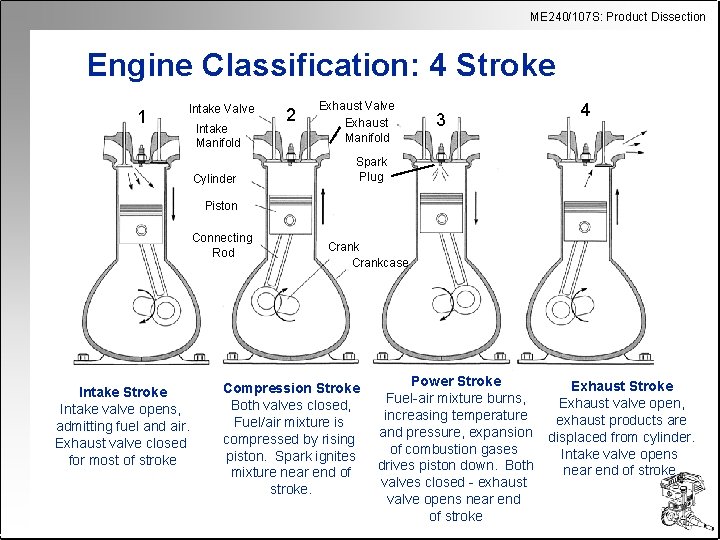
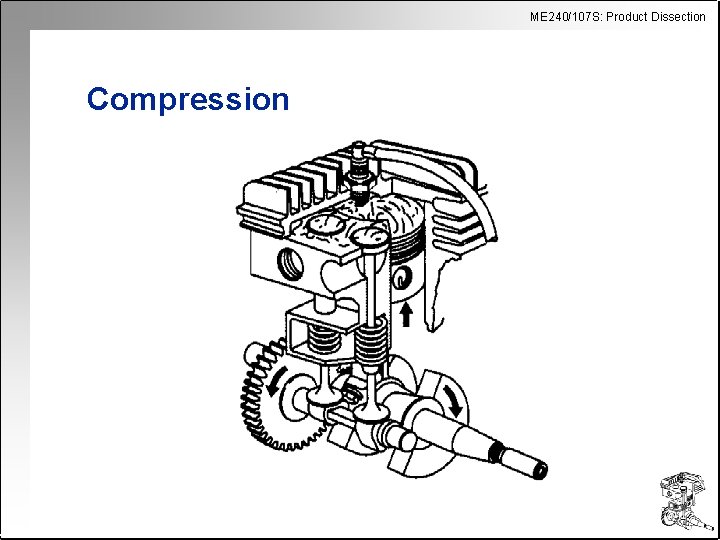
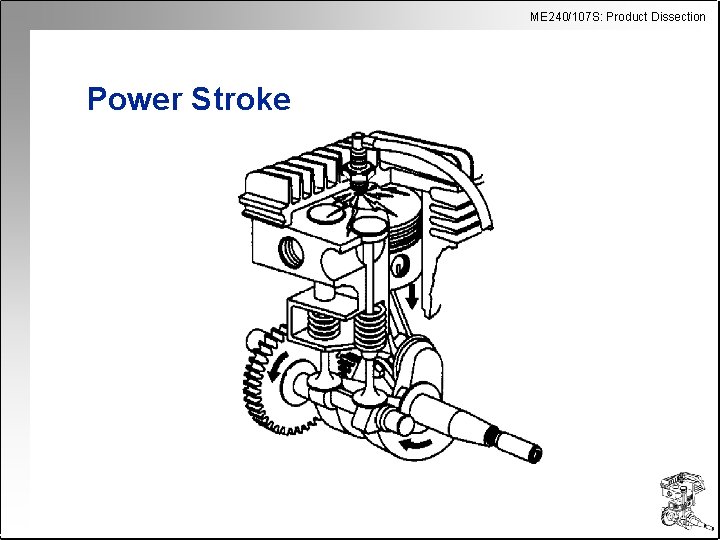
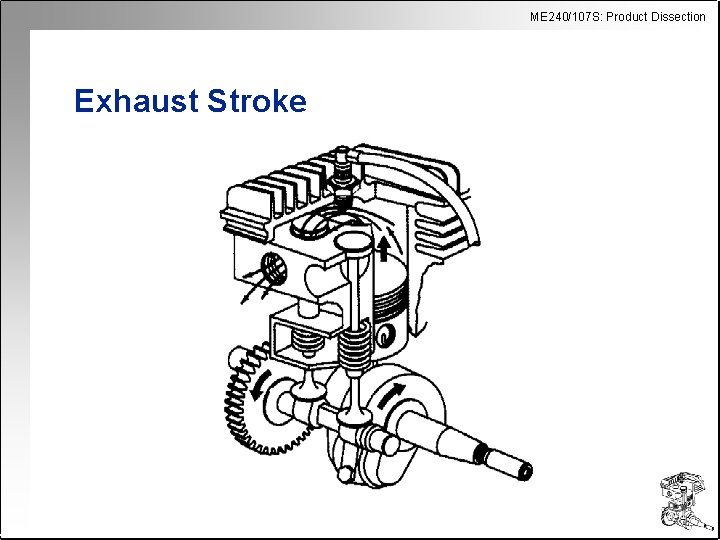
ME 240/107 S: Product Dissection Engine Classification: 4 Stroke 1 Intake Valve Intake Manifold Cylinder 2 Exhaust Valve Exhaust Manifold 3 4 Spark Plug Piston Connecting Rod Intake Stroke Intake valve opens, admitting fuel and air. Exhaust valve closed for most of stroke Crankcase Compression Stroke Both valves closed, Fuel/air mixture is compressed by rising piston. Spark ignites mixture near end of stroke. Power Stroke Fuel-air mixture burns, increasing temperature and pressure, expansion of combustion gases drives piston down. Both valves closed - exhaust valve opens near end of stroke Exhaust Stroke Exhaust valve open, exhaust products are displaced from cylinder. Intake valve opens near end of stroke.
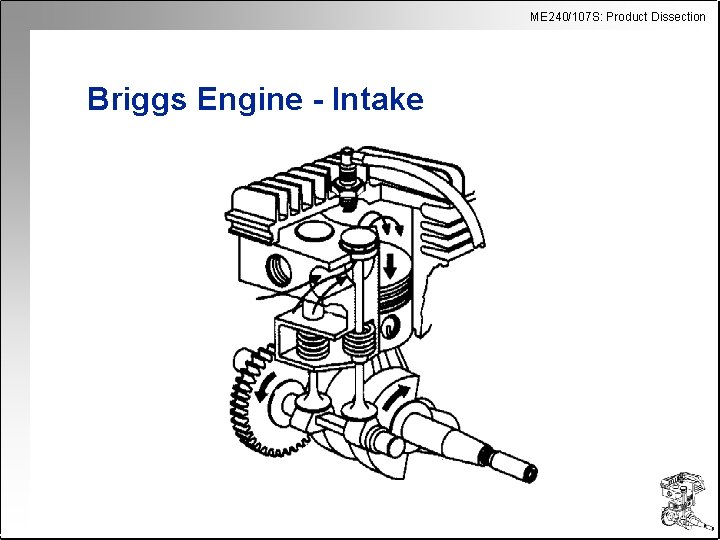
ME 240/107 S: Product Dissection Briggs Engine - Intake
ME 240/107 S: Product Dissection Compression
ME 240/107 S: Product Dissection Power Stroke
ME 240/107 S: Product Dissection Exhaust Stroke
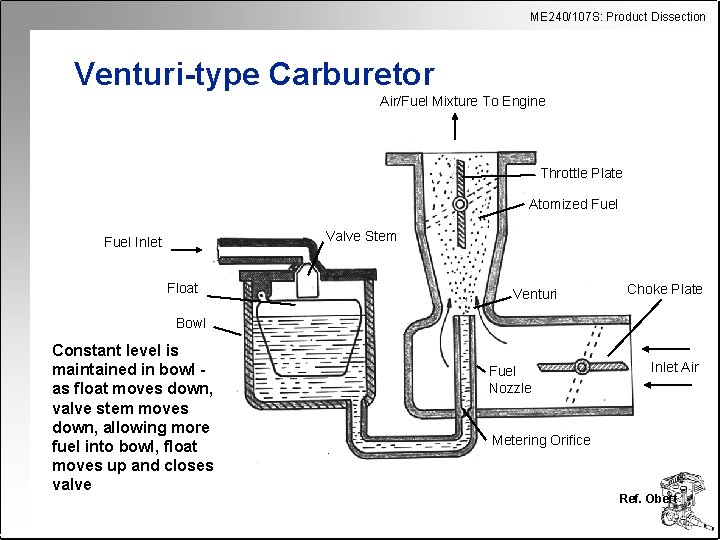
ME 240/107 S: Product Dissection Carburetors n Purpose of the carburetor is to produce a mixture of fuel and air on which the engine can operate n Must produce economical fuel consumption and smooth engine operation over a wide range of speeds n Requires complicated device rather than a simple mixing valve; price is very important!
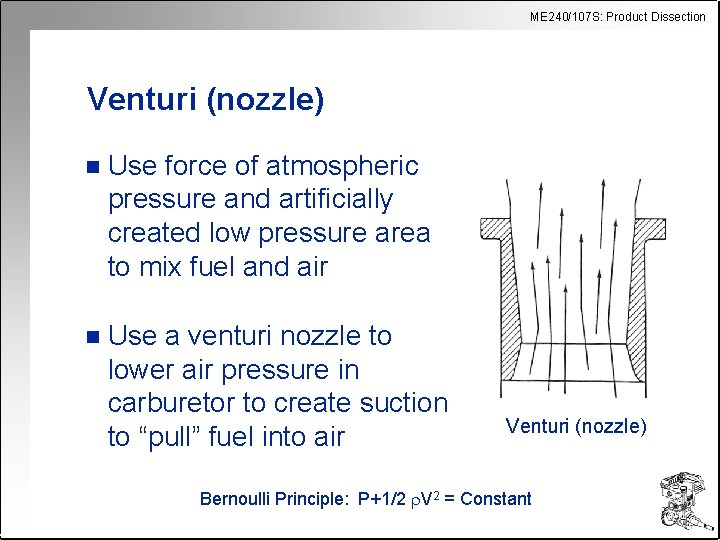
ME 240/107 S: Product Dissection Venturi (nozzle) n Use force of atmospheric pressure and artificially created low pressure area to mix fuel and air n Use a venturi nozzle to lower air pressure in carburetor to create suction to “pull” fuel into air Venturi (nozzle) Bernoulli Principle: P+1/2 V 2 = Constant
ME 240/107 S: Product Dissection Venturi-type Carburetor Air/Fuel Mixture To Engine Throttle Plate Atomized Fuel Valve Stem Fuel Inlet Float Venturi Choke Plate Bowl Constant level is maintained in bowl as float moves down, valve stem moves down, allowing more fuel into bowl, float moves up and closes valve Fuel Nozzle Inlet Air Metering Orifice Ref. Obert
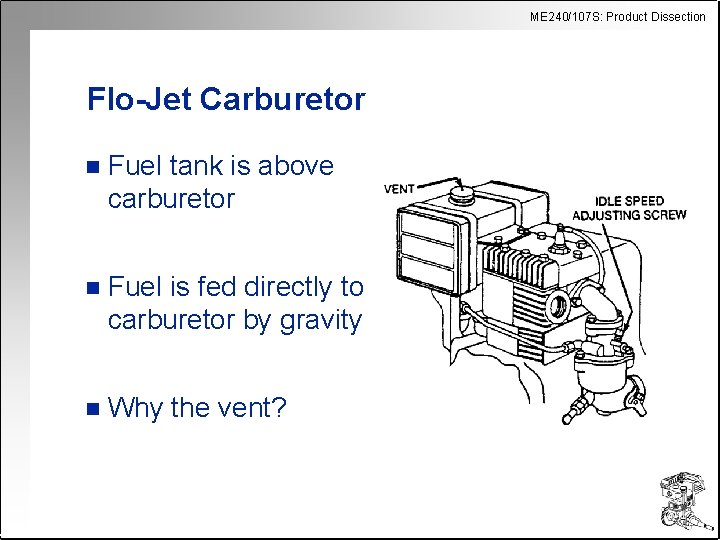
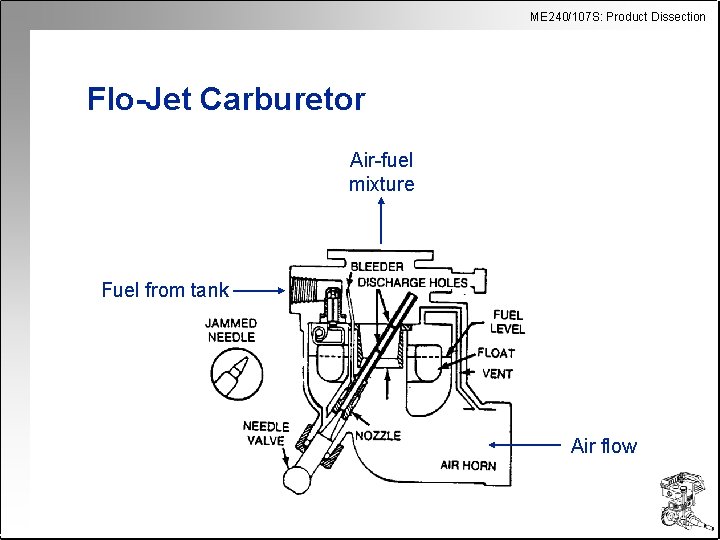
ME 240/107 S: Product Dissection Flo-Jet Carburetor n Fuel tank is above carburetor n Fuel is fed directly to carburetor by gravity n Why the vent?
ME 240/107 S: Product Dissection Flo-Jet Carburetor Air-fuel mixture Fuel from tank Air flow
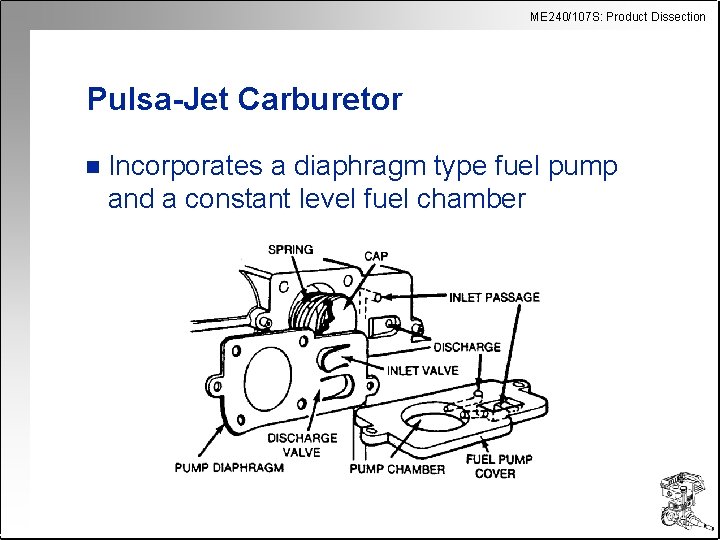
ME 240/107 S: Product Dissection Pulsa-Jet Carburetor n Incorporates a diaphragm type fuel pump and a constant level fuel chamber
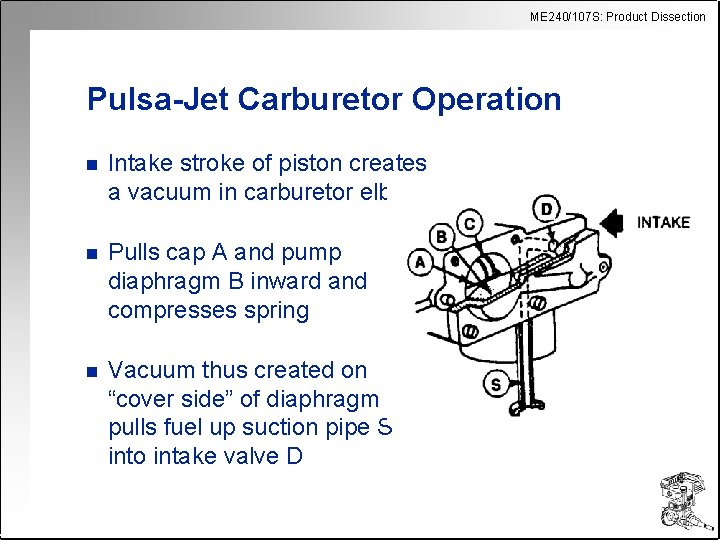
ME 240/107 S: Product Dissection Pulsa-Jet Carburetor Operation n Intake stroke of piston creates a vacuum in carburetor elbow n Pulls cap A and pump diaphragm B inward and compresses spring n Vacuum thus created on “cover side” of diaphragm pulls fuel up suction pipe S into intake valve D
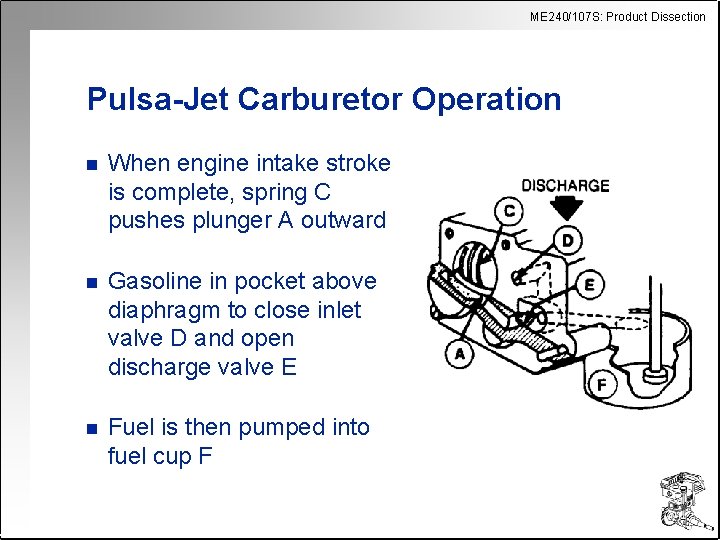
ME 240/107 S: Product Dissection Pulsa-Jet Carburetor Operation n When engine intake stroke is complete, spring C pushes plunger A outward n Gasoline in pocket above diaphragm to close inlet valve D and open discharge valve E n Fuel is then pumped into fuel cup F
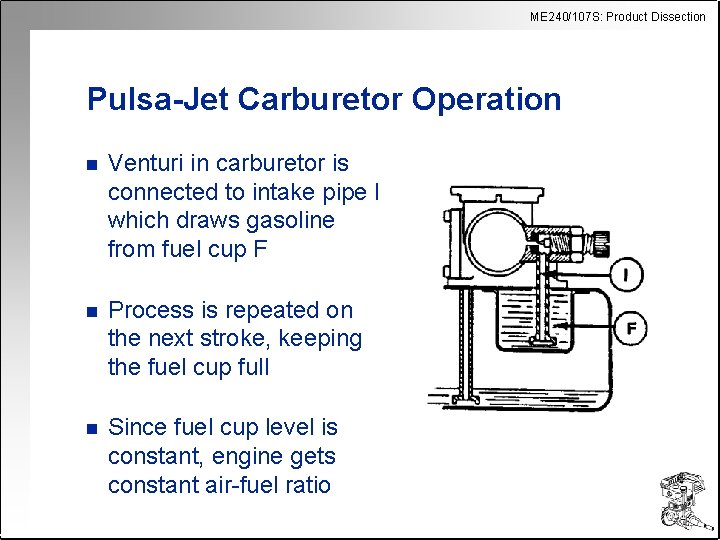
ME 240/107 S: Product Dissection Pulsa-Jet Carburetor Operation n Venturi in carburetor is connected to intake pipe I which draws gasoline from fuel cup F n Process is repeated on the next stroke, keeping the fuel cup full n Since fuel cup level is constant, engine gets constant air-fuel ratio
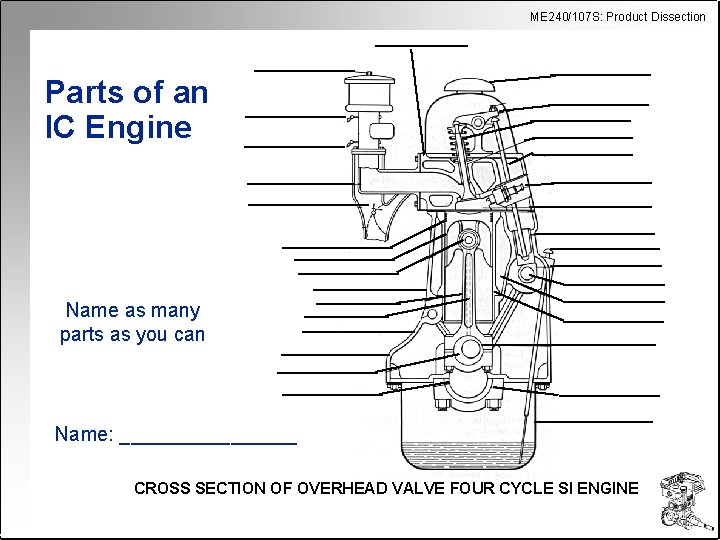
ME 240/107 S: Product Dissection Parts of an IC Engine Name as many parts as you can Name: ________ CROSS SECTION OF OVERHEAD VALVE FOUR CYCLE SI ENGINE