
ME 111 Development of surfaces 1 Development is



- Slides: 15
ME 111 Development of surfaces 1
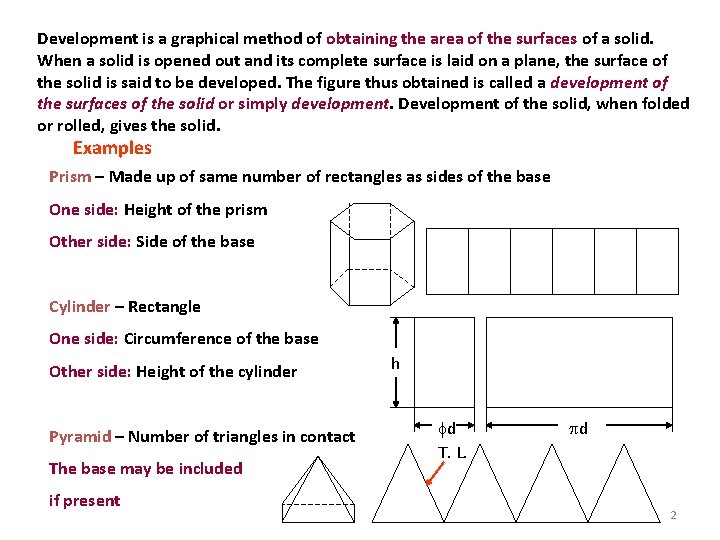
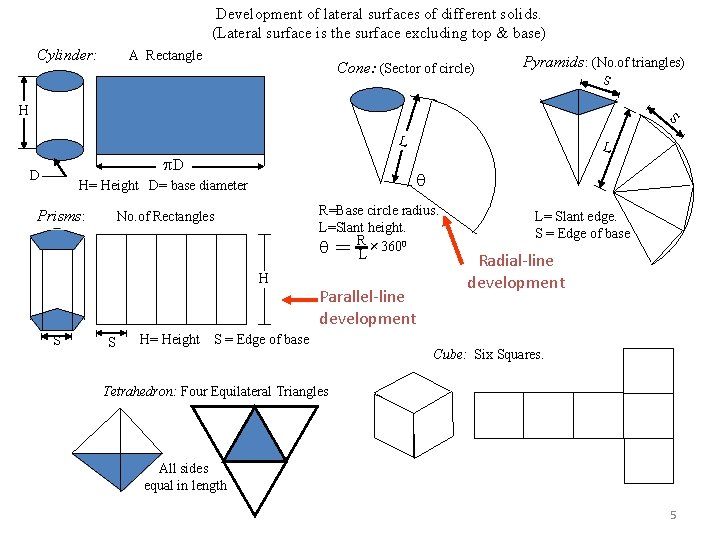
Development is a graphical method of obtaining the area of the surfaces of a solid. When a solid is opened out and its complete surface is laid on a plane, the surface of the solid is said to be developed. The figure thus obtained is called a development of the surfaces of the solid or simply development. Development of the solid, when folded or rolled, gives the solid. Examples Prism – Made up of same number of rectangles as sides of the base One side: Height of the prism Other side: Side of the base Cylinder – Rectangle One side: Circumference of the base Other side: Height of the cylinder Pyramid – Number of triangles in contact The base may be included if present h fd T. L. d 2
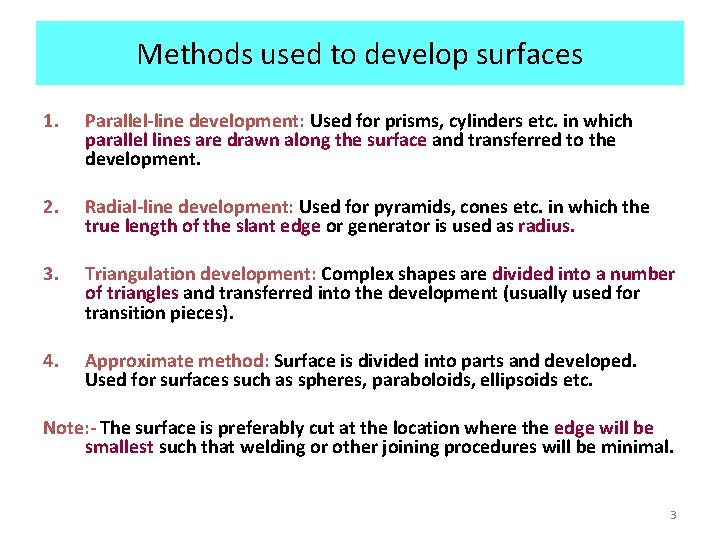
Methods used to develop surfaces 1. Parallel-line development: Used for prisms, cylinders etc. in which parallel lines are drawn along the surface and transferred to the development. 2. Radial-line development: Used for pyramids, cones etc. in which the true length of the slant edge or generator is used as radius. 3. Triangulation development: Complex shapes are divided into a number of triangles and transferred into the development (usually used for transition pieces). 4. Approximate method: Surface is divided into parts and developed. Used for surfaces such as spheres, paraboloids, ellipsoids etc. Note: - The surface is preferably cut at the location where the edge will be smallest such that welding or other joining procedures will be minimal. 3
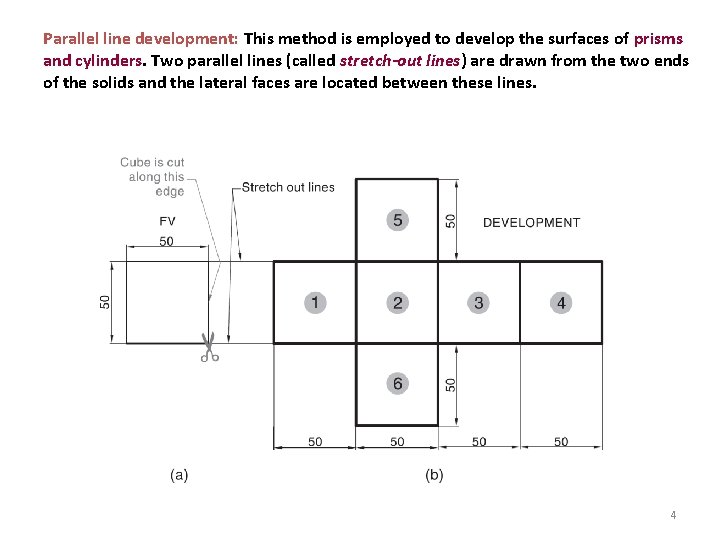
Parallel line development: This method is employed to develop the surfaces of prisms and cylinders. Two parallel lines (called stretch-out lines) are drawn from the two ends of the solids and the lateral faces are located between these lines. 4
Development of lateral surfaces of different solids. (Lateral surface is the surface excluding top & base) A Rectangle Cone: (Sector of circle) Pyramids: (No. of triangles) L L S Cylinder: H S D D H= Height D= base diameter Prisms: = H S S H= Height + R=Base circle radius. L=Slant height. R 3600 L No. of Rectangles Parallel-line development S = Edge of base L= Slant edge. S = Edge of base Radial-line development Cube: Six Squares. Tetrahedron: Four Equilateral Triangles All sides equal in length 5
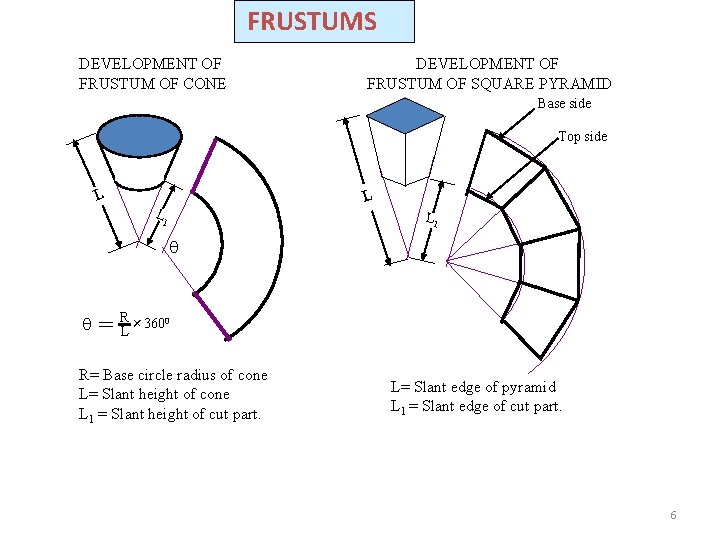
FRUSTUMS DEVELOPMENT OF FRUSTUM OF CONE DEVELOPMENT OF FRUSTUM OF SQUARE PYRAMID Base side Top side L L L 1 = R 3600 L + R= Base circle radius of cone L= Slant height of cone L 1 = Slant height of cut part. L= Slant edge of pyramid L 1 = Slant edge of cut part. 6
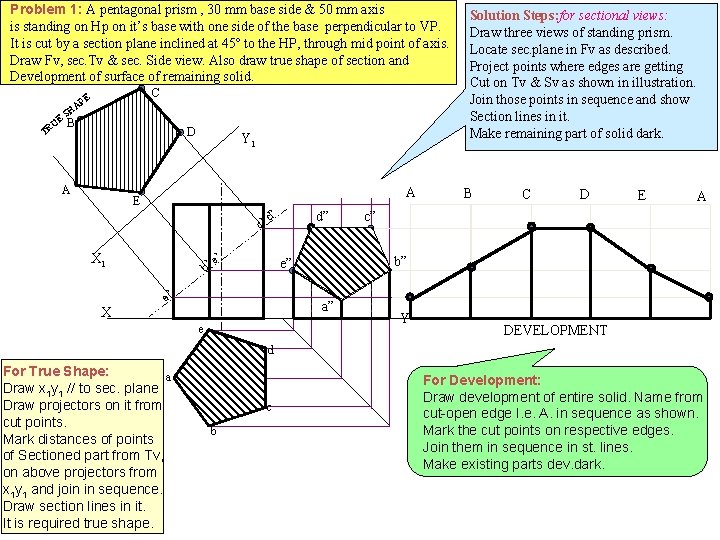
Problem 1: A pentagonal prism , 30 mm base side & 50 mm axis is standing on Hp on it’s base with one side of the base perpendicular to VP. It is cut by a section plane inclined at 45º to the HP, through mid point of axis. Draw Fv, sec. Tv & sec. Side view. Also draw true shape of section and Development of surface of remaining solid. C E AP SH EB U TR D A Y 1 A E ’ d” d c’ X 1 b’ e’ a” X e B C D E A c” b” e” a’ Solution Steps: for sectional views: Draw three views of standing prism. Locate sec. plane in Fv as described. Project points where edges are getting Cut on Tv & Sv as shown in illustration. Join those points in sequence and show Section lines in it. Make remaining part of solid dark. Y DEVELOPMENT d For True Shape: a Draw x 1 y 1 // to sec. plane Draw projectors on it from cut points. Mark distances of points of Sectioned part from Tv, on above projectors from x 1 y 1 and join in sequence. Draw section lines in it. It is required true shape. c b For Development: Draw development of entire solid. Name from cut-open edge I. e. A. in sequence as shown. Mark the cut points on respective edges. Join them in sequence in st. lines. Make existing parts dev. dark.
Problem 2: A cone, 50 mm base diameter and 70 mm axis is standing on it’s base on Hp. It cut by a section plane 450 inclined to Hp through base end of end generator. Draw projections, sectional views, true shape of section and development of surfaces of remaining solid. Solution Steps: for sectional views: Draw three views of standing cone. Locate sec. plane in Fv as described. Project points where generators are getting Cut on Tv & Sv as shown in illustration. Join those points in sequence and show Section lines in it. Make remaining part of solid dark. N O I CT E U R T O SE Y 1 A SH A SECTIONAL S. V o’ SE PL CT AN IO E N PE F B DEVELOPMENT C D X 1 E X a’ h’b’ c’ g’ f’ d’ e’ g For True Shape: Draw x 1 y 1 // to sec. plane Draw projectors on it from cut points. Mark distances of points of Sectioned part from Tv, on above projectors from x 1 y 1 and join in sequence. Draw section lines in it. It is required true shape. h g” h”f” a”e” b”d” c” Y F G f a e b d c SECTIONAL T. V For Development: Draw development of entire solid. Name from cut-open edge i. e. A. in sequence as shown. Mark the cut points on respective edges. Join them in sequence in curvature. Make existing parts dev. dark. H A
Problem 3: A cone 40 mm diameter and 50 mm axis is resting on one generator on Hp( lying on Hp) which is // to Vp. . Draw it’s projections. It is cut by a horizontal section plane through it’s base center. Draw sectional TV, development of the surface of the remaining part of cone. Follow similar solution steps for Sec. views - True shape – Development as per previous problem! DEVELOPMENT A o’ a’ ’b’ c’g h B ’ HORIZONTAL SECTION PLANE c’ g’ f’ d’ e’ g h a o’ Y e’ a’ h’b’ D d’f’ X f 1 d c E F h 1 e e 1 O b O g 1 f C a 1 G o 1 H b 1 d 1 A c 1 SECTIONAL T. V (SHOWING TRUE SHAPE OF SECTION)
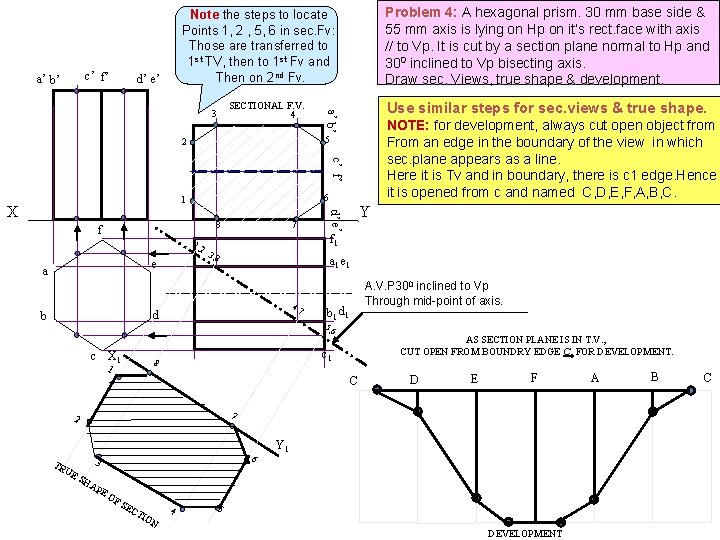
c’ f’ a’ b’ Problem 4: A hexagonal prism. 30 mm base side & 55 mm axis is lying on Hp on it’s rect. face with axis // to Vp. It is cut by a section plane normal to Hp and 300 inclined to Vp bisecting axis. Draw sec. Views, true shape & development. Note the steps to locate Points 1, 2 , 5, 6 in sec. Fv: Those are transferred to 1 st TV, then to 1 st Fv and Then on 2 nd Fv. d’ e’ SECTIONAL F. V. 4 Use similar steps for sec. views & true shape. a’ b’ 3 1 6 NOTE: for development, always cut open object from From an edge in the boundary of the view in which sec. plane appears as a line. Here it is Tv and in boundary, there is c 1 edge. Hence it is opened from c and named C, D, E, F, A, B, C. c’ f’ 2 5 8 f 1, 2 e a 7 f 1 3, 8 a 1 e 1 4, 7 d b c X 1 A. V. P 300 inclined to Vp Through mid-point of axis. b 1 d 1 5, 6 AS SECTION PLANE IS IN T. V. , CUT OPEN FROM BOUNDRY EDGE C 1 FOR DEVELOPMENT. c 1 8 1 Y d’ e’ X C E F 7 2 6 3 TR UE D SH AP EO FS EC 4 TIO Y 1 5 N DEVELOPMENT A B C
PE A SH 2 E RU Problem 5: A solid composed of a half-cone and half- hexagonal pyramid is shown in figure. It is cut by a section plane 450 inclined to Hp, passing through mid-point of axis. Draw F. v. , sectional T. v. , true shape of section and development of remaining part of the solid. ( take radius of cone and each side of hexagon 30 mm long and axis 70 mm. ) 3 T 4 Y 1 5 1 O’ Note: A Fv & TV 8 f two solids sandwiched Section lines style in both: Development of half cone & half pyramid: PM EN T 6 X 1 2’ 6’ DE VE 4’ 3’ 5’ B LO 7 F. V. 4 C 2 3 X d’e’ c’f’ f a’ Y O 5 4 4 1 5 6 a F 3 2 c E 7 g SECTIONAL 7 TOP VIEW. d g’b’ 6 e D 1 1’ 7’ b G A
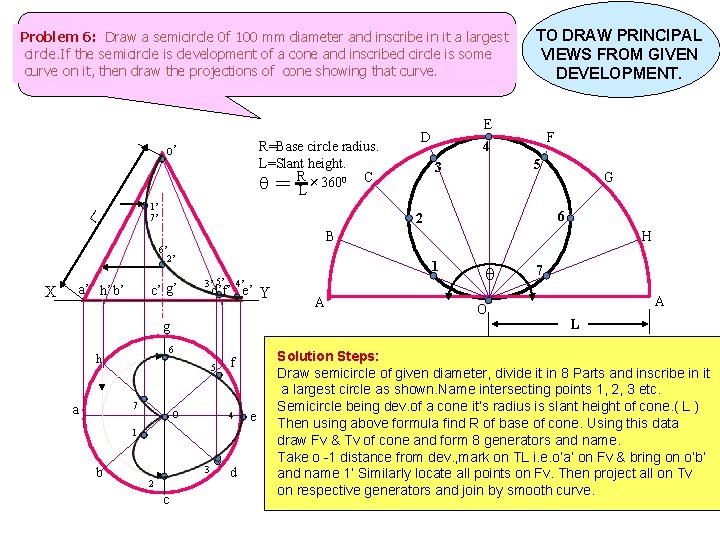
Problem 6: Draw a semicircle 0 f 100 mm diameter and inscribe in it a largest circle. If the semicircle is development of a cone and inscribed circle is some curve on it, then draw the projections of cone showing that curve. = 1’ 7’ L c’ g’ a’ h’ b’ 3’ 5’ 4’ d’f’ e’ Y 5 7 o f 4 1 3 2 c G 6 H 1 6 h b 5 3 B g a F 4 2 6’ 2’ X E D + R=Base circle radius. L=Slant height. R 3600 C L o’ TO DRAW PRINCIPAL VIEWS FROM GIVEN DEVELOPMENT. d e A O 7 A L Solution Steps: Draw semicircle of given diameter, divide it in 8 Parts and inscribe in it a largest circle as shown. Name intersecting points 1, 2, 3 etc. Semicircle being dev. of a cone it’s radius is slant height of cone. ( L ) Then using above formula find R of base of cone. Using this data draw Fv & Tv of cone and form 8 generators and name. Take o -1 distance from dev. , mark on TL i. e. o’a’ on Fv & bring on o’b’ and name 1’ Similarly locate all points on Fv. Then project all on Tv on respective generators and join by smooth curve.
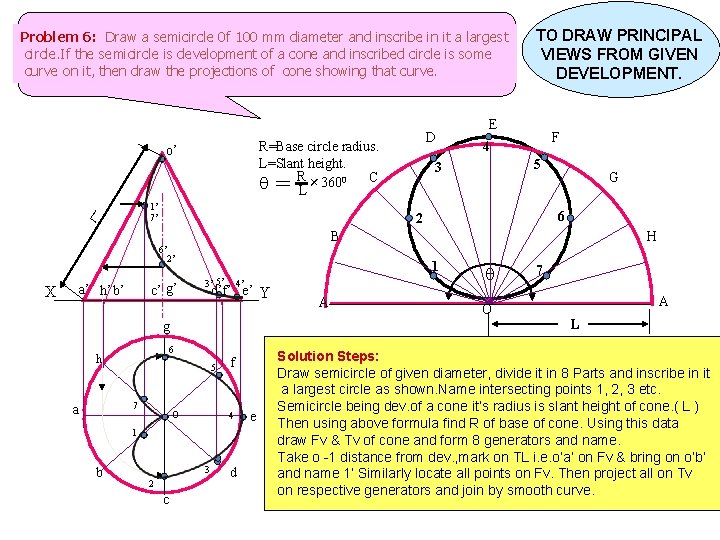
Problem 6: Draw a semicircle 0 f 100 mm diameter and inscribe in it a largest circle. If the semicircle is development of a cone and inscribed circle is some curve on it, then draw the projections of cone showing that curve. R=Base circle radius. L=Slant height. R 3600 C L o’ 1’ 7’ c’ g’ a’ h’ b’ 3’ 5’ 4’ d’f’ e’ Y 5 7 o f 4 1 3 2 c G 6 H 1 6 h b 5 3 B g a F 4 2 6’ 2’ X E + = L D TO DRAW PRINCIPAL VIEWS FROM GIVEN DEVELOPMENT. d e A O 7 A L Solution Steps: Draw semicircle of given diameter, divide it in 8 Parts and inscribe in it a largest circle as shown. Name intersecting points 1, 2, 3 etc. Semicircle being dev. of a cone it’s radius is slant height of cone. ( L ) Then using above formula find R of base of cone. Using this data draw Fv & Tv of cone and form 8 generators and name. Take o -1 distance from dev. , mark on TL i. e. o’a’ on Fv & bring on o’b’ and name 1’ Similarly locate all points on Fv. Then project all on Tv on respective generators and join by smooth curve.
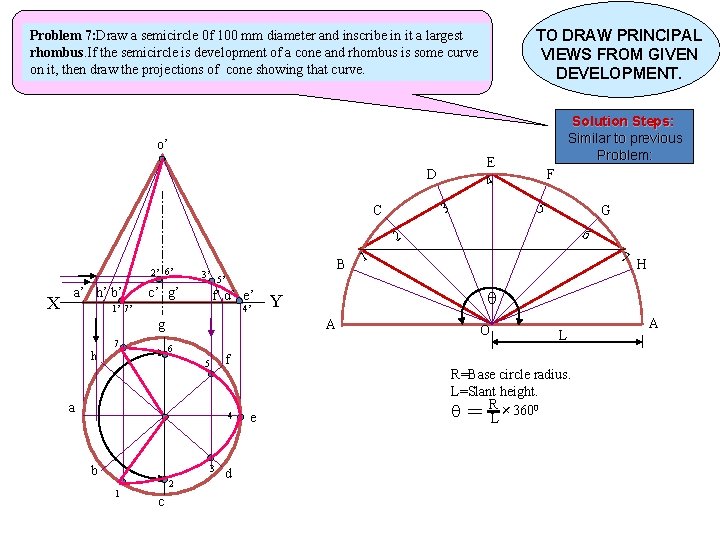
TO DRAW PRINCIPAL VIEWS FROM GIVEN DEVELOPMENT. Problem 7: Draw a semicircle 0 f 100 mm diameter and inscribe in it a largest rhombus. If the semicircle is development of a cone and rhombus is some curve on it, then draw the projections of cone showing that curve. Solution Steps: Similar to previous Problem: o’ E 4 D 5 3 C F G 6 2 2’ 6’ X a’ h’ b’ c’ g’ B 3’ 5’ f’ d’ e’ 1’ 7’ 4’ g h 7 5 4 b 3 1 2 c d e O L R=Base circle radius. L=Slant height. R 3600 L = + a f H Y A 6 7 1 A
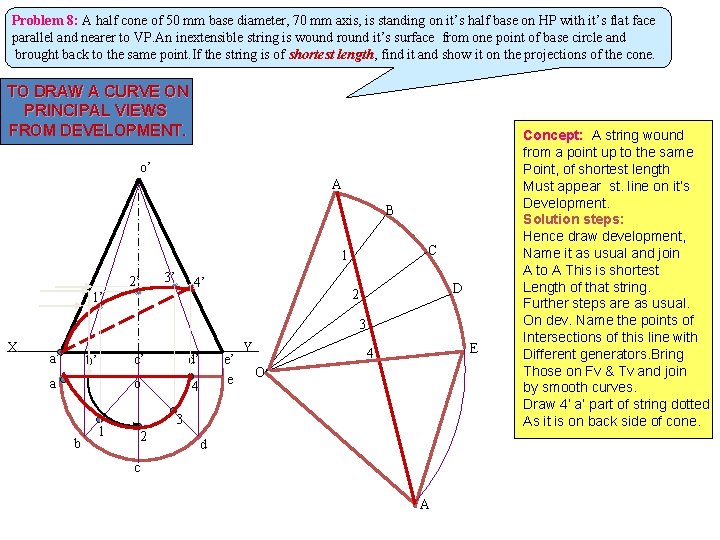
Problem 8: A half cone of 50 mm base diameter, 70 mm axis, is standing on it’s half base on HP with it’s flat face parallel and nearer to VP. An inextensible string is wound round it’s surface from one point of base circle and brought back to the same point. If the string is of shortest length, find it and show it on the projections of the cone. TO DRAW A CURVE ON PRINCIPAL VIEWS FROM DEVELOPMENT. o’ A B C 1 1’ 2’ 3’ 4’ D 2 3 X a’ b’ a b 1 c’ d’ o 4 e’ e Y E 4 O 3 2 d c A Concept: A string wound from a point up to the same Point, of shortest length Must appear st. line on it’s Development. Solution steps: Hence draw development, Name it as usual and join A to A This is shortest Length of that string. Further steps are as usual. On dev. Name the points of Intersections of this line with Different generators. Bring Those on Fv & Tv and join by smooth curves. Draw 4’ a’ part of string dotted As it is on back side of cone.