
MDROs 101 MultidrugResistant Organisms By Dr Sherif Ibrahim
MDROs 101 Multidrug-Resistant Organisms By Dr. Sherif Ibrahim 1
Objectives �Review ◦ ◦ epidemiology of MDROs Reservoir Mode of transmission Type of infection Role of environment �Review specific MDROs �Prevention strategies �Contact Precautions �Exercise Office of Epidemiology and preventive Services Division of Infectious Disease Epidemiology 2
Multi-Drug Resistant Organisms (MDROs) Epidemiology �Definition: ◦ microorganisms, predominantly bacteria, that are resistant to one or more classes of antimicrobial agents �Importance: ◦ ◦ Limited options for treatment Increase the length of stay and cost of hospitalization Increase admission to and stay in ICU High mortality rates Office of Epidemiology and preventive Services Division of Infectious Disease Epidemiology 3
MDROs - Epidemiology � Transmission: ◦ Mainly person to person through hands of healthcare personnel (HCP) ◦ Contact with contaminated environmental surfaces ◦ Transmission depends on �Availability of vulnerable patients �Antimicrobial pressure �Colonization pressure �Adherence to infection control measures �Frequent movement among healthcare facilities Office of Epidemiology and preventive Services Division of Infectious Disease Epidemiology 4
MDROs – Epidemiology �Reservoirs ◦ Infected and colonized patients ◦ Contaminated environmental surfaces & patient care equipment � Risk factors ◦ Colonization, age > 65, ICU admission, long hospital stay, frequent hospitalizations, invasive procedures, indwelling devices, underlying diseases, enteral feeding, LTCFs, antimicrobial exposure Office of Epidemiology and preventive Services Division of Infectious Disease Epidemiology 5

MDROs – Epidemiology �Infected: a person who has culture-positive for an MDRO and displays signs or symptoms of infection �Colonized: a person who has culturepositive for an MDRO but has no signs or symptoms of infection Office of Epidemiology and preventive Services Division of Infectious Disease Epidemiology 6
Important MDROs ESCAPE Enterococcus faecium (VRE) Staphylococcus aureus (MRSA) Clostridium difficile (C. Diff) Acinetobacter baumannii Pseudomonas aeruginosa Enterobacteriaceae (CRKP/CRE) Office of Epidemiology and preventive Services Division of Infectious Disease Epidemiology 7
Gram Positive MDROs �Methicillin‐Resistant Staphylococcus aureus (MRSA) �Vancomycin‐Resistant Enterococci (VRE) Office of Epidemiology and preventive Services Division of Infectious Disease Epidemiology 8
MRSA – Epidemiology � Staph aureus (SA) resistant to beta‐lactams. � Nasal colonization general population � Other colonization sites: rectum, axilla, throat, wounds ◦ 25 -30 % for SA ◦ < 2% for MRSA � Higher carriage among HCP, dialysis patients, diabetics, IV drug users � Reservoirs: ……. and……. . . � Transmission…… and……… Office of Epidemiology and preventive Services Division of Infectious Disease Epidemiology 9
MRSA – Epidemiology � 49 -65 % of HA-Staph infections NHSN ◦ 94, 360 invasive MRSA infections annually/US ◦ 18, 650 associated deaths ◦ 86% of all invasive MRSA are HAIs � Staphylococcus ◦ ◦ aureus Intrinsic virulence Cause a wide range of life threatening infections Adapt to different environmental conditions Can survive in the environment 1 -56 days Office of Epidemiology and preventive Services Division of Infectious Disease Epidemiology 10
Prevention and Control � MRSA colonization generally precedes infection � Risk of developing MRSA infection among colonized individuals is 29% in 18 months � Rationale for prevention ◦ Prevent transmission from colonized to un-colonized individuals ◦ Prevent infection in colonized individuals �MRSA-specific strategies (Decolonization) �Non MRSA-specific strategies (reduce deviceassociated infections) Office of Epidemiology and preventive Services Division of Infectious Disease Epidemiology 11
Vancomycin‐Resistant Enterococci (VRE) Epidemiology � Aerobic Gram positive cocci that inhabitant of GI tract and female genital tract � Endemic � 25% in most U. S. hospitals all enterococcal isolates are VRE � Resistance is commonly seen in isolates of E. faecium than E. faecalis � Risk factors (Host, Healthcare facility, Antimicrobial exposure) Office of Epidemiology and preventive Services Division of Infectious Disease Epidemiology 12
VRE Epidemiology � Reservoirs: …. . and ……. . � Transmission: ……and …… � Common sites of infection: urinary tract, surgical wound, blood stream � Mortality rate is 2 times higher in VRE than VSE infections � Survives on environment days – weeks Office of Epidemiology and preventive Services Division of Infectious Disease Epidemiology 13
Gram Negative MDROs �Glucose fermenter (Enterobacteriaceae) ◦ Foodborne (Salmonella, Shigella) ◦ Healthcare-associated Enterobacter species (E. cloacae) ◦ Community and Healthcare-associated �Klebsiella species (K. pneumoniae) �Escherichia coli �Non–glucose fermenters ◦ Acinetobacter baumannii ◦ Pseudomonas aeruginosa Office of Epidemiology and preventive Services Division of Infectious Disease Epidemiology 14
Enterobacteriaceae Epidemiology � Normal human gut flora � Environment � Important (soil & water) cause of community and HA infections � Wide range of infections (UTI, Bacteremia, pneumonia, wound infection) � E. coli most common cause of outpatient UTIs �E coli and Klebsiella accounted for 15% all HAIs reported to NHSN 2007 Office of Epidemiology and preventive Services Division of Infectious Disease Epidemiology 15
Development of Antimicrobial-Resistant Enterobacteriaceae �B lactamases resistant to B-lactams for decades � Extended spectrum B-lactamases (ESBL) resistant to 3 rd generation cephalosporins, monobactams ◦ Usually nosocomial however 34% from patients with no healthcare contact ◦ Carbapenems the last line of defense for treatment Office of Epidemiology and preventive Services Division of Infectious Disease Epidemiology 16
Development of Antimicrobial-Resistant Enterobacteriaceae � Carbapenem-Resistant Enterobacteriaceae (CRE) ◦ Resistance production of a carbapenemase also known as KP carbapenemase (KPC) ◦ Resides on transferable plasmids wide spread transmission ◦ Limits options for treatment (Polymyxins problems with nephrotoxicity) ◦ Reservoirs: ……. . and …. . ◦ Transmission; …. . and …… Office of Epidemiology and preventive Services Division of Infectious Disease Epidemiology 17
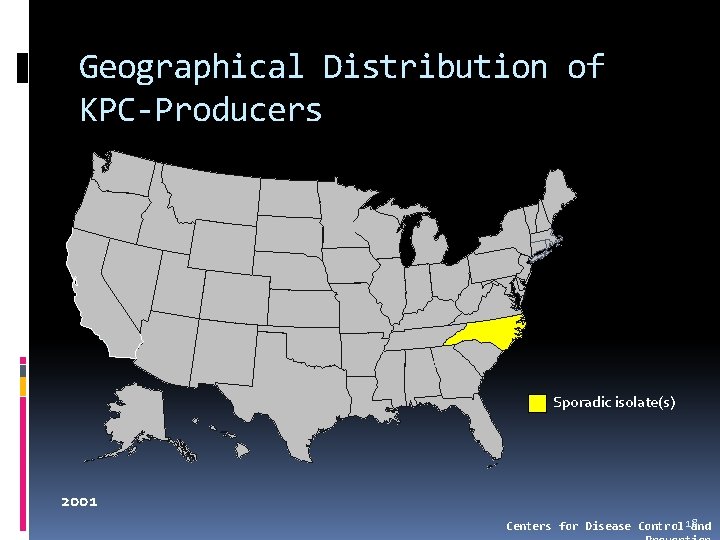
Geographical Distribution of KPC-Producers Sporadic isolate(s) 2001 Centers for Disease Control 18 and
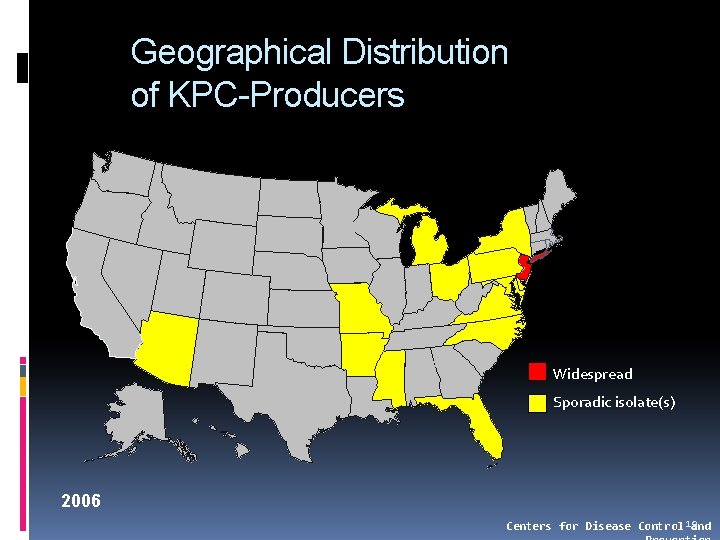
Geographical Distribution of KPC-Producers Widespread Sporadic isolate(s) 2006 Centers for Disease Control 19 and
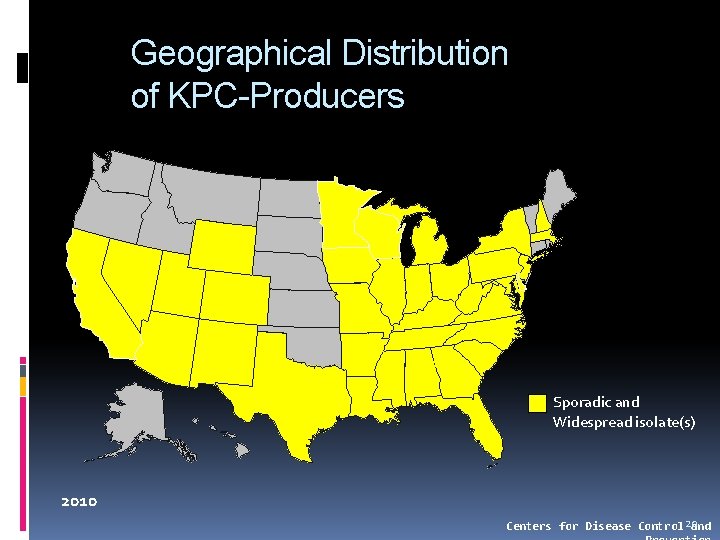
Geographical Distribution of KPC-Producers Sporadic and Widespread isolate(s) 2010 Centers for Disease Control 20 and
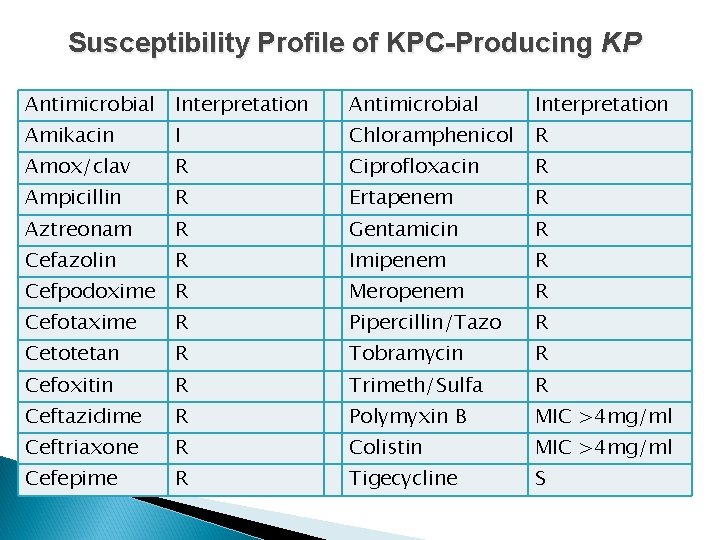
Susceptibility Profile of KPC-Producing KP Antimicrobial Interpretation Amikacin I Chloramphenicol R Amox/clav R Ciprofloxacin R Ampicillin R Ertapenem R Aztreonam R Gentamicin R Cefazolin R Imipenem R Cefpodoxime R Meropenem R Cefotaxime R Pipercillin/Tazo R Cetotetan R Tobramycin R Cefoxitin R Trimeth/Sulfa R Ceftazidime R Polymyxin B MIC >4 mg/ml Ceftriaxone R Colistin MIC >4 mg/ml Cefepime R Tigecycline S
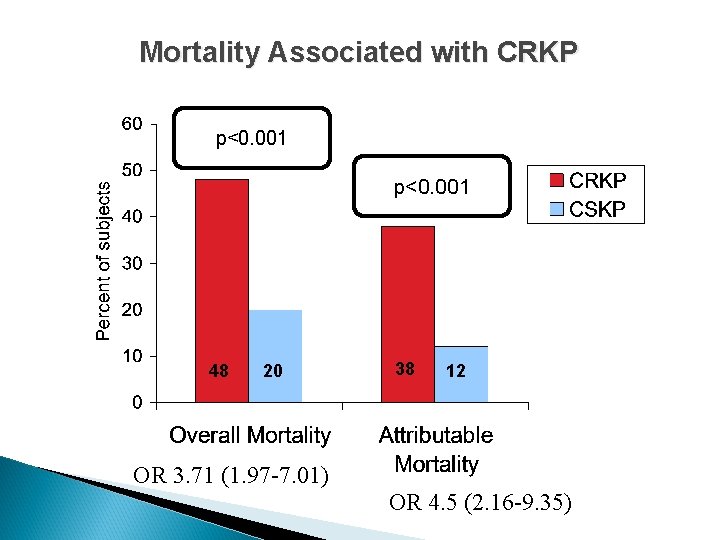
Mortality Associated with CRKP p<0. 001 48 20 38 12 OR 3. 71 (1. 97 -7. 01) OR 4. 5 (2. 16 -9. 35)
CRKP in Long-Term Care Facilities �Few clinical cases large reservoir of colonized patients in LTCFs. �Colonization outbreak �Recipe rate was as high as 49% in one for CRKP outbreaks: ◦ Infection control breaches (lack of compliance) ◦ Unrecognized colonized residents serving as reservoirs for transmission Office of Epidemiology and preventive Services Division of Infectious Disease Epidemiology 23
MDR- Acinetobacter baumannii (Ab) Epidemiology � Non-motile gram negative bacteria (32 species) � Ubiquitous widely distributed in nature (soil, water, food, sewage) & the hospital environment � MDR-Ab is primarily a nosocomial pathogen � Long survival time on inanimate surfaces extensive environmental contamination � Transmission …. and…… � Reservoirs: …… and …. . Office of Epidemiology and preventive Services Division of Infectious Disease Epidemiology 24
MDR- Ab Epidemiology Widespread environmental contamination Respiratory care equipment Bed rails, Bedside tables, Mattresses, Pillows Curtains, door handles Keyboards Floor mops, sinks Air humidifiers Patient care items Wound care procedures Equipment carts, Infusion pumps Patient monitors and Xray board Most common gram negative carried by skin of HCP � Frequently colonizes tracheostomy site � Chlorohexidine resistance 25
MDR- Ab Epidemiology � MDR- ◦ ◦ ◦ Pneumonia (Ventilator-associated pneumonia) Urinary tract Bacteremia Meningitis Skin/wound infections � MDR- ◦ ◦ Acinetobacter mainly causes HAIs Acinetobacter infections Acute care (ICUs) traditionally, associated with outbreaks LTAC & LTCFs Injured military personnel Outbreaks mortality rates up to 75% Office of Epidemiology and preventive Services Division of Infectious Disease Epidemiology 26
MDR- Pseudomonas aeruginosa Epidemiology � Aerobic gram-negative rods � Ubiquitous in soil and water � Moist environment (hydrophilic) (e. g. sink drains, vegetables, river water, etc. ) � P. aeruginosa is an opportunistic infection rarely colonize healthy individuals � At Risk individuals: ◦ ◦ Immuno-compromised Burn patients Patients on mechanical ventilation Cystic fibrosis patients Office of Epidemiology and preventive Services Division of Infectious Disease Epidemiology 27
P. aeruginosa Epidemiology � 10% of all hospital-acquired infections � Often cause severe life threatening HAIs � Can be found everywhere � Can be community acquired � In healthcare facilities: respiratory equipment, food, sinks, taps, toilets, weak disinfectants, showers and mops, uncooked vegetables, flower water � � Transmission …. . and ………. Reservoirs ……. and ………… � Colonization precedes infection in 50% of cases Office of Epidemiology and preventive Services Division of Infectious Disease Epidemiology 28
Prevention Strategies (MDROs) Core Measures Administrative support Surveillance Patient placement Patient/staff cohorting Hand hygiene Contact precautions Protocol for lab notification Dedicated equipment Device use Environmental measures Monitor compliance Education Antimicrobial stewardship Supplemental Measures Preemptive isolation Active surveillance culture Chlorohexidine bathing 29
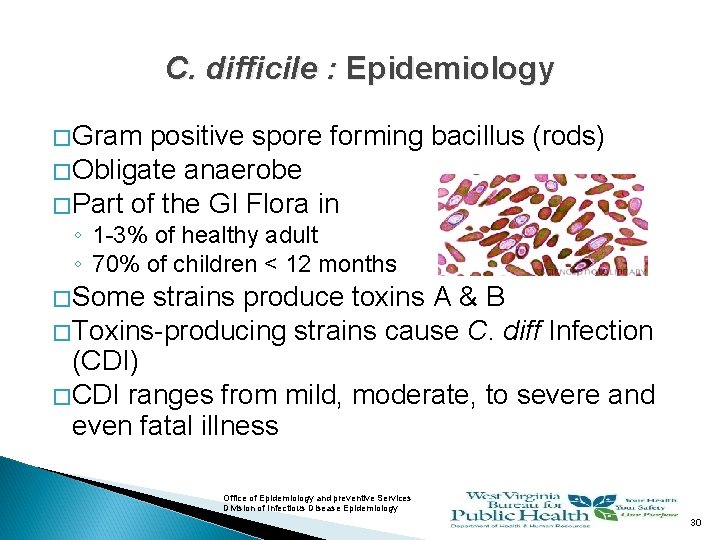
C. difficile : Epidemiology � Gram positive spore forming bacillus (rods) � Obligate anaerobe � Part of the GI Flora in ◦ 1 -3% of healthy adult ◦ 70% of children < 12 months � Some strains produce toxins A & B � Toxins-producing strains cause C. diff Infection (CDI) � CDI ranges from mild, moderate, to severe and even fatal illness Office of Epidemiology and preventive Services Division of Infectious Disease Epidemiology 30
C. difficile Epidemiology Transmission � Fecal – oral route ◦ Contaminated hands of healthcare workers ◦ Contaminated environmental surfaces. � Person to person in hospitals and LTCFs � Reservoir: ◦ Human: colonized or infected persons ◦ Contaminated environment � C. diff spores can survive for up 5 months on environmental surfaces. Office of Epidemiology and preventive Services Division of Infectious Disease Epidemiology 31
C. difficile: Epidemiology �A common cause of nosocomial antibioticassociated diarrhea (AAD) � Most common infectious cause of acute diarrheal illness in LTCFs � The only nosocomial organism that is anaerobic and forms spores � Infective dose is < 10 spores Office of Epidemiology and preventive Services Division of Infectious Disease Epidemiology 32
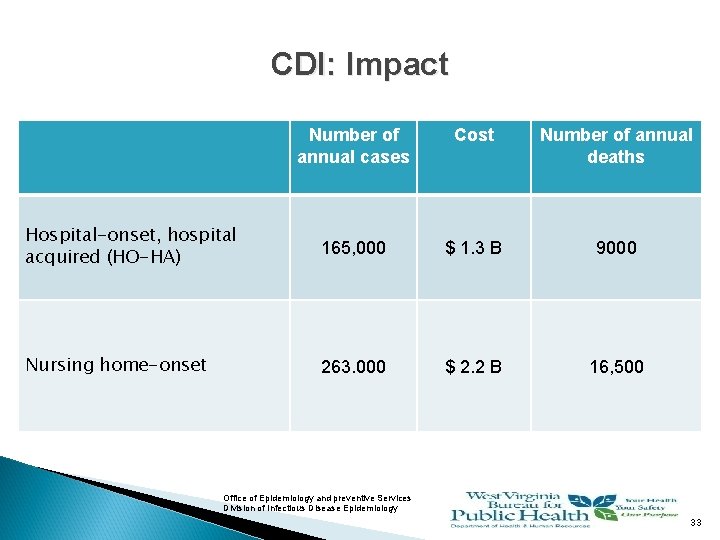
CDI: Impact Number of annual cases Cost Number of annual deaths Hospital-onset, hospital acquired (HO-HA) 165, 000 $ 1. 3 B 9000 Nursing home-onset 263. 000 $ 2. 2 B 16, 500 Office of Epidemiology and preventive Services Division of Infectious Disease Epidemiology 33
Clinical Manifestations �Illness caused by toxin-producing strains of C. difficile ranges from ◦ Asymptomatic carriers = Colonized ◦ Mild or moderate diarrhea ◦ Pseudo membranous colitis that can be fatal �A median time between exposure to onset of CDI symptoms is of 2– 3 days �Risk of developing CDI after exposure ranges between 5 -10 days to 10 weeks Office of Epidemiology and preventive Services Division of Infectious Disease Epidemiology 34
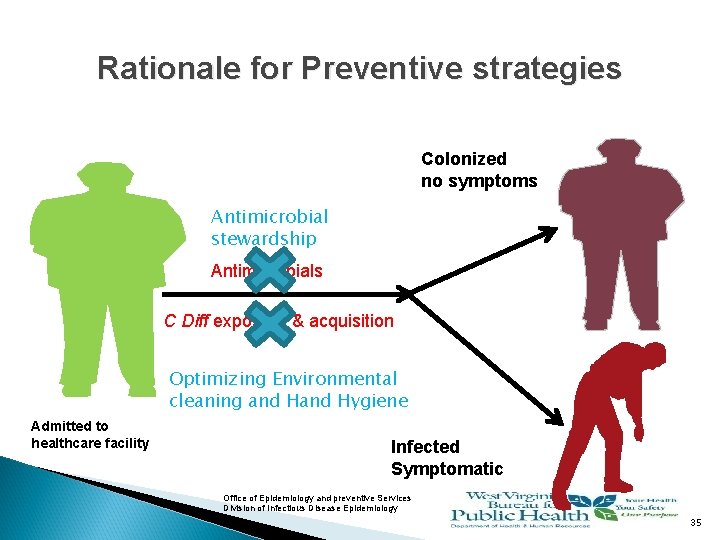
Rationale for Preventive strategies Colonized no symptoms Antimicrobial stewardship Antimicrobials C Diff exposure & acquisition Optimizing Environmental cleaning and Hygiene Admitted to healthcare facility Infected Symptomatic Office of Epidemiology and preventive Services Division of Infectious Disease Epidemiology 35
Preventive Strategies: C. Diff Core Measures Surveillance Contact Precautions (CP) for duration of diarrhea Hand hygiene (HH) Dedicated equipment Cleaning and disinfection of equipment and environment Laboratory-based alert system for immediate notification Educate HCP, housekeeping, admin staff, patients, families, visitors, about CDI Monitor compliance � � � Supplemental Measures Extend (CP) beyond duration of diarrhea (48 hours) Presumptive isolation for symptomatic patients Implement soap and water for HH before exiting room of a patient with CDI Implement universal glove use on units with high CDI rates Use sodium hypochlorite (bleach) - containing agents for environmental cleaning Implement an antimicrobial stewardship program Office of Epidemiology and preventive Services Division of Infectious Disease Epidemiology 36
Contact Precautions (CP) Patient placement (factors to consider) � Hand hygiene (HH) � Gloves � ◦ ◦ � Don gloves upon room entry Change gloves after contact with infectious materials Change gloves when moving from contaminated to non contaminated site Remove gloves and HH before leaving the room or caring for another patient Gowns ◦ Don gown upon room entry ◦ Remove and discard gloves before removing gown ◦ Discarding gown before exiting the room After gown and gloves removal HH make sure not to touch any potentially contaminated environmental surface in the room � Dedicated equipment (BP cuff, stethoscope, thermometer, etc. ) � Office of Epidemiology and preventive Services Division of Infectious Disease Epidemiology 37
Contact Precautions in LTCFs � Challenges of implementing CP in LTCFs � Contact Precautions should be used for the following residents with MDROs ◦ ◦ Dependent on HCP in their activities of daily life Ventilator-dependent Incontinent of stool Wound with difficult to contain discharge � Contact Precautions can be relaxed for all others residents with MDROs (consider resident’s mental status and personal hygiene) � Standard precautions should be observed all times � Dedicated equipment � Signage for HCP and visitors Office of Epidemiology and preventive Services Division of Infectious Disease Epidemiology 38
Conclusion �MDROs represent a major clinical and infection control challenge particularly in LTCFs �You cannot do it alone Regional approach �Aggressive infection control approach works �Appropriate antimicrobial use �Training and education (HCP, Patients, Families) �Communications (intrafacility and interfacilities) Office of Epidemiology and preventive Services Division of Infectious Disease Epidemiology 39
Exercise � During morning rounds you were assigned rooms 103 and 107 for the day � Room 103 � Room # 107 ◦ Under contact precautions ◦ Has 2 patients �Patient #1 was recently treated for CRKP UTI, has a Foley catheter and is stool incontinent �Patient # 2 is CRKP colonized and has a deep bedsore in the right buttock ◦ Has two residents admitted for short term rehabilitation S/P total knee replacement. One of them is stool incontinent Office of Epidemiology and preventive Services Division of Infectious Disease Epidemiology 40
Questions � What type of precautions would you use upon entering Room 103 and why? � How is this type of organism transmitted? � What type of precautions will you be using for room 107 and why? � Do you think it is a good practice to provide care for these two rooms in the same day? Please explain why and what is the best practice in this situation? � Patient # 2 in room 103 is ambulatory and he wants to go to the activity room. What would you do? � In the schedule, all four patients are due for bathing. Specify who would go first. Office of Epidemiology and preventive Services Division of Infectious Disease Epidemiology 41

Questions Office of Epidemiology and preventive Services Division of Infectious Disease Epidemiology 42
Resources and References � SHEA/APIC Guideline: Infection Prevention and Control in the Long. Term Care Facility http: //www. dhhr. wv. gov/oeps/disease/Ato. Z/Documents/SHEA%20 Guide%20 to%20 LTCF%20 Infe ction%20 Control%20 Jul 08. pdf � Guideline for Isolation Precautions: Preventing Transmission of Infectious Agents in Healthcare Settings http: //www. cdc. gov/hicpac/pdf/isolation/Isolation 2007. pdf � � � Management of Multidrug-Resistant Organisms In Healthcare Settings, 2006 http: //www. cdc. gov/hicpac/pdf/MDROGuideline 2006. pdf DIDE Website http: //www. dhhr. wv. gov/oeps/disease/HAI/Pages/default. aspx CDC Healthcare-Associated Infections http: //www. cdc. gov/hai/ CDC SHEA “Train the Trainer” May 2011 Epidemiology and Prevention of Common Emerging MDROs “Alex Kallen, MD, MPH” DHQP, CDC Office of Epidemiology and preventive Services Division of Infectious Disease Epidemiology 43
- Slides: 43