
MDMP Inputs 1 Higher headquarters plan or a
- Slides: 1
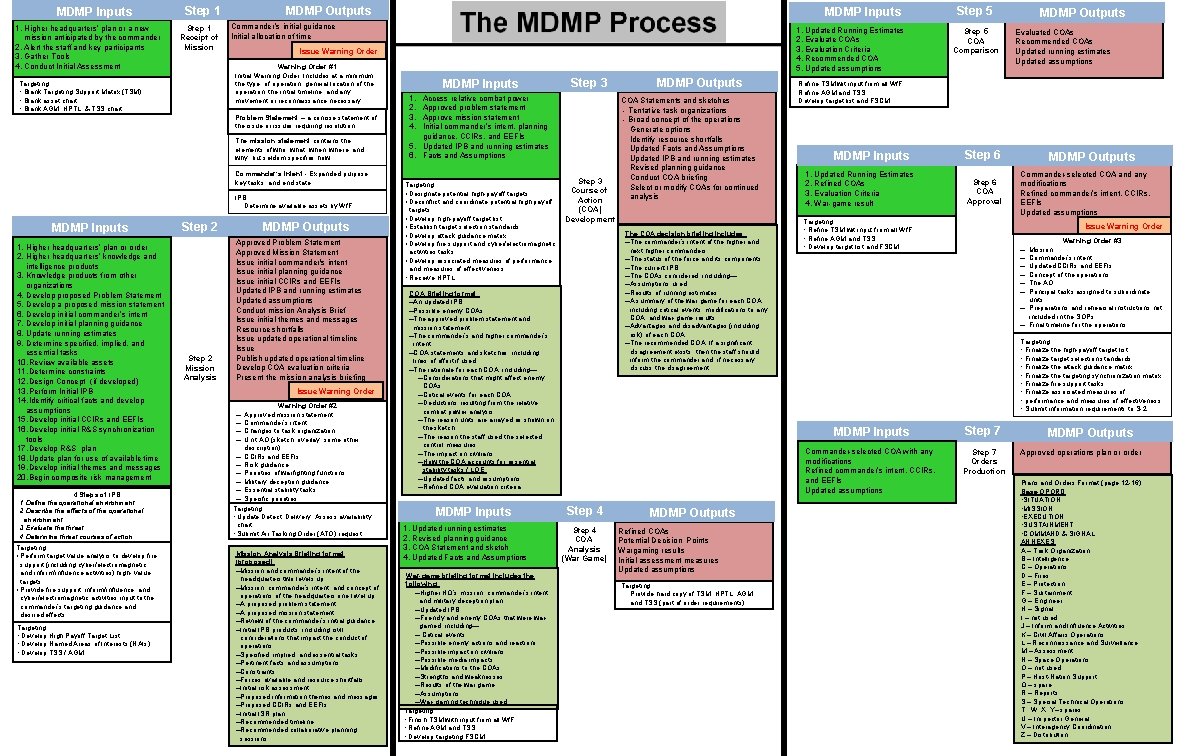
MDMP Inputs 1. Higher headquarters’ plan or a new mission anticipated by the commander 2. Alert the staff and key participants 3. Gather Tools 4. Conduct Initial Assessment Step 1 Receipt of Mission MDMP Outputs Commander’s initial guidance Initial allocation of time Problem Statement – a concise statement of the issue or issues requiring resolution The mission statement contains the elements of who, what, when, where, and why, but seldom specifies how. Commander’s intent - Expanded purpose, key tasks, and end state. IPB Determine available assets by Wf. F. MDMP Inputs Step 2 1. Higher headquarters’ plan or order 2. Higher headquarters’ knowledge and intelligence products 3. Knowledge products from other organizations 4. Develop proposed Problem Statement 5. Develop a proposed mission statement 6. Develop initial commander’s intent 7. Develop initial planning guidance 8. Update running estimates 9. Determine specified, implied, and essential tasks 10. Review available assets 11. Determine constraints 12. Design Concept (if developed) 13. Perform Initial IPB 14. Identify critical facts and develop assumptions 15. Develop initial CCIRs and EEFIs 16. Develop initial R&S synchronization tools 17. Develop R&S plan 18. Update plan for use of available time 19. Develop initial themes and messages 20. Begin composite risk management 4 Steps of IPB 1. Define the operational environment. 2. Describe the effects of the operational environment. 3. Evaluate threat. 4. Determine threat courses of action. Targeting • Perform target value analysis to develop fire support (including cyber/electromagnetic and inform/influence activities) high- value targets. • Provide fire support, inform/influence, and cyber/electromagnetic activities input to the commander’s targeting guidance and desired effects. Targeting • Develop High Payoff Target List • Develop Named Areas of Interests (NAIs) • Develop TSS / AGM Step 2 Mission Analysis 1. Updated Running Estimates 2. Evaluate COAs 3. Evaluation Criteria 4. Recommended COA 5. Updated assumptions Issue Warning Order #1 Initial Warning Order: Includes at a minimum the type of operation, general location of the operation, the initial timeline, and any movement or reconnaissance necessary Targeting • Blank Targeting Support Matrix (TSM) • Blank asset chart • Blank AGM, HPTL, & TSS chart MDMP Inputs MDMP Outputs Approved Problem Statement Approved Mission Statement Issue initial commander's intent Issue initial planning guidance Issue initial CCIRs and EEFIs Updated IPB and running estimates Updated assumptions Conduct mission Analysis Brief Issue initial themes and messages Resource shortfalls Issue updated operational timeline Issue Publish updated operational timeline Develop COA evaluation criteria Present the mission analysis briefing Issue Warning Order #2 Approved mission statement Commander’s intent Changes to task organization Unit AO (sketch, overlay, some other description) – CCIRs and EEFIs – Risk guidance – Priorities of warfighting functions – Military deception guidance – Essential stability tasks – Specific priorities Targeting • Update Detect, Delivery, Assess availability chart • Submit Air Tasking Order (ATO) request – – Mission Analysis Briefing format (proposed): – Mission and commander‘s intent of the headquarters two levels up. – Mission, commander‘s intent, and concept of operations of the headquarters one level up. – A proposed problem statement. – A proposed mission statement. – Review of the commander‘s initial guidance. – Initial IPB products, including civil considerations that impact the conduct of operations. – Specified, implied, and essential tasks. – Pertinent facts and assumptions. – Constraints. – Forces available and resource shortfalls. – Initial risk assessment. – Proposed information themes and messages. – Proposed CCIRs and EEFIs. – Initial ISR plan. – Recommended timeline. – Recommended collaborative planning sessions MDMP Inputs Step 3 1. 2. 3. 4. Access relative combat power Approved problem statement Approve mission statement Initial commander’s intent, planning guidance, CCIRs, and EEFIs 5. Updated IPB and running estimates 6. Facts and Assumptions Targeting • Designate potential high-payoff targets. • Deconflict and coordinate potential high payoff targets. • Develop high-payoff target list. • Establish target selection standards. • Develop attack guidance matrix. • Develop fire support and cyber/electromagnetic activities tasks. • Develop associated measures of performance and measures of effectiveness. • Receive HPTL Step 3 Course of Action (COA) Development 1. Updated running estimates 2. Revised planning guidance 3. COA Statement and sketch 4. Updated Facts and Assumptions War-game briefing format includes the following: –Higher HQ‘s mission, commander‘s intent, and military deception plan. –Updated IPB. –Friendly and enemy COAs that were wargamed, including— – Critical events. –Possible enemy actions and reactions. –Possible impact on civilians. –Possible media impacts. –Modifications to the COAs. –Strengths and weaknesses. –Results of the war game. –Assumptions. –War-gaming technique used. Targeting • Finish TSM with input from all Wf. F • Refine AGM and TSS • Develop targeting FSCM COA Statements and sketches - Tentative task organizations - Broad concept of the operations Generate options Identify resource shortfalls Updated Facts and Assumptions Updated IPB and running estimates Revised planning guidance Conduct COA briefing Select or modify COAs for continued analysis The COA decision briefing includes: –The commander‘s intent of the higher and next higher commanders. –The status of the force and its components. –The current IPB. –The COAs considered, including— –Assumptions used. –Results of running estimates. –A summary of the war game for each COA, including critical events, modifications to any COA, and war-game results. –Advantages and disadvantages (including risk) of each COA. –The recommended COA. If a significant disagreement exists, then the staff should inform the commander and, if necessary, discuss the disagreement. COA Briefing format: –An updated IPB. –Possible enemy COAs. –The approved problem statement and mission statement. –The commander‘s and higher commander‘s intent. –COA statements and sketches, including lines of effort if used. –The rationale for each COA, including— – Considerations that might affect enemy COAs. – Critical events for each COA. – Deductions resulting from the relative combat power analysis. – The reason units are arrayed as shown on the sketch. – The reason the staff used the selected control measures. – The impact on civilians. – How the COA accounts for essential stability tasks / LOE. – Updated facts and assumptions. – Refined COA evaluation criteria. MDMP Inputs MDMP Outputs Step 4 COA Analysis (War Game) MDMP Outputs Refined COAs Potential Decision Points Wargaming results Initial assessment measures Updated assumptions Targeting Provide hard copy of TSM, HPTL, AGM, and TSS (part of order requirements) Step 5 COA Comparison MDMP Outputs Evaluated COAs Recommended COAs Updated running estimates Updated assumptions Refine TSM wit input from all Wf. F Refine AGM and TSS Develop target list and FSCM MDMP Inputs 1. Updated Running Estimates 2. Refined COAs 3. Evaluation Criteria 4. War-game result Step 6 COA Approval Targeting • Refine TSM wit input from all Wf. F • Refine AGM and TSS • Develop target list and FSCM MDMP Outputs Commander-selected COA and any modifications Refined commander’s intent, CCIRs, EEFIs Updated assumptions Issue Warning Order #3 – – – Mission Commander’s intent Updated CCIRs and EEFIs Concept of the operations The AO Principal tasks assigned to subordinate units – Preparations and rehearsal instructions not included in the SOPs – Final timeline for the operations. Targeting • Finalize the high-payoff target list. • Finalize target selection standards. • Finalize the attack guidance matrix. • Finalize the targeting synchronization matrix. • Finalize fire support tasks. • Finalize associated measures of • performance and measures of effectiveness. • Submit information requirements to S-2. MDMP Inputs Step 7 Commander-selected COA with any modifications Refined commander’s intent, CCIRs, and EEFIs Updated assumptions Step 7 Orders Production MDMP Outputs Approved operations plan or order Plans and Orders Format (page 12 -16) Base OPORD • SITUATION • MISSION • EXECUTION • SUSTAINMENT • COMMAND & SIGNAL ANNEXES: A – Task Organization B – Intelligence C – Operations D – Fires E – Protection F – Sustainment G – Engineer H – Signal I – not used J – Inform and Influence Activities K – Civil Affairs Operations L – Reconnaissance and Surveillance M – Assessment N – Space Operations O – not used P – Host-Nation Support Q – spare R – Reports S – Special Technical Operations T , W, X, Y– spares U – Inspector General V – Interagency Coordination Z – Distribution