
MD 5 A Hash Algorithm MD 5 Why

- Slides: 12
MD 5 A Hash Algorithm…
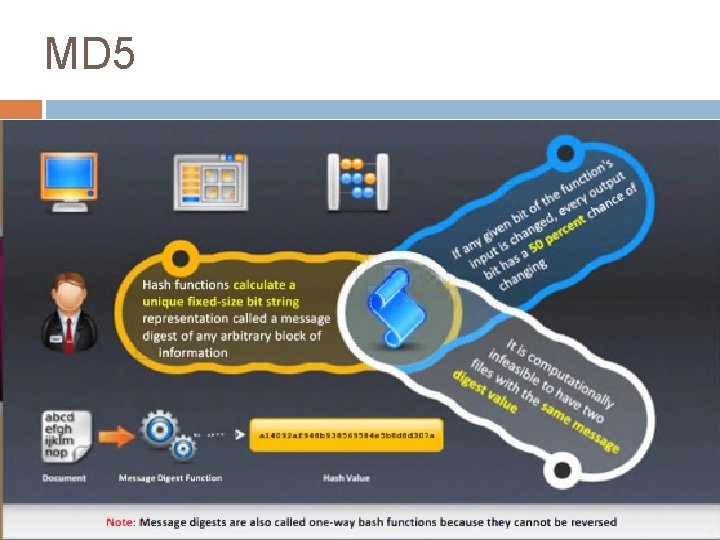
MD 5
Why HASH? Fingerprint of message does not tell anything about the message. This is because there are infinite other possible equations which can produce same result.
Principle Of MD Easy to Compute Same message same MD Difficult to reverse Different message different MD Collision Birthday Paradox for collision detection
History Series of MD algorithm. Original message digest algorithm called as MD. MD 2 (1989) for 8 bit PC, rounds 18 found to be quite weak. MD 3 was failure never released. MD 4 (1990) digest length 128 bits rounds 3, found to wantig. MD 5 (1992) we will discuss it in details. MD 6 (2008) variable digest size up to 512 bits & rounds.
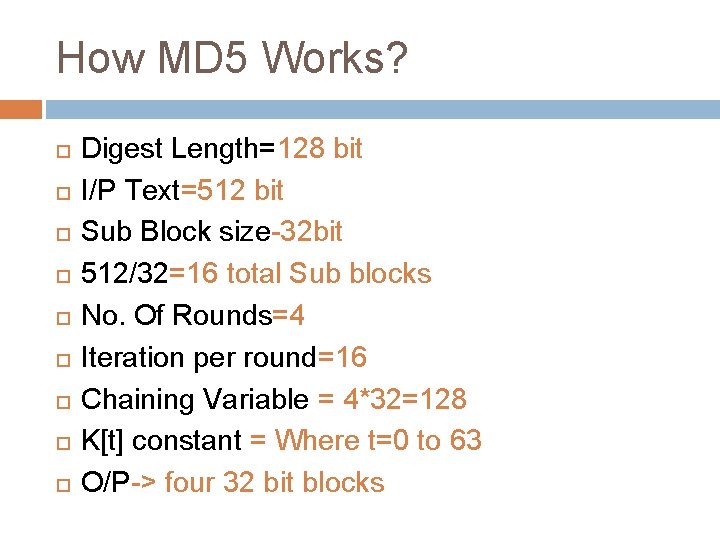
How MD 5 Works? Digest Length=128 bit I/P Text=512 bit Sub Block size-32 bit 512/32=16 total Sub blocks No. Of Rounds=4 Iteration per round=16 Chaining Variable = 4*32=128 K[t] constant = Where t=0 to 63 O/P-> four 32 bit blocks
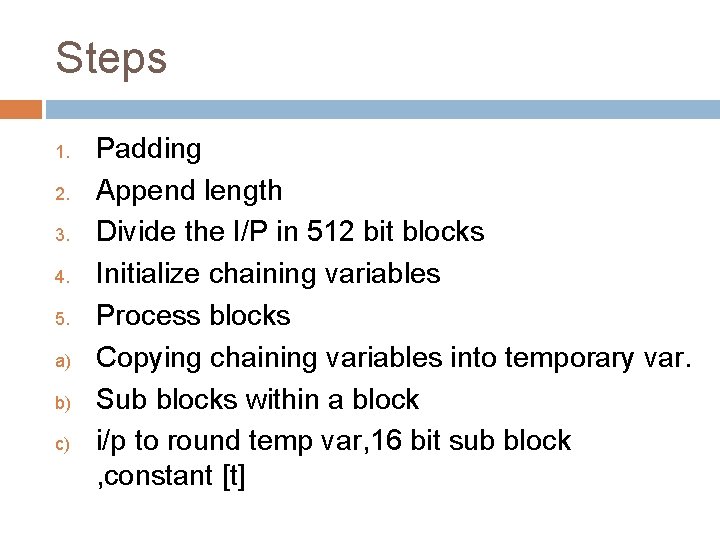
Steps 1. 2. 3. 4. 5. a) b) c) Padding Append length Divide the I/P in 512 bit blocks Initialize chaining variables Process blocks Copying chaining variables into temporary var. Sub blocks within a block i/p to round temp var, 16 bit sub block , constant [t]
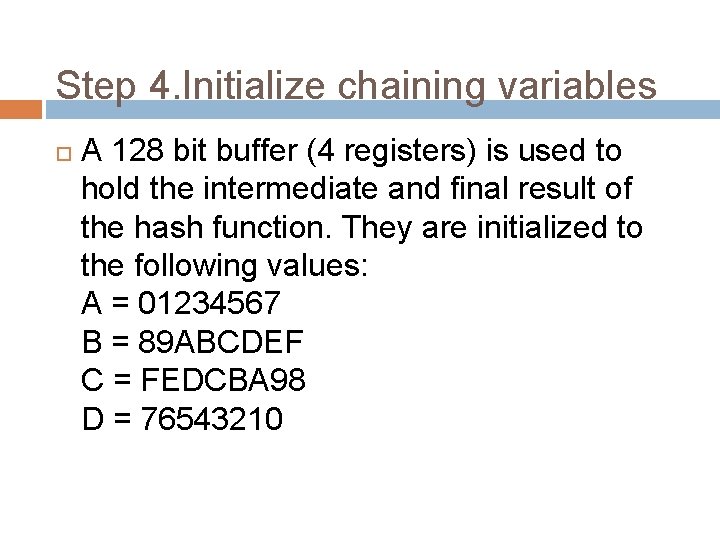
Step 4. Initialize chaining variables A 128 bit buffer (4 registers) is used to hold the intermediate and final result of the hash function. They are initialized to the following values: A = 01234567 B = 89 ABCDEF C = FEDCBA 98 D = 76543210
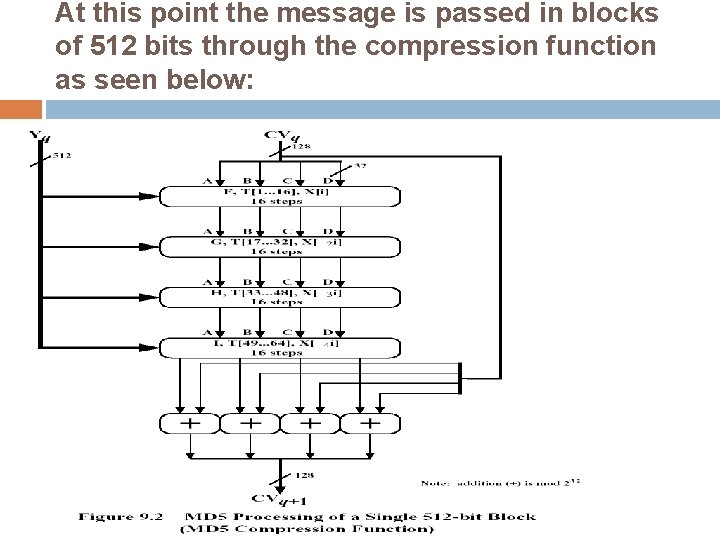
At this point the message is passed in blocks of 512 bits through the compression function as seen below:
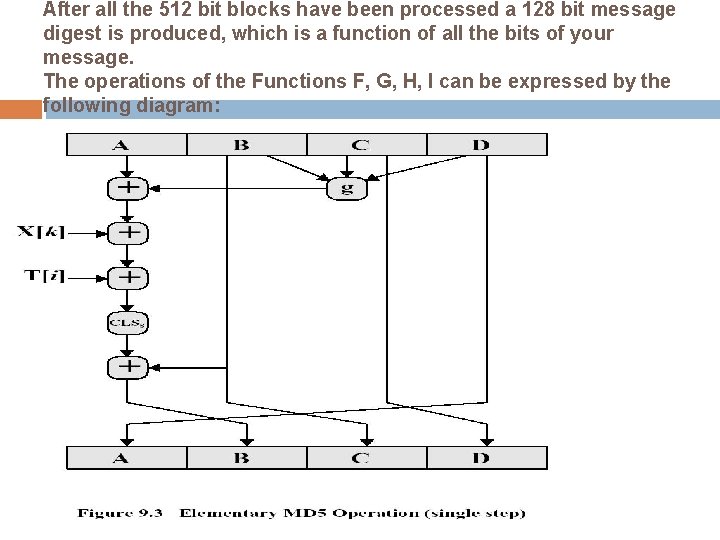
After all the 512 bit blocks have been processed a 128 bit message digest is produced, which is a function of all the bits of your message. The operations of the Functions F, G, H, I can be expressed by the following diagram:
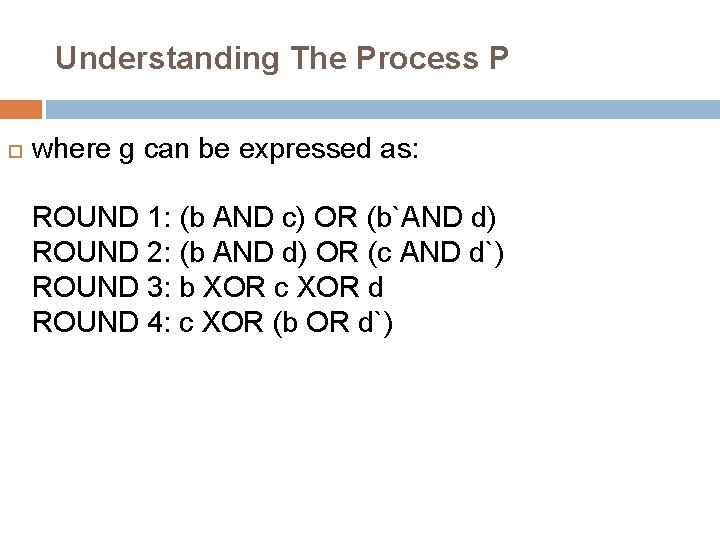
Understanding The Process P where g can be expressed as: ROUND 1: (b AND c) OR (b`AND d) ROUND 2: (b AND d) OR (c AND d`) ROUND 3: b XOR c XOR d ROUND 4: c XOR (b OR d`)
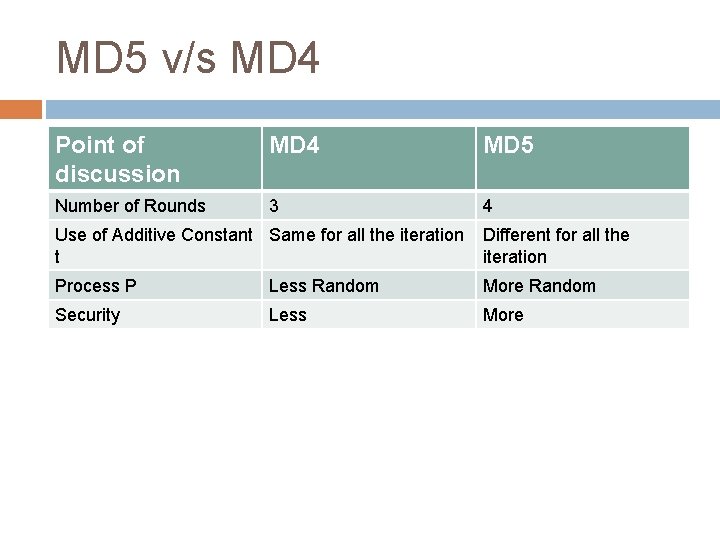
MD 5 v/s MD 4 Point of discussion MD 4 MD 5 Number of Rounds 3 4 Use of Additive Constant Same for all the iteration t Different for all the iteration Process P Less Random More Random Security Less More