
MCQ for Unit 2 By Prof R S
MCQ for Unit 2 By, Prof. R. S. Chaudhari. Asst. professor Mechanical Engineering Department
Q. 1 Inertia force acts _____. (a) perpendicular to the accelerate force. (b) along the direction of acceleforce. (c) opposite to the direction of accelerate force. (d) in any direction w. r. t. accelerate force depending on the magnet two.
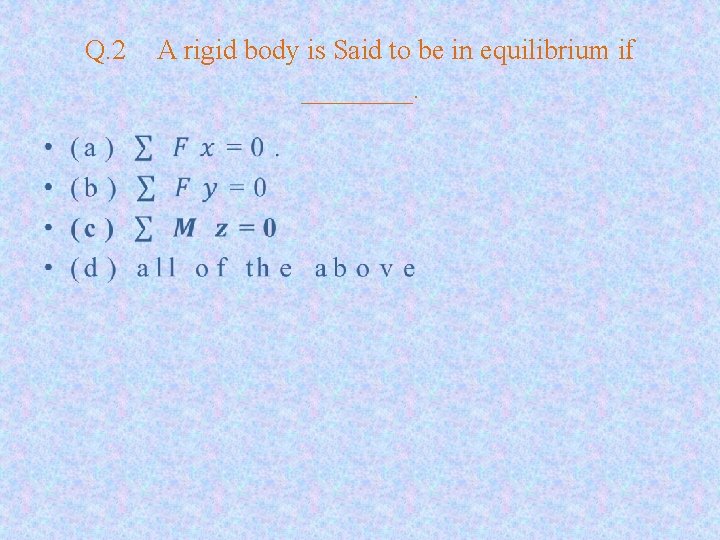
Q. 2 • A rigid body is Said to be in equilibrium if ____.
Q. 3 In simple harmonic motion _____. • (a) the acceleration is inversely proportional to displacement. • (b) the acceleration is always equal to zero. • (c) the acceleration is directly proportional to displacement. • (d) none of the above
Q. 4 In a simple pendulum the time of oscillation depeds upon ____. • (a) mass of the pendulum and the length of the pendulum • (b) mass of the pendulum and the local acceleration due to gravity • (c) total acceleration due to gravity and length of pendulum • (d) mass of the pendulum, the length of pendulum ad the blocal acceleration due to gravity.
Q. 5 In simple Harmonic Motion the acceleration is------- • • a) directly proportional to displacement b) inversely proportional to displacement c) directly proportional to velocity d) inversely proportional to velocity
6 If the radius of gyration of a compound pendulum about an axis through C. G. is more, then its frequency of oscillation will be……………. . • • a) less b) more c) same d) data are insufficient to determine same
Q. 7 The Bifilar suspention method is used to determine…………… • • a) natural frequency of vibration b) position of balancing weights c) moment of inertia d)centripetal acceleration

Q. 8 The simple method to find mass moment of inertia of connecting is……… • • a) compound pendulam b) Bifilar suspention c)Trifilar suspention d) All of above
Q. 9 The mass moment of inertia of flywheel can be determine by ____. • • a) Compound pendulum b) Bifilar suspention c) Trifilar suspention d) All of above
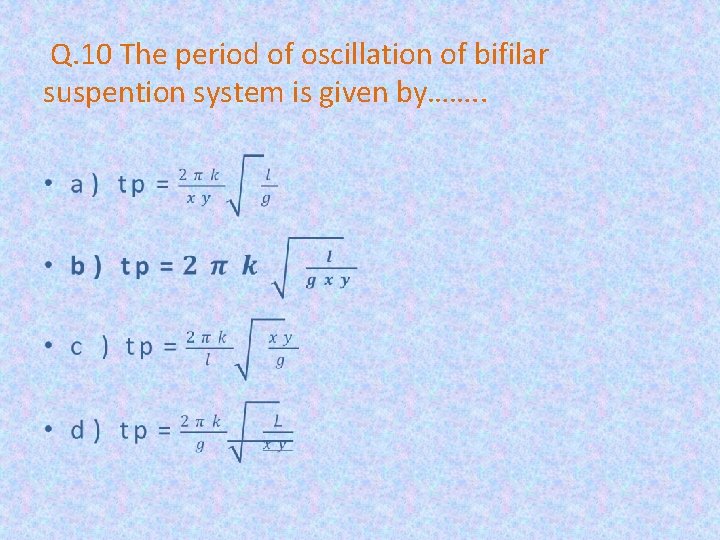
Q. 10 The period of oscillation of bifilar suspention system is given by……. . •
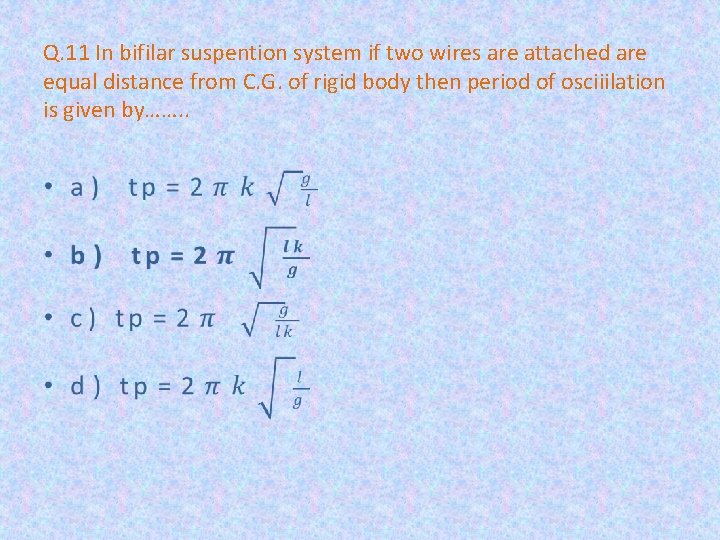
Q. 11 In bifilar suspention system if two wires are attached are equal distance from C. G. of rigid body then period of osciiilation is given by……. . •
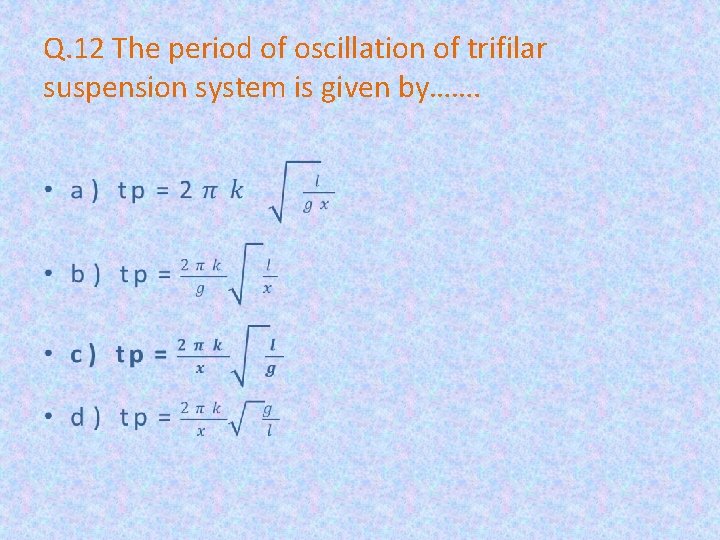
Q. 12 The period of oscillation of trifilar suspension system is given by……. •
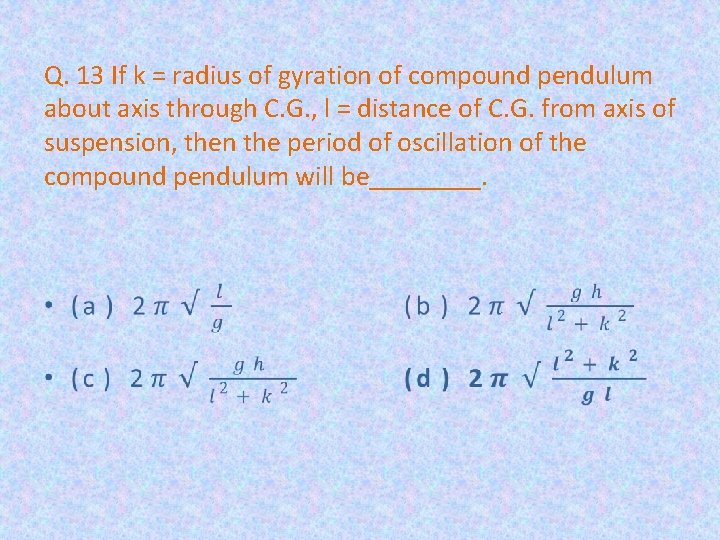
Q. 13 If k = radius of gyration of compound pendulum about axis through C. G. , l = distance of C. G. from axis of suspension, then the period of oscillation of the compound pendulum will be____. •
Q. 14 Acompound pendulum can be treated for analysis as simple pendulum if _____. • (a) length of compound pendulum is same as that of simple pendulum • (b) mass of compound pendulum is same as that of simple pendulum • (c) time period of oscillation of compound pendulum is same as that of simple pendulum • (d) compound pendulum and simple pendulum give time period of oscillation of only 1 sec
Q. 15 When l=k, the time period of oscillation of compound pendulum is _____ • • (a) maximum (b) minimum (c) zero (d) 1 sec
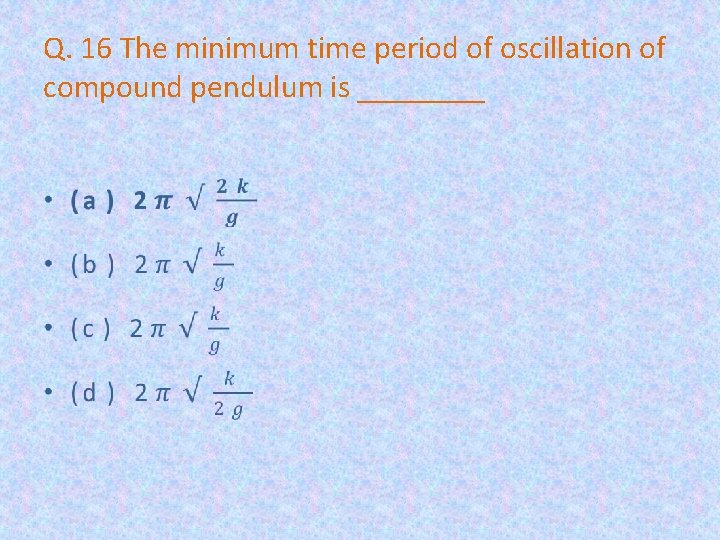
Q. 16 The minimum time period of oscillation of compound pendulum is ____ •
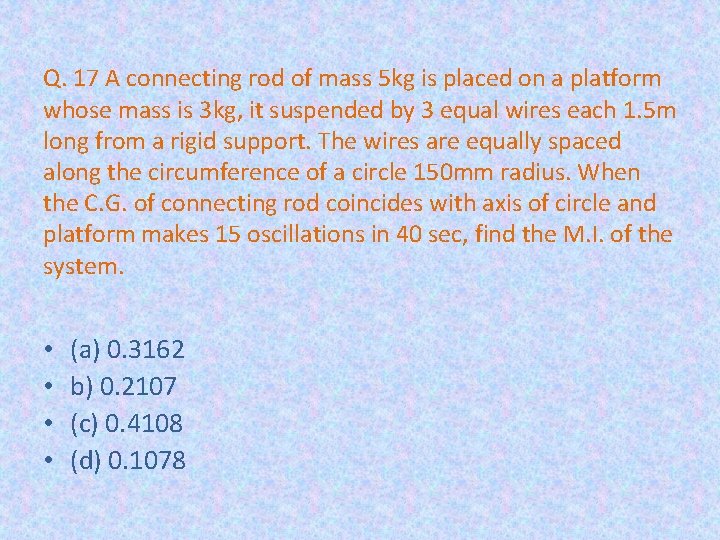
Q. 17 A connecting rod of mass 5 kg is placed on a platform whose mass is 3 kg, it suspended by 3 equal wires each 1. 5 m long from a rigid support. The wires are equally spaced along the circumference of a circle 150 mm radius. When the C. G. of connecting rod coincides with axis of circle and platform makes 15 oscillations in 40 sec, find the M. I. of the system. • • (a) 0. 3162 b) 0. 2107 (c) 0. 4108 (d) 0. 1078
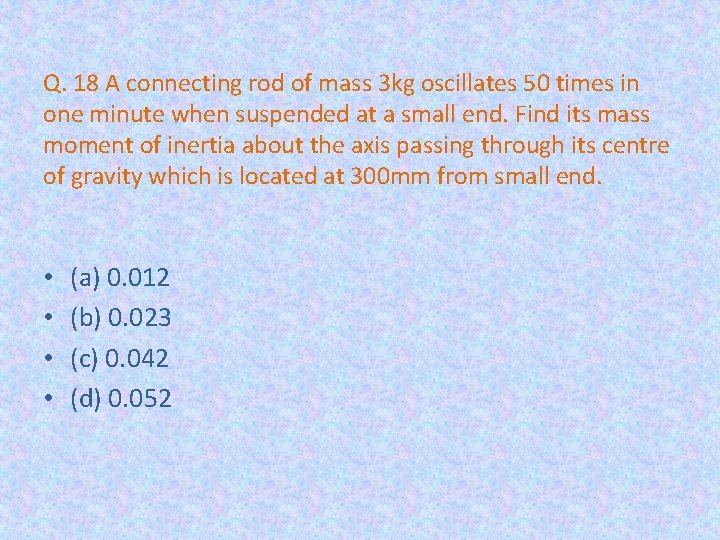
Q. 18 A connecting rod of mass 3 kg oscillates 50 times in one minute when suspended at a small end. Find its mass moment of inertia about the axis passing through its centre of gravity which is located at 300 mm from small end. • • (a) 0. 012 (b) 0. 023 (c) 0. 042 (d) 0. 052
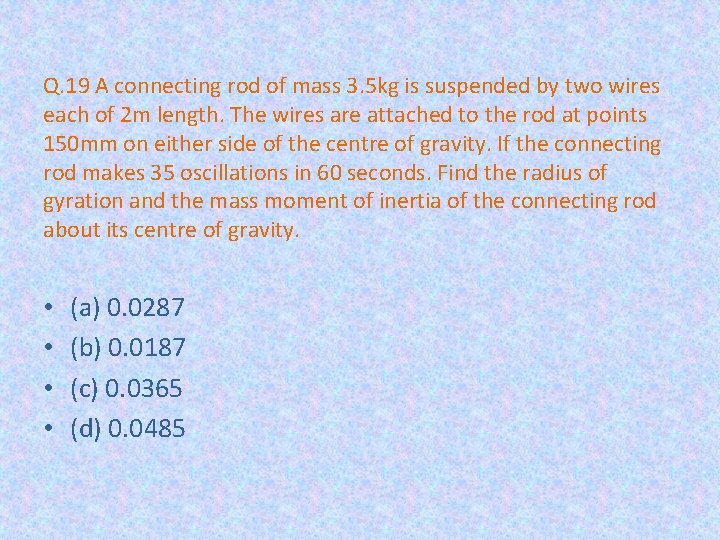
Q. 19 A connecting rod of mass 3. 5 kg is suspended by two wires each of 2 m length. The wires are attached to the rod at points 150 mm on either side of the centre of gravity. If the connecting rod makes 35 oscillations in 60 seconds. Find the radius of gyration and the mass moment of inertia of the connecting rod about its centre of gravity. • • (a) 0. 0287 (b) 0. 0187 (c) 0. 0365 (d) 0. 0485
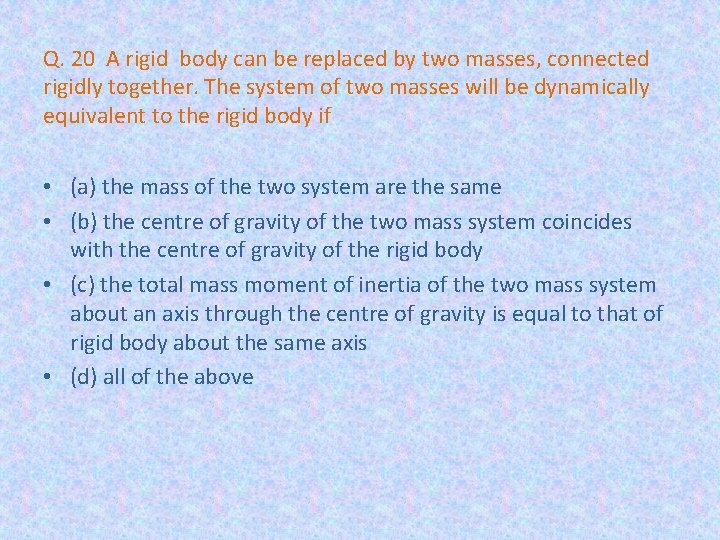
Q. 20 A rigid body can be replaced by two masses, connected rigidly together. The system of two masses will be dynamically equivalent to the rigid body if • (a) the mass of the two system are the same • (b) the centre of gravity of the two mass system coincides with the centre of gravity of the rigid body • (c) the total mass moment of inertia of the two mass system about an axis through the centre of gravity is equal to that of rigid body about the same axis • (d) all of the above
Q. 21 A rigid body , under the action of external forces, can be replaced by two masses placed at a fixed distance apart. The two masses form an equivalent dynamical system, if • (a) the sum of two masses is equal to the total mass of the body • (b) the centre of gravity of the two masses coincide with that of the body • (c) the sum of mass moment of inertia of the masses about their centre of gravity is equal to the mass moment of inertia of the body • (d) all of the above
Q. 22 Any distributed mass can be replaced by two point masses to have the same dynamical properties if • (a) the sum of the two masses is equal to the total mass • (b) the combined centre of mass coincides with that of the mass • (c) the moment of inertia of two masses about perpendicular axis through their combined centre of mass is equal to that of the rod. • (d) all of the above.
Q. 23 The rigid body is replaced by two concentrated masses rigidly connected together. The system will be kinematically equivalent of the body if • (a) the mass of two masses is equal to the mass of rigid body • (b) the centre of gravity of two mass system coincides with the centre of gravity of rigid body • (c) the mass moment of inertia of the two mass system and the rigid body about centre of gravity are equal • (d ) all of the above.
Q. 24 Which one of the following conditions is satisfied for a system to be dynamically equivalent? • • (a) l 1. l 2=k 2 (b)l 1+l 2=k 2 (c) l 1 -l 2=k 2 (d) l 1. l 2=k 2 Where l and l =distance of two masses from C. G of the body, and k= radius of gyration of the body.
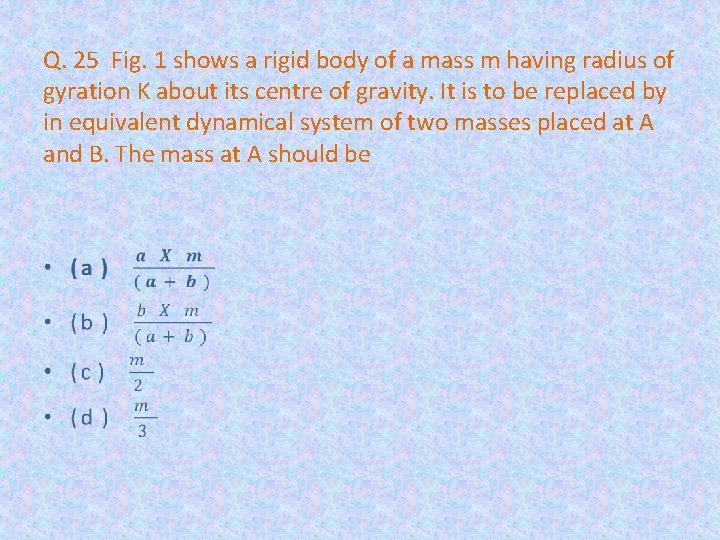
Q. 25 Fig. 1 shows a rigid body of a mass m having radius of gyration K about its centre of gravity. It is to be replaced by in equivalent dynamical system of two masses placed at A and B. The mass at A should be •
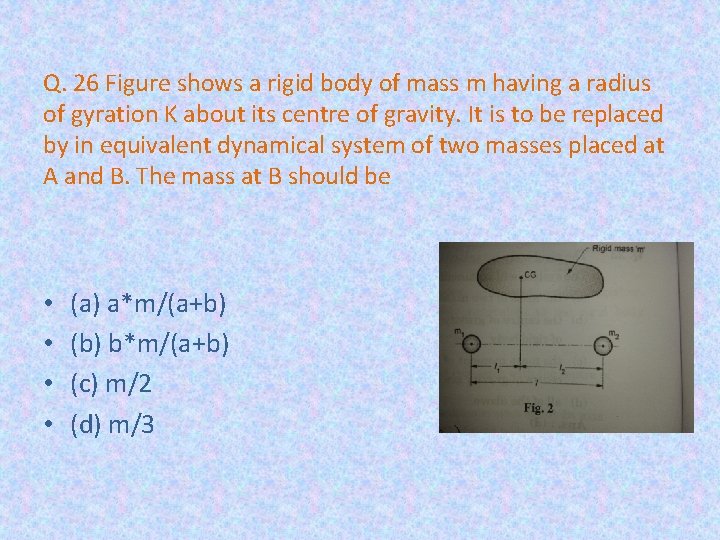
Q. 26 Figure shows a rigid body of mass m having a radius of gyration K about its centre of gravity. It is to be replaced by in equivalent dynamical system of two masses placed at A and B. The mass at B should be • • (a) a*m/(a+b) (b) b*m/(a+b) (c) m/2 (d) m/3
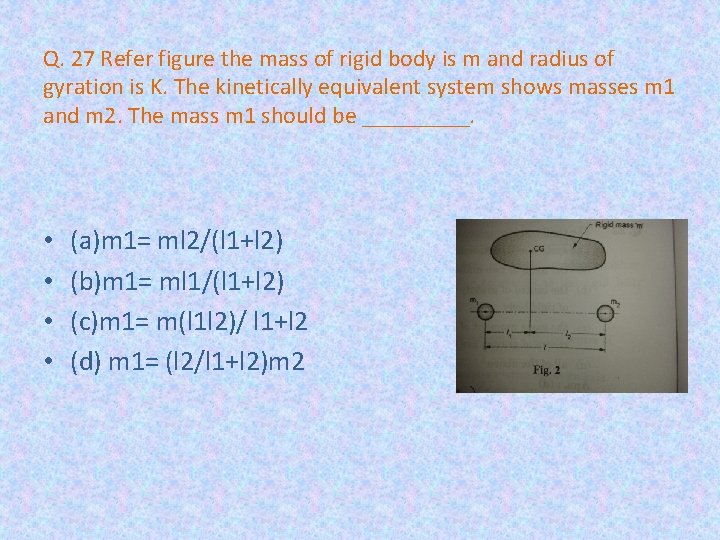
Q. 27 Refer figure the mass of rigid body is m and radius of gyration is K. The kinetically equivalent system shows masses m 1 and m 2. The mass m 1 should be _____. • • (a)m 1= ml 2/(l 1+l 2) (b)m 1= ml 1/(l 1+l 2) (c)m 1= m(l 1 l 2)/ l 1+l 2 (d) m 1= (l 2/l 1+l 2)m 2
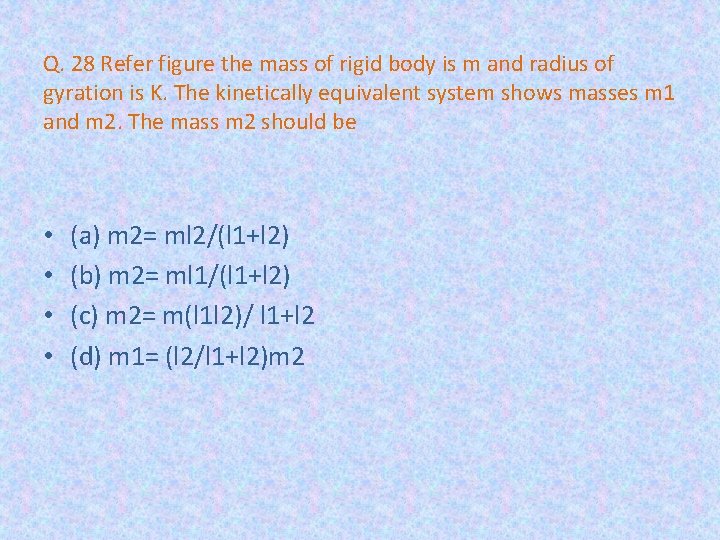
Q. 28 Refer figure the mass of rigid body is m and radius of gyration is K. The kinetically equivalent system shows masses m 1 and m 2. The mass m 2 should be • • (a) m 2= ml 2/(l 1+l 2) (b) m 2= ml 1/(l 1+l 2) (c) m 2= m(l 1 l 2)/ l 1+l 2 (d) m 1= (l 2/l 1+l 2)m 2
Q. 29 Two systems shall be dynamically equivalent when • (a) the mass of two are same • (b) example of two coincides • (c) M. I. of two about an axis through example is equal • (d) All of the above
Q. 30 The essential condition of placing the two masses, so that the system becomes dynamically equivalent is (a) L 1. l 2 = k. G 2 (b) L 1. l 2=k. G (c) L 1=k. G (d) L 2=k. G Where l 1 andl 2 = distance of two masses from the centre of gravity of the body, k. G = radius of gyration of the body • • •

Q. 31 For a link to be dynamically equivalent which condition needs to be satisfied? (a)K 2=l 1/l 2 (b)K 2=l 2/l 1 (c)K 2=l 1/l 2 (d)K 2=l 1+l 2
Q. 32 In a dynamically equivalent system, a uniformly distributed mass is divided into _____ point masses. • • (a) Two (b) Three (c) Four (d) Five
Q. 33 If m is the mass of connecting rod , k is the radius of gyration of connecting rod, k 1 is the new radius of gyration of connecting rod, and α is the angular acceleration of connecting rod than correction couple is given by _____. • • (a) (b) (c) (d) TC=m[k 2 -k 12] α TC=m[k 12 -k 2] α TC=m[k 12 k 2] α TC=m/ α [k 12 -k 2]

Q. 34 Crank effort is the net force applied at the crankpin ______ to the crank which gives the required turning moment on the crankshaft. • • Parallel Perpendicular At 450 1350
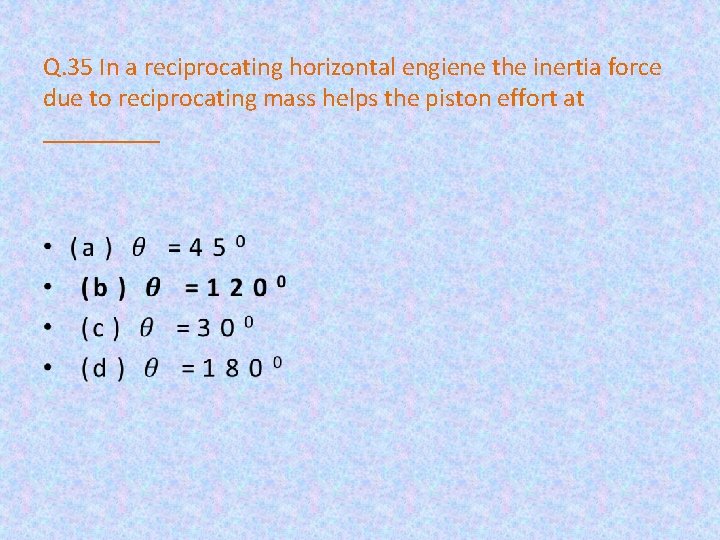
Q. 35 In a reciprocating horizontal engiene the inertia force due to reciprocating mass helps the piston effort at _____ •
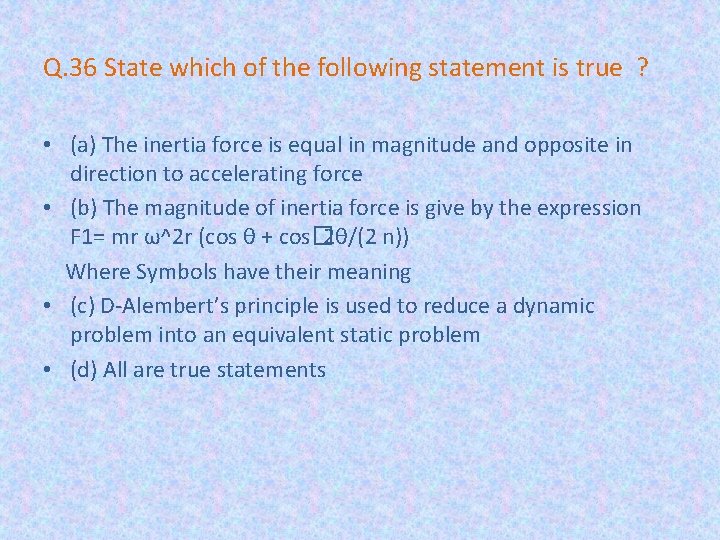
Q. 36 State which of the following statement is true ? • (a) The inertia force is equal in magnitude and opposite in direction to accelerating force • (b) The magnitude of inertia force is give by the expression F 1= mr ω^2 r (cos θ + cos� 2θ/(2 n)) Where Symbols have their meaning • (c) D-Alembert’s principle is used to reduce a dynamic problem into an equivalent static problem • (d) All are true statements
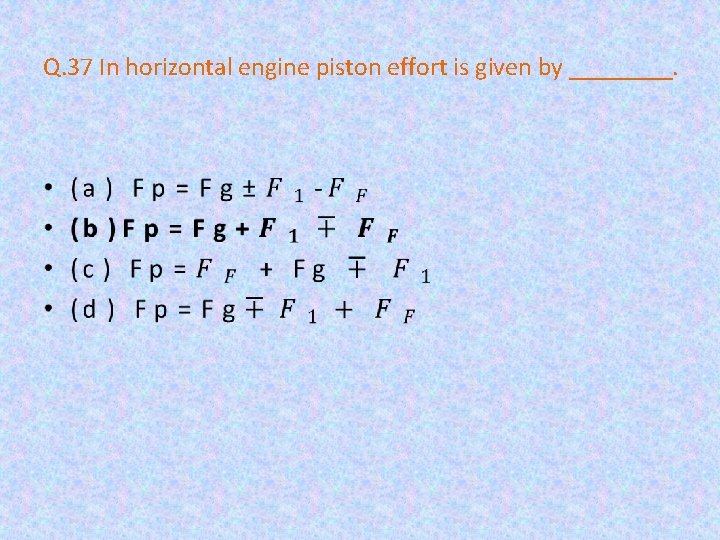
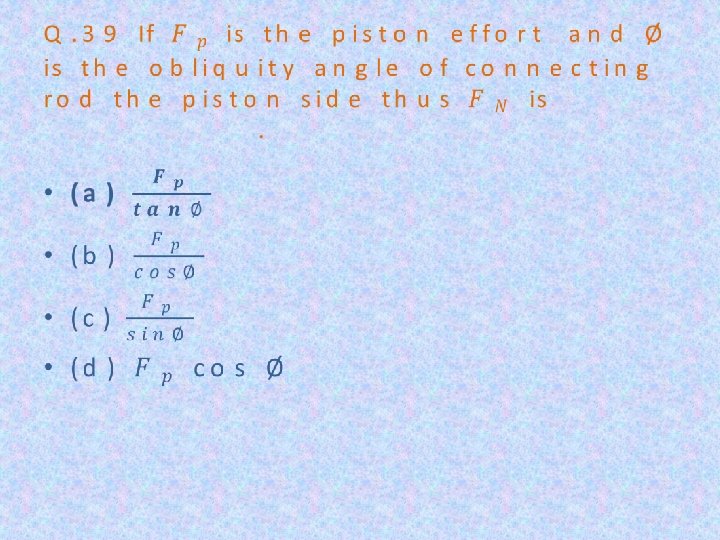
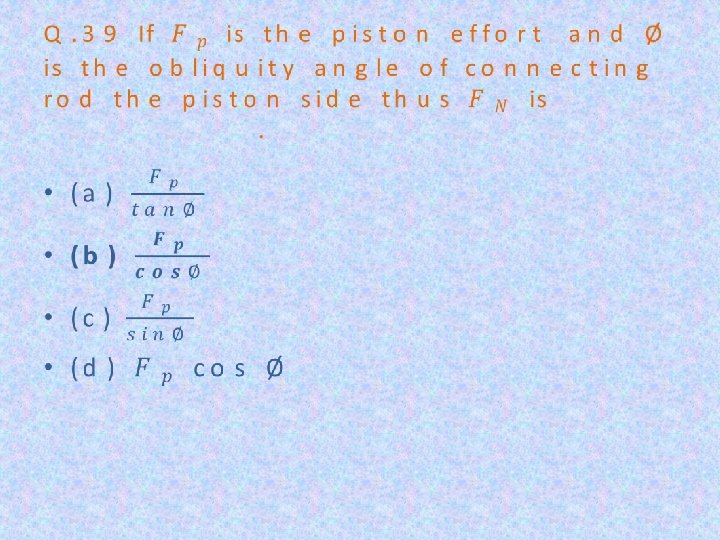
Q. 37 In horizontal engine piston effort is given by ____. •
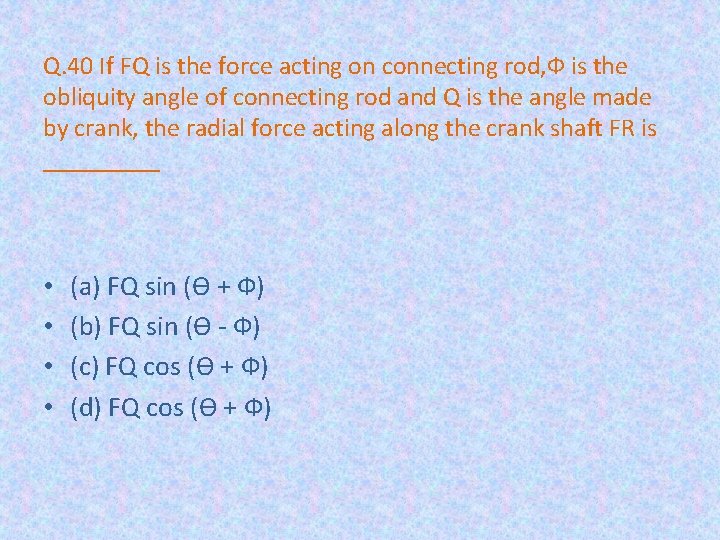
Q. 40 If FQ is the force acting on connecting rod, Ф is the obliquity angle of connecting rod and Q is the angle made by crank, the radial force acting along the crank shaft FR is _____ • • (a) FQ sin (Ѳ + Ф) (b) FQ sin (Ѳ - Ф) (c) FQ cos (Ѳ + Ф) (d) FQ cos (Ѳ + Ф)

Q. 42 The turning moment of crank shaft is _____. •
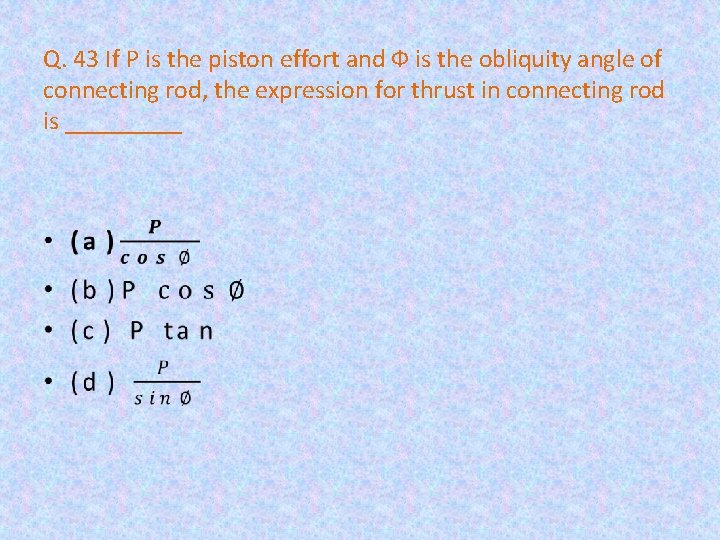
Q. 43 If P is the piston effort and Ф is the obliquity angle of connecting rod, the expression for thrust in connecting rod is _____ •
Q. 44 If piston effort of 100 k. N is acting and crank is made 45° from TDC and obliquity ratio is 2, then the thrust in connecting rod is _____. • • (a) 110 k. N (b) 106. 9 k. N (c) 95. 2 k. N (d) 109. 70

Q. 45 If the piston effort of 100 k. N is acting and crank is made 45° from TDC and obliquity ratio is two then the piston side thrust is _____. • • (a) 38. 40 (b) 35. 40 (c) 36. 58 (d) 37. 78

Q. 46 If piston effort of 100 k. N is acting and crank is made 45’ from TDC and obliquity ratio is 2, then tangential force acting on crank shaft is ______. • • (a) 95. 42 (b) 97. 42 (c) 93. 42 (d) 92. 38

Q. 47 If piston effort of 100 k. N is acting and crank is made 45’ from TDC and obliquity ratio is 2, then radial force or load on main bearing is ______. • • (a) 44. 99 (b) 42. 99 (c) 43. 99 (d) 41. 99
Q. 48 The tangential force acting on engine is 100 k. N and radius of crank is 500 mm, the torque acting on crank is _____. • • (a) 60 k. N. m (b) 50 k. N. m (c) 45 k. N. m (d) 55 k. N. m
Q. 49 According to the law of dryness friction, the force of friction ______. • (a) Is independent of area of contact. • (b) Is directly proportional to the normal pressure between the surface of contact. • (c) Is independent of velocity of sliding. • (d) Is dependent on material of bodies in contact. • (e) All of the above.
Q. 50 Which of the following statements is true when _____. • (a) tan ∅= µ body will move over the surface • (b) tan ∅> µ the motion of body over the surface is not possible • (c) tan ∅ cannot be smaller than µ • (d) tan ∅< µ the motion of body over the surface is not possible
Q. 51 Angle of inclination of plane at which body starts moving downwardsis called as _____. • • (a) Angle of projection (b) Horizontal angle (c) Angle of friction (d) angle of repose

Q. 52 If the angle of friction is tan ∅, then which of the following cannot be the value of tan ∅ • • (a) 0. 1 µ (b) 0. 5 µ (c) µ (d) 1. 5 µ
Q. 53 Shaft of radius r is revolving inside a bearing then radius of friction angle is given by ____. • • (a) r sin ∅ (b) r tan ∅ (c) r cos ∅ (d) r cot ∅

Q. 54 Boundary film lubrication is _____. (a) thin film lubrication • (b) thick film lubrication • (c) solid lubrication • (d) none of the above
Q. 55 When a journal is rotating in its bearing the resultant of the normal force (RN) and frictional force (µRN) _____. • (a) Passes through the centre of the journal • (b) Is tangent to the circle of the jurnal at the point of contact • (c) Is tangent to a small circle of radius r x sin∅ where ∅= tan^(-1)�µ • (d) None of the above
Q. 56 Friction circle in case of journal bearig is ______. • (a) the circle in which resultant force of F is tangent. • (b) the circle which is having radius equal to half of the radius of the journal. • (c) the circle which is having radius equal to µ x R where R is the radius of the journal. • (d) both (a) and (c).
Q. 57 The radius of friction circle increases _____. • • (a) with the increases of radius of journal. (b) with the increase of speed. (c) with the increase of coefficient of sliding friction. (d) (a) and (c) only.
Q. 58 A friction circle is a circle drawn when the journal rotates in a bearing. Its radius depends on the coefficient of friction and ____ • • (a) magnitude of the forces on the journal. (b) angular velocity of the journal. (c) clearance between the journal and the bearing. (d) radius of the journal.
Q. 59 The tendancy of a body to resist change from rest or motion is known as _____. • • (a) mass (b) friction (c) inertia (d) resisting force.
Q. 60 The friction force, which comes into play, when the sliding motion of the body is just to commence, is called ______. • • (a) static friction (b) dynamic friction (c) limiting friction (d) none of these
Q. 61 The kinematic friction is the friction experienced by a body, when the body _____. • • (a) is at rest (b) just beings to slide (c) is in motion (d) none of these
Q. 62 The radius of a friction circle for a shaft of a radius r, , rotating slide a bearing with cefficient, of friction µ = tanØ, is ____. • • (a) (r/2) tan Ø (b) r. sin Ø (c) r. cos Ø (d) r/2 sin Ø
Q. 63 The friction force is independent of _____. • • (a) material (b) area of contact (c) normal reaction (d) surface finish
Q. 64 Choose the correct statement. • (a) The force of friction always opposes the relative motion of one surface over another. • (b) The force of friction is directly proportional to normal load between surfaces in contact. • (c) The force of friction is independent of are as of contact between the surfaces for a given load. • (d) All of the above.
Q. 65 Choose the correct statement. • (a) static friction is greater than dynamic friction. • (b) Angle of friction is the angle included between the direction of normal reaction and direction of resultant reaction when a body is at impeding slide on the plane. • (c) Angle of repose is equal to angle included between the direction of normal reaction and direction of resultant reaction when a body is at impeding slide on the plane. • (d) All of the above.
Q. 66 The radius of the friction circle ______. • (a) increases as the load increases. • (b) increases as the radius of journal increases. • (c) increases as the speed of the shaft in journal increases. • (d) increases as the coefficient of friction increases
Q. 67 The radius of friction circle for a shaft rotating inside a bearing of radius r is equal to ______. • • (a) r sin Ø (b) r cos Ø (c) r (d) r/cos Ø
Q. 68 When journal is rotating , the resultant of the normal force Rn and tangential force µRn ______ • (a) passes approximately through the centre of journal • (b) approximately tangential to the circle of the journal of radius r at contact point • (c) is approximately tangential to the small circle of radius = µr • (d) none of the above
- Slides: 69