
MCnet Marie Curie Research Training Network for Monte
- Slides: 9
MCnet • Marie Curie Research Training Network • for Monte Carlo event generator – development – validation and tuning • Approved for four years from 1 st Jan 2007
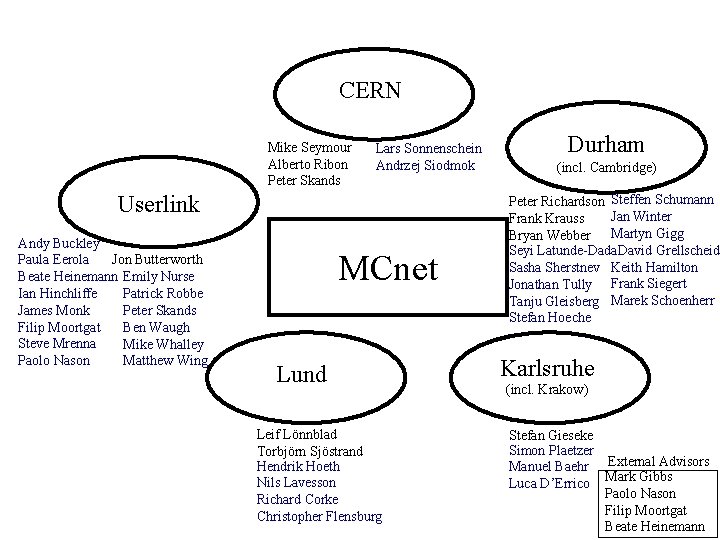
CERN Mike Seymour Alberto Ribon Peter Skands Lars Sonnenschein Andrzej Siodmok Userlink Andy Buckley Paula Eerola Jon Butterworth Beate Heinemann Emily Nurse Ian Hinchliffe Patrick Robbe James Monk Peter Skands Filip Moortgat Ben Waugh Steve Mrenna Mike Whalley Paolo Nason Matthew Wing MCnet Lund Leif Lönnblad Torbjörn Sjöstrand Hendrik Hoeth Nils Lavesson Richard Corke Christopher Flensburg Durham (incl. Cambridge) Peter Richardson Steffen Schumann Jan Winter Frank Krauss Bryan Webber Martyn Gigg Seyi Latunde-Dada David Grellscheid Sasha Sherstnev Keith Hamilton Jonathan Tully Frank Siegert Tanju Gleisberg Marek Schoenherr Stefan Hoeche Karlsruhe (incl. Krakow) Stefan Gieseke Simon Plaetzer Manuel Baehr External Advisors Mark Gibbs Luca D’Errico Paolo Nason Filip Moortgat Beate Heinemann
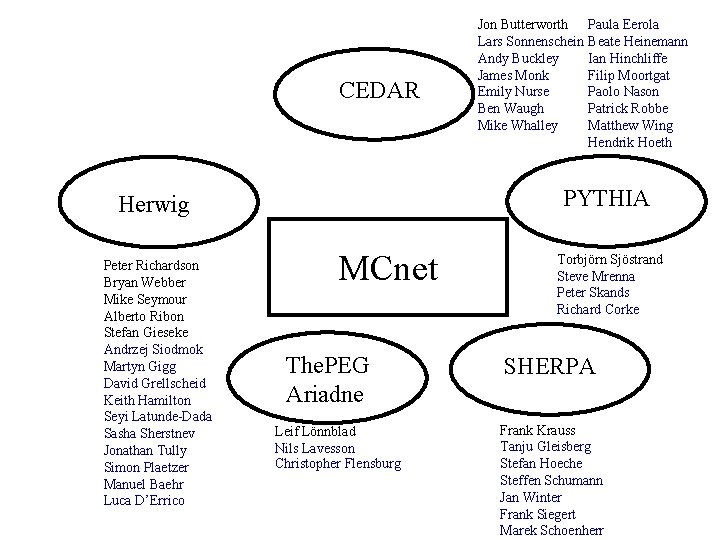
CEDAR Paula Eerola Beate Heinemann Ian Hinchliffe Filip Moortgat Paolo Nason Patrick Robbe Matthew Wing Hendrik Hoeth PYTHIA Herwig Peter Richardson Bryan Webber Mike Seymour Alberto Ribon Stefan Gieseke Andrzej Siodmok Martyn Gigg David Grellscheid Keith Hamilton Seyi Latunde-Dada Sasha Sherstnev Jonathan Tully Simon Plaetzer Manuel Baehr Luca D’Errico Jon Butterworth Lars Sonnenschein Andy Buckley James Monk Emily Nurse Ben Waugh Mike Whalley MCnet The. PEG Ariadne Leif Lönnblad Nils Lavesson Christopher Flensburg Torbjörn Sjöstrand Steve Mrenna Peter Skands Richard Corke SHERPA Frank Krauss Tanju Gleisberg Stefan Hoeche Steffen Schumann Jan Winter Frank Siegert Marek Schoenherr
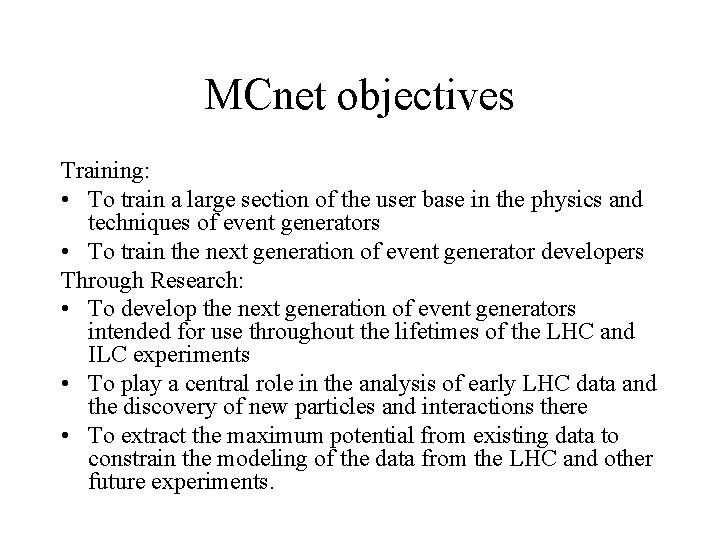
MCnet objectives Training: • To train a large section of the user base in the physics and techniques of event generators • To train the next generation of event generator developers Through Research: • To develop the next generation of event generators intended for use throughout the lifetimes of the LHC and ILC experiments • To play a central role in the analysis of early LHC data and the discovery of new particles and interactions there • To extract the maximum potential from existing data to constrain the modeling of the data from the LHC and other future experiments.
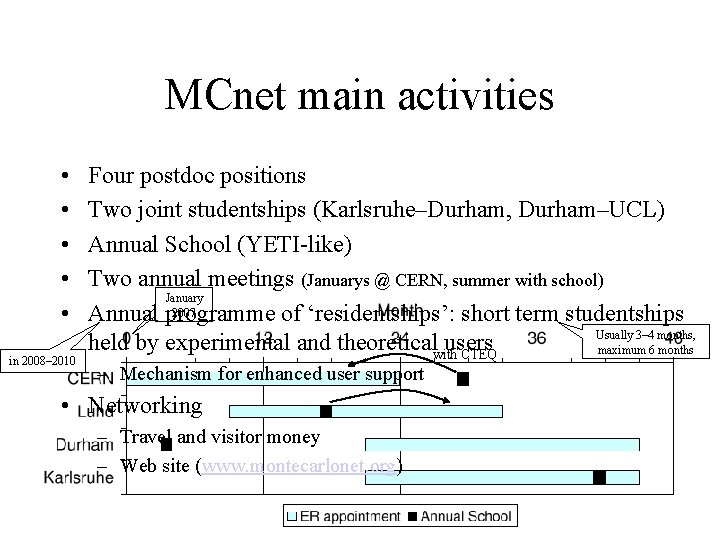
MCnet main activities • • • in 2008– 2010 Four postdoc positions Two joint studentships (Karlsruhe–Durham, Durham–UCL) Annual School (YETI-like) Two annual meetings (Januarys @ CERN, summer with school) January 2007 Annual programme of ‘residentships’: short term studentships Usually 3– 4 months, held by experimental and theoreticalwith users maximum 6 months CTEQ – Mechanism for enhanced user support • Networking – Travel and visitor money – Web site (www. montecarlonet. org)
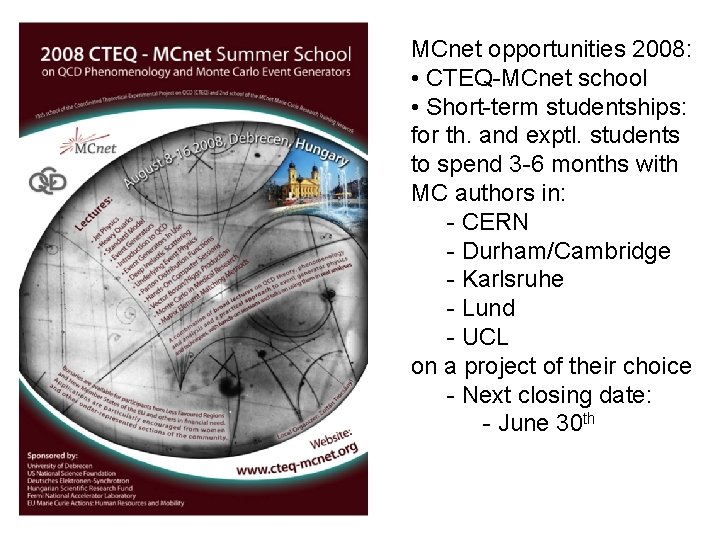
MCnet opportunities 2008: • CTEQ-MCnet school • Short-term studentships: for th. and exptl. students to spend 3 -6 months with MC authors in: - CERN - Durham/Cambridge - Karlsruhe - Lund - UCL on a project of their choice - Next closing date: - June 30 th
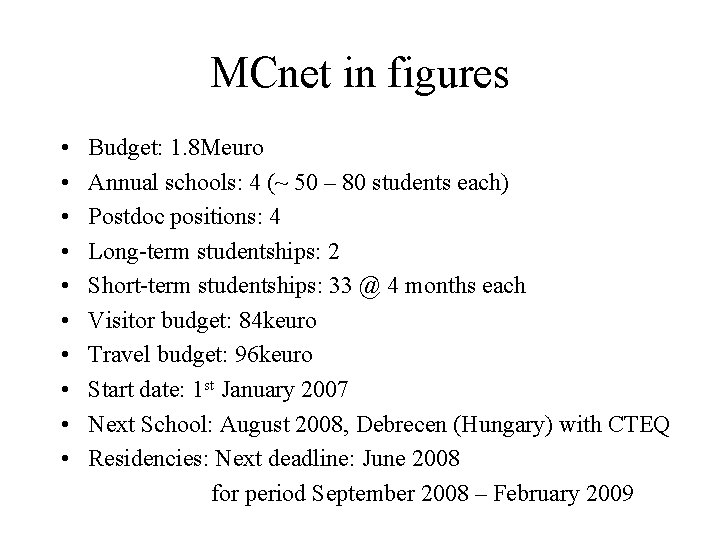
MCnet in figures • • • Budget: 1. 8 Meuro Annual schools: 4 (~ 50 – 80 students each) Postdoc positions: 4 Long-term studentships: 2 Short-term studentships: 33 @ 4 months each Visitor budget: 84 keuro Travel budget: 96 keuro Start date: 1 st January 2007 Next School: August 2008, Debrecen (Hungary) with CTEQ Residencies: Next deadline: June 2008 for period September 2008 – February 2009