
MCKINNEY VENTO EDUCATION TRAINING November 18 22 2019
MCKINNEY VENTO EDUCATION TRAINING November 18 & 22, 2019 Eileen Shoup – ROE 26 and Area 3 MKV Liaison
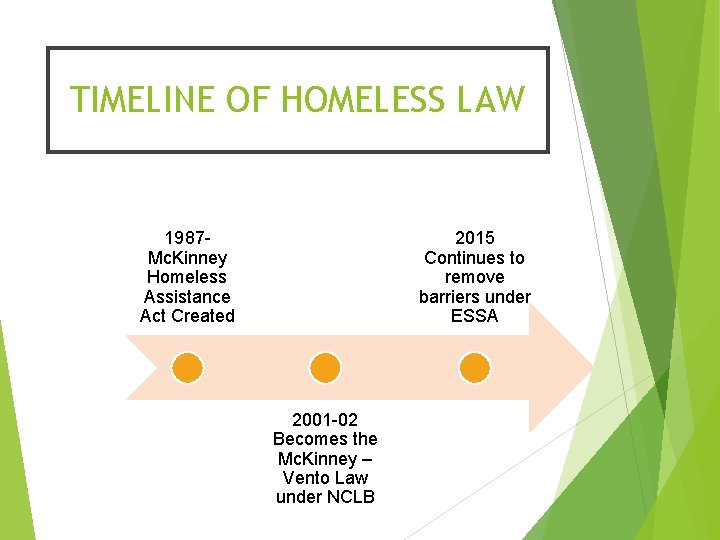
TIMELINE OF HOMELESS LAW 1987 Mc. Kinney Homeless Assistance Act Created 2015 Continues to remove barriers under ESSA 2001 -02 Becomes the Mc. Kinney – Vento Law under NCLB
Definition of Homeless Very different from the HUD definition A student that lacks a Fixed Regular or Adequate nighttime residence.
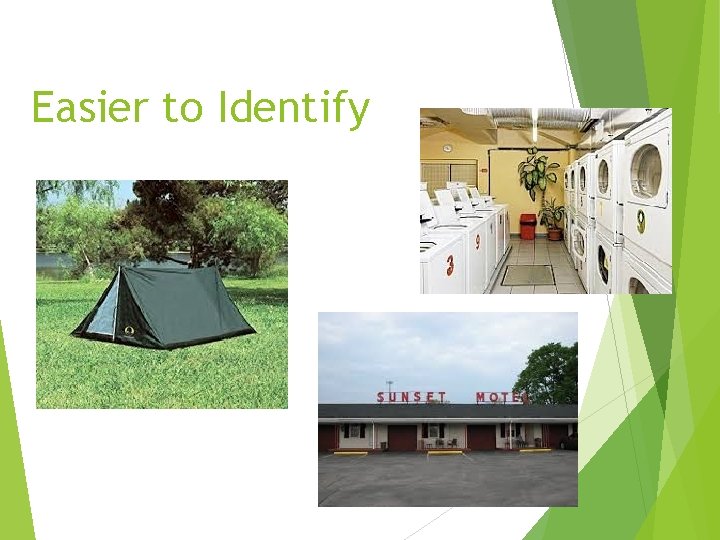
Easier to Identify
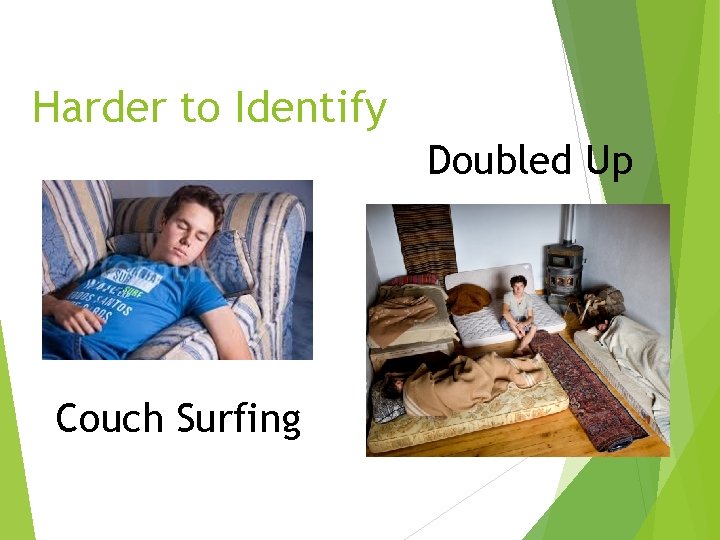
Harder to Identify Doubled Up Couch Surfing
Unaccompanied Youth The term unaccompanied youth includes a homeless child or youth not in the physical custody of a parent or guardian Pub. L. No. 114 -95, § 9105(a)(3), 129 Stat. 2137
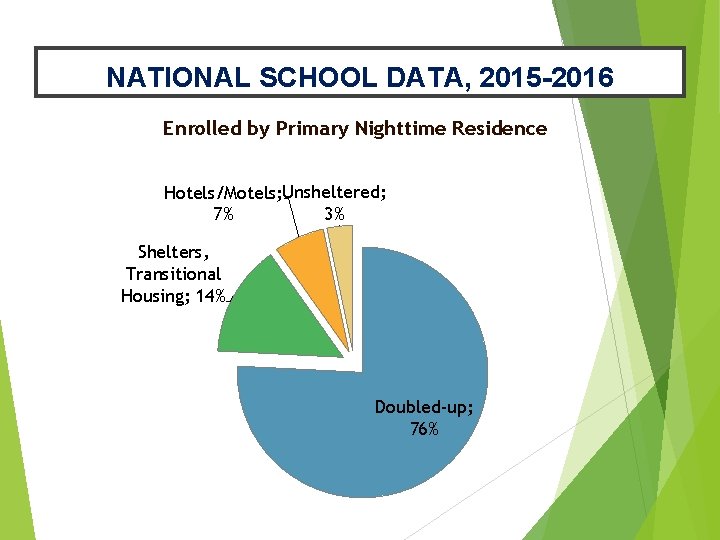
NATIONAL SCHOOL DATA, 2015 -2016 Enrolled by Primary Nighttime Residence Hotels/Motels; Unsheltered; 3% 7% Shelters, Transitional Housing; 14% Doubled-up; 76%
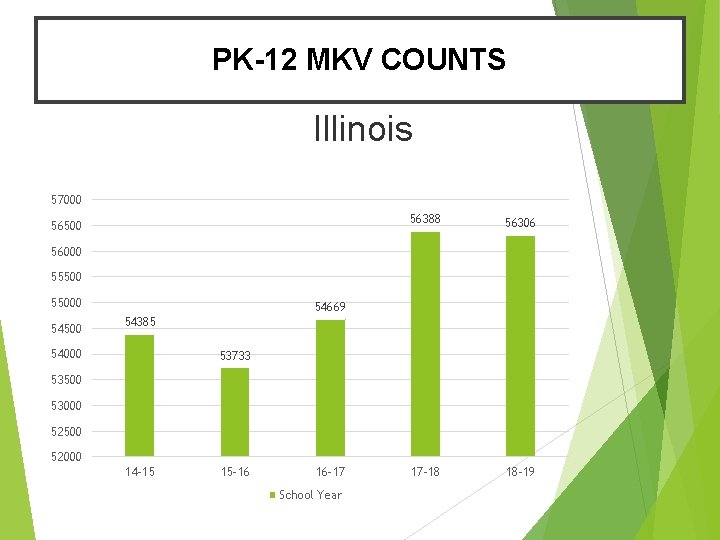
PK-12 MKV COUNTS Illinois 57000 56500 56388 56306 17 -18 18 -19 56000 555000 54500 54669 54385 54000 53733 53500 53000 52500 52000 14 -15 15 -16 16 -17 School Year
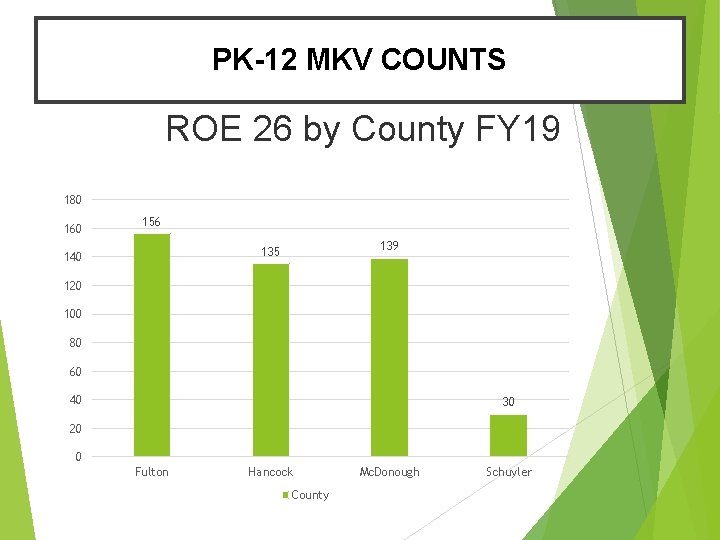
PK-12 MKV COUNTS ROE 26 by County FY 19 180 160 156 139 135 140 120 100 80 60 40 30 20 0 Fulton Hancock County Mc. Donough Schuyler
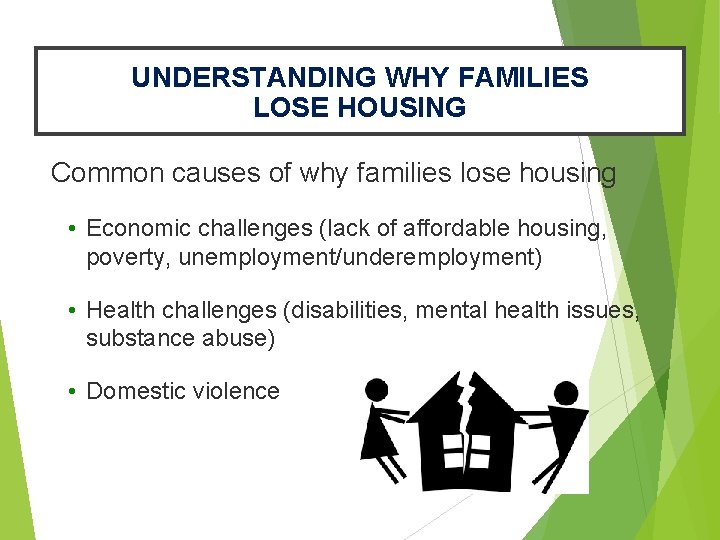
UNDERSTANDING WHY FAMILIES LOSE HOUSING Common causes of why families lose housing • Economic challenges (lack of affordable housing, poverty, unemployment/underemployment) • Health challenges (disabilities, mental health issues, substance abuse) • Domestic violence
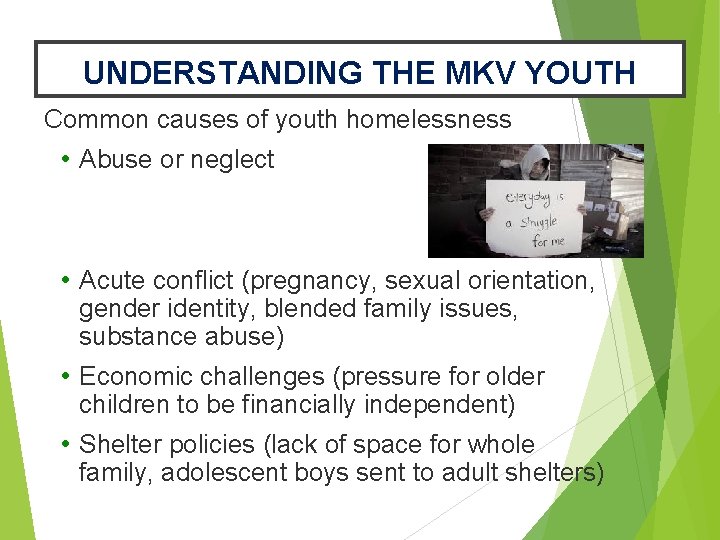
UNDERSTANDING THE MKV YOUTH Common causes of youth homelessness • Abuse or neglect • Acute conflict (pregnancy, sexual orientation, gender identity, blended family issues, substance abuse) • Economic challenges (pressure for older children to be financially independent) • Shelter policies (lack of space for whole family, adolescent boys sent to adult shelters)
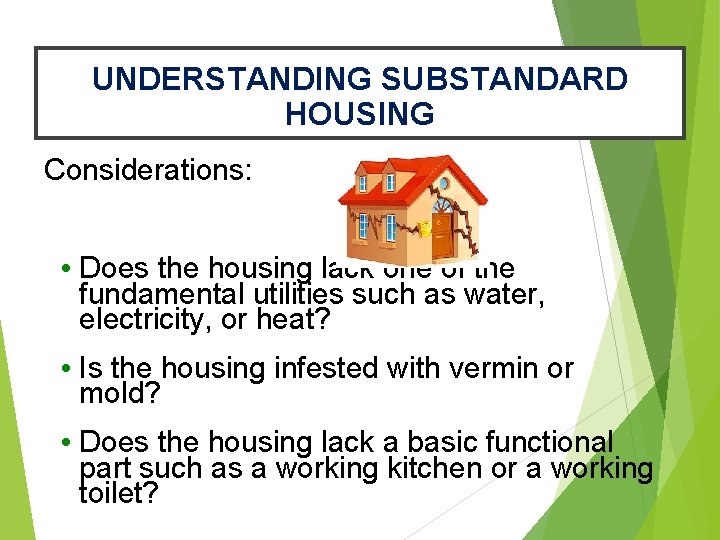
UNDERSTANDING SUBSTANDARD HOUSING Considerations: • Does the housing lack one of the fundamental utilities such as water, electricity, or heat? • Is the housing infested with vermin or mold? • Does the housing lack a basic functional part such as a working kitchen or a working toilet?
Foster Care Students under the care of DCFS are NOT MKV-eligible, but all the rules still apply.
MAIN THEMES OF MCKINNEY-VENTO • • • Identification School stability School enrollment Support for academic success. Child-centered, best interest decision making
OBSTACLES TO IDENTIFICATION ▪ Embarrassment or fear of being judged ▪ Fear of losing custody (NOT a reason for having children removed) ▪ Unaccompanied youth may fear being returned to an unsafe family environment or taken into the child welfare system
OBSTACLES TO IDENTIFICATION (CONT. ) ▪ Schools and service providers may be unaware of students who are not enrolled in school but are in shelters or are doubled up. ▪ Do not realize that they are considered MKV-eligible since MKV and HUD definitions are different.
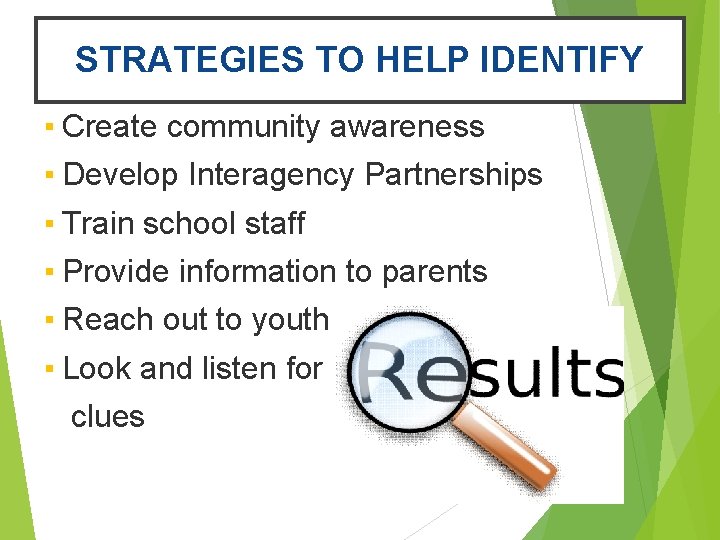
STRATEGIES TO HELP IDENTIFY ▪ Create community awareness ▪ Develop Interagency Partnerships ▪ Train school staff ▪ Provide information to parents ▪ Reach out to youth ▪ Look and listen for clues
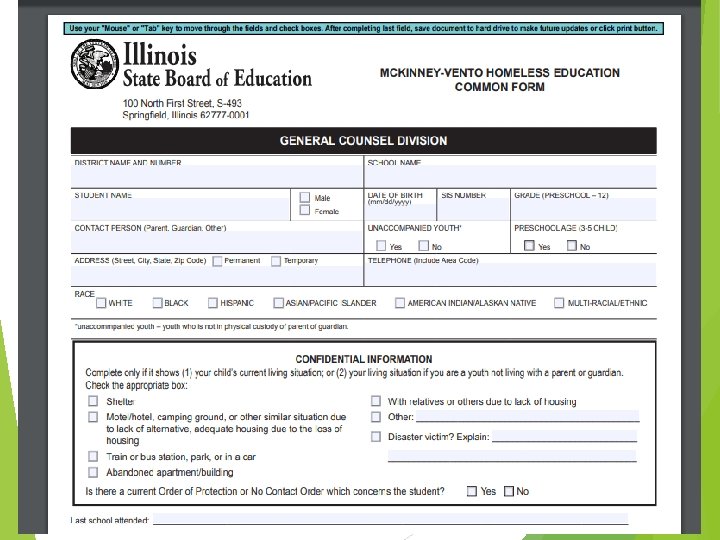
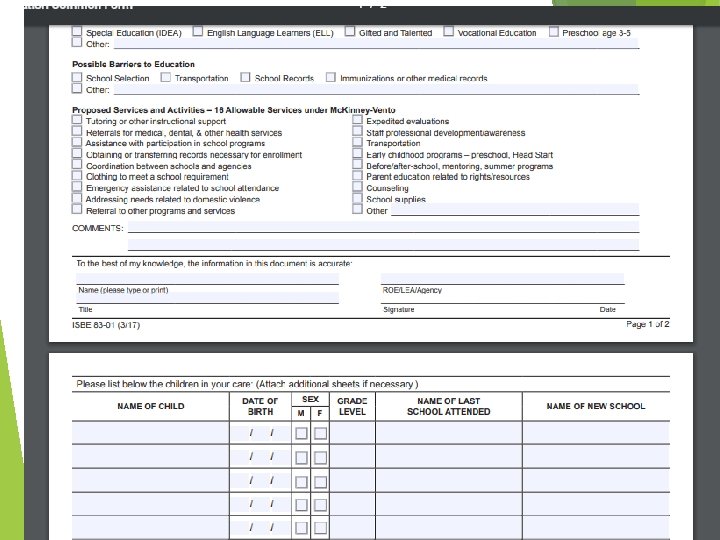
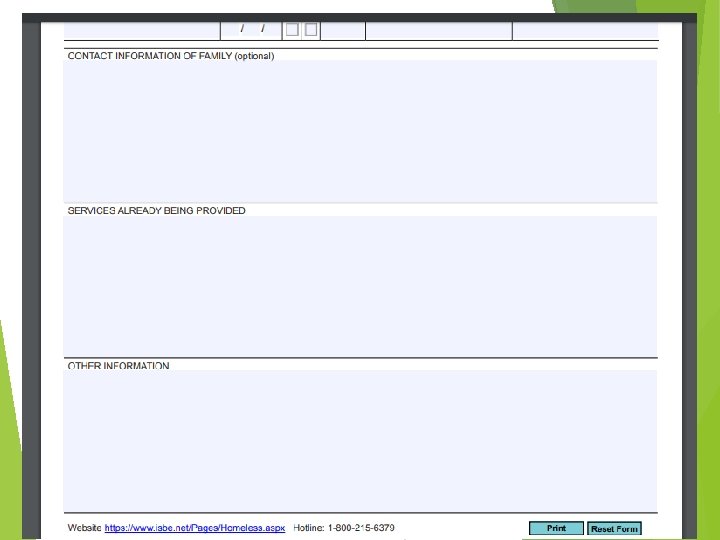
THE STUDENT HAS BEEN IDENTIFIED AS MKV-ELIGIBLE NOW WHAT? ?
SCHOOL STABILITY Each LEA shall, according to each child’s or youth’s best interest: ➢ Continue the student’s education in the school of origin for the duration of homelessness, and until the end of the academic year in which the student becomes permanently housed; OR ➢ Enroll in any public school that housed students living where the student is living are eligible to attend. ➢ In Illinois, the parent/guardian makes the best interest determination.
SCHOOL OF ORIGIN School of origin is the school attended when permanently housed or school in which last enrolled, including a preschool and including the designated receiving school at the next grade level for feeder schools.
ENROLLMENT When remaining in the school of origin is not in the student’s best interest or what the parent, guardian or youth requests: Mc. Kinney-Vento students are entitled to immediate enrollment in any public school that students living in the same attendance area are eligible to attend; even if: • Students do not have required documents, such as school records, records of immunization and other required health records, proof of residency, guardianship, or other documents; or • Students have missed application or enrollment deadlines during any period of homelessness.
FREE BIRTH CERTIFICATES FOR MKV ▪ As of January 1, 2018 MKV-eligible students can get a free birth certificate for Illinois courthouses. ▪ The form can be found at the following address: https: //www. isbe. net/Documents/Homeless_Birth _Certificate_Form. pdf
ENROLLMENT Enrollment” includes attending classes and participating fully in school activities. ➢ “ ➢SEAs and LEAs must develop, review, and revise policies to remove barriers to the identification, enrollment and retention of children and youth in homeless situations, including barriers due to outstanding fees or fines, or absences. ➢https: //www. isbe. net/Documents/guidance_reg. p df
ENROLLMENT OF UNACCOMPANIED YOUTH “Unaccompanied Youth: A youth who is not in the physical custody of a parent or guardian. 11432(g)(1)(H)(iv) ➢ Immediate enrollment applies, even without parent or guardian. • Youth self-enrollment; Caregiver authorization form • https: //www. isbe. net/Documents/83 -04 J_caregivers. pdf • Liaisons must help unaccompanied youth choose and enroll in a school, give priority to the youth’s wishes, and inform the youth of his/her appeal rights. ➢ https: //nche. ed. gov/downloads/
SUPPORT FOR SUCCESS – YOU DON’T HAVE TO DO IT ALONE! ➢Collaborate with area community agencies – help with food, services, transportation, etc. ➢Share the information with other teachers and staff as needed. ➢Create networks.
HELPING HANDS • During registration gather a list of parents and as many other interested people (and contact information) as you can who are willing to offer assistance on an as needed basis. • Extend that list to area agencies, churches, businesses and others in the community • Create a listserv (email group) • Have forms for teachers and staff to fill out when they see a specific student need. • The lead contact then sends out an email to the listserv asking for help to fulfil the need. • OFTEN PEOPLE JUST NEED TO KNOW HOW TO HELP
SUPPORT FOR SUCCESS – TITLE IA ➢Mc. Kinney-Vento students attending any school in the LEA are automatically eligible for Title IA services. 20 USC 6315(c)(2)(E); Guidance M 1
SUPPORT FOR SUCCESS – TITLE IA ➢Funds may be used: • For homeless children and youth attending any school in the LEA. • For services not ordinarily provided to other students. • To fund the Mc. Kinney-Vento liaison. • To provide transportation to the school of origin. • For educationally related support services, including preschool.
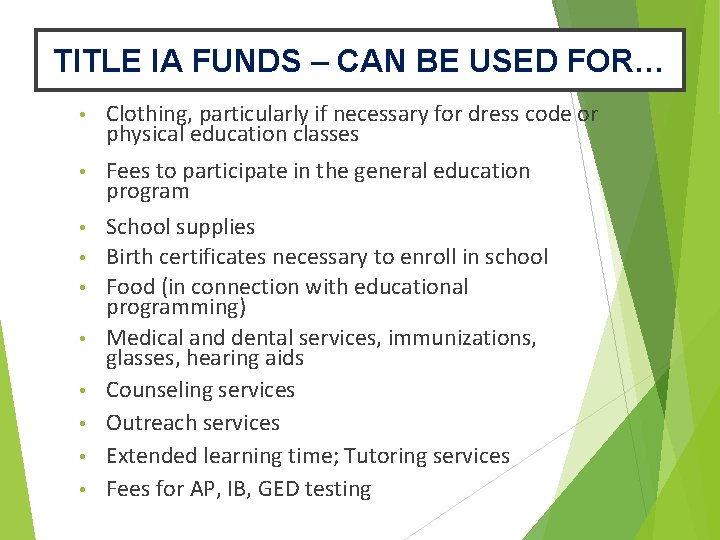
TITLE IA FUNDS – CAN BE USED FOR… • Clothing, particularly if necessary for dress code or physical education classes • Fees to participate in the general education program • School supplies Birth certificates necessary to enroll in school Food (in connection with educational programming) Medical and dental services, immunizations, glasses, hearing aids Counseling services Outreach services Extended learning time; Tutoring services Fees for AP, IB, GED testing • •
NATIONAL SCHOOL LUNCH ACT ✔ Mc. Kinney-Vento students are automatically eligible for free school meals. ✔ USDA policy permits liaisons and shelter directors to obtain free school meals for students immediately by providing a list of names of students experiencing homelessness with effective dates.
TRANSPORTATION ➢ LEAs must provide transportation to and from the school/preschool of origin, including until the end of the year when the student obtains permanent housing, at a parent or guardian’s request (or at the liaison’s request for unaccompanied youth). • If staying in the same LEA, that LEA must provide or arrange transportation to the school of origin. • If crossing LEA lines, both LEAs must determine how to divide the responsibility and share the cost, or they must share the cost equally. https: //www. isbe. net/Documents/50 -27 -homelesstransportation. pdf
TRANSPORTATION ➢ LEAs also must provide students in homeless situations with transportation services comparable to those provided to other students. ➢ SEAs and LEAs must review and revise transportation policies that may act as barriers to identification, enrollment, attendance or success. ➢ Transportation must be arranged promptly to ensure immediate enrollment and not create barriers to attendance, retention or success.
DISPUTE RESOLUTION a dispute arises over eligibility, school selection, transportation or enrollment in a school (including full participation): • The student shall be immediately enrolled and/or provided transportation; • Illinois: • The Regional Superintendent shall appoint a fair and impartial Ombudsperson to convene a meeting of the parties. • The Ombudsperson’s decision may be appealed to the State Coordinator for review. The State Superintendent shall make the final determination. • “If
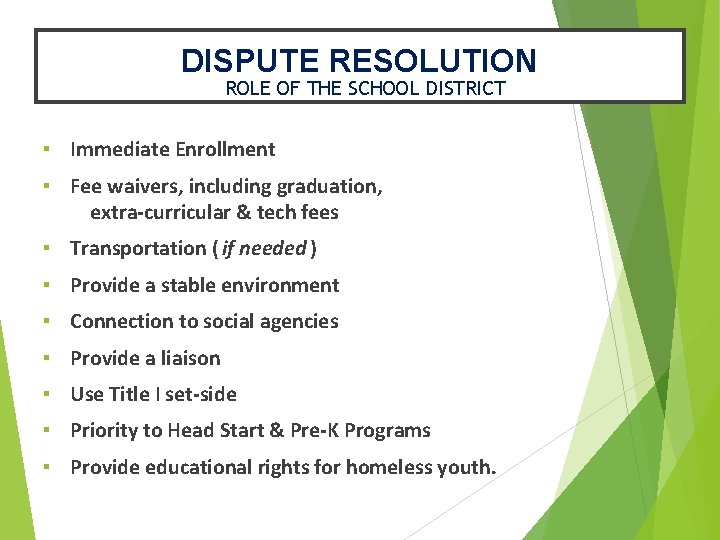
DISPUTE RESOLUTION ROLE OF THE SCHOOL DISTRICT ▪ Immediate Enrollment ▪ Fee waivers, including graduation, extra-curricular & tech fees ▪ Transportation ( if needed ) ▪ Provide a stable environment ▪ Connection to social agencies ▪ Provide a liaison ▪ Use Title I set-side ▪ Priority to Head Start & Pre-K Programs ▪ Provide educational rights for homeless youth.
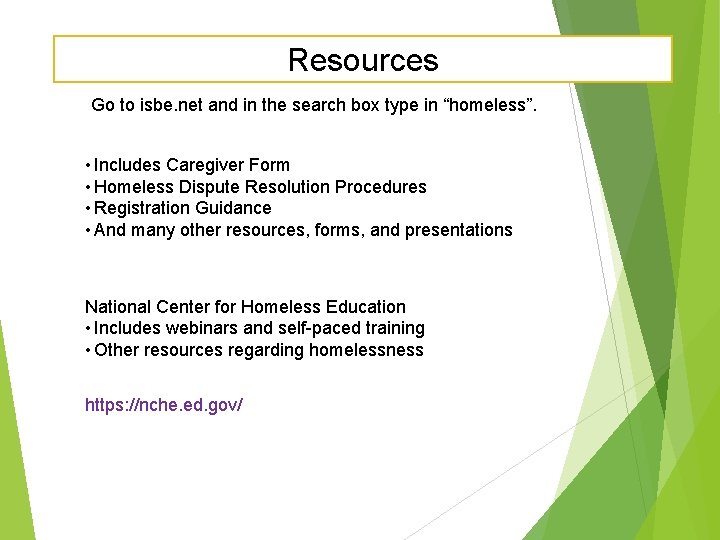
Resources Go to isbe. net and in the search box type in “homeless”. • Includes Caregiver Form • Homeless Dispute Resolution Procedures • Registration Guidance • And many other resources, forms, and presentations National Center for Homeless Education • Includes webinars and self-paced training • Other resources regarding homelessness https: //nche. ed. gov/

SCENARIOS
SCENARIO 1 Ben is a seven-year old living in a low-cost motel with his mom. She wants to register him in your district but he won’t have his transfer records for a couple of weeks. • Is Ben MKV-eligible? Do you register him? When does he start?
SCENARIO 1 ANSWER Is Ben MKV-eligible? YES Do you register him? YES When does he start? IMMEDIATELY (using the same time frame as a regularly housed student) The records can be obtained by you contacting the former school by phone, fax, or email. If the family is unable to obtain the records, the district liaison must help them obtain copies.
SCENARIO 2 Jessie is the 7 -year old daughter of a migrant worker. She moves into the district in August and the family moves to the next job in April. During this time she lives with her family at the orchard’s ranch house. Is this child homeless? ?
SCENARIO 2 ANSWER Is this child homeless? ? A migrant child is only considered homeless if the living situation fits that of the definition. If the ranch house is fixed, regular, and adequate then this student would NOT be homeless.
SCENARIO 3 Grandma and Grandpa have legal custody of their 4 th grade grandchild, Alex. Mom is in Georgia and dad is in prison. Is Alex MKV-eligible? Why or why not?
SCENARIO 3 ANSWER Is Alex MKV-eligible? NO Why or why not? The keyword here is legal. Since grandparents have legal custody Alex is NOT MKV-eligible.
SCENARIO 4 • Two moms each have 3 children and are living at the same address. • Are these children homeless?
SCENARIO 4 ANSWER • Are these children homeless? • There is not enough information here to make a determination. You are going to need to ask some questions. Are they living together out of financial necessity? Are they married? Are they sharing the household for convenience?
SCENARIO 5 Mom and two kids moved in with grandma two years ago. • Are they still homeless?
SCENARIO 5 ANSWER • Are they still homeless? Perhaps. If they cannot afford to live on their own, they would be considered doubled up. There is no specific timetable when they can no longer be homeless. If the student is homeless at the beginning of the year they are counted as homeless the entire school year.
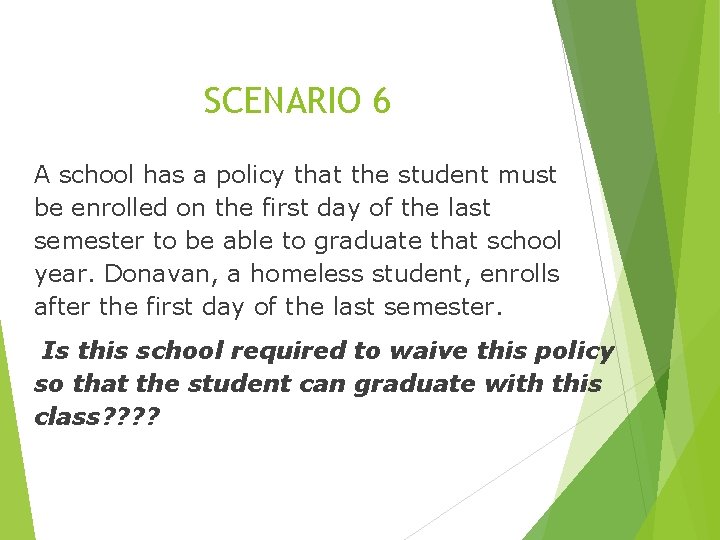
SCENARIO 6 A school has a policy that the student must be enrolled on the first day of the last semester to be able to graduate that school year. Donavan, a homeless student, enrolls after the first day of the last semester. Is this school required to waive this policy so that the student can graduate with this class? ?
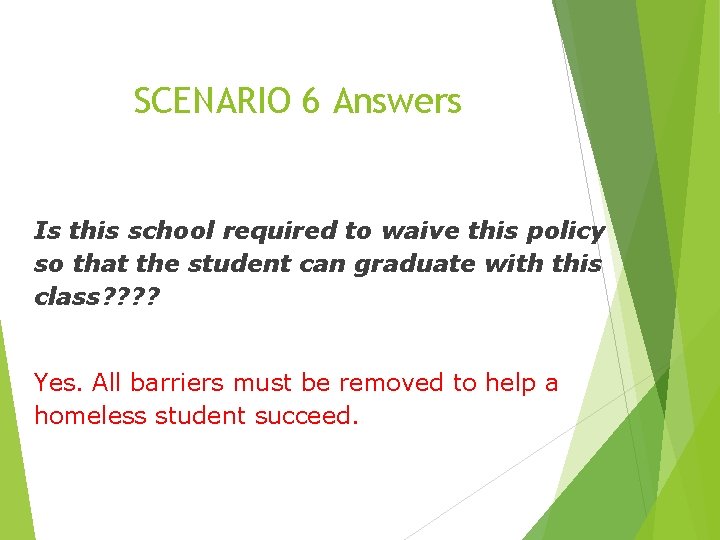
SCENARIO 6 Answers Is this school required to waive this policy so that the student can graduate with this class? ? Yes. All barriers must be removed to help a homeless student succeed.

QUESTIONS? Eileen Shoup eshoup@roe 26. net 309 -575 -3259
- Slides: 52