
MCC 1213 INTERCULTURAL COMMUNICATION LECTURE 3 Cultural Perception


- Slides: 17
MCC 1213 INTERCULTURAL COMMUNICATION LECTURE 3 Cultural Perception and Values ALL RIGHTS RESERVED No part of this document may be reproduced without written approval from Limkokwing University of Creative Technology, Cyberjaya
Learning Outcome • Be able to define and understand such terms as perception, stereotypes, prejudice and cultural value orientation • Increase your understanding of the nature of values • Know the four models of cultural value orientations ALL RIGHTS RESERVED No part of this document may be reproduced without written approval from Limkokwing University of Creative Technology, Cyberjaya
The Nature Of Perception Defined: perception is a process by which we make what we sense into a meaningful experience by selecting, categorizing, and interpreting internal and external stimuli to form our view of world. ALL RIGHTS RESERVED No part of this document may be reproduced without written approval from Limkokwing University of Creative Technology, Cyberjaya
Stages Of The Perception Process Selection: a major part of the process of converting the environment stimuli into meaningful experience. Through a selective process, where we can dictate and pay attention to one piece of our environment. Selective perception involves 3 steps: selective exposure, selective attention and selective retention (Klopf, 1995) • ALL RIGHTS RESERVED No part of this document may be reproduced without written approval from Limkokwing University of Creative Technology, Cyberjaya
• Categorization: arrange stimuli into meaningful patterns. Give human perception structure. The process shows the human perception is stable (stable patterns) • Interpretation: assigning meaning ALL RIGHTS RESERVED No part of this document may be reproduced without written approval from Limkokwing University of Creative Technology, Cyberjaya
Cultural Influence on Perception • Culture provides the foundation for the meanings we give to our perceptions and directs us to word specific kinds of message and events ALL RIGHTS RESERVED No part of this document may be reproduced without written approval from Limkokwing University of Creative Technology, Cyberjaya
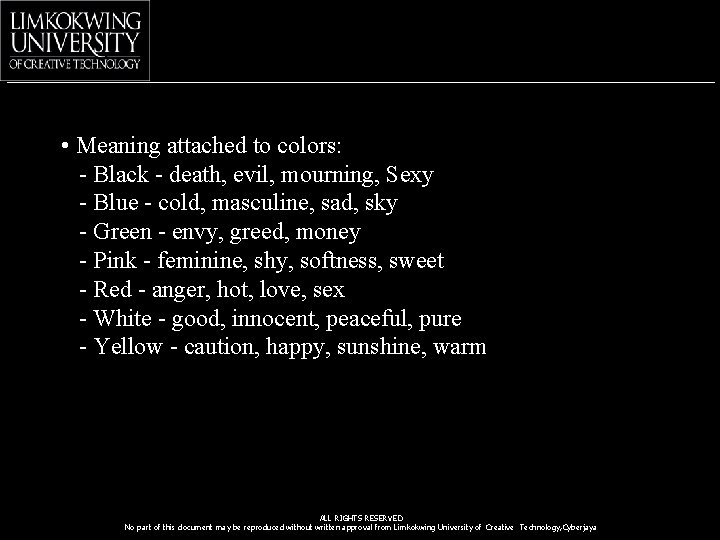
• Meaning attached to colors: - Black - death, evil, mourning, Sexy - Blue - cold, masculine, sad, sky - Green - envy, greed, money - Pink - feminine, shy, softness, sweet - Red - anger, hot, love, sex - White - good, innocent, peaceful, pure - Yellow - caution, happy, sunshine, warm ALL RIGHTS RESERVED No part of this document may be reproduced without written approval from Limkokwing University of Creative Technology, Cyberjaya
Stereotypes • Stereotypes are those over generalized and over simplified beliefs we use to categorize a group of people. • Tendency to make a claim that often goes beyond the facts, with no valid basis • May be based on the truth, but they are exaggerated statements regarding our belief. ALL RIGHTS RESERVED No part of this document may be reproduced without written approval from Limkokwing University of Creative Technology, Cyberjaya
Prejudice • Develop from a set of oversimplified beliefs into a rigid attitude toward a group of people. • Based on erroneous beliefs or preconceptions ALL RIGHTS RESERVED No part of this document may be reproduced without written approval from Limkokwing University of Creative Technology, Cyberjaya
• Prejudice is a learned tendency by which we respond to a given group of people or event in a consistent (usually negative) way. • When cognitions (stereotypes) are assigned values (prejudice), we may enact biased action (e. g. discrimiation) ALL RIGHTS RESERVED No part of this document may be reproduced without written approval from Limkokwing University of Creative Technology, Cyberjaya
The Nature Of Value • Value tend to be the basis of all the decisions we make and provide standards for us to evaluate our own and others 'action‘ • Value can be defined as “a conception, explicit or implicit, distinctive of an individual or characteristic of a group, of the desirable which influence the selection from available modes, means and ends of action” • Values are guiding forces of human behavior. E. g. “Time is money”, “cleanliness is next to godliness” ALL RIGHTS RESERVED No part of this document may be reproduced without written approval from Limkokwing University of Creative Technology, Cyberjaya
Cultural Value Orientations • Value orientations are the means society uses to solve the universal problems of daily life. ALL RIGHTS RESERVED No part of this document may be reproduced without written approval from Limkokwing University of Creative Technology, Cyberjaya
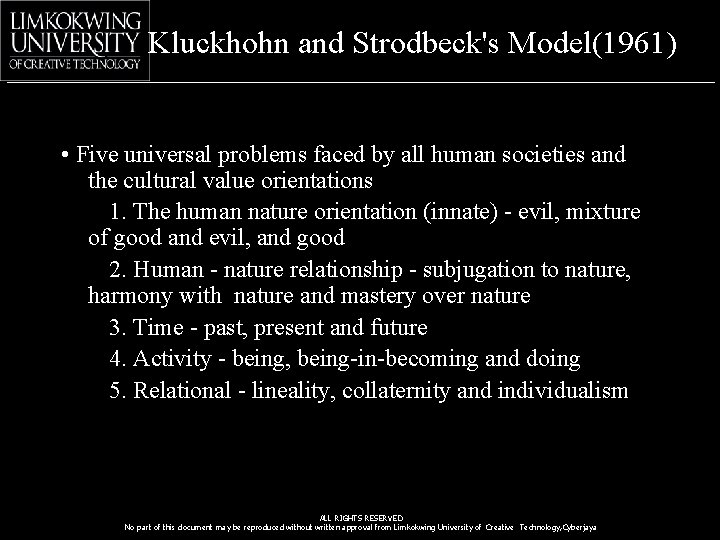
Kluckhohn and Strodbeck's Model(1961) • Five universal problems faced by all human societies and the cultural value orientations 1. The human nature orientation (innate) - evil, mixture of good and evil, and good 2. Human - nature relationship - subjugation to nature, harmony with nature and mastery over nature 3. Time - past, present and future 4. Activity - being, being-in-becoming and doing 5. Relational - lineality, collaternity and individualism ALL RIGHTS RESERVED No part of this document may be reproduced without written approval from Limkokwing University of Creative Technology, Cyberjaya
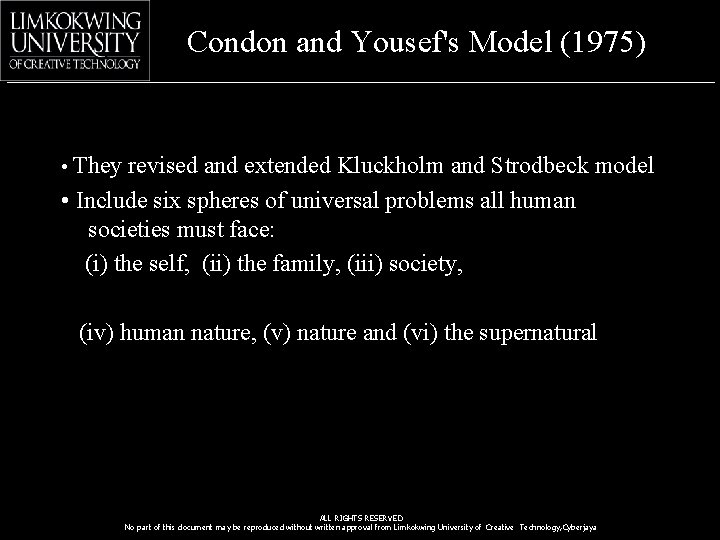
Condon and Yousef's Model (1975) • They revised and extended Kluckholm and Strodbeck model • Include six spheres of universal problems all human societies must face: (i) the self, (ii) the family, (iii) society, (iv) human nature, (v) nature and (vi) the supernatural ALL RIGHTS RESERVED No part of this document may be reproduced without written approval from Limkokwing University of Creative Technology, Cyberjaya
• The 6 spheres intersect each other and are interdependent • Develop 25 value orientations encompassed by the six sphere of universal problems • The model offers a comprehensive list of cultural value orientations. ALL RIGHTS RESERVED No part of this document may be reproduced without written approval from Limkokwing University of Creative Technology, Cyberjaya
Hall's Culture Context Model (1976) • Divided cultural differences into 2 categories: low context culture and high context culture • Differences in the following areas: • Verbal expression • Non-verbal expression • Value of group and individualism • Logic (linear and spiral) • Presenting ideas (logic and feeling) • message structure ALL RIGHTS RESERVED No part of this document may be reproduced without written approval from Limkokwing University of Creative Technology, Cyberjaya
Hofstede's Cultural Dimensions (1984) • Individualism and collectivism • Power distance (low and high) • Uncertainty avoidance • Masculinity and feminility ALL RIGHTS RESERVED No part of this document may be reproduced without written approval from Limkokwing University of Creative Technology, Cyberjaya