
Mc LAB A toolkit for static and dynamic
Mc. LAB: A toolkit for static and dynamic compilers for MATLAB Amina Aslam Toheed Aslam Andrew Casey Maxime Chevalier- Boisvert Jesse Doherty Anton Dubrau Rahul Garg Maja Frydrychowicz Nurudeen Lameed Jun Li Soroush Radpour Olivier Savary Laurie Hendren Mc. Gill University Leverhulme Visiting Professor Department of Computer Science University of Oxford 6/13/2021 Mc. LAB, Leverhulme Lecture #3, Laurie Hendren Intro - 1
Overview • Why MATLAB? • Overview of the Mc. LAB tools • Mc. VM – a Virtual Machine and Just-In-Time (JIT) compiler • Mc. FOR – translating MATLAB to FORTRAN 95 6/13/2021 Mc. LAB, Leverhulme Lecture #3, Laurie Hendren Intro - 2
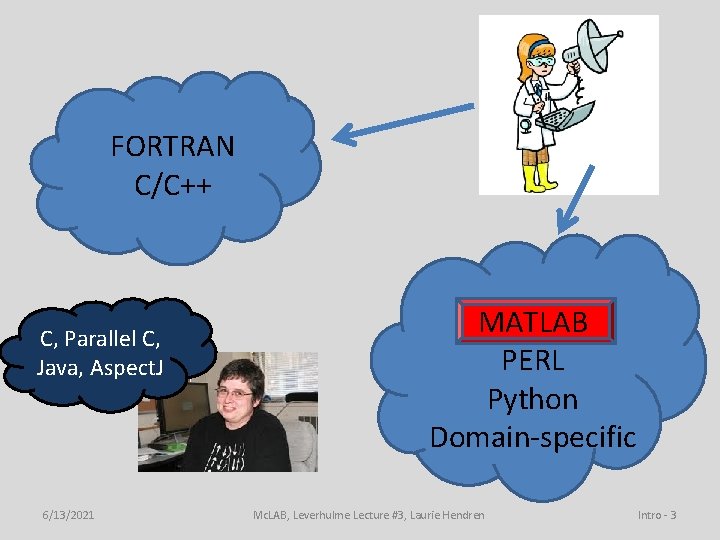
FORTRAN C/C++ C, Parallel C, Java, Aspect. J 6/13/2021 MATLAB PERL Python Domain-specific Mc. LAB, Leverhulme Lecture #3, Laurie Hendren Intro - 3
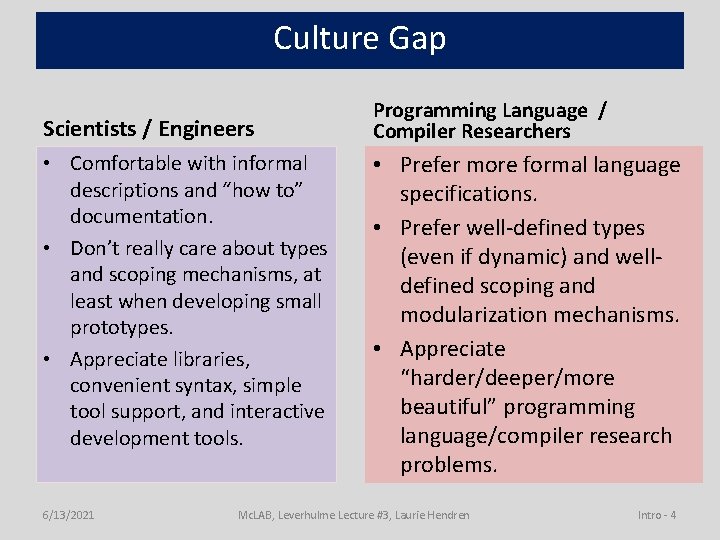
Culture Gap Scientists / Engineers • Comfortable with informal descriptions and “how to” documentation. • Don’t really care about types and scoping mechanisms, at least when developing small prototypes. • Appreciate libraries, convenient syntax, simple tool support, and interactive development tools. 6/13/2021 Programming Language / Compiler Researchers • Prefer more formal language specifications. • Prefer well-defined types (even if dynamic) and welldefined scoping and modularization mechanisms. • Appreciate “harder/deeper/more beautiful” programming language/compiler research problems. Mc. LAB, Leverhulme Lecture #3, Laurie Hendren Intro - 4

Mc. LAB Compiler Framework Ok, I can deal with this! Frontend Analysis Framework Backends Ok, this is useful! 6/13/2021 Mc. LAB, Leverhulme Lecture #3, Laurie Hendren Intro - 5
Goals of the Mc. Lab Project • Improve the understanding and documentation of the semantics of MATLAB. • Provide front-end compiler tools suitable for MATLAB and language extensions of MATLAB. • Provide a flow-analysis framework and a suite of analyses suitable for a wide range of compiler/soft. eng. applications. • Provide back-ends that enable experimentation with JIT and ahead-of-time compilation. Enable PL, Compiler and SE Researchers to work on MATLAB 6/13/2021 Mc. LAB, Leverhulme Lecture #3, Laurie Hendren Intro - 6
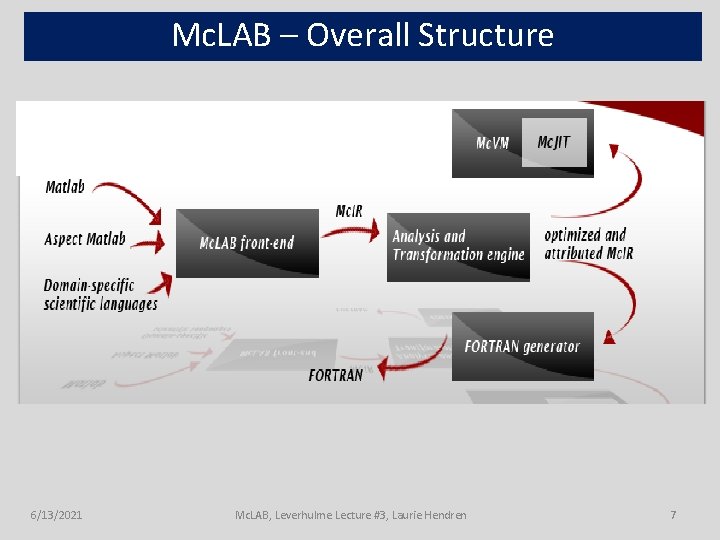
Mc. LAB – Overall Structure 6/13/2021 Mc. LAB, Leverhulme Lecture #3, Laurie Hendren 7
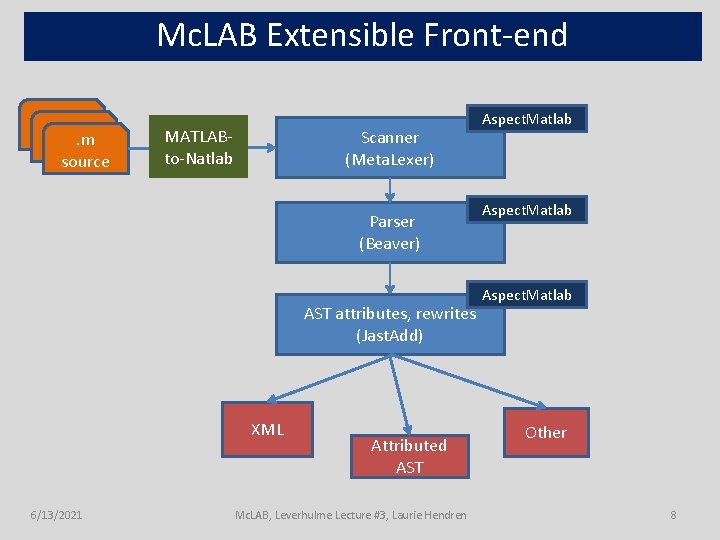
Mc. LAB Extensible Front-end. m. m source MATLABto-Natlab Scanner (Meta. Lexer) Parser (Beaver) AST attributes, rewrites (Jast. Add) XML 6/13/2021 Attributed AST Mc. LAB, Leverhulme Lecture #3, Laurie Hendren Aspect. Matlab Other 8
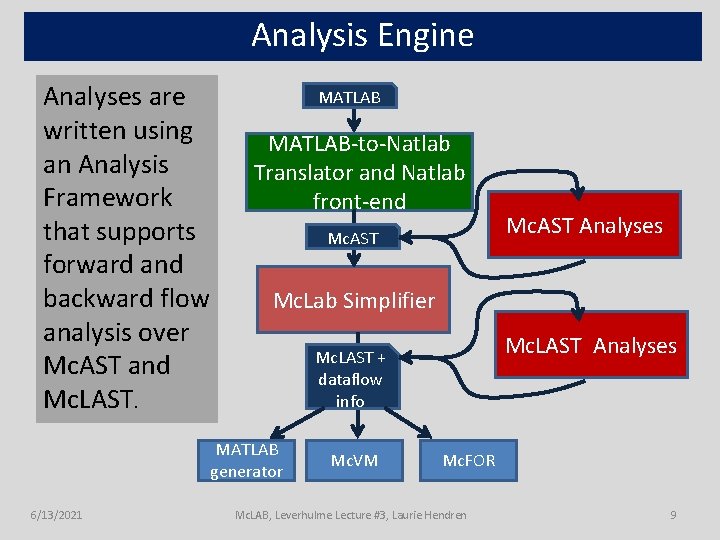
Analysis Engine Analyses are written using an Analysis Framework that supports forward and backward flow analysis over Mc. AST and Mc. LAST. MATLAB-to-Natlab Translator and Natlab front-end Mc. AST Mc. Lab Simplifier Mc. LAST Analyses Mc. LAST + dataflow info MATLAB generator 6/13/2021 Mc. AST Analyses Mc. VM Mc. FOR Mc. LAB, Leverhulme Lecture #3, Laurie Hendren 9
How to build the backends? • No official language specification. • Closed-source implementations, including the library. 6/13/2021 Mc. LAB, Leverhulme Lecture #3, Laurie Hendren 10
Back-end #1: MATLAB generator • Mc. LAB can be used as a source-to-source translator: – source-level optimizations like loop unrolling – source-level refactoring tool • Mc. LAB can generate: – xml files (used to communicate with Mc. VM) – text. m files • Comments are maintained to enable readable output. 6/13/2021 Mc. LAB, Leverhulme Lecture #3, Laurie Hendren Intro - 11
Back-end #2: Mc. VM with JIT compiler • Based on Maxime Chevalier-Boisvert's M. Sc. thesis, Mc. Gill, published in CC 2010. • Currently being extended by Nurudeen Lameed and Rahul Garg, Ph. D. candidates, Mc. Gill. 6/13/2021 Mc. LAB, Leverhulme Lecture #3, Laurie Hendren 12
Mc. VM-Mc. JIT • The dynamic nature of MATLAB makes it very suitable for a VM/JIT. • Math. Works' implementation does have a JIT, although technical details are not known. • Mc. VM/Mc. JIT is an open implementation aimed at supporting research into dynamic optimization techniques for MATLAB. 6/13/2021 Mc. LAB, Leverhulme Lecture #3, Laurie Hendren Backends- 13
Design Choices for JITs 1. Interpreter + JIT compiler with various levels of optimizations. 2. Fast JIT for naïve code generation + optimizing JIT with various levels of optimizations. • Mc. VM uses the 1 st option because it simplifies adding new features, if a feature is not yet supported by the JIT it can back-up to the interpreter implementation, which is easy to provide. 6/13/2021 Mc. LAB, Leverhulme Lecture #3, Laurie Hendren 14
Mc. VM Design • A basic, but fast, interpreter for the MATLAB language. • A garbage-collected JIT Compiler as an extension to the interpreter. • Easy to add new data types and statements by modifying only the interpreter. • Supported by the LLVM compiler framework and some numerical computing libraries. • Written entirely in C++; interface with the Mc. LAB front-end via a network port. 6/13/2021 Mc. LAB, Leverhulme Lecture #3, Laurie Hendren Backends- 15
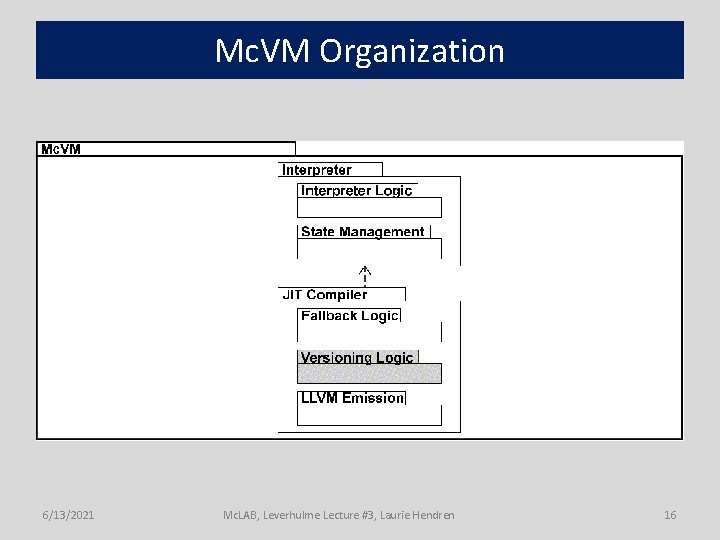
Mc. VM Organization 6/13/2021 Mc. LAB, Leverhulme Lecture #3, Laurie Hendren 16
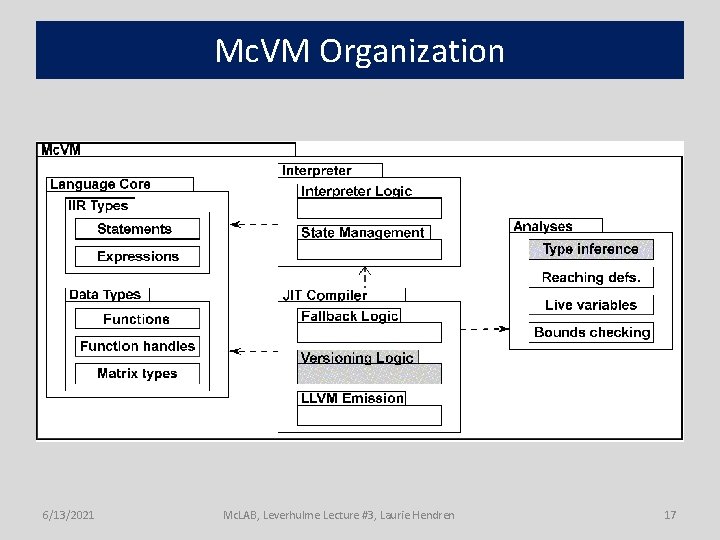
Mc. VM Organization 6/13/2021 Mc. LAB, Leverhulme Lecture #3, Laurie Hendren 17
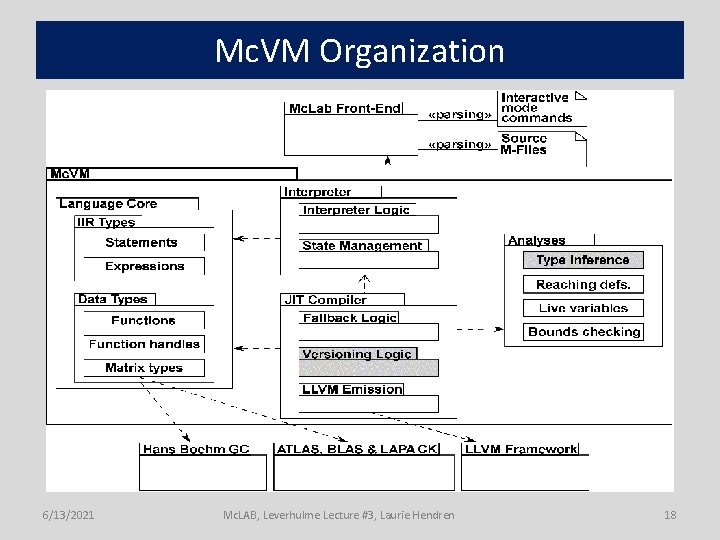
Mc. VM Organization 6/13/2021 Mc. LAB, Leverhulme Lecture #3, Laurie Hendren 18
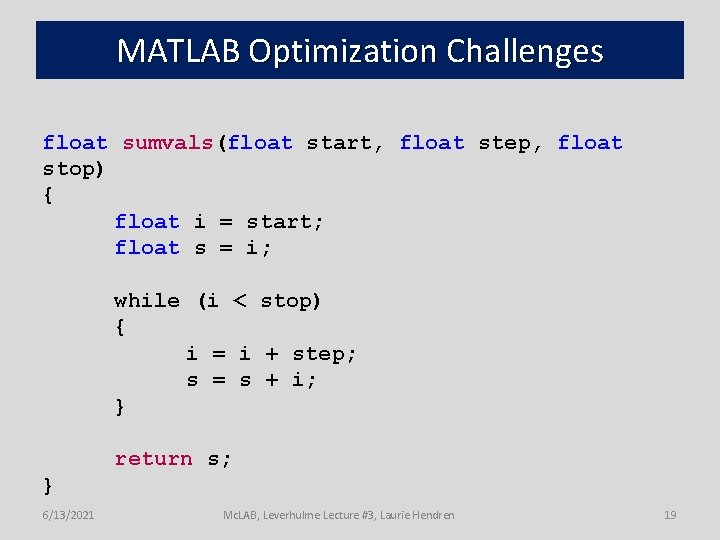
MATLAB Optimization Challenges float sumvals(float start, float step, float stop) { float i = start; float s = i; while (i < stop) { i = i + step; s = s + i; } return s; } 6/13/2021 Mc. LAB, Leverhulme Lecture #3, Laurie Hendren 19
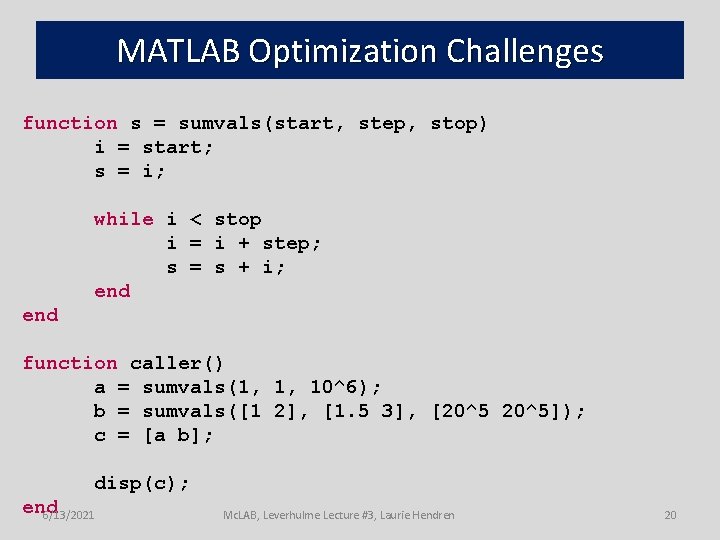
MATLAB Optimization Challenges function s = sumvals(start, step, stop) i = start; s = i; while i < stop i = i + step; s = s + i; end function caller() a = sumvals(1, 1, 10^6); b = sumvals([1 2], [1. 5 3], [20^5]); c = [a b]; disp(c); end 6/13/2021 Mc. LAB, Leverhulme Lecture #3, Laurie Hendren 20
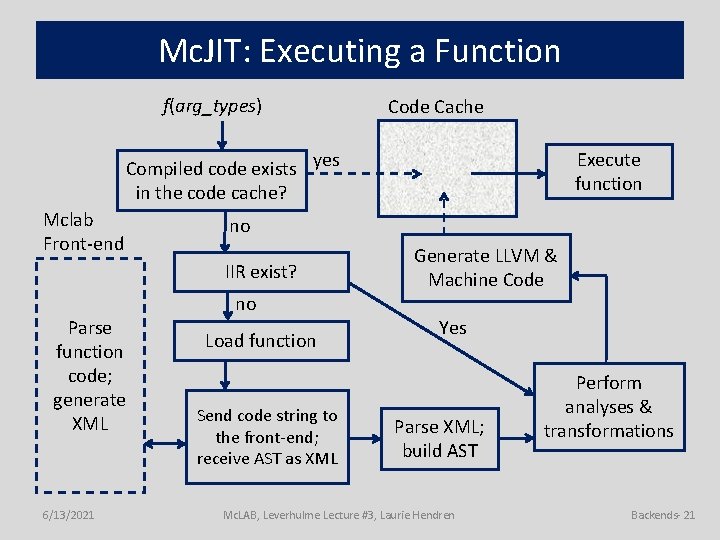
Mc. JIT: Executing a Function f(arg_types) Code Cache Compiled code exists yes in the code cache? Mclab Front-end no IIR exist? Parse function code; generate XML 6/13/2021 Execute function no Load function Send code string to the front-end; receive AST as XML Generate LLVM & Machine Code Yes Parse XML; build AST Mc. LAB, Leverhulme Lecture #3, Laurie Hendren Perform analyses & transformations Backends- 21
![Just-In-Time Specialization (1) >> a = sumvals(1, 1, 10^6); >> b = sumvals([1 2],](http://slidetodoc.com/presentation_image_h2/6af977000b9c1ec6367fa810088a093e/image-22.jpg "Just-In-Time Specialization (1) >> a = sumvals(1, 1, 10^6); >> b = sumvals([1 2],")
Just-In-Time Specialization (1) >> a = sumvals(1, 1, 10^6); >> b = sumvals([1 2], [1. 5 3], [20^5]); >> a = sumvals(1, 1, 500); >> c = [a b]; >> disp(c); 6/13/2021 Mc. LAB, Leverhulme Lecture #3, Laurie Hendren 22
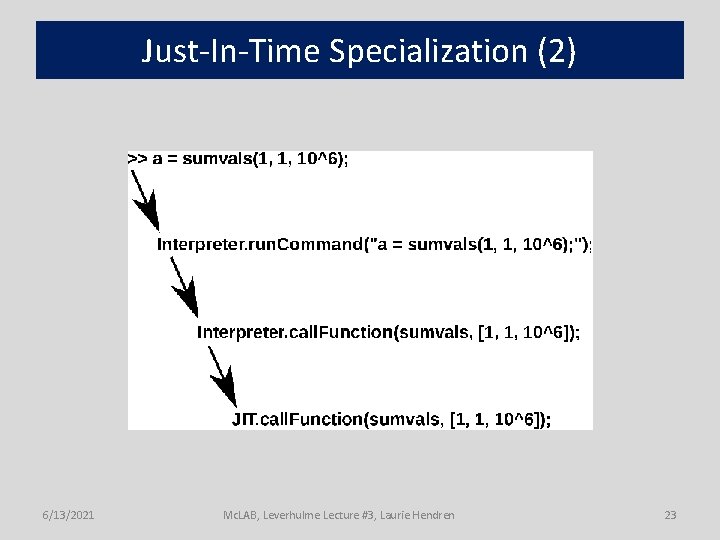
Just-In-Time Specialization (2) 6/13/2021 Mc. LAB, Leverhulme Lecture #3, Laurie Hendren 23
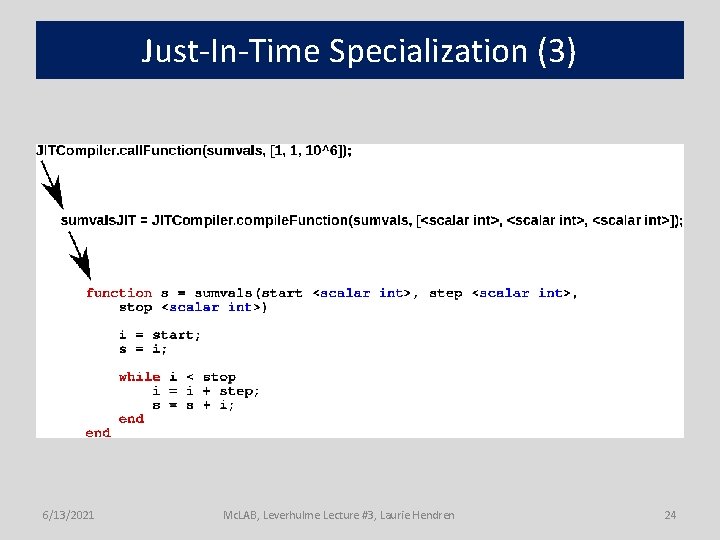
Just-In-Time Specialization (3) 6/13/2021 Mc. LAB, Leverhulme Lecture #3, Laurie Hendren 24
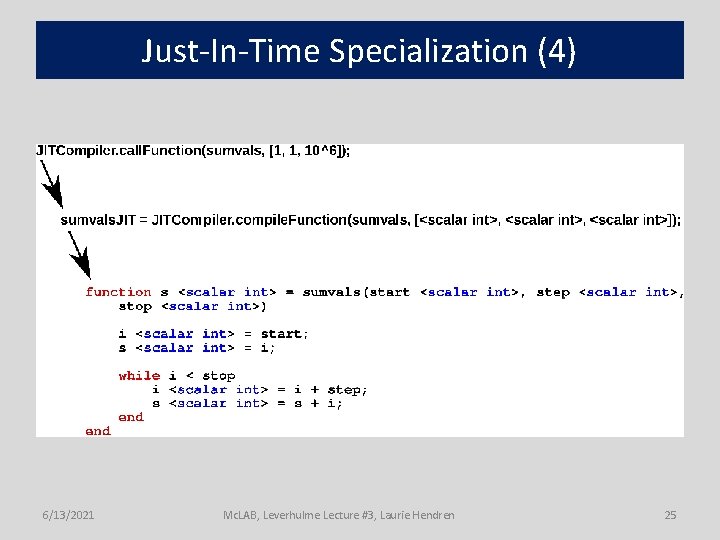
Just-In-Time Specialization (4) 6/13/2021 Mc. LAB, Leverhulme Lecture #3, Laurie Hendren 25
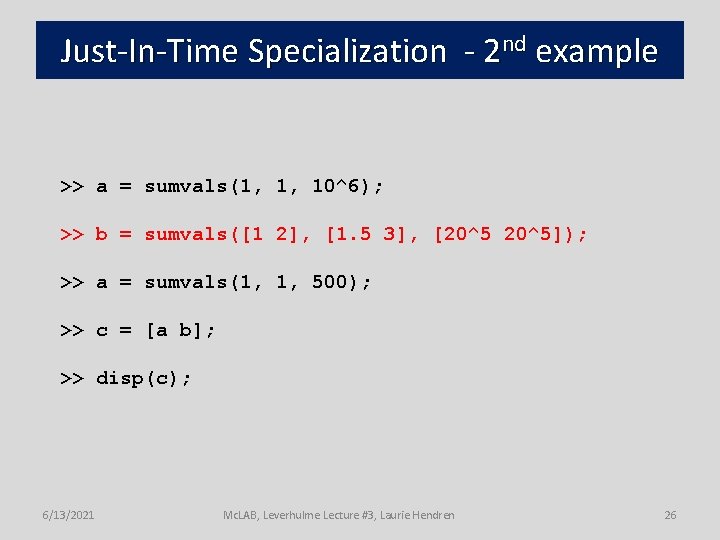
Just-In-Time Specialization - 2 nd example >> a = sumvals(1, 1, 10^6); >> b = sumvals([1 2], [1. 5 3], [20^5]); >> a = sumvals(1, 1, 500); >> c = [a b]; >> disp(c); 6/13/2021 Mc. LAB, Leverhulme Lecture #3, Laurie Hendren 26
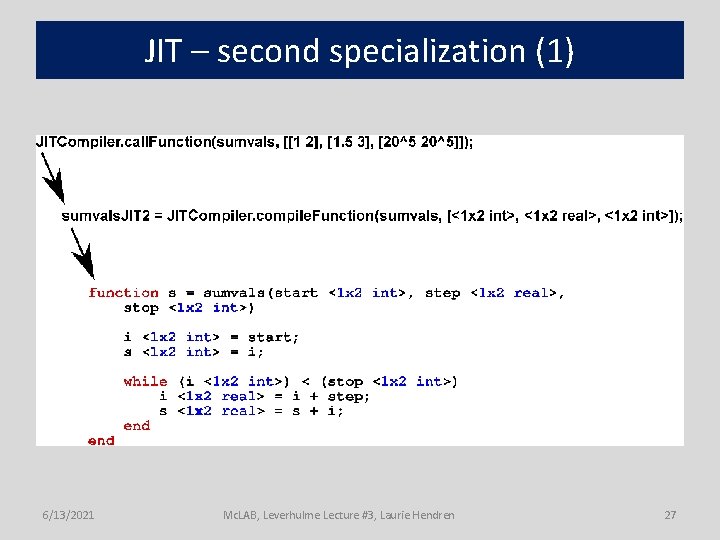
JIT – second specialization (1) 6/13/2021 Mc. LAB, Leverhulme Lecture #3, Laurie Hendren 27
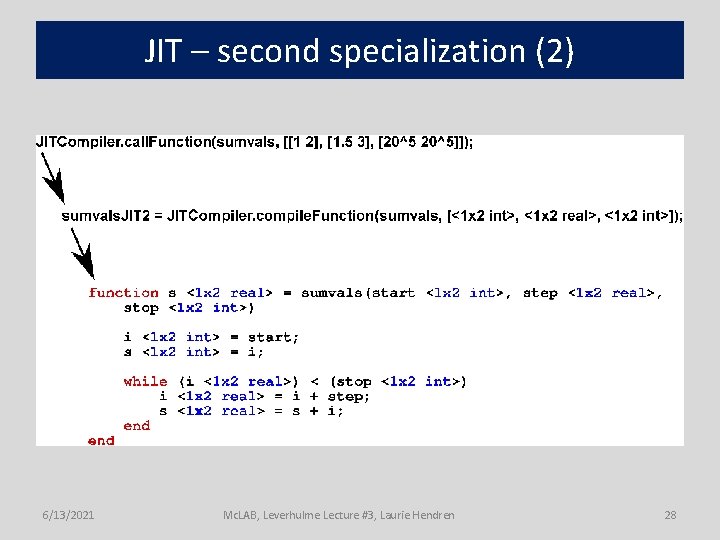
JIT – second specialization (2) 6/13/2021 Mc. LAB, Leverhulme Lecture #3, Laurie Hendren 28
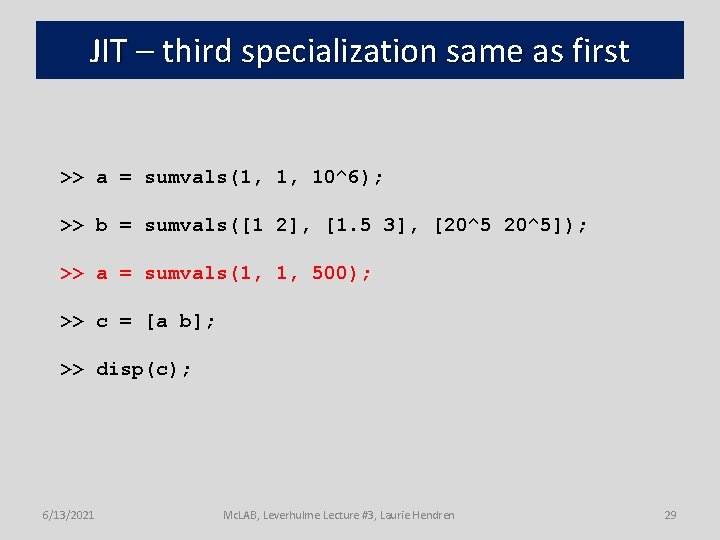
JIT – third specialization same as first >> a = sumvals(1, 1, 10^6); >> b = sumvals([1 2], [1. 5 3], [20^5]); >> a = sumvals(1, 1, 500); >> c = [a b]; >> disp(c); 6/13/2021 Mc. LAB, Leverhulme Lecture #3, Laurie Hendren 29
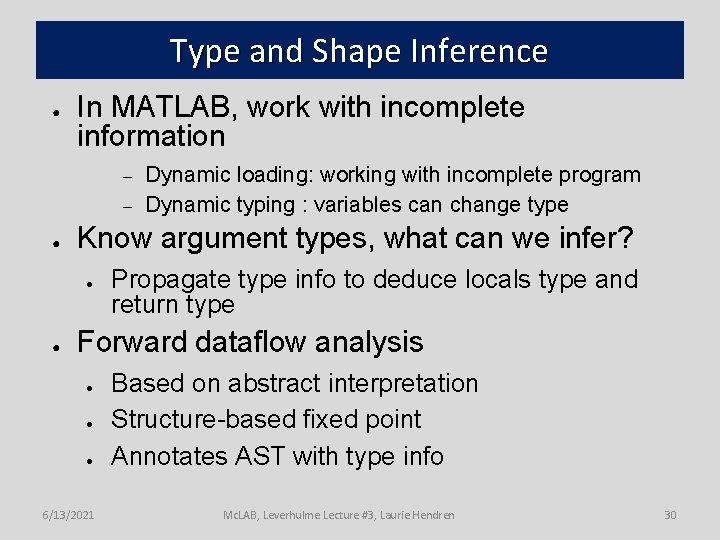
Type and Shape Inference ● In MATLAB, work with incomplete information – – ● Know argument types, what can we infer? ● ● Dynamic loading: working with incomplete program Dynamic typing : variables can change type Propagate type info to deduce locals type and return type Forward dataflow analysis ● ● ● 6/13/2021 Based on abstract interpretation Structure-based fixed point Annotates AST with type info Mc. LAB, Leverhulme Lecture #3, Laurie Hendren 30
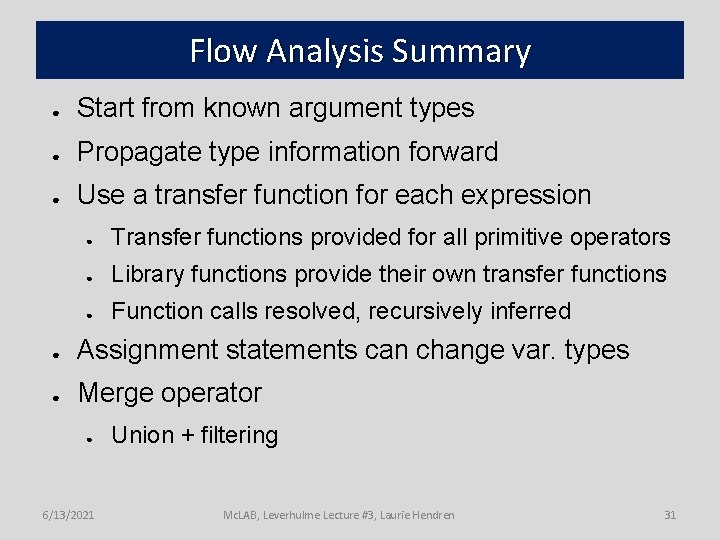
Flow Analysis Summary ● Start from known argument types ● Propagate type information forward ● Use a transfer function for each expression ● Transfer functions provided for all primitive operators ● Library functions provide their own transfer functions ● Function calls resolved, recursively inferred ● Assignment statements can change var. types ● Merge operator ● 6/13/2021 Union + filtering Mc. LAB, Leverhulme Lecture #3, Laurie Hendren 31
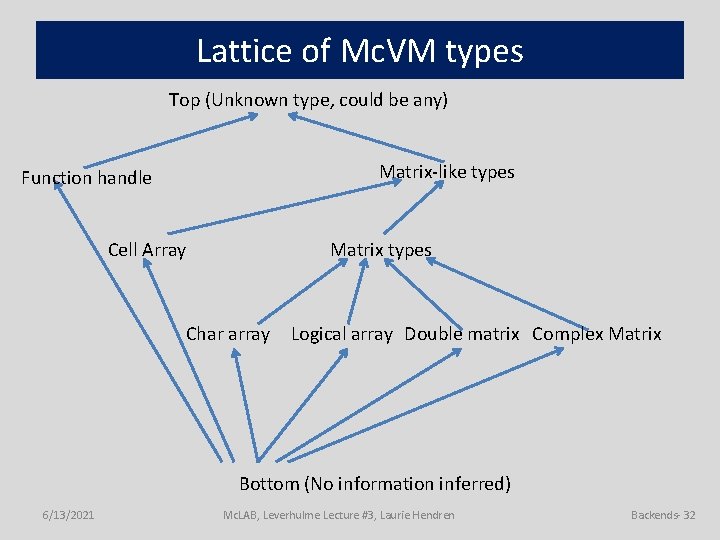
Lattice of Mc. VM types Top (Unknown type, could be any) Matrix-like types Function handle Cell Array Matrix types Char array Logical array Double matrix Complex Matrix Bottom (No information inferred) 6/13/2021 Mc. LAB, Leverhulme Lecture #3, Laurie Hendren Backends- 32
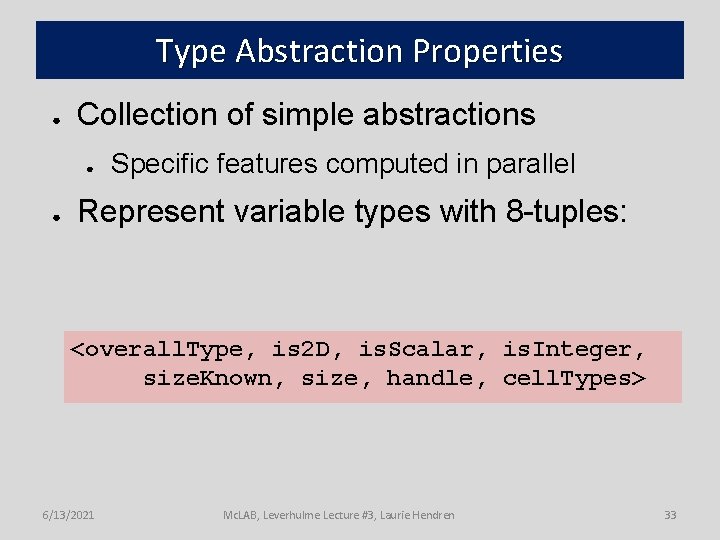
Type Abstraction Properties ● Collection of simple abstractions ● ● Specific features computed in parallel Represent variable types with 8 -tuples: <overall. Type, is 2 D, is. Scalar, is. Integer, size. Known, size, handle, cell. Types> 6/13/2021 Mc. LAB, Leverhulme Lecture #3, Laurie Hendren 33
![Type Abstraction Properties a = [1 2]; type(a) = <overall. Type = double, is](http://slidetodoc.com/presentation_image_h2/6af977000b9c1ec6367fa810088a093e/image-34.jpg "Type Abstraction Properties a = [1 2]; type(a) = <overall. Type = double, is")
Type Abstraction Properties a = [1 2]; type(a) = <overall. Type = double, is 2 D = T, is. Scalar = F, is. Integer = T, size. Known = T, size = (1, 2), handle = null, cell. Types = {}> 6/13/2021 Mc. LAB, Leverhulme Lecture #3, Laurie Hendren 34
![Variable Types: Type Sets if (c 1) a = [1 2]; elseif (c 2)](http://slidetodoc.com/presentation_image_h2/6af977000b9c1ec6367fa810088a093e/image-35.jpg "Variable Types: Type Sets if (c 1) a = [1 2]; elseif (c 2)")
Variable Types: Type Sets if (c 1) a = [1 2]; elseif (c 2) a = 1. 5; else a = 'a'; end 6/13/2021 type(a) = { <overall. Type = double, is 2 D = T, is. Scalar = F, is. Integer = T, size. Known = T, size = (1, 2), handle = null, cell. Types = {}>, <overall. Type = double, is 2 D = T, is. Scalar = T, is. Integer = F, size. Known = T, size = (1, 1), handle = null, cell. Types = {}>, <overall. Type = char, is 2 D = T, is. Scalar = T, is. Integer = T, size. Known = T, size = (1, 1), handle = null, cell. Types = {}> } Mc. LAB, Leverhulme Lecture #3, Laurie Hendren 35
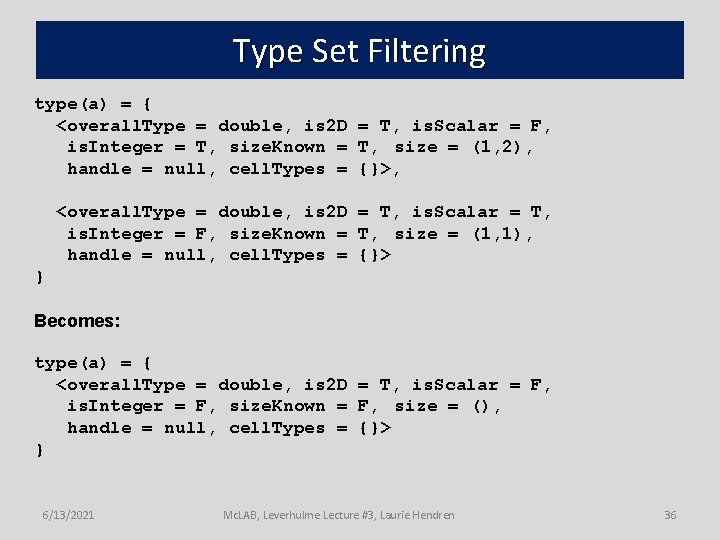
Type Set Filtering type(a) = { <overall. Type = double, is 2 D = T, is. Scalar = F, is. Integer = T, size. Known = T, size = (1, 2), handle = null, cell. Types = {}>, <overall. Type = double, is 2 D = T, is. Scalar = T, is. Integer = F, size. Known = T, size = (1, 1), handle = null, cell. Types = {}> } Becomes: type(a) = { <overall. Type = double, is 2 D = T, is. Scalar = F, is. Integer = F, size. Known = F, size = (), handle = null, cell. Types = {}> } 6/13/2021 Mc. LAB, Leverhulme Lecture #3, Laurie Hendren 36
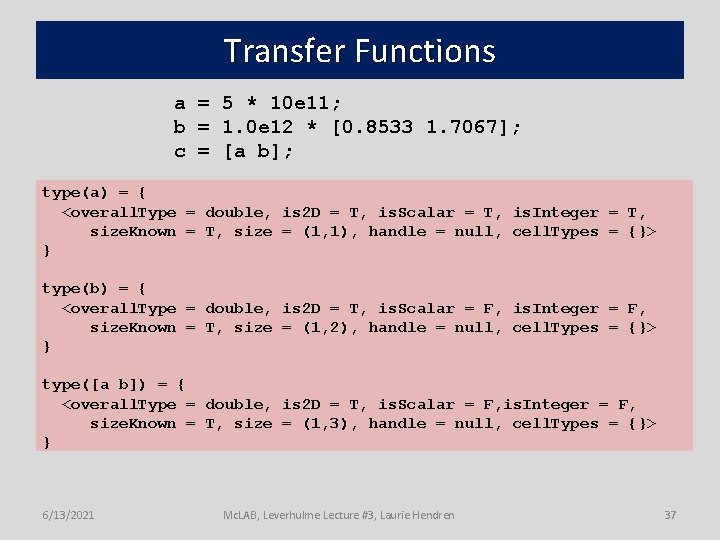
Transfer Functions a = 5 * 10 e 11; b = 1. 0 e 12 * [0. 8533 1. 7067]; c = [a b]; type(a) = { <overall. Type = double, is 2 D = T, is. Scalar = T, is. Integer = T, size. Known = T, size = (1, 1), handle = null, cell. Types = {}> } type(b) = { <overall. Type = double, is 2 D = T, is. Scalar = F, is. Integer = F, size. Known = T, size = (1, 2), handle = null, cell. Types = {}> } type([a b]) = { <overall. Type = double, is 2 D = T, is. Scalar = F, is. Integer = F, size. Known = T, size = (1, 3), handle = null, cell. Types = {}> } 6/13/2021 Mc. LAB, Leverhulme Lecture #3, Laurie Hendren 37
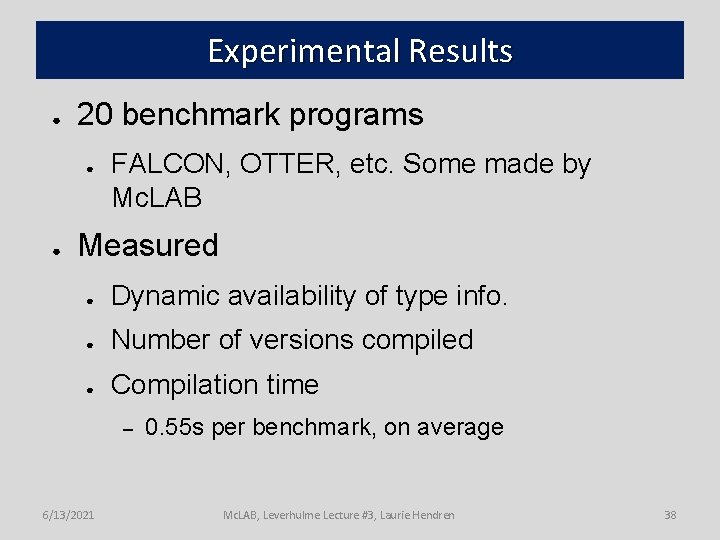
Experimental Results ● 20 benchmark programs ● ● FALCON, OTTER, etc. Some made by Mc. LAB Measured ● Dynamic availability of type info. ● Number of versions compiled ● Compilation time – 6/13/2021 0. 55 s per benchmark, on average Mc. LAB, Leverhulme Lecture #3, Laurie Hendren 38
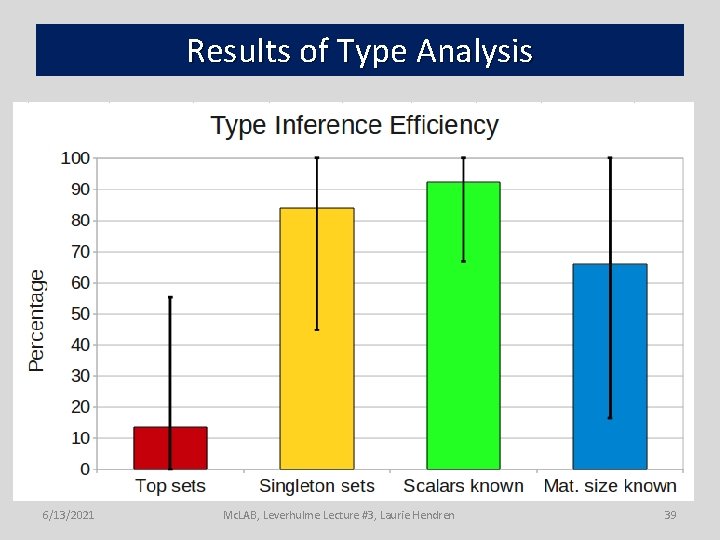
Results of Type Analysis 6/13/2021 Mc. LAB, Leverhulme Lecture #3, Laurie Hendren 39
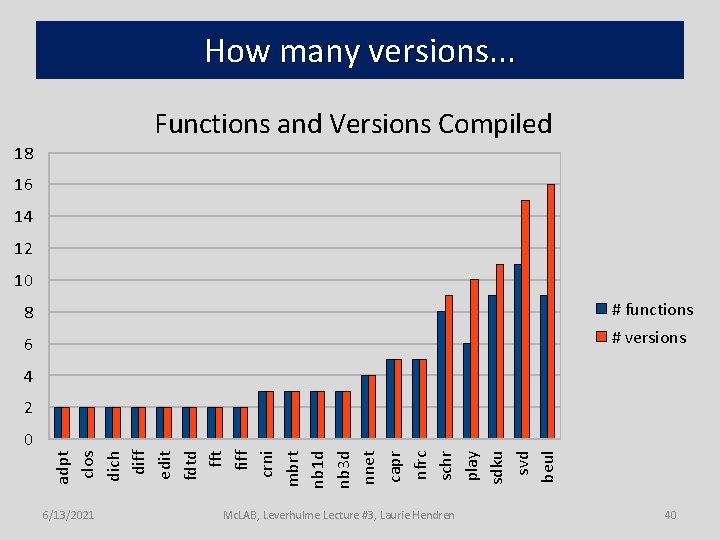
How many versions. . . Functions and Versions Compiled 18 16 14 12 10 8 # functions 6 # versions 4 2 adpt clos dich diff edit fdtd fft fiff crni mbrt nb 1 d nb 3 d nnet capr nfrc schr play sdku svd beul 0 6/13/2021 Mc. LAB, Leverhulme Lecture #3, Laurie Hendren 40
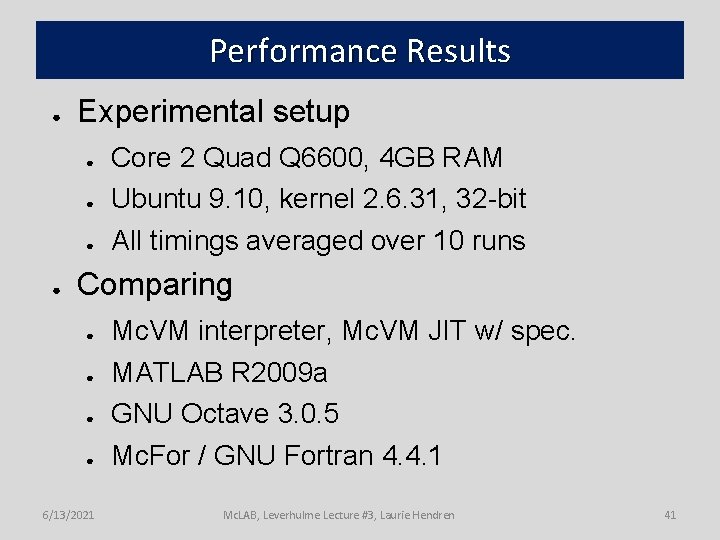
Performance Results ● Experimental setup ● ● Core 2 Quad Q 6600, 4 GB RAM Ubuntu 9. 10, kernel 2. 6. 31, 32 -bit All timings averaged over 10 runs Comparing ● ● 6/13/2021 Mc. VM interpreter, Mc. VM JIT w/ spec. MATLAB R 2009 a GNU Octave 3. 0. 5 Mc. For / GNU Fortran 4. 4. 1 Mc. LAB, Leverhulme Lecture #3, Laurie Hendren 41
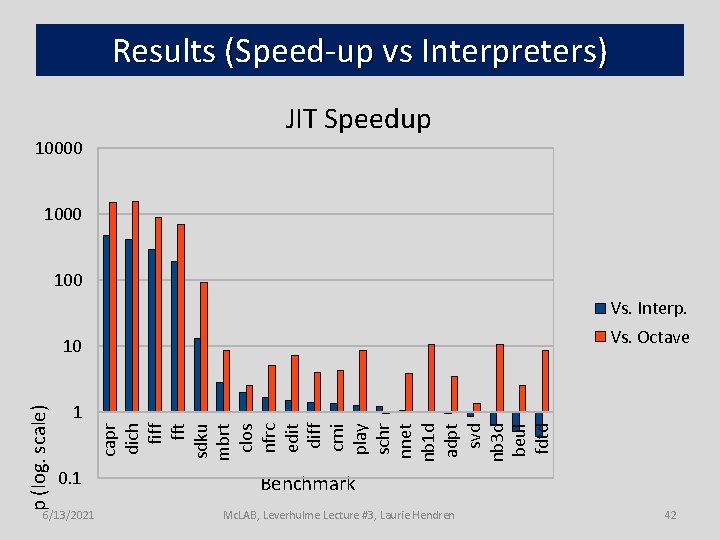
Results (Speed-up vs Interpreters) JIT Speedup 10000 100 Vs. Interp. Vs. Octave 1 capr dich fiff fft sdku mbrt clos nfrc edit diff crni play schr nnet nb 1 d adpt svd nb 3 d beul fdtd dup (log. scale) 10 0. 1 6/13/2021 Benchmark Mc. LAB, Leverhulme Lecture #3, Laurie Hendren 42
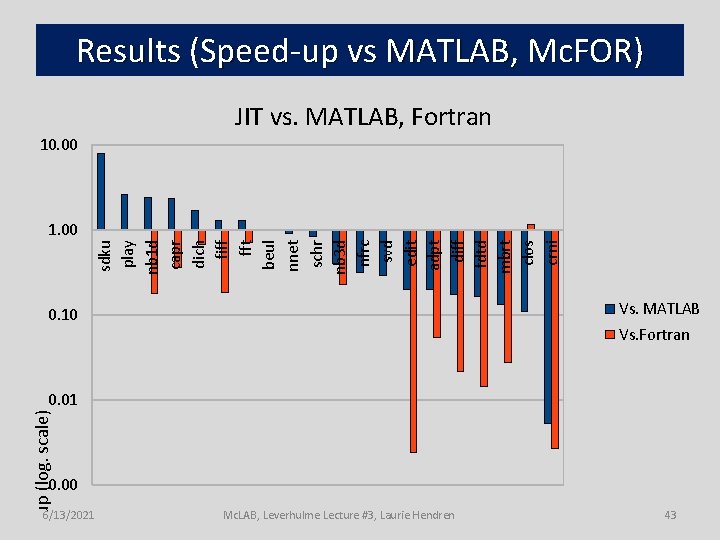
Results (Speed-up vs MATLAB, Mc. FOR) JIT vs. MATLAB, Fortran 10. 00 sdku play nb 1 d capr dich fiff fft beul nnet schr nb 3 d nfrc svd edit adpt diff fdtd mbrt clos crni 1. 00 Vs. MATLAB 0. 10 Vs. Fortran edup (log. scale) 0. 01 0. 00 6/13/2021 Mc. LAB, Leverhulme Lecture #3, Laurie Hendren 43
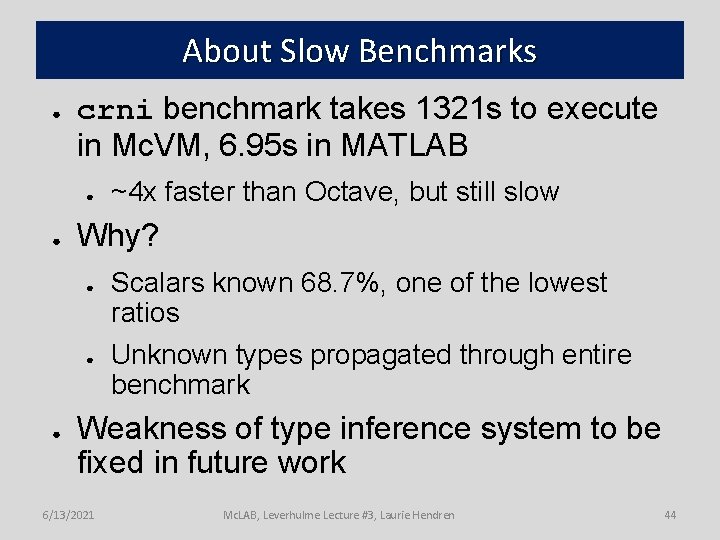
About Slow Benchmarks ● crni benchmark takes 1321 s to execute in Mc. VM, 6. 95 s in MATLAB ● ● Why? ● ● ● ~4 x faster than Octave, but still slow Scalars known 68. 7%, one of the lowest ratios Unknown types propagated through entire benchmark Weakness of type inference system to be fixed in future work 6/13/2021 Mc. LAB, Leverhulme Lecture #3, Laurie Hendren 44
Back-end #3: Mc. FORTRAN 95 generator • First version of Mc. FOR based on Jun Li's M. Sc. thesis, Mc. Gill. • Current version under development by Anton Dubrau, M. Sc. candidate, Mc. Gill. 6/13/2021 Mc. LAB, Leverhulme Lecture #3, Laurie Hendren 45
Goals of Mc. FOR • Handle as large a sub-set of MATLAB as possible, while staying in the "static" setting. • Generate code that can be effectively compiled by modern FORTRAN compilers. • Make the generated code readable by programmers. • Allow longer compile times and whole program analysis. • Limit the need for type annotations. 6/13/2021 Mc. LAB, Leverhulme Lecture #3, Laurie Hendren 46
Challenges • Determining which identifiers are variables and which are functions. • Finding static types which match those of FORTRAN. • Mapping high-level MATLAB array operations to the FORTRAN 95 equivalents. • Handling reshaping implicit in MATLAB operations, including concatenation. 6/13/2021 Mc. LAB, Leverhulme Lecture #3, Laurie Hendren 47
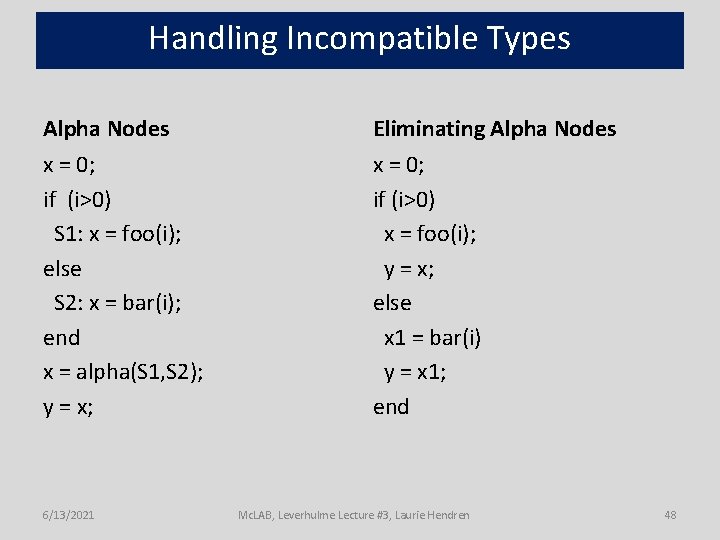
Handling Incompatible Types Alpha Nodes Eliminating Alpha Nodes x = 0; if (i>0) S 1: x = foo(i); else S 2: x = bar(i); end x = alpha(S 1, S 2); y = x; x = 0; if (i>0) x = foo(i); y = x; else x 1 = bar(i) y = x 1; end 6/13/2021 Mc. LAB, Leverhulme Lecture #3, Laurie Hendren 48
![Value Range Propagation MATLAB FORTRAN n = floor(11. 5); //n =[n, n] n =](http://slidetodoc.com/presentation_image_h2/6af977000b9c1ec6367fa810088a093e/image-49.jpg "Value Range Propagation MATLAB FORTRAN n = floor(11. 5); //n =[n, n] n =")
Value Range Propagation MATLAB FORTRAN n = floor(11. 5); //n =[n, n] n = foor(10. 5); for i = 1: n // i=[1, n] DO i = 1, n x = 1+2*i; // x=[3, 1+2*n] x = (1+(2*i)); IF((. NOT. ALLOCATED(A))) THEN ALLOCATE(A((1+(2*n)))); END IF A(x) = i; // Size(A)= A(x) = i; end 1+2*n END DO n = fix(n/2); // n = [n, n] n = fix(n/2); ARRAYBOUNDSCHECKING(A, [n+1]); A(n+1) = n; 6/13/2021 Mc. LAB, Leverhulme Lecture #3, Laurie Hendren Intro - 49
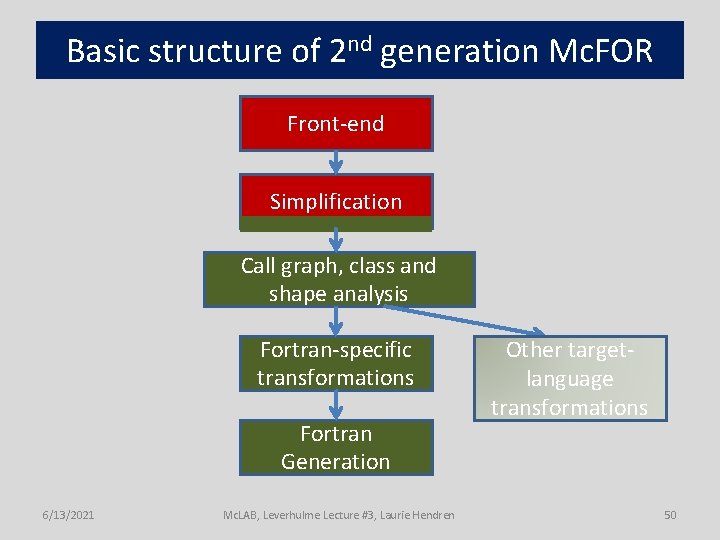
Basic structure of 2 nd generation Mc. FOR Front-end Simplification Call graph, class and shape analysis Fortran-specific transformations Fortran Generation 6/13/2021 Mc. LAB, Leverhulme Lecture #3, Laurie Hendren Other targetlanguage transformations 50
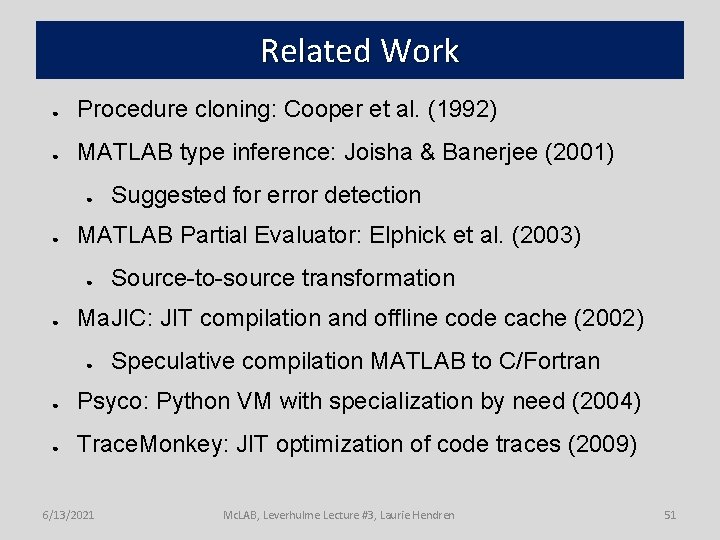
Related Work ● Procedure cloning: Cooper et al. (1992) ● MATLAB type inference: Joisha & Banerjee (2001) ● ● MATLAB Partial Evaluator: Elphick et al. (2003) ● ● Suggested for error detection Source-to-source transformation Ma. JIC: JIT compilation and offline code cache (2002) ● Speculative compilation MATLAB to C/Fortran ● Psyco: Python VM with specialization by need (2004) ● Trace. Monkey: JIT optimization of code traces (2009) 6/13/2021 Mc. LAB, Leverhulme Lecture #3, Laurie Hendren 51
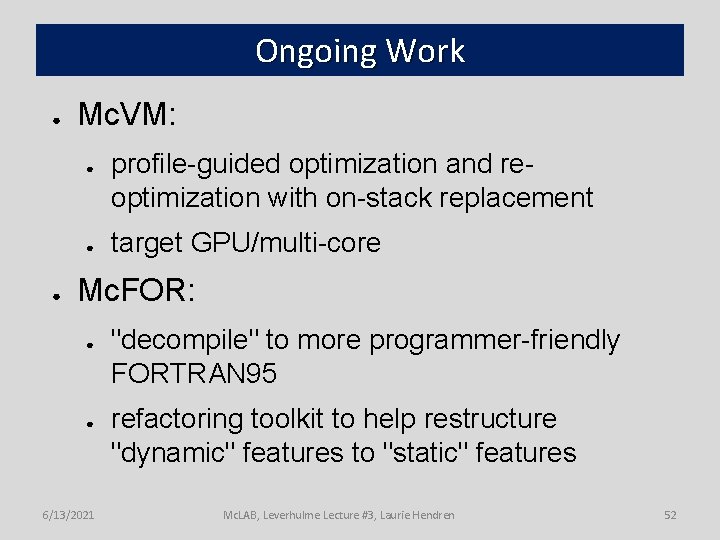
Ongoing Work ● Mc. VM: ● ● ● profile-guided optimization and reoptimization with on-stack replacement target GPU/multi-core Mc. FOR: ● ● 6/13/2021 "decompile" to more programmer-friendly FORTRAN 95 refactoring toolkit to help restructure "dynamic" features to "static" features Mc. LAB, Leverhulme Lecture #3, Laurie Hendren 52
Conclusions ● Mc. LAB is a toolkit to enable PL, Compiler and SE research for MATLAB ● front-end for language extensions ● analysis framework ● three back-ends including Mc. VM and Mc. FOR http: //www. sable. mcgill. ca/mclab 6/13/2021 Mc. LAB, Leverhulme Lecture #3, Laurie Hendren 53
Intermediate Representation EXTRA SLIDES 6/13/2021 Mc. LAB, Leverhulme Lecture #3, Laurie Hendren 54
Internal Intermediate Representation • A simplified form of the Abstract Syntax Tree (AST) of the original source program • It is machine independent • All IIR nodes are garbage collected 6/13/2021 Mc. LAB, Leverhulme Lecture #3, Laurie Hendren Backends- 55
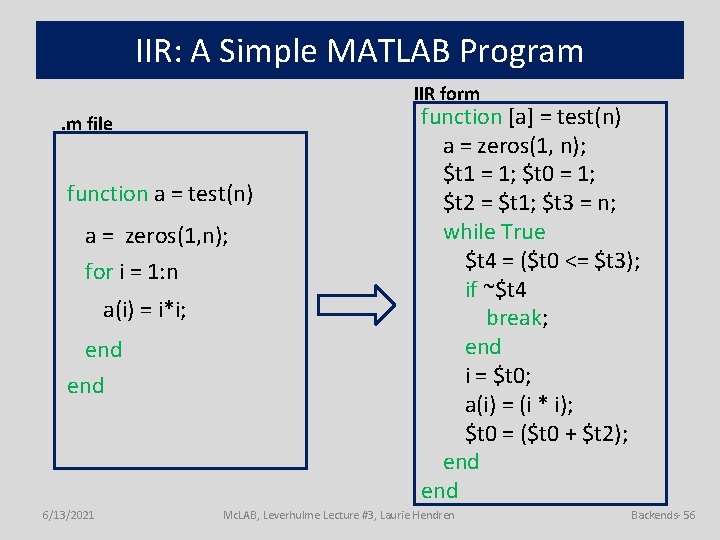
IIR: A Simple MATLAB Program IIR form. m file function a = test(n) a = zeros(1, n); for i = 1: n a(i) = i*i; end 6/13/2021 function [a] = test(n) a = zeros(1, n); $t 1 = 1; $t 0 = 1; $t 2 = $t 1; $t 3 = n; while True $t 4 = ($t 0 <= $t 3); if ~$t 4 break; end i = $t 0; a(i) = (i * i); $t 0 = ($t 0 + $t 2); end Mc. LAB, Leverhulme Lecture #3, Laurie Hendren Backends- 56
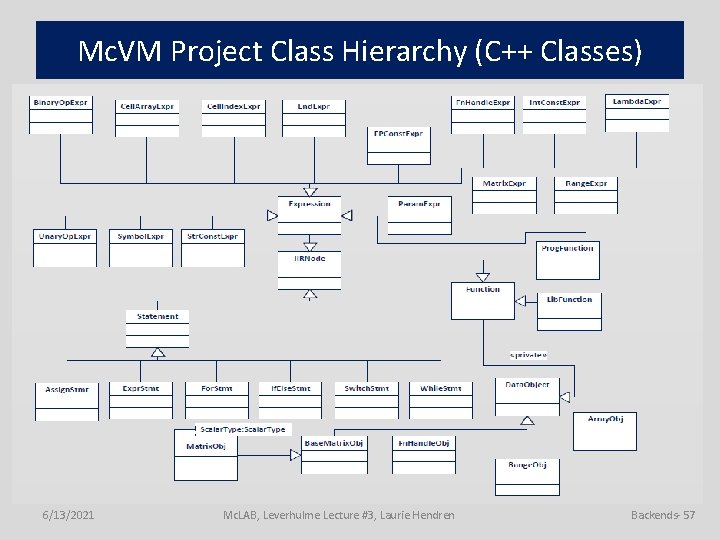
Mc. VM Project Class Hierarchy (C++ Classes) 6/13/2021 Mc. LAB, Leverhulme Lecture #3, Laurie Hendren Backends- 57
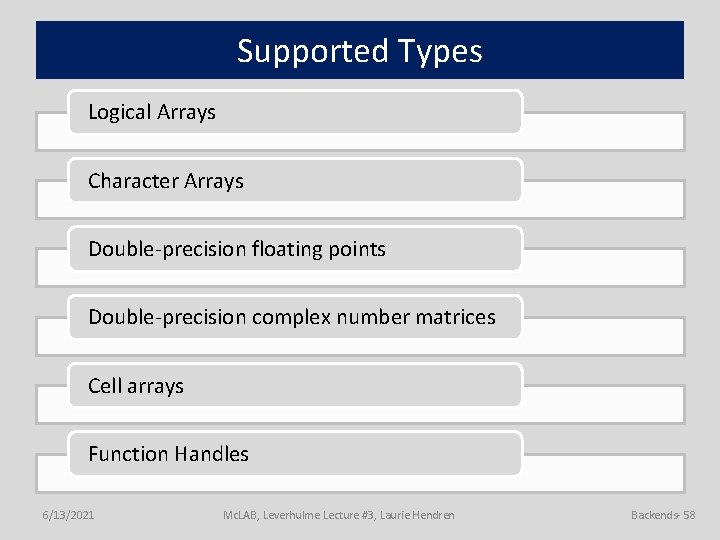
Supported Types Logical Arrays Character Arrays Double-precision floating points Double-precision complex number matrices Cell arrays Function Handles 6/13/2021 Mc. LAB, Leverhulme Lecture #3, Laurie Hendren Backends- 58
- Slides: 58