
Mc Cabe Thiele Part Two Today we will
Mc. Cabe Thiele Part Two Today we will discuss: 1) Mc. Cabe-Thiele graphical construction 2) Determination of N and XB 3) Minimum number of stages N 4) Minimum reflux 5) Example 6) Subcooled Reflux 7) Multiple Feeds 8) Side stream products 9) Open steam 10) Non-ideal distillation: Murphree efficiency Lecture 13: Mc. Cabe-Theile 1
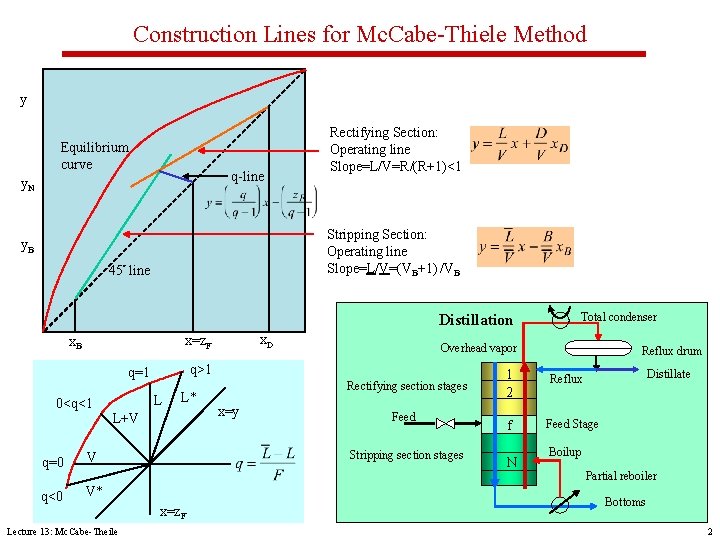
Construction Lines for Mc. Cabe-Thiele Method y Equilibrium curve q-line y. N Rectifying Section: Operating line Slope=L/V=R/(R+1)<1 Stripping Section: Operating line Slope=L/V=(VB+1) /VB y. B 45° line Distillation x. D x=z. F x. B 0<q<1 q=0 V q<0 V* L L* L+V Lecture 13: Mc. Cabe-Theile Overhead vapor q>1 q=1 Rectifying section stages x=y Feed Stripping section stages x=z. F Total condenser 1 2 f N Reflux drum Distillate Reflux Feed Stage Boilup Partial reboiler Bottoms 2
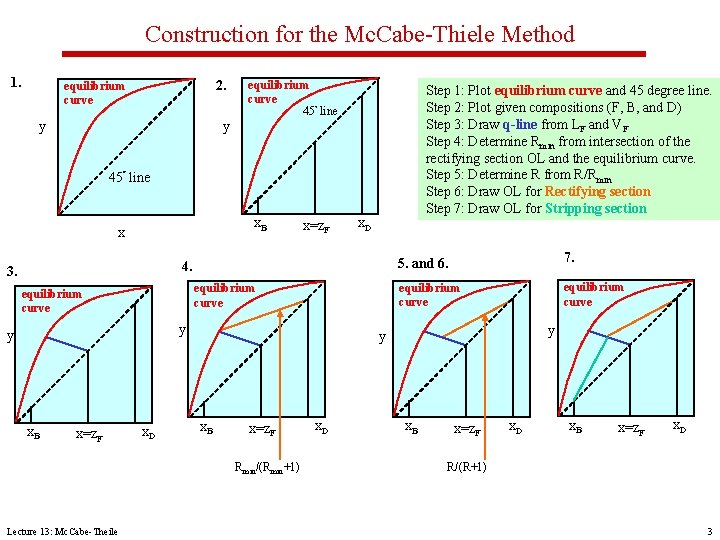
Construction for the Mc. Cabe-Thiele Method 1. 2. equilibrium curve 45° line Step 1: Plot equilibrium curve and 45 degree line. Step 2: Plot given compositions (F, B, and D) Step 3: Draw q-line from LF and VF Step 4: Determine Rmin from intersection of the rectifying section OL and the equilibrium curve. Step 5: Determine R from R/Rmin Step 6: Draw OL for Rectifying section Step 7: Draw OL for Stripping section y y 45° line x. B x x=z. F x. D y y x. B x=z. F Rmin/(Rmin+1) Lecture 13: Mc. Cabe-Theile equilibrium curve 7. 5. and 6. 4. 3. x. D x. B x=z. F x. D R/(R+1) 3
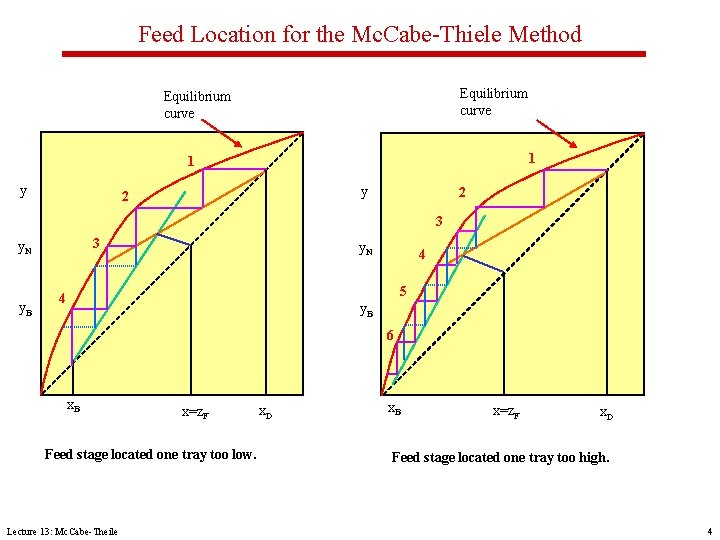
Feed Location for the Mc. Cabe-Thiele Method Equilibrium curve 1 1 y y 2 2 3 3 y. N y. B y. N 4 5 4 y. B 6 x. B x=z. F Feed stage located one tray too low. Lecture 13: Mc. Cabe-Theile x. D x. B x=z. F x. D Feed stage located one tray too high. 4
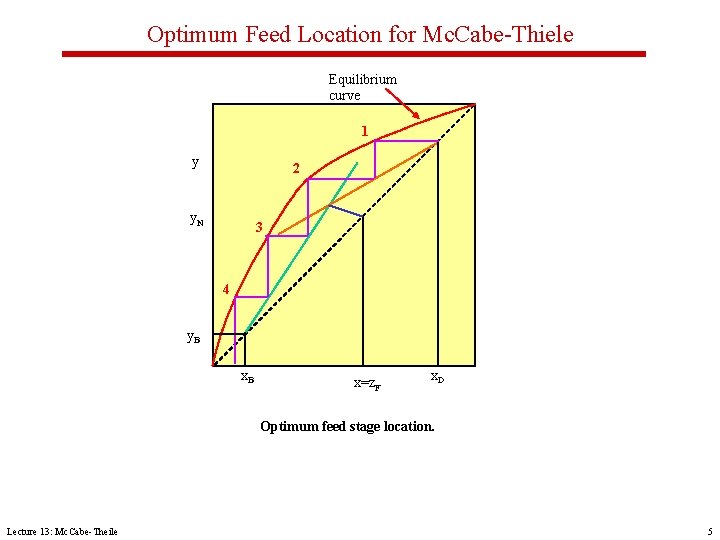
Optimum Feed Location for Mc. Cabe-Thiele Equilibrium curve 1 y 2 y. N 3 4 y. B x=z. F x. D Optimum feed stage location. Lecture 13: Mc. Cabe-Theile 5
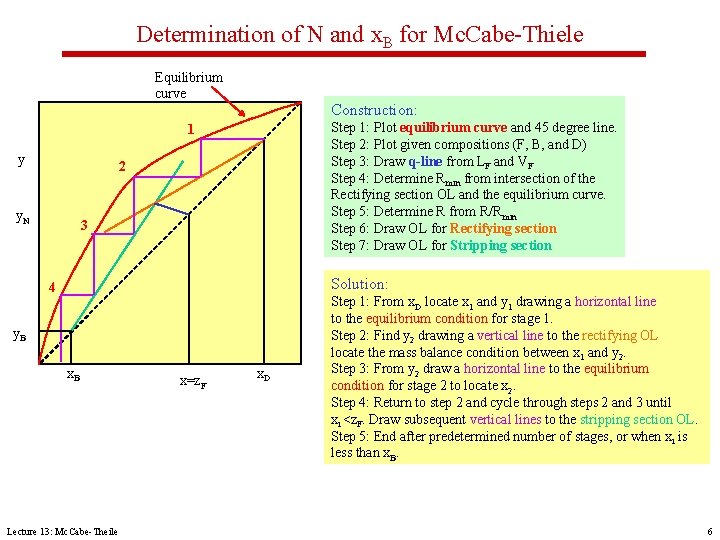
Determination of N and x. B for Mc. Cabe-Thiele Equilibrium curve Construction: Step 1: Plot equilibrium curve and 45 degree line. Step 2: Plot given compositions (F, B, and D) Step 3: Draw q-line from LF and VF Step 4: Determine Rmin from intersection of the Rectifying section OL and the equilibrium curve. Step 5: Determine R from R/Rmin Step 6: Draw OL for Rectifying section Step 7: Draw OL for Stripping section 1 y 2 y. N 3 Solution: 4 y. B x. B Lecture 13: Mc. Cabe-Theile x=z. F x. D Step 1: From x. D locate x 1 and y 1 drawing a horizontal line to the equilibrium condition for stage 1. Step 2: Find y 2 drawing a vertical line to the rectifying OL locate the mass balance condition between x 1 and y 2. Step 3: From y 2 draw a horizontal line to the equilibrium condition for stage 2 to locate x 2. Step 4: Return to step 2 and cycle through steps 2 and 3 until xi <z. F. Draw subsequent vertical lines to the stripping section OL. Step 5: End after predetermined number of stages, or when xi is less than x. B. 6
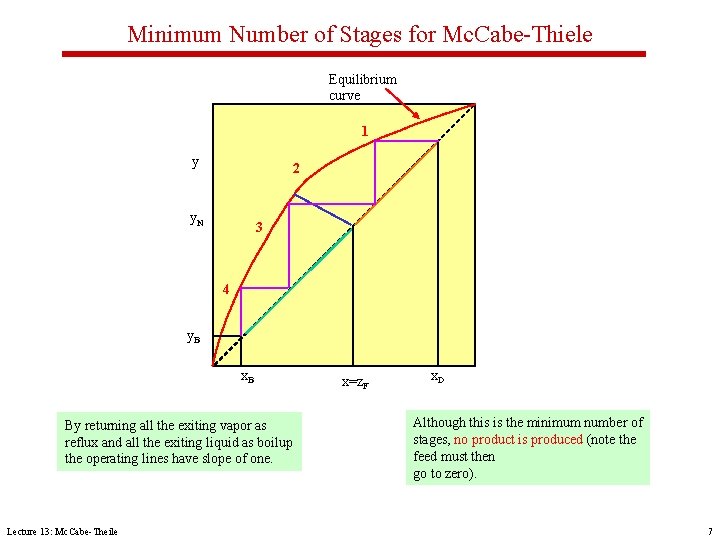
Minimum Number of Stages for Mc. Cabe-Thiele Equilibrium curve 1 y 2 y. N 3 4 y. B x. B By returning all the exiting vapor as reflux and all the exiting liquid as boilup the operating lines have slope of one. Lecture 13: Mc. Cabe-Theile x=z. F x. D Although this is the minimum number of stages, no product is produced (note the feed must then go to zero). 7
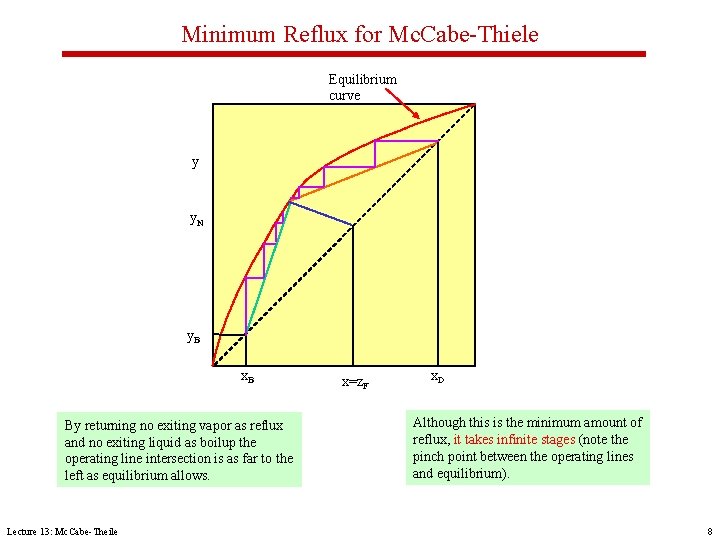
Minimum Reflux for Mc. Cabe-Thiele Equilibrium curve y y. N y. B x. B By returning no exiting vapor as reflux and no exiting liquid as boilup the operating line intersection is as far to the left as equilibrium allows. Lecture 13: Mc. Cabe-Theile x=z. F x. D Although this is the minimum amount of reflux, it takes infinite stages (note the pinch point between the operating lines and equilibrium). 8
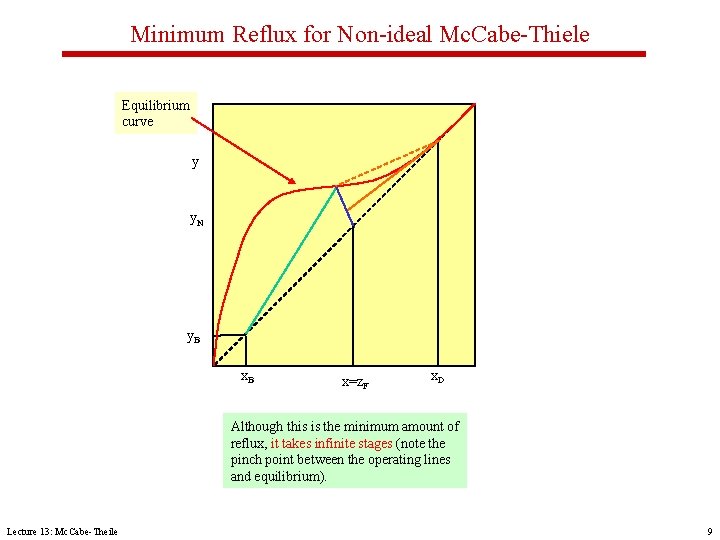
Minimum Reflux for Non-ideal Mc. Cabe-Thiele Equilibrium curve y y. N y. B x=z. F x. D Although this is the minimum amount of reflux, it takes infinite stages (note the pinch point between the operating lines and equilibrium). Lecture 13: Mc. Cabe-Theile 9

Example: Determination of N and x. B for Mc. Cabe-Thiele Given: 100 Kmol/hr of a feed of 60% benzene and 40% heptane is to be separated by distillation. The distillate is to be 90% benzene and The bottoms 10% benzene. The feed enters the column as 30 mol% vapor. Use R 1. 5 times the minimum. Assume a constant relative Volatility of 4 and that the pressure is constant throughout the column at 1 atm. Construction: Step 1: Plot equilibrium curve and 45 degree line. The equilibrium curve is found using: Step 2: Plot given compositions (F, B, and D) Step 3: Draw q-line from LF and VF. Use y to find q. Then plot the q-line using: x Lecture 13: Mc. Cabe-Theile Step 4: Determine Rmin from intersection of the rectifying section OL and the equilibrium curve. This happens at a slope of about. 25 10
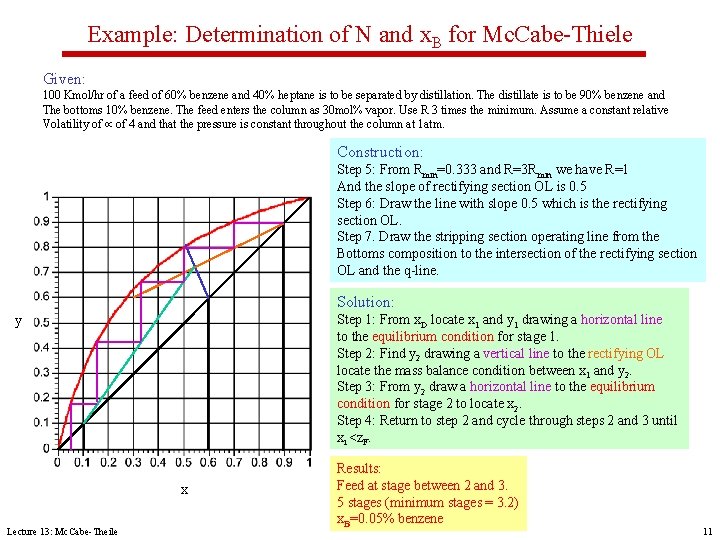
Example: Determination of N and x. B for Mc. Cabe-Thiele Given: 100 Kmol/hr of a feed of 60% benzene and 40% heptane is to be separated by distillation. The distillate is to be 90% benzene and The bottoms 10% benzene. The feed enters the column as 30 mol% vapor. Use R 3 times the minimum. Assume a constant relative Volatility of 4 and that the pressure is constant throughout the column at 1 atm. Construction: Step 5: From Rmin=0. 333 and R=3 Rmin we have R=1 And the slope of rectifying section OL is 0. 5 Step 6: Draw the line with slope 0. 5 which is the rectifying section OL. Step 7. Draw the stripping section operating line from the Bottoms composition to the intersection of the rectifying section OL and the q-line. Solution: Step 1: From x. D locate x 1 and y 1 drawing a horizontal line to the equilibrium condition for stage 1. Step 2: Find y 2 drawing a vertical line to the rectifying OL locate the mass balance condition between x 1 and y 2. Step 3: From y 2 draw a horizontal line to the equilibrium condition for stage 2 to locate x 2. Step 4: Return to step 2 and cycle through steps 2 and 3 until xi <z. F. y x Lecture 13: Mc. Cabe-Theile Results: Feed at stage between 2 and 3. 5 stages (minimum stages = 3. 2) x. B=0. 05% benzene 11
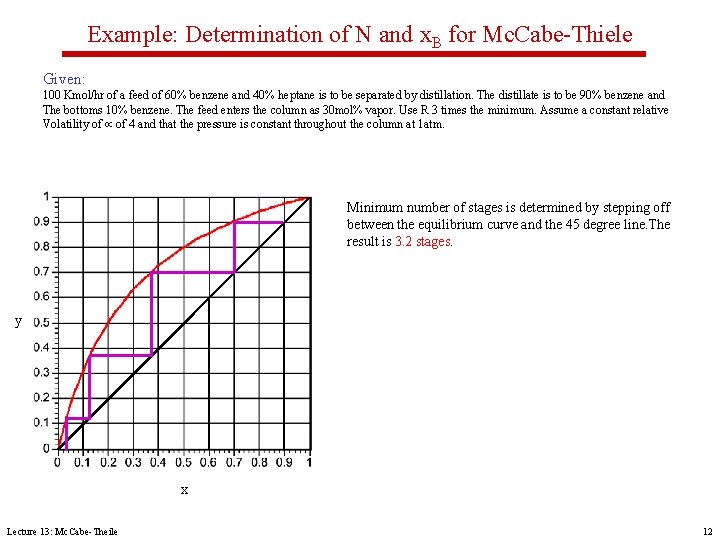
Example: Determination of N and x. B for Mc. Cabe-Thiele Given: 100 Kmol/hr of a feed of 60% benzene and 40% heptane is to be separated by distillation. The distillate is to be 90% benzene and The bottoms 10% benzene. The feed enters the column as 30 mol% vapor. Use R 3 times the minimum. Assume a constant relative Volatility of 4 and that the pressure is constant throughout the column at 1 atm. Minimum number of stages is determined by stepping off between the equilibrium curve and the 45 degree line. The result is 3. 2 stages. y x Lecture 13: Mc. Cabe-Theile 12
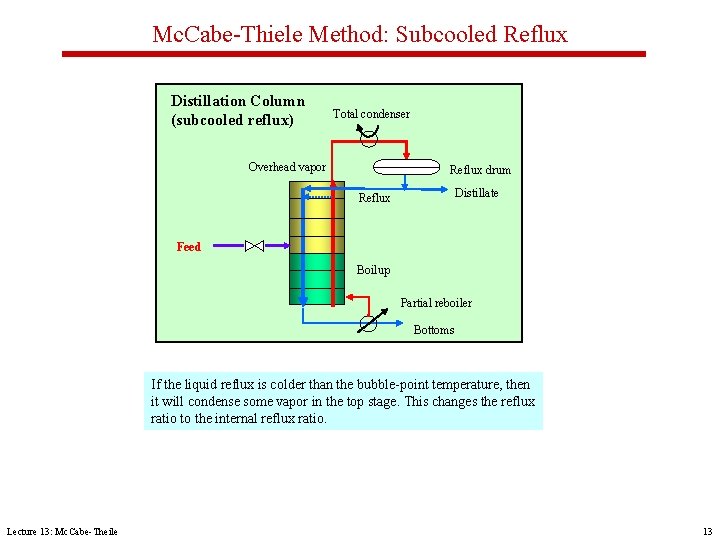
Mc. Cabe-Thiele Method: Subcooled Reflux Distillation Column (subcooled reflux) Total condenser Overhead vapor Reflux drum Distillate Reflux Feed Boilup Partial reboiler Bottoms If the liquid reflux is colder than the bubble-point temperature, then it will condense some vapor in the top stage. This changes the reflux ratio to the internal reflux ratio. Lecture 13: Mc. Cabe-Theile 13
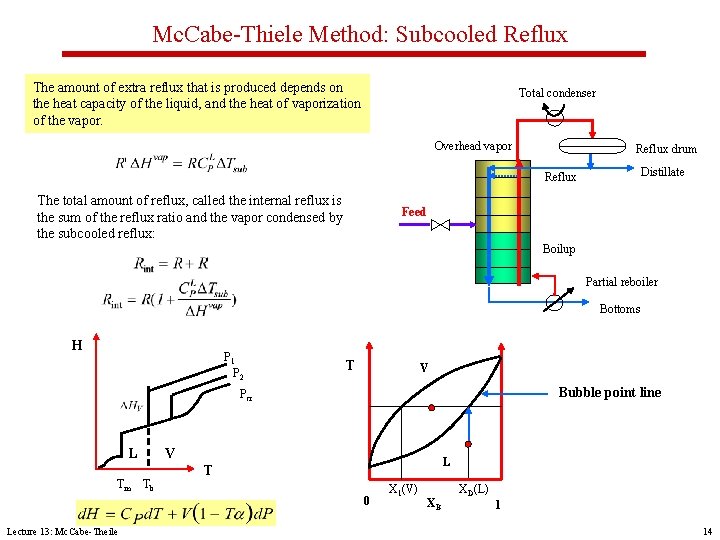
Mc. Cabe-Thiele Method: Subcooled Reflux The amount of extra reflux that is produced depends on the heat capacity of the liquid, and the heat of vaporization of the vapor. Total condenser Overhead vapor Reflux drum Distillate Reflux The total amount of reflux, called the internal reflux is the sum of the reflux ratio and the vapor condensed by the subcooled reflux: Feed Boilup Partial reboiler Bottoms H P 1 P 2 T V Bubble point line Pcr L Tm Tb V L T 0 Lecture 13: Mc. Cabe-Theile X 1(V) XB XD(L) 1 14
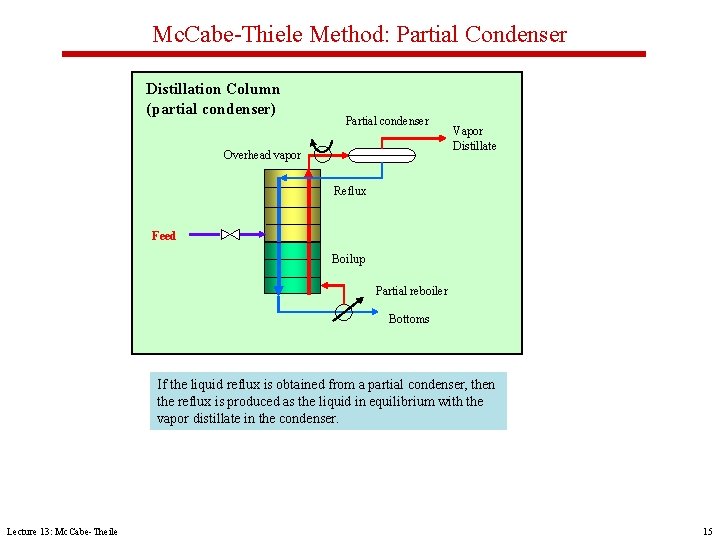
Mc. Cabe-Thiele Method: Partial Condenser Distillation Column (partial condenser) Partial condenser Overhead vapor Vapor Distillate Reflux Feed Boilup Partial reboiler Bottoms If the liquid reflux is obtained from a partial condenser, then the reflux is produced as the liquid in equilibrium with the vapor distillate in the condenser. Lecture 13: Mc. Cabe-Theile 15
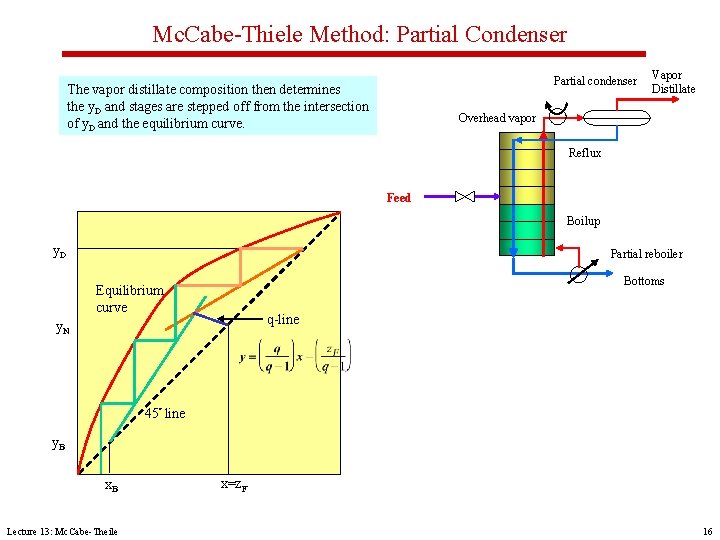
Mc. Cabe-Thiele Method: Partial Condenser Partial condenser The vapor distillate composition then determines the y. D and stages are stepped off from the intersection of y. D and the equilibrium curve. Vapor Distillate Overhead vapor Reflux Feed Boilup y. D Partial reboiler Bottoms Equilibrium curve q-line y. N 45° line y. B x. B Lecture 13: Mc. Cabe-Theile x=z. F 16
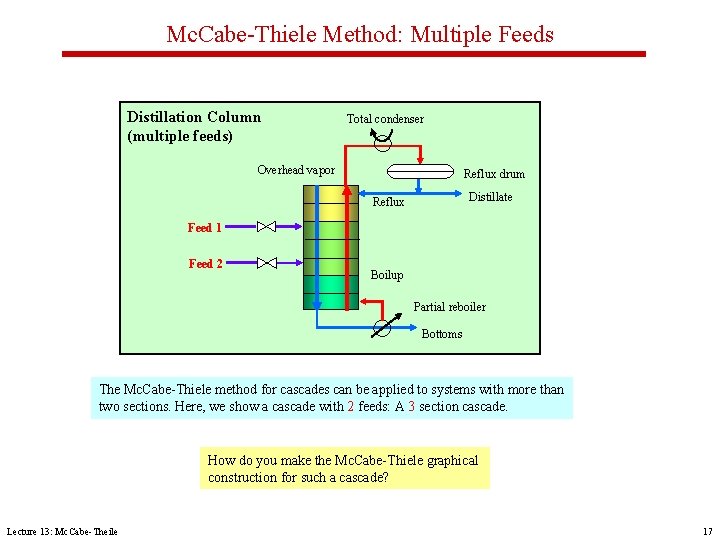
Mc. Cabe-Thiele Method: Multiple Feeds Distillation Column (multiple feeds) Total condenser Overhead vapor Reflux drum Distillate Reflux Feed 1 Feed 2 Boilup Partial reboiler Bottoms The Mc. Cabe-Thiele method for cascades can be applied to systems with more than two sections. Here, we show a cascade with 2 feeds: A 3 section cascade. How do you make the Mc. Cabe-Thiele graphical construction for such a cascade? Lecture 13: Mc. Cabe-Theile 17
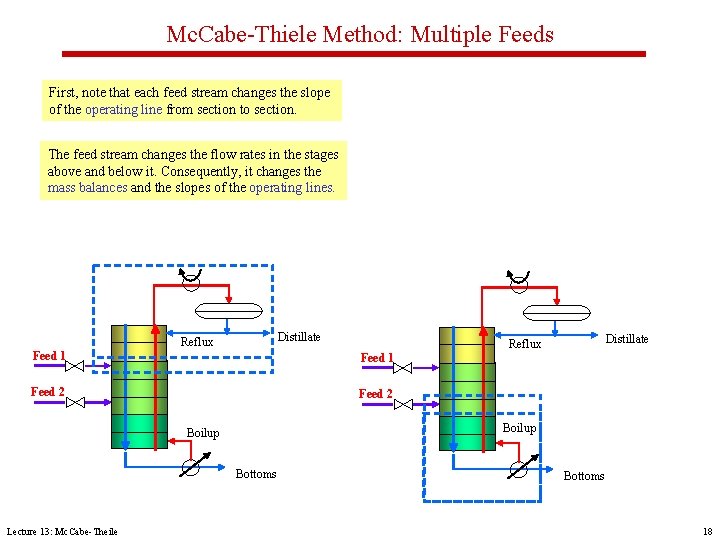
Mc. Cabe-Thiele Method: Multiple Feeds First, note that each feed stream changes the slope of the operating line from section to section. The feed stream changes the flow rates in the stages above and below it. Consequently, it changes the mass balances and the slopes of the operating lines. Distillate Reflux Feed 1 Feed 2 Boilup Bottoms Lecture 13: Mc. Cabe-Theile Distillate Reflux Bottoms 18
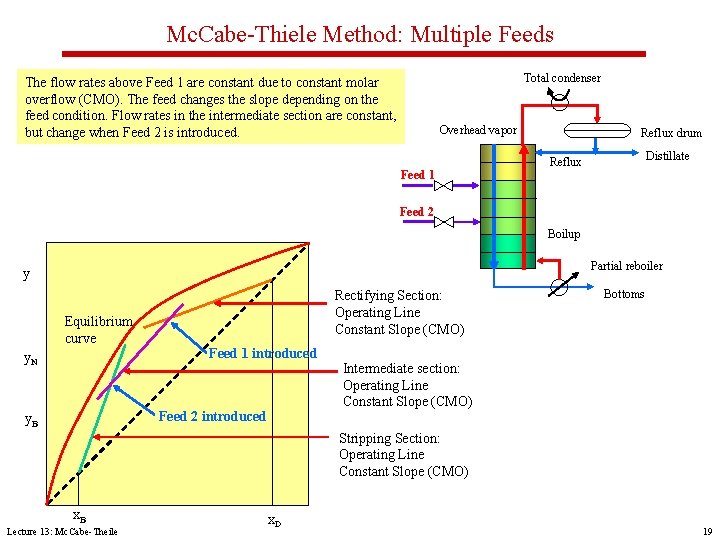
Mc. Cabe-Thiele Method: Multiple Feeds Total condenser The flow rates above Feed 1 are constant due to constant molar overflow (CMO). The feed changes the slope depending on the feed condition. Flow rates in the intermediate section are constant, but change when Feed 2 is introduced. Overhead vapor Reflux drum Distillate Reflux Feed 1 Feed 2 Boilup Partial reboiler y Rectifying Section: Operating Line Constant Slope (CMO) Equilibrium curve Feed 1 introduced y. N Feed 2 introduced y. B Bottoms Intermediate section: Operating Line Constant Slope (CMO) Stripping Section: Operating Line Constant Slope (CMO) x. B Lecture 13: Mc. Cabe-Theile x. D 19
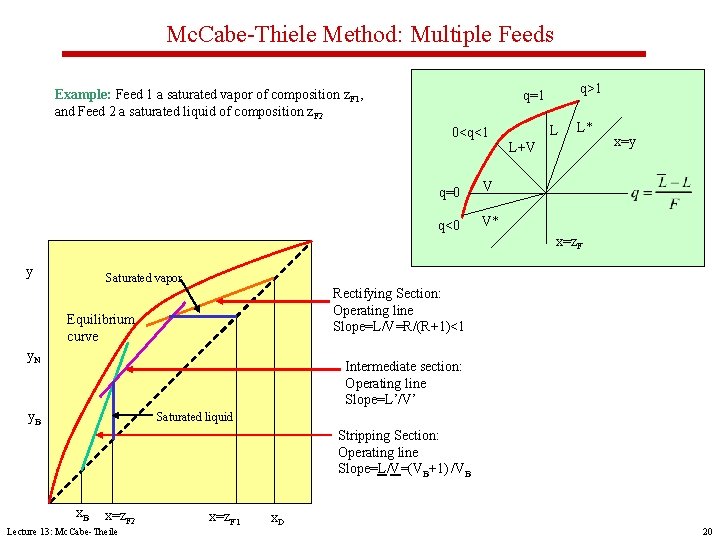
Mc. Cabe-Thiele Method: Multiple Feeds Example: Feed 1 a saturated vapor of composition z. F 1, and Feed 2 a saturated liquid of composition z. F 2 0<q<1 y q>1 q=0 V q<0 V* L L* L+V x=y x=z. F Saturated vapor Rectifying Section: Operating line Slope=L/V=R/(R+1)<1 Equilibrium curve y. N Intermediate section: Operating line Slope=L’/V’ y. B Saturated liquid Stripping Section: Operating line Slope=L/V=(VB+1) /VB x. B x=z. F 2 Lecture 13: Mc. Cabe-Theile x=z. F 1 x. D 20
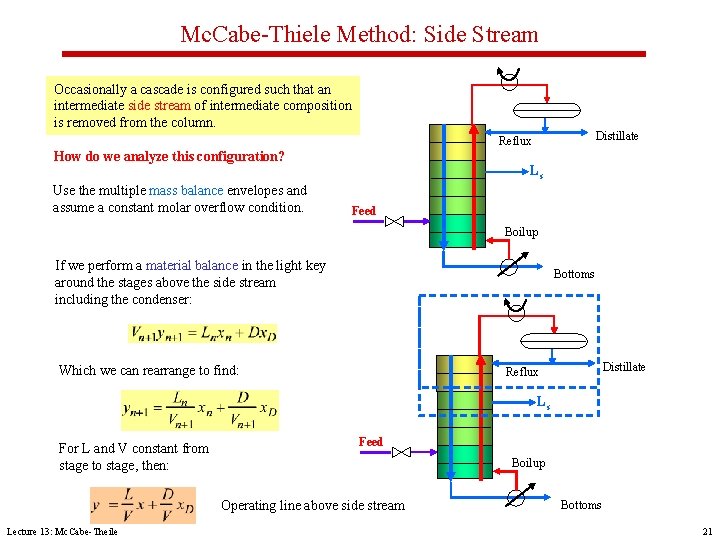
Mc. Cabe-Thiele Method: Side Stream Occasionally a cascade is configured such that an intermediate side stream of intermediate composition is removed from the column. Distillate Reflux How do we analyze this configuration? Use the multiple mass balance envelopes and assume a constant molar overflow condition. Ls Feed Boilup If we perform a material balance in the light key around the stages above the side stream including the condenser: Bottoms Which we can rearrange to find: Distillate Reflux Ls For L and V constant from stage to stage, then: Feed Boilup Operating line above side stream Lecture 13: Mc. Cabe-Theile Bottoms 21
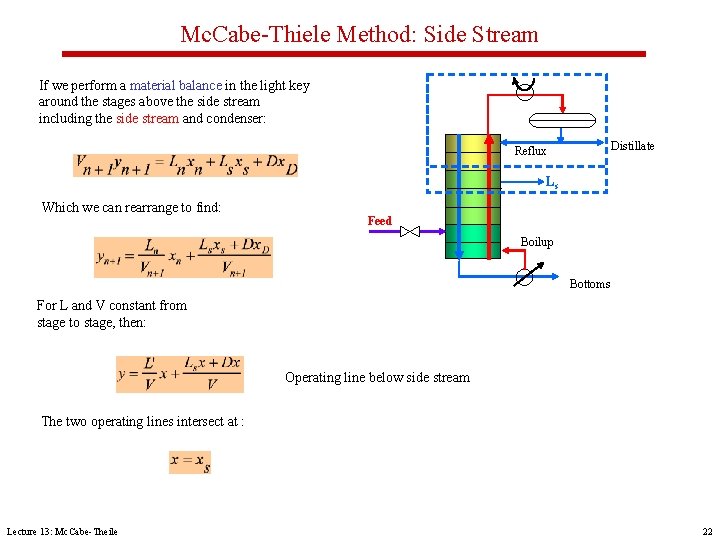
Mc. Cabe-Thiele Method: Side Stream If we perform a material balance in the light key around the stages above the side stream including the side stream and condenser: Distillate Reflux Ls Which we can rearrange to find: Feed Boilup Bottoms For L and V constant from stage to stage, then: Operating line below side stream The two operating lines intersect at : Lecture 13: Mc. Cabe-Theile 22
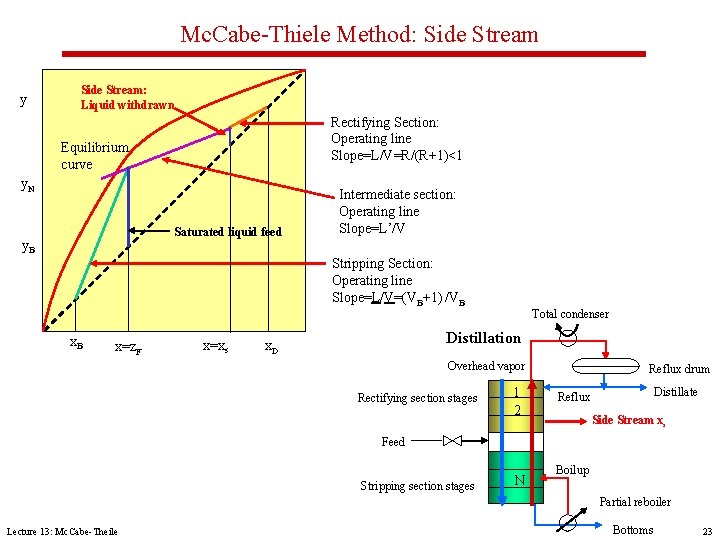
Mc. Cabe-Thiele Method: Side Stream y Side Stream: Liquid withdrawn Rectifying Section: Operating line Slope=L/V=R/(R+1)<1 Equilibrium curve y. N Saturated liquid feed y. B Intermediate section: Operating line Slope=L’/V Stripping Section: Operating line Slope=L/V=(VB+1) /VB x. B x=z. F x=xs Total condenser Distillation x. D Overhead vapor Rectifying section stages 1 2 Reflux drum Distillate Reflux Side Stream xs Feed Stripping section stages N Boilup Partial reboiler Lecture 13: Mc. Cabe-Theile Bottoms 23
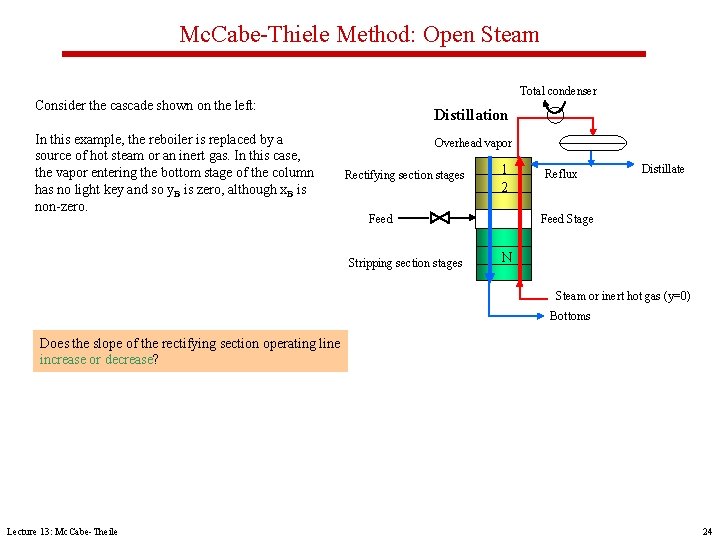
Mc. Cabe-Thiele Method: Open Steam Total condenser Consider the cascade shown on the left: In this example, the reboiler is replaced by a source of hot steam or an inert gas. In this case, the vapor entering the bottom stage of the column has no light key and so y. B is zero, although x. B is non-zero. Distillation Overhead vapor Rectifying section stages 1 2 Distillate Feed Stage Feed Stripping section stages Reflux N Steam or inert hot gas (y=0) Bottoms Does the slope of the rectifying section operating line increase or decrease? Lecture 13: Mc. Cabe-Theile 24
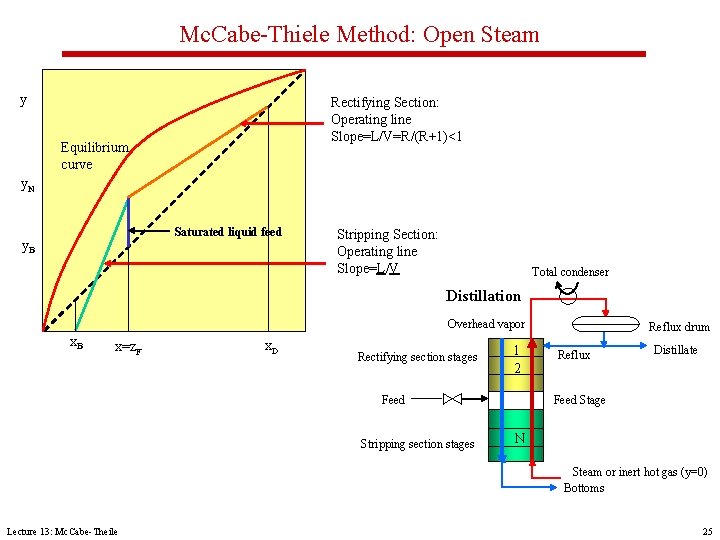
Mc. Cabe-Thiele Method: Open Steam y Rectifying Section: Operating line Slope=L/V=R/(R+1)<1 Equilibrium curve y. N Saturated liquid feed y. B Stripping Section: Operating line Slope=L/V Total condenser Distillation Overhead vapor x. B x=z. F x. D Rectifying section stages 1 2 Reflux Distillate Feed Stage Feed Stripping section stages Reflux drum N Steam or inert hot gas (y=0) Bottoms Lecture 13: Mc. Cabe-Theile 25
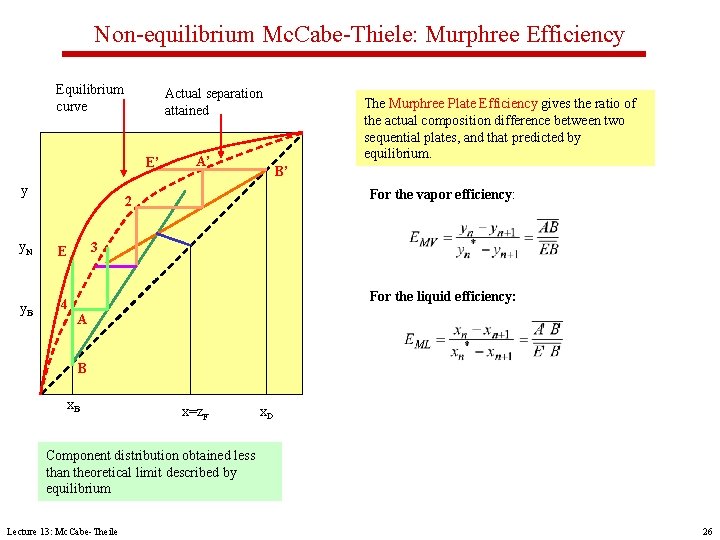
Non-equilibrium Mc. Cabe-Thiele: Murphree Efficiency Equilibrium curve Actual separation attained E’ y A’ B’ For the vapor efficiency: 2 y. N E y. B 4 The Murphree Plate Efficiency gives the ratio of the actual composition difference between two sequential plates, and that predicted by equilibrium. 3 For the liquid efficiency: A B x=z. F x. D Component distribution obtained less than theoretical limit described by equilibrium Lecture 13: Mc. Cabe-Theile 26
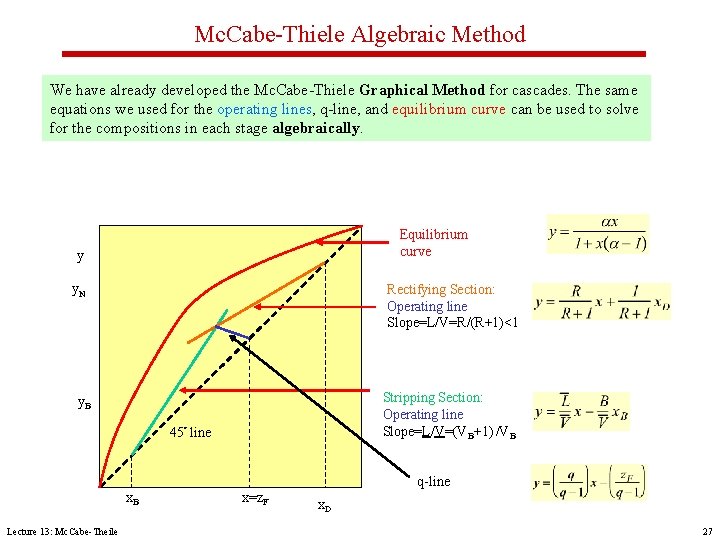
Mc. Cabe-Thiele Algebraic Method We have already developed the Mc. Cabe-Thiele Graphical Method for cascades. The same equations we used for the operating lines, q-line, and equilibrium curve can be used to solve for the compositions in each stage algebraically. Equilibrium curve y y. N Rectifying Section: Operating line Slope=L/V=R/(R+1)<1 Stripping Section: Operating line Slope=L/V=(VB+1) /VB y. B 45° line x. B Lecture 13: Mc. Cabe-Theile x=z. F q-line x. D 27
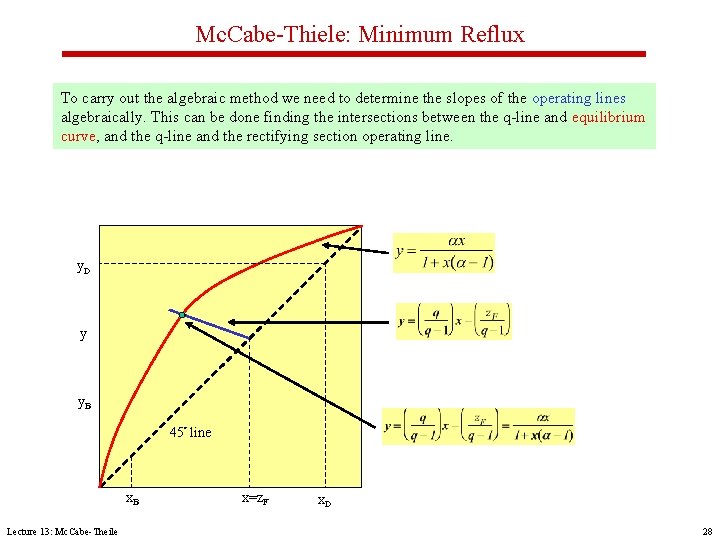
Mc. Cabe-Thiele: Minimum Reflux To carry out the algebraic method we need to determine the slopes of the operating lines algebraically. This can be done finding the intersections between the q-line and equilibrium curve, and the q-line and the rectifying section operating line. y. D y y. B 45° line x. B Lecture 13: Mc. Cabe-Theile x=z. F x. D 28
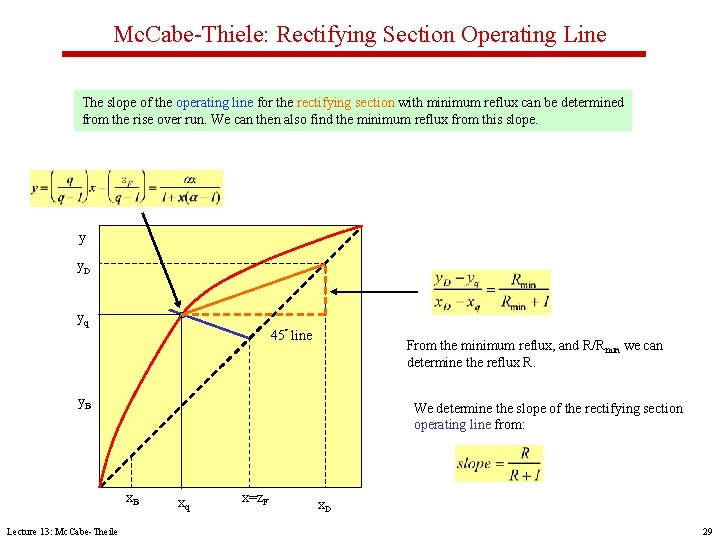
Mc. Cabe-Thiele: Rectifying Section Operating Line The slope of the operating line for the rectifying section with minimum reflux can be determined from the rise over run. We can then also find the minimum reflux from this slope. y y. D yq 45° line From the minimum reflux, and R/Rmin we can determine the reflux R. y. B We determine the slope of the rectifying section operating line from: x. B Lecture 13: Mc. Cabe-Theile xq x=z. F x. D 29
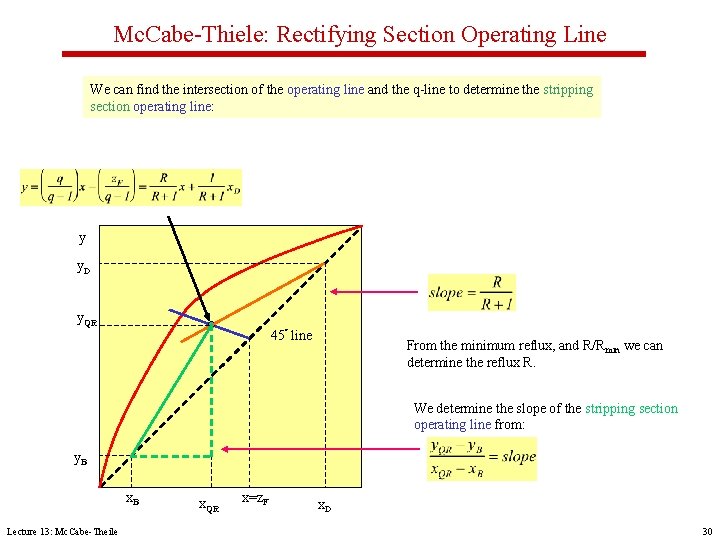
Mc. Cabe-Thiele: Rectifying Section Operating Line We can find the intersection of the operating line and the q-line to determine the stripping section operating line: y y. D y. QR 45° line From the minimum reflux, and R/Rmin we can determine the reflux R. We determine the slope of the stripping section operating line from: y. B x. B Lecture 13: Mc. Cabe-Theile x. QR x=z. F x. D 30
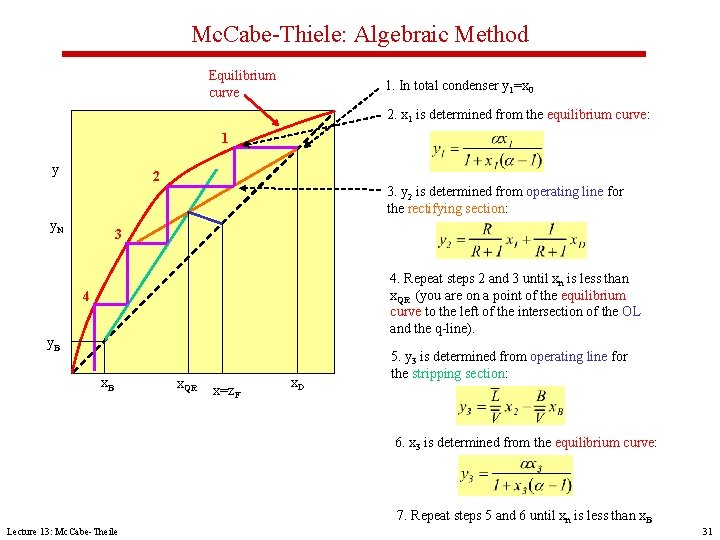
Mc. Cabe-Thiele: Algebraic Method Equilibrium curve 1. In total condenser y 1=x 0 2. x 1 is determined from the equilibrium curve: 1 y 2 y. N 3. y 2 is determined from operating line for the rectifying section: 3 4. Repeat steps 2 and 3 until xn is less than x. QR (you are on a point of the equilibrium curve to the left of the intersection of the OL and the q-line). 4 y. B x. QR x=z. F x. D 5. y 3 is determined from operating line for the stripping section: 6. x 3 is determined from the equilibrium curve: 7. Repeat steps 5 and 6 until xn is less than x. B Lecture 13: Mc. Cabe-Theile 31
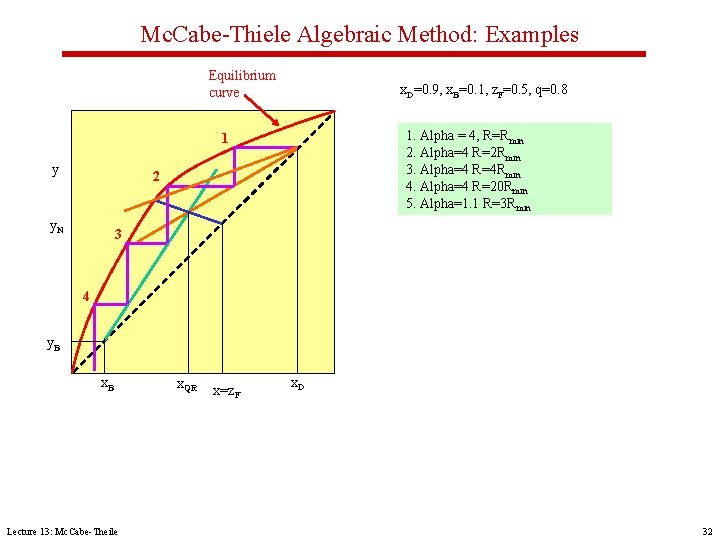
Mc. Cabe-Thiele Algebraic Method: Examples Equilibrium curve x. D=0. 9, x. B=0. 1, z. F=0. 5, q=0. 8 1. Alpha = 4, R=Rmin 2. Alpha=4 R=2 Rmin 3. Alpha=4 R=4 Rmin 4. Alpha=4 R=20 Rmin 5. Alpha=1. 1 R=3 Rmin 1 y 2 y. N 3 4 y. B x. B Lecture 13: Mc. Cabe-Theile x. QR x=z. F x. D 32
- Slides: 32