
MBTI Myers Briggs Type Indicator Personality Types According
MBTI Myers Briggs Type Indicator
Personality Types � According to Carl Jung's typology all people can be classified using the following three criteria: � Extraversion - Introversion � Sensing - Intuition � Thinking - Feeling � Isabel Briggs-Myers added fourth criterion: � Judging - Perceiving
Extraversion - Introversion The extravert has a source and direction of energy expression mainly in the external world while the introvert has a source of energy mainly in the internal world.
Where You Get Your Energy � Extroverts (E) recharge their energy by being with others, socializing, and engaging in outward directed activities. � Extroverts also tend to speak out loud to determine what it is they are trying to say. � Introverts (I) recharge their energy by being alone and engaging in quieter activities. � Introverts would generally prefer to think through what they want to say beforehand, sometimes losing their chance to speak in group settings. � Extroverts tend to feel much more uncomfortable with silences than Introverts.
Extroverts are more naturally active, expressive, social, interested in many things. � oriented to the outside world � several projects at the same time naturally � enthusiastic demeanour � tolerate noise and crowds better � high energy level � focused on people and things � hates to do nothing � prefer more to be around � on the go others � think out loud � talk more than listen (actually talk first than think about what � easily distracted � change subjects quickly use they are saying) trial and error with confidence � communicate with enthusiasm � look outward for stimulation � act first and think about it later � interrupt and finish sentences
Introverts are more naturally reserved, private, cautious, and interested in fewer interactions, but with typically greater depth and focus. Introverts do not need people for energy. � oriented to the inner world � avoid crowds and seek quiet � focused on ideas, concepts, and inner impressions � prefer more to spend time by self � listen more than talk � keep enthusiasm to self � think first then speak (maybe, maybe not) � talk less
Sensing - i. Ntuition Sensing means that a person believes mainly information he or she receives directly from the external world. Intuition means that a person believes mainly information he or she receives from the internal or imaginative world.
How You Take in Information � Sensors (S) tend to be practical and detail-oriented, and to focus on the physical and tangible aspects of the world around them. Therefore, when they are learning about a new project, they'll want first to know all about the specifics. � Intuitives (N), on the other hand, hone in on the big picture, and tend to be more imaginative and focus on implied meaning. � Intuitives have trouble processing detailed information without knowing how it fits into the big picture.
Sensors more instinctively notice the facts, details, and realities of the world around them in the here and the now. � perceiving with the five senses � clear straightforward speech pattern � attends to practical and factual details � focused on actual experiences � more literal using facts and real examples � present oriented in the moment folk � sensible down to earth � see little things in everyday life � attend to step-by-step experience � the eyes will tell the mind what is going on
Intuits more naturally see the potential connections and relationships between facts as well as the meaning, or possibilities of the information. perceive with memory and � project possibilities for the future associations � bored easily after learning skills � complex conceptual speech � read between the lines pattern using lots of compound � looking for the big picture sentences � get hunches out of nowhere � more figurative using � finish other peoples thoughts analogies/metaphors (interrupt) � focused on the possibilities � see patterns and meanings more � leap around in a roundabout way mentally in their heads � repeat themselves recap and rephrase �
Thinking - Feeling Thinking means that a person makes a decision mainly through logic. Feeling means that, as a rule, he or she makes a decision based on emotion.
How You Make Decisions Thinkers (T) tend to make decisions in an objective, logical and analytical manner, while Feelers (F) tend to be more subjective, personal and compassionate in their decision making process. Women tend to be Feelers due to the way they are socialized. In a job situation, Thinkers will make personnel decisions based on the good of the company, while Feelers might choose based on how their decision will impact the people involved.
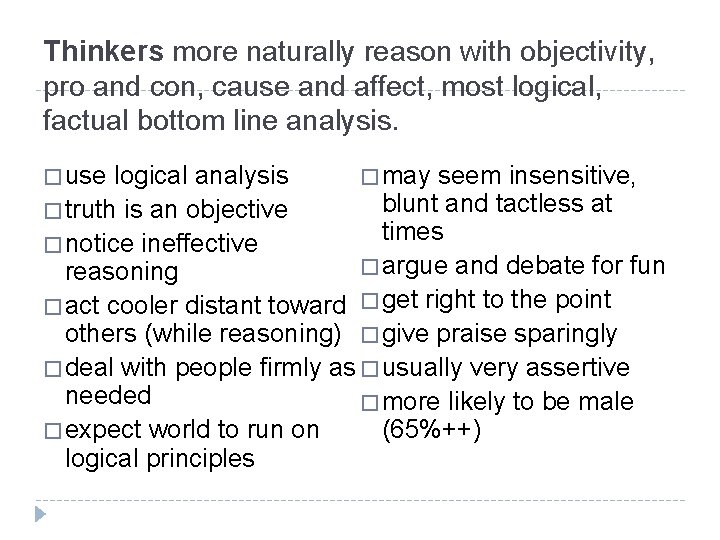
Thinkers more naturally reason with objectivity, pro and con, cause and affect, most logical, factual bottom line analysis. � may seem insensitive, logical analysis blunt and tactless at � truth is an objective times � notice ineffective � argue and debate for fun reasoning � act cooler distant toward � get right to the point others (while reasoning) � give praise sparingly � deal with people firmly as � usually very assertive needed � more likely to be male (65%++) � expect world to run on logical principles � use
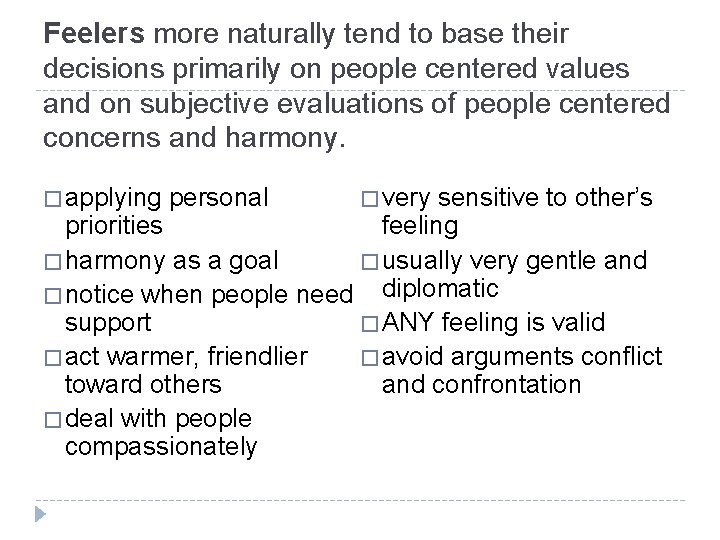
Feelers more naturally tend to base their decisions primarily on people centered values and on subjective evaluations of people centered concerns and harmony. sensitive to other’s feeling priorities � usually very gentle and � harmony as a goal � notice when people need diplomatic � ANY feeling is valid support � avoid arguments conflict � act warmer, friendlier and confrontation toward others � deal with people compassionately � applying personal � very
Judging - Perceiving Judging means that a person organizes all his life events and acts strictly according to his plans. Perceiving means that he or she is inclined to improvise and seek alternatives.
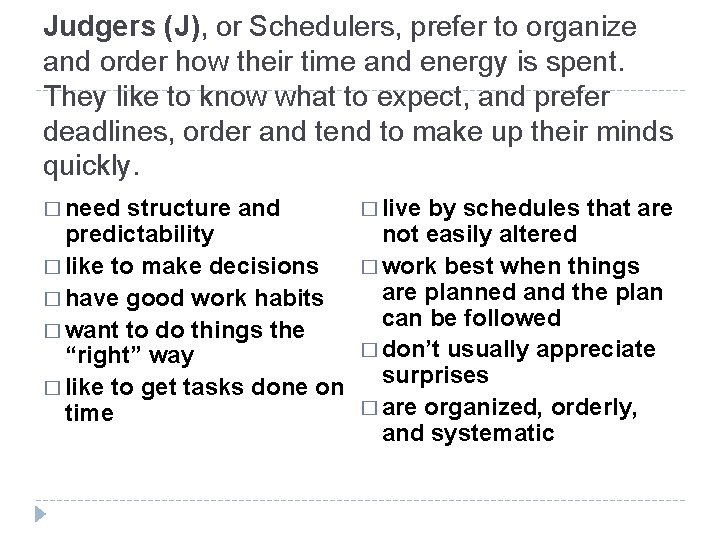
Judgers (J), or Schedulers, prefer to organize and order how their time and energy is spent. They like to know what to expect, and prefer deadlines, order and tend to make up their minds quickly. � need structure and predictability � like to make decisions � have good work habits � want to do things the “right” way � like to get tasks done on time � live by schedules that are not easily altered � work best when things are planned and the plan can be followed � don’t usually appreciate surprises � are organized, orderly, and systematic
How You Spend Your Time and Energy � Judgers (J), or Schedulers, prefer to organize and order how their time and energy is spent. They like to know what to expect, and prefer deadlines, order and tend to make up their minds quickly. � Perceivers (P), on the other hand, prefer flexibility and like to keep their options open. � Perceivers are brilliant at generating alternatives, while Judgers are great at making decisions. Perceivers are often surrounded by clutter while they work, and love variety.
“Perceivers” are people who enjoy being flexible, adaptable, and spontaneous. They prefer to be open to new experiences and information, and they are most comfortable exploring options. � act spontaneously � let work accumulate and then accomplish a lot with a � like freedom to move last minute fury � find too much detail work to � find deadlines imposing and be boring may turn in projects late as � enjoy games a result of poor planning or � enjoy dramatization and time management may like to perform � enjoy the activity itself more � may start too many projects than the result and have difficulty finishing them all

Assignment
� Take a free online test at http: //www. humanmetrics. com/cgi-win/JTypes 2. asp This is not the Myers-Briggs Type Indicator, but a free copy which will give you a personality type based on the Myers-Briggs typology. � Take another quick quiz to cross reference for accuracy at this site. http: //www. personalitytype. com/career_quiz_2 � Go to the following website to find information on your Myers Briggs type indicator � http: //students. usask. ca/support/employment/careerg uide/discover
Find out � What kind of learner you are � What kind of careers you would pursue � At least three careers that interest you most � What kind of worker you would be � How you perform in a team � What kind of leader you make � How you communicate � How you play � How you deal with stress �Go to this website https: //www. personalitypage. com/portraits. html to find out an overview of this personality type, careers for this personality type and information about relationships for this personality type.
- Slides: 21