
MBSE Challenge Team SE2 Sys ML in Telescope
MBSE Challenge Team SE^2 Sys. ML in Telescope Modeling Credit to members of the ESO, OMG, INCOSE, and the MBSE initiative to use some of their material Presentation of the Telescope Challenge Team © 2010 by ESO, oose Gmb. H, TUM, Hood Group Gmb. H page 1
MBSE Challenge Team SE^2 Sys. ML in Telescope Modeling Agenda n n n Introduction to Model Based Systems Engineering (MBSE) Overview of the Sys. ML INCOSE's MBSE Vision & Initiative Challenge team for Telescope Modeling Early Adopters at ESO Live Demo of the Model Presentation of the Telescope Challenge Team © 2010 by ESO, oose Gmb. H, TUM, Hood Group Gmb. H page 2
MBSE Challenge Team SE^2 Sys. ML in Telescope Modeling Introduction to Model Based Systems Engineering Presentation of the Telescope Challenge Team © 2010 by ESO, oose Gmb. H, TUM, Hood Group Gmb. H page
MBSE Challenge Team SE^2 Sys. ML in Telescope Modeling MBSE Definitions Model-based systems engineering (MBSE) is the formalized application of modeling to support system requirements, design, analysis, verification and validation activities beginning in the conceptual design phase and continuing throughout development and later life cycle phases (INCOSE-TP-2004 -00402, Version 2. 03, September 2007). n A model is an approximation, representation, or idealization of selected aspects of the structure, behavior, operation, or other characteristics of a realworld process, concept, or system (IEEE 610. 12 -1990), i. e. an abstraction. n A model usually offers different views in order to serve different purposes. A view is a representation of a system from the perspective of related concerns or issues (IEEE 1471 -2000). n Presentation of the Telescope Challenge Team © 2010 by ESO, oose Gmb. H, TUM, Hood Group Gmb. H page 4
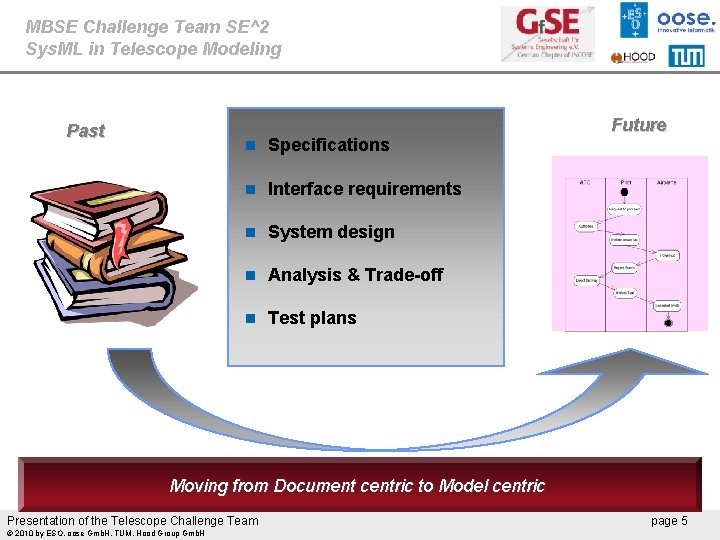
MBSE Challenge Team SE^2 Sys. ML in Telescope Modeling Past n Specifications n Interface requirements n System design n Analysis & Trade-off n Test plans Future Moving from Document centric to Model centric Presentation of the Telescope Challenge Team © 2010 by ESO, oose Gmb. H, TUM, Hood Group Gmb. H page 5
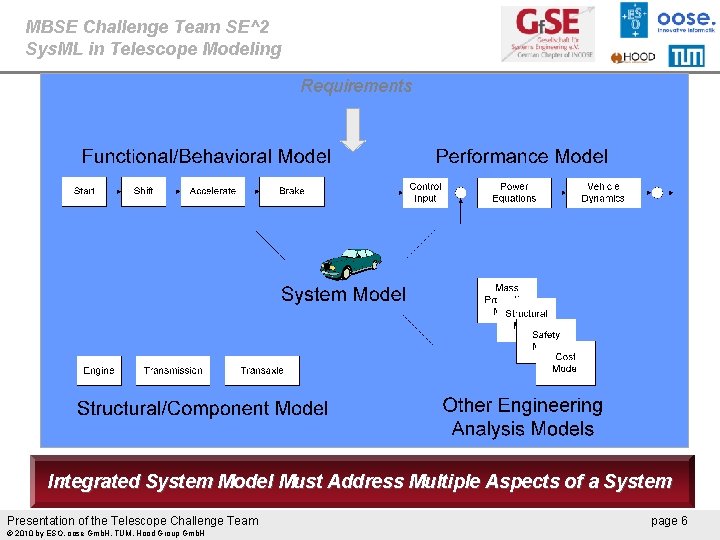
MBSE Challenge Team SE^2 Sys. ML in Telescope Modeling Requirements Integrated System Model Must Address Multiple Aspects of a System Presentation of the Telescope Challenge Team © 2010 by ESO, oose Gmb. H, TUM, Hood Group Gmb. H page 6
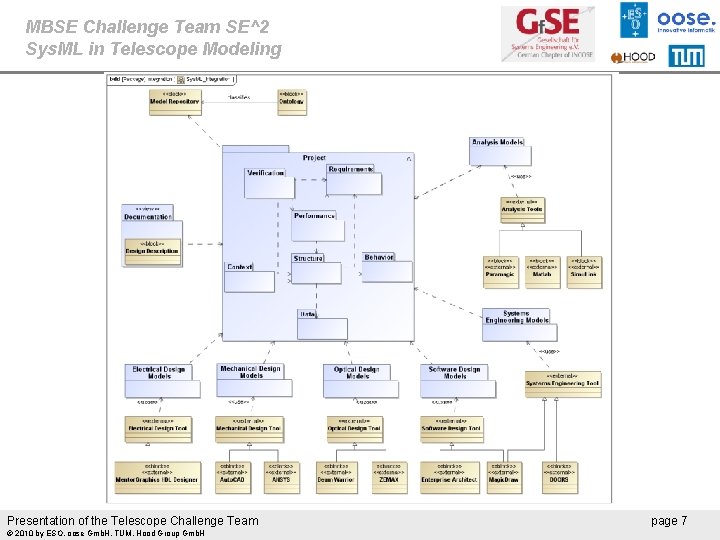
MBSE Challenge Team SE^2 Sys. ML in Telescope Modeling Presentation of the Telescope Challenge Team © 2010 by ESO, oose Gmb. H, TUM, Hood Group Gmb. H page 7
MBSE Challenge Team SE^2 Sys. ML in Telescope Modeling Overview of the Systems Engineering Modeling Language (Sys. ML) Presentation of the Telescope Challenge Team © 2010 by ESO, oose Gmb. H, TUM, Hood Group Gmb. H page
MBSE Challenge Team SE^2 Sys. ML in Telescope Modeling What is Sys. ML? Graphical modelling language for Systems Engineering n Supports the specification, analysis, design, verification, and validation of systems that include hardware, software, data, personnel, procedures, and facilities n Is a visual modeling language that provides n Semantics = meaning n Notation = representation of meaning n Is not a methodology or a tool n Sys. ML is methodology and tool independent n Sys. ML is Critical Enabler for Model Driven SE Presentation of the Telescope Challenge Team © 2010 by ESO, oose Gmb. H, TUM, Hood Group Gmb. H page 9
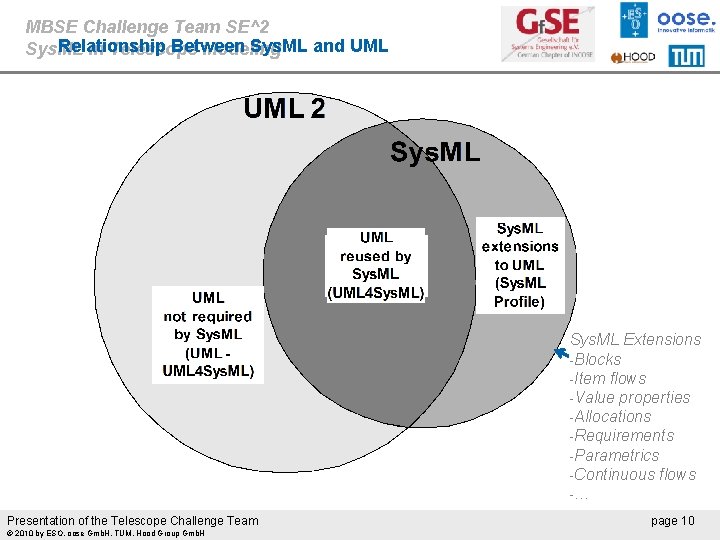
MBSE Challenge Team SE^2 Relationship Between Sys. ML and UML Sys. ML in Telescope Modeling Sys. ML Extensions -Blocks -Item flows -Value properties -Allocations -Requirements -Parametrics -Continuous flows -… Presentation of the Telescope Challenge Team © 2010 by ESO, oose Gmb. H, TUM, Hood Group Gmb. H page 10
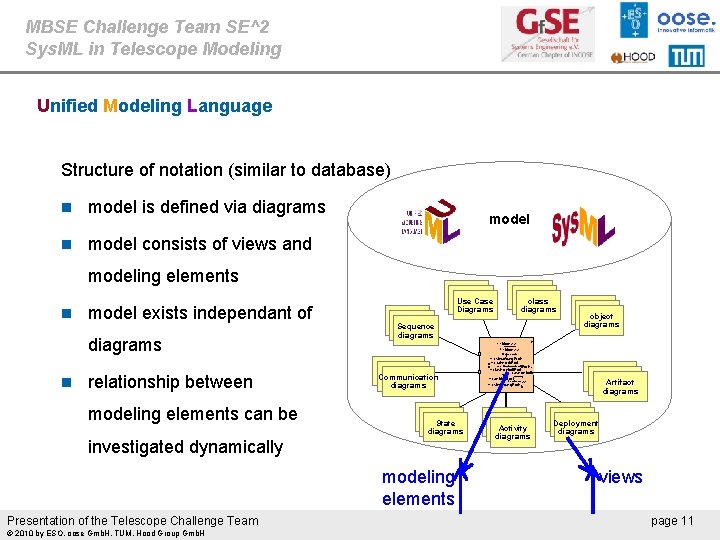
MBSE Challenge Team SE^2 Sys. ML in Telescope Modeling Unified Modeling Language Structure of notation (similar to database) n model is defined via diagrams n model consists of views and modeling elements n model exists independant of diagrams n relationship between modeling elements can be Use Case Diagrams Sequence diagrams <<block>> Aufzug <<block>> Communication diagrams State diagrams investigated dynamically modeling elements Presentation of the Telescope Challenge Team © 2010 by ESO, oose Gmb. H, TUM, Hood Group Gmb. H class diagrams object diagrams n Fahrkorb + / steuerung. Prot~ + / fahrkorb. Prot + / lastkontroll. Port~ <<block>> + / lastkontroll. Prot Lastkontrolle + / antrieb. Prot <<block>> + / steuerung. Prot~ Antrieb Activity diagrams Artifact diagrams Deployment diagrams views page 11
MBSE Challenge Team SE^2 Sys. ML in Telescope Modeling INCOSE’s MBSE Vision & MBSE Initiative *Reference: SYSTEMS ENGINEERING VISION 2020 INCOSE-TP-2004 -02, Version 2. 03, September 2007 Presentation of the Telescope Challenge Team © 2010 by ESO, oose Gmb. H, TUM, Hood Group Gmb. H page
MBSE Challenge Team SE^2 Sys. ML in Telescope Modeling MBSE Initiative Background INCOSE held a series of workshops to formulate the MBSE Vision as part of the overall SE Vision 2020 n Established MBSE Initiative to help realize the MBSE Vision n Workshops, Articles, Webinars Promote, advance, and institutionalize the practice of MBSE to attain the MBSE 2020 Vision through broad industry and academic involvement in: n Research, Standards, Processes, Practices, & Methods, Tools & Technology, Outreach, Training & Education Presentation of the Telescope Challenge Team © 2010 by ESO, oose Gmb. H, TUM, Hood Group Gmb. H page 13
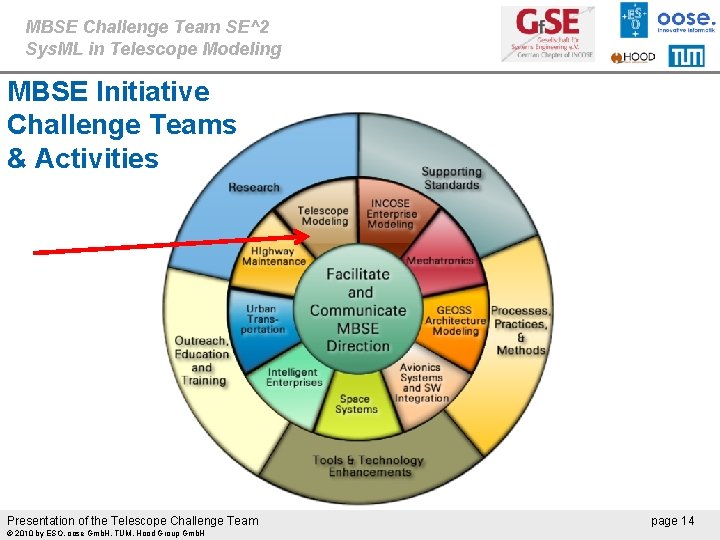
MBSE Challenge Team SE^2 Sys. ML in Telescope Modeling MBSE Initiative Challenge Teams & Activities Presentation of the Telescope Challenge Team © 2010 by ESO, oose Gmb. H, TUM, Hood Group Gmb. H page 14
MBSE Challenge Team SE^2 Sys. ML in Telescope Modeling Challenge team for Telescope Modeling Presentation of the Telescope Challenge Team © 2010 by ESO, oose Gmb. H, TUM, Hood Group Gmb. H page
MBSE Challenge Team SE^2 Sys. ML in Telescope Modeling About SE^2 Collaboration between European Southern Observatory (ESO) and German Chapter of INCOSE (Gf. SE) since 2007 n Access to high-tech project, the Active Phasing Experiment (APE). n The team members are: n Robert Karban (ESO) n Tim Weilkiens (oose Gmb. H) n Rudolf Hauber (HOOD Group) n Rainer Diekmann n Michele Zamparelli (ESO) n Andreas Hein (TU Munich) n Former members: Andreas Peukert (TU Munich) n Presentation of the Telescope Challenge Team © 2010 by ESO, oose Gmb. H, TUM, Hood Group Gmb. H page 16
MBSE Challenge Team SE^2 Sys. ML in Telescope Modeling What is ESO? Non-profit Intergovernmental European Organisation for Astronomical Research in the Southern Hemisphere http: //www. eso. org Headquarters in Munich, Germany 3 Observatories in Chile Mission statement Build and operate world class ground based astronomical facilities 17 Presentation of the Telescope Challenge Team © 2010 by ESO, oose Gmb. H, TUM, Hood Group Gmb. H page 17
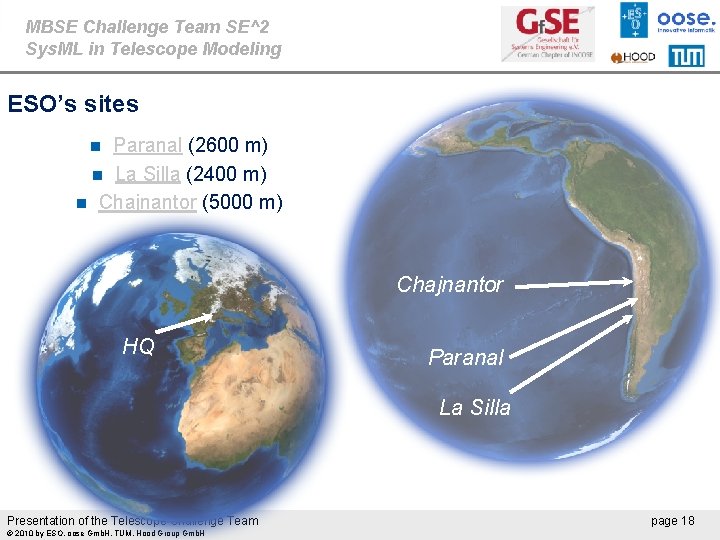
MBSE Challenge Team SE^2 Sys. ML in Telescope Modeling ESO’s sites Paranal (2600 m) n La Silla (2400 m) n Chajnantor (5000 m) n Chajnantor HQ Paranal La Silla Presentation of the Telescope Challenge Team © 2010 by ESO, oose Gmb. H, TUM, Hood Group Gmb. H page 18
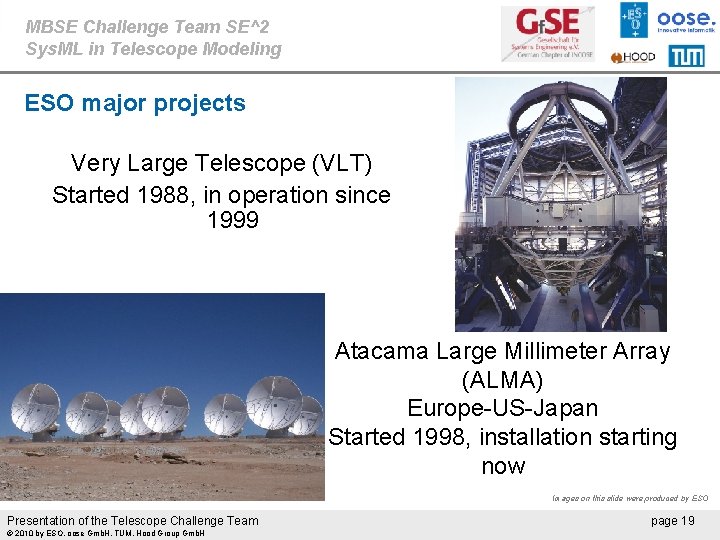
MBSE Challenge Team SE^2 Sys. ML in Telescope Modeling ESO major projects Very Large Telescope (VLT) Started 1988, in operation since 1999 Atacama Large Millimeter Array (ALMA) Europe-US-Japan Started 1998, installation starting now Images on this slide were produced by ESO Presentation of the Telescope Challenge Team © 2010 by ESO, oose Gmb. H, TUM, Hood Group Gmb. H page 19
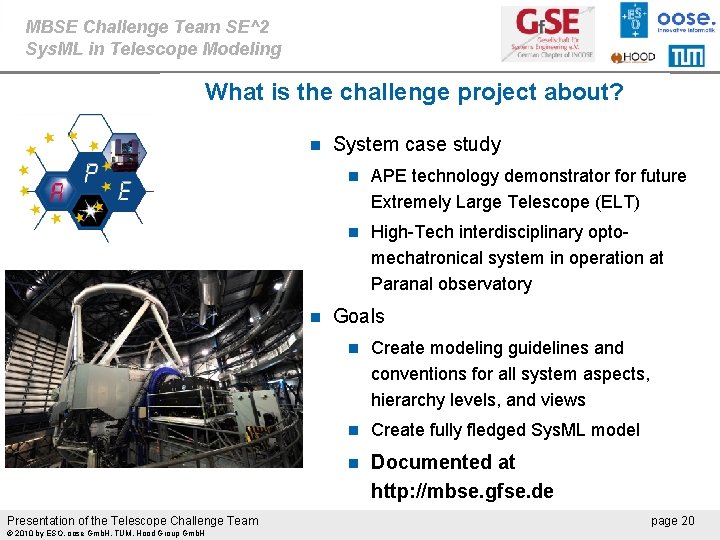
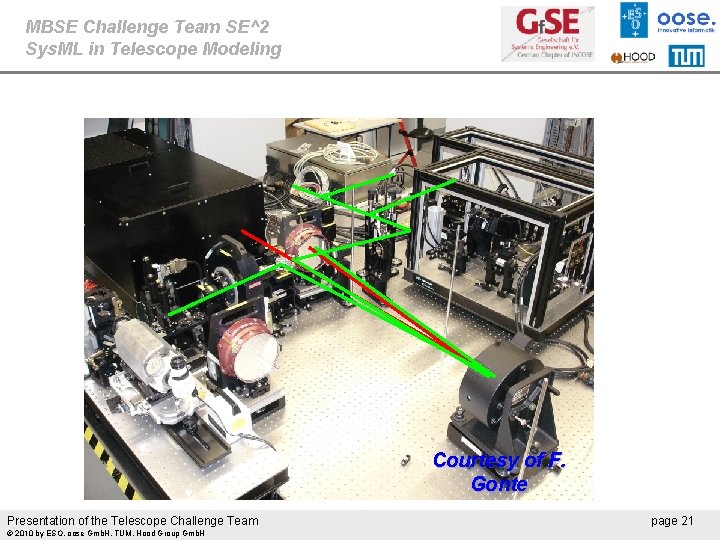
MBSE Challenge Team SE^2 Sys. ML in Telescope Modeling What is the challenge project about? n n Presentation of the Telescope Challenge Team © 2010 by ESO, oose Gmb. H, TUM, Hood Group Gmb. H System case study n APE technology demonstrator future Extremely Large Telescope (ELT) n High-Tech interdisciplinary optomechatronical system in operation at Paranal observatory Goals n Create modeling guidelines and conventions for all system aspects, hierarchy levels, and views n Create fully fledged Sys. ML model n Documented at http: //mbse. gfse. de page 20
MBSE Challenge Team SE^2 Sys. ML in Telescope Modeling Courtesy of F. Gonte Presentation of the Telescope Challenge Team © 2010 by ESO, oose Gmb. H, TUM, Hood Group Gmb. H page 21
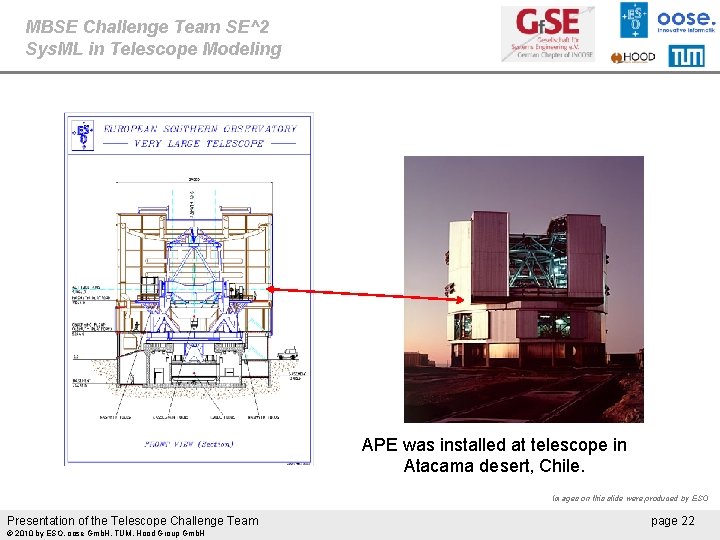
MBSE Challenge Team SE^2 Sys. ML in Telescope Modeling APE was installed at telescope in Atacama desert, Chile. Images on this slide were produced by ESO Presentation of the Telescope Challenge Team © 2010 by ESO, oose Gmb. H, TUM, Hood Group Gmb. H page 22
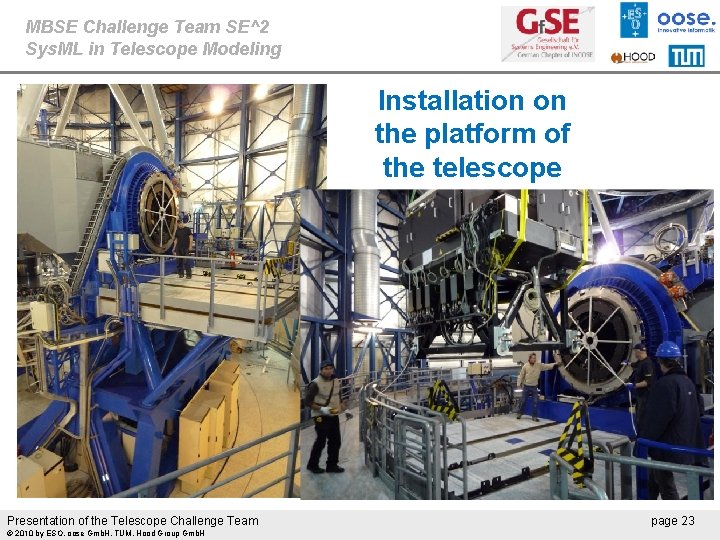
MBSE Challenge Team SE^2 Sys. ML in Telescope Modeling Installation on the platform of the telescope Presentation of the Telescope Challenge Team © 2010 by ESO, oose Gmb. H, TUM, Hood Group Gmb. H page 23
MBSE Challenge Team SE^2 Sys. ML in Telescope Modeling What have we achieved? APE model, guidelines and best practices: n Model Organization n Style, Layout Naming Conventions n System Views n Requirements and Use Case Modeling n Structure, Interface, and Behavior Modeling n Non-functional Aspects Ontologies, Part Catalogs n Variant Modeling n Integration with other Disciplines n Cross-cutting the model and Traceability n Domain Specific Model Extensions n Model, Model library and SE Profile n Plug-in for modeling tool n Input for tool vendor and Sys. ML RTF n Cookbook for MBSE with Sys. ML Presentation of the Telescope Challenge Team © 2010 by ESO, oose Gmb. H, TUM, Hood Group Gmb. H page 24
MBSE Challenge Team SE^2 Sys. ML in Telescope Modeling Major problems already addressed n n Use properly Sys. ML language and its elements to represent a system n Representative model n Practices and guidelines Scalable model organization Reuse of blocks (catalogue) n Modeling challenges n n n Identified and provided feed back to RTF WGs Notation (e. g. Connection of nested blocks) Modelling technicalities (e. g. Grouping of interfaces, Variant modeling) Tool (e. g. Configuration and Quality Control) Methodology (e. g. multi-layer allocation) n Feed back to vendor for improvement of tool n And many more smaller problems (see guidelines) Presentation of the Telescope Challenge Team © 2010 by ESO, oose Gmb. H, TUM, Hood Group Gmb. H page 25
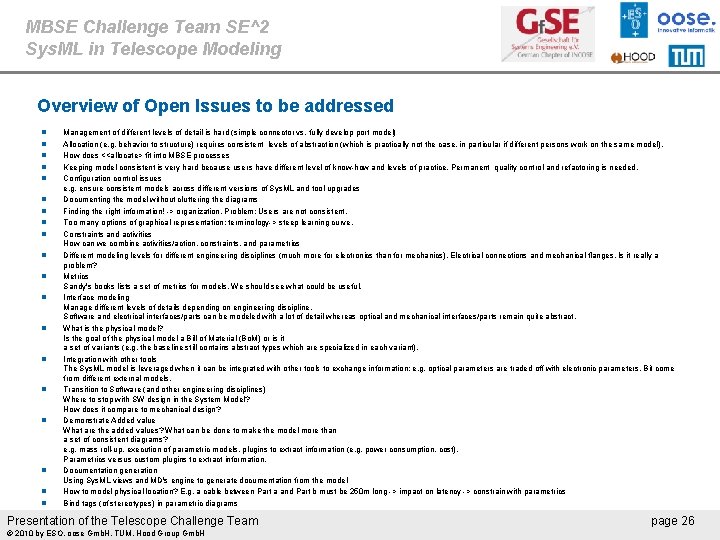
MBSE Challenge Team SE^2 Sys. ML in Telescope Modeling Overview of Open Issues to be addressed n n n n n Management of different levels of detail is hard (simple connector vs. fully develop port model) Allocation (e. g. behavior to structure) requires consistent levels of abstraction (which is practically not the case, in particular if different persons work on the same model). How does <<allocate> fit into MBSE processes Keeping model consistent is very hard because users have different level of know-how and levels of practice. Permanent quality control and refactoring is needed. Configuration control issues e. g. ensure consistent models across different versions of Sys. ML and tool upgrades Documenting the model without cluttering the diagrams Finding the right information! -> organization. Problem: Users are not consistent. Too many options of graphical representation; terminology-> steep learning curve. Constraints and activities How can we combine activities/action, constraints, and parametrics Different modeling levels for different engineering disciplines (much more for electronics than for mechanics). Electrical connections and mechanical flanges. Is it really a problem? Metrics Sandy's books lists a set of metrics for models. We should see what could be useful. Interface modeling Manage different levels of details depending on engineering discipline. Software and electrical interfaces/parts can be modeled with a lot of detail whereas optical and mechanical interfaces/parts remain quite abstract. What is the physical model? Is the goal of the physical model a Bill of Material (Bo. M) or is it a set of variants (e. g. the baseline still contains abstract types which are specialized in each variant). Integration with other tools The Sys. ML model is leveraged when it can be integrated with other tools to exchange information; e. g. optical parameters are traded off with electronic parameters. Bit come from different external models. Transition to Software (and other engineering disciplines) Where to stop with SW design in the System Model? How does it compare to mechanical design? Demonstrate Added value What are the added values? What can be done to make the model more than a set of consistent diagrams? e. g. mass roll-up, execution of parametric models, plugins to extract information (e. g. power consumption, cost). Parametrics versus custom plugins to extract information. Documentation generation Using Sys. ML views and MD's engine to generate documentation from the model How to model physical location? E. g. a cable between Part a and Part b must be 250 m long -> impact on latency -> constrain with parametrics Bind tags (of stereotypes) in parametric diagrams Presentation of the Telescope Challenge Team © 2010 by ESO, oose Gmb. H, TUM, Hood Group Gmb. H page 26
MBSE Challenge Team SE^2 Sys. ML in Telescope Modeling What is next? n Update and elaborate guidelines and best practices n Create a product – MBSE Sys. ML Cookbook n Recipes, applied guidelines, and best practices n Integrated navigable Sys. ML reference model n Automatically generated booklet n Elaborate APE reference model n More applications of variant modelling and parametric modelling n Enhance integration of modelling with MBSE process n Create examples and guidelines for open issues Presentation of the Telescope Challenge Team © 2010 by ESO, oose Gmb. H, TUM, Hood Group Gmb. H page 27
MBSE Challenge Team SE^2 Sys. ML in Telescope Modeling Early MBSE Adopters at ESO Presentation of the Telescope Challenge Team © 2010 by ESO, oose Gmb. H, TUM, Hood Group Gmb. H page
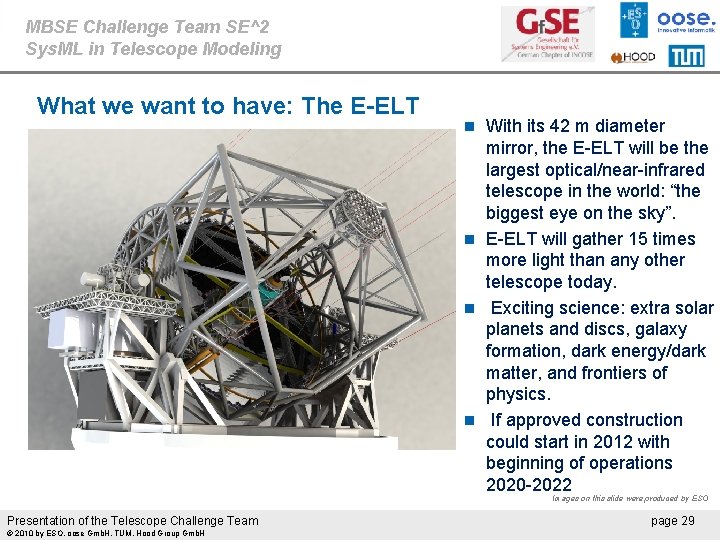
MBSE Challenge Team SE^2 Sys. ML in Telescope Modeling What we want to have: The E-ELT With its 42 m diameter mirror, the E-ELT will be the largest optical/near-infrared telescope in the world: “the biggest eye on the sky”. n E-ELT will gather 15 times more light than any other telescope today. n Exciting science: extra solar planets and discs, galaxy formation, dark energy/dark matter, and frontiers of physics. n If approved construction could start in 2012 with beginning of operations 2020 -2022 n Images on this slide were produced by ESO Presentation of the Telescope Challenge Team © 2010 by ESO, oose Gmb. H, TUM, Hood Group Gmb. H page 29
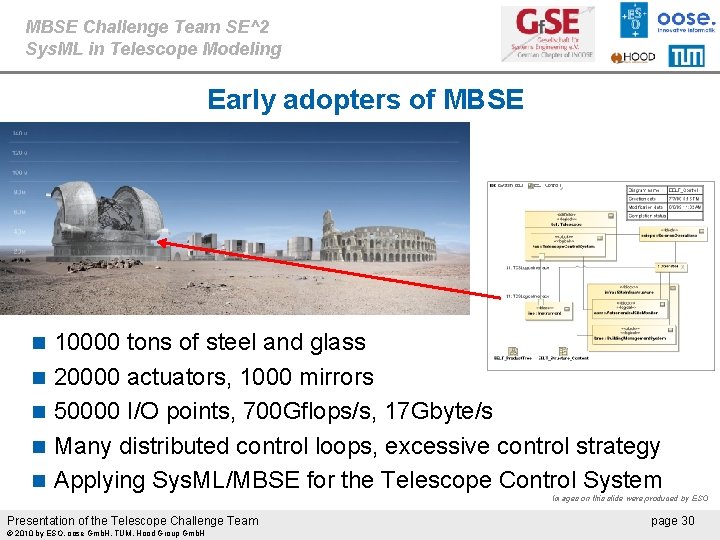
MBSE Challenge Team SE^2 Sys. ML in Telescope Modeling Early adopters of MBSE n n n 10000 tons of steel and glass 20000 actuators, 1000 mirrors 50000 I/O points, 700 Gflops/s, 17 Gbyte/s Many distributed control loops, excessive control strategy Applying Sys. ML/MBSE for the Telescope Control System Images on this slide were produced by ESO Presentation of the Telescope Challenge Team © 2010 by ESO, oose Gmb. H, TUM, Hood Group Gmb. H page 30
MBSE Challenge Team SE^2 Sys. ML in Telescope Modeling Why a model for the E-ELT TCS? n n n n Define infrastructure (e. g. network) Define interfaces to sub-systems Provide a cost estimate, power consumption Define common standards based on catalogs and design conventions Define requirements for subsystems (e. g. data rates, data volume, latency) Consistent information model of TCS properties to manage its size Provide a design which satisfies telescope functions (e. g. wave front control strategies) Presentation of the Telescope Challenge Team © 2010 by ESO, oose Gmb. H, TUM, Hood Group Gmb. H page 31
- Slides: 31