
MBB Lab 6 Anatomy of the Neck Power
MBB Lab 6: Anatomy of the Neck Power. Point Handout Review ”The Basics” and ”The Details” for the following cranial nerves in the Cranial Nerve Power. Point Handout (Lab 2). • Vagus nerve (CN X) Don’t be intimidated by the length of this Power. Point Handout. Many of the slides are review from MSI or previous MBB labs. All review slides are indicated by: (Review).
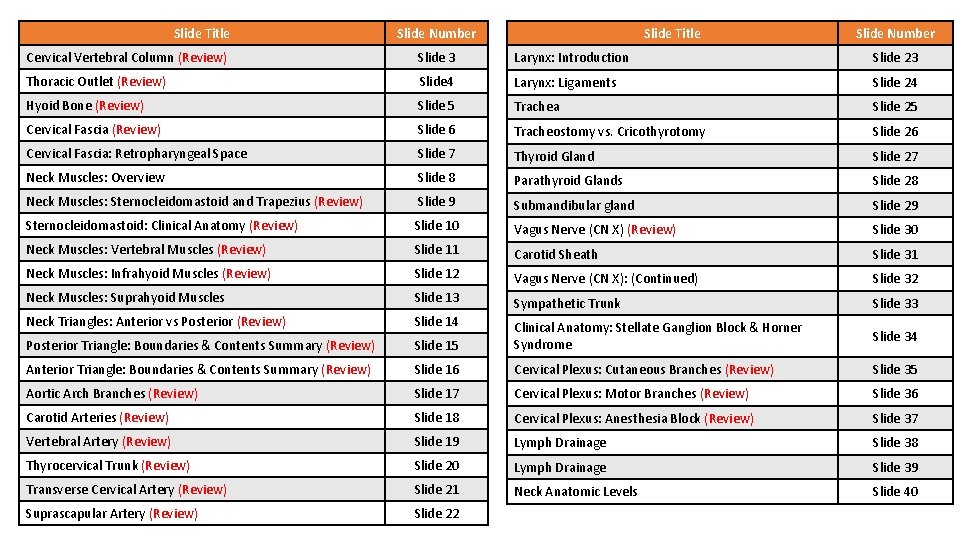
Slide Title Slide Number Cervical Vertebral Column (Review) Slide 3 Larynx: Introduction Slide 23 Thoracic Outlet (Review) Slide 4 Larynx: Ligaments Slide 24 Hyoid Bone (Review) Slide 5 Trachea Slide 25 Cervical Fascia (Review) Slide 6 Tracheostomy vs. Cricothyrotomy Slide 26 Cervical Fascia: Retropharyngeal Space Slide 7 Thyroid Gland Slide 27 Neck Muscles: Overview Slide 8 Parathyroid Glands Slide 28 Neck Muscles: Sternocleidomastoid and Trapezius (Review) Slide 9 Submandibular gland Slide 29 Sternocleidomastoid: Clinical Anatomy (Review) Slide 10 Vagus Nerve (CN X) (Review) Slide 30 Neck Muscles: Vertebral Muscles (Review) Slide 11 Carotid Sheath Slide 31 Neck Muscles: Infrahyoid Muscles (Review) Slide 12 Vagus Nerve (CN X): (Continued) Slide 32 Neck Muscles: Suprahyoid Muscles Slide 13 Sympathetic Trunk Slide 33 Neck Triangles: Anterior vs Posterior (Review) Slide 14 Posterior Triangle: Boundaries & Contents Summary (Review) Slide 15 Clinical Anatomy: Stellate Ganglion Block & Horner Syndrome Slide 34 Anterior Triangle: Boundaries & Contents Summary (Review) Slide 16 Cervical Plexus: Cutaneous Branches (Review) Slide 35 Aortic Arch Branches (Review) Slide 17 Cervical Plexus: Motor Branches (Review) Slide 36 Carotid Arteries (Review) Slide 18 Cervical Plexus: Anesthesia Block (Review) Slide 37 Vertebral Artery (Review) Slide 19 Lymph Drainage Slide 38 Thyrocervical Trunk (Review) Slide 20 Lymph Drainage Slide 39 Transverse Cervical Artery (Review) Slide 21 Neck Anatomic Levels Slide 40 Suprascapular Artery (Review) Slide 22
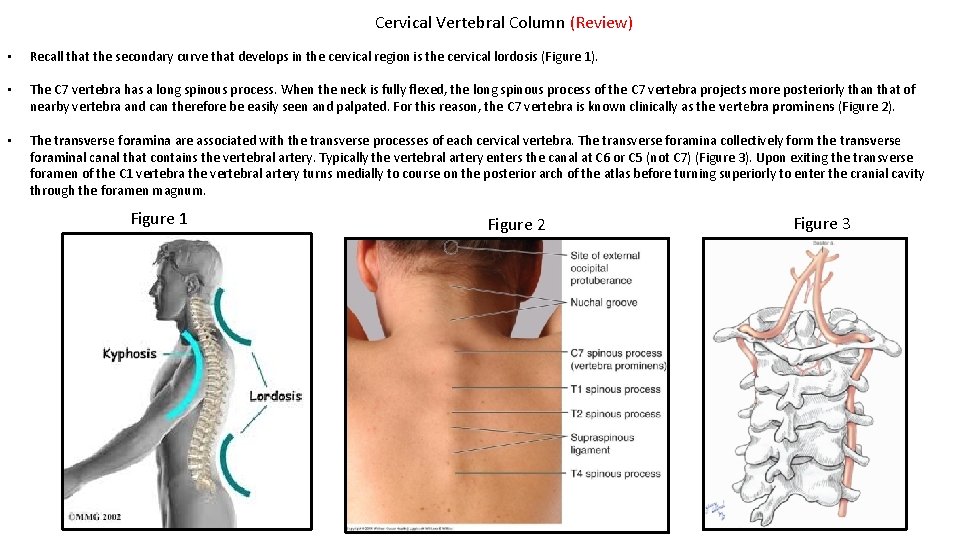
Cervical Vertebral Column (Review) • Recall that the secondary curve that develops in the cervical region is the cervical lordosis (Figure 1). • The C 7 vertebra has a long spinous process. When the neck is fully flexed, the long spinous process of the C 7 vertebra projects more posteriorly than that of nearby vertebra and can therefore be easily seen and palpated. For this reason, the C 7 vertebra is known clinically as the vertebra prominens (Figure 2). • The transverse foramina are associated with the transverse processes of each cervical vertebra. The transverse foramina collectively form the transverse foraminal canal that contains the vertebral artery. Typically the vertebral artery enters the canal at C 6 or C 5 (not C 7) (Figure 3). Upon exiting the transverse foramen of the C 1 vertebra the vertebral artery turns medially to course on the posterior arch of the atlas before turning superiorly to enter the cranial cavity through the foramen magnum. Figure 1 Figure 2 Figure 3
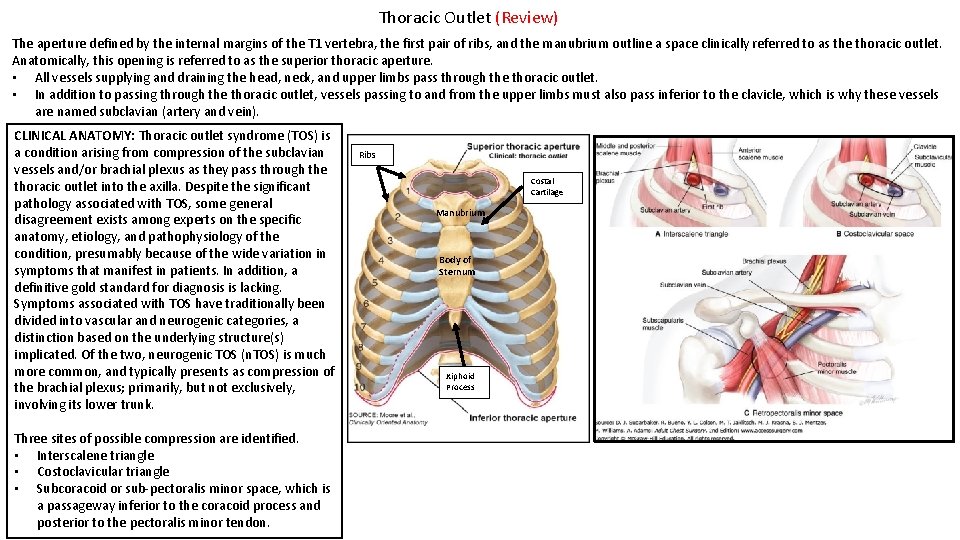
Thoracic Outlet (Review) The aperture defined by the internal margins of the T 1 vertebra, the first pair of ribs, and the manubrium outline a space clinically referred to as the thoracic outlet. Anatomically, this opening is referred to as the superior thoracic aperture. • All vessels supplying and draining the head, neck, and upper limbs pass through the thoracic outlet. • In addition to passing through the thoracic outlet, vessels passing to and from the upper limbs must also pass inferior to the clavicle, which is why these vessels are named subclavian (artery and vein). CLINICAL ANATOMY: Thoracic outlet syndrome (TOS) is a condition arising from compression of the subclavian vessels and/or brachial plexus as they pass through the thoracic outlet into the axilla. Despite the significant pathology associated with TOS, some general disagreement exists among experts on the specific anatomy, etiology, and pathophysiology of the condition, presumably because of the wide variation in symptoms that manifest in patients. In addition, a definitive gold standard for diagnosis is lacking. Symptoms associated with TOS have traditionally been divided into vascular and neurogenic categories, a distinction based on the underlying structure(s) implicated. Of the two, neurogenic TOS (n. TOS) is much more common, and typically presents as compression of the brachial plexus; primarily, but not exclusively, involving its lower trunk. Three sites of possible compression are identified. • Interscalene triangle • Costoclavicular triangle • Subcoracoid or sub-pectoralis minor space, which is a passageway inferior to the coracoid process and posterior to the pectoralis minor tendon. Ribs Costal Cartilage Manubrium Body of Sternum Xiphoid Process
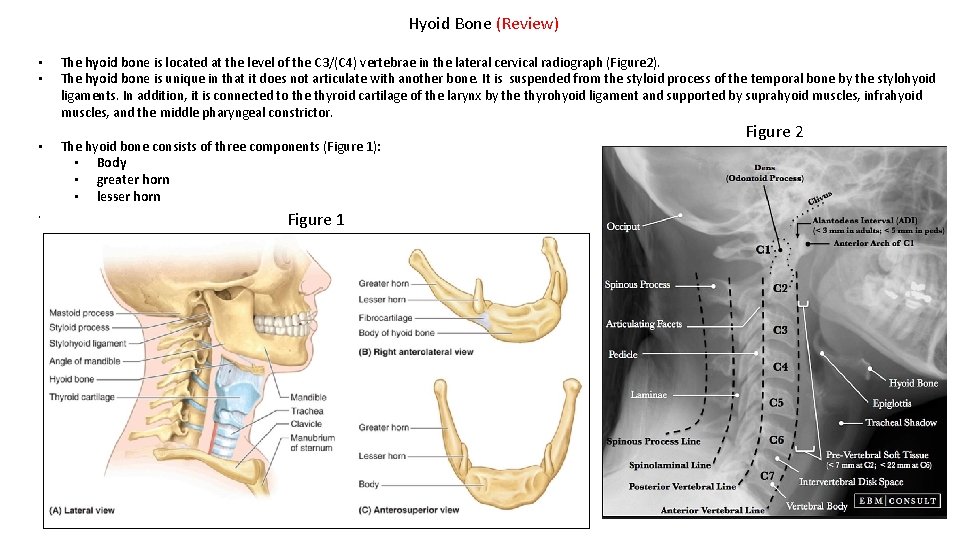
Hyoid Bone (Review) • • The hyoid bone is located at the level of the C 3/(C 4) vertebrae in the lateral cervical radiograph (Figure 2). The hyoid bone is unique in that it does not articulate with another bone. It is suspended from the styloid process of the temporal bone by the stylohyoid ligaments. In addition, it is connected to the thyroid cartilage of the larynx by the thyrohyoid ligament and supported by suprahyoid muscles, infrahyoid muscles, and the middle pharyngeal constrictor. • The hyoid bone consists of three components (Figure 1): • Body • greater horn • lesser horn . Figure 1 Figure 2
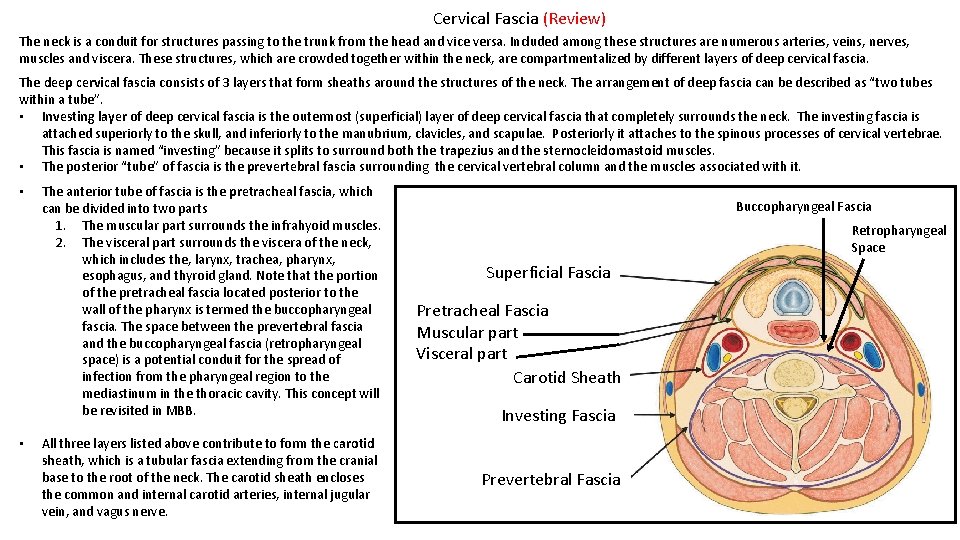
Cervical Fascia (Review) The neck is a conduit for structures passing to the trunk from the head and vice versa. Included among these structures are numerous arteries, veins, nerves, muscles and viscera. These structures, which are crowded together within the neck, are compartmentalized by different layers of deep cervical fascia. The deep cervical fascia consists of 3 layers that form sheaths around the structures of the neck. The arrangement of deep fascia can be described as “two tubes within a tube”. • Investing layer of deep cervical fascia is the outermost (superficial) layer of deep cervical fascia that completely surrounds the neck. The investing fascia is attached superiorly to the skull, and inferiorly to the manubrium, clavicles, and scapulae. Posteriorly it attaches to the spinous processes of cervical vertebrae. This fascia is named “investing” because it splits to surround both the trapezius and the sternocleidomastoid muscles. • The posterior “tube” of fascia is the prevertebral fascia surrounding the cervical vertebral column and the muscles associated with it. • • The anterior tube of fascia is the pretracheal fascia, which can be divided into two parts 1. The muscular part surrounds the infrahyoid muscles. 2. The visceral part surrounds the viscera of the neck, which includes the, larynx, trachea, pharynx, esophagus, and thyroid gland. Note that the portion of the pretracheal fascia located posterior to the wall of the pharynx is termed the buccopharyngeal fascia. The space between the prevertebral fascia and the buccopharyngeal fascia (retropharyngeal space) is a potential conduit for the spread of infection from the pharyngeal region to the mediastinum in the thoracic cavity. This concept will be revisited in MBB. All three layers listed above contribute to form the carotid sheath, which is a tubular fascia extending from the cranial base to the root of the neck. The carotid sheath encloses the common and internal carotid arteries, internal jugular vein, and vagus nerve. Buccopharyngeal Fascia Retropharyngeal Space Superficial Fascia Pretracheal Fascia Muscular part Visceral part Carotid Sheath Investing Fascia Prevertebral Fascia

Cervical Fascia: Retropharyngeal Space The deep cervical fascial layers are clinically important because they determine the direction and extent to which an infection in the neck may spread to the thorax. Knowledge of their distribution is therefore critical. CINICAL ANATOMY: The retropharyngeal space is a potential space between the prevertebral fascia and the buccopharyngeal fascia. It is a potential conduit for the spread of infection from the pharyngeal region to the mediastinum in the thoracic cavity. Buccopharyngeal Fascia Retropharyngeal Space Superficial Fascia Pretracheal Fascia Muscular part Visceral part Carotid Sheath Investing Fascia Prevertebral Fascia

Neck Muscles: Overview The muscles of the neck organized into groups according to their deep cervical fascia separations. • • • The platysma muscle is located within the superficial fascia. Recall that it is innervated by the cervical branch of the facial nerve. Sternocleidomastoid and trapezius muscles are enclosed by investing fascia. Vertebral muscles are surrounded by prevertebral fascia. Suprahyoid muscles are deep to the investing fascia. Infrahyoid muscles are enclosed by pretracheal fascia (muscular part of pretrachial fascia). Buccopharyngeal Fascia Infrahyoid mm. Retropharyngeal Space Superficial Fascia Platysma Pretracheal Fascia Muscular part Visceral part SCM Carotid Sheath Investing Fascia Vertebral mm. Prevertebral Fascia Trapezius

Neck Muscles: Sternocleidomastoid and Trapezius (Review) The sternocleidomastoid is named for its attachments to the mastoid process, clavicle and sternum. https: //3 d 4 medic. al/Cz 4 j. Lck 5 • It forms the separation between the anterior and posterior triangles of the neck. The trapezius is attached to the occipital bone, nuchal ligament, spinous processes C 7 -T 12, scapular spine, acromion, and the lateral clavicle. • It forms the anterior border of the posterior triangle. Both muscles are innervated by the spinal accessory nerve. • After exiting the jugular foramen, the spinal accessory nerve descends along the internal carotid artery to reach the sternocleidomastoid muscle, which it innervates. It then traverses the posterior triangle of the neck to supply motor fibers to the trapezius. MUSCLE INNERVATION Trapezius Spinal accessory n Sternocleidomastoid Spinal accessory n BLOOD SUPPLY ACTION • Superior fibers elevate scapula, upward rotation scapula (rotates glenoid cavity super) Transverse cervical a • Middle fibers retract scapula • Inferior fibers: depress scapula, upward rotation scapula (rotates glenoid cavity superiorly) Bilateral contraction: flexion of the head and neck Unilateral contraction: • Ipsilateral flexion • Contralateral rotation
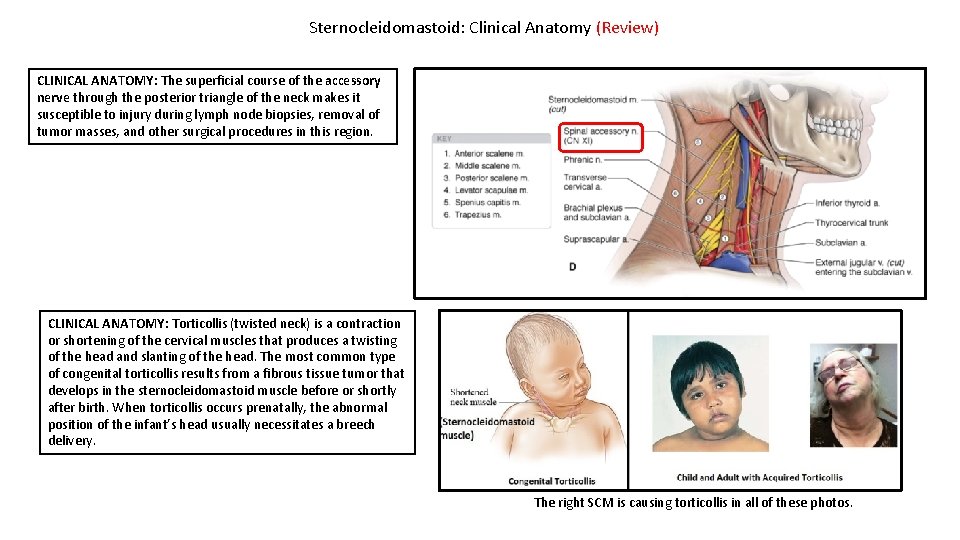
Sternocleidomastoid: Clinical Anatomy (Review) CLINICAL ANATOMY: The superficial course of the accessory nerve through the posterior triangle of the neck makes it susceptible to injury during lymph node biopsies, removal of tumor masses, and other surgical procedures in this region. CLINICAL ANATOMY: Torticollis (twisted neck) is a contraction or shortening of the cervical muscles that produces a twisting of the head and slanting of the head. The most common type of congenital torticollis results from a fibrous tissue tumor that develops in the sternocleidomastoid muscle before or shortly after birth. When torticollis occurs prenatally, the abnormal position of the infant’s head usually necessitates a breech delivery. The right SCM is causing torticollis in all of these photos.

Neck Muscles: Vertebral Muscles (Review) The vertebral muscles are surrounded by prevertebral fascia and can be organized into three groups. • Prevertebral muscles: These muscles are in an anterolateral position relative to the vertebral column. The prevertebral fascia covering them forms the posterior boundary of the retropharyngeal space. • Deep cervical muscles: This group is located posteriorly in the neck and consists of splenius, erector spinae and transversospinalis muscles. • Scalene muscles: The anterior, middle, and posterior scalene muscles attach to the cervical transverse processes and the first two ribs. The anterior scalene, middle scalene, and first rib form the boundaries of the interscalene triangle. **The most important vertebral muscles in this unit are the scalene muscles because of their anatomical relationships to to the following structures in the posterior triangle of the neck. • The rami of the brachial plexus pass through the interscalene triangle to form the trunks of the brachial plexus. • The subclavian artery passes through the interscalene triangle. • The subclavian vein passes anterior to the anterior scalene muscle. • The phrenic nerve (C 3 -C 5) descends along the anterior surface of the anterior scalene muscle on its path to the thorax. • The dorsal scapular nerve pierces the middle scalene muscle. Prevertebral Muscles
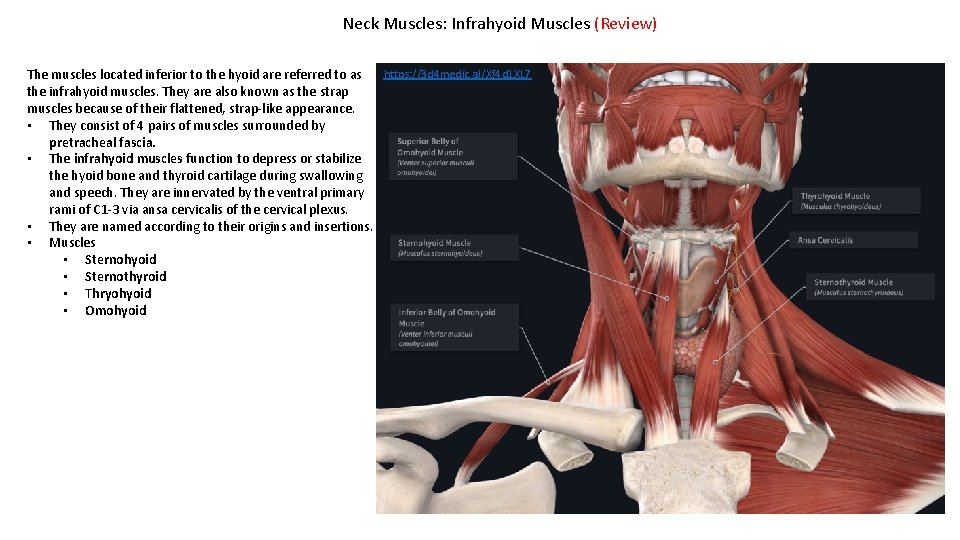
Neck Muscles: Infrahyoid Muscles (Review) https: //3 d 4 medic. al/Xf 4 d 1 XL 7 The muscles located inferior to the hyoid are referred to as the infrahyoid muscles. They are also known as the strap muscles because of their flattened, strap-like appearance. • They consist of 4 pairs of muscles surrounded by pretracheal fascia. • The infrahyoid muscles function to depress or stabilize the hyoid bone and thyroid cartilage during swallowing and speech. They are innervated by the ventral primary rami of C 1 -3 via ansa cervicalis of the cervical plexus. • They are named according to their origins and insertions. • Muscles • Sternohyoid • Sternothyroid • Thryohyoid • Omohyoid
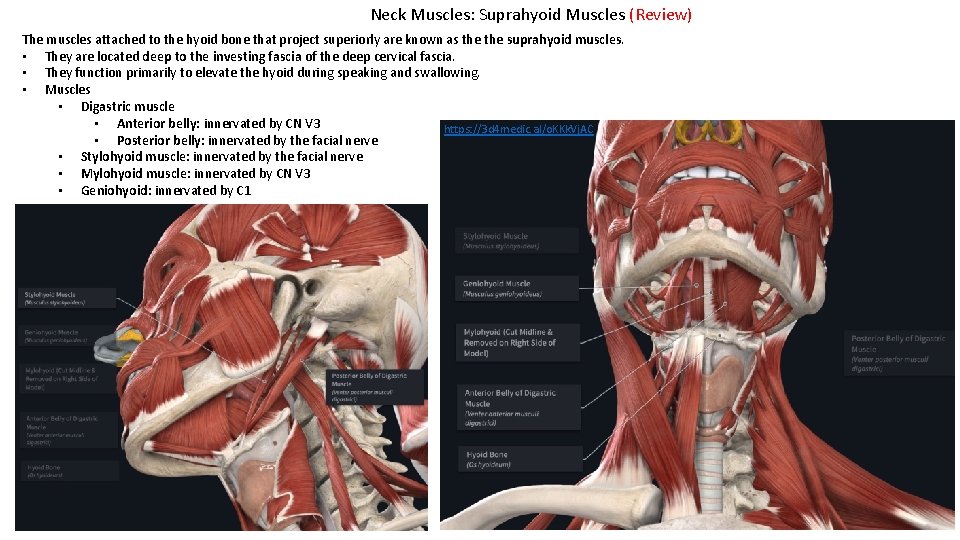
Neck Muscles: Suprahyoid Muscles (Review) The muscles attached to the hyoid bone that project superiorly are known as the suprahyoid muscles. • They are located deep to the investing fascia of the deep cervical fascia. • They function primarily to elevate the hyoid during speaking and swallowing. • Muscles • Digastric muscle • Anterior belly: innervated by CN V 3 https: //3 d 4 medic. al/o. KKk. Vj. AC • Posterior belly: innervated by the facial nerve • Stylohyoid muscle: innervated by the facial nerve • Mylohyoid muscle: innervated by CN V 3 • Geniohyoid: innervated by C 1
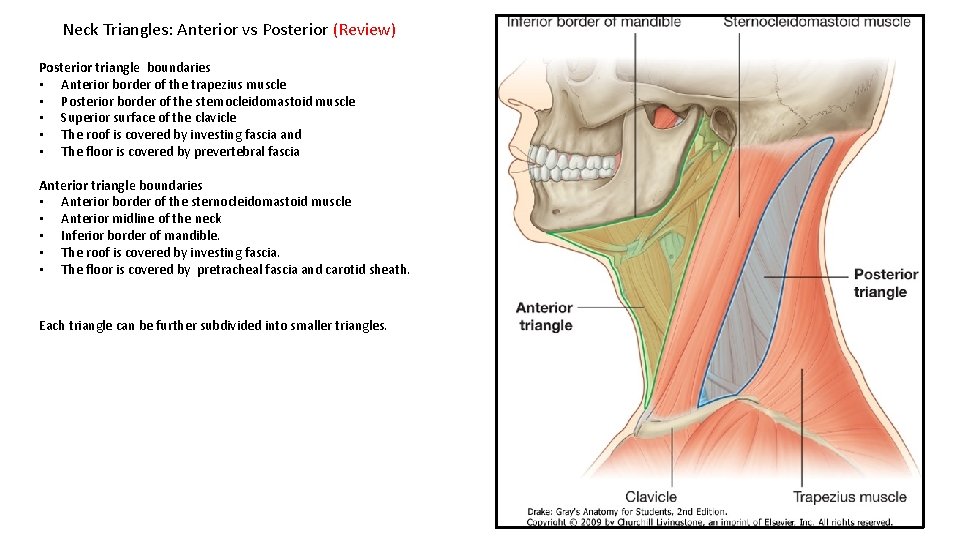
Neck Triangles: Anterior vs Posterior (Review) Posterior triangle boundaries • Anterior border of the trapezius muscle • Posterior border of the sternocleidomastoid muscle • Superior surface of the clavicle • The roof is covered by investing fascia and • The floor is covered by prevertebral fascia Anterior triangle boundaries • Anterior border of the sternocleidomastoid muscle • Anterior midline of the neck • Inferior border of mandible. • The roof is covered by investing fascia. • The floor is covered by pretracheal fascia and carotid sheath. Each triangle can be further subdivided into smaller triangles.
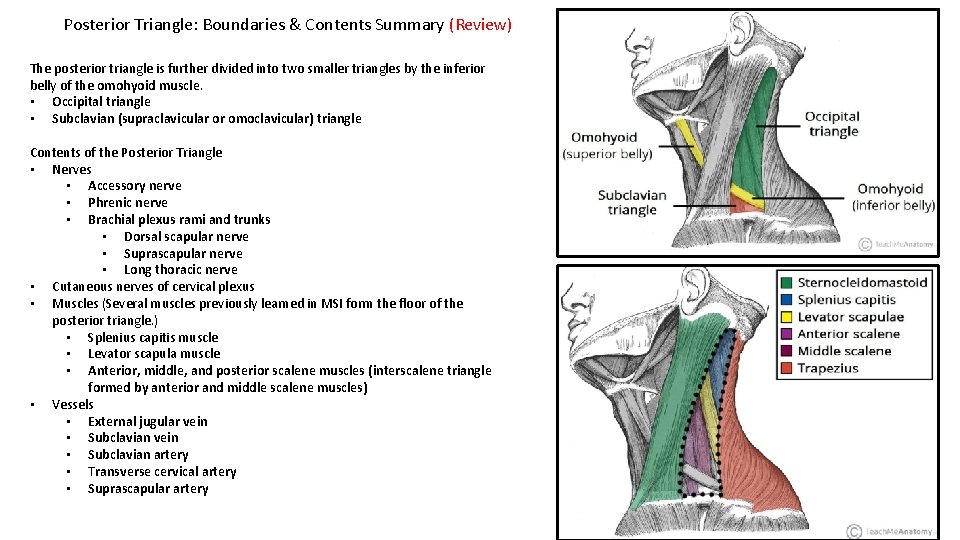
Posterior Triangle: Boundaries & Contents Summary (Review) The posterior triangle is further divided into two smaller triangles by the inferior belly of the omohyoid muscle. • Occipital triangle • Subclavian (supraclavicular or omoclavicular) triangle Contents of the Posterior Triangle • Nerves • Accessory nerve • Phrenic nerve • Brachial plexus rami and trunks • Dorsal scapular nerve • Suprascapular nerve • Long thoracic nerve • Cutaneous nerves of cervical plexus • Muscles (Several muscles previously learned in MSI form the floor of the posterior triangle. ) • Splenius capitis muscle • Levator scapula muscle • Anterior, middle, and posterior scalene muscles (interscalene triangle formed by anterior and middle scalene muscles) • Vessels • External jugular vein • Subclavian artery • Transverse cervical artery • Suprascapular artery
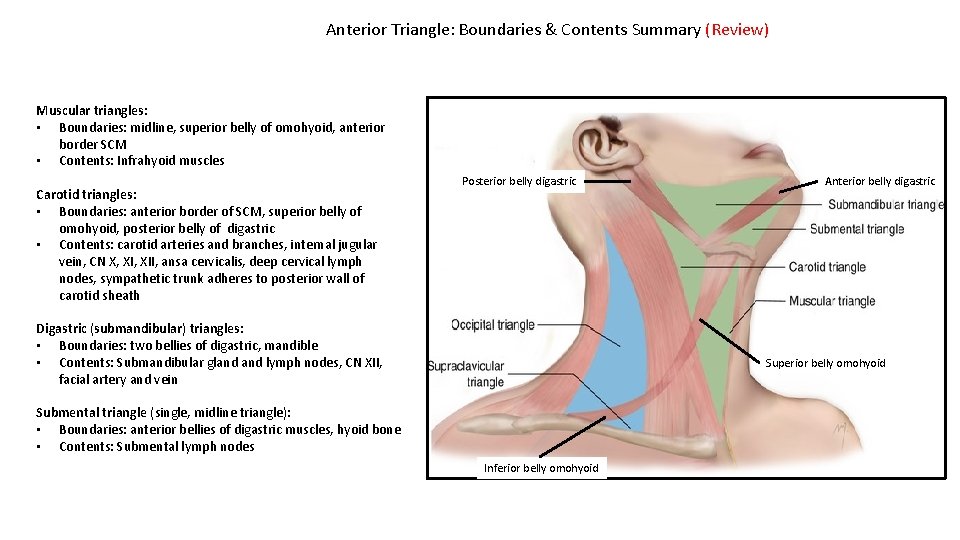
Anterior Triangle: Boundaries & Contents Summary (Review) Muscular triangles: • Boundaries: midline, superior belly of omohyoid, anterior border SCM • Contents: Infrahyoid muscles Carotid triangles: • Boundaries: anterior border of SCM, superior belly of omohyoid, posterior belly of digastric • Contents: carotid arteries and branches, internal jugular vein, CN X, XII, ansa cervicalis, deep cervical lymph nodes, sympathetic trunk adheres to posterior wall of carotid sheath Posterior belly digastric Digastric (submandibular) triangles: • Boundaries: two bellies of digastric, mandible • Contents: Submandibular gland lymph nodes, CN XII, facial artery and vein Anterior belly digastric Superior belly omohyoid Submental triangle (single, midline triangle): • Boundaries: anterior bellies of digastric muscles, hyoid bone • Contents: Submental lymph nodes Inferior belly omohyoid
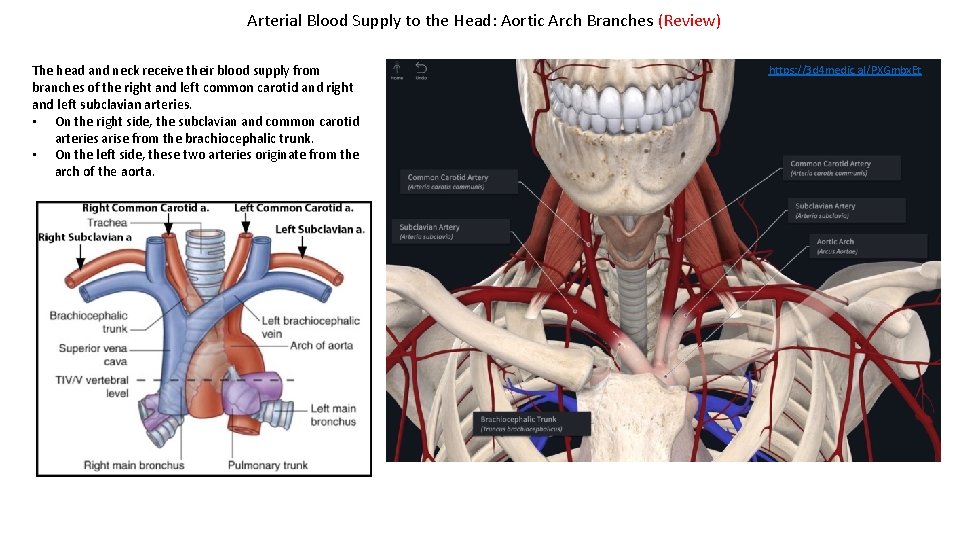
Arterial Blood Supply to the Head: Aortic Arch Branches (Review) The head and neck receive their blood supply from branches of the right and left common carotid and right and left subclavian arteries. • On the right side, the subclavian and common carotid arteries arise from the brachiocephalic trunk. • On the left side, these two arteries originate from the arch of the aorta. https: //3 d 4 medic. al/PXGmbx. Et
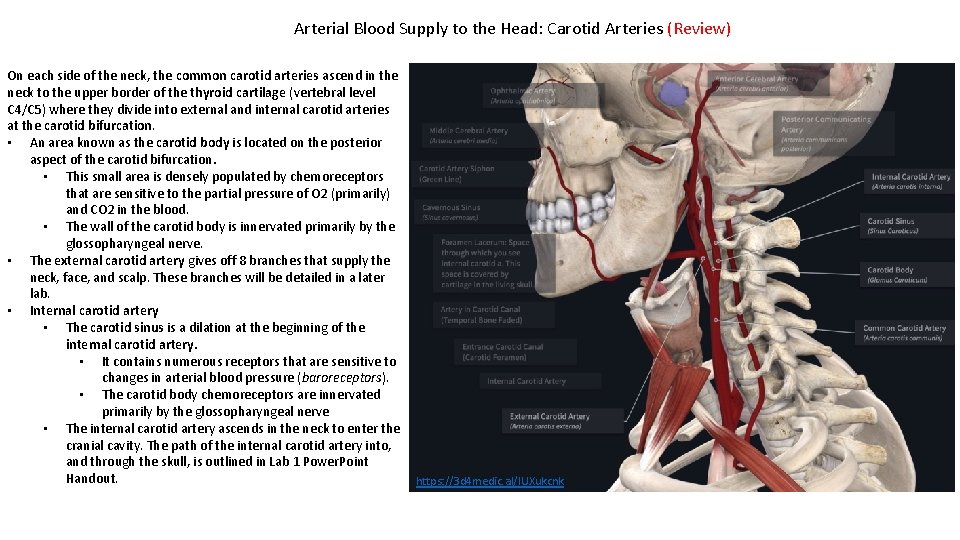
Arterial Blood Supply to the Head: Carotid Arteries (Review) On each side of the neck, the common carotid arteries ascend in the neck to the upper border of the thyroid cartilage (vertebral level C 4/C 5) where they divide into external and internal carotid arteries at the carotid bifurcation. • An area known as the carotid body is located on the posterior aspect of the carotid bifurcation. • This small area is densely populated by chemoreceptors that are sensitive to the partial pressure of O 2 (primarily) and CO 2 in the blood. • The wall of the carotid body is innervated primarily by the glossopharyngeal nerve. • The external carotid artery gives off 8 branches that supply the neck, face, and scalp. These branches will be detailed in a later lab. • Internal carotid artery • The carotid sinus is a dilation at the beginning of the internal carotid artery. • It contains numerous receptors that are sensitive to changes in arterial blood pressure (baroreceptors). • The carotid body chemoreceptors are innervated primarily by the glossopharyngeal nerve • The internal carotid artery ascends in the neck to enter the cranial cavity. The path of the internal carotid artery into, and through the skull, is outlined in Lab 1 Power. Point Handout. https: //3 d 4 medic. al/IUXukcnk
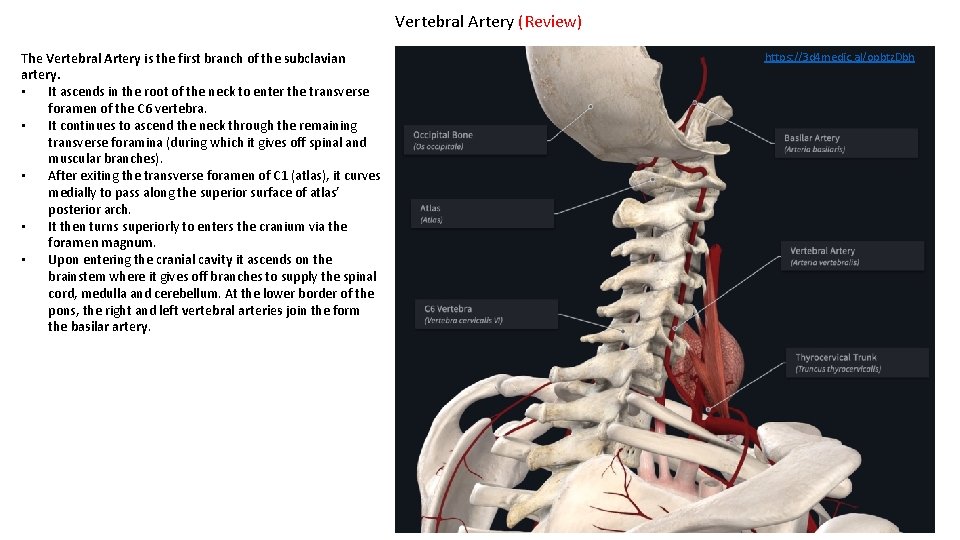
Vertebral Artery (Review) The Vertebral Artery is the first branch of the subclavian artery. • It ascends in the root of the neck to enter the transverse foramen of the C 6 vertebra. • It continues to ascend the neck through the remaining transverse foramina (during which it gives off spinal and muscular branches). • After exiting the transverse foramen of C 1 (atlas), it curves medially to pass along the superior surface of atlas’ posterior arch. • It then turns superiorly to enters the cranium via the foramen magnum. • Upon entering the cranial cavity it ascends on the brainstem where it gives off branches to supply the spinal cord, medulla and cerebellum. At the lower border of the pons, the right and left vertebral arteries join the form the basilar artery. https: //3 d 4 medic. al/opbtz. Dbh
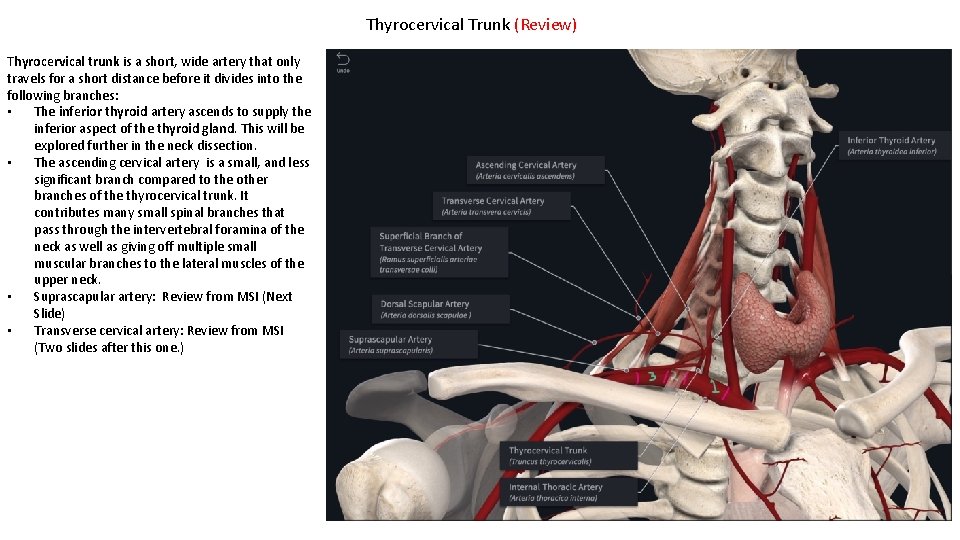
Thyrocervical Trunk (Review) Thyrocervical trunk is a short, wide artery that only travels for a short distance before it divides into the following branches: • The inferior thyroid artery ascends to supply the inferior aspect of the thyroid gland. This will be explored further in the neck dissection. • The ascending cervical artery is a small, and less significant branch compared to the other branches of the thyrocervical trunk. It contributes many small spinal branches that pass through the intervertebral foramina of the neck as well as giving off multiple small muscular branches to the lateral muscles of the upper neck. • Suprascapular artery: Review from MSI (Next Slide) • Transverse cervical artery: Review from MSI (Two slides after this one. )
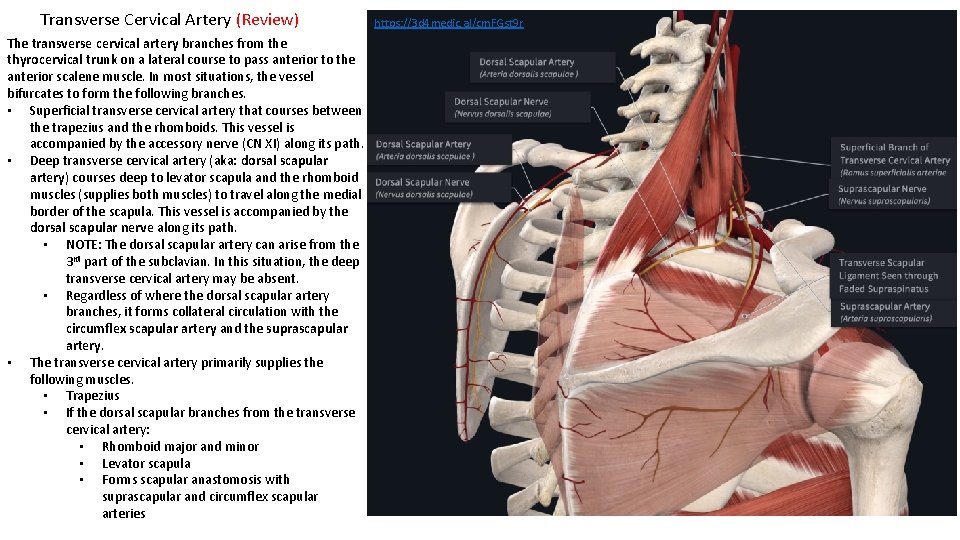
Transverse Cervical Artery (Review) The transverse cervical artery branches from the thyrocervical trunk on a lateral course to pass anterior to the anterior scalene muscle. In most situations, the vessel bifurcates to form the following branches. • Superficial transverse cervical artery that courses between the trapezius and the rhomboids. This vessel is accompanied by the accessory nerve (CN XI) along its path. • Deep transverse cervical artery (aka: dorsal scapular artery) courses deep to levator scapula and the rhomboid muscles (supplies both muscles) to travel along the medial border of the scapula. This vessel is accompanied by the dorsal scapular nerve along its path. • NOTE: The dorsal scapular artery can arise from the 3 rd part of the subclavian. In this situation, the deep transverse cervical artery may be absent. • Regardless of where the dorsal scapular artery branches, it forms collateral circulation with the circumflex scapular artery and the suprascapular artery. • The transverse cervical artery primarily supplies the following muscles. • Trapezius • If the dorsal scapular branches from the transverse cervical artery: • Rhomboid major and minor • Levator scapula • Forms scapular anastomosis with suprascapular and circumflex scapular arteries https: //3 d 4 medic. al/cm. FGst 9 r
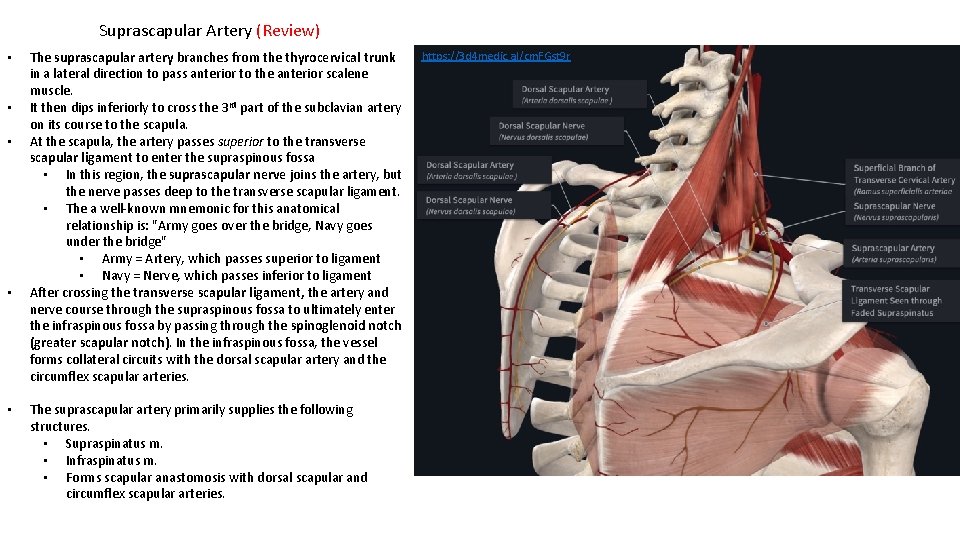
Suprascapular Artery (Review) • • • The suprascapular artery branches from the thyrocervical trunk in a lateral direction to pass anterior to the anterior scalene muscle. It then dips inferiorly to cross the 3 rd part of the subclavian artery on its course to the scapula. At the scapula, the artery passes superior to the transverse scapular ligament to enter the supraspinous fossa • In this region, the suprascapular nerve joins the artery, but the nerve passes deep to the transverse scapular ligament. • The a well-known mnemonic for this anatomical relationship is: "Army goes over the bridge, Navy goes under the bridge" • Army = Artery, which passes superior to ligament • Navy = Nerve, which passes inferior to ligament After crossing the transverse scapular ligament, the artery and nerve course through the supraspinous fossa to ultimately enter the infraspinous fossa by passing through the spinoglenoid notch (greater scapular notch). In the infraspinous fossa, the vessel forms collateral circuits with the dorsal scapular artery and the circumflex scapular arteries. The suprascapular artery primarily supplies the following structures. • Supraspinatus m. • Infraspinatus m. • Forms scapular anastomosis with dorsal scapular and circumflex scapular arteries. https: //3 d 4 medic. al/cm. FGst 9 r
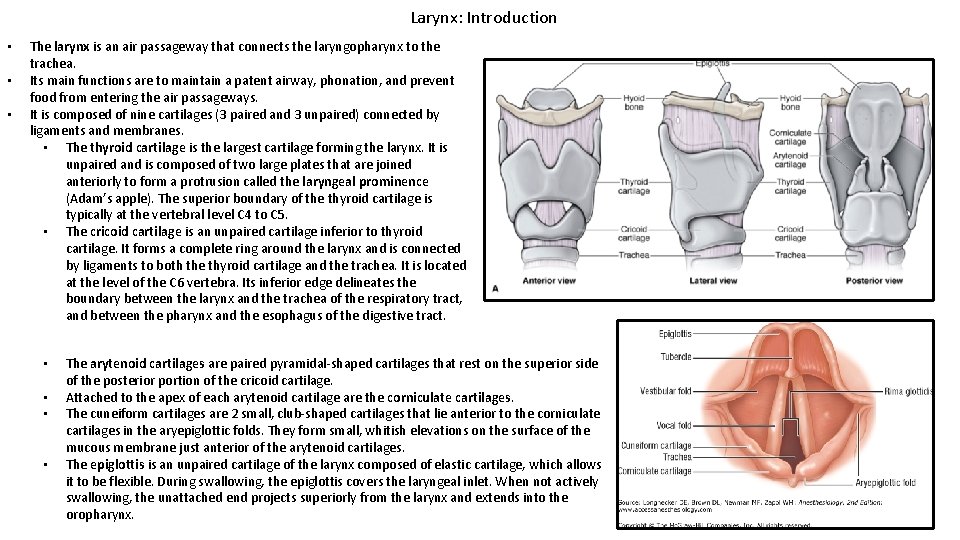
Larynx: Introduction • • • The larynx is an air passageway that connects the laryngopharynx to the trachea. Its main functions are to maintain a patent airway, phonation, and prevent food from entering the air passageways. It is composed of nine cartilages (3 paired and 3 unpaired) connected by ligaments and membranes. • The thyroid cartilage is the largest cartilage forming the larynx. It is unpaired and is composed of two large plates that are joined anteriorly to form a protrusion called the laryngeal prominence (Adam’s apple). The superior boundary of the thyroid cartilage is typically at the vertebral level C 4 to C 5. • The cricoid cartilage is an unpaired cartilage inferior to thyroid cartilage. It forms a complete ring around the larynx and is connected by ligaments to both the thyroid cartilage and the trachea. It is located at the level of the C 6 vertebra. Its inferior edge delineates the boundary between the larynx and the trachea of the respiratory tract, and between the pharynx and the esophagus of the digestive tract. • • The arytenoid cartilages are paired pyramidal-shaped cartilages that rest on the superior side of the posterior portion of the cricoid cartilage. Attached to the apex of each arytenoid cartilage are the corniculate cartilages. The cuneiform cartilages are 2 small, club-shaped cartilages that lie anterior to the corniculate cartilages in the aryepiglottic folds. They form small, whitish elevations on the surface of the mucous membrane just anterior of the arytenoid cartilages. The epiglottis is an unpaired cartilage of the larynx composed of elastic cartilage, which allows it to be flexible. During swallowing, the epiglottis covers the laryngeal inlet. When not actively swallowing, the unattached end projects superiorly from the larynx and extends into the oropharynx.
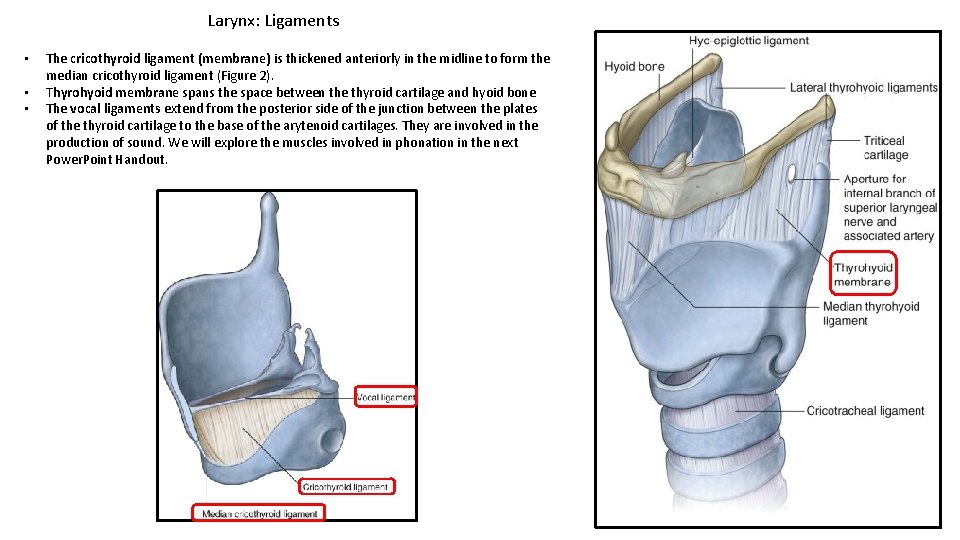
Larynx: Ligaments • • • The cricothyroid ligament (membrane) is thickened anteriorly in the midline to form the median cricothyroid ligament (Figure 2). Thyrohyoid membrane spans the space between the thyroid cartilage and hyoid bone The vocal ligaments extend from the posterior side of the junction between the plates of the thyroid cartilage to the base of the arytenoid cartilages. They are involved in the production of sound. We will explore the muscles involved in phonation in the next Power. Point Handout.
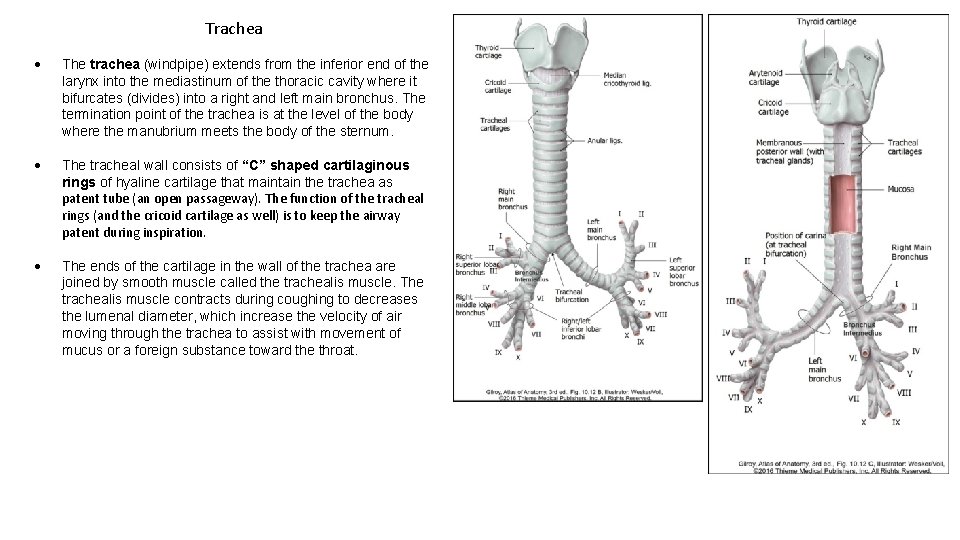
Trachea The trachea (windpipe) extends from the inferior end of the larynx into the mediastinum of the thoracic cavity where it bifurcates (divides) into a right and left main bronchus. The termination point of the trachea is at the level of the body where the manubrium meets the body of the sternum. The tracheal wall consists of “C” shaped cartilaginous rings of hyaline cartilage that maintain the trachea as patent tube (an open passageway). The function of the tracheal rings (and the cricoid cartilage as well) is to keep the airway patent during inspiration. The ends of the cartilage in the wall of the trachea are joined by smooth muscle called the trachealis muscle. The trachealis muscle contracts during coughing to decreases the lumenal diameter, which increase the velocity of air moving through the trachea to assist with movement of mucus or a foreign substance toward the throat.
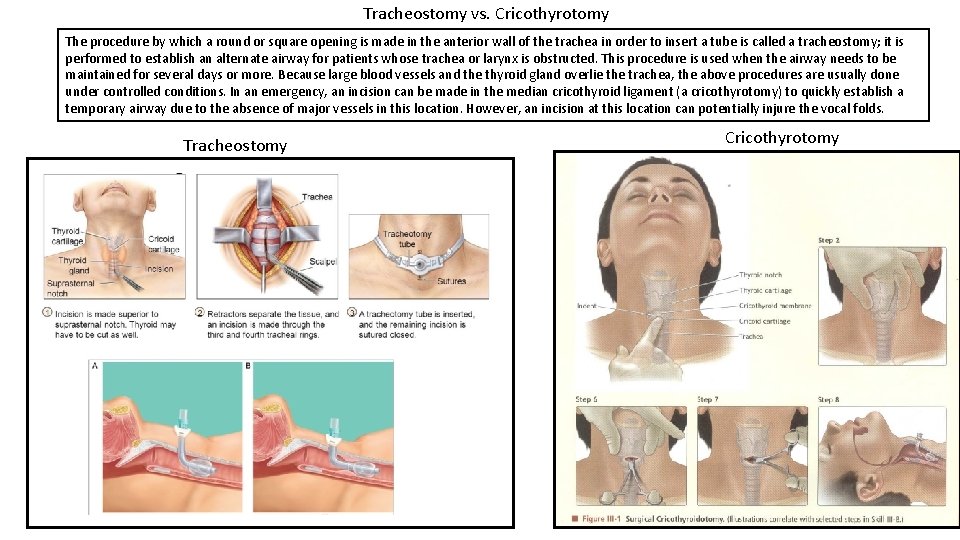
Tracheostomy vs. Cricothyrotomy The procedure by which a round or square opening is made in the anterior wall of the trachea in order to insert a tube is called a tracheostomy; it is performed to establish an alternate airway for patients whose trachea or larynx is obstructed. This procedure is used when the airway needs to be maintained for several days or more. Because large blood vessels and the thyroid gland overlie the trachea, the above procedures are usually done under controlled conditions. In an emergency, an incision can be made in the median cricothyroid ligament (a cricothyrotomy) to quickly establish a temporary airway due to the absence of major vessels in this location. However, an incision at this location can potentially injure the vocal folds. Tracheostomy Cricothyrotomy
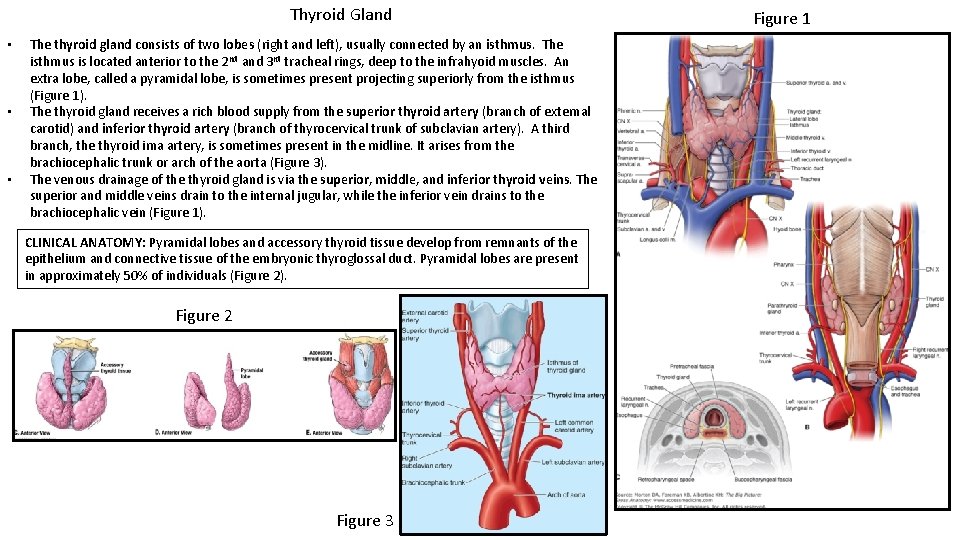
Thyroid Gland • • • The thyroid gland consists of two lobes (right and left), usually connected by an isthmus. The isthmus is located anterior to the 2 nd and 3 rd tracheal rings, deep to the infrahyoid muscles. An extra lobe, called a pyramidal lobe, is sometimes present projecting superiorly from the isthmus (Figure 1). The thyroid gland receives a rich blood supply from the superior thyroid artery (branch of external carotid) and inferior thyroid artery (branch of thyrocervical trunk of subclavian artery). A third branch, the thyroid ima artery, is sometimes present in the midline. It arises from the brachiocephalic trunk or arch of the aorta (Figure 3). The venous drainage of the thyroid gland is via the superior, middle, and inferior thyroid veins. The superior and middle veins drain to the internal jugular, while the inferior vein drains to the brachiocephalic vein (Figure 1). CLINICAL ANATOMY: Pyramidal lobes and accessory thyroid tissue develop from remnants of the epithelium and connective tissue of the embryonic thyroglossal duct. Pyramidal lobes are present in approximately 50% of individuals (Figure 2). Figure 2 Figure 3 Figure 1
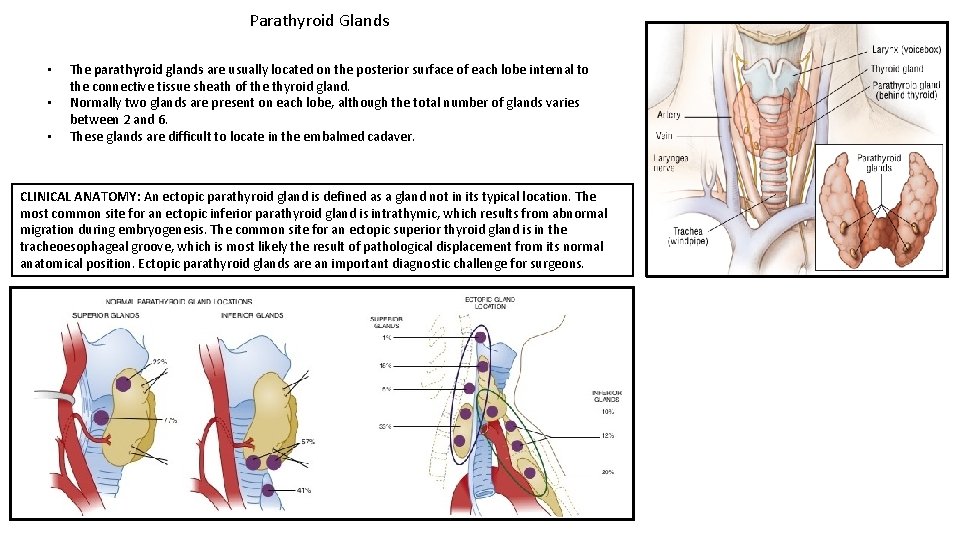
Parathyroid Glands • • • The parathyroid glands are usually located on the posterior surface of each lobe internal to the connective tissue sheath of the thyroid gland. Normally two glands are present on each lobe, although the total number of glands varies between 2 and 6. These glands are difficult to locate in the embalmed cadaver. CLINICAL ANATOMY: An ectopic parathyroid gland is defined as a gland not in its typical location. The most common site for an ectopic inferior parathyroid gland is intrathymic, which results from abnormal migration during embryogenesis. The common site for an ectopic superior thyroid gland is in the tracheoesophageal groove, which is most likely the result of pathological displacement from its normal anatomical position. Ectopic parathyroid glands are an important diagnostic challenge for surgeons.
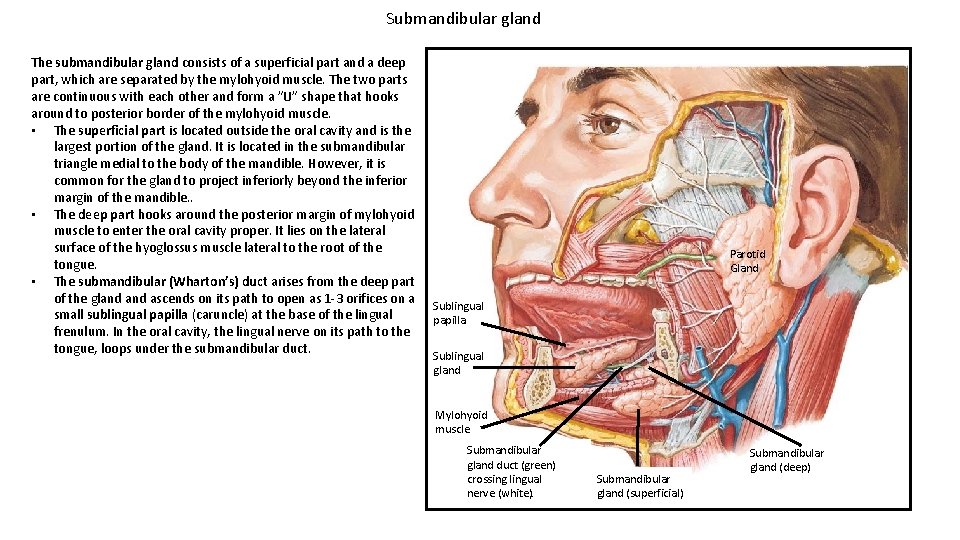
Submandibular gland The submandibular gland consists of a superficial part and a deep part, which are separated by the mylohyoid muscle. The two parts are continuous with each other and form a ”U” shape that hooks around to posterior border of the mylohyoid muscle. • The superficial part is located outside the oral cavity and is the largest portion of the gland. It is located in the submandibular triangle medial to the body of the mandible. However, it is common for the gland to project inferiorly beyond the inferior margin of the mandible. . • The deep part hooks around the posterior margin of mylohyoid muscle to enter the oral cavity proper. It lies on the lateral surface of the hyoglossus muscle lateral to the root of the tongue. • The submandibular (Wharton’s) duct arises from the deep part of the gland ascends on its path to open as 1 -3 orifices on a small sublingual papilla (caruncle) at the base of the lingual frenulum. In the oral cavity, the lingual nerve on its path to the tongue, loops under the submandibular duct. Parotid Gland Sublingual papilla Sublingual gland Mylohyoid muscle Submandibular gland duct (green) crossing lingual nerve (white). Submandibular gland (superficial) Submandibular gland (deep)
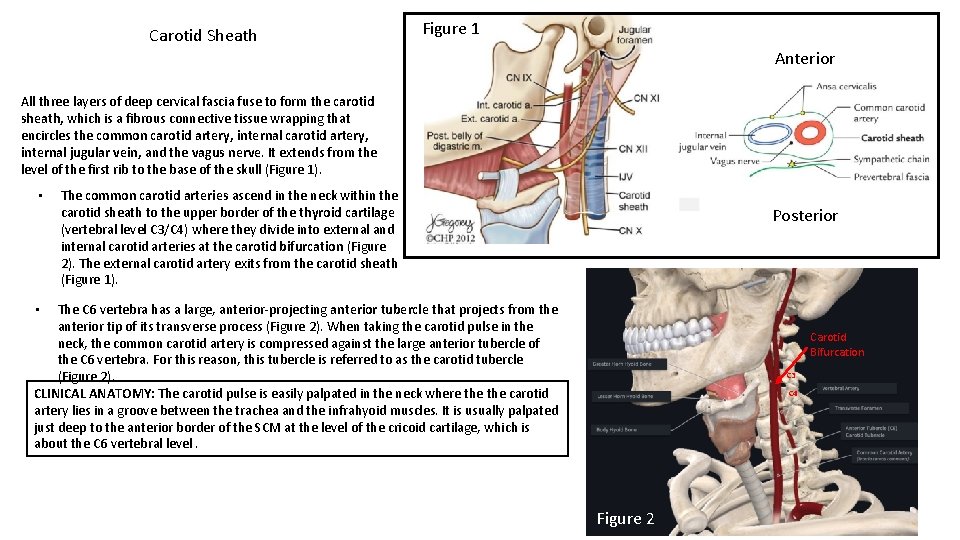
Carotid Sheath Figure 1 Anterior All three layers of deep cervical fascia fuse to form the carotid sheath, which is a fibrous connective tissue wrapping that encircles the common carotid artery, internal jugular vein, and the vagus nerve. It extends from the level of the first rib to the base of the skull (Figure 1). • The common carotid arteries ascend in the neck within the carotid sheath to the upper border of the thyroid cartilage (vertebral level C 3/C 4) where they divide into external and internal carotid arteries at the carotid bifurcation (Figure 2). The external carotid artery exits from the carotid sheath (Figure 1). Posterior The C 6 vertebra has a large, anterior-projecting anterior tubercle that projects from the anterior tip of its transverse process (Figure 2). When taking the carotid pulse in the neck, the common carotid artery is compressed against the large anterior tubercle of the C 6 vertebra. For this reason, this tubercle is referred to as the carotid tubercle (Figure 2). CLINICAL ANATOMY: The carotid pulse is easily palpated in the neck where the carotid artery lies in a groove between the trachea and the infrahyoid muscles. It is usually palpated just deep to the anterior border of the SCM at the level of the cricoid cartilage, which is about the C 6 vertebral level. • Carotid Bifurcation C 3 C 4 Figure 2
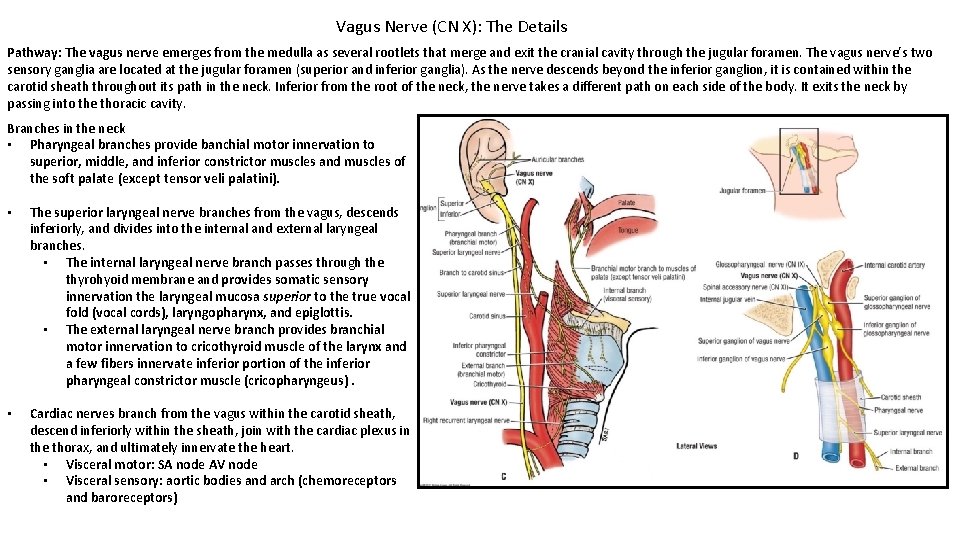
Vagus Nerve (CN X): The Details Pathway: The vagus nerve emerges from the medulla as several rootlets that merge and exit the cranial cavity through the jugular foramen. The vagus nerve’s two sensory ganglia are located at the jugular foramen (superior and inferior ganglia). As the nerve descends beyond the inferior ganglion, it is contained within the carotid sheath throughout its path in the neck. Inferior from the root of the neck, the nerve takes a different path on each side of the body. It exits the neck by passing into the thoracic cavity. Branches in the neck • Pharyngeal branches provide banchial motor innervation to superior, middle, and inferior constrictor muscles and muscles of the soft palate (except tensor veli palatini). • The superior laryngeal nerve branches from the vagus, descends inferiorly, and divides into the internal and external laryngeal branches. • The internal laryngeal nerve branch passes through the thyrohyoid membrane and provides somatic sensory innervation the laryngeal mucosa superior to the true vocal fold (vocal cords), laryngopharynx, and epiglottis. • The external laryngeal nerve branch provides branchial motor innervation to cricothyroid muscle of the larynx and a few fibers innervate inferior portion of the inferior pharyngeal constrictor muscle (cricopharyngeus). • Cardiac nerves branch from the vagus within the carotid sheath, descend inferiorly within the sheath, join with the cardiac plexus in the thorax, and ultimately innervate the heart. • Visceral motor: SA node AV node • Visceral sensory: aortic bodies and arch (chemoreceptors and baroreceptors)
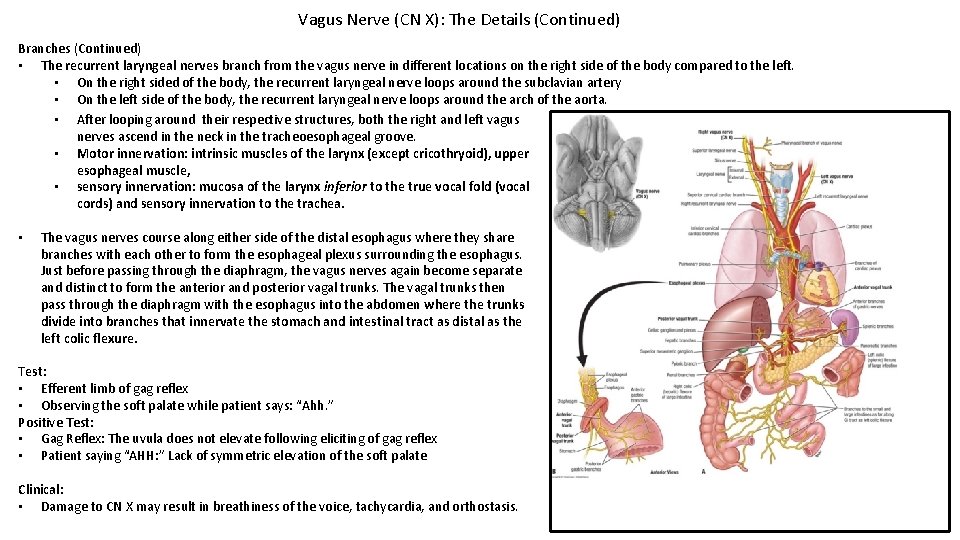
Vagus Nerve (CN X): The Details (Continued) Branches (Continued) • The recurrent laryngeal nerves branch from the vagus nerve in different locations on the right side of the body compared to the left. • On the right sided of the body, the recurrent laryngeal nerve loops around the subclavian artery • On the left side of the body, the recurrent laryngeal nerve loops around the arch of the aorta. • After looping around their respective structures, both the right and left vagus nerves ascend in the neck in the tracheoesophageal groove. • Motor innervation: intrinsic muscles of the larynx (except cricothryoid), upper esophageal muscle, • sensory innervation: mucosa of the larynx inferior to the true vocal fold (vocal cords) and sensory innervation to the trachea. • The vagus nerves course along either side of the distal esophagus where they share branches with each other to form the esophageal plexus surrounding the esophagus. Just before passing through the diaphragm, the vagus nerves again become separate and distinct to form the anterior and posterior vagal trunks. The vagal trunks then pass through the diaphragm with the esophagus into the abdomen where the trunks divide into branches that innervate the stomach and intestinal tract as distal as the left colic flexure. Test: • Efferent limb of gag reflex • Observing the soft palate while patient says: “Ahh. ” Positive Test: • Gag Reflex: The uvula does not elevate following eliciting of gag reflex • Patient saying “AHH: ” Lack of symmetric elevation of the soft palate Clinical: • Damage to CN X may result in breathiness of the voice, tachycardia, and orthostasis.
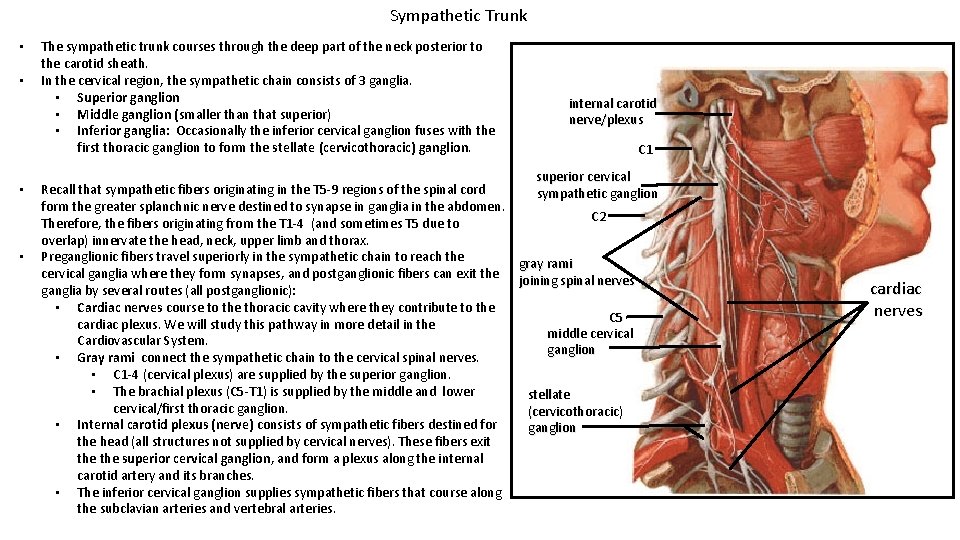
Sympathetic Trunk • • The sympathetic trunk courses through the deep part of the neck posterior to the carotid sheath. In the cervical region, the sympathetic chain consists of 3 ganglia. • Superior ganglion • Middle ganglion (smaller than that superior) • Inferior ganglia: Occasionally the inferior cervical ganglion fuses with the first thoracic ganglion to form the stellate (cervicothoracic) ganglion. internal carotid nerve/plexus C 1 superior cervical Recall that sympathetic fibers originating in the T 5 -9 regions of the spinal cord sympathetic ganglion form the greater splanchnic nerve destined to synapse in ganglia in the abdomen. C 2 Therefore, the fibers originating from the T 1 -4 (and sometimes T 5 due to overlap) innervate the head, neck, upper limb and thorax. Preganglionic fibers travel superiorly in the sympathetic chain to reach the gray rami cervical ganglia where they form synapses, and postganglionic fibers can exit the joining spinal nerves ganglia by several routes (all postganglionic): • Cardiac nerves course to the thoracic cavity where they contribute to the C 5 cardiac plexus. We will study this pathway in more detail in the middle cervical Cardiovascular System. ganglion • Gray rami connect the sympathetic chain to the cervical spinal nerves. • C 1 -4 (cervical plexus) are supplied by the superior ganglion. • The brachial plexus (C 5 -T 1) is supplied by the middle and lower stellate cervical/first thoracic ganglion. (cervicothoracic) • Internal carotid plexus (nerve) consists of sympathetic fibers destined for ganglion the head (all structures not supplied by cervical nerves). These fibers exit the superior cervical ganglion, and form a plexus along the internal carotid artery and its branches. • The inferior cervical ganglion supplies sympathetic fibers that course along the subclavian arteries and vertebral arteries. cardiac nerves
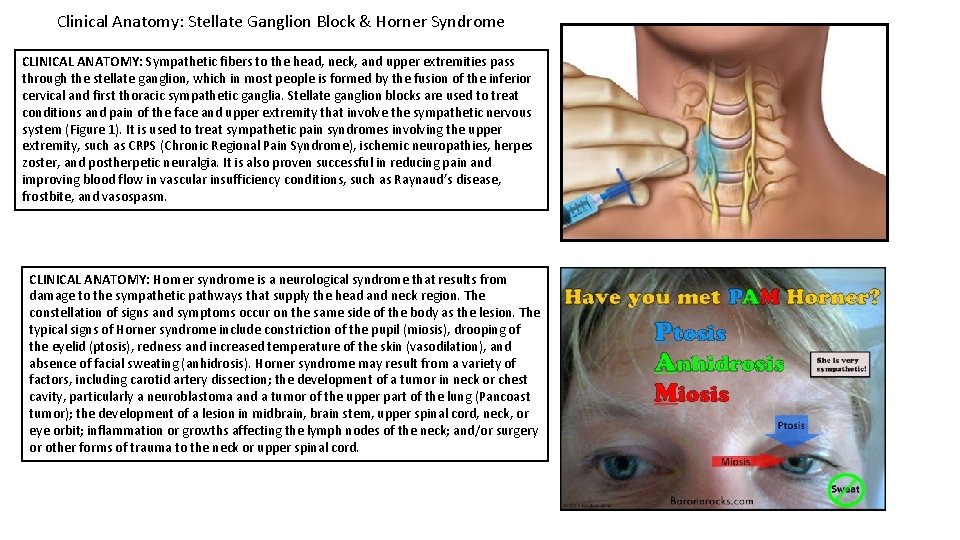
Clinical Anatomy: Stellate Ganglion Block & Horner Syndrome CLINICAL ANATOMY: Sympathetic fibers to the head, neck, and upper extremities pass through the stellate ganglion, which in most people is formed by the fusion of the inferior cervical and first thoracic sympathetic ganglia. Stellate ganglion blocks are used to treat conditions and pain of the face and upper extremity that involve the sympathetic nervous system (Figure 1). It is used to treat sympathetic pain syndromes involving the upper extremity, such as CRPS (Chronic Regional Pain Syndrome), ischemic neuropathies, herpes zoster, and postherpetic neuralgia. It is also proven successful in reducing pain and improving blood flow in vascular insufficiency conditions, such as Raynaud’s disease, frostbite, and vasospasm. CLINICAL ANATOMY: Horner syndrome is a neurological syndrome that results from damage to the sympathetic pathways that supply the head and neck region. The constellation of signs and symptoms occur on the same side of the body as the lesion. The typical signs of Horner syndrome include constriction of the pupil (miosis), drooping of the eyelid (ptosis), redness and increased temperature of the skin (vasodilation), and absence of facial sweating (anhidrosis). Horner syndrome may result from a variety of factors, including carotid artery dissection; the development of a tumor in neck or chest cavity, particularly a neuroblastoma and a tumor of the upper part of the lung (Pancoast tumor); the development of a lesion in midbrain, brain stem, upper spinal cord, neck, or eye orbit; inflammation or growths affecting the lymph nodes of the neck; and/or surgery or other forms of trauma to the neck or upper spinal cord.
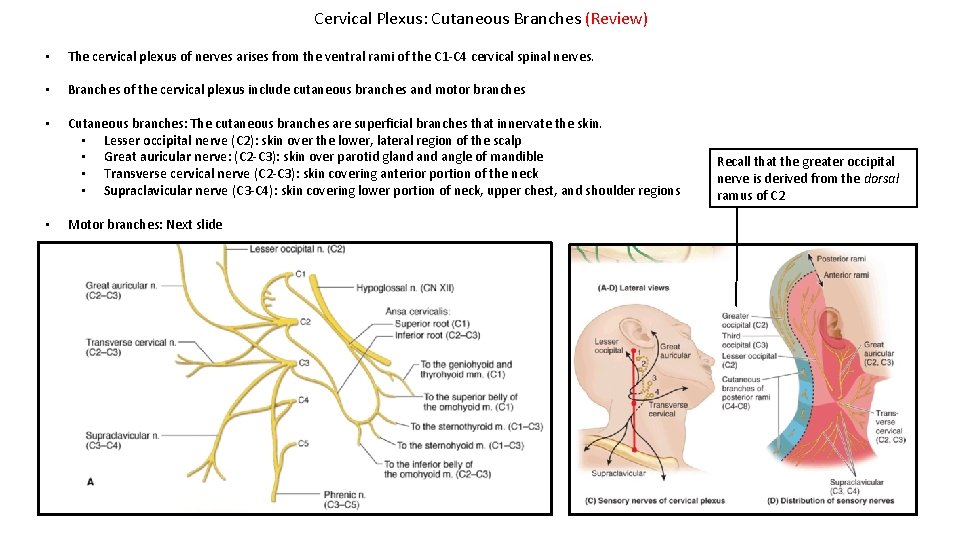
Cervical Plexus: Cutaneous Branches (Review) • The cervical plexus of nerves arises from the ventral rami of the C 1 -C 4 cervical spinal nerves. • Branches of the cervical plexus include cutaneous branches and motor branches • Cutaneous branches: The cutaneous branches are superficial branches that innervate the skin. • Lesser occipital nerve (C 2): skin over the lower, lateral region of the scalp • Great auricular nerve: (C 2 -C 3): skin over parotid gland angle of mandible • Transverse cervical nerve (C 2 -C 3): skin covering anterior portion of the neck • Supraclavicular nerve (C 3 -C 4): skin covering lower portion of neck, upper chest, and shoulder regions • Motor branches: Next slide Recall that the greater occipital nerve is derived from the dorsal ramus of C 2
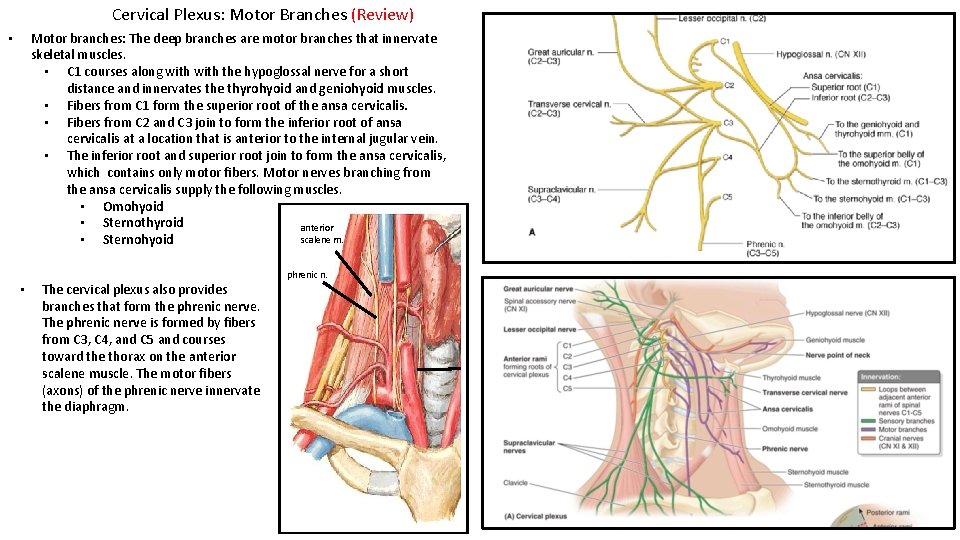
Cervical Plexus: Motor Branches (Review) Motor branches: The deep branches are motor branches that innervate skeletal muscles. • C 1 courses along with the hypoglossal nerve for a short distance and innervates the thyrohyoid and geniohyoid muscles. • Fibers from C 1 form the superior root of the ansa cervicalis. • Fibers from C 2 and C 3 join to form the inferior root of ansa cervicalis at a location that is anterior to the internal jugular vein. • The inferior root and superior root join to form the ansa cervicalis, which contains only motor fibers. Motor nerves branching from the ansa cervicalis supply the following muscles. • Omohyoid • Sternothyroid anterior scalene m. • Sternohyoid • • The cervical plexus also provides branches that form the phrenic nerve. The phrenic nerve is formed by fibers from C 3, C 4, and C 5 and courses toward the thorax on the anterior scalene muscle. The motor fibers (axons) of the phrenic nerve innervate the diaphragm. phrenic n.
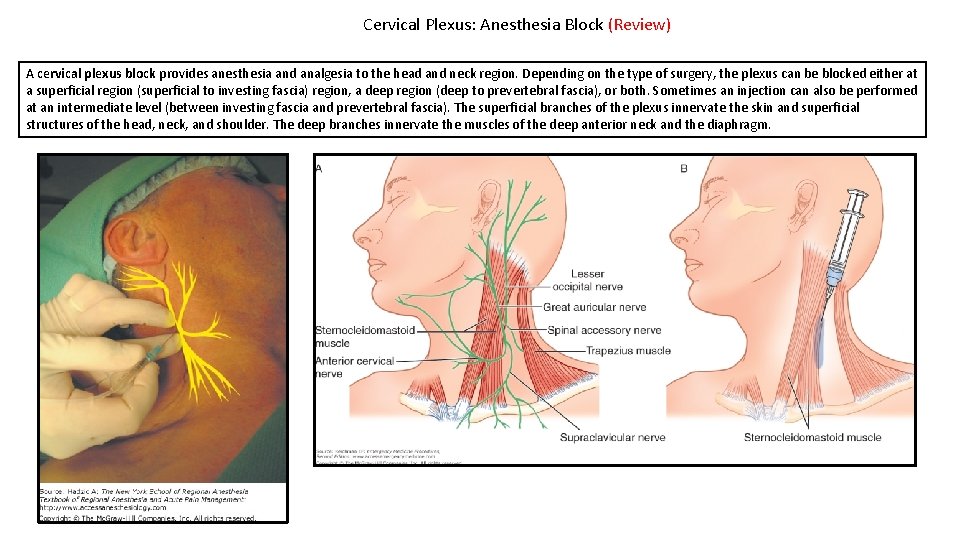
Cervical Plexus: Anesthesia Block (Review) A cervical plexus block provides anesthesia and analgesia to the head and neck region. Depending on the type of surgery, the plexus can be blocked either at a superficial region (superficial to investing fascia) region, a deep region (deep to prevertebral fascia), or both. Sometimes an injection can also be performed at an intermediate level (between investing fascia and prevertebral fascia). The superficial branches of the plexus innervate the skin and superficial structures of the head, neck, and shoulder. The deep branches innervate the muscles of the deep anterior neck and the diaphragm.
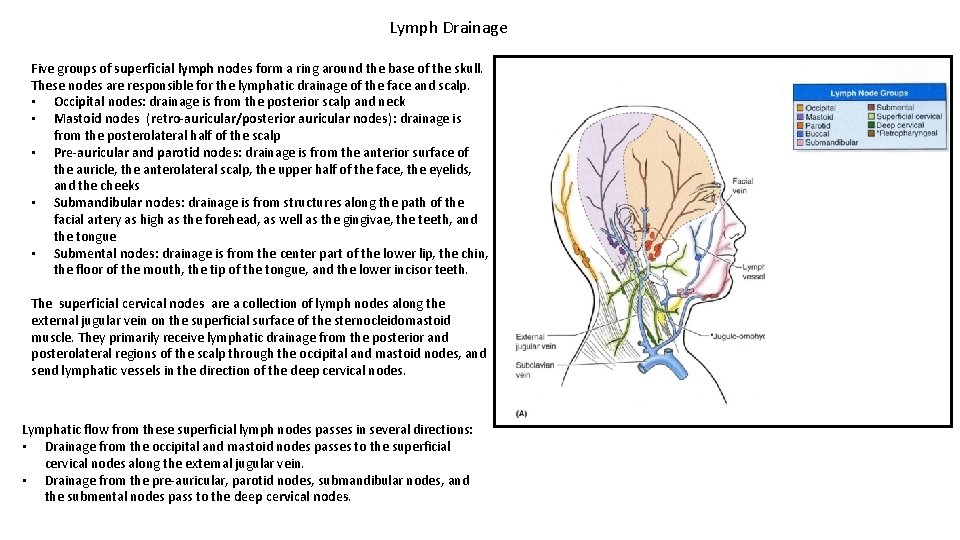
Lymph Drainage Five groups of superficial lymph nodes form a ring around the base of the skull. These nodes are responsible for the lymphatic drainage of the face and scalp. • Occipital nodes: drainage is from the posterior scalp and neck • Mastoid nodes (retro-auricular/posterior auricular nodes): drainage is from the posterolateral half of the scalp • Pre-auricular and parotid nodes: drainage is from the anterior surface of the auricle, the anterolateral scalp, the upper half of the face, the eyelids, and the cheeks • Submandibular nodes: drainage is from structures along the path of the facial artery as high as the forehead, as well as the gingivae, the teeth, and the tongue • Submental nodes: drainage is from the center part of the lower lip, the chin, the floor of the mouth, the tip of the tongue, and the lower incisor teeth. The superficial cervical nodes are a collection of lymph nodes along the external jugular vein on the superficial surface of the sternocleidomastoid muscle. They primarily receive lymphatic drainage from the posterior and posterolateral regions of the scalp through the occipital and mastoid nodes, and send lymphatic vessels in the direction of the deep cervical nodes. Lymphatic flow from these superficial lymph nodes passes in several directions: • Drainage from the occipital and mastoid nodes passes to the superficial cervical nodes along the external jugular vein. • Drainage from the pre-auricular, parotid nodes, submandibular nodes, and the submental nodes pass to the deep cervical nodes.
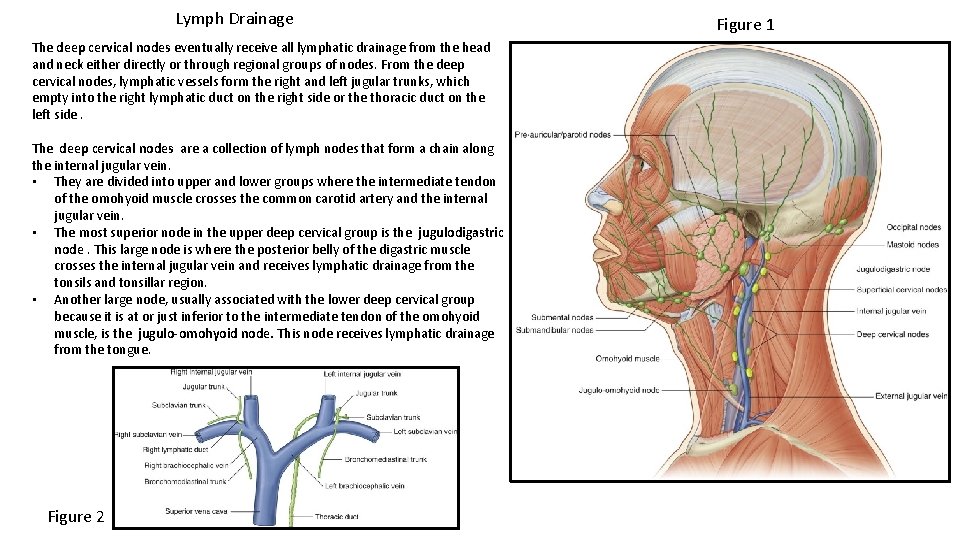
Lymph Drainage The deep cervical nodes eventually receive all lymphatic drainage from the head and neck either directly or through regional groups of nodes. From the deep cervical nodes, lymphatic vessels form the right and left jugular trunks, which empty into the right lymphatic duct on the right side or the thoracic duct on the left side. The deep cervical nodes are a collection of lymph nodes that form a chain along the internal jugular vein. • They are divided into upper and lower groups where the intermediate tendon of the omohyoid muscle crosses the common carotid artery and the internal jugular vein. • The most superior node in the upper deep cervical group is the jugulodigastric node. This large node is where the posterior belly of the digastric muscle crosses the internal jugular vein and receives lymphatic drainage from the tonsils and tonsillar region. • Another large node, usually associated with the lower deep cervical group because it is at or just inferior to the intermediate tendon of the omohyoid muscle, is the jugulo-omohyoid node. This node receives lymphatic drainage from the tongue. Figure 2 Figure 1
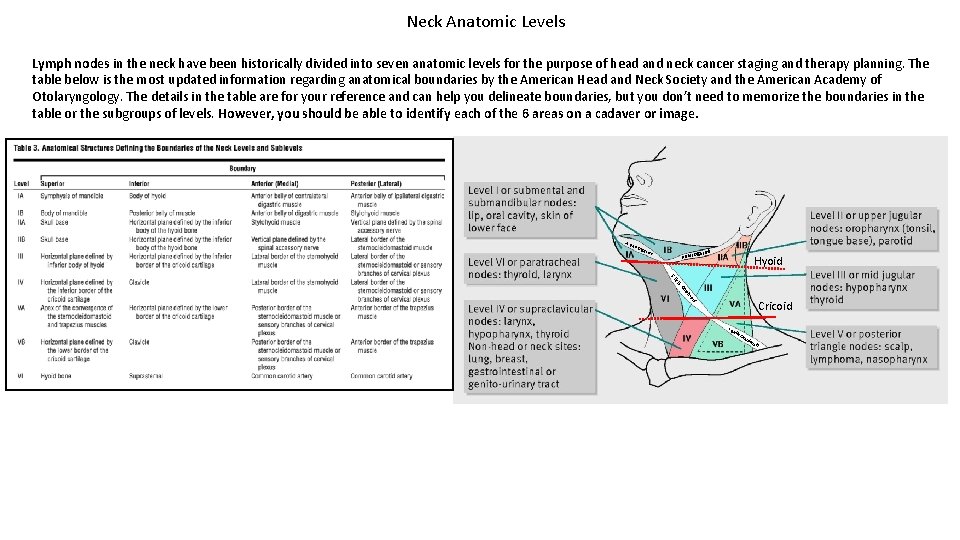
Neck Anatomic Levels Lymph nodes in the neck have been historically divided into seven anatomic levels for the purpose of head and neck cancer staging and therapy planning. The table below is the most updated information regarding anatomical boundaries by the American Head and Neck Society and the American Academy of Otolaryngology. The details in the table are for your reference and can help you delineate boundaries, but you don’t need to memorize the boundaries in the table or the subgroups of levels. However, you should be able to identify each of the 6 areas on a cadaver or image. AB ell D igastric P Bell D Hyoid m y. O ell SB yo oh id Cricoid IB elly Om oh yoi d
- Slides: 40