
MBASem II Sub C 24 Operation Management Unit
MBA-Sem: II Sub: (C 24) Operation Management Unit – IV: Material Management A Theoretical & Practical Perspective by Prof. Rajkaml 9765900862 padmakars 21@gmail. com 9/18/2020 1
Unit –IV : Material Management 4 Role of Materials Management- materials and profitability, Purchase functions, Procurement procedures including bid systems, Vendor selection and development, Vendor rating, ethics in purchasing. Roles and responsibilities of purchase professionals. 4 Concepts of lead time, purchase requisition, purchase order, amendments, forms used and records maintained. 4 Inventory Management: Concepts of inventory, types, Classification, selective inventory management, ABC analysis. Inventory costs, Inventory models – EOQ, safety stocks, Re order point, Quantity discounts. Stores- types, 9/18/2020 Padmakar S. - GWCET 2 functions, roles responsibilities, Inventory records
Introduction: Reasons for popularity of Materials 4 Five M’s: Men, Machines, Money, Materials & Methods 1. The amount spent on materials is higher than other inputs 2. Materials offer considerable scope for reducing cost and improving profit 3. Improving return on investment depends on effective utilization of materials 4. Materials add value to products 5. Quality of end product depend s on materials 6. Need for preservation of scarce resources for posterity 7. Materials management assumes responsibility for whatever happens in purchasing, storing, inventory or any other area connected with materials 8. Increasing demand for ensuring environmental safety 9. The efficiency of any organization depends upon the availability of right materials, in right quantity, at the right time & the right price 9/18/2020 Padmakar S. - GWCET 3 10. Materials are the life-blood of man’s development
Objectives / Importance of Material Management: 4 Primary Objectives: 4 Lower price for materials and equipment 4 Faster inventory turnover 4 Continuity of supply 4 Low payroll costs 4 Favorable supplier relations 4 Development of personnel 4 Good records 4 Secondary Objectives: 4 Reciprocal relations 4 New materials and products 4 Economic make-or-buy 4 Standardization product improvement ‘interdepartmental harmony 4 Forecasts 9/18/2020 4 Acquisitions Padmakar S. - GWCET 4
Purchase Management: (Procurement) Functions of Purchasing Department: 4 Fully delegated to purchasing function: – – – – 9/18/2020 Obtaining prices Selecting vendors Awarding purchase orders Following up on delivery promises Adjusting and settling Selecting and training of purchasing personnel Vendor relations Padmakar S. - GWCET 5

Purchase Management: (Procurement) Functions of Purchasing Department: 4 Functions other than purchasing functions: – Obtaining technical information and advice – Receiving sales presentation and arranging for sales opportunities with – – – – interested personnel (Lead Generation) Establishing specifications Scheduling order & deliveries Inspecting Specifying delivery methods and routing Expediting and purchasing for employee Accounting Purchasing and market research – Inventory and warehousing policy and/or control – Forward buying and hedging policies and procedures – Contract and agreements Padmakar S. - GWCET 9/18/2020 – Sale of scrap, salvage and surplus 6
Role and responsibilities of Purchase professional: 4 Make or buy decision 4 Authority to commit the funds for acquisition of goods & 4 4 services Satisfy needs Interview all vendor representative Bidding and negotiation, trial order Purchase of right quality, right quantity, right price, right time and from right source 4 9/18/2020 Padmakar S. - GWCET 7
Inventory Management: 4 Originate from French word ‘Inventaire’ & latin word ‘Inventariom’ 4 The term includes materials-raw, in process, finished packaging, spares and other stocked in order to meet an expected demand or distribution in the future 4 It can be used to refer to the stock on hand at a particular time of raw materials, goods-in-process of manufacture, finished product, tangible assets which can be seen, measured and counted 9/18/2020 Padmakar S. - GWCET 8
Types of inventories: 4 Production Inventories 4 MRO Inventories (Maintenance, repair, operating supplies) 4 In-process Inventories 4 Finished goods Inventories 4 Raw materials 4 Purchased parts and supplies 4 Labour 4 Working capital 4 Tools, machinery and equipment 9/18/2020 Padmakar S. - GWCET 9
Inventory Costs: 4 Ordering Costs 4 Carrying Costs – – – Capital Costs Storage Space Costs Inventory service costs Handling-equipment costs Inventory risk costs 4 Out-of stock costs 4 Capacity costs 9/18/2020 Padmakar S. - GWCET 10
Benefits of Inventory Management & Control: 4 Ensures an adequate supply of materials, stores etc. , minimize stock-outs 4 4 4 4 and shortage, and avoids costly interruptions in operation It keeps down investment in inventories, inventory carrying cost and obsolescence loses to the minimum If facilitates purchasing economies through the measurement of requirement on the basis of recorded experience Eliminate duplication It permits better utilization of available stocks by facilitating interdepartment transfer within a company It provides a check against the loss of materials It enables management to make cost and consumption comparison between operations and periods For preparing financial statement 9/18/2020 Padmakar S. - GWCET 11
Inventory Control Techniques: 4 Always Better Control (ABC) Classification 4 High, medium and low (HML) classification 4 Vital, Essential and Desirable (VED) classification 4 Scarce, difficult and easy to obtain (SDE) 4 Fast moving, slow moving and non-moving (FSN) 4 Economic Order Quantity (EOQ) 4 Max-Minimum system 4 Two bin system 9/18/2020 Padmakar S. - GWCET 12
Always Better Control (ABC) Analysis: 4 Objective is to vary the expenses associated with maintaining appropriate control according to the potential savings associated with the proper level of control 9/18/2020 Padmakar S. - GWCET 13
Economic Order Quantity (EOQ): 4 It is the technique which solves the problem of materials manager. Q Opt (Optimum Quantity) is the order size at which the total cost, comprising ordering cost and plus carrying cost, is the least 9/18/2020 Padmakar S. - GWCET 14
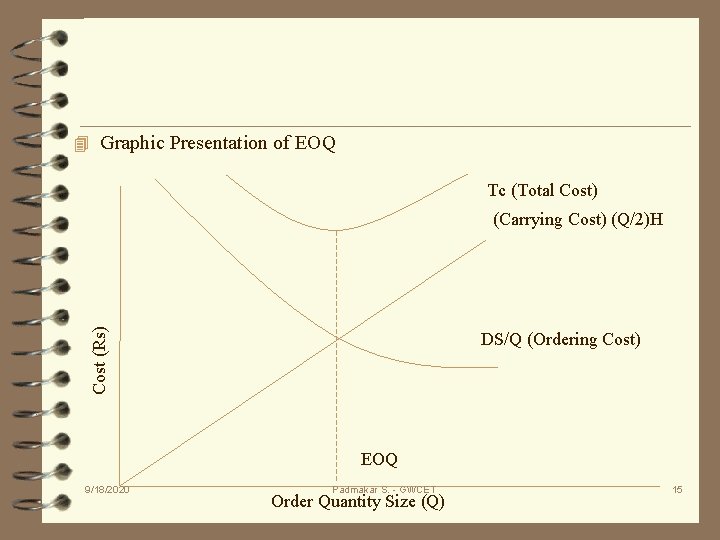
4 Graphic Presentation of EOQ Tc (Total Cost) Cost (Rs) (Carrying Cost) (Q/2)H DS/Q (Ordering Cost) EOQ 9/18/2020 Padmakar S. - GWCET Order Quantity Size (Q) 15
Assumptions: 4 Demand for the product is constant and uniform throughout 4 4 4 the period Lead time (time from ordering to receipt) constant Price per unit of product is constant Inventory holding cost is based on average inventory Ordering costs are constant All demands for the product will be satisfied (no back orders are allowed) 9/18/2020 Padmakar S. - GWCET 16
Economic Order Quantity (EOQ): 4 It is 9/18/2020 Padmakar S. - GWCET 17
Economic Order Quantity (EOQ): 4 It 9/18/2020 Padmakar S. - GWCET 18
- Slides: 18