
MBA 691 Business Ethics and Corporations Should companys
MBA 691 Business Ethics and Corporations Should company’s adopt social policies
Ethics and Morality n Morality is not necessarily based on Religion – although we draw beliefs from many sources; culture, religion, upbringing, personal feelings etc. • For Philosophers the issue is whether or not those beliefs can be justified n Morality consists of: • • • Forming moral judgments Developing moral standards Assessing the moral worth of actions, people, policies, organizations etc. Morality: the social rules that govern and limit our conduct, especially the ultimate rules that concern right and wrong
Ethics and Morality We have more in common than you might think! We all share some basic common values and norms ( n n n re major religions and wisdom traditions in Judaism, Christianity, Islam, Hinduism, Buddhism, ect…) Respect (Treat others as you want to be treated) Follow Your Conscience (Do what you know in your heart is right) Beneficence (Be kind and don’t hurt anyone) Justice and Equality (Give everyone their fair due and keep promises) Honesty (Speak the truth and don’t hide it) Compassion (Show care for others, especially closest ties) n n n n Generosity (Give to the poor without thinking of return) Peace (Live in harmony with others) Unity of Humanity (Think of everyone as one big family) Stewardship (Look after the earth and take only what you need) Sharing (Share your wealth) Magnanimity (Be great and noble of heart and mind) Moderation (Practice self control)
What is the Role of Management n What is the responsibility of Management? and to Whom?
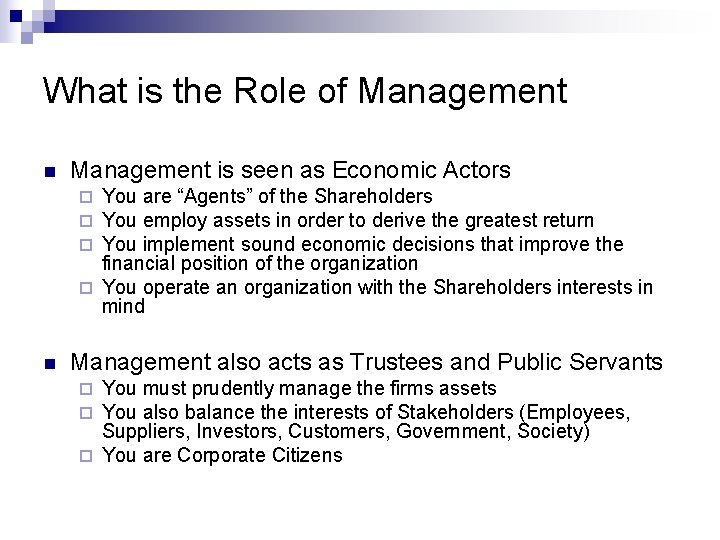
What is the Role of Management n Management is seen as Economic Actors You are “Agents” of the Shareholders You employ assets in order to derive the greatest return You implement sound economic decisions that improve the financial position of the organization ¨ You operate an organization with the Shareholders interests in mind ¨ ¨ ¨ n Management also acts as Trustees and Public Servants You must prudently manage the firms assets You also balance the interests of Stakeholders (Employees, Suppliers, Investors, Customers, Government, Society) ¨ You are Corporate Citizens ¨ ¨
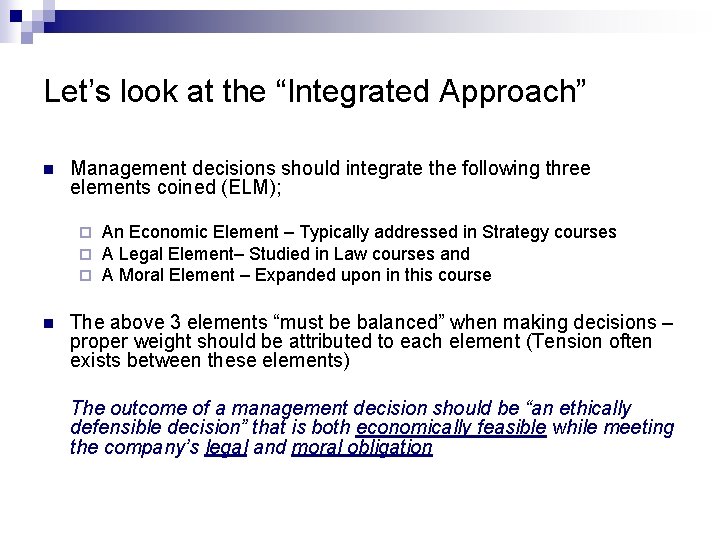
Let’s look at the “Integrated Approach” n Management decisions should integrate the following three elements coined (ELM); ¨ ¨ ¨ n An Economic Element – Typically addressed in Strategy courses A Legal Element– Studied in Law courses and A Moral Element – Expanded upon in this course The above 3 elements “must be balanced” when making decisions – proper weight should be attributed to each element (Tension often exists between these elements) The outcome of a management decision should be “an ethically defensible decision” that is both economically feasible while meeting the company’s legal and moral obligation
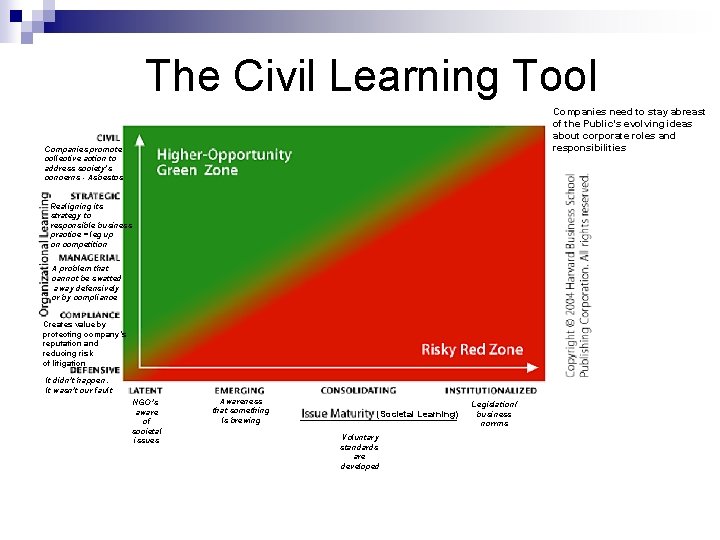
The Civil Learning Tool Companies need to stay abreast of the Public’s evolving ideas about corporate roles and responsibilities Companies promote collective action to address society’s concerns - Asbestos Realigning its strategy to responsible business practice = leg up on competition A problem that cannot be swatted away defensively or by compliance Creates value by protecting company’s reputation and reducing risk of litigation It didn’t happen. It wasn’t our fault NGO’s aware of societal issues Awareness that something Is brewing (Societal Learning) Voluntary standards are developed Legislation/ business norrms
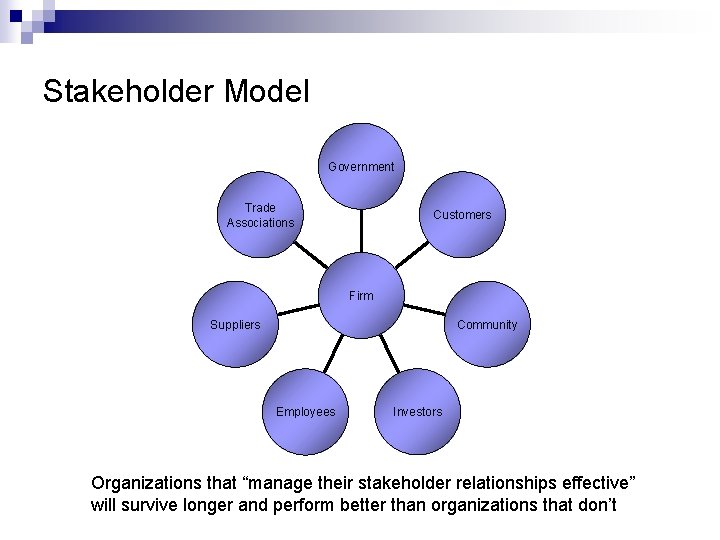
Stakeholder Model Government Trade Associations Customers Firm Community Suppliers Employees Investors Organizations that “manage their stakeholder relationships effective” will survive longer and perform better than organizations that don’t
“Stockholder Perspective” n The Shareholder Value Perspective ¨ n n n emphasizes profitability over responsibility Organizational success is measured by things such as share price, dividends and economic profit – otherwise known as Economic Rational Society is best served by organizations pursuing self-interest and economic efficiency Employment, local communities, the environment, consumer welfare, and social developments are not organizational matters, but are better left to individuals and governments In the mind of the Stockholder: By pursuing enlightened self-interest and maintaining market-based relationships between the corporation and all stakeholders, pursuing maximal value for the shareholders “will result” in societal wealth being “maximized”.
“Stakeholder Perspective” n The Stakeholder Value Perspective ¨ n n emphasizes responsibility over profitability Social responsibility is an organizational matter and society is best served by pursuing joint-interests and economic symbiosis A company is not an instrument of shareholders, but a coalition between various resource suppliers, with the intention of increasing their common wealth. In the mind of the Stakeholder: Due to the need of having strongly motivated employees and nurturing high levels of trust with all parties surrounding the organization, the pursuit of joint interests of all stakeholders “will result” in societal wealth being “maximized”.

Ownership n Question: Do shareholders own the company? Ø Give reasons why you think shareholders “own” the company Ø Give reasons why you think shareholders “do not own” the company
Stockholders - Do shareholders own the company n The “Yes” Camp WHY? Implied Risk: Value rises and falls with the firm – as the demand for the stock increases so does its share price and vis versa ¨ Social responsibility involves imposing a tax on stockholders of the company – either dividend income and or capital gain. Assumption = If I’m paying tax, I must own it. ¨ n The “No” Camp WHY? Do not own assets – i. e. you do not own the employees ¨ A corporation is an entity all on its own – lives beyond its shareholders – i. e. Coca Cola (1886) ¨ Shareholders are concerned with the future revenue generating stream of the company not it’s physical assets (in most cases) ¨ Property: Institutional investors, unknowledgeable investors, do not have input into the decision making process on a day to day basis. ¨

What about Stakeholders! Ø Question: Do stakeholders have a legitimate claim to influence corporate decision making? Ø Give reasons why you think stakeholders have a legitimate claim to influence corporate decision making Ø Give reasons why you think stakeholders “do not” have a legitimate claim to influence corporate decision making
Stakeholders - Do stakeholders have a legitimate claim to influence corporate decision making? n The “Yes” Camp WHY? Stakeholders have an implied interest as they provide the various resources needed to run a business (i. e. investment funds, labor, raw materials, sales, Gov. subsidies etc. ) ¨ As the economic bases of our society, “corporations” must act with these interests in mind ¨ Taxation argument is weak ¨ n n Equity not profit is key Investors have a conscience – maximizing profits is not always the best choice n The “No” Camp WHY? Without a strong emphasis toward profits, businesses will be at a disadvantage in comparison to competition ¨ It is difficult to continually evaluate the impact of decision making on each stakeholder and decide on trade-offs – what may be good for certain suppliers may not be good for the community such as depleting one’s own resource base (Fort Mc. Murray) ¨
Stockholder vs Stakeholder Shareholders are stakeholders in a corporation, but stakeholders are not always shareholders. A shareholder owns part of a company through stock ownership, while a stakeholder is interested in the performance of a company for reasons other than just stock appreciation.
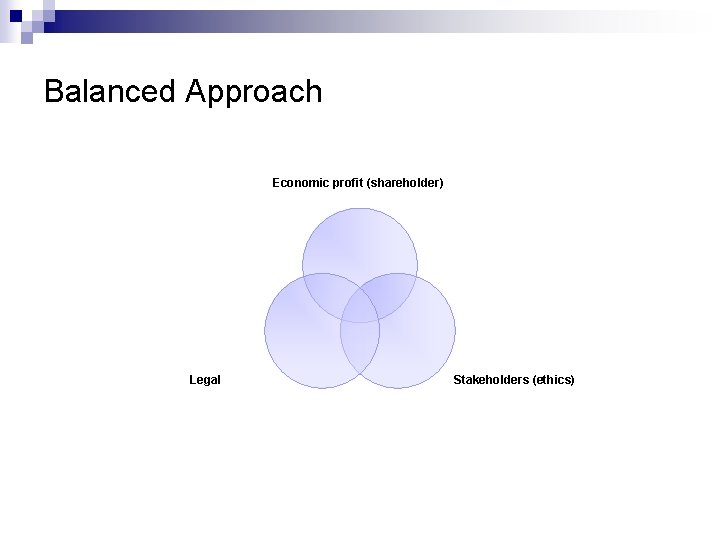
Balanced Approach Economic profit (shareholder) Legal Stakeholders (ethics)
Balanced Approach n Corporate Responsibility – How should you perform as a corporate executive: ¨ ¨ ¨ Operate the corporation on a level higher than the law requires Chose options that are less profitable but more socially desirable (meeting a threshold of economic profit) Contribute to non-profit institutions Provide benefits to employees and improve the workplace Use corporate resources to address major social problems
Who Are Some of the Best Corporate Citizen
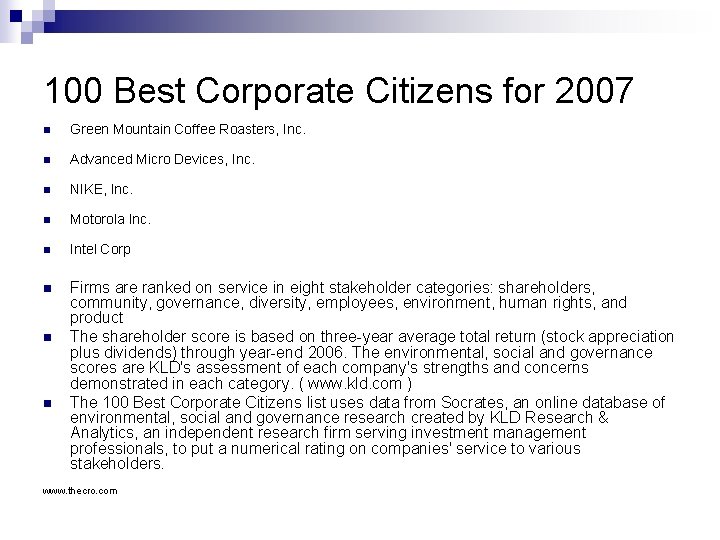
100 Best Corporate Citizens for 2007 n Green Mountain Coffee Roasters, Inc. n Advanced Micro Devices, Inc. n NIKE, Inc. n Motorola Inc. n Intel Corp n Firms are ranked on service in eight stakeholder categories: shareholders, community, governance, diversity, employees, environment, human rights, and product The shareholder score is based on three-year average total return (stock appreciation plus dividends) through year-end 2006. The environmental, social and governance scores are KLD's assessment of each company's strengths and concerns demonstrated in each category. ( www. kld. com ) The 100 Best Corporate Citizens list uses data from Socrates, an online database of environmental, social and governance research created by KLD Research & Analytics, an independent research firm serving investment management professionals, to put a numerical rating on companies' service to various stakeholders. n n www. thecro. com
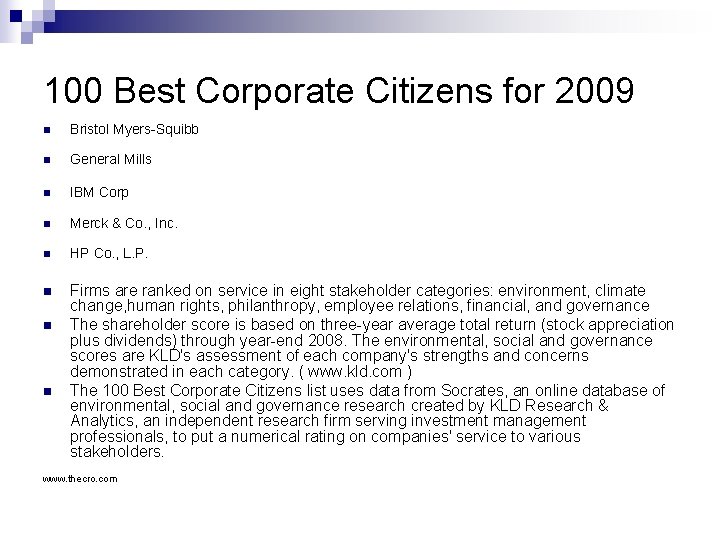
100 Best Corporate Citizens for 2009 n Bristol Myers-Squibb n General Mills n IBM Corp n Merck & Co. , Inc. n HP Co. , L. P. n Firms are ranked on service in eight stakeholder categories: environment, climate change, human rights, philanthropy, employee relations, financial, and governance The shareholder score is based on three-year average total return (stock appreciation plus dividends) through year-end 2008. The environmental, social and governance scores are KLD's assessment of each company's strengths and concerns demonstrated in each category. ( www. kld. com ) The 100 Best Corporate Citizens list uses data from Socrates, an online database of environmental, social and governance research created by KLD Research & Analytics, an independent research firm serving investment management professionals, to put a numerical rating on companies' service to various stakeholders. n n www. thecro. com
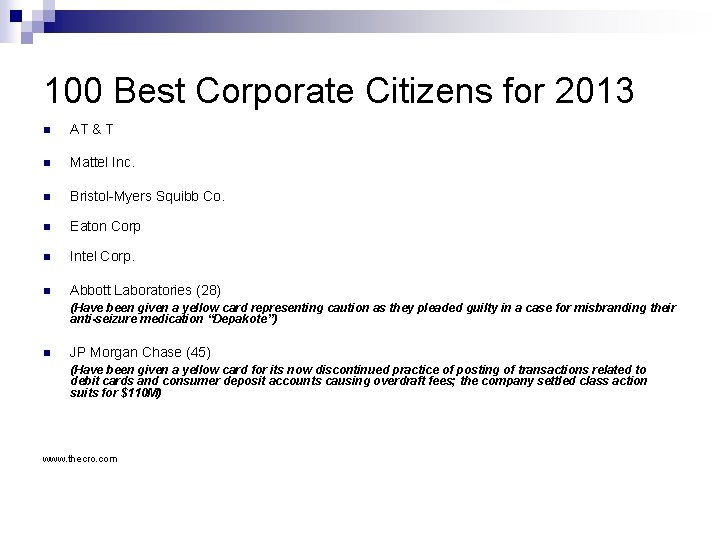
100 Best Corporate Citizens for 2013 n AT & T n Mattel Inc. n Bristol-Myers Squibb Co. n Eaton Corp n Intel Corp. n Abbott Laboratories (28) (Have been given a yellow card representing caution as they pleaded guilty in a case for misbranding their anti-seizure medication “Depakote”) n JP Morgan Chase (45) (Have been given a yellow card for its now discontinued practice of posting of transactions related to debit cards and consumer deposit accounts causing overdraft fees; the company settled class action suits for $110 M) www. thecro. com
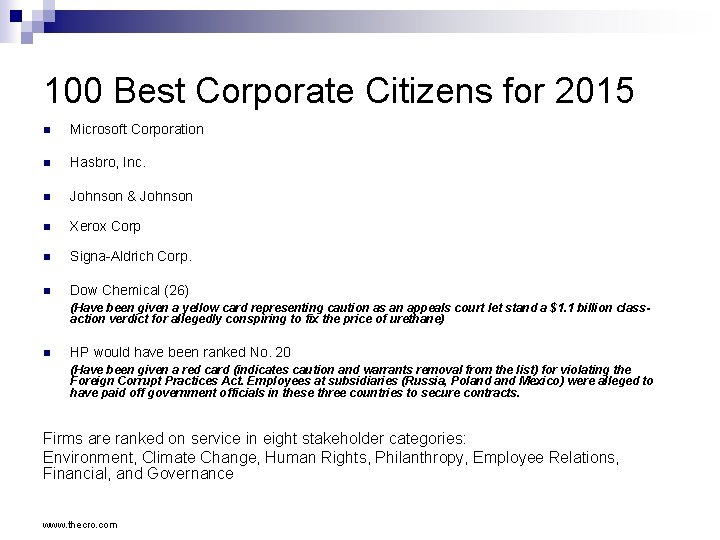
100 Best Corporate Citizens for 2015 n Microsoft Corporation n Hasbro, Inc. n Johnson & Johnson n Xerox Corp n Signa-Aldrich Corp. n Dow Chemical (26) (Have been given a yellow card representing caution as an appeals court let stand a $1. 1 billion classaction verdict for allegedly conspiring to fix the price of urethane) n HP would have been ranked No. 20 (Have been given a red card (indicates caution and warrants removal from the list) for violating the Foreign Corrupt Practices Act. Employees at subsidiaries (Russia, Poland Mexico) were alleged to have paid off government officials in these three countries to secure contracts. Firms are ranked on service in eight stakeholder categories: Environment, Climate Change, Human Rights, Philanthropy, Employee Relations, Financial, and Governance www. thecro. com

Beech-Nut Nutrition
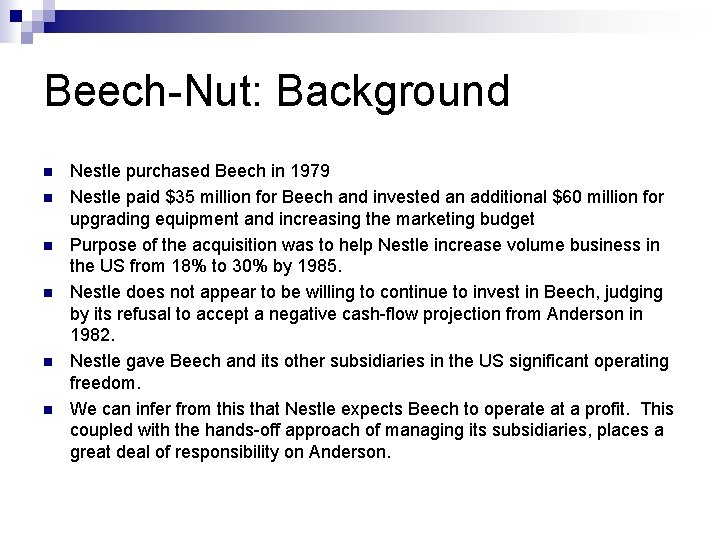
Beech-Nut: Background n n n Nestle purchased Beech in 1979 Nestle paid $35 million for Beech and invested an additional $60 million for upgrading equipment and increasing the marketing budget Purpose of the acquisition was to help Nestle increase volume business in the US from 18% to 30% by 1985. Nestle does not appear to be willing to continue to invest in Beech, judging by its refusal to accept a negative cash-flow projection from Anderson in 1982. Nestle gave Beech and its other subsidiaries in the US significant operating freedom. We can infer from this that Nestle expects Beech to operate at a profit. This coupled with the hands-off approach of managing its subsidiaries, places a great deal of responsibility on Anderson.
Beech-Nut: Identify Key Issues associated with each of the following 3 Elements of the Integrated Approach Theory: Economic Elements: Legal Elements: Elements associated with the Stakeholders (Moral):
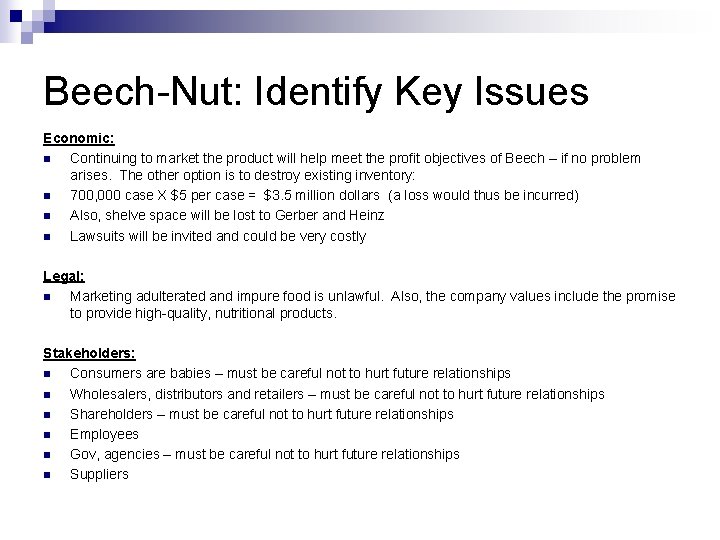
Beech-Nut: Identify Key Issues Economic: n Continuing to market the product will help meet the profit objectives of Beech – if no problem arises. The other option is to destroy existing inventory: n 700, 000 case X $5 per case = $3. 5 million dollars (a loss would thus be incurred) n Also, shelve space will be lost to Gerber and Heinz n Lawsuits will be invited and could be very costly Legal: n Marketing adulterated and impure food is unlawful. Also, the company values include the promise to provide high-quality, nutritional products. Stakeholders: n Consumers are babies – must be careful not to hurt future relationships n Wholesalers, distributors and retailers – must be careful not to hurt future relationships n Shareholders – must be careful not to hurt future relationships n Employees n Gov, agencies – must be careful not to hurt future relationships n Suppliers

Beech-Nut Nutrition Corp. n If you were Andersen (CEO), what would be your assessment of the situation on Monday morning June 28? If you were Storer (VP Operations), what would be ……. . ? n How difficult will it be for Andersen to handle this situation well? What are the sources of difficulty and who is responsible for them?
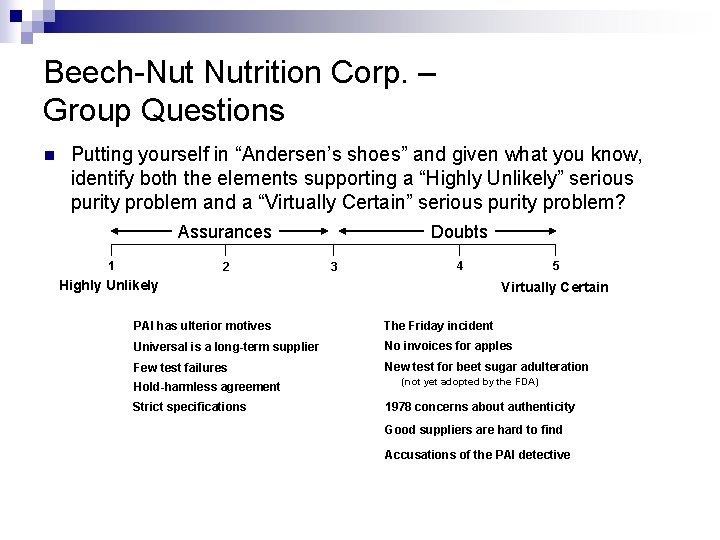
Beech-Nut Nutrition Corp. – Group Questions n Putting yourself in “Andersen’s shoes” and given what you know, identify both the elements supporting a “Highly Unlikely” serious purity problem and a “Virtually Certain” serious purity problem? Assurances 1 2 Doubts 3 4 Highly Unlikely 5 Virtually Certain PAI has ulterior motives The Friday incident Universal is a long-term supplier No invoices for apples Few test failures New test for beet sugar adulteration Hold-harmless agreement Strict specifications (not yet adopted by the FDA) 1978 concerns about authenticity Good suppliers are hard to find Accusations of the PAI detective
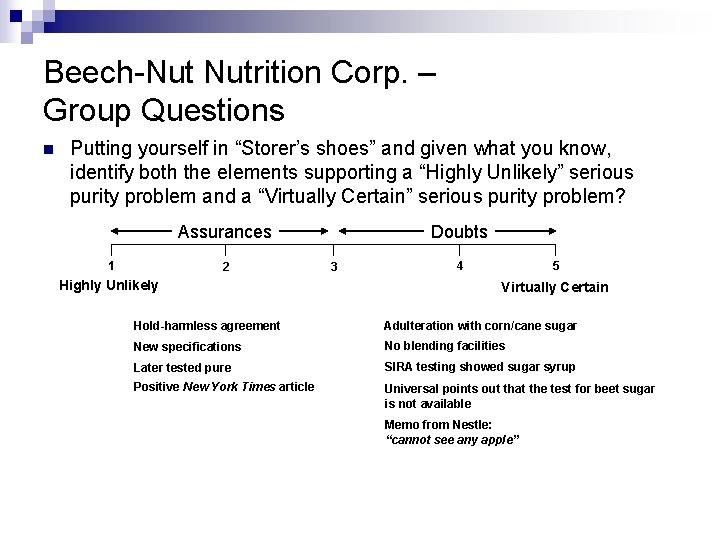
Beech-Nut Nutrition Corp. – Group Questions n Putting yourself in “Storer’s shoes” and given what you know, identify both the elements supporting a “Highly Unlikely” serious purity problem and a “Virtually Certain” serious purity problem? Assurances 1 2 Highly Unlikely Doubts 3 4 5 Virtually Certain Hold-harmless agreement Adulteration with corn/cane sugar New specifications No blending facilities Later tested pure SIRA testing showed sugar syrup Positive New York Times article Universal points out that the test for beet sugar is not available Memo from Nestle: “cannot see any apple”
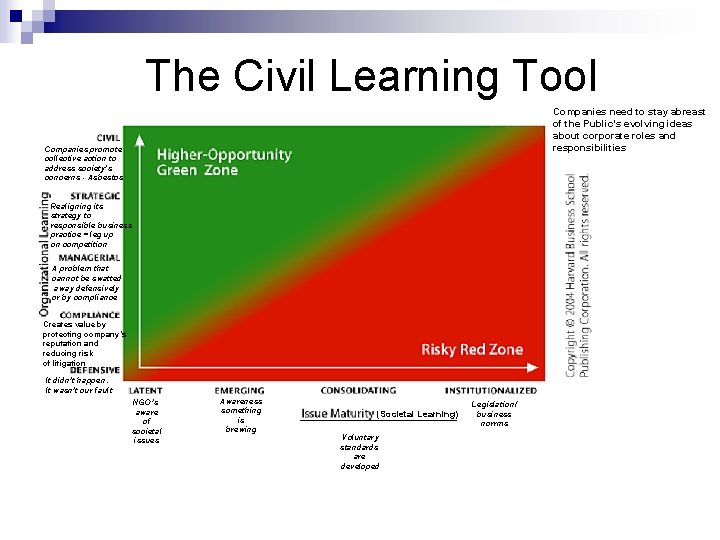
The Civil Learning Tool Companies need to stay abreast of the Public’s evolving ideas about corporate roles and responsibilities Companies promote collective action to address society’s concerns - Asbestos Realigning its strategy to responsible business practice = leg up on competition A problem that cannot be swatted away defensively or by compliance Creates value by protecting company’s reputation and reducing risk of litigation It didn’t happen. It wasn’t our fault NGO’s aware of societal issues Awareness something is brewing (Societal Learning) Voluntary standards are developed Legislation/ business norrms
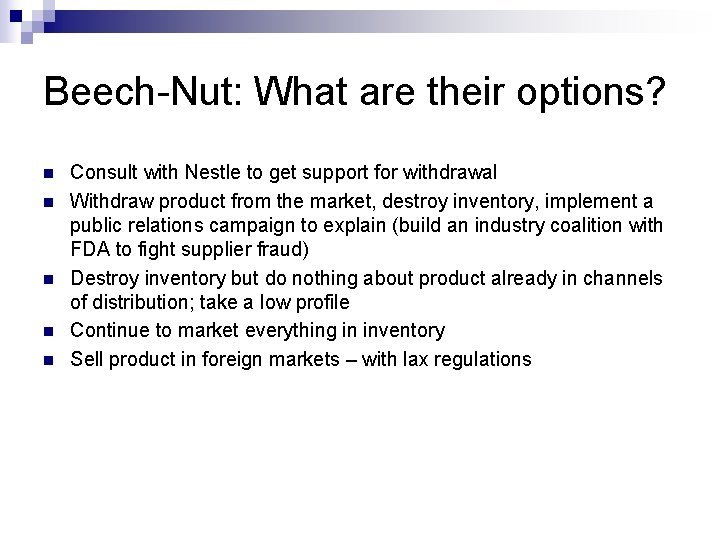
Beech-Nut: What are their options? n n n Consult with Nestle to get support for withdrawal Withdraw product from the market, destroy inventory, implement a public relations campaign to explain (build an industry coalition with FDA to fight supplier fraud) Destroy inventory but do nothing about product already in channels of distribution; take a low profile Continue to market everything in inventory Sell product in foreign markets – with lax regulations
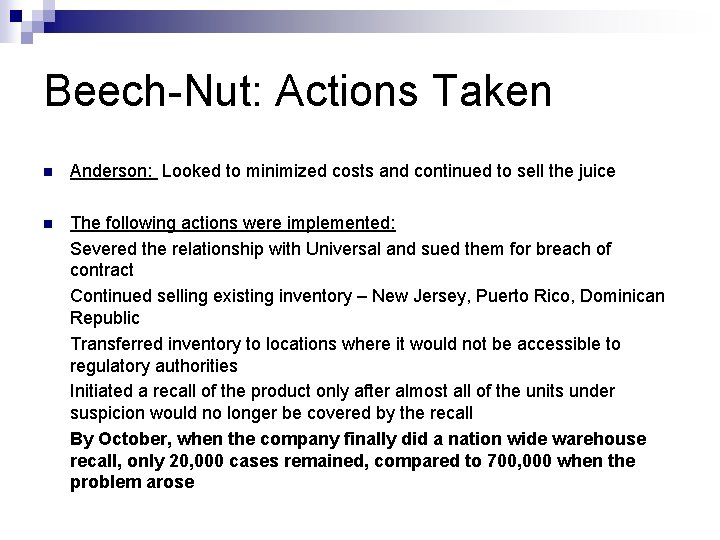
Beech-Nut: Actions Taken n Anderson: Looked to minimized costs and continued to sell the juice n The following actions were implemented: Severed the relationship with Universal and sued them for breach of contract Continued selling existing inventory – New Jersey, Puerto Rico, Dominican Republic Transferred inventory to locations where it would not be accessible to regulatory authorities Initiated a recall of the product only after almost all of the units under suspicion would no longer be covered by the recall By October, when the company finally did a nation wide warehouse recall, only 20, 000 cases remained, compared to 700, 000 when the problem arose
Beech-Nut Nutrition Corp. What Happened !!!!!
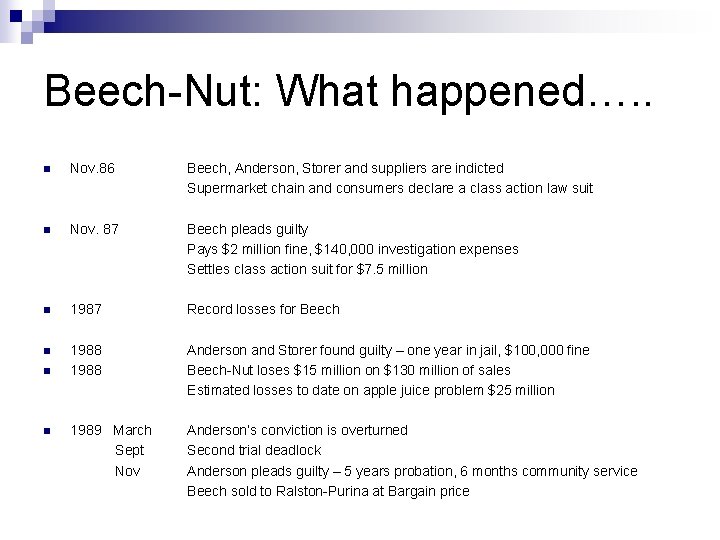
Beech-Nut: What happened…. . n Nov. 86 Beech, Anderson, Storer and suppliers are indicted Supermarket chain and consumers declare a class action law suit n Nov. 87 Beech pleads guilty Pays $2 million fine, $140, 000 investigation expenses Settles class action suit for $7. 5 million n 1987 Record losses for Beech n 1988 Anderson and Storer found guilty – one year in jail, $100, 000 fine Beech-Nut loses $15 million on $130 million of sales Estimated losses to date on apple juice problem $25 million 1989 March Sept Nov Anderson’s conviction is overturned Second trial deadlock Anderson pleads guilty – 5 years probation, 6 months community service Beech sold to Ralston-Purina at Bargain price n n
- Slides: 34