
MB MC Overview of Market Allocation The economic
MB MC Overview of Market Allocation • The economic problem • Overview of markets, supply, demand market equilibrium • Elasticity • The demand side: benefits • The Supply side: costs • Market equilibrium • Quest for profits and the invisible hand • Market failures • Alternatives and policies Copyright c 2004 by The Mc. Graw-Hill Companies, Inc. All rights reserved.
Demand: The Benefit Side of The Market MB MC
MB MC Goals for this lecture Understand needs and wants Neoclassical and alternative approaches Introduce the concept of utility Understand the Equimarginal Principle of Optimization (rational spending rule for consumers) Relationship between individual demand curves and market demand for rival goods Understand consumer surplus Copyright c 2004 by The Mc. Graw-Hill Companies, Inc. All rights reserved. Chapter 5: Demand: The Benefit Side of the Market Slide 3
MB MC The Law of Demand People do less of what they want to do as the cost of doing it rises ‘Cost’ includes all individual costs (opportunity costs), but generally ignores costs to society Is this always true? E. g. speculation, housing bubble How do we know what people want to do? Preferences revealed in the market Africans want to eat less than Americans Copyright c 2004 by The Mc. Graw-Hill Companies, Inc. All rights reserved. Chapter 5: Demand: The Benefit Side of the Market Slide 4
MB MC The Law of Demand The benefit of an activity to an individual equals the highest price (including opportunity costs) she’d be willing to pay to pursue it (i. e. , the reservation price). ‘price’ needn’t be $$ Who gets a greater benefit from food, a malnourished African or an overfed American? As the cost to individuals of an activity rises and exceeds the reservation price (for the marginal unit), less of the activity will be pursued. Copyright c 2004 by The Mc. Graw-Hill Companies, Inc. All rights reserved. Chapter 5: Demand: The Benefit Side of the Market Slide 5
MB MC Examining the assumptions Are humans only concerned about themselves? Homo economicus vs. Homo reciprocans Altruism—people make sacrifices to help others Fairness– remember the capuchin monkeys? Volunteering, charity, etc. http: //www. youtube. com/watch? feature=player_embedded& v=g 8 mynr. Rd 7 Ak Relative needs, positional wealth Copyright c 2004 by The Mc. Graw-Hill Companies, Inc. All rights reserved. Chapter 5: Demand: The Benefit Side of the Market Slide 6
MB MC Examining the assumptions NYT Headlines High Prices Help Sell All-in-One Products In Tuition Game, Popularity Rises With Price Copyright c 2004 by The Mc. Graw-Hill Companies, Inc. All rights reserved. Chapter 5: Demand: The Benefit Side of the Market Slide 7
MB MC The Origins of Demand What determines “tastes” or “preferences”? Are preferences exogenous or endogenous? Advertising- producers create demand Culture Peer Influences Keeping up with the Jones’s Biology Copyright c 2004 by The Mc. Graw-Hill Companies, Inc. All rights reserved. Chapter 5: Demand: The Benefit Side of the Market Slide 8
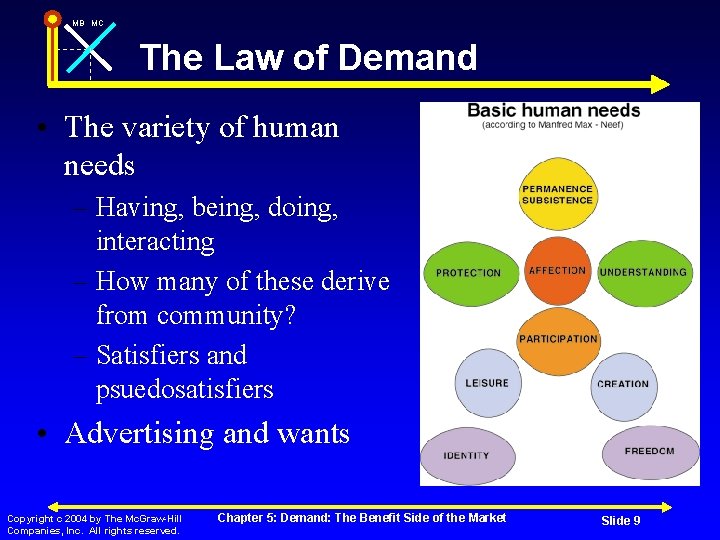
MB MC The Law of Demand • The variety of human needs – Having, being, doing, interacting – How many of these derive from community? – Satisfiers and psuedosatisfiers • Advertising and wants Copyright c 2004 by The Mc. Graw-Hill Companies, Inc. All rights reserved. Chapter 5: Demand: The Benefit Side of the Market Slide 9
MB MC Advertising and quality of life What’s a reasonable definition of quality of life? “The ability to satisfy your wants and needs” What does advertising do to your wants? What’s its impact on your ability to satisfy them? Copyright c 2004 by The Mc. Graw-Hill Companies, Inc. All rights reserved. Chapter 5: Demand: The Benefit Side of the Market Slide 10
MB MC Translating Wants into Demand How should we allocate our incomes among the various goods and services that are available? Demand = preferences (wants) weighted by income Copyright c 2004 by The Mc. Graw-Hill Companies, Inc. All rights reserved. Chapter 5: Demand: The Benefit Side of the Market Slide 11
MB MC Measuring wants: utility Utility Not directly measurable. Is this true for essential, non-substitutable resource? Revealed preferences The satisfaction people derive from their consumption (having) activities What about doing activities? Being activities? Are we just consumers, or prosumers? Citizens? Family, friends, neighbors, Social animals? Copyright c 2004 by The Mc. Graw-Hill Companies, Inc. All rights reserved. Chapter 5: Demand: The Benefit Side of the Market Slide 12
MB MC Measuring wants: utility Assumption People allocate their resources to maximize their satisfaction or total utility Copyright c 2004 by The Mc. Graw-Hill Companies, Inc. All rights reserved. Chapter 5: Demand: The Benefit Side of the Market Slide 13
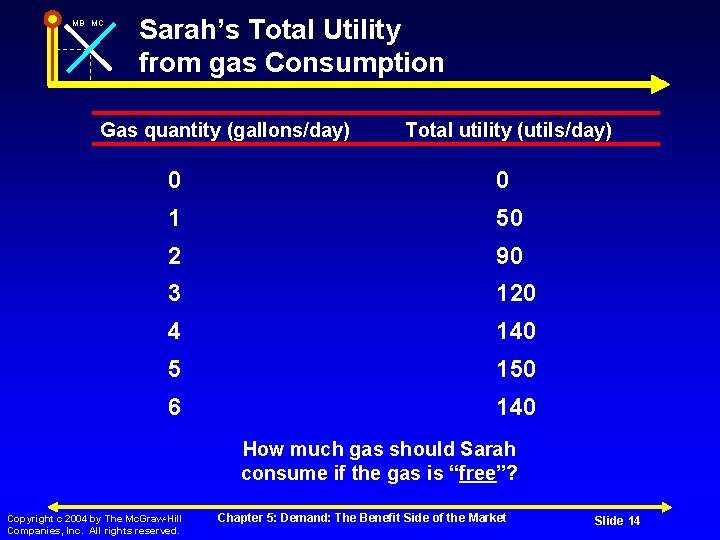
MB MC Sarah’s Total Utility from gas Consumption Gas quantity (gallons/day) Total utility (utils/day) 0 0 1 50 2 90 3 120 4 140 5 150 6 140 How much gas should Sarah consume if the gas is “free”? Copyright c 2004 by The Mc. Graw-Hill Companies, Inc. All rights reserved. Chapter 5: Demand: The Benefit Side of the Market Slide 14
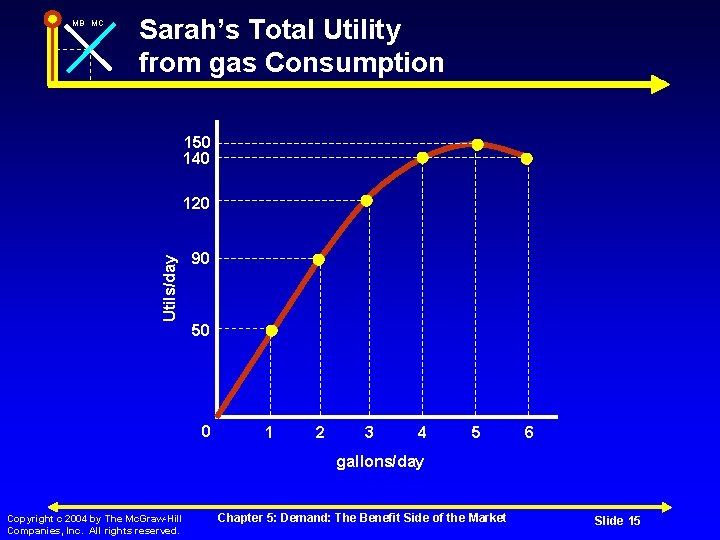
MB MC Sarah’s Total Utility from gas Consumption 150 140 Utils/day 120 90 50 0 1 2 3 4 5 6 gallons/day Copyright c 2004 by The Mc. Graw-Hill Companies, Inc. All rights reserved. Chapter 5: Demand: The Benefit Side of the Market Slide 15
MB MC Translating Wants Into Demand What do you think? Are the negative impacts of gasoline on society (e. g. oil spills, climate destabilization, air pollution, resource wars) relevant to how much she should order? Are they relevant to how much she does order? Is the time spent waiting in gas lines relevant? Copyright c 2004 by The Mc. Graw-Hill Companies, Inc. All rights reserved. Chapter 5: Demand: The Benefit Side of the Market Slide 16
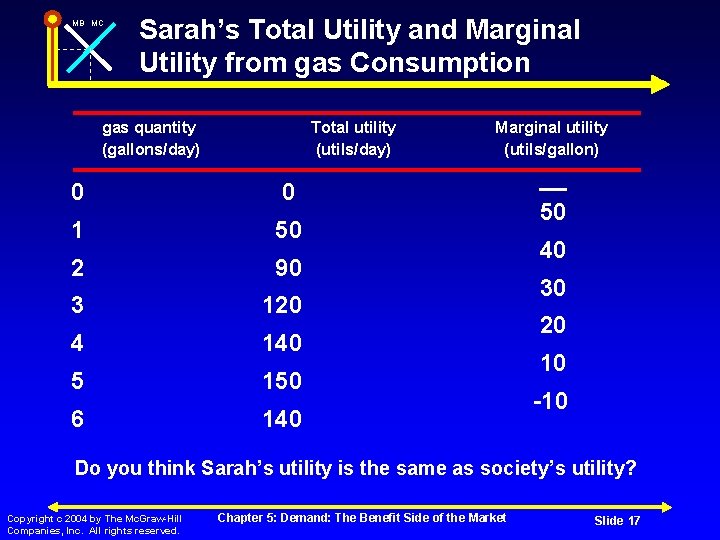
MB MC Sarah’s Total Utility and Marginal Utility from gas Consumption gas quantity (gallons/day) Total utility (utils/day) 0 0 1 50 2 90 3 120 4 140 5 150 6 140 Marginal utility (utils/gallon) __ 50 40 30 20 10 -10 Do you think Sarah’s utility is the same as society’s utility? Copyright c 2004 by The Mc. Graw-Hill Companies, Inc. All rights reserved. Chapter 5: Demand: The Benefit Side of the Market Slide 17
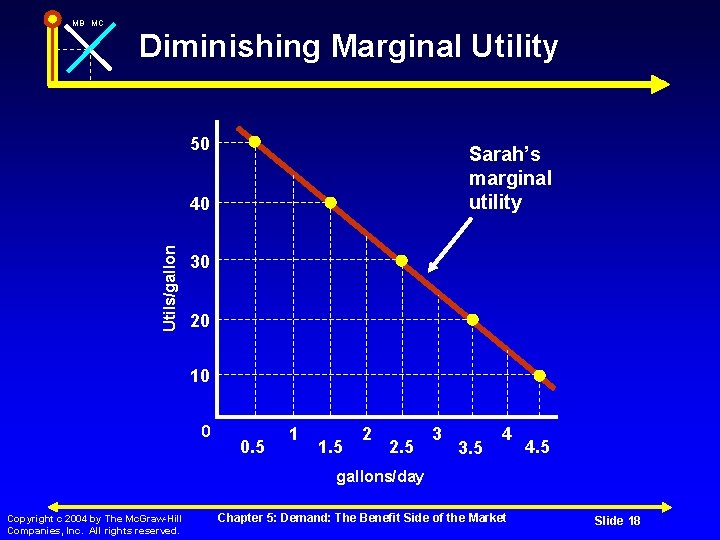
MB MC Diminishing Marginal Utility 50 Sarah’s marginal utility Utils/gallon 40 30 20 10 0 0. 5 1 1. 5 2 2. 5 3 3. 5 4 4. 5 gallons/day Copyright c 2004 by The Mc. Graw-Hill Companies, Inc. All rights reserved. Chapter 5: Demand: The Benefit Side of the Market Slide 18
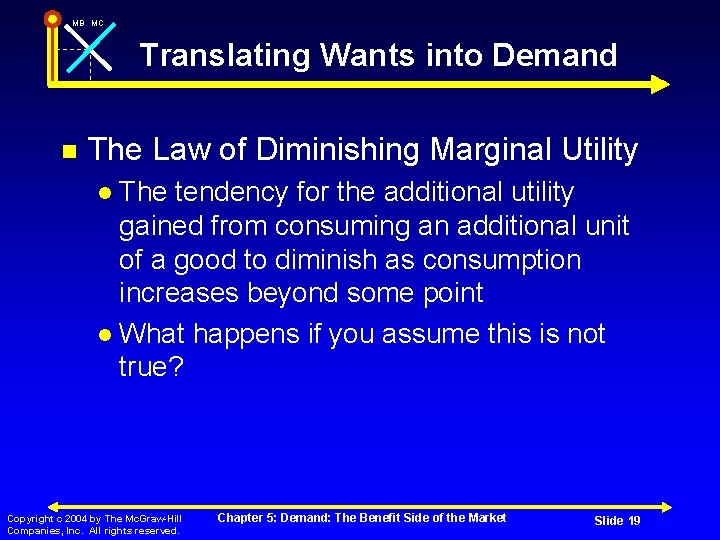
MB MC Translating Wants into Demand The Law of Diminishing Marginal Utility The tendency for the additional utility gained from consuming an additional unit of a good to diminish as consumption increases beyond some point What happens if you assume this is not true? Copyright c 2004 by The Mc. Graw-Hill Companies, Inc. All rights reserved. Chapter 5: Demand: The Benefit Side of the Market Slide 19
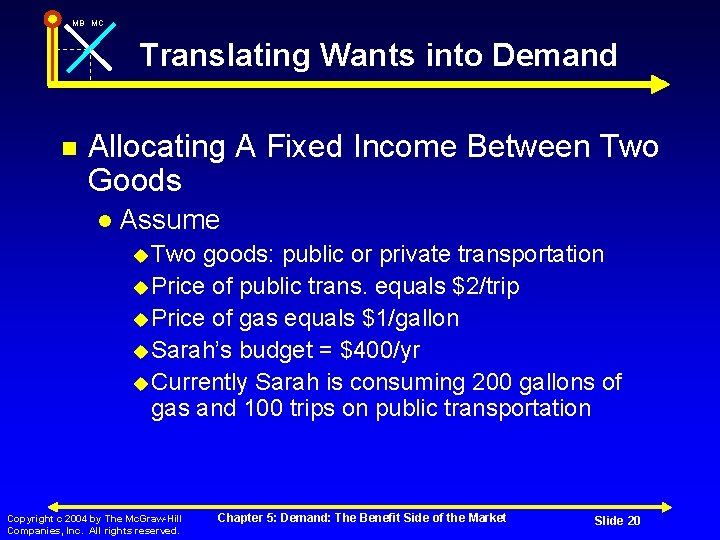
MB MC Translating Wants into Demand Allocating A Fixed Income Between Two Goods Assume Two goods: public or private transportation Price of public trans. equals $2/trip Price of gas equals $1/gallon Sarah’s budget = $400/yr Currently Sarah is consuming 200 gallons of gas and 100 trips on public transportation Copyright c 2004 by The Mc. Graw-Hill Companies, Inc. All rights reserved. Chapter 5: Demand: The Benefit Side of the Market Slide 20
MB MC Translating Wants into Demand Question Is Sarah maximizing her total utility? Copyright c 2004 by The Mc. Graw-Hill Companies, Inc. All rights reserved. Chapter 5: Demand: The Benefit Side of the Market Slide 21
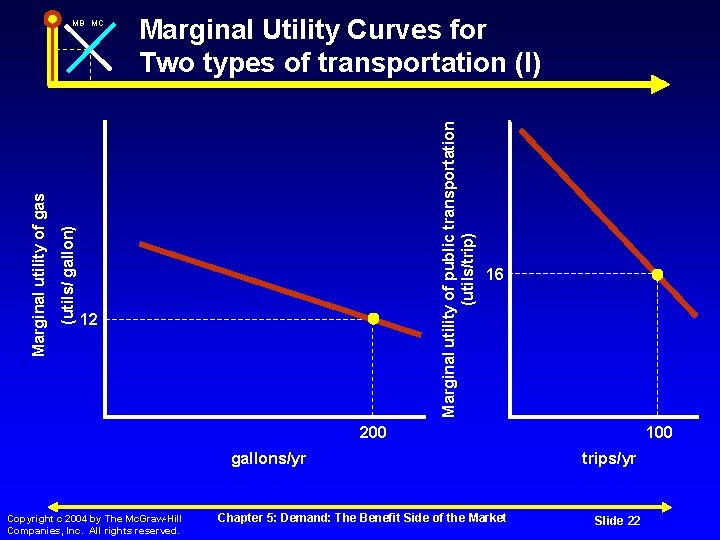
Marginal Utility Curves for Two types of transportation (I) Marginal utility of public transportation (utils/trip) (utils/ gallon) Marginal utility of gas MB MC 12 16 200 gallons/yr Copyright c 2004 by The Mc. Graw-Hill Companies, Inc. All rights reserved. Chapter 5: Demand: The Benefit Side of the Market 100 trips/yr Slide 22
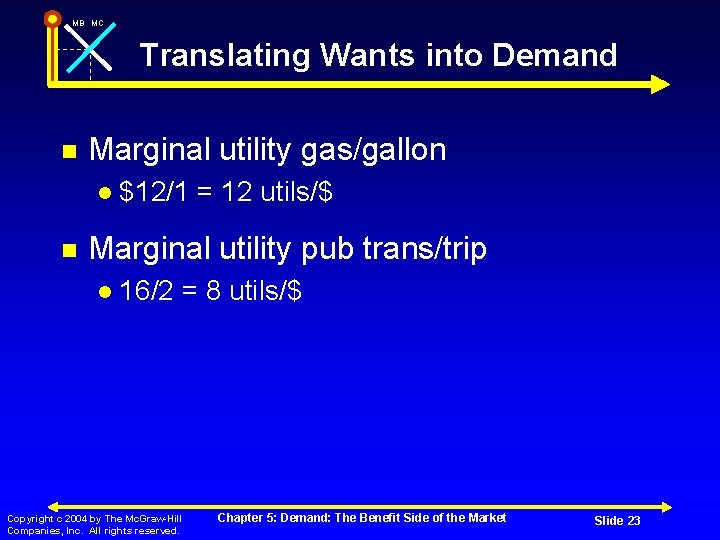
MB MC Translating Wants into Demand Marginal utility gas/gallon $12/1 = 12 utils/$ Marginal utility pub trans/trip 16/2 = 8 utils/$ Copyright c 2004 by The Mc. Graw-Hill Companies, Inc. All rights reserved. Chapter 5: Demand: The Benefit Side of the Market Slide 23
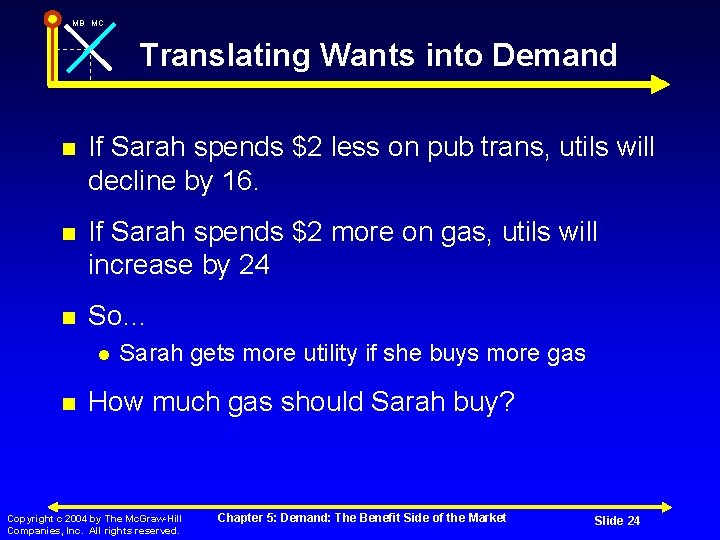
MB MC Translating Wants into Demand If Sarah spends $2 less on pub trans, utils will decline by 16. If Sarah spends $2 more on gas, utils will increase by 24 So… Sarah gets more utility if she buys more gas How much gas should Sarah buy? Copyright c 2004 by The Mc. Graw-Hill Companies, Inc. All rights reserved. Chapter 5: Demand: The Benefit Side of the Market Slide 24
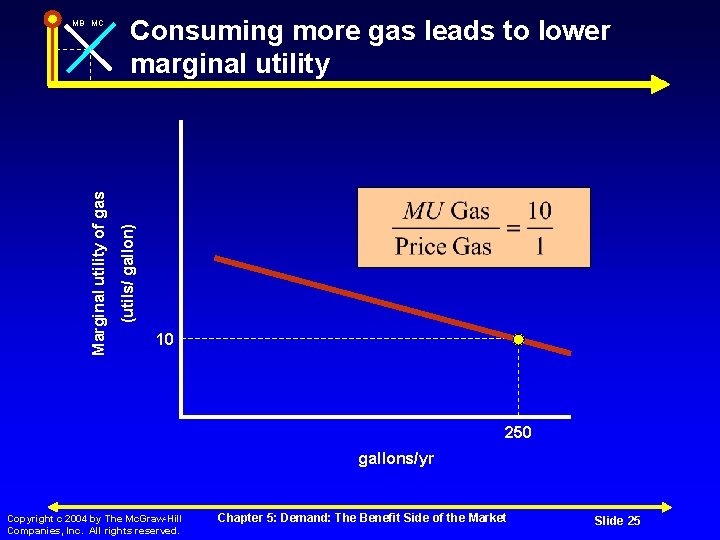
Consuming more gas leads to lower marginal utility (utils/ gallon) Marginal utility of gas MB MC 10 250 gallons/yr Copyright c 2004 by The Mc. Graw-Hill Companies, Inc. All rights reserved. Chapter 5: Demand: The Benefit Side of the Market Slide 25
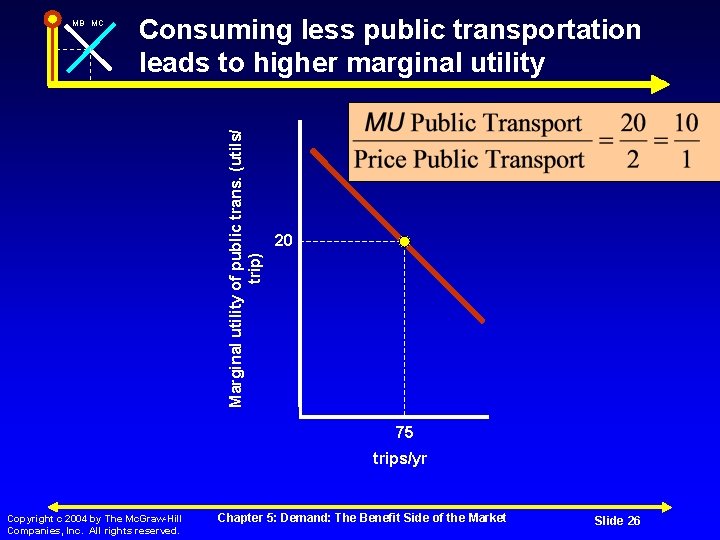
Consuming less public transportation leads to higher marginal utility Marginal utility of public trans. (utils/ trip) MB MC 20 75 trips/yr Copyright c 2004 by The Mc. Graw-Hill Companies, Inc. All rights reserved. Chapter 5: Demand: The Benefit Side of the Market Slide 26
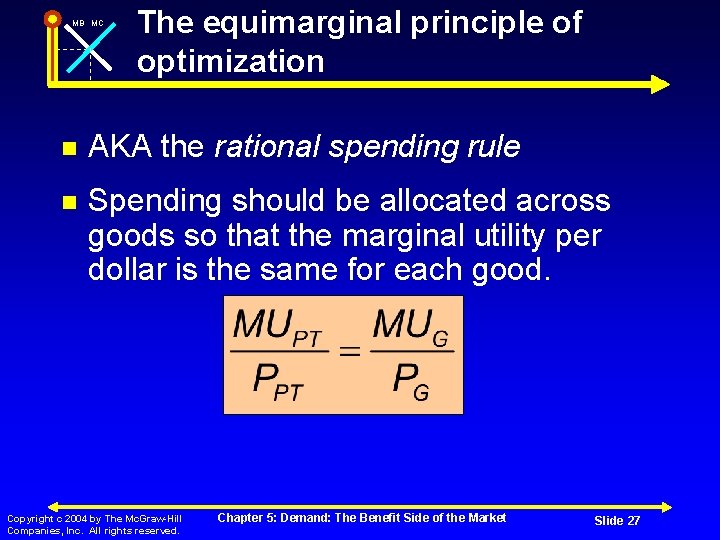
MB MC The equimarginal principle of optimization AKA the rational spending rule Spending should be allocated across goods so that the marginal utility per dollar is the same for each good. Copyright c 2004 by The Mc. Graw-Hill Companies, Inc. All rights reserved. Chapter 5: Demand: The Benefit Side of the Market Slide 27
MB MC The equimarginal principle of optimization This applies to all goods Is it an optimal outcome for society? How could we improve the outcome? What will make people consume less of a good? What would happen if we subsidized public transportation? Copyright c 2004 by The Mc. Graw-Hill Companies, Inc. All rights reserved. Chapter 5: Demand: The Benefit Side of the Market Slide 28
MB MC Translating Wants into Demand Income and Substitution Effects Revisited How should Sarah respond to a reduction in the price of public transportation? Copyright c 2004 by The Mc. Graw-Hill Companies, Inc. All rights reserved. Chapter 5: Demand: The Benefit Side of the Market Slide 29
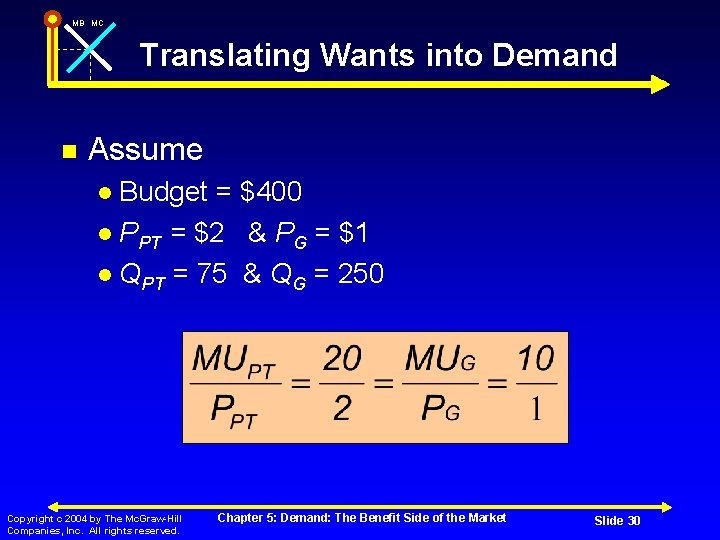
MB MC Translating Wants into Demand Assume Budget = $400 PPT = $2 & PG = $1 QPT = 75 & QG = 250 Copyright c 2004 by The Mc. Graw-Hill Companies, Inc. All rights reserved. Chapter 5: Demand: The Benefit Side of the Market Slide 30
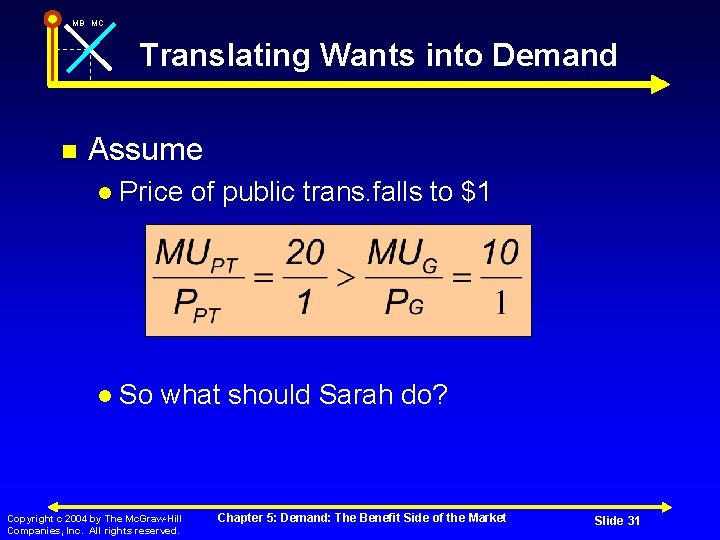
MB MC Translating Wants into Demand Assume Price So of public trans. falls to $1 what should Sarah do? Copyright c 2004 by The Mc. Graw-Hill Companies, Inc. All rights reserved. Chapter 5: Demand: The Benefit Side of the Market Slide 31
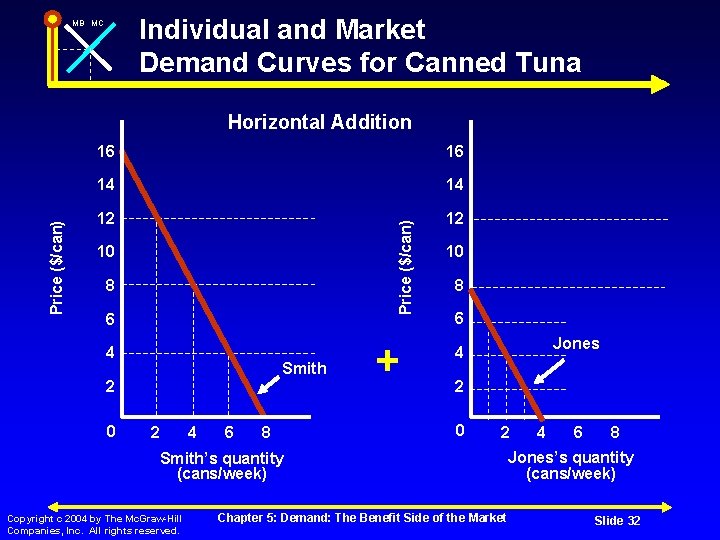
Individual and Market Demand Curves for Canned Tuna MB MC 16 16 14 14 12 12 Price ($/can) Horizontal Addition 10 8 6 4 Smith 2 0 2 4 6 8 + 10 8 6 Jones 4 2 0 2 Smith’s quantity (cans/week) Copyright c 2004 by The Mc. Graw-Hill Companies, Inc. All rights reserved. Chapter 5: Demand: The Benefit Side of the Market 4 6 8 Jones’s quantity (cans/week) Slide 32
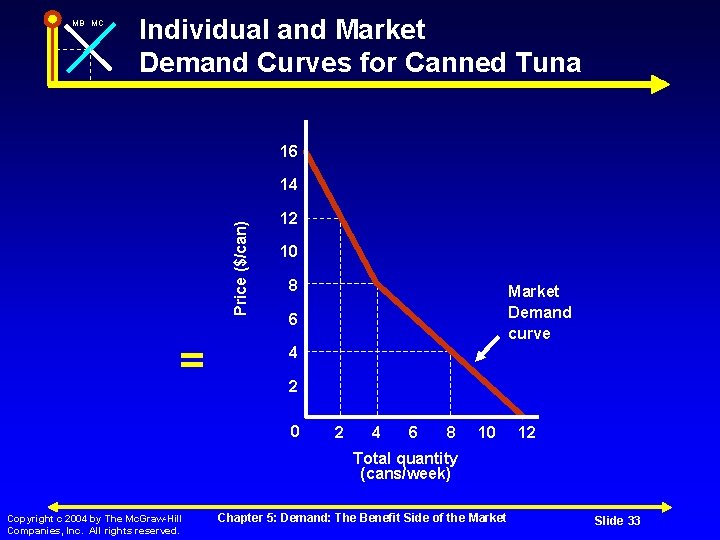
MB MC Individual and Market Demand Curves for Canned Tuna 16 Price ($/can) 14 = 12 10 8 Market Demand curve 6 4 2 0 2 4 6 8 10 12 Total quantity (cans/week) Copyright c 2004 by The Mc. Graw-Hill Companies, Inc. All rights reserved. Chapter 5: Demand: The Benefit Side of the Market Slide 33
MB MC Individual and Market Demand Curves for Food Copyright c 2004 by The Mc. Graw-Hill Companies, Inc. All rights reserved. Chapter 5: Demand: The Benefit Side of the Market Slide 34
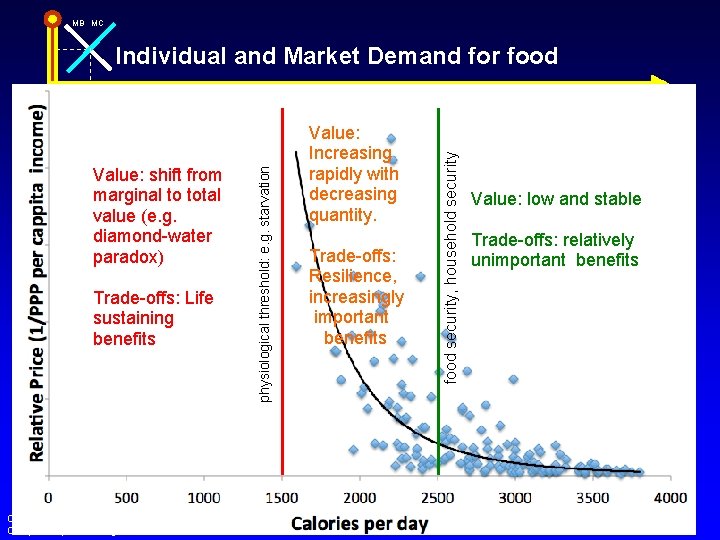
MB MC Trade-offs: Life sustaining benefits Copyright c 2004 by The Mc. Graw-Hill Companies, Inc. All rights reserved. Value: Increasing rapidly with decreasing quantity. Trade-offs: Resilience, increasingly important benefits food security, household security Value: shift from marginal to total value (e. g. diamond-water paradox) physiological threshold: e. g. starvation Individual and Market Demand for food Value: low and stable Trade-offs: relatively unimportant benefits
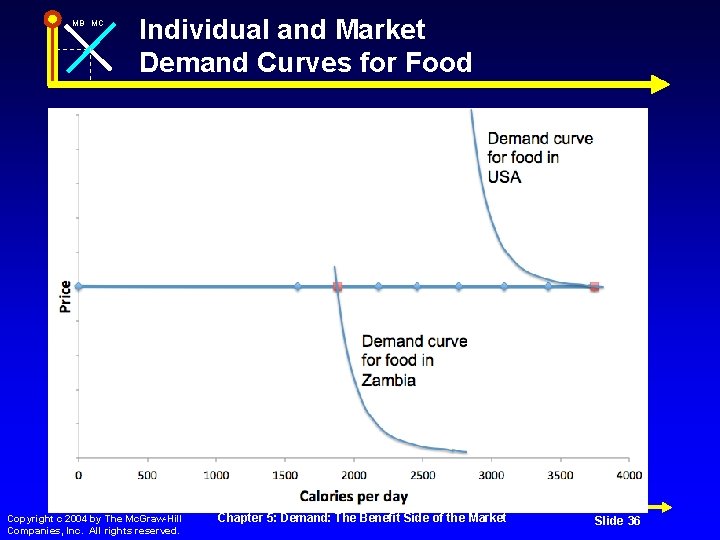
MB MC Individual and Market Demand Curves for Food Copyright c 2004 by The Mc. Graw-Hill Companies, Inc. All rights reserved. Chapter 5: Demand: The Benefit Side of the Market Slide 36
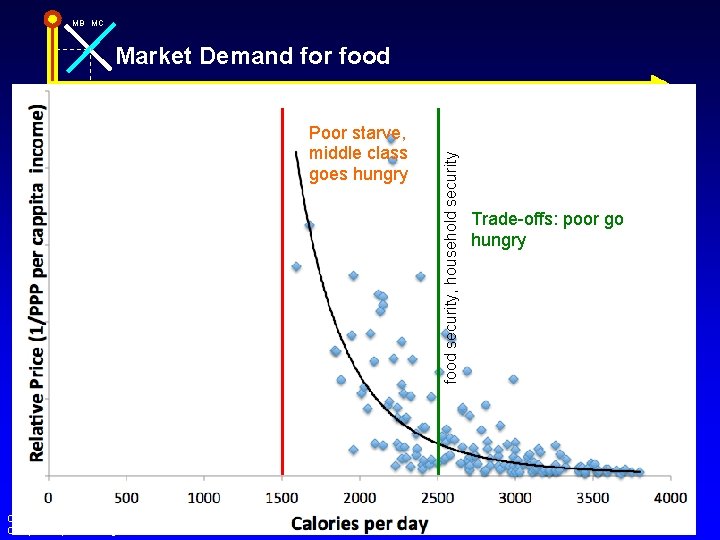
MB MC Poor starve, middle class goes hungry Copyright c 2004 by The Mc. Graw-Hill Companies, Inc. All rights reserved. food security, household security Market Demand for food Trade-offs: poor go hungry
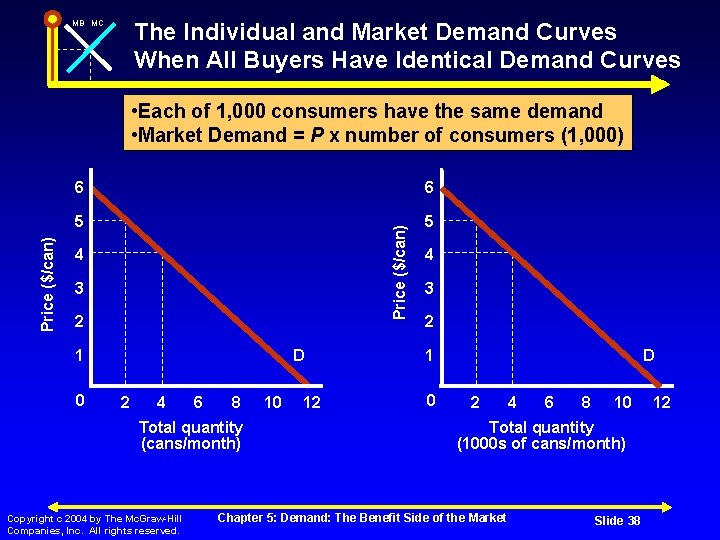
The Individual and Market Demand Curves When All Buyers Have Identical Demand Curves MB MC 6 6 5 5 Price ($/can) • Each of 1, 000 consumers have the same demand • Market Demand = P x number of consumers (1, 000) 4 3 2 1 0 D 2 4 6 8 Total quantity (cans/month) Copyright c 2004 by The Mc. Graw-Hill Companies, Inc. All rights reserved. 10 12 4 3 2 1 0 D 2 4 6 8 10 Total quantity (1000 s of cans/month) Chapter 5: Demand: The Benefit Side of the Market Slide 38 12
MB MC Demand Consumer Surplus The difference between a buyer’s reservation price for a product and the price actually paid Copyright c 2004 by The Mc. Graw-Hill Companies, Inc. All rights reserved. Chapter 5: Demand: The Benefit Side of the Market Slide 39
MB MC Demand Consumer Surplus Question How much do buyers benefit from their participation in the market for milk? Copyright c 2004 by The Mc. Graw-Hill Companies, Inc. All rights reserved. Chapter 5: Demand: The Benefit Side of the Market Slide 40
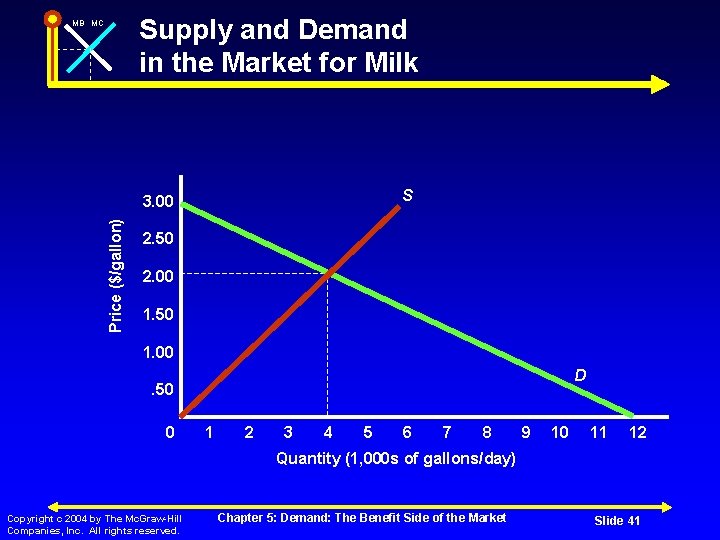
Supply and Demand in the Market for Milk MB MC S Price ($/gallon) 3. 00 2. 50 2. 00 1. 50 1. 00 D . 50 0 1 2 3 4 5 6 7 8 9 10 11 12 Quantity (1, 000 s of gallons/day) Copyright c 2004 by The Mc. Graw-Hill Companies, Inc. All rights reserved. Chapter 5: Demand: The Benefit Side of the Market Slide 41
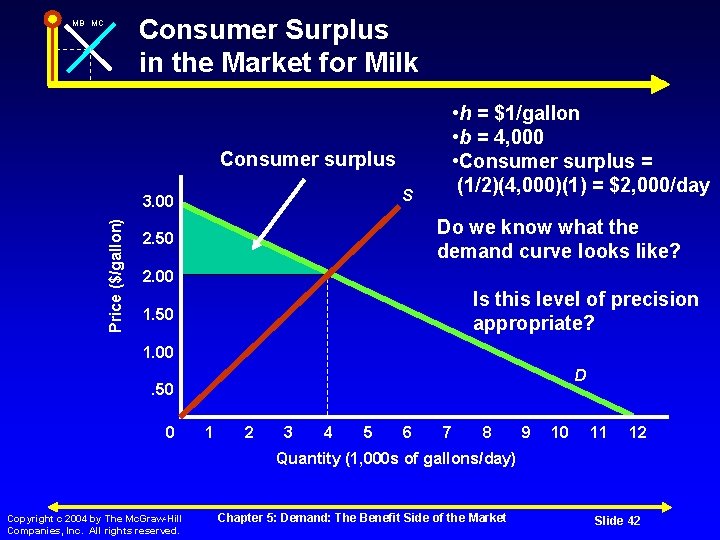
Consumer Surplus in the Market for Milk MB MC Consumer surplus S Price ($/gallon) 3. 00 • h = $1/gallon • b = 4, 000 • Consumer surplus = (1/2)(4, 000)(1) = $2, 000/day Do we know what the demand curve looks like? 2. 50 2. 00 Is this level of precision appropriate? 1. 50 1. 00 D . 50 0 1 2 3 4 5 6 7 8 9 10 11 12 Quantity (1, 000 s of gallons/day) Copyright c 2004 by The Mc. Graw-Hill Companies, Inc. All rights reserved. Chapter 5: Demand: The Benefit Side of the Market Slide 42
- Slides: 42