
May GATE Equity Webinar Mental Health 101 Crafting
May GATE Equity Webinar Mental Health 101: Crafting an Integrated System of Supports Exploring topics related to equity in graduation success The webinar will begin soon. While you wait, please share in the chat panel: Use 6 words to describe your connection to Mental Health or Social Emotional Learning Office of Superintendent of Public Instruction Chris Reykdal, State Superintendent
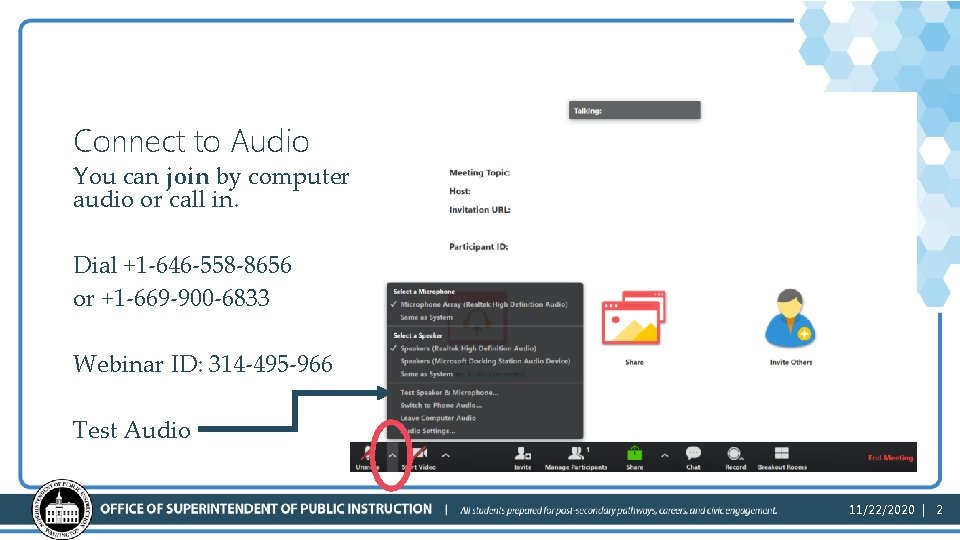
Connect to Audio You can join by computer audio or call in. Dial +1 -646 -558 -8656 or +1 -669 -900 -6833 Webinar ID: 314 -495 -966 Test Audio 11/22/2020 | 2
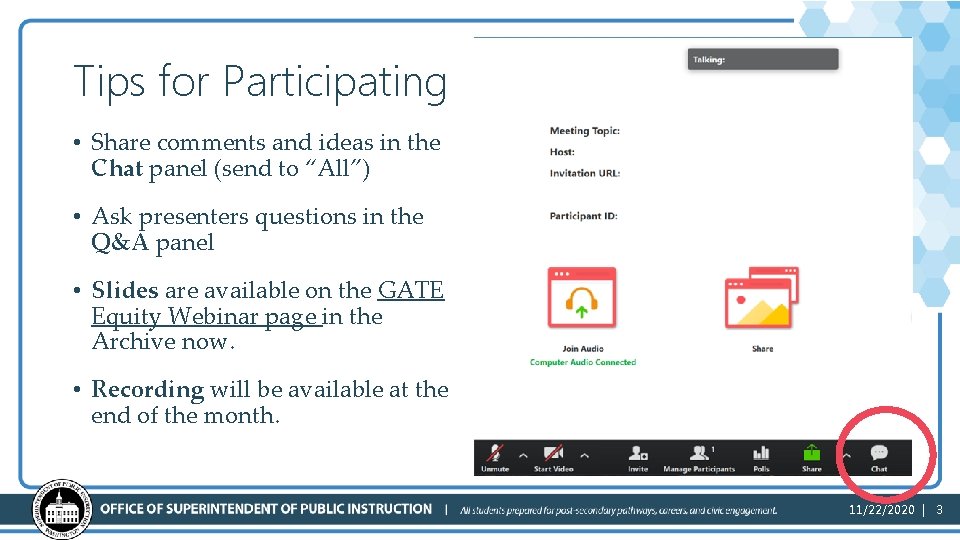
Tips for Participating • Share comments and ideas in the Chat panel (send to “All”) • Ask presenters questions in the Q&A panel • Slides are available on the GATE Equity Webinar page in the Archive now. • Recording will be available at the end of the month. 11/22/2020 | 3
Webinar Etiquette If you aren’t speaking, please mute your audio Growth mindset Focus on the topic, stay present Assume positive intent 11/22/2020 | 4
Do you need clock hours? We are offering 3 free Clock Hours for attending both of today’s Dual Credit Webinars. 1. 2. 3. 4. 5. Attend both the morning and afternoon GATE Equity Webinars Live. Complete the pre-reading assignment. Register for clock hours. Print and sign the clock hour form. Send the signed evaluation to Ronnie. Larson@k 12. wa. us. • Clock Hour Instructions and Registration Here! 11/22/2020 | 5
May GATE Equity Webinar Mental Health 101: Crafting an Integrated System of Supports Exploring topics related to equity in graduation success Office of Superintendent of Public Instruction Chris Reykdal, State Superintendent
Objectives • Get an overview of the Shape System to assess your MH supports • Learn the big supports ideas that are framing the Navigators Pilot • Learn from a district how they are implementing these supports • Get resources to get started! 11/22/2020 | 7
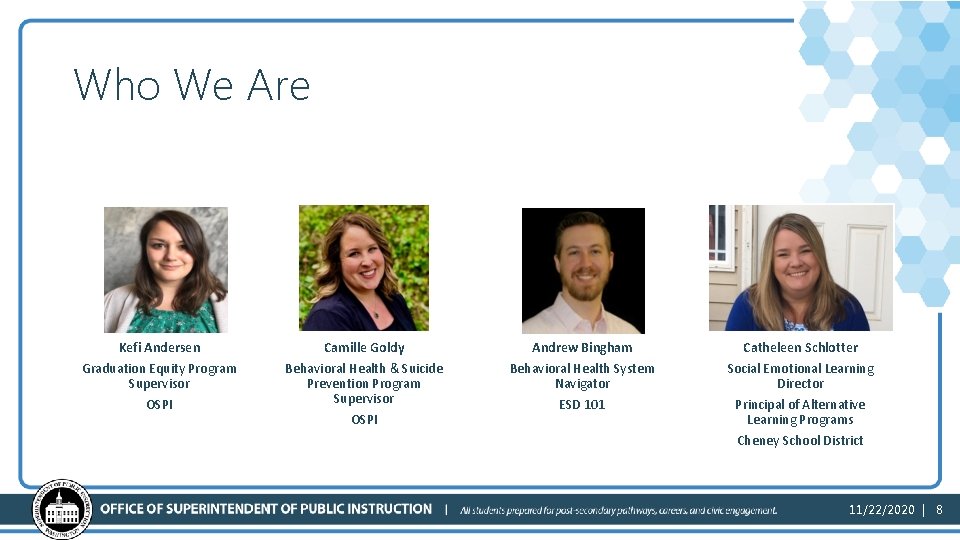
Who We Are Kefi Andersen Camille Goldy Andrew Bingham Catheleen Schlotter Graduation Equity Program Supervisor Behavioral Health & Suicide Prevention Program Supervisor OSPI Behavioral Health System Navigator Social Emotional Learning Director ESD 101 Principal of Alternative Learning Programs Cheney School District OSPI 11/22/2020 | 8
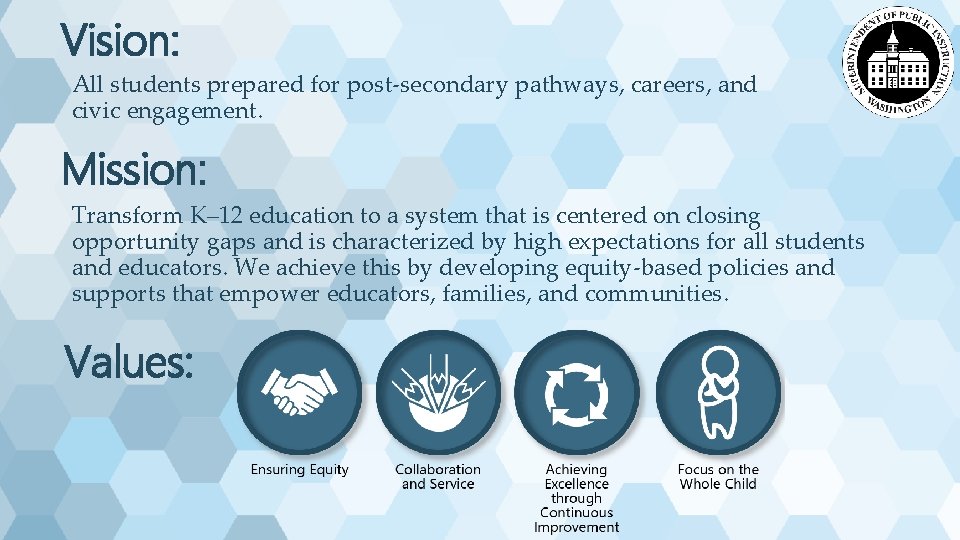
Vision: All students prepared for post-secondary pathways, careers, and civic engagement. Mission: Transform K– 12 education to a system that is centered on closing opportunity gaps and is characterized by high expectations for all students and educators. We achieve this by developing equity-based policies and supports that empower educators, families, and communities. Values:
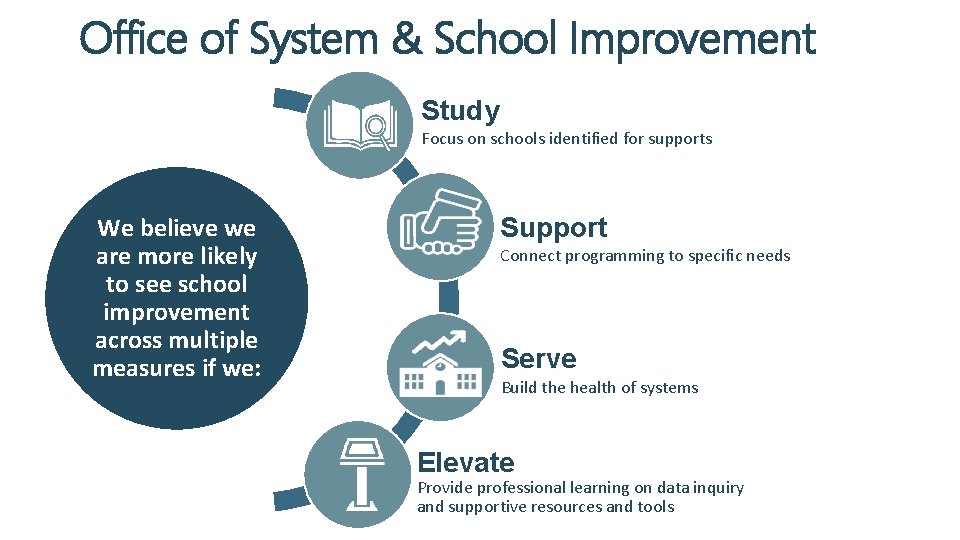
Office of System & School Improvement Study Focus on schools identified for supports We believe we are more likely to see school improvement across multiple measures if we: Support Connect programming to specific needs Serve Build the health of systems Elevate Provide professional learning on data inquiry and supportive resources and tools
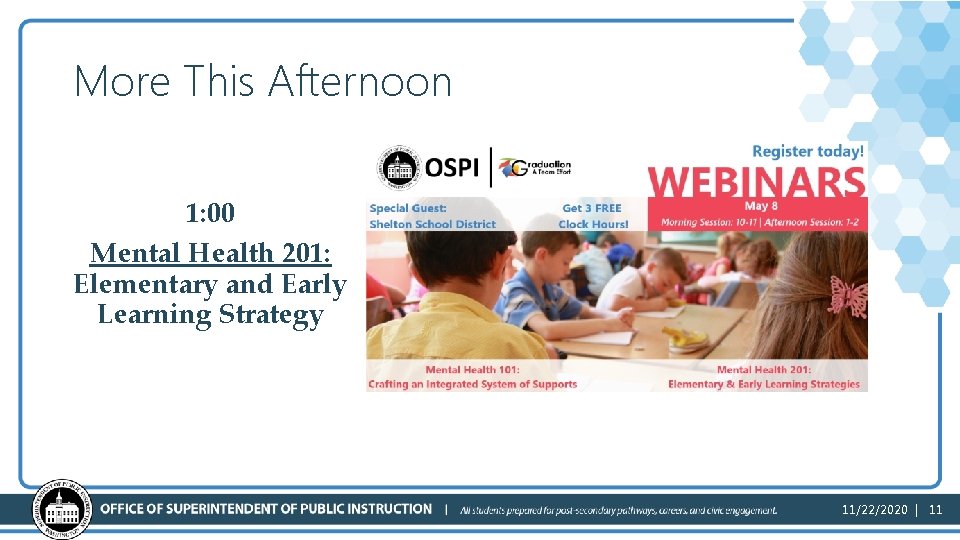
More This Afternoon 1: 00 Mental Health 201: Elementary and Early Learning Strategy 11/22/2020 | 11
Next Month May 8, 2019 Graduation 101: Supporting What’s Next 10 a. m. – 11 a. m. Graduation 201: Alternative Learning Experience 1 p. m. – 2 p. m. 11/22/2020 | 12
Questions & Polling 1 Who’s here? q Administrator q Counselor q Teacher q Parent q ESD q District q Other How familiar are you with our topic? A. Very B. Somewhat C. It’s new! 11/22/2020 | 13
OSPI & ESD Regional Behavioral Health Pilot Project
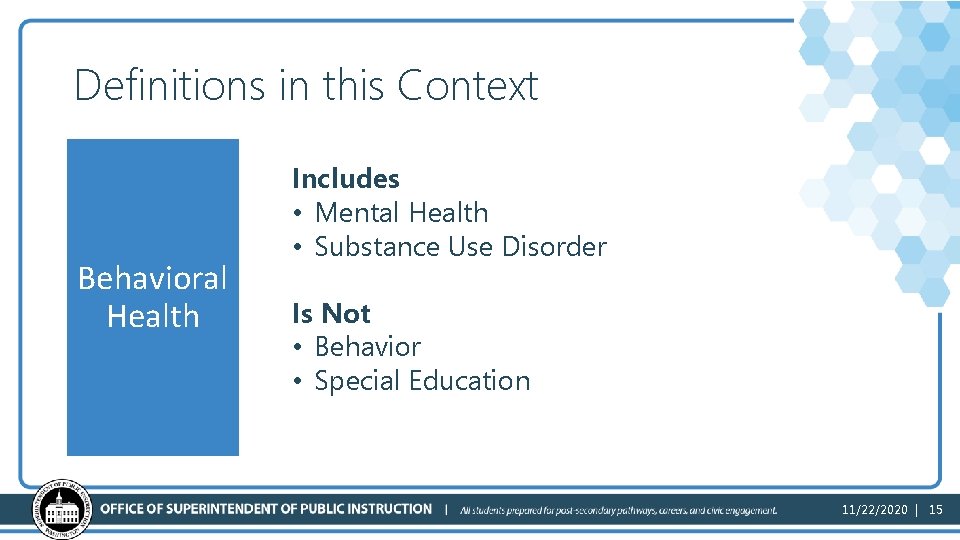
Definitions in this Context Behavioral Health Includes • Mental Health • Substance Use Disorder Is Not • Behavior • Special Education 11/22/2020 | 15
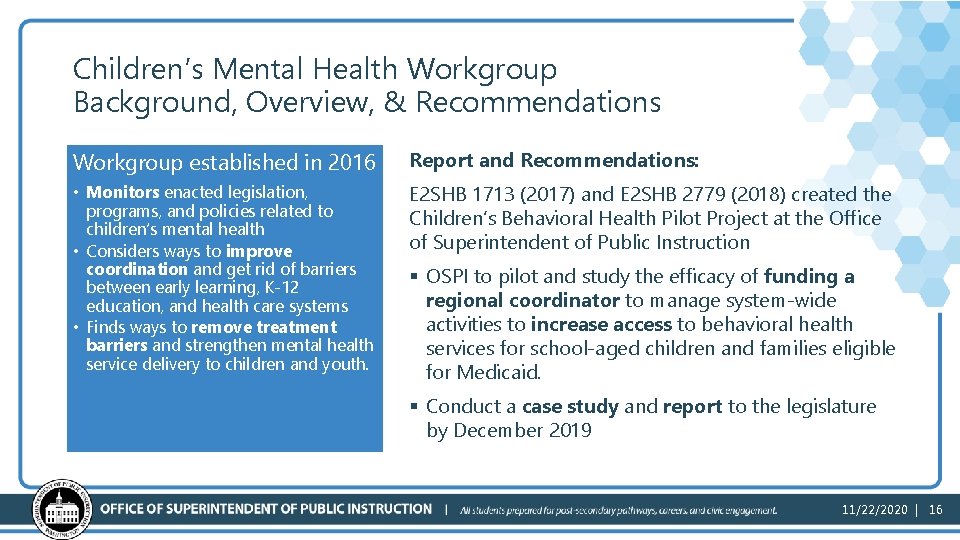
Children’s Mental Health Workgroup Background, Overview, & Recommendations Workgroup established in 2016 Report and Recommendations: • Monitors enacted legislation, programs, and policies related to children’s mental health • Considers ways to improve coordination and get rid of barriers between early learning, K-12 education, and health care systems • Finds ways to remove treatment barriers and strengthen mental health service delivery to children and youth. E 2 SHB 1713 (2017) and E 2 SHB 2779 (2018) created the Children’s Behavioral Health Pilot Project at the Office of Superintendent of Public Instruction § OSPI to pilot and study the efficacy of funding a regional coordinator to manage system-wide activities to increase access to behavioral health services for school-aged children and families eligible for Medicaid. § Conduct a case study and report to the legislature by December 2019 11/22/2020 | 16
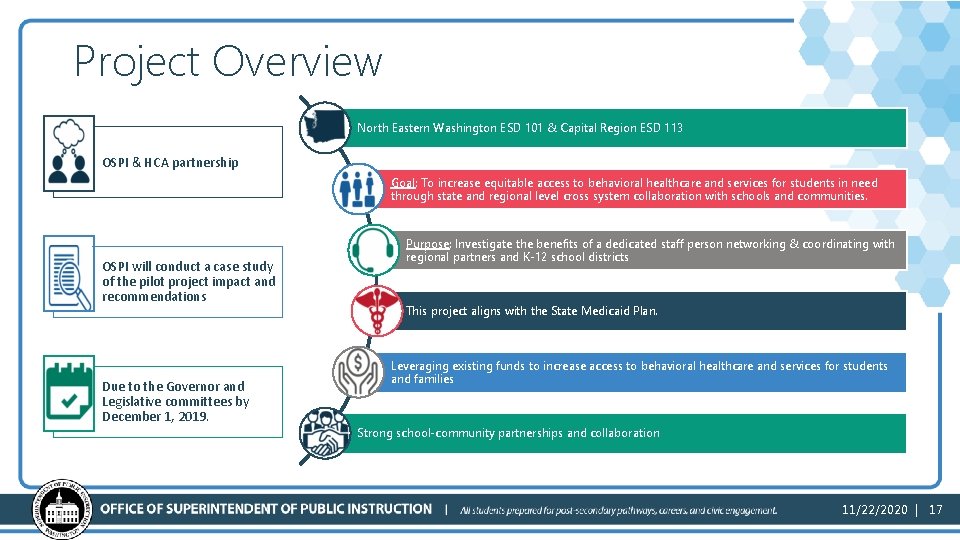
Project Overview North Eastern Washington ESD 101 & Capital Region ESD 113 OSPI & HCA partnership Goal: To increase equitable access to behavioral healthcare and services for students in need through state and regional level cross system collaboration with schools and communities. OSPI will conduct a case study of the pilot project impact and recommendations Due to the Governor and Legislative committees by December 1, 2019. Purpose: Investigate the benefits of a dedicated staff person networking & coordinating with regional partners and K-12 school districts This project aligns with the State Medicaid Plan. Leveraging existing funds to increase access to behavioral healthcare and services for students and families Strong school-community partnerships and collaboration 11/22/2020 | 17
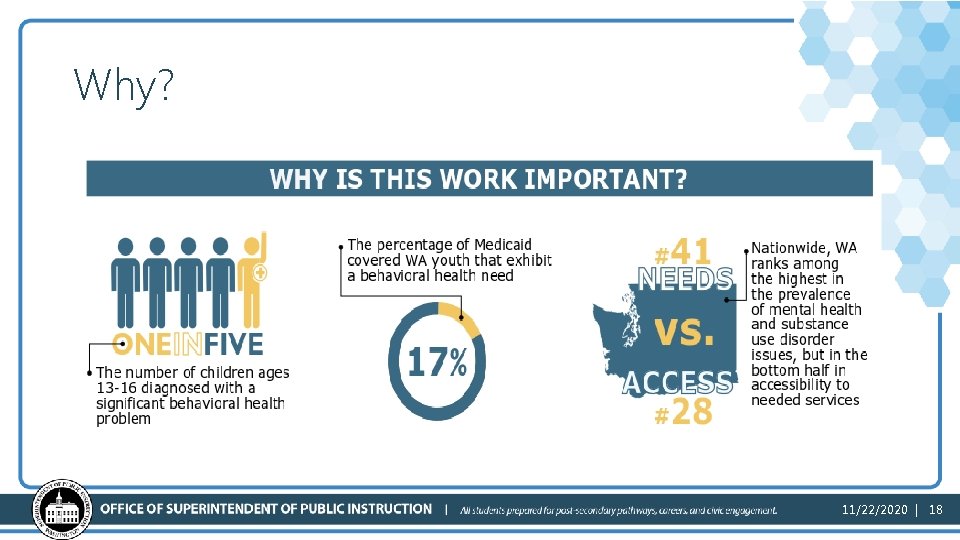
Why? 11/22/2020 | 18
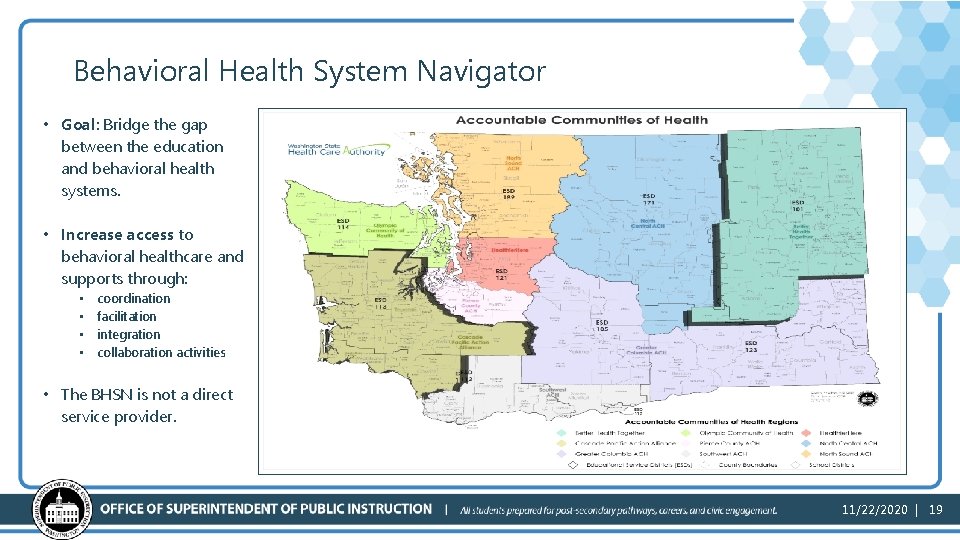
Behavioral Health System Navigator • Goal: Bridge the gap between the education and behavioral health systems. • Increase access to behavioral healthcare and supports through: • • coordination facilitation integration collaboration activities • The BHSN is not a direct service provider. 11/22/2020 | 19
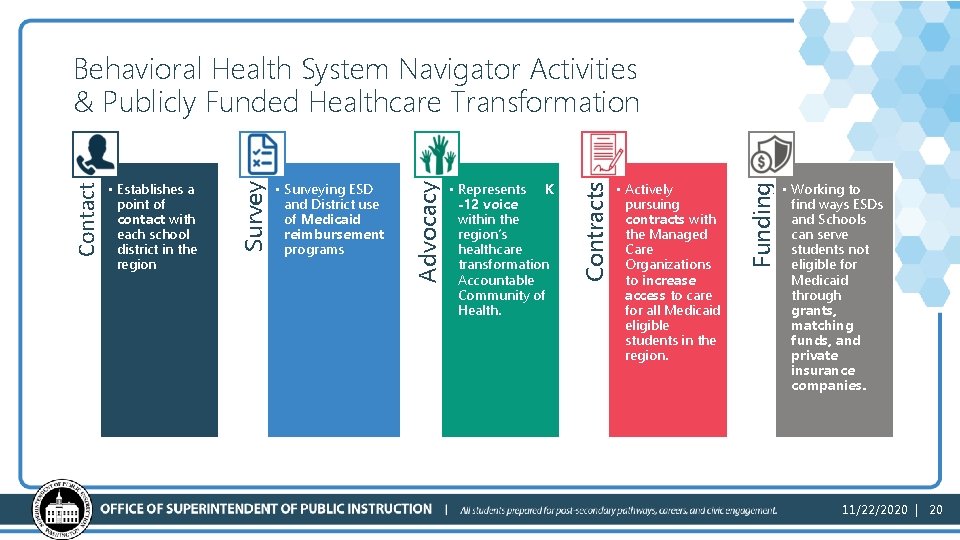
• Actively pursuing contracts with the Managed Care Organizations to increase access to care for all Medicaid eligible students in the region. Funding • Represents K -12 voice within the region’s healthcare transformation Accountable Community of Health. Contracts • Surveying ESD and District use of Medicaid reimbursement programs Advocacy • Establishes a point of contact with each school district in the region Survey Contact Behavioral Health System Navigator Activities & Publicly Funded Healthcare Transformation • Working to find ways ESDs and Schools can serve students not eligible for Medicaid through grants, matching funds, and private insurance companies. 11/22/2020 | 20
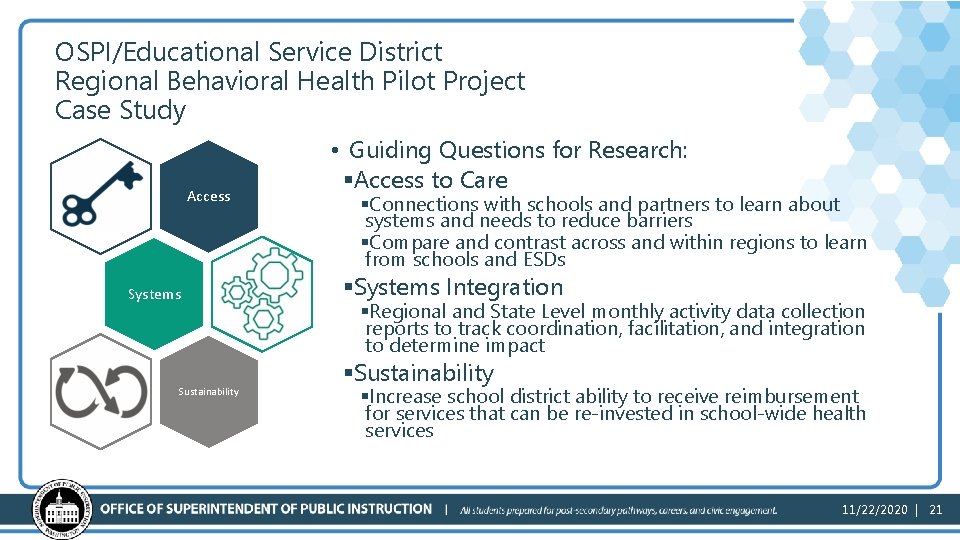
OSPI/Educational Service District Regional Behavioral Health Pilot Project Case Study Access Systems Sustainability • Guiding Questions for Research: §Access to Care §Connections with schools and partners to learn about systems and needs to reduce barriers §Compare and contrast across and within regions to learn from schools and ESDs §Systems Integration §Regional and State Level monthly activity data collection reports to track coordination, facilitation, and integration to determine impact §Sustainability §Increase school district ability to receive reimbursement for services that can be re-invested in school-wide health services 11/22/2020 | 21
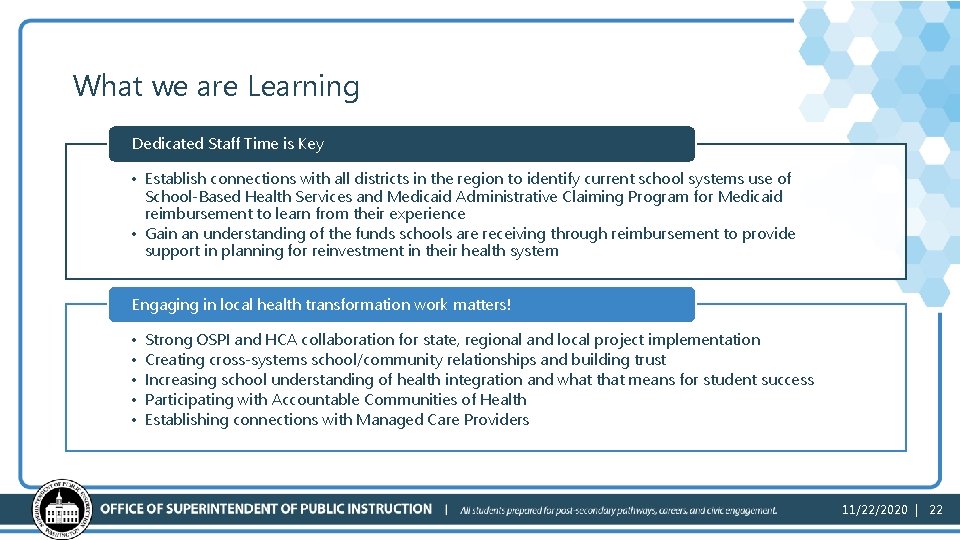
What we are Learning Dedicated Staff Time is Key • Establish connections with all districts in the region to identify current school systems use of School-Based Health Services and Medicaid Administrative Claiming Program for Medicaid reimbursement to learn from their experience • Gain an understanding of the funds schools are receiving through reimbursement to provide support in planning for reinvestment in their health system Engaging in local health transformation work matters! • • • Strong OSPI and HCA collaboration for state, regional and local project implementation Creating cross-systems school/community relationships and building trust Increasing school understanding of health integration and what that means for student success Participating with Accountable Communities of Health Establishing connections with Managed Care Providers 11/22/2020 | 22
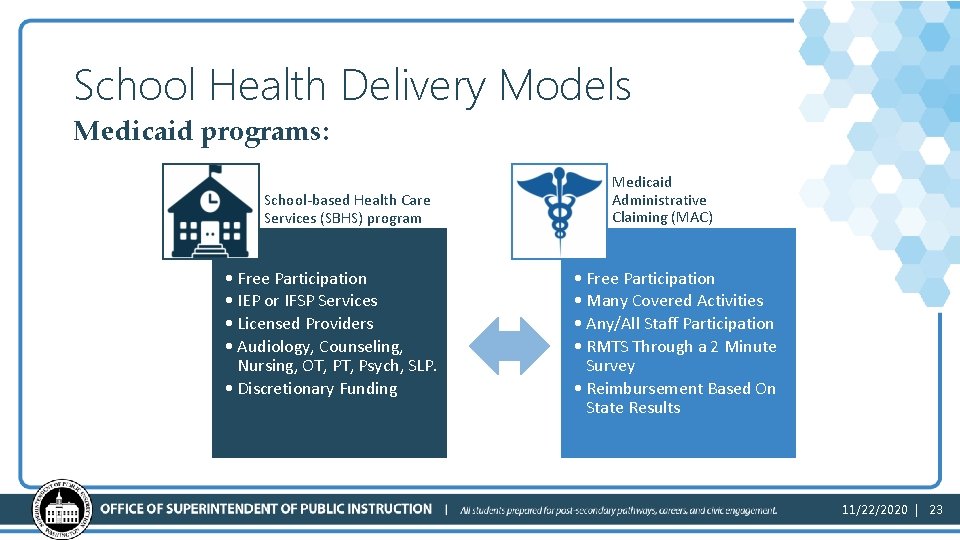
School Health Delivery Models Medicaid programs: School-based Health Care Services (SBHS) program • Free Participation • IEP or IFSP Services • Licensed Providers • Audiology, Counseling, Nursing, OT, Psych, SLP. • Discretionary Funding Medicaid Administrative Claiming (MAC) program • Free Participation • Many Covered Activities • Any/All Staff Participation • RMTS Through a 2 Minute Survey • Reimbursement Based On State Results 11/22/2020 | 23
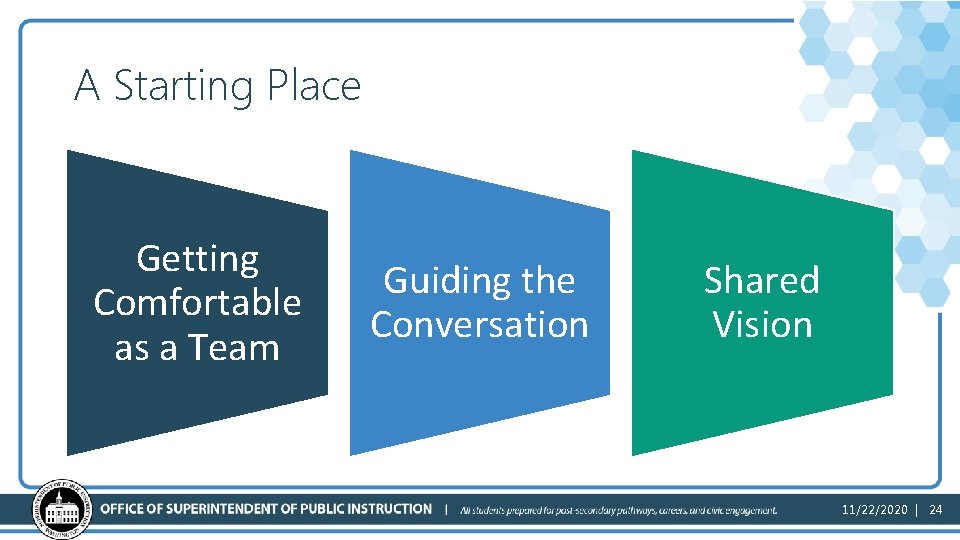
A Starting Place Getting Comfortable as a Team Guiding the Conversation Shared Vision 11/22/2020 | 24
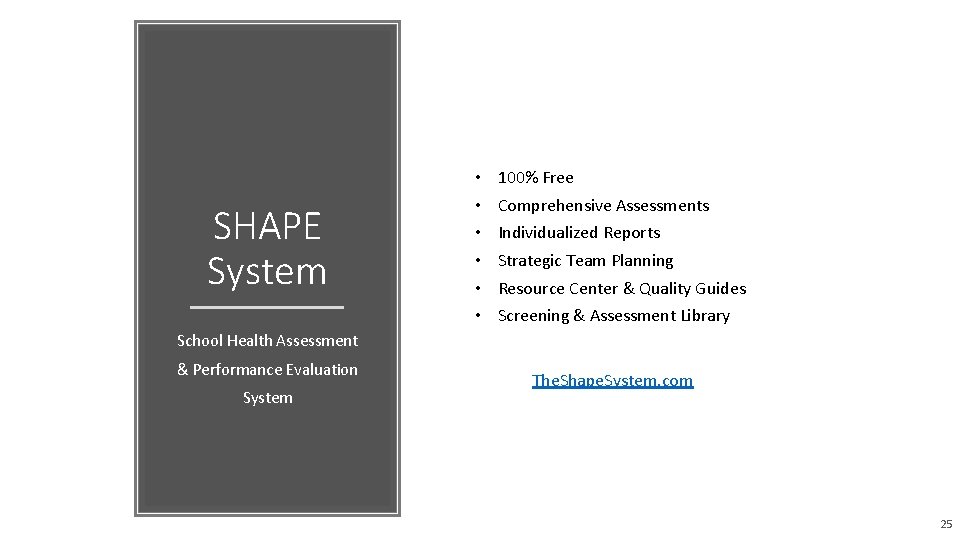
SHAPE System • • • 100% Free Comprehensive Assessments Individualized Reports Strategic Team Planning Resource Center & Quality Guides Screening & Assessment Library School Health Assessment & Performance Evaluation System The. Shape. System. com 25
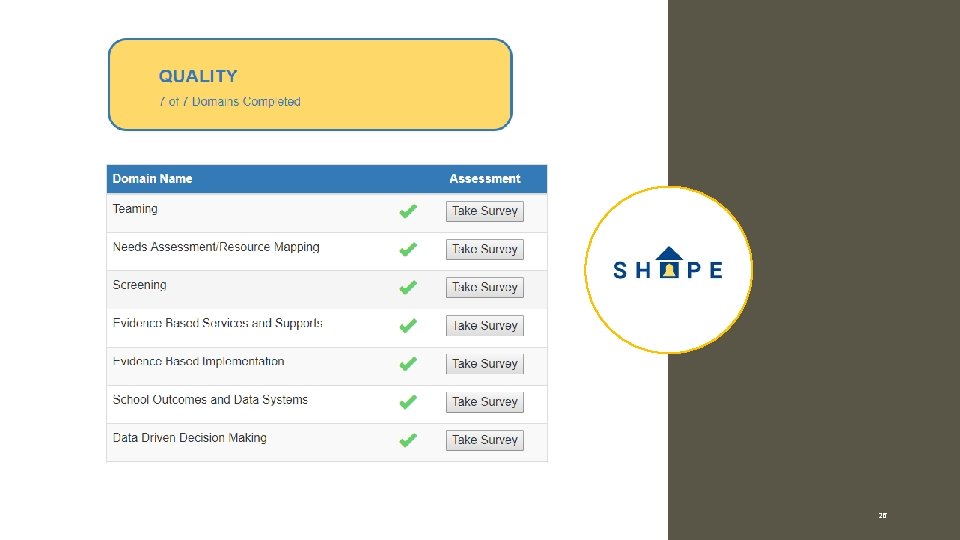
Quality 26
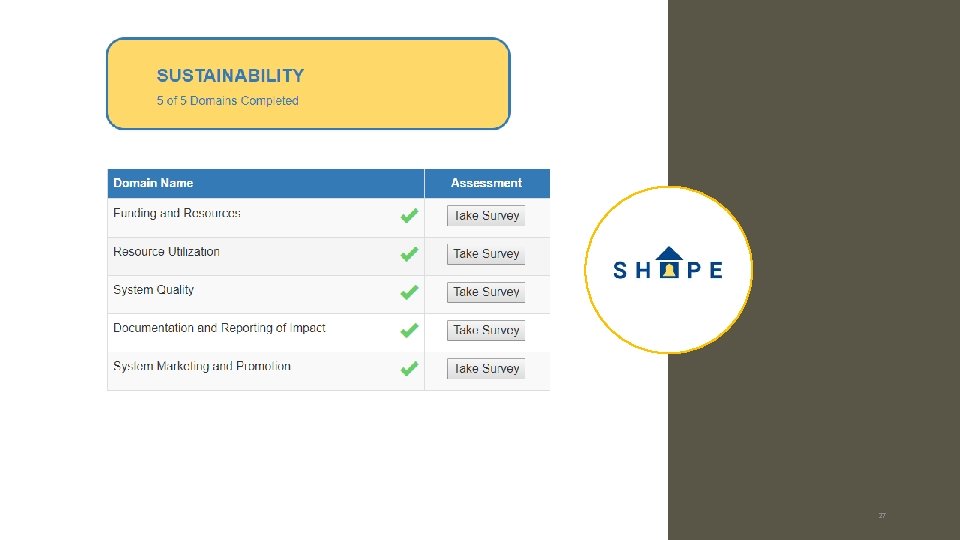
Sustainability 27
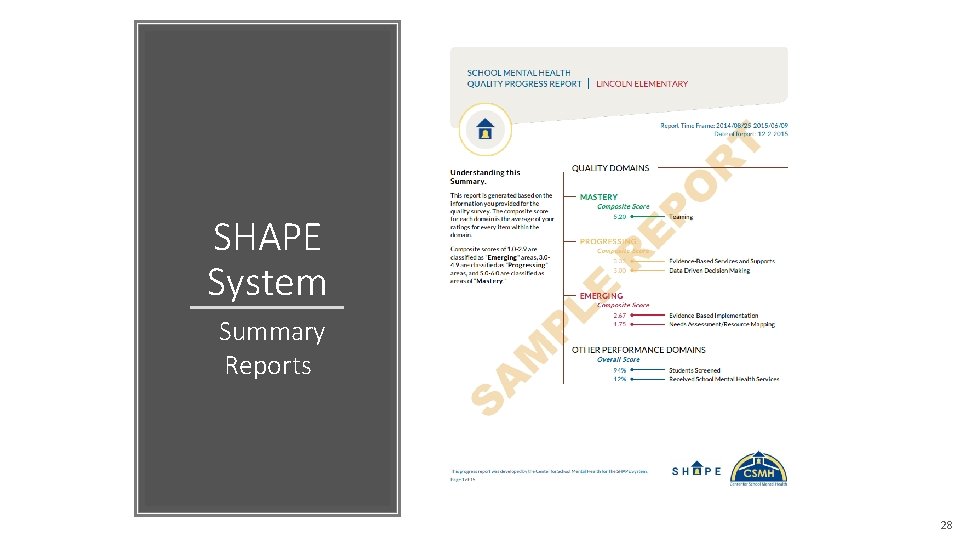
SHAPE System Summary Reports 28
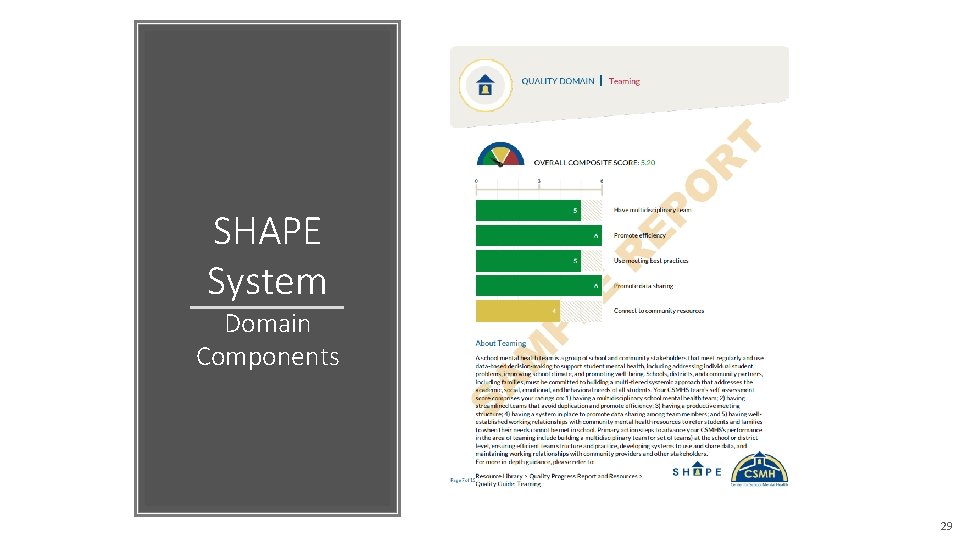
SHAPE System Domain Components 29
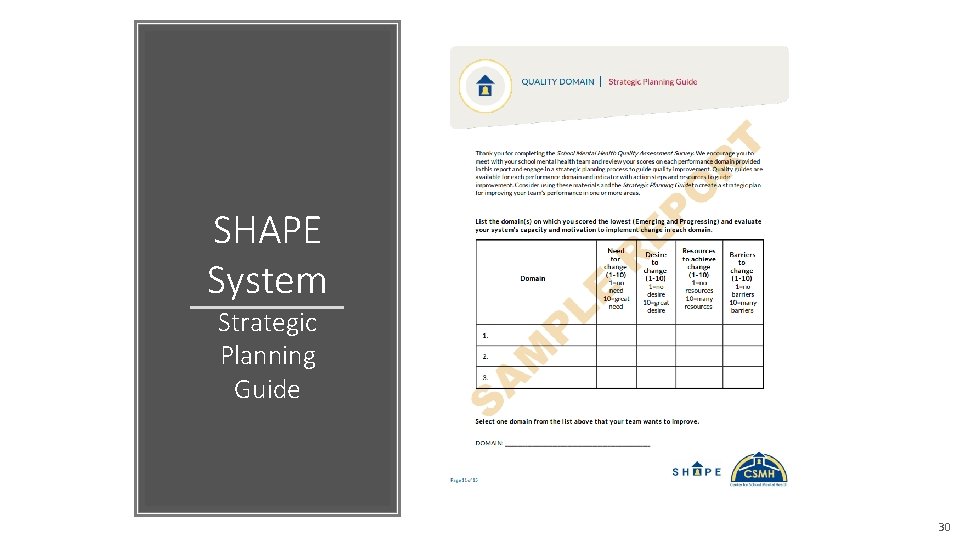
SHAPE System Strategic Planning Guide 30
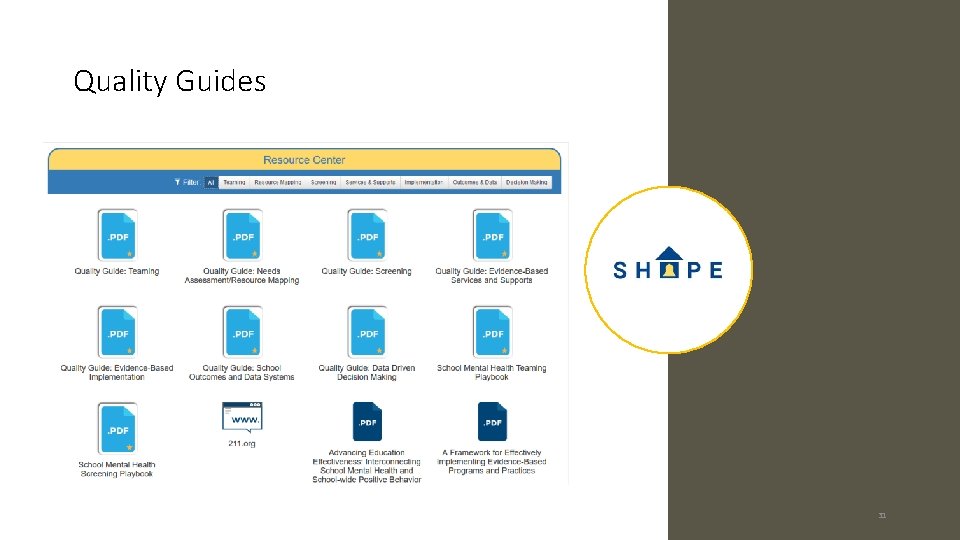
Quality Guides 31
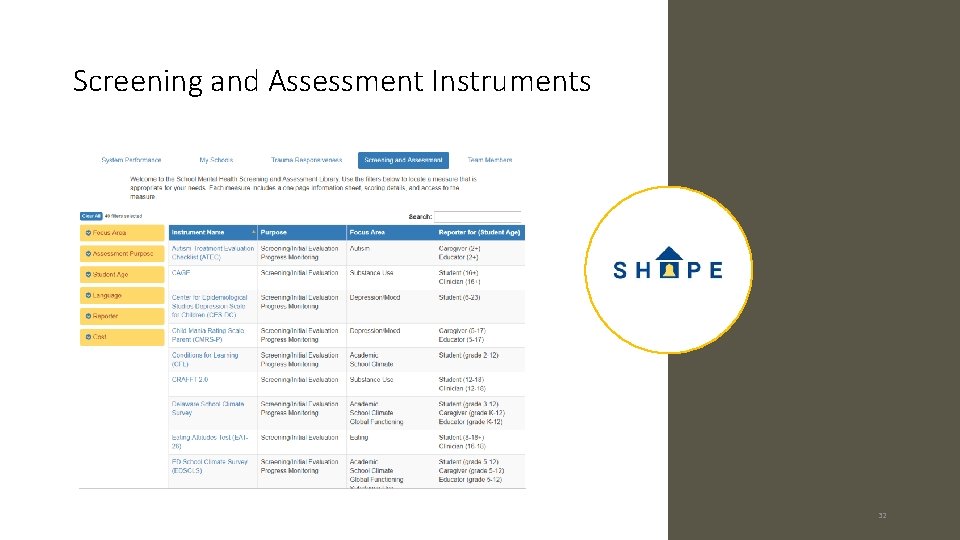
Screening and Assessment Instruments 32
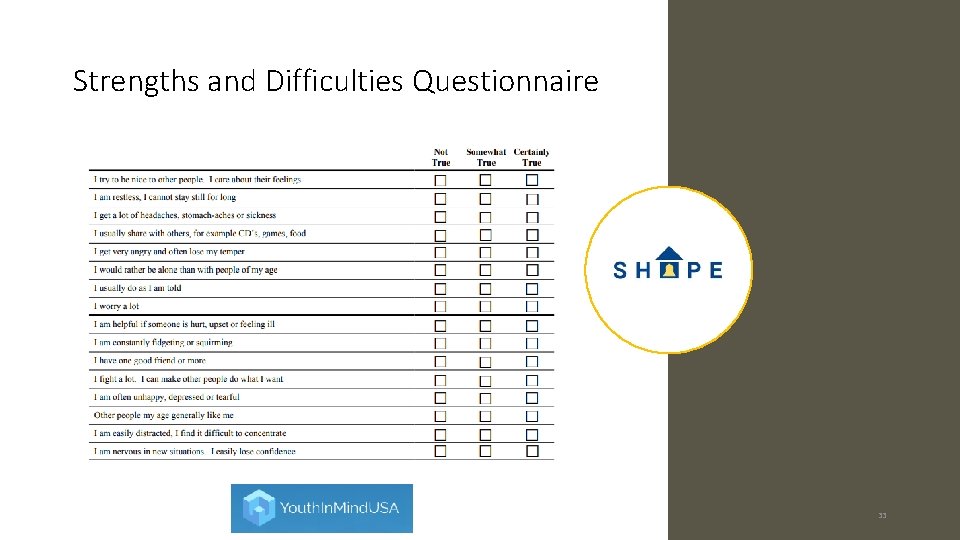
Strengths and Difficulties Questionnaire 33
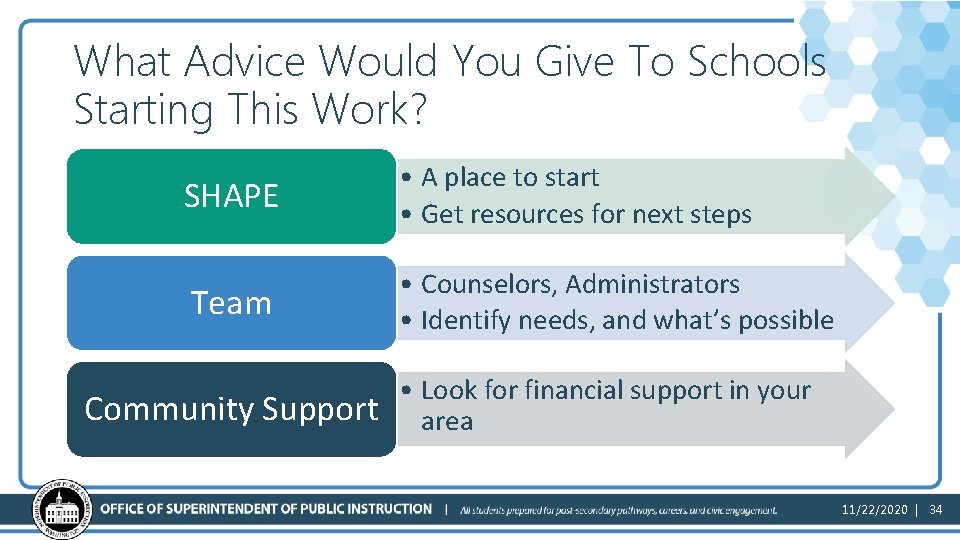
What Advice Would You Give To Schools Starting This Work? SHAPE • A place to start • Get resources for next steps Team • Counselors, Administrators • Identify needs, and what’s possible Community Support • Look for financial support in your area 11/22/2020 | 34
Questions & Polling 2 How interested are you in the SHAPE System? A. I’m in! B. It could be interesting C. Probably not for us 11/22/2020 | 35
What Does Implementation Look Like? Cheney School District
Who Am I? Where Am I From? Catheleen Schlotter Cheney School District WHY 11/22/2020 | 37
Big Ideas • Our Journey • Tiered strategies organized with adults • Marrying to academic frameworks • How Andrew has helped • Our Next Steps • What We Learned 11/22/2020 | 38
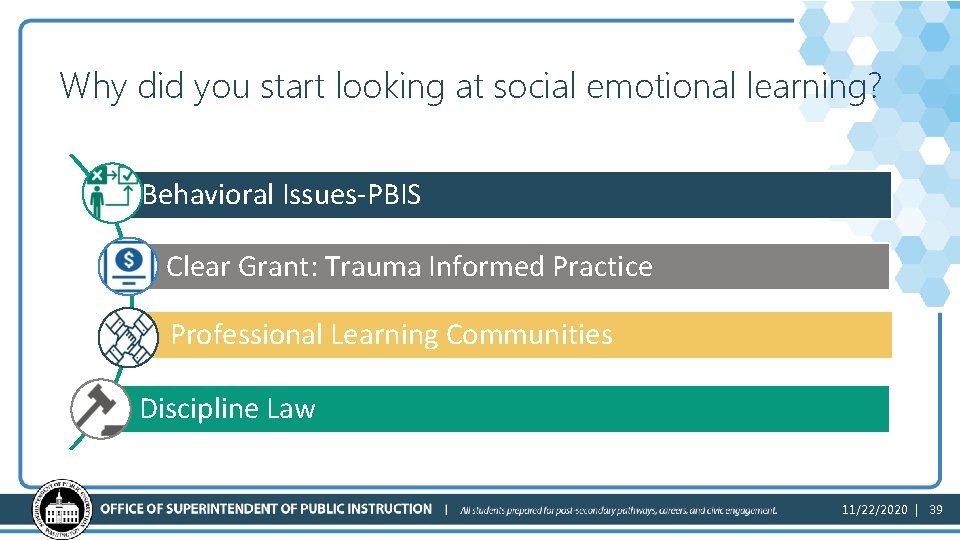
Why did you start looking at social emotional learning? Behavioral Issues-PBIS Clear Grant: Trauma Informed Practice Professional Learning Communities Discipline Law 11/22/2020 | 39
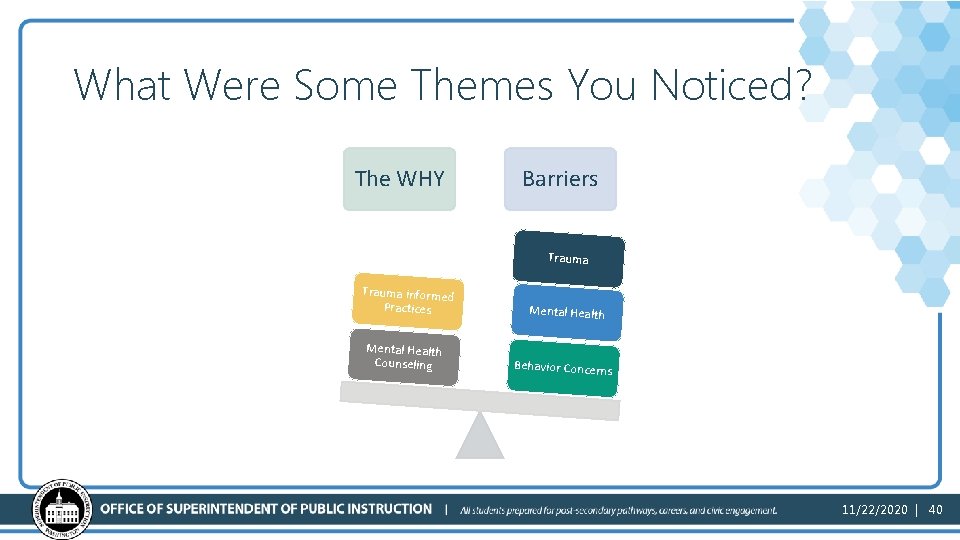
What Were Some Themes You Noticed? The WHY Barriers Trauma informed Practices Mental Health Counseling Mental Health Behavior Concerns 11/22/2020 | 40
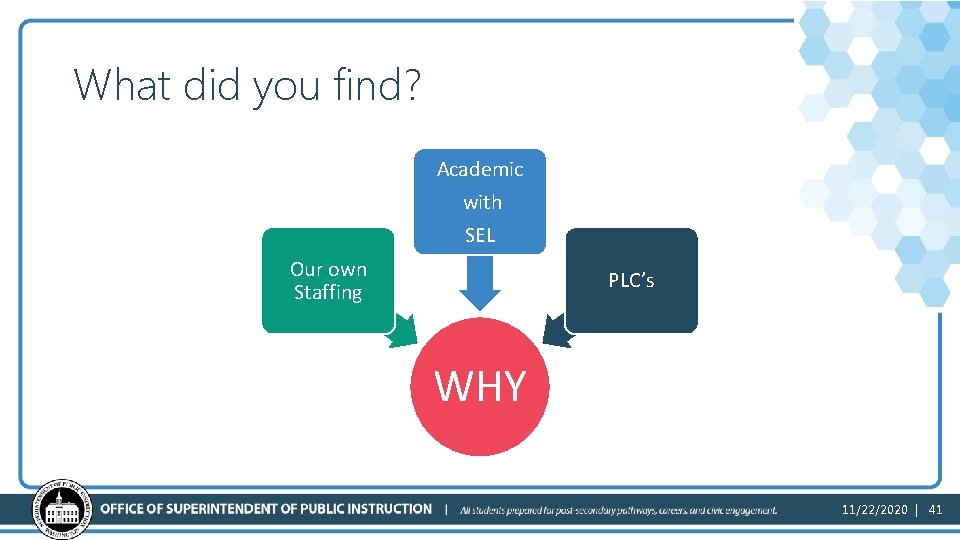
What did you find? Academic with SEL Our own Staffing PLC’s WHY 11/22/2020 | 41
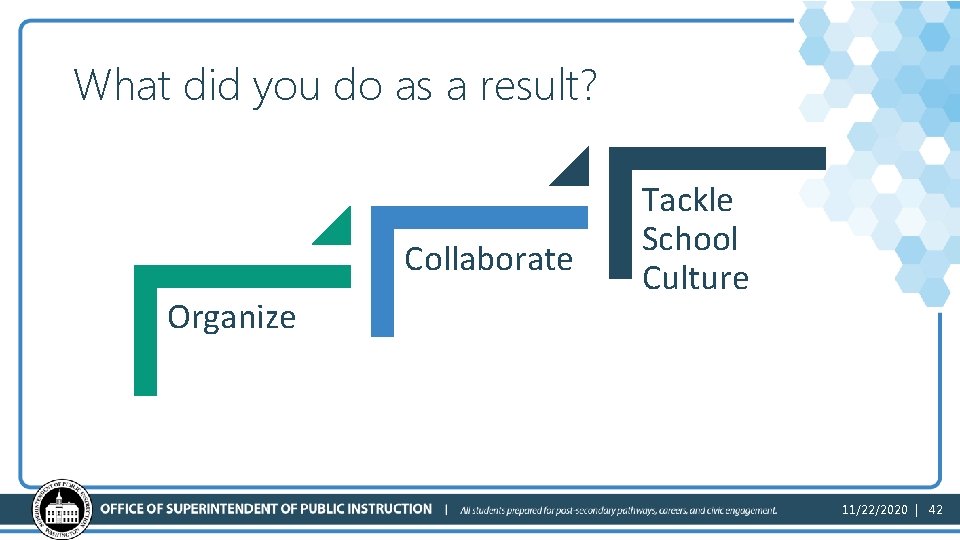
What did you do as a result? Collaborate Organize Tackle School Culture 11/22/2020 | 42
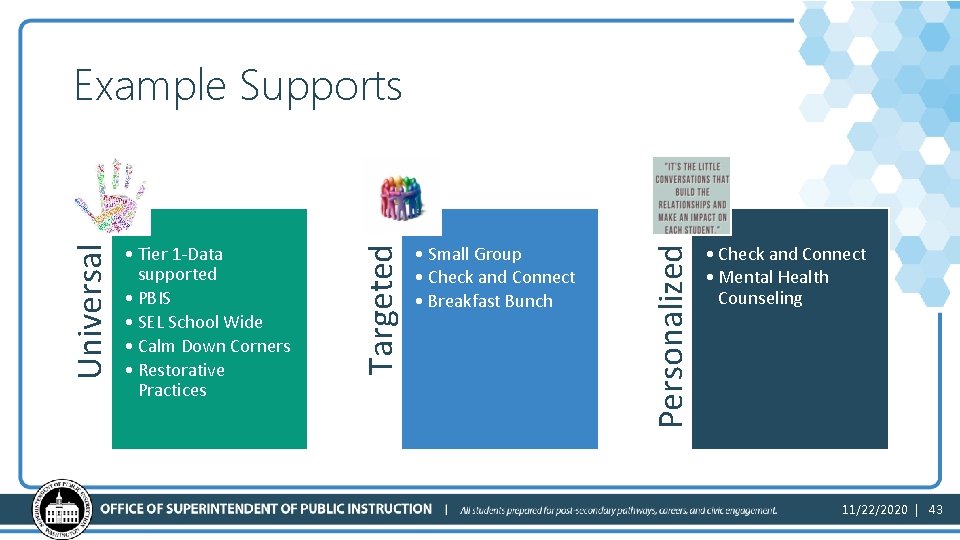
• Small Group • Check and Connect • Breakfast Bunch Personalized • Tier 1 -Data supported • PBIS • SEL School Wide • Calm Down Corners • Restorative Practices Targeted Universal Example Supports • Check and Connect • Mental Health Counseling 11/22/2020 | 43
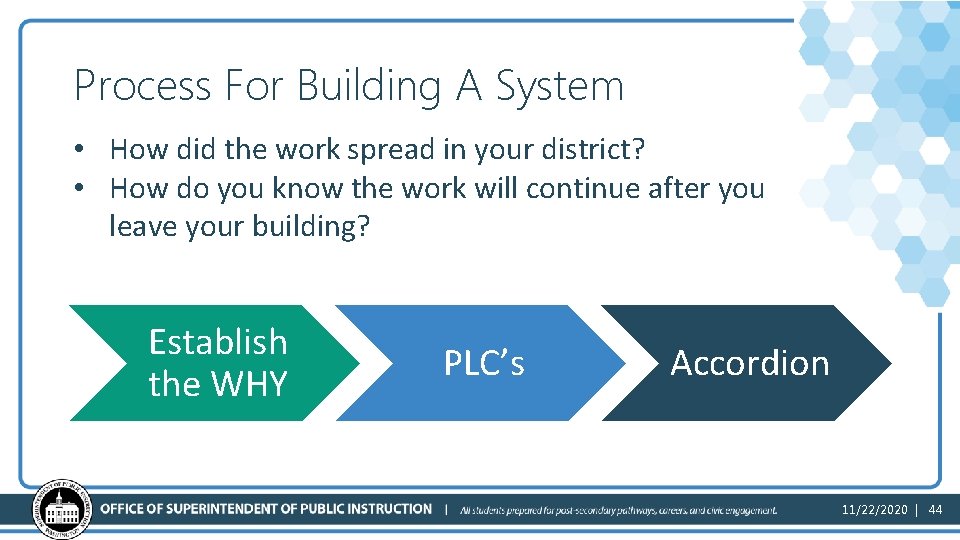
Process For Building A System • How did the work spread in your district? • How do you know the work will continue after you leave your building? Establish the WHY PLC’s Accordion 11/22/2020 | 44
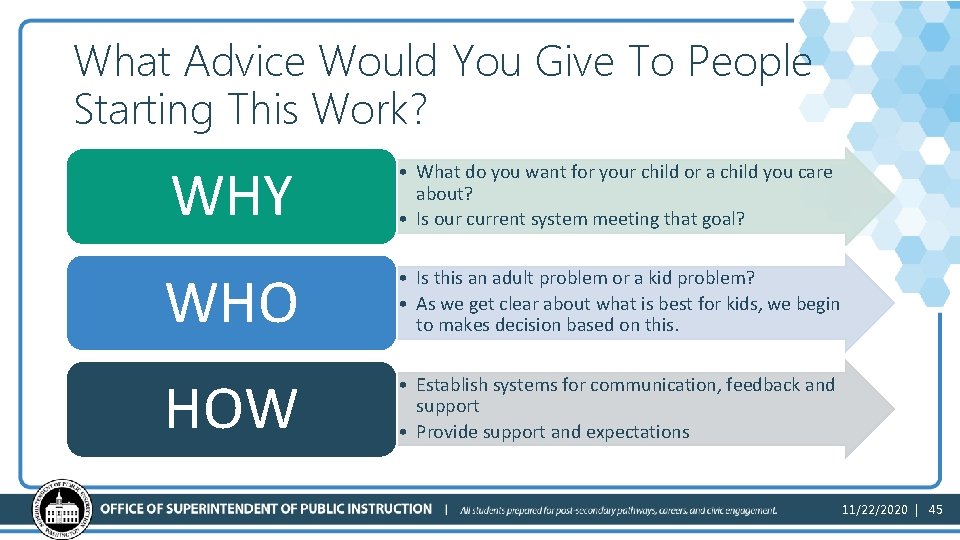
What Advice Would You Give To People Starting This Work? WHY • What do you want for your child or a child you care about? • Is our current system meeting that goal? WHO • Is this an adult problem or a kid problem? • As we get clear about what is best for kids, we begin to makes decision based on this. HOW • Establish systems for communication, feedback and support • Provide support and expectations 11/22/2020 | 45
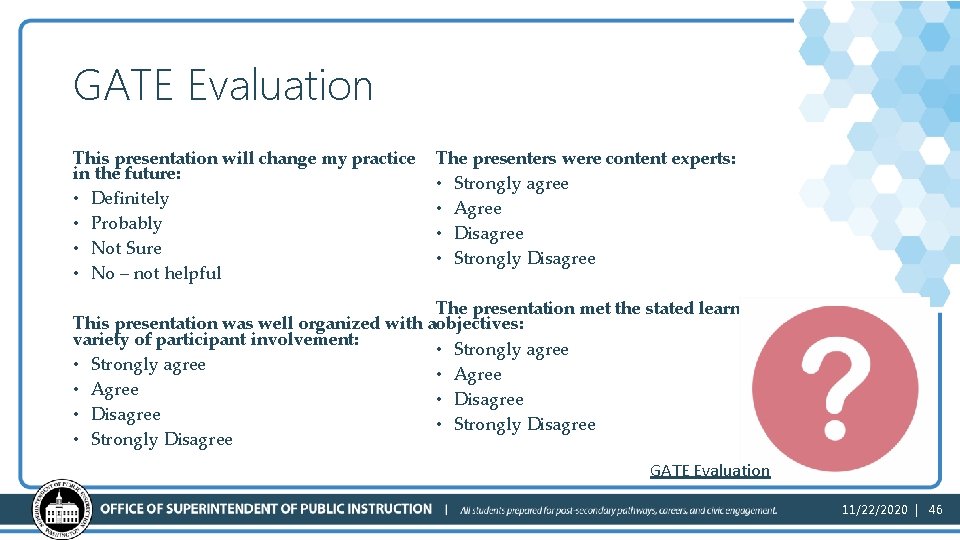
GATE Evaluation This presentation will change my practice in the future: • Definitely • Probably • Not Sure • No – not helpful The presenters were content experts: • Strongly agree • Agree • Disagree • Strongly Disagree The presentation met the stated learning This presentation was well organized with aobjectives: variety of participant involvement: • Strongly agree • Agree • Disagree • Strongly Disagree GATE Evaluation 11/22/2020 | 46
SEL Resources
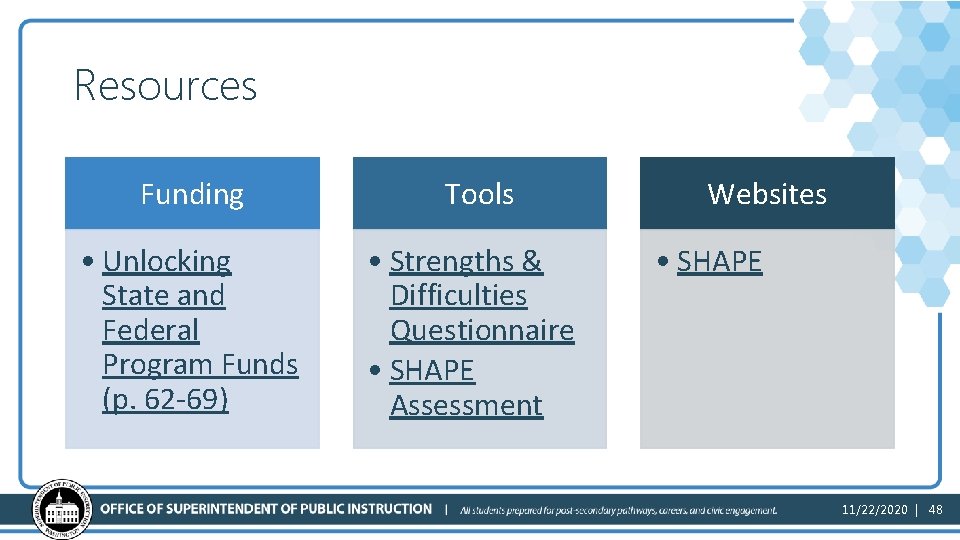
Resources Funding Tools • Unlocking State and Federal Program Funds (p. 62 -69) • Strengths & Difficulties Questionnaire • SHAPE Assessment Websites • SHAPE 11/22/2020 | 48
Creative Commons • Except where otherwise noted, this work by the Office of Superintendent of Public Instruction is licensed under a Creative Commons 4. 0 International License. • Many of our images come from Canva. com and The. Noun. Project. com. 11/22/2020 | 49
Discussion Questions for the Chat What were the big ideas you got from today? What are your next leadership moves? What did you value in the presentation? What questions do you still have? 11/22/2020 | 50
- Slides: 50