
May 2012 doc IEEE 802 11 111160 r
- Slides: 40
May 2012 doc. : IEEE 802. 11 -11/1160 r 9 Fast Authentication in TGai • Date: 2012 -05 -14 Authors: Name George Cherian Santosh Abraham Hemanth Sampath Jouni Malinen Menzo Wentink Affiliations Qualcomm Address Phone 5775 Morehouse Dr, San Diego, CA, USA +1 (858)-651 -6645 email gcherian@qualcomm. com sabraham@qualcomm. com hsampath@qualcomm. com jouni@qca. qualcomm. com mwentink@qualcomm. com Hitoshi MORIOKA Hiroshi Mano Allied Telesis R&D Center. 2 -14 -38 Tenjin, Chuo-ku, Fukuoka 810 -0001 JAPAN +81 -92 -771 -7630 hmorioka@root-hq. com hmano@root-hq. com Mark RISON CSR Cambridge Business Park, Cowley Road, Cambridge CB 4 0 WZ UK +44 -1223 -692000 Mark. Rison@csr. com Marc Emmelmann Fraunhofer FOKUS Kaiserin-Augusta-Alle 31 10589 Berlin Germany +49 -30 -3463 -7268 emmelmann@ieee. org Ping Fang Zhiming Ding Phillip Barber Rob Sun Chengyan Feng Bo Sun Lin Wang Submission Bldg 7, Vision Software Park, Huawei Technologies Co. , Road Gaoxin Sourth 9, Nanshan +86 755 36835101 Ltd. District, Shenzhen, Guangdong, China, 518057 ZTE Corporation Slide 1 ping. fang@huawei. com dingzhiming@huawei. com pbarber@huawei. com Rob. sun@huawei. com feng. chengyan@zte. com. cn sun. bo 1@zte. com. cn wang. lin 45@zte. com. cn Qualcomm, Allied Telsis, CSR, FOKUS, Huawei
May 2012 doc. : IEEE 802. 11 -11/1160 r 9 Abstract • This document proposes Fast authentication for FILS. Submission Slide 2 Qualcomm, Allied Telsis, CSR, FOKUS, Huawei
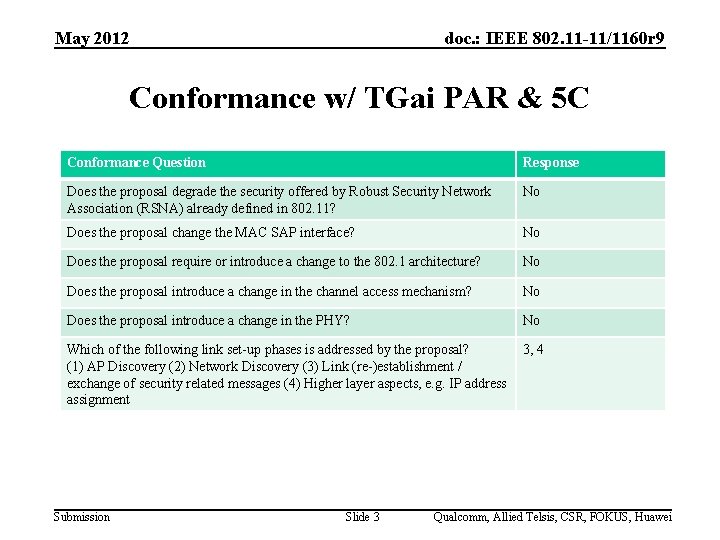
May 2012 doc. : IEEE 802. 11 -11/1160 r 9 Conformance w/ TGai PAR & 5 C Conformance Question Response Does the proposal degrade the security offered by Robust Security Network Association (RSNA) already defined in 802. 11? No Does the proposal change the MAC SAP interface? No Does the proposal require or introduce a change to the 802. 1 architecture? No Does the proposal introduce a change in the channel access mechanism? No Does the proposal introduce a change in the PHY? No Which of the following link set-up phases is addressed by the proposal? 3, 4 (1) AP Discovery (2) Network Discovery (3) Link (re-)establishment / exchange of security related messages (4) Higher layer aspects, e. g. IP address assignment Submission Slide 3 Qualcomm, Allied Telsis, CSR, FOKUS, Huawei
May 2012 doc. : IEEE 802. 11 -11/1160 r 9 Background • Contribution 1160 r 7 proposed fast authentication for FILS using EAP/EAP-RP • See the details of the contribution in the appendix • This contribution has updates on – Concurrent use of ERP with 4 -way handshake – Updated on Optimized EAP Submission Slide 4 Qualcomm, Allied Telsis, CSR, FOKUS, Huawei, ZTE
May 2012 doc. : IEEE 802. 11 -11/1160 r 9 Update on ERP Submission Slide 5 Qualcomm, Allied Telsis, CSR, FOKUS, Huawei, ZTE
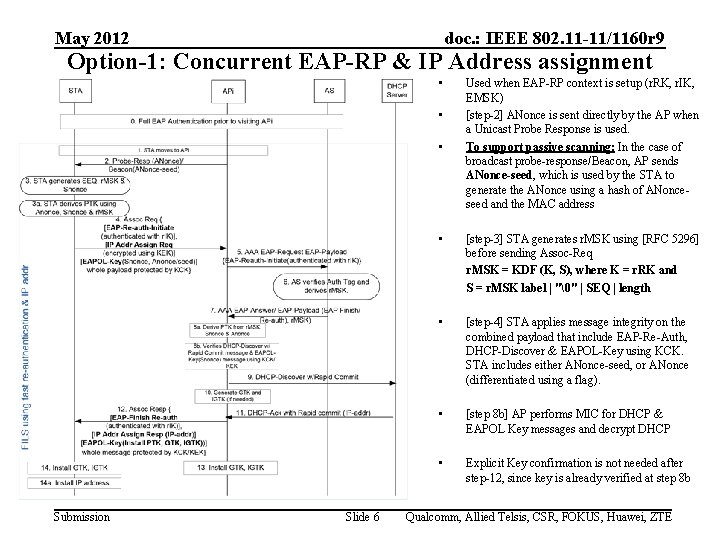
May 2012 doc. : IEEE 802. 11 -11/1160 r 9 Option-1: Concurrent EAP-RP & IP Address assignment • • • Submission Slide 6 Used when EAP-RP context is setup (r. RK, r. IK, EMSK) [step-2] ANonce is sent directly by the AP when a Unicast Probe Response is used. To support passive scanning: In the case of broadcast probe-response/Beacon, AP sends ANonce-seed, which is used by the STA to generate the ANonce using a hash of ANonceseed and the MAC address • [step-3] STA generates r. MSK using [RFC 5296] before sending Assoc-Req r. MSK = KDF (K, S), where K = r. RK and S = r. MSK label | "" | SEQ | length • [step-4] STA applies message integrity on the combined payload that include EAP-Re-Auth, DHCP-Discover & EAPOL-Key using KCK. STA includes either ANonce-seed, or ANonce (differentiated using a flag). • [step 8 b] AP performs MIC for DHCP & EAPOL Key messages and decrypt DHCP • Explicit Key confirmation is not needed after step-12, since key is already verified at step 8 b Qualcomm, Allied Telsis, CSR, FOKUS, Huawei, ZTE
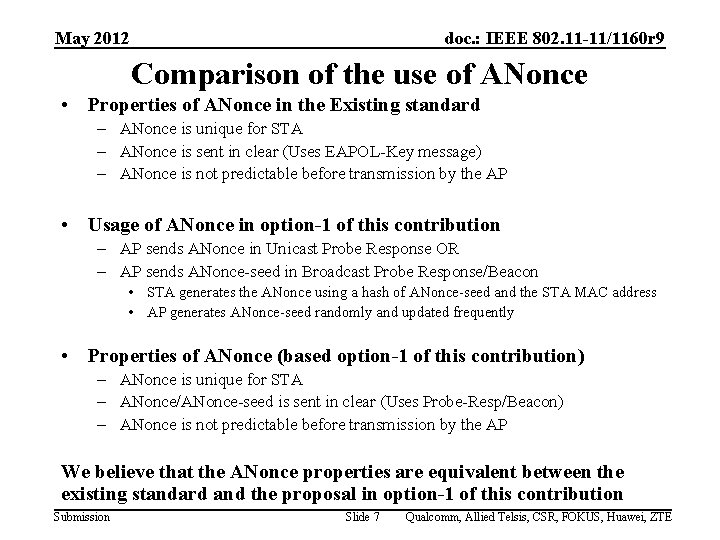
May 2012 doc. : IEEE 802. 11 -11/1160 r 9 Comparison of the use of ANonce • Properties of ANonce in the Existing standard – ANonce is unique for STA – ANonce is sent in clear (Uses EAPOL-Key message) – ANonce is not predictable before transmission by the AP • Usage of ANonce in option-1 of this contribution – AP sends ANonce in Unicast Probe Response OR – AP sends ANonce-seed in Broadcast Probe Response/Beacon • STA generates the ANonce using a hash of ANonce-seed and the STA MAC address • AP generates ANonce-seed randomly and updated frequently • Properties of ANonce (based option-1 of this contribution) – ANonce is unique for STA – ANonce/ANonce-seed is sent in clear (Uses Probe-Resp/Beacon) – ANonce is not predictable before transmission by the AP We believe that the ANonce properties are equivalent between the existing standard and the proposal in option-1 of this contribution Submission Slide 7 Qualcomm, Allied Telsis, CSR, FOKUS, Huawei, ZTE
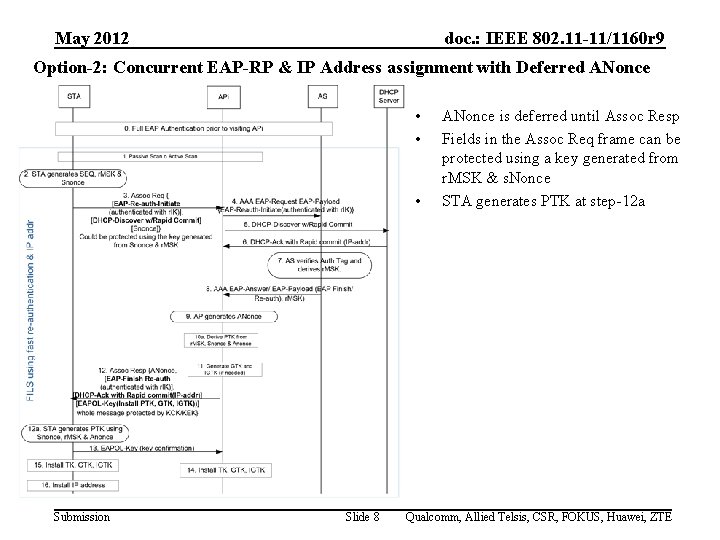
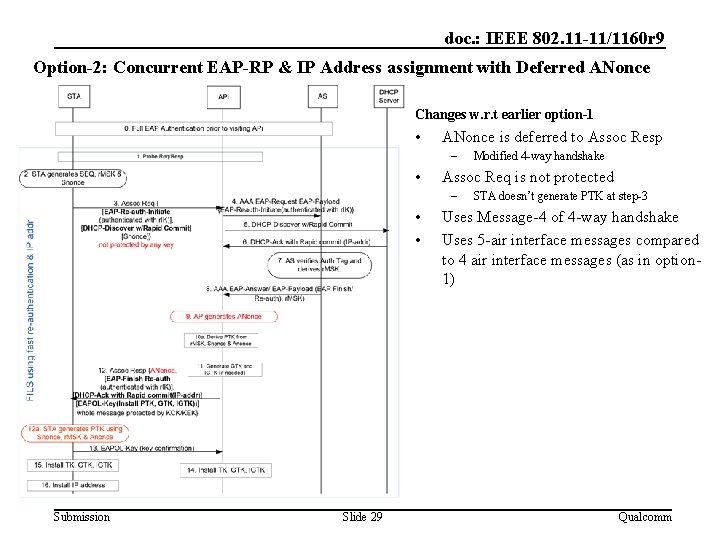
May 2012 doc. : IEEE 802. 11 -11/1160 r 9 Option-2: Concurrent EAP-RP & IP Address assignment with Deferred ANonce • • • Submission Slide 8 ANonce is deferred until Assoc Resp Fields in the Assoc Req frame can be protected using a key generated from r. MSK & s. Nonce STA generates PTK at step-12 a Qualcomm, Allied Telsis, CSR, FOKUS, Huawei, ZTE
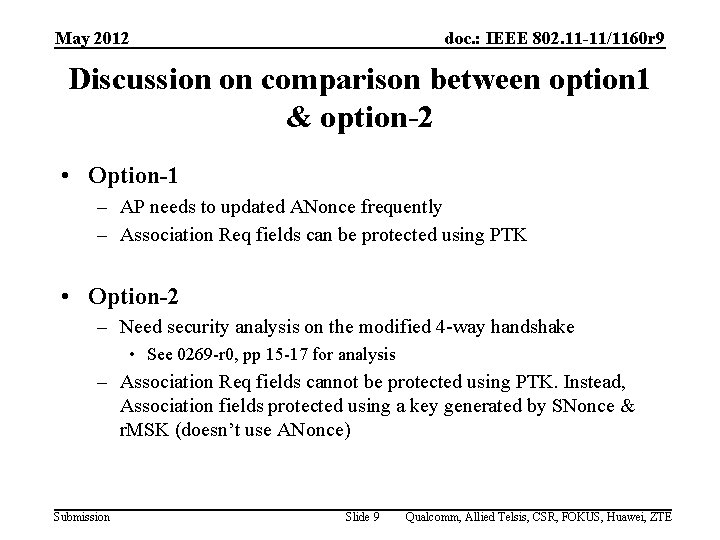
May 2012 doc. : IEEE 802. 11 -11/1160 r 9 Discussion on comparison between option 1 & option-2 • Option-1 – AP needs to updated ANonce frequently – Association Req fields can be protected using PTK • Option-2 – Need security analysis on the modified 4 -way handshake • See 0269 -r 0, pp 15 -17 for analysis – Association Req fields cannot be protected using PTK. Instead, Association fields protected using a key generated by SNonce & r. MSK (doesn’t use ANonce) Submission Slide 9 Qualcomm, Allied Telsis, CSR, FOKUS, Huawei, ZTE
May 2012 doc. : IEEE 802. 11 -11/1160 r 9 Straw polls • Do you support the ANonce derivation at the STA based on the ANonce seed sent by AP in Broadcast Probe. Resp/Beacon? Yes No Abstain Submission Slide 10 Qualcomm, Allied Telsis, CSR, FOKUS, Huawei, ZTE
May 2012 doc. : IEEE 802. 11 -11/1160 r 9 Updates on Optimized EAP Submission Slide 11 Huawei
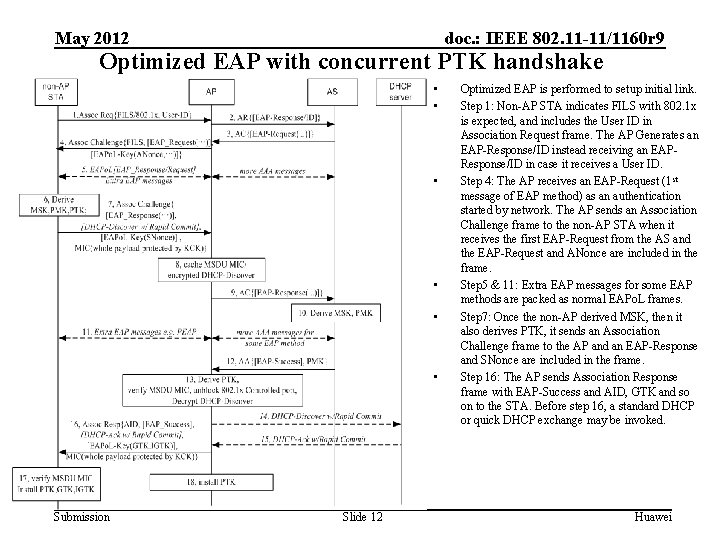
May 2012 doc. : IEEE 802. 11 -11/1160 r 9 Optimized EAP with concurrent PTK handshake • • • Submission Slide 12 Optimized EAP is performed to setup initial link. Step 1: Non-AP STA indicates FILS with 802. 1 x is expected, and includes the User ID in Association Request frame. The AP Generates an EAP-Response/ID instead receiving an EAPResponse/ID in case it receives a User ID. Step 4: The AP receives an EAP-Request (1 st message of EAP method) as an authentication started by network. The AP sends an Association Challenge frame to the non-AP STA when it receives the first EAP-Request from the AS and the EAP-Request and ANonce are included in the frame. Step 5 & 11: Extra EAP messages for some EAP methods are packed as normal EAPo. L frames. Step 7: Once the non-AP derived MSK, then it also derives PTK, it sends an Association Challenge frame to the AP and an EAP-Response and SNonce are included in the frame. Step 16: The AP sends Association Response frame with EAP-Success and AID, GTK and so on to the STA. Before step 16, a standard DHCP or quick DHCP exchange may be invoked. Huawei
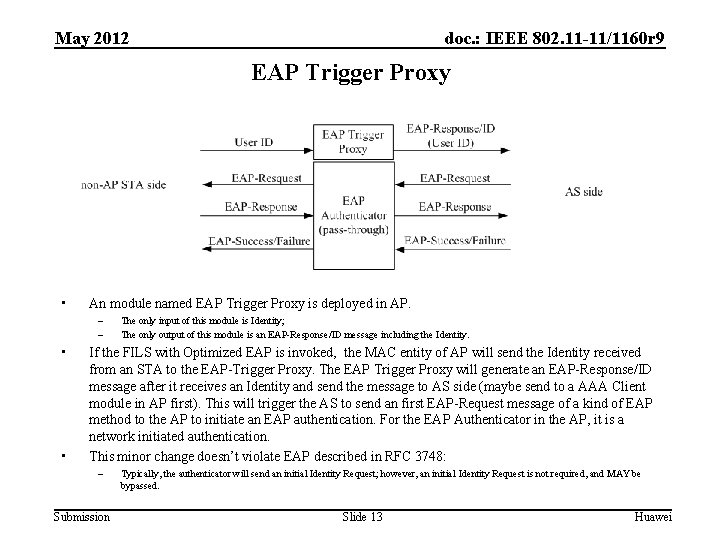
May 2012 doc. : IEEE 802. 11 -11/1160 r 9 EAP Trigger Proxy • An module named EAP Trigger Proxy is deployed in AP. – – • • The only input of this module is Identity; The only output of this module is an EAP-Response/ID message including the Identity. If the FILS with Optimized EAP is invoked, the MAC entity of AP will send the Identity received from an STA to the EAP-Trigger Proxy. The EAP Trigger Proxy will generate an EAP-Response/ID message after it receives an Identity and send the message to AS side (maybe send to a AAA Client module in AP first). This will trigger the AS to send an first EAP-Request message of a kind of EAP method to the AP to initiate an EAP authentication. For the EAP Authenticator in the AP, it is a network initiated authentication. This minor change doesn’t violate EAP described in RFC 3748: – Submission Typically, the authenticator will send an initial Identity Request; however, an initial Identity Request is not required, and MAY be bypassed. Slide 13 Huawei
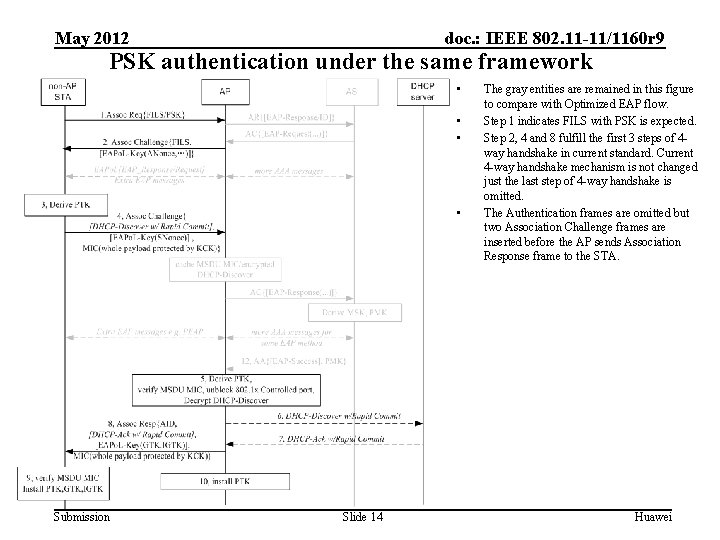
May 2012 doc. : IEEE 802. 11 -11/1160 r 9 PSK authentication under the same framework • • Submission Slide 14 The gray entities are remained in this figure to compare with Optimized EAP flow. Step 1 indicates FILS with PSK is expected. Step 2, 4 and 8 fulfill the first 3 steps of 4 way handshake in current standard. Current 4 -way handshake mechanism is not changed just the last step of 4 -way handshake is omitted. The Authentication frames are omitted but two Association Challenge frames are inserted before the AP sends Association Response frame to the STA. Huawei
May 2012 doc. : IEEE 802. 11 -11/1160 r 9 Conclusion • Proposal Summary – Association procedure is change from two messages to four messages. – 4 -way handshake is carried out concurrently with Association procedure to reduce message exchange. – Existing EAP Method can be used so that interworking between cellular network and Wi. Fi network will not be impacted. – The EAP-Request/ID and EAP-Response/ID messages are skipped to reduce messages on the air interface. – AP shall support network initiated EAP authentication. Submission Slide 15 Ping Fang etc, Huawei.
May 2012 doc. : IEEE 802. 11 -11/1160 r 9 Stroll Poll 1 • Do you support network initiated EAP authentication as mentioned in slide 13? – – – Submission Yes: No: Don’t care: Slide 16 Ping Fang etc, Huawei.
May 2012 doc. : IEEE 802. 11 -11/1160 r 9 Stroll Poll 2 • Do you support adding an EAP Trigger Proxy function in AP for EAPResponse/Identity message generating when FILS/802. 1 x authentication request frame with a User Identity is received, in order to skip EAPRequest/Identity and EAP-Response/Identity message as mentioned in slide 13? – – – Submission Yes: No: Don’t care: Slide 17 Ping Fang etc, Huawei.
Sept 2011 doc. : IEEE 802. 11 -11/1160 r 9 Appendix Original Proposal (1160 r 7) Submission Slide 18 Qualcomm
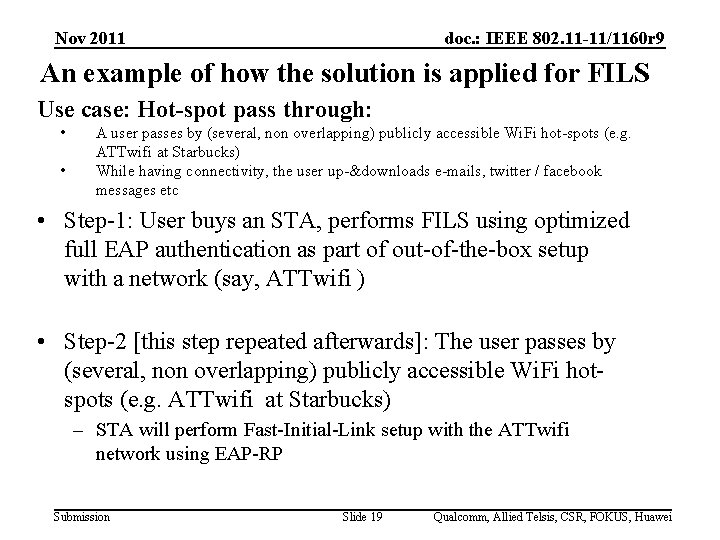
Nov 2011 doc. : IEEE 802. 11 -11/1160 r 9 An example of how the solution is applied for FILS Use case: Hot-spot pass through: • • A user passes by (several, non overlapping) publicly accessible Wi. Fi hot-spots (e. g. ATTwifi at Starbucks) While having connectivity, the user up-&downloads e-mails, twitter / facebook messages etc • Step-1: User buys an STA, performs FILS using optimized full EAP authentication as part of out-of-the-box setup with a network (say, ATTwifi ) • Step-2 [this step repeated afterwards]: The user passes by (several, non overlapping) publicly accessible Wi. Fi hotspots (e. g. ATTwifi at Starbucks) – STA will perform Fast-Initial-Link setup with the ATTwifi network using EAP-RP Submission Slide 19 Qualcomm, Allied Telsis, CSR, FOKUS, Huawei
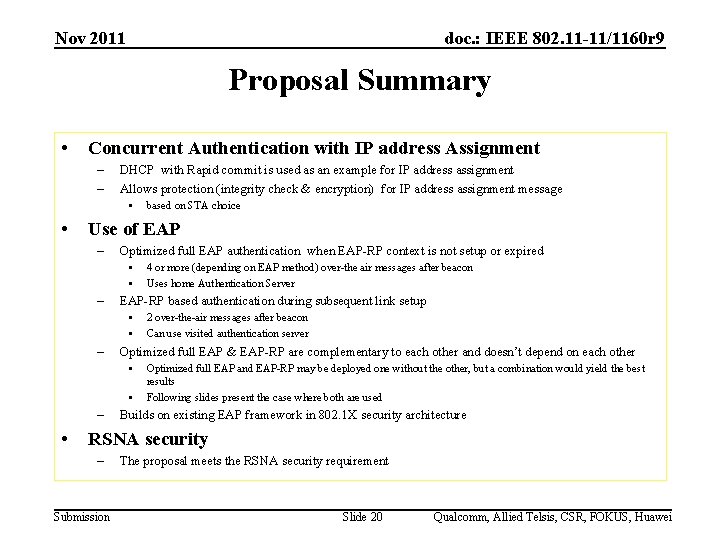
Nov 2011 doc. : IEEE 802. 11 -11/1160 r 9 Proposal Summary • Concurrent Authentication with IP address Assignment – – DHCP with Rapid commit is used as an example for IP address assignment Allows protection (integrity check & encryption) for IP address assignment message • • Use of EAP – Optimized full EAP authentication when EAP-RP context is not setup or expired • • – – 2 over-the-air messages after beacon Can use visited authentication server Optimized full EAP & EAP-RP are complementary to each other and doesn’t depend on each other • • – 4 or more (depending on EAP method) over-the air messages after beacon Uses home Authentication Server EAP-RP based authentication during subsequent link setup • • • based on STA choice Optimized full EAP and EAP-RP may be deployed one without the other, but a combination would yield the best results Following slides present the case where both are used Builds on existing EAP framework in 802. 1 X security architecture RSNA security – Submission The proposal meets the RSNA security requirement Slide 20 Qualcomm, Allied Telsis, CSR, FOKUS, Huawei
Nov 2011 doc. : IEEE 802. 11 -11/1160 r 9 Benefits of using EAP/EAP-RP for FILS • • EAP/EAP-RP allows multiple authentication protocols to be supported Allows authentication server to control which authentication protocol is used without the authenticator(Access Point) being fully configured – Authenticator can act as a “pass through” – Authenticator acts only on the outcome of authentication (say, deny access etc. ) • • Allows reuse of subscriber credentials defined for interworking with 3 GPP EPC No additional standardization effort needed for AP-AS communication No CPU intensive cryptographic computation required at the AP Minimal air interface occupancy – Proposal reduces link setup including secure IP address assignment to 1. 5 roundtrip (including beacon) when EAP-ERP is used • Allows encryption of IP address assignment req/resp Submission Slide 21 Qualcomm, Allied Telsis, CSR, FOKUS, Huawei
Nov 2011 doc. : IEEE 802. 11 -11/1160 r 9 EAP-RP Overview Submission Slide 22 Qualcomm, Allied Telsis, CSR, FOKUS, Huawei
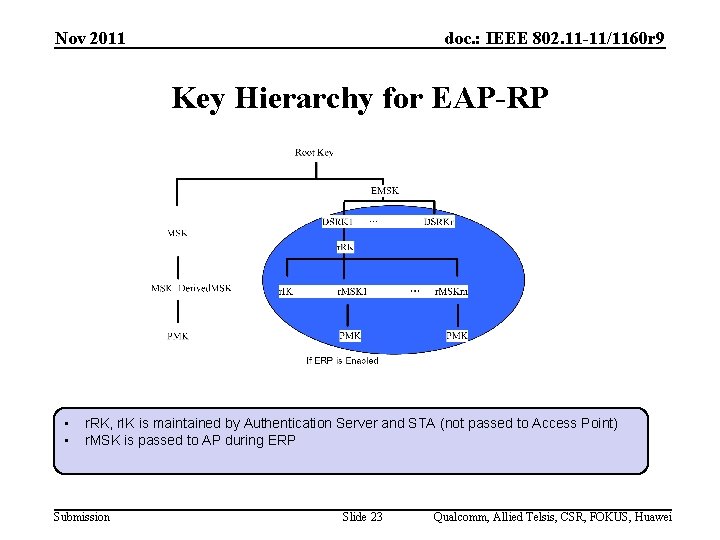
Nov 2011 doc. : IEEE 802. 11 -11/1160 r 9 Key Hierarchy for EAP-RP • • r. RK, r. IK is maintained by Authentication Server and STA (not passed to Access Point) r. MSK is passed to AP during ERP Submission Slide 23 Qualcomm, Allied Telsis, CSR, FOKUS, Huawei
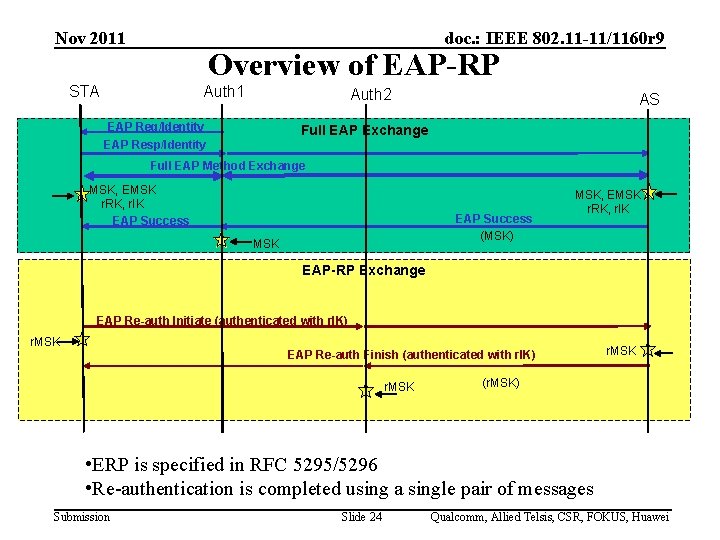
Nov 2011 doc. : IEEE 802. 11 -11/1160 r 9 Overview of EAP-RP STA Auth 1 Auth 2 EAP Req/Identity EAP Resp/Identity AS Full EAP Exchange Full EAP Method Exchange MSK, EMSK r. RK, r. IK EAP Success (MSK) MSK, EMSK r. RK, r. IK EAP-RP Exchange EAP Re-auth Initiate (authenticated with r. IK) r. MSK EAP Re-auth Finish (authenticated with r. IK) r. MSK (r. MSK) • ERP is specified in RFC 5295/5296 • Re-authentication is completed using a single pair of messages Submission Slide 24 Qualcomm, Allied Telsis, CSR, FOKUS, Huawei
Nov 2011 doc. : IEEE 802. 11 -11/1160 r 9 Proposal Details Submission Slide 25 Qualcomm, Allied Telsis, CSR, FOKUS, Huawei
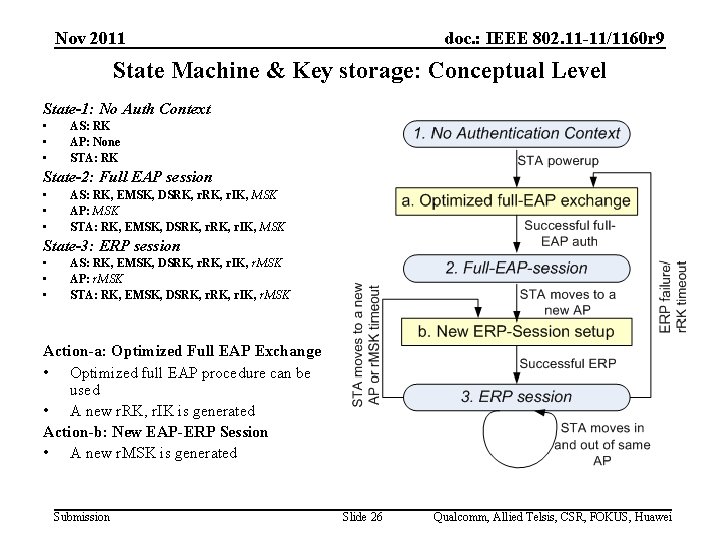
Nov 2011 doc. : IEEE 802. 11 -11/1160 r 9 State Machine & Key storage: Conceptual Level State-1: No Auth Context • • • AS: RK AP: None STA: RK State-2: Full EAP session • • • AS: RK, EMSK, DSRK, r. IK, MSK AP: MSK STA: RK, EMSK, DSRK, r. IK, MSK State-3: ERP session • • • AS: RK, EMSK, DSRK, r. IK, r. MSK AP: r. MSK STA: RK, EMSK, DSRK, r. IK, r. MSK Action-a: Optimized Full EAP Exchange • Optimized full EAP procedure can be used • A new r. RK, r. IK is generated Action-b: New EAP-ERP Session • A new r. MSK is generated Submission Slide 26 Qualcomm, Allied Telsis, CSR, FOKUS, Huawei
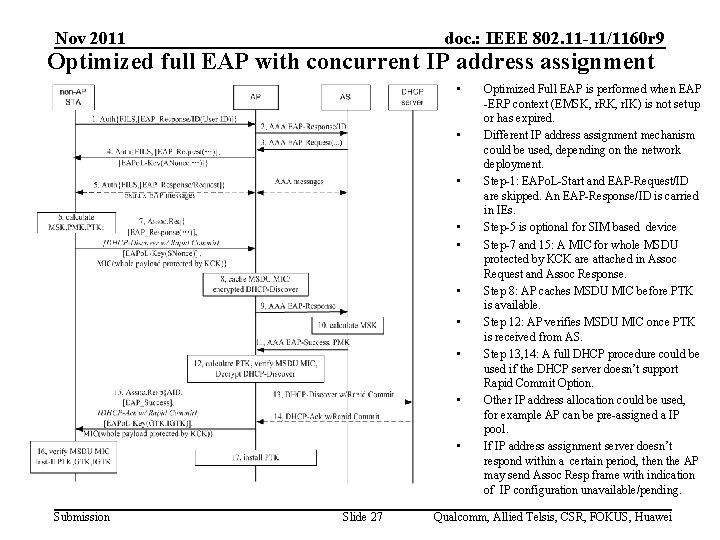
Nov 2011 doc. : IEEE 802. 11 -11/1160 r 9 Optimized full EAP with concurrent IP address assignment • • • Submission Slide 27 Optimized Full EAP is performed when EAP -ERP context (EMSK, r. RK, r. IK) is not setup or has expired. Different IP address assignment mechanism could be used, depending on the network deployment. Step-1: EAPo. L-Start and EAP-Request/ID are skipped. An EAP-Response/ID is carried in IEs. Step-5 is optional for SIM based device Step-7 and 15: A MIC for whole MSDU protected by KCK are attached in Assoc Request and Assoc Response. Step 8: AP caches MSDU MIC before PTK is available. Step 12: AP verifies MSDU MIC once PTK is received from AS. Step 13, 14: A full DHCP procedure could be used if the DHCP server doesn’t support Rapid Commit Option. Other IP address allocation could be used, for example AP can be pre-assigned a IP pool. If IP address assignment server doesn’t respond within a certain period, then the AP may send Assoc Resp frame with indication of IP configuration unavailable/pending. Qualcomm, Allied Telsis, CSR, FOKUS, Huawei
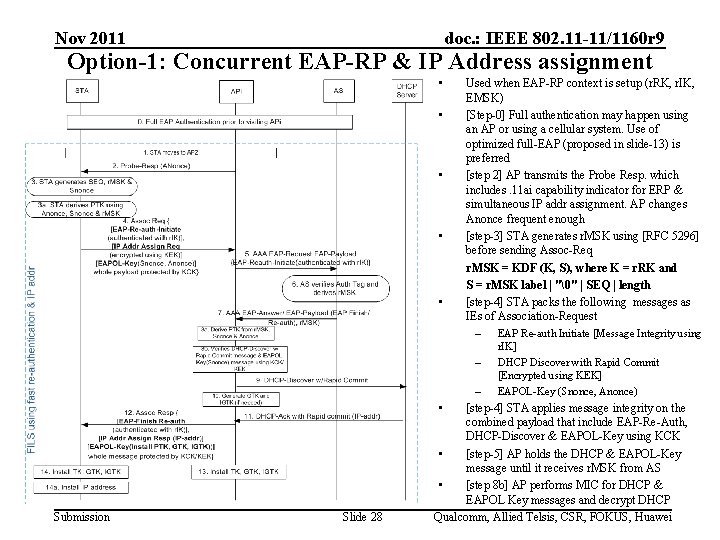
Nov 2011 doc. : IEEE 802. 11 -11/1160 r 9 Option-1: Concurrent EAP-RP & IP Address assignment • • • Used when EAP-RP context is setup (r. RK, r. IK, EMSK) [Step-0] Full authentication may happen using an AP or using a cellular system. Use of optimized full-EAP (proposed in slide-13) is preferred [step 2] AP transmits the Probe Resp. which includes. 11 ai capability indicator for ERP & simultaneous IP addr assignment. AP changes Anonce frequent enough [step-3] STA generates r. MSK using [RFC 5296] before sending Assoc-Req r. MSK = KDF (K, S), where K = r. RK and S = r. MSK label | "" | SEQ | length [step-4] STA packs the following messages as IEs of Association-Request – EAP Re-auth Initiate [Message Integrity using – • • Submission Slide 28 r. IK] DHCP Discover with Rapid Commit [Encrypted using KEK] EAPOL-Key (Snonce, Anonce) – [step-4] STA applies message integrity on the combined payload that include EAP-Re-Auth, DHCP-Discover & EAPOL-Key using KCK [step-5] AP holds the DHCP & EAPOL-Key message until it receives r. MSK from AS • [step 8 b] AP performs MIC for DHCP & EAPOL Key messages and decrypt DHCP Qualcomm, Allied Telsis, CSR, FOKUS, Huawei
doc. : IEEE 802. 11 -11/1160 r 9 Option-2: Concurrent EAP-RP & IP Address assignment with Deferred ANonce Changes w. r. t earlier option-1 • ANonce is deferred to Assoc Resp – • Assoc Req is not protected – • • Submission Slide 29 Modified 4 -way handshake STA doesn’t generate PTK at step-3 Uses Message-4 of 4 -way handshake Uses 5 -air interface messages compared to 4 air interface messages (as in option 1) Qualcomm
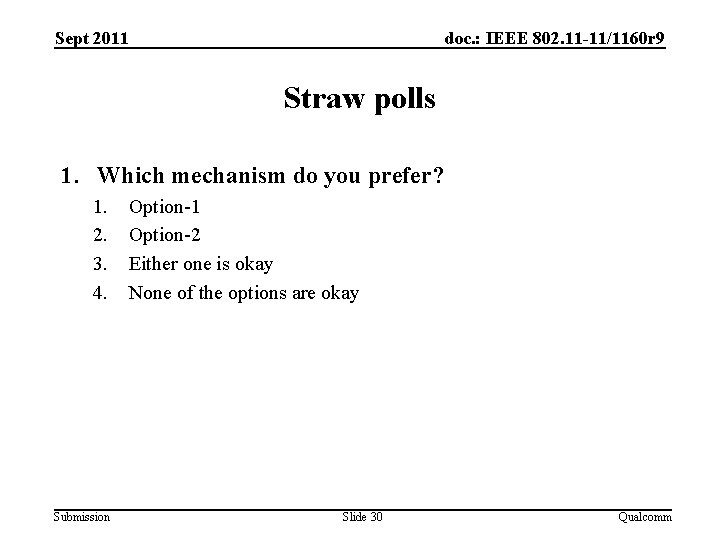
Sept 2011 doc. : IEEE 802. 11 -11/1160 r 9 Straw polls 1. Which mechanism do you prefer? 1. 2. 3. 4. Submission Option-1 Option-2 Either one is okay None of the options are okay Slide 30 Qualcomm
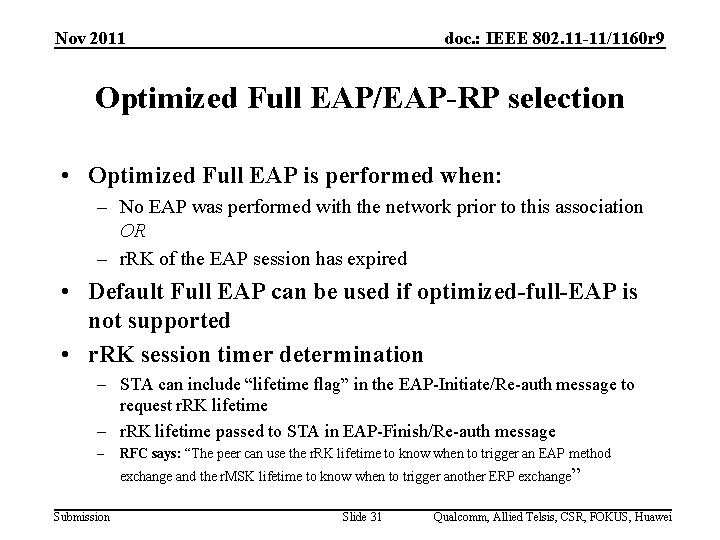
Nov 2011 doc. : IEEE 802. 11 -11/1160 r 9 Optimized Full EAP/EAP-RP selection • Optimized Full EAP is performed when: – No EAP was performed with the network prior to this association OR – r. RK of the EAP session has expired • Default Full EAP can be used if optimized-full-EAP is not supported • r. RK session timer determination – STA can include “lifetime flag” in the EAP-Initiate/Re-auth message to request r. RK lifetime – r. RK lifetime passed to STA in EAP-Finish/Re-auth message – RFC says: “The peer can use the r. RK lifetime to know when to trigger an EAP method exchange and the r. MSK lifetime to know when to trigger another ERP exchange” Submission Slide 31 Qualcomm, Allied Telsis, CSR, FOKUS, Huawei
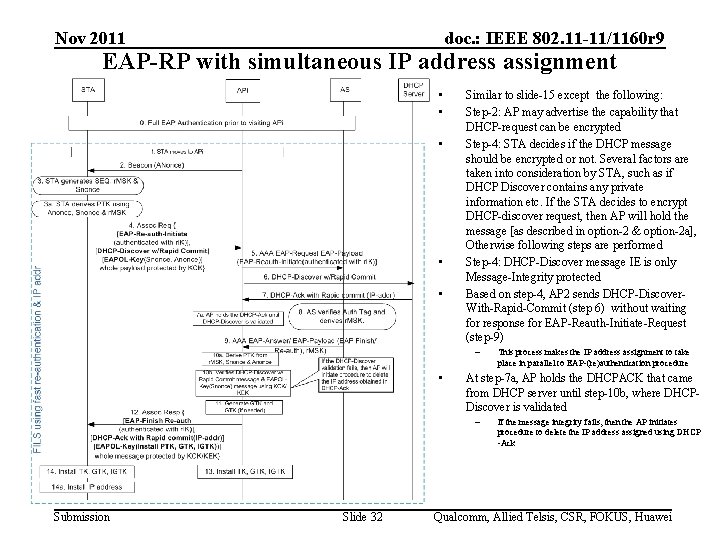
Nov 2011 doc. : IEEE 802. 11 -11/1160 r 9 EAP-RP with simultaneous IP address assignment • • • Similar to slide-15 except the following: Step-2: AP may advertise the capability that DHCP-request can be encrypted Step-4: STA decides if the DHCP message should be encrypted or not. Several factors are taken into consideration by STA, such as if DHCP Discover contains any private information etc. If the STA decides to encrypt DHCP-discover request, then AP will hold the message [as described in option-2 & option-2 a], Otherwise following steps are performed Step-4: DHCP-Discover message IE is only Message-Integrity protected Based on step-4, AP 2 sends DHCP-Discover. With-Rapid-Commit (step 6) without waiting for response for EAP-Reauth-Initiate-Request (step-9) – • At step-7 a, AP holds the DHCPACK that came from DHCP server until step-10 b, where DHCPDiscover is validated – Submission Slide 32 This process makes the IP address assignment to take place in parallel to EAP-(re)authentication procedure If the message integrity fails, then the AP initiates procedure to delete the IP address assigned using DHCP -Ack Qualcomm, Allied Telsis, CSR, FOKUS, Huawei
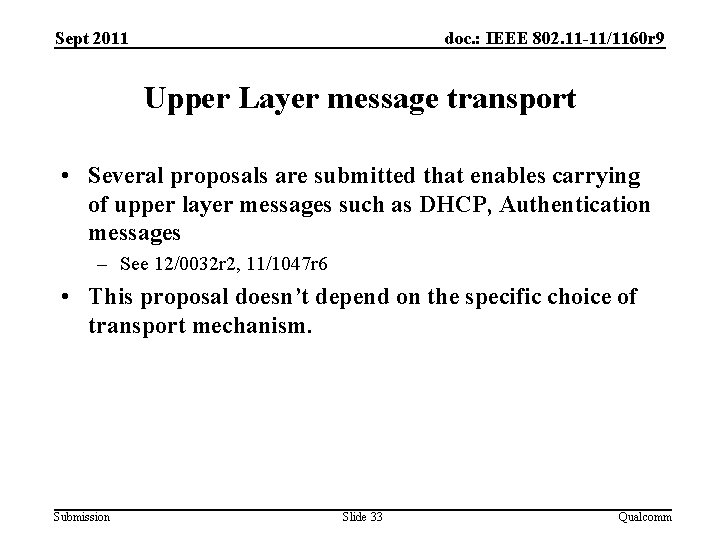
Sept 2011 doc. : IEEE 802. 11 -11/1160 r 9 Upper Layer message transport • Several proposals are submitted that enables carrying of upper layer messages such as DHCP, Authentication messages – See 12/0032 r 2, 11/1047 r 6 • This proposal doesn’t depend on the specific choice of transport mechanism. Submission Slide 33 Qualcomm
Nov 2011 doc. : IEEE 802. 11 -11/1160 r 9 Response to Questions Submission Slide 34 Qualcomm, Allied Telsis, CSR, FOKUS, Huawei
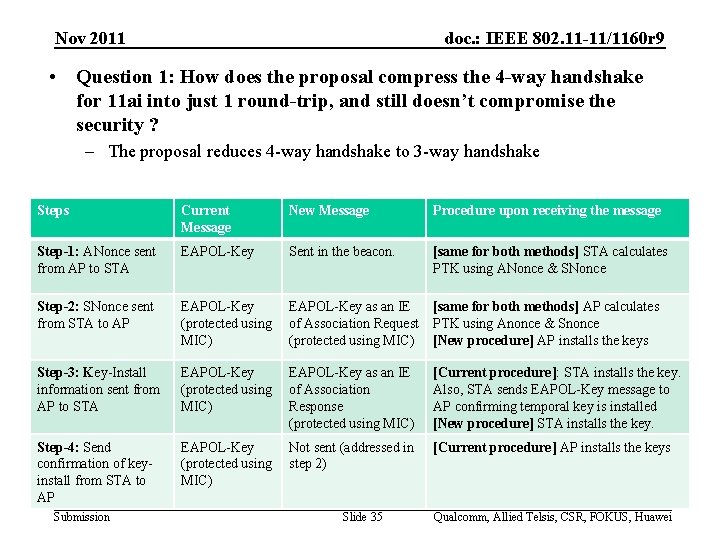
Nov 2011 doc. : IEEE 802. 11 -11/1160 r 9 • Question 1: How does the proposal compress the 4 -way handshake for 11 ai into just 1 round-trip, and still doesn’t compromise the security ? – The proposal reduces 4 -way handshake to 3 -way handshake Steps Current Message New Message Procedure upon receiving the message Step-1: ANonce sent from AP to STA EAPOL-Key Sent in the beacon. [same for both methods] STA calculates PTK using ANonce & SNonce Step-2: SNonce sent from STA to AP EAPOL-Key as an IE (protected using of Association Request MIC) (protected using MIC) [same for both methods] AP calculates PTK using Anonce & Snonce [New procedure] AP installs the keys Step-3: Key-Install information sent from AP to STA EAPOL-Key as an IE (protected using of Association MIC) Response (protected using MIC) [Current procedure]: STA installs the key. Also, STA sends EAPOL-Key message to AP confirming temporal key is installed [New procedure] STA installs the key. Step-4: Send confirmation of keyinstall from STA to AP EAPOL-Key Not sent (addressed in (protected using step 2) MIC) [Current procedure] AP installs the keys Submission Slide 35 Qualcomm, Allied Telsis, CSR, FOKUS, Huawei
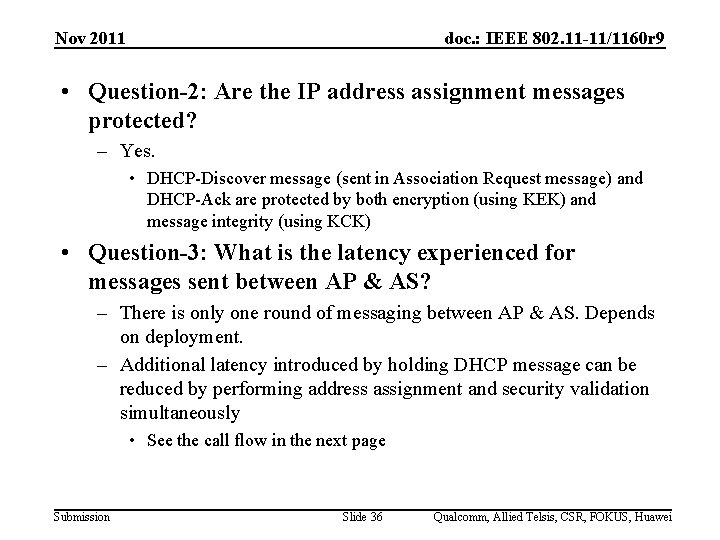
Nov 2011 doc. : IEEE 802. 11 -11/1160 r 9 • Question-2: Are the IP address assignment messages protected? – Yes. • DHCP-Discover message (sent in Association Request message) and DHCP-Ack are protected by both encryption (using KEK) and message integrity (using KCK) • Question-3: What is the latency experienced for messages sent between AP & AS? – There is only one round of messaging between AP & AS. Depends on deployment. – Additional latency introduced by holding DHCP message can be reduced by performing address assignment and security validation simultaneously • See the call flow in the next page Submission Slide 36 Qualcomm, Allied Telsis, CSR, FOKUS, Huawei
Nov 2011 doc. : IEEE 802. 11 -11/1160 r 9 • Question-4: Can you transfer state information across networks so that you don’t have to repeat EAP, every time you switch networks? – STA may have a large interval (with no Wi. Fi connectivity) after leaving the first AP (where the STA had a connectivity) before it connects to a new AP – Caching the information for a large number of STAs over a large period of time is not scalable • Question-5: What happens if EAP-RP fails? – Falls back to full-EAP • Question-6: What to do if AP has multiple AS’s? How does the STA know which key to use ? – Even though AP may be connected to multiple AS’s, only one AS should be used for an STA. – AP forwards EAP messages to the appropriate AS based on the identity sent by the STA in “key. Name-NAI” sent in the ERP-Initiate/Re-auth message Submission Slide 37 Qualcomm, Allied Telsis, CSR, FOKUS, Huawei
Nov 2011 doc. : IEEE 802. 11 -11/1160 r 9 • Question-7: How does STA know the full-authentication timer so that STA may proactively perform full authentication? – STA can include “lifetime flag” in the EAP-Initiate/Re-auth message to request r. RK lifetime – r. RK lifetime passed to STA in EAP-Finish/Re-auth message – RFC says: “The peer can use the r. RK lifetime to know when to trigger an EAP method exchange and the r. MSK lifetime to know when to trigger another ERP exchange” Submission Slide 38 Qualcomm, Allied Telsis, CSR, FOKUS, Huawei
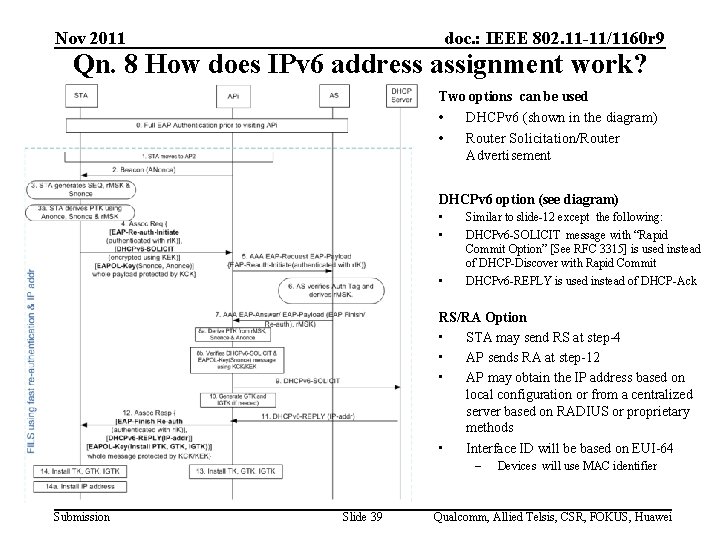
Nov 2011 doc. : IEEE 802. 11 -11/1160 r 9 Qn. 8 How does IPv 6 address assignment work? Two options can be used • DHCPv 6 (shown in the diagram) • Router Solicitation/Router Advertisement DHCPv 6 option (see diagram) • • • Similar to slide-12 except the following: DHCPv 6 -SOLICIT message with “Rapid Commit Option” [See RFC 3315] is used instead of DHCP-Discover with Rapid Commit DHCPv 6 -REPLY is used instead of DHCP-Ack RS/RA Option • STA may send RS at step-4 • AP sends RA at step-12 • AP may obtain the IP address based on local configuration or from a centralized server based on RADIUS or proprietary methods • Interface ID will be based on EUI-64 – Submission Slide 39 Devices will use MAC identifier Qualcomm, Allied Telsis, CSR, FOKUS, Huawei
Nov 2011 doc. : IEEE 802. 11 -11/1160 r 9 • Qn. 9 How does STA know the support of IP address type and IP address assignment method? – Beacon/Probe-Response sent from the AP includes the following information • IP address type supported – IPv 4, IPv 6, IPv 4 v 6 • IP address assignment method supported – DHCP, DHCPv 6, RS/RA, etc. Submission Slide 40 Qualcomm, Allied Telsis, CSR, FOKUS, Huawei