
May 2004 doc IEEE 802 15 040253 r
- Slides: 55
May 2004 doc. : IEEE 802. 15 -04/0253 r 0 Project: IEEE P 802. 15 Working Group for Wireless Personal Area Networks (WPANs) Submission Title: [SSA-UWB and Cognitive Radio: a suggestion for global harmonization and compromise in IEEE 802. 15. 3 a WPAN] Date Submitted: [11 May, 2004] Source: [Honggang Zhang, Kamya Y. Yazdandoost, Keren Li, Ryuji Kohno ] Company [ National Institute of Information and Communications Technology (NICT)] Connector’s Address [3 -4, Hikarino-oka, Yokosuka, 239 -0847, Japan] Voice: [+81 -468 -47 -5101], FAX: [+81 -468 -47 -5431], E-Mail: [honggang@nict. go. jp, yazdandoost@nict. go. jp, keren@nict. go. jp, kohno@nict. go. jp] Re: [IEEE P 802. 15 Alternative PHY Call For Proposals, IEEE P 802. 15 -02/327 r 7] Abstract: [In order to realize the global harmonization and compromise in IEEE 802. 15. 3 a UWB WPAN, PSWF-based SSA-UWB systems with improved Common Signaling Mode (CSM) are investigated in NICT and the recent investigation results are briefly summarized. ] Purpose: [For investigating the characteristics of High Rate Alternative PHY standard in 802. 15 TG 3 a, based on the Soft-Spectrum Adaptation (SSA) proposal by NICT. ] Notice: This document has been prepared to assist the IEEE P 802. 15. It is offered as a basis for discussion and is not binding on the contributing individual(s) or organization(s). The material in this document is subject to change in form and content after further study. The contributor(s) reserve(s) the right to add, amend or withdraw material contained herein. Release: The contributor acknowledges and accepts that this contribution becomes the property of IEEE and may be made publicly available by P 802. 15. Submission 1 Honggang ZHANG, NICT
May 2004 doc. : IEEE 802. 15 -04/0253 r 0 SSA-UWB and Cognitive Radio: A Suggestion for Global Harmonization and Compromise in IEEE 802. 15. 3 a WPAN Honggang ZHANG, Kamya Y. YAZDANDOOST, Keren LI, Ryuji KOHNO National Institute of Information and Communications Technology (NICT) Submission 2 Honggang ZHANG, NICT
May 2004 doc. : IEEE 802. 15 -04/0253 r 0 Outline of presentation 1. Brief historical retrospect of SSA-UWB PHY proposal 2. Description of Cognitive Radio (CR) concept 3. Global harmonization and compromise based on SSA-UWB and Cognitive Radio 4. Improved Common Signaling Mode (ICSM) using PSWF-type SSA pulse wavelets 5. 4. Design and implementation of PSWF-type SSA pulse wavelets 6. 5. Conclusion remarks 6. Backup materials Submission 3 Honggang ZHANG, NICT
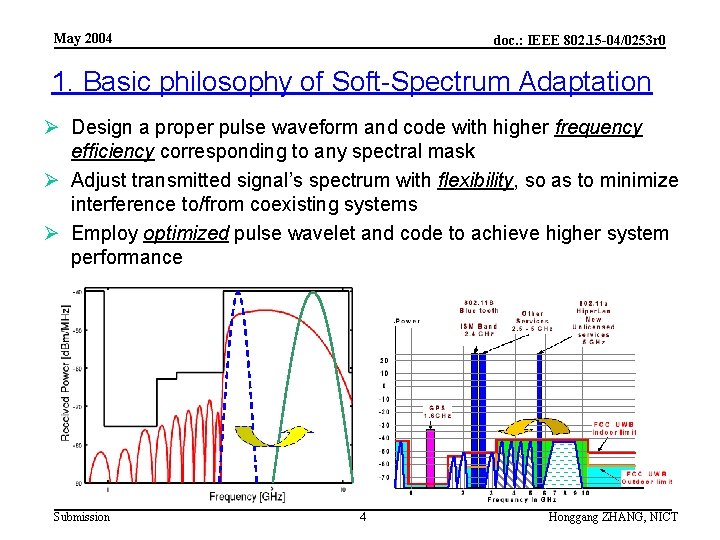
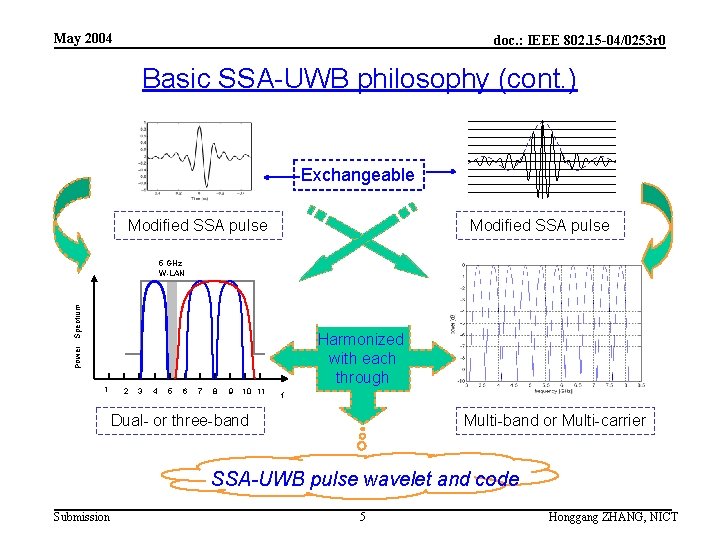
May 2004 doc. : IEEE 802. 15 -04/0253 r 0 1. Basic philosophy of Soft-Spectrum Adaptation Ø Design a proper pulse waveform and code with higher frequency efficiency corresponding to any spectral mask Ø Adjust transmitted signal’s spectrum with flexibility, so as to minimize interference to/from coexisting systems Ø Employ optimized pulse wavelet and code to achieve higher system performance Submission 4 Honggang ZHANG, NICT
May 2004 doc. : IEEE 802. 15 -04/0253 r 0 Basic SSA-UWB philosophy (cont. ) Exchangeable Modified SSA pulse Power Spectrum 5 GHz W-LAN 1 2 3 4 5 6 7 8 9 10 11 Harmonized with each through f Dual- or three-band Multi-band or Multi-carrier SSA-UWB pulse wavelet and code Submission 5 Honggang ZHANG, NICT
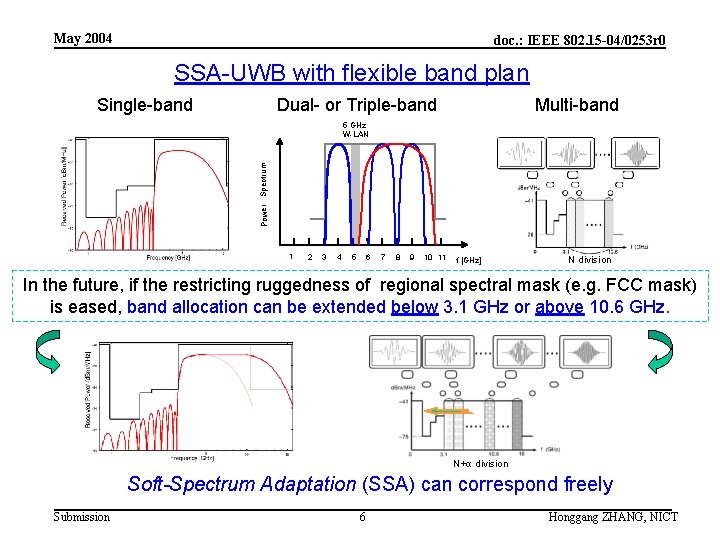
May 2004 doc. : IEEE 802. 15 -04/0253 r 0 SSA-UWB with flexible band plan Single-band Dual- or Triple-band Multi-band Power Spectrum 5 GHz W-LAN 1 2 3 4 5 6 7 8 9 10 11 f [GHz] N division In the future, if the restricting ruggedness of regional spectral mask (e. g. FCC mask) is eased, band allocation can be extended below 3. 1 GHz or above 10. 6 GHz. N+α division Soft-Spectrum Adaptation (SSA) can correspond freely Submission 6 Honggang ZHANG, NICT
May 2004 doc. : IEEE 802. 15 -04/0253 r 0 Features of SSA-UWB Ø SSA-UWB with flexible pulse waveform, code and frequency band can be applied to single and multiband/multi-carrier UWB. Ø Interference avoidance for co-existence, harmonization for various systems, and global implementation can be realized. SSA-UWB can flexibly adjust UWB signal spectrum so as to match with any spectral restriction, i. e. spectral masks in both cases of single and multiple bands. Ø Scalable, adaptive performance improvement. Ø Smooth system version-up similar to Software Defined Radio (SDR) and Cognitive Radio (CR). Submission 7 Honggang ZHANG, NICT
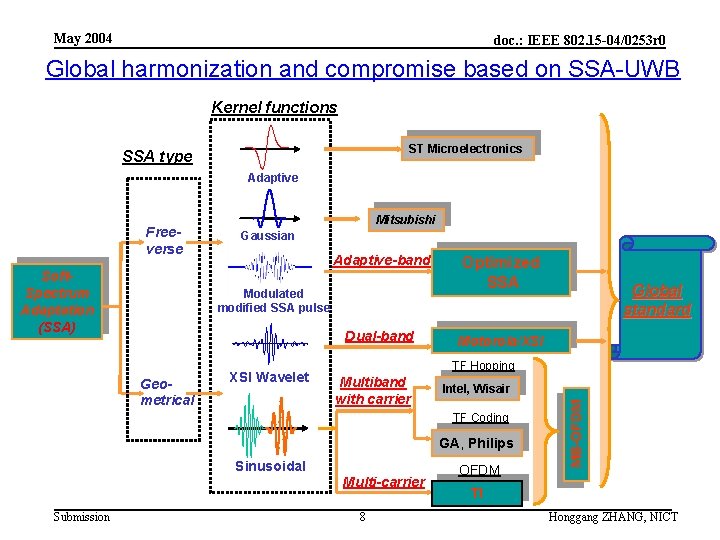
May 2004 doc. : IEEE 802. 15 -04/0253 r 0 Global harmonization and compromise based on SSA-UWB Kernel functions ST Microelectronics SSA type Adaptive Soft. Spectrum Adaptation (SSA) Gaussian Adaptive-band Modulated modified SSA pulse Dual-band Geometrical XSI Wavelet Optimized SSA Motorola/XSI TF Hopping Multiband with carrier Intel, Wisair TF Coding GA, Philips Sinusoidal Multi-carrier Submission Global standard 8 OFDM MB-OFDM Freeverse Mitsubishi TI Honggang ZHANG, NICT
May 2004 doc. : IEEE 802. 15 -04/0253 r 0 2. Improving spectrum usage through Cognitive Radio (CR) technology “ A Cognitive Radio is a radio frequency transmitter/receiver that is designed to intelligently detect whether a particular segment of the radio spectrum is currently in use, and to jump into (and out of, as necessary) the temporarily-unused spectrum very rapidly, without interfering with the transmissions of other authorized users. ” http: //www. ieeeusa. org/forum/POSITIONS/cognitiveradio. html Submission 9 Honggang ZHANG, NICT
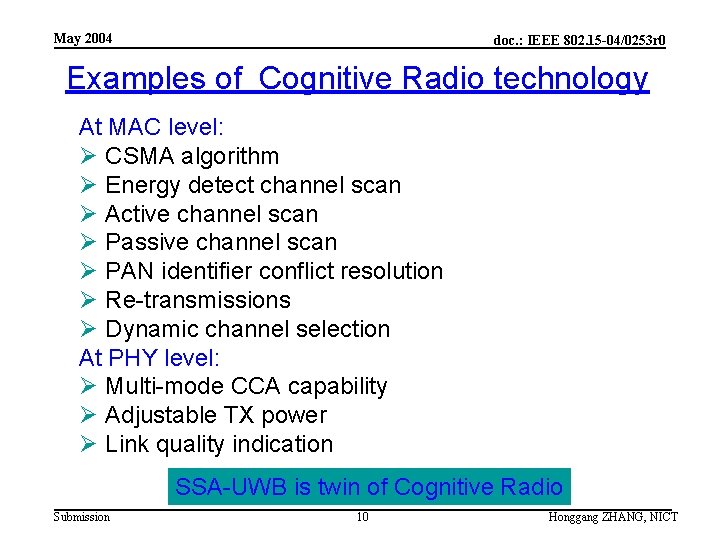
May 2004 doc. : IEEE 802. 15 -04/0253 r 0 Examples of Cognitive Radio technology At MAC level: Ø CSMA algorithm Ø Energy detect channel scan Ø Active channel scan Ø Passive channel scan Ø PAN identifier conflict resolution Ø Re-transmissions Ø Dynamic channel selection At PHY level: Ø Multi-mode CCA capability Ø Adjustable TX power Ø Link quality indication SSA-UWB is twin of Cognitive Radio Submission 10 Honggang ZHANG, NICT
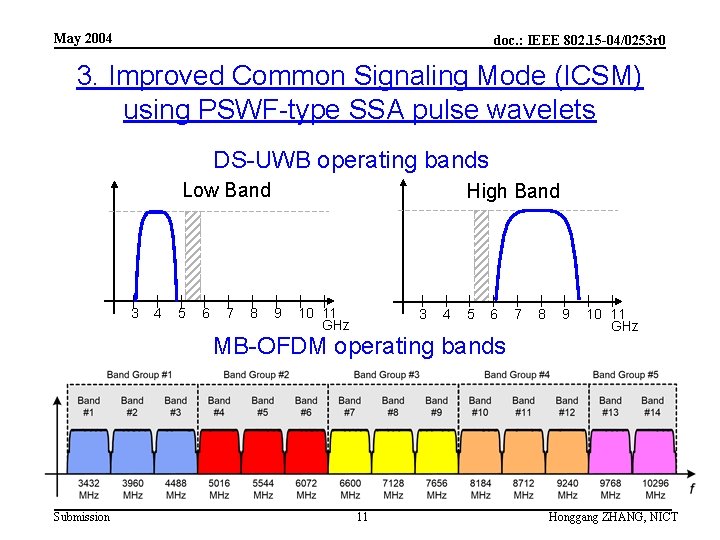
May 2004 doc. : IEEE 802. 15 -04/0253 r 0 3. Improved Common Signaling Mode (ICSM) using PSWF-type SSA pulse wavelets DS-UWB operating bands Low Band 3 4 5 6 7 8 High Band 9 10 11 GHz 3 4 5 6 MB-OFDM operating bands Submission 11 7 8 9 10 11 GHz Honggang ZHANG, NICT
May 2004 doc. : IEEE 802. 15 -04/0253 r 0 Overview of band division and multipiconets in DS-UWB and MB-OFDM 1. DS-UWB has two band group: low band high band • 2 x center frequency and bandwidth in high band • Support for 6 piconets in each of low band high band 2. MB-OFDM has added full FDM support for multiple piconets using band groups • New band groups have higher frequencies • All use same Time-Frequency-Codes (TFC) Submission 12 Honggang ZHANG, NICT
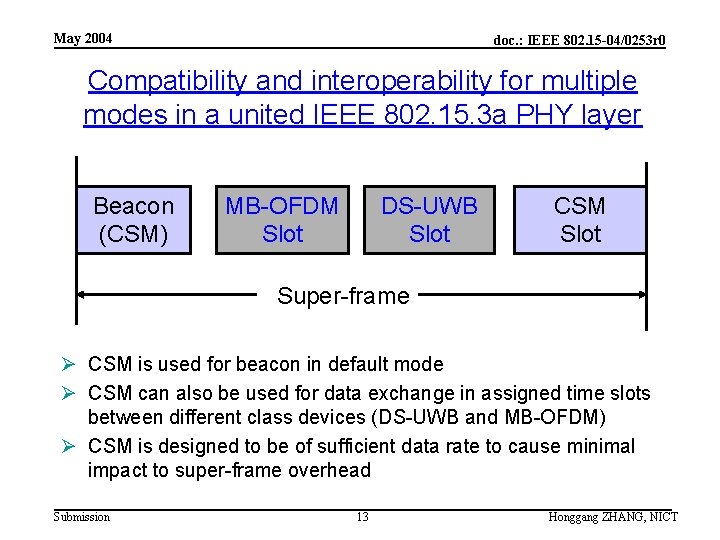
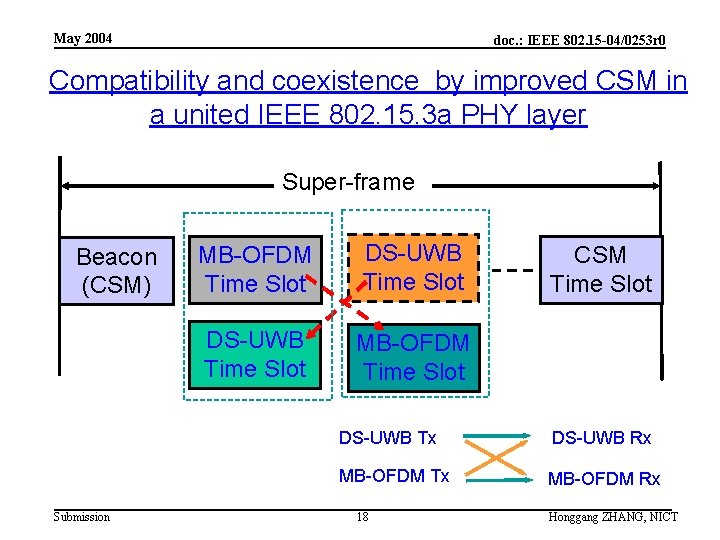
May 2004 doc. : IEEE 802. 15 -04/0253 r 0 Compatibility and interoperability for multiple modes in a united IEEE 802. 15. 3 a PHY layer Beacon (CSM) MB-OFDM Slot DS-UWB Slot CSM Slot Super-frame Ø CSM is used for beacon in default mode Ø CSM can also be used for data exchange in assigned time slots between different class devices (DS-UWB and MB-OFDM) Ø CSM is designed to be of sufficient data rate to cause minimal impact to super-frame overhead Submission 13 Honggang ZHANG, NICT
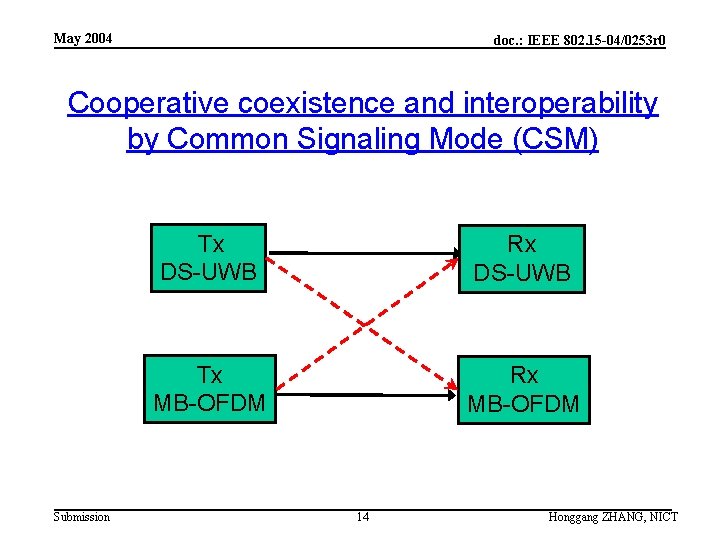
May 2004 doc. : IEEE 802. 15 -04/0253 r 0 Cooperative coexistence and interoperability by Common Signaling Mode (CSM) Submission Tx DS-UWB Rx DS-UWB Tx MB-OFDM Rx MB-OFDM 14 Honggang ZHANG, NICT
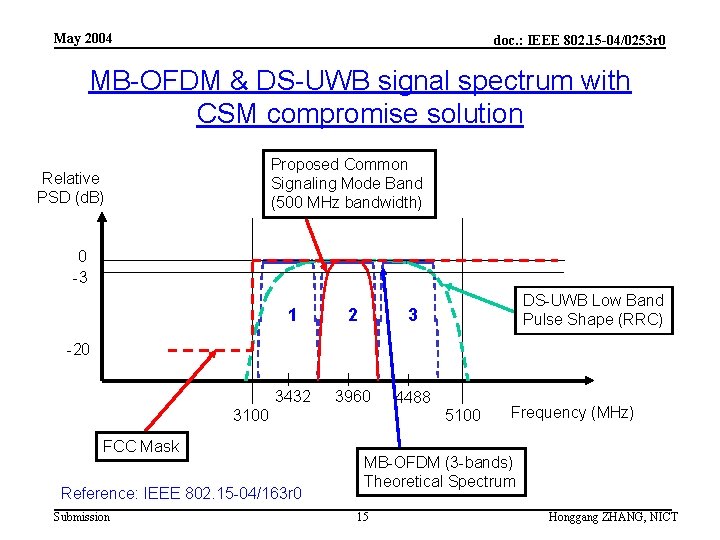
May 2004 doc. : IEEE 802. 15 -04/0253 r 0 MB-OFDM & DS-UWB signal spectrum with CSM compromise solution Proposed Common Signaling Mode Band (500 MHz bandwidth) Relative PSD (d. B) 0 -3 1 2 3 3432 3960 4488 DS-UWB Low Band Pulse Shape (RRC) -20 3100 FCC Mask Reference: IEEE 802. 15 -04/163 r 0 Submission 5100 Frequency (MHz) MB-OFDM (3 -bands) Theoretical Spectrum 15 Honggang ZHANG, NICT
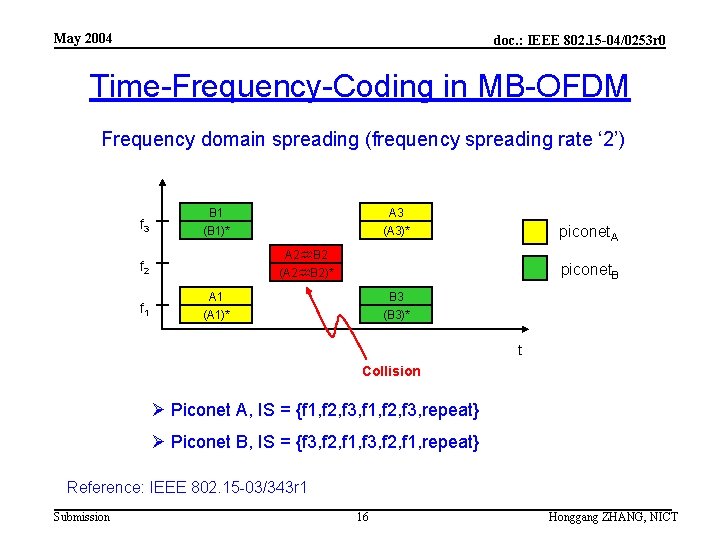
May 2004 doc. : IEEE 802. 15 -04/0253 r 0 Time-Frequency-Coding in MB-OFDM Frequency domain spreading (frequency spreading rate ‘ 2’) f 3 B 1 A 3 (B 1)* (A 3)* A 2 B 2 (A 2 B 2)* f 2 f 1 piconet. A piconet. B A 1 (A 1)* B 3 (B 3)* t Collision Ø Piconet A, IS = {f 1, f 2, f 3, repeat} Ø Piconet B, IS = {f 3, f 2, f 1, repeat} Reference: IEEE 802. 15 -03/343 r 1 Submission 16 Honggang ZHANG, NICT
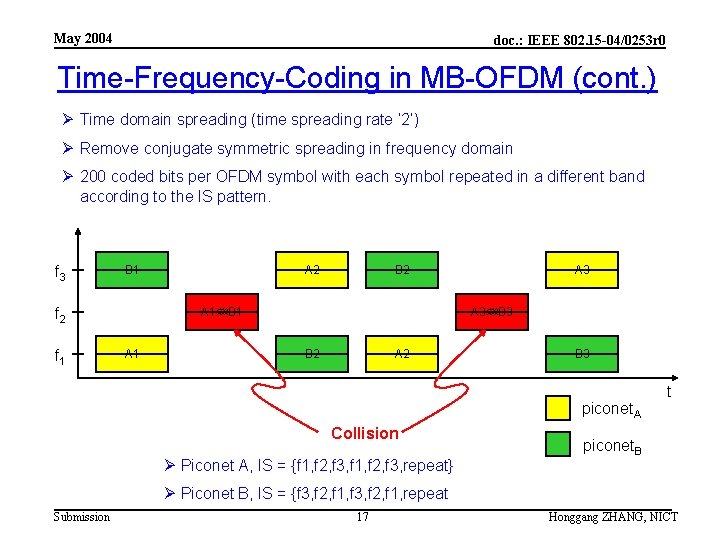
May 2004 doc. : IEEE 802. 15 -04/0253 r 0 Time-Frequency-Coding in MB-OFDM (cont. ) Ø Time domain spreading (time spreading rate ‘ 2’) Ø Remove conjugate symmetric spreading in frequency domain Ø 200 coded bits per OFDM symbol with each symbol repeated in a different band according to the IS pattern. f 3 B 1 f 2 f 1 A 2 B 2 A 1 B 1 A 3 A 3 B 2 A 2 B 3 piconet. A Collision Ø Piconet A, IS = {f 1, f 2, f 3, repeat} t piconet. B Ø Piconet B, IS = {f 3, f 2, f 1, repeat Submission 17 Honggang ZHANG, NICT
May 2004 doc. : IEEE 802. 15 -04/0253 r 0 Compatibility and coexistence by improved CSM in a united IEEE 802. 15. 3 a PHY layer Super-frame Beacon (CSM) Submission MB-OFDM Time Slot DS-UWB Time Slot MB-OFDM Time Slot CSM Time Slot DS-UWB Tx DS-UWB Rx MB-OFDM Tx MB-OFDM Rx 18 Honggang ZHANG, NICT
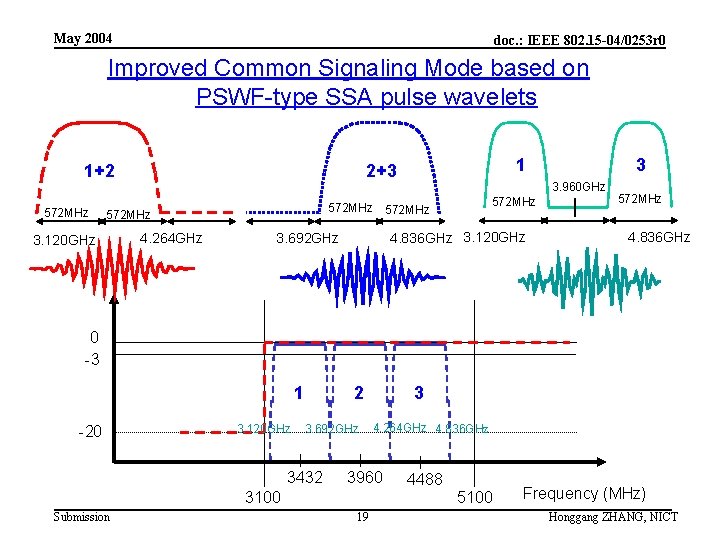
May 2004 doc. : IEEE 802. 15 -04/0253 r 0 Improved Common Signaling Mode based on PSWF-type SSA pulse wavelets 1+2 572 MHz 4. 264 GHz 572 MHz 4. 836 GHz 3. 120 GHz 3. 692 GHz 3 3. 960 GHz 572 MHz 3. 120 GHz 1 2+3 572 MHz 4. 836 GHz 0 -3 1 -20 3. 120 GHz 2 3. 692 GHz 3432 4. 264 GHz 4. 836 GHz 3960 3100 Submission 3 4488 5100 19 Frequency (MHz) Honggang ZHANG, NICT
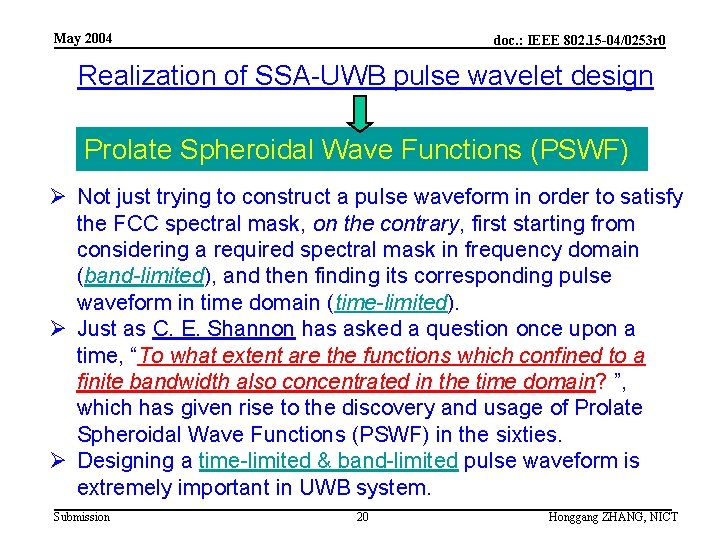
May 2004 doc. : IEEE 802. 15 -04/0253 r 0 Realization of SSA-UWB pulse wavelet design Prolate Spheroidal Wave Functions (PSWF) Ø Not just trying to construct a pulse waveform in order to satisfy the FCC spectral mask, on the contrary, first starting from considering a required spectral mask in frequency domain (band-limited), and then finding its corresponding pulse waveform in time domain (time-limited). Ø Just as C. E. Shannon has asked a question once upon a time, “To what extent are the functions which confined to a finite bandwidth also concentrated in the time domain? ”, which has given rise to the discovery and usage of Prolate Spheroidal Wave Functions (PSWF) in the sixties. Ø Designing a time-limited & band-limited pulse waveform is extremely important in UWB system. Submission 20 Honggang ZHANG, NICT
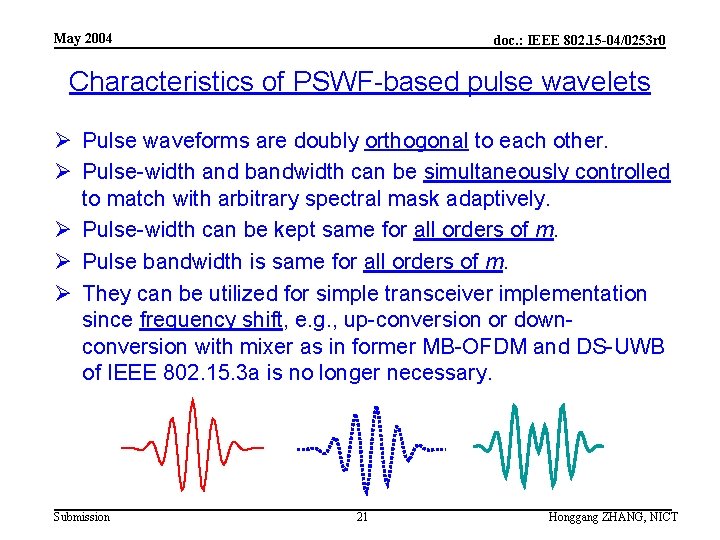
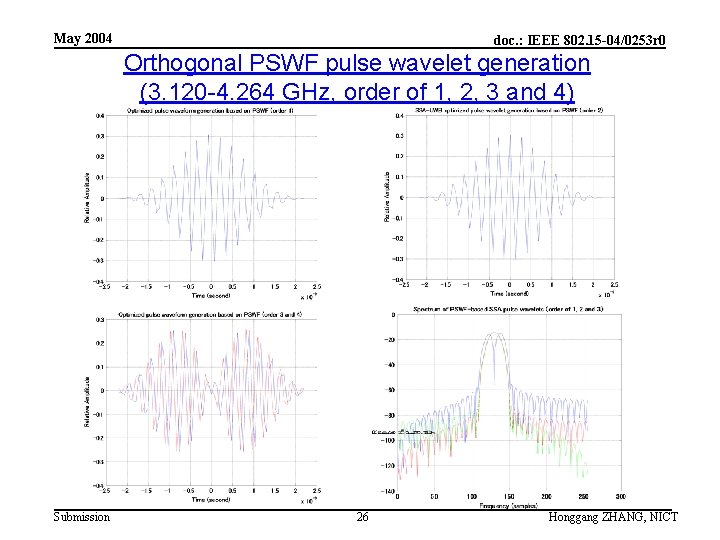
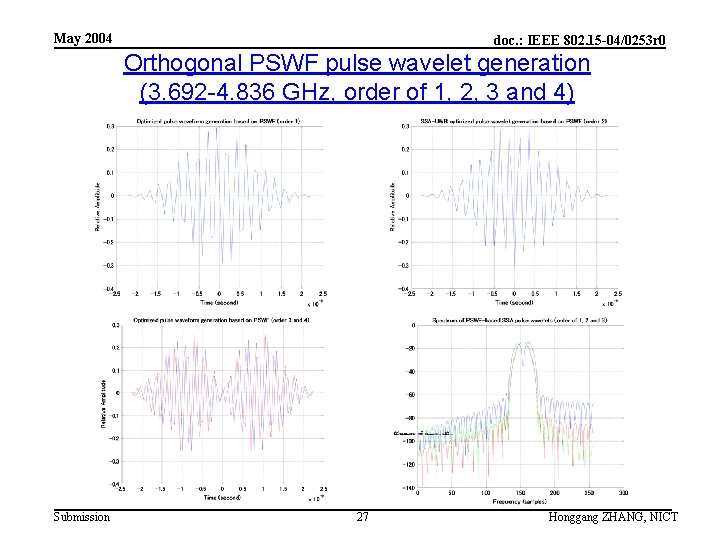
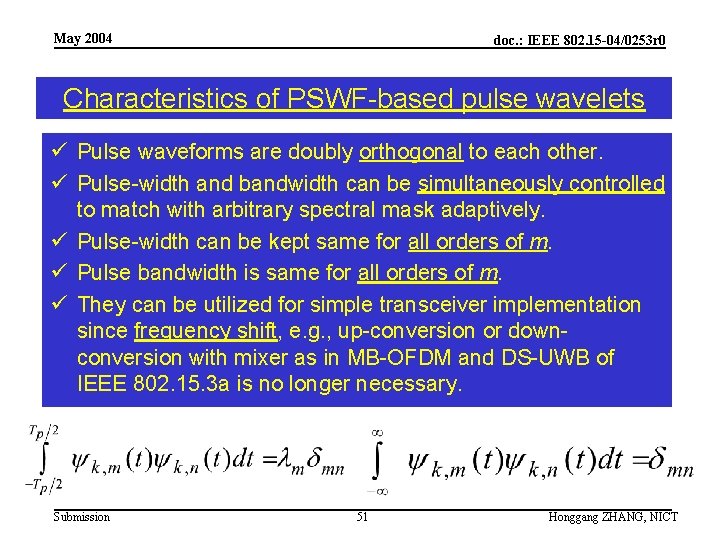
May 2004 doc. : IEEE 802. 15 -04/0253 r 0 Characteristics of PSWF-based pulse wavelets Ø Pulse waveforms are doubly orthogonal to each other. Ø Pulse-width and bandwidth can be simultaneously controlled to match with arbitrary spectral mask adaptively. Ø Pulse-width can be kept same for all orders of m. Ø Pulse bandwidth is same for all orders of m. Ø They can be utilized for simple transceiver implementation since frequency shift, e. g. , up-conversion or downconversion with mixer as in former MB-OFDM and DS-UWB of IEEE 802. 15. 3 a is no longer necessary. Submission 21 Honggang ZHANG, NICT
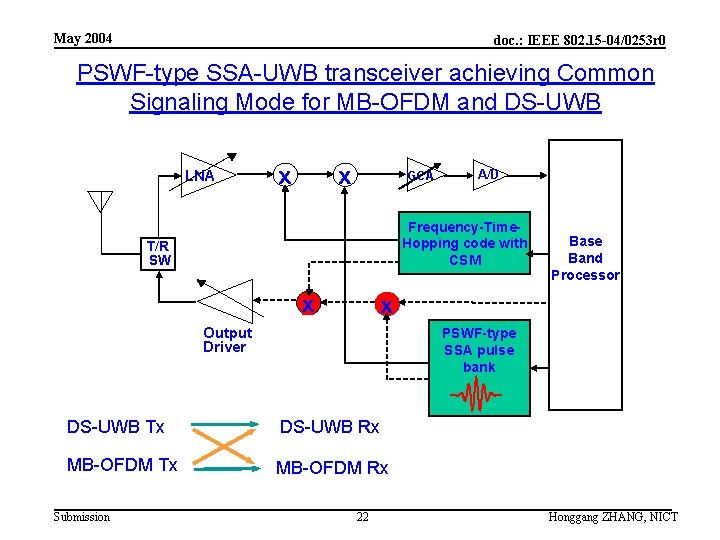
May 2004 doc. : IEEE 802. 15 -04/0253 r 0 PSWF-type SSA-UWB transceiver achieving Common Signaling Mode for MB-OFDM and DS-UWB LNA X X GCA Frequency-Time. Hopping code with CSM T/R SW X Base Band Processor X Output Driver PSWF-type SSA pulse bank DS-UWB Tx DS-UWB Rx MB-OFDM Tx MB-OFDM Rx Submission A/D 22 Honggang ZHANG, NICT
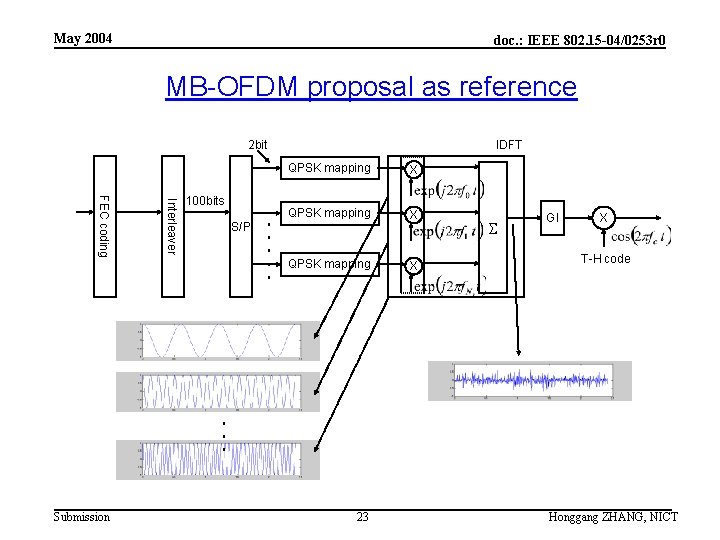
May 2004 doc. : IEEE 802. 15 -04/0253 r 0 MB-OFDM proposal as reference 2 bit Interleaver FEC coding 100 bits S/P ・ ・ ・ IDFT QPSK mapping X S GI X T-H code ・ ・ ・ Submission 23 Honggang ZHANG, NICT
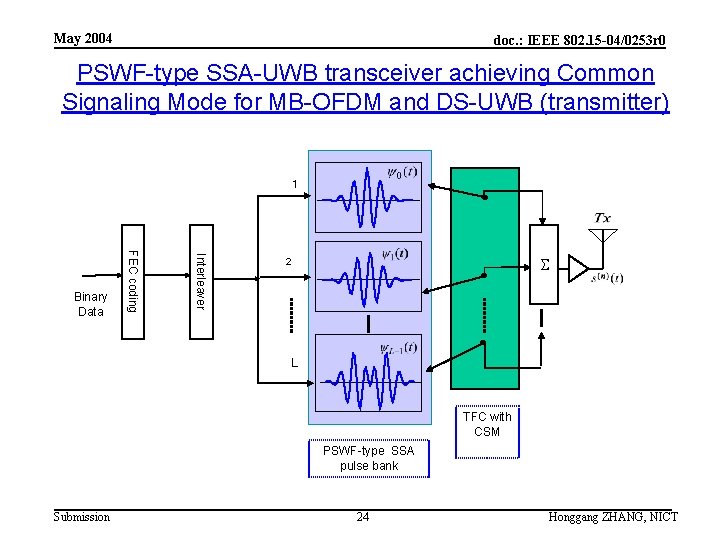
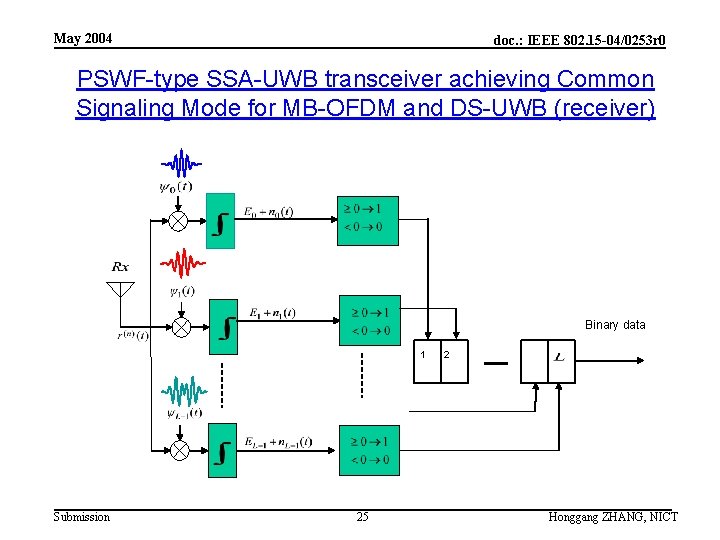
May 2004 doc. : IEEE 802. 15 -04/0253 r 0 PSWF-type SSA-UWB transceiver achieving Common Signaling Mode for MB-OFDM and DS-UWB (transmitter) 1 Interleaver FEC coding Binary Data S 2 L TFC with CSM PSWF-type SSA pulse bank Submission 24 Honggang ZHANG, NICT
May 2004 doc. : IEEE 802. 15 -04/0253 r 0 PSWF-type SSA-UWB transceiver achieving Common Signaling Mode for MB-OFDM and DS-UWB (receiver) Binary data 1 Submission 25 2 Honggang ZHANG, NICT
May 2004 doc. : IEEE 802. 15 -04/0253 r 0 Orthogonal PSWF pulse wavelet generation (3. 120 -4. 264 GHz, order of 1, 2, 3 and 4) Submission 26 Honggang ZHANG, NICT
May 2004 doc. : IEEE 802. 15 -04/0253 r 0 Orthogonal PSWF pulse wavelet generation (3. 692 -4. 836 GHz, order of 1, 2, 3 and 4) Submission 27 Honggang ZHANG, NICT
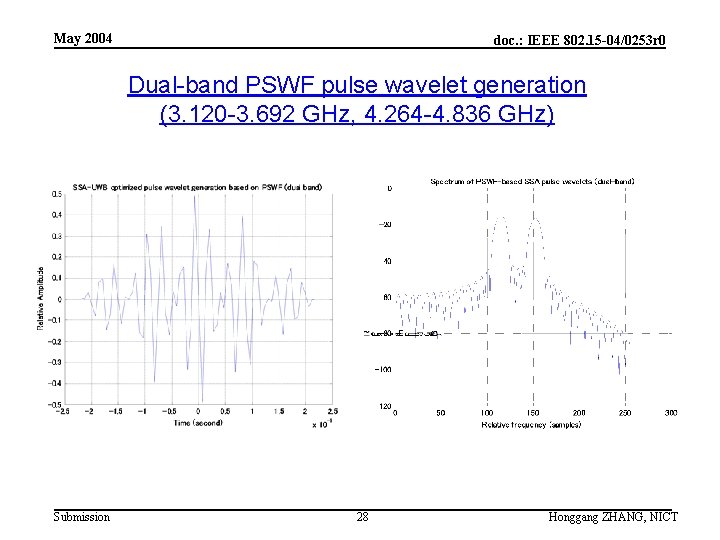
May 2004 doc. : IEEE 802. 15 -04/0253 r 0 Dual-band PSWF pulse wavelet generation (3. 120 -3. 692 GHz, 4. 264 -4. 836 GHz) Submission 28 Honggang ZHANG, NICT
May 2004 doc. : IEEE 802. 15 -04/0253 r 0 4. Design and implementation of PSWF-type SSA pulse wavelets Effects of UWB antennas on implementation of PSWF-type SSA pulse wavelets Submission 29 Honggang ZHANG, NICT
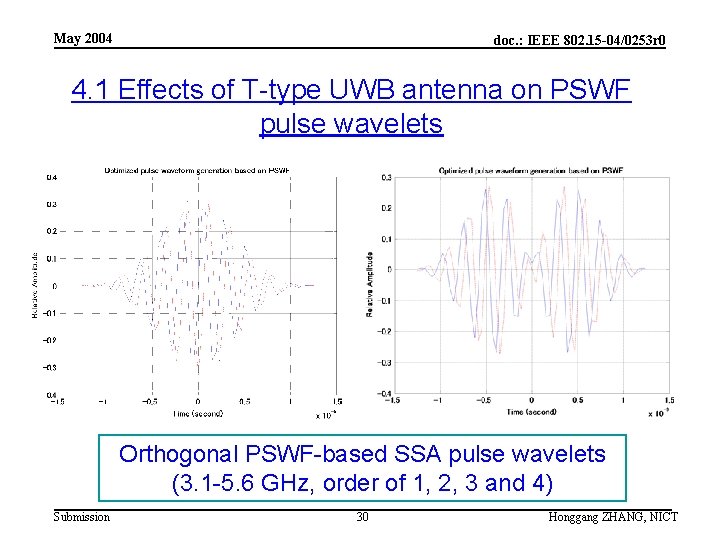
May 2004 doc. : IEEE 802. 15 -04/0253 r 0 4. 1 Effects of T-type UWB antenna on PSWF pulse wavelets Orthogonal PSWF-based SSA pulse wavelets (3. 1 -5. 6 GHz, order of 1, 2, 3 and 4) Submission 30 Honggang ZHANG, NICT
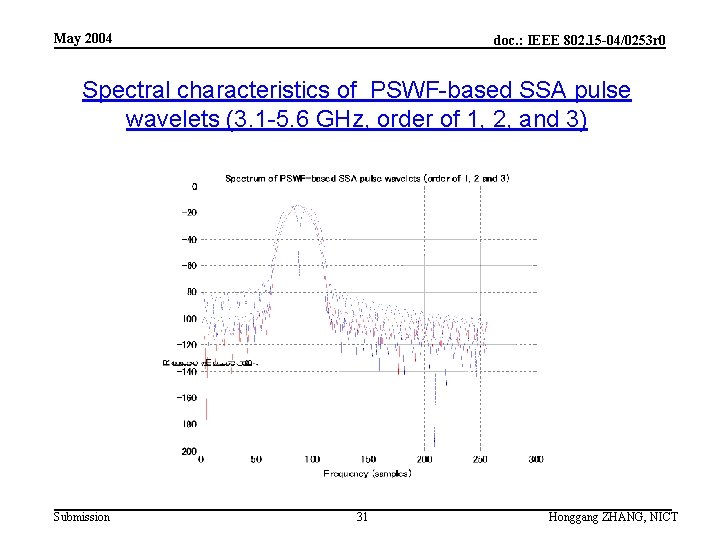
May 2004 doc. : IEEE 802. 15 -04/0253 r 0 Spectral characteristics of PSWF-based SSA pulse wavelets (3. 1 -5. 6 GHz, order of 1, 2, and 3) Submission 31 Honggang ZHANG, NICT
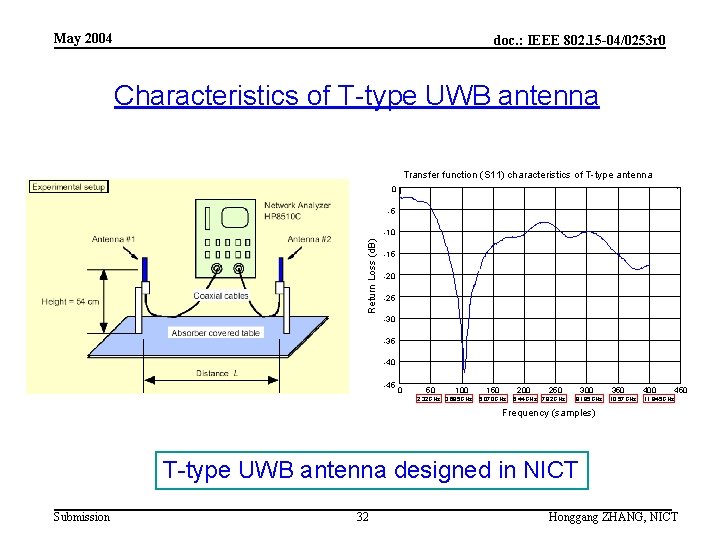
May 2004 doc. : IEEE 802. 15 -04/0253 r 0 Characteristics of T-type UWB antenna Transfer function (S 11) characteristics of T-type antenna 0 -5 Return Loss (d. B) -10 -15 -20 -25 -30 -35 -40 -45 0 50 100 2. 32 GHz 3. 695 GHz 150 200 5. 070 GHz 250 6. 44 GHz 7. 82 GHz 300 9. 195 GHz 350 10. 57 GHz 400 450 11. 945 GHz Frequency (samples) T-type UWB antenna designed in NICT Submission 32 Honggang ZHANG, NICT
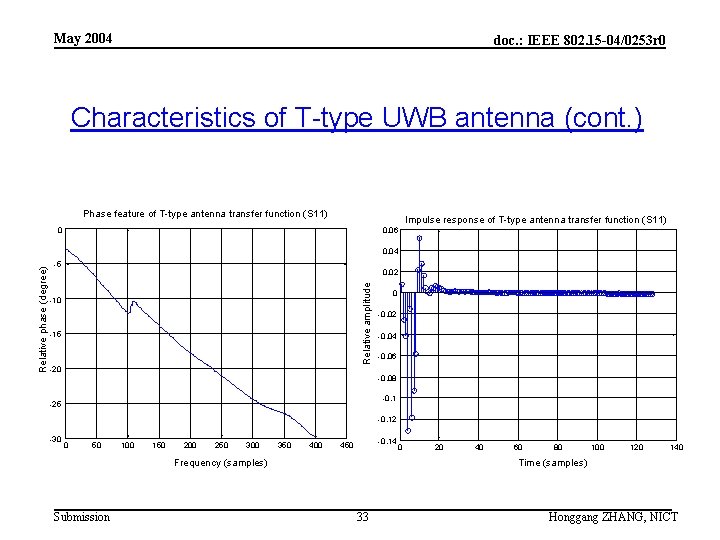
May 2004 doc. : IEEE 802. 15 -04/0253 r 0 Characteristics of T-type UWB antenna (cont. ) Phase feature of T-type antenna transfer function (S 11) Impulse response of T-type antenna transfer function (S 11) 0 0. 06 0. 02 Relative amplitude Relative phase (degree) 0. 04 -5 -10 -15 -20 0 -0. 02 -0. 04 -0. 06 -0. 08 -0. 1 -25 -0. 12 -30 0 50 100 150 200 250 300 350 400 -0. 14 450 Frequency (samples) Submission 0 20 40 60 80 100 120 140 Time (samples) 33 Honggang ZHANG, NICT
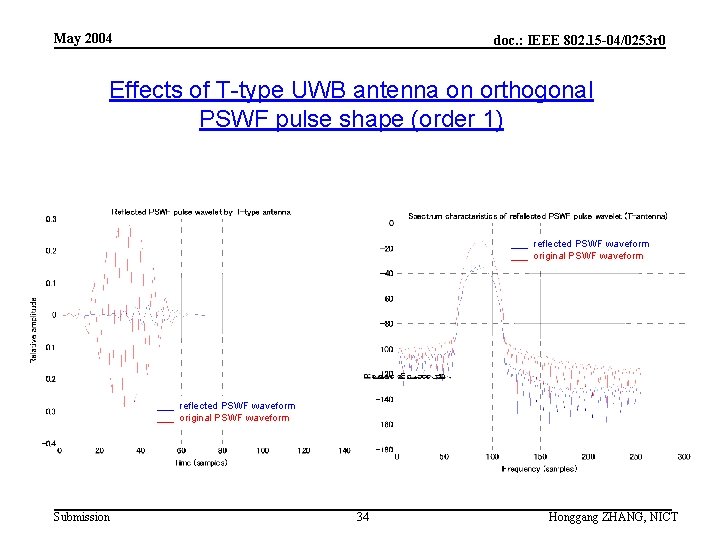
May 2004 doc. : IEEE 802. 15 -04/0253 r 0 Effects of T-type UWB antenna on orthogonal PSWF pulse shape (order 1) ___ reflected PSWF waveform ___ original PSWF waveform Submission 34 Honggang ZHANG, NICT
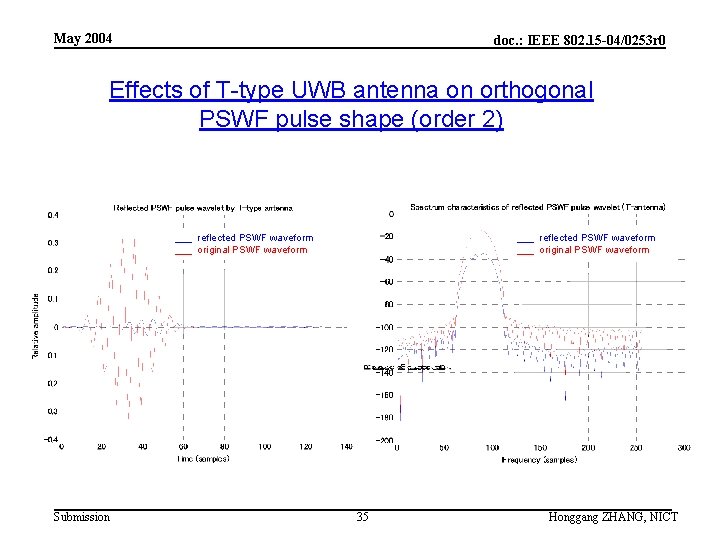
May 2004 doc. : IEEE 802. 15 -04/0253 r 0 Effects of T-type UWB antenna on orthogonal PSWF pulse shape (order 2) ___ reflected PSWF waveform ___ original PSWF waveform Submission ___ reflected PSWF waveform ___ original PSWF waveform 35 Honggang ZHANG, NICT
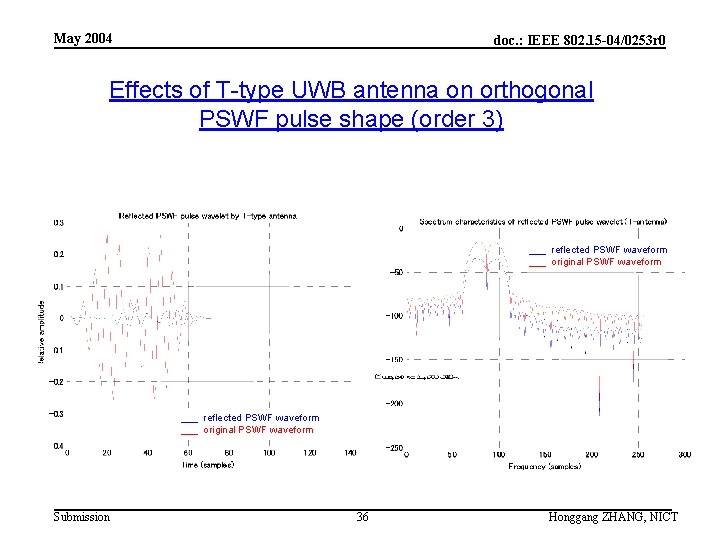
May 2004 doc. : IEEE 802. 15 -04/0253 r 0 Effects of T-type UWB antenna on orthogonal PSWF pulse shape (order 3) ___ reflected PSWF waveform ___ original PSWF waveform Submission 36 Honggang ZHANG, NICT
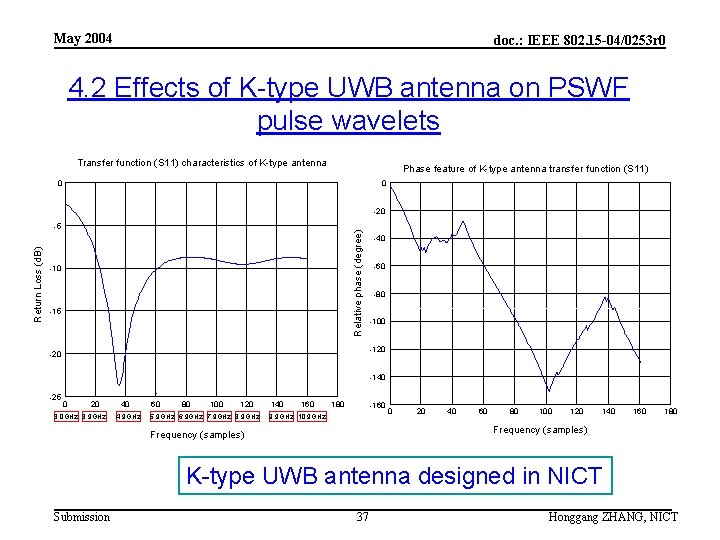
May 2004 doc. : IEEE 802. 15 -04/0253 r 0 4. 2 Effects of K-type UWB antenna on PSWF pulse wavelets Transfer function (S 11) characteristics of K-type antenna Phase feature of K-type antenna transfer function (S 11) 0 0 -20 Relative phase (degree) Return Loss (d. B) -5 -10 -15 -40 -60 -80 -100 -120 -140 -25 0 20 3. 0 GHz 3. 9 GHz 40 4. 9 GHz 60 80 100 120 5. 9 GHz 6. 9 GHz 7. 9 GHz 8. 9 GHz 140 160 180 -160 9. 9 GHz 10. 9 GHz 0 20 40 60 80 100 120 140 160 180 Frequency (samples) K-type UWB antenna designed in NICT Submission 37 Honggang ZHANG, NICT
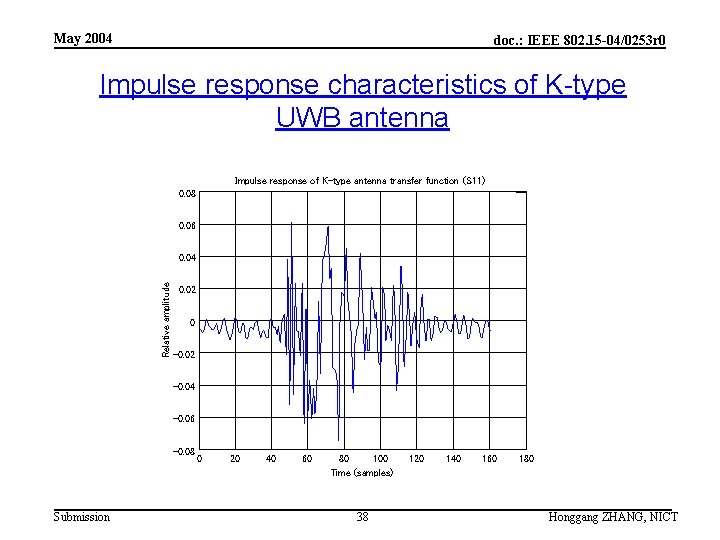
May 2004 doc. : IEEE 802. 15 -04/0253 r 0 Impulse response characteristics of K-type UWB antenna Impulse response of K-type antenna transfer function (S 11) 0. 08 0. 06 Relative amplitude 0. 04 0. 02 0 -0. 02 -0. 04 -0. 06 -0. 08 Submission 0 20 40 60 80 100 Time (samples) 38 120 140 160 180 Honggang ZHANG, NICT
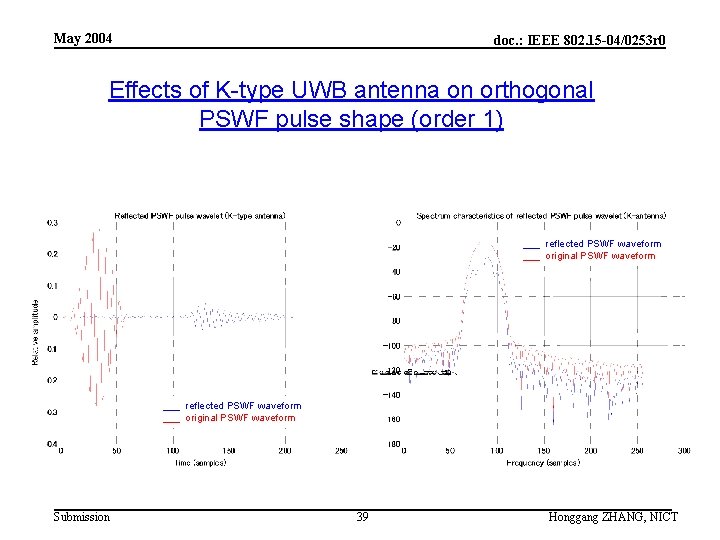
May 2004 doc. : IEEE 802. 15 -04/0253 r 0 Effects of K-type UWB antenna on orthogonal PSWF pulse shape (order 1) ___ reflected PSWF waveform ___ original PSWF waveform Submission 39 Honggang ZHANG, NICT
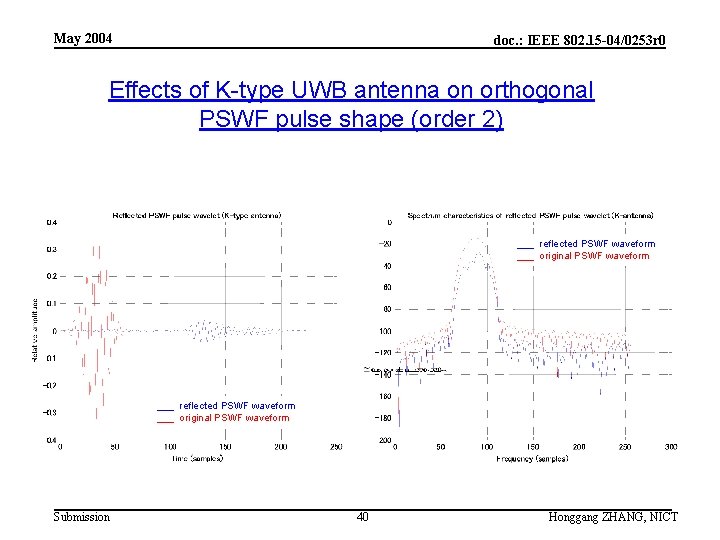
May 2004 doc. : IEEE 802. 15 -04/0253 r 0 Effects of K-type UWB antenna on orthogonal PSWF pulse shape (order 2) ___ reflected PSWF waveform ___ original PSWF waveform Submission 40 Honggang ZHANG, NICT
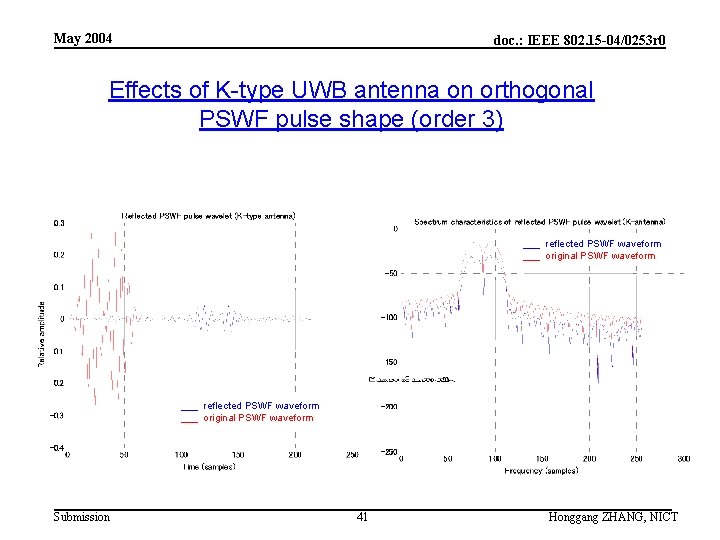
May 2004 doc. : IEEE 802. 15 -04/0253 r 0 Effects of K-type UWB antenna on orthogonal PSWF pulse shape (order 3) ___ reflected PSWF waveform ___ original PSWF waveform Submission 41 Honggang ZHANG, NICT
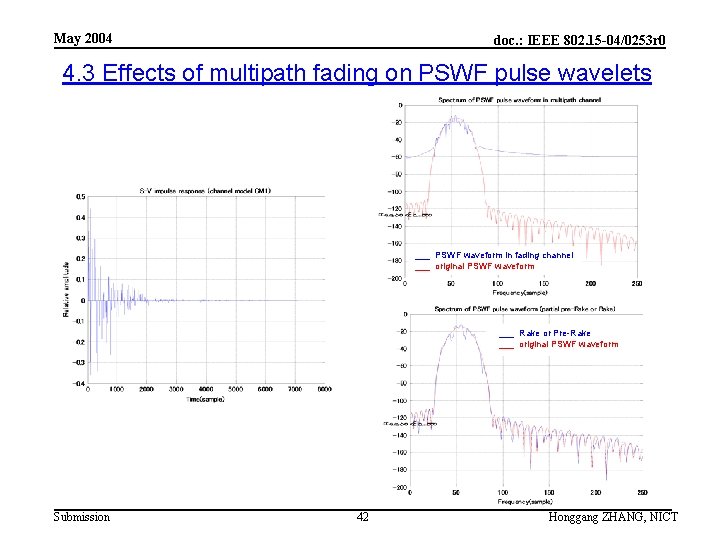
May 2004 doc. : IEEE 802. 15 -04/0253 r 0 4. 3 Effects of multipath fading on PSWF pulse wavelets ___ PSWF waveform in fading channel ___ original PSWF waveform ___ in. Rake or Pre-Rake ___ channel ___ original PSWF waveform ___ waveform Submission 42 Honggang ZHANG, NICT
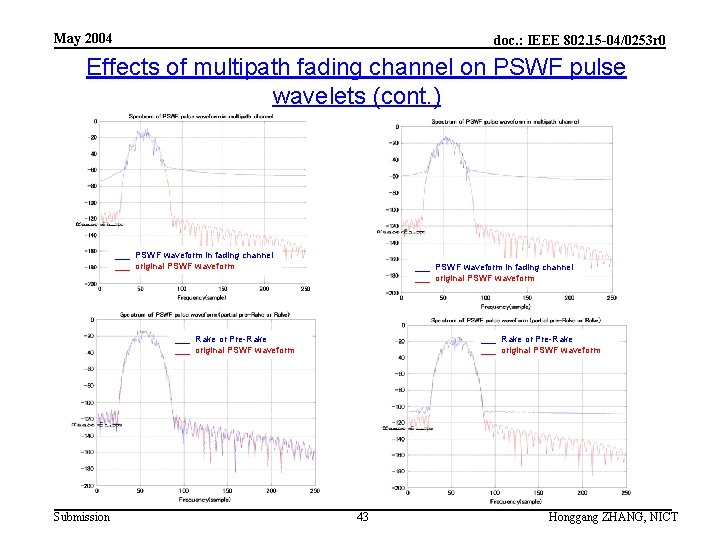
May 2004 doc. : IEEE 802. 15 -04/0253 r 0 Effects of multipath fading channel on PSWF pulse wavelets (cont. ) ___ PSWF waveform in fading channel ___ original PSWF waveform ___ Rake or Pre-Rake ___ original PSWF waveform Submission ___ Rake or Pre-Rake ___ original PSWF waveform 43 Honggang ZHANG, NICT
May 2004 doc. : IEEE 802. 15 -04/0253 r 0 5. Conclusion remarks Ø A combined SSA-UWB and Cognitive Radio scheme has been suggested for global harmonization and compromise in IEEE 802. 15. 3 a, based on Common Signaling Mode with PSWF-type pulse wavelets. Ø We also have investigated the effects of two specific Ultra Wideband antennas on the implementation issue of PSWF-type pulse wavelets. Measurement and simulation results are very encouraging as well. Ø Scalable and adaptive performance improvement with multi-mode (DS-UWB & MB-OFDM) can be further expected by utilizing the PSWF-based SSAUWB and Cognitive Radio. Submission 44 Honggang ZHANG, NICT
May 2004 doc. : IEEE 802. 15 -04/0253 r 0 6. Background materials Submission 45 Honggang ZHANG, NICT
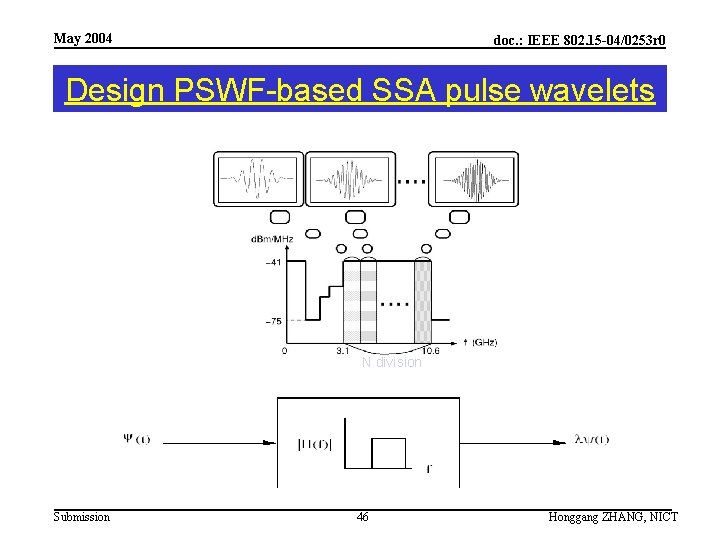
May 2004 doc. : IEEE 802. 15 -04/0253 r 0 Design PSWF-based SSA pulse wavelets N division Submission 46 Honggang ZHANG, NICT
May 2004 doc. : IEEE 802. 15 -04/0253 r 0 Realization of SSA-UWB pulse wavelet design Prolate Spheroidal Wave Functions (PSWF) Ø Not just trying to construct a pulse waveform in order to satisfy the FCC spectral mask, on the contrary, first starting from considering a required spectral mask in frequency domain (band-limited), and then finding its corresponding pulse waveform in time domain (time-limited). Ø Just as C. E. Shannon has asked a question once upon a time, “To what extent are the functions which confined to a finite bandwidth also concentrated in the time domain? ”, which has given rise to the discovery and usage of Prolate Spheroidal Wave Functions (PSWF) in the sixties. Ø Designing a time-limited & band-limited pulse waveform is extremely important in UWB system. Submission 47 Honggang ZHANG, NICT
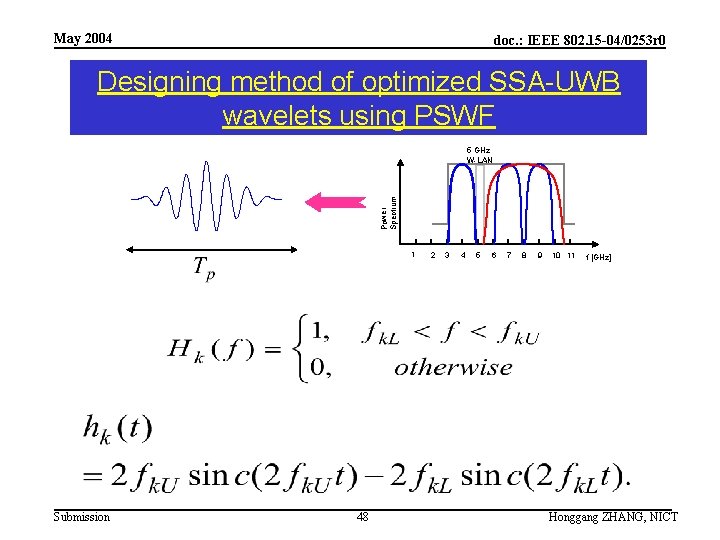
May 2004 doc. : IEEE 802. 15 -04/0253 r 0 Designing method of optimized SSA-UWB wavelets using PSWF Power Spectrum 5 GHz W-LAN 1 Submission 48 2 3 4 5 6 7 8 9 10 11 f [GHz] Honggang ZHANG, NICT
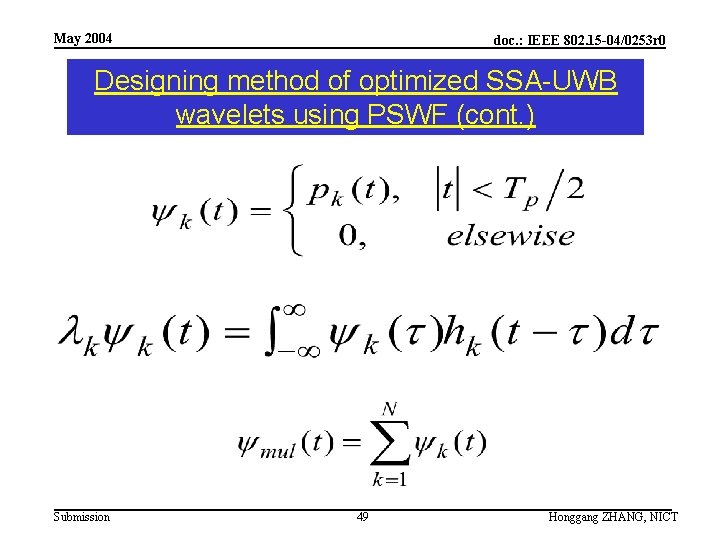
May 2004 doc. : IEEE 802. 15 -04/0253 r 0 Designing method of optimized SSA-UWB wavelets using PSWF (cont. ) Submission 49 Honggang ZHANG, NICT
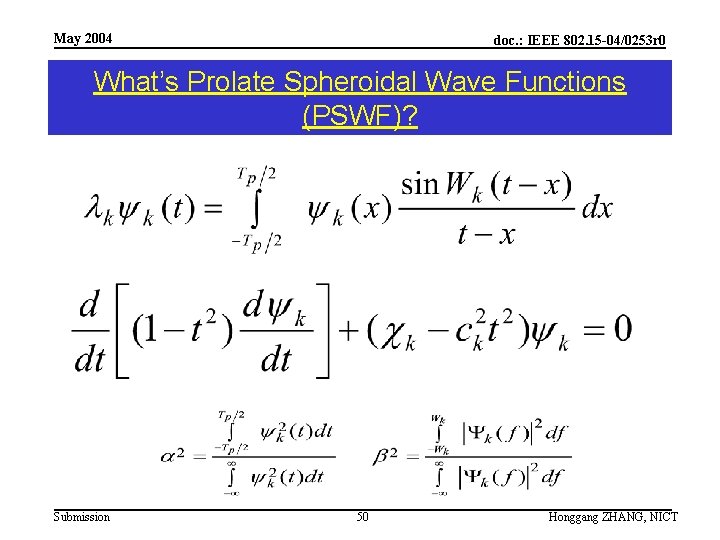
May 2004 doc. : IEEE 802. 15 -04/0253 r 0 What’s Prolate Spheroidal Wave Functions (PSWF)? Submission 50 Honggang ZHANG, NICT
May 2004 doc. : IEEE 802. 15 -04/0253 r 0 Characteristics of PSWF-based pulse wavelets ü Pulse waveforms are doubly orthogonal to each other. ü Pulse-width and bandwidth can be simultaneously controlled to match with arbitrary spectral mask adaptively. ü Pulse-width can be kept same for all orders of m. ü Pulse bandwidth is same for all orders of m. ü They can be utilized for simple transceiver implementation since frequency shift, e. g. , up-conversion or downconversion with mixer as in MB-OFDM and DS-UWB of IEEE 802. 15. 3 a is no longer necessary. Submission 51 Honggang ZHANG, NICT
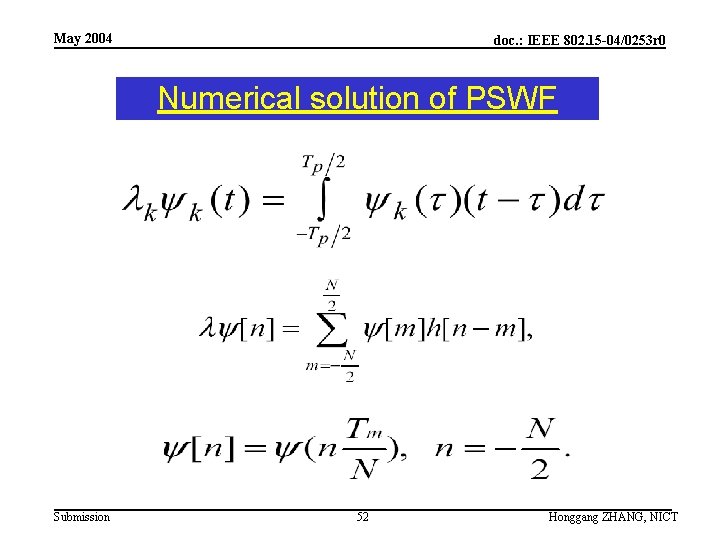
May 2004 doc. : IEEE 802. 15 -04/0253 r 0 Numerical solution of PSWF Submission 52 Honggang ZHANG, NICT
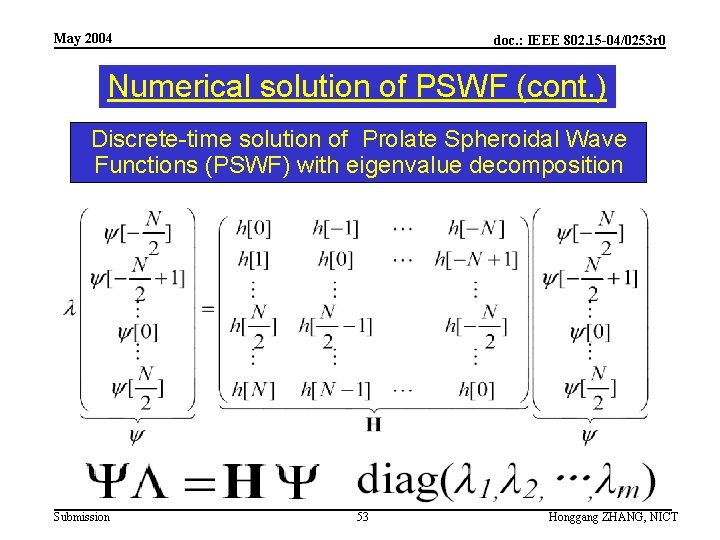
May 2004 doc. : IEEE 802. 15 -04/0253 r 0 Numerical solution of PSWF (cont. ) Discrete-time solution of Prolate Spheroidal Wave Functions (PSWF) with eigenvalue decomposition Submission 53 Honggang ZHANG, NICT
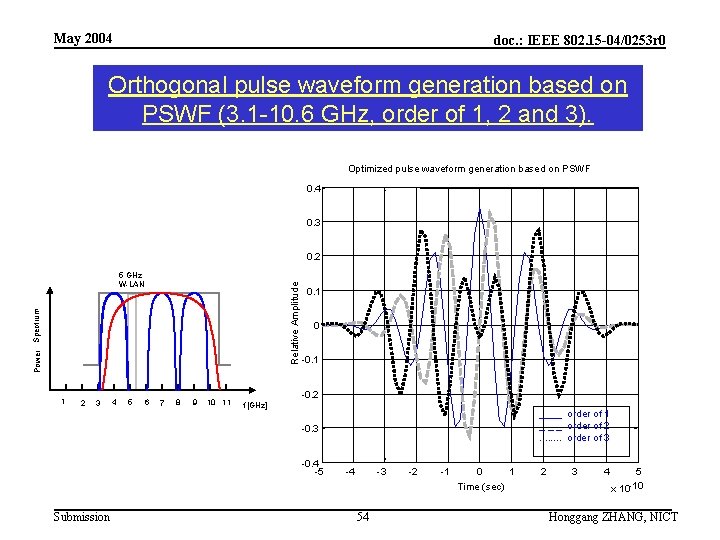
May 2004 doc. : IEEE 802. 15 -04/0253 r 0 Orthogonal pulse waveform generation based on PSWF (3. 1 -10. 6 GHz, order of 1, 2 and 3). Optimized pulse waveform generation based on PSWF 0. 4 0. 3 0. 2 Power Spectrum Relative Amplitude 5 GHz W-LAN 1 2 3 4 5 6 7 8 9 10 11 0. 1 0 -0. 1 -0. 2 f [GHz] ____ order of 1 _ _ _ order of 2. . . . order of 3 -0. 4 -5 Submission -4 -3 54 -2 -1 0 1 Time (sec) 2 3 4 5 x 10 -10 Honggang ZHANG, NICT
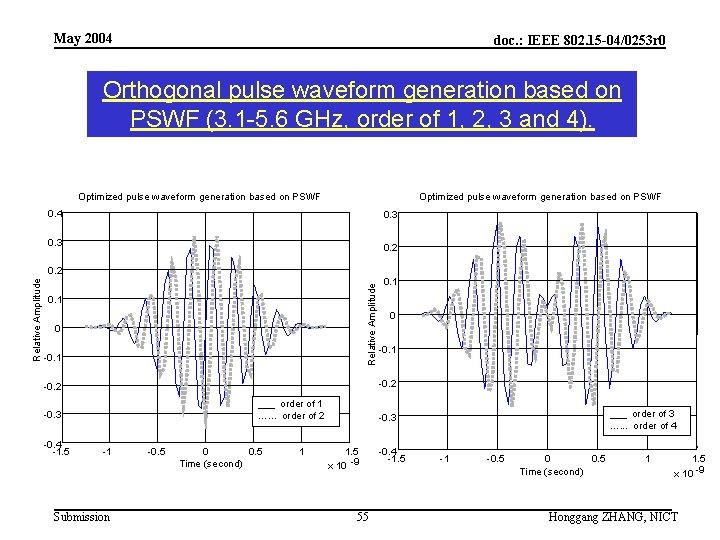
May 2004 doc. : IEEE 802. 15 -04/0253 r 0 Orthogonal pulse waveform generation based on PSWF (3. 1 -5. 6 GHz, order of 1, 2, 3 and 4). Optimized pulse waveform generation based on PSWF 0. 4 0. 3 0. 2 Relative Amplitude 0. 2 0. 1 0 -0. 1 -0. 2 ___ order of 1 …. . . order of 2 -0. 3 -0. 4 -1. 5 0. 1 -1 Submission -0. 5 0 0. 5 Time (second) 1 ___ order of 3 …. . . order of 4 -0. 3 1. 5 x 10 -9 55 -0. 4 -1. 5 -1 -0. 5 0 0. 5 Time (second) 1 1. 5 x 10 -9 Honggang ZHANG, NICT