
Maxx Link Resins for Corrugated Board A Primer
Maxx. Link® Resins for Corrugated Board – A Primer 2018 The evolution of solutions™
MCTRON Values MCTRON Technologies is a service-oriented specialty chemical company with a broad range of products. We support these products in our customers’ mills with our experienced technical support team. • MCTRON values customers. the opportunity to serve our • We believe that offering the most competitive, innovative and flexible solutions creates our value in the market. • MCTRON Technologies adhesive products are designed to meet the specific requirements of our customers. • Let MCTRON Technologies raise your expectations.
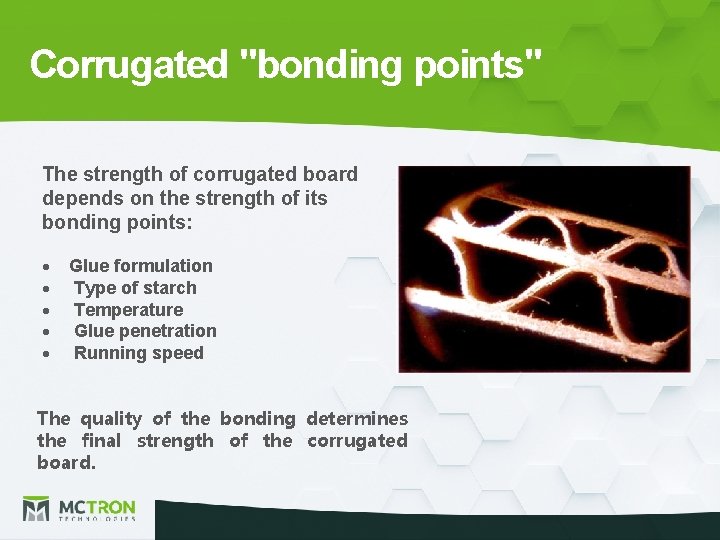
Corrugated "bonding points" The strength of corrugated board depends on the strength of its bonding points: Glue formulation Type of starch Temperature Glue penetration Running speed The quality of the bonding determines the final strength of the corrugated board.
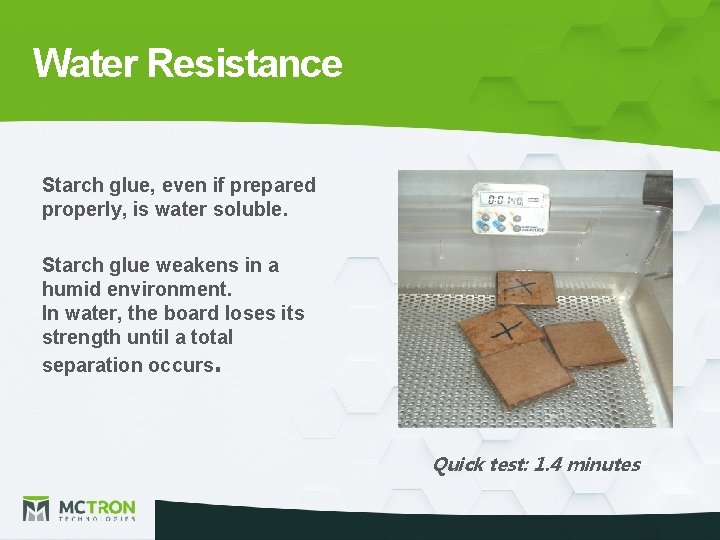
Water Resistance Starch glue, even if prepared properly, is water soluble. Starch glue weakens in a humid environment. In water, the board loses its strength until a total separation occurs. Quick test: 1. 4 minutes
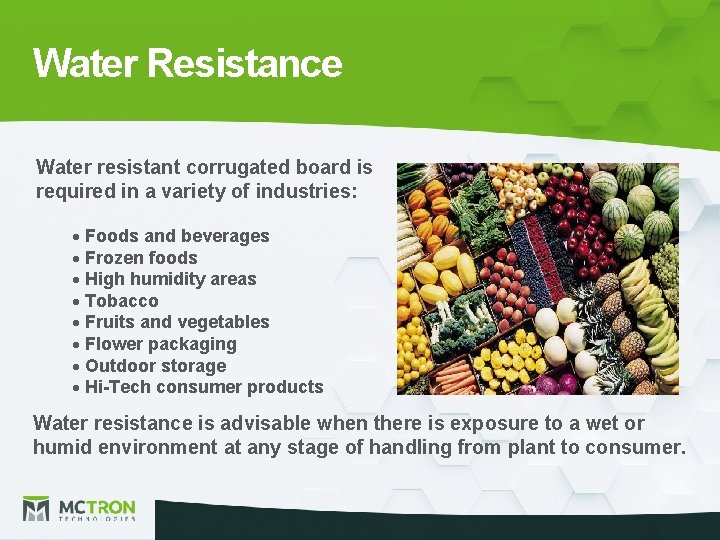
Water Resistance Water resistant corrugated board is required in a variety of industries: Foods and beverages Frozen foods High humidity areas Tobacco Fruits and vegetables Flower packaging Outdoor storage Hi-Tech consumer products Water resistance is advisable when there is exposure to a wet or humid environment at any stage of handling from plant to consumer.
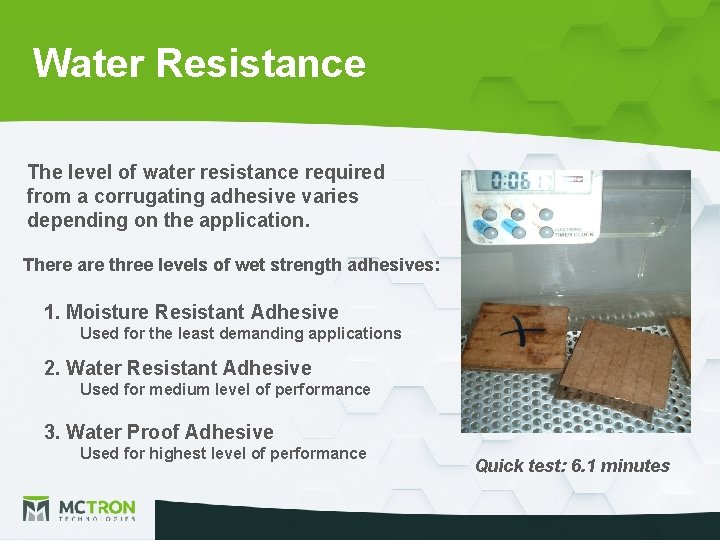
Water Resistance The level of water resistance required from a corrugating adhesive varies depending on the application. There are three levels of wet strength adhesives: 1. Moisture Resistant Adhesive Used for the least demanding applications 2. Water Resistant Adhesive Used for medium level of performance 3. Water Proof Adhesive Used for highest level of performance Quick test: 6. 1 minutes
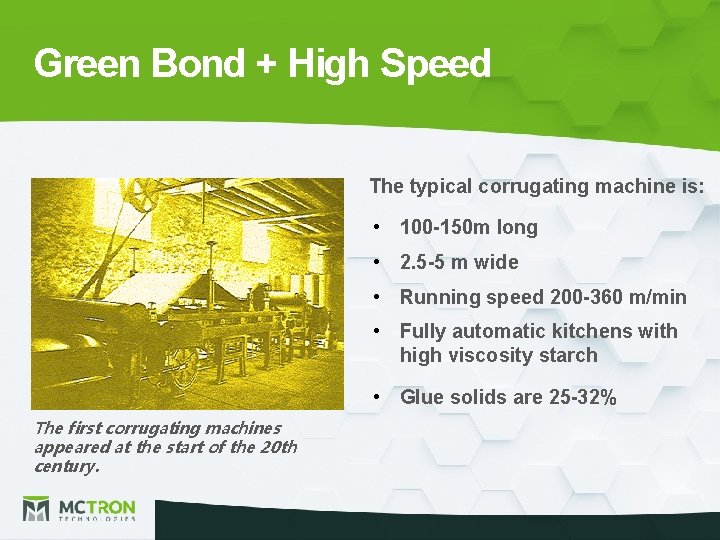
Green Bond + High Speed The typical corrugating machine is: • 100 -150 m long • 2. 5 -5 m wide • Running speed 200 -360 m/min • Fully automatic kitchens with high viscosity starch • Glue solids are 25 -32% The first corrugating machines appeared at the start of the 20 th century.
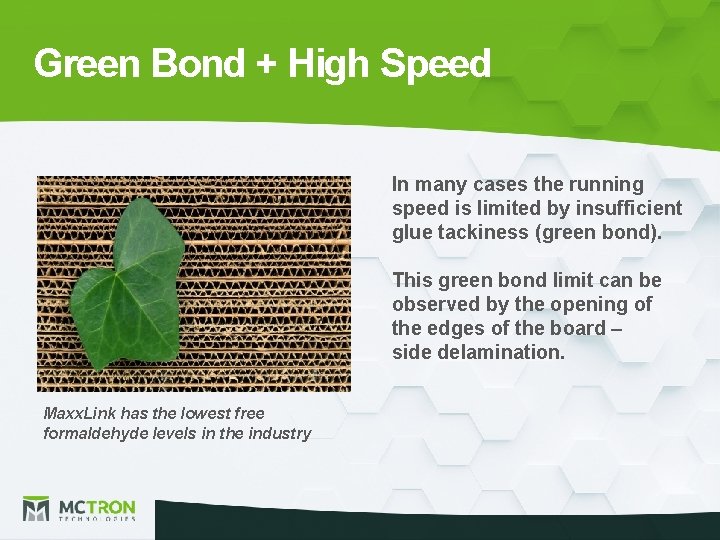
Green Bond + High Speed In many cases the running speed is limited by insufficient glue tackiness (green bond). This green bond limit can be observed by the opening of the edges of the board – side delamination. Maxx. Link has the lowest free formaldehyde levels in the industry
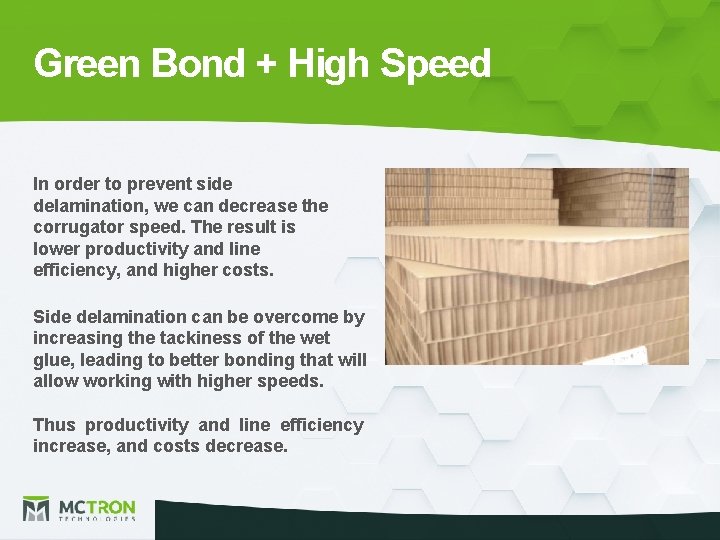
Green Bond + High Speed In order to prevent side delamination, we can decrease the corrugator speed. The result is lower productivity and line efficiency, and higher costs. Side delamination can be overcome by increasing the tackiness of the wet glue, leading to better bonding that will allow working with higher speeds. Thus productivity and line efficiency increase, and costs decrease.
Additives - Compounds added to starch based corrugating adhesives that change and improve certain properties like water resistance and green bond. We will discuss three kinds of additives: 1. Green bond (PVOH Solutions) 2. Water resistance (Acetone Formaldehyde Resin) 3. Additives which impart both water resistance and green bond (Blended Products)
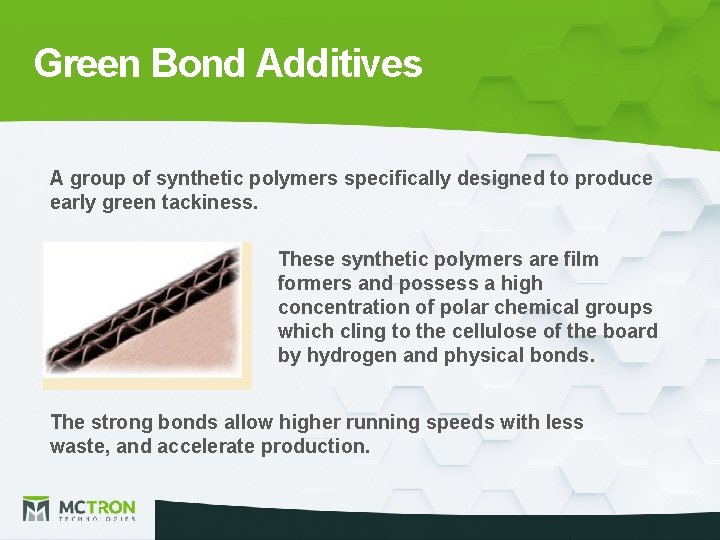
Green Bond Additives A group of synthetic polymers specifically designed to produce early green tackiness. These synthetic polymers are film formers and possess a high concentration of polar chemical groups which cling to the cellulose of the board by hydrogen and physical bonds. The strong bonds allow higher running speeds with less waste, and accelerate production.
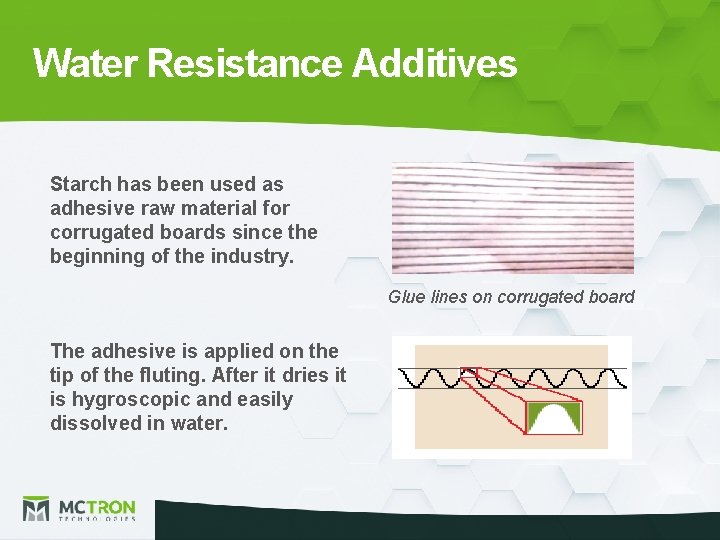
Water Resistance Additives Starch has been used as adhesive raw material for corrugated boards since the beginning of the industry. Glue lines on corrugated board The adhesive is applied on the tip of the fluting. After it dries it is hygroscopic and easily dissolved in water.
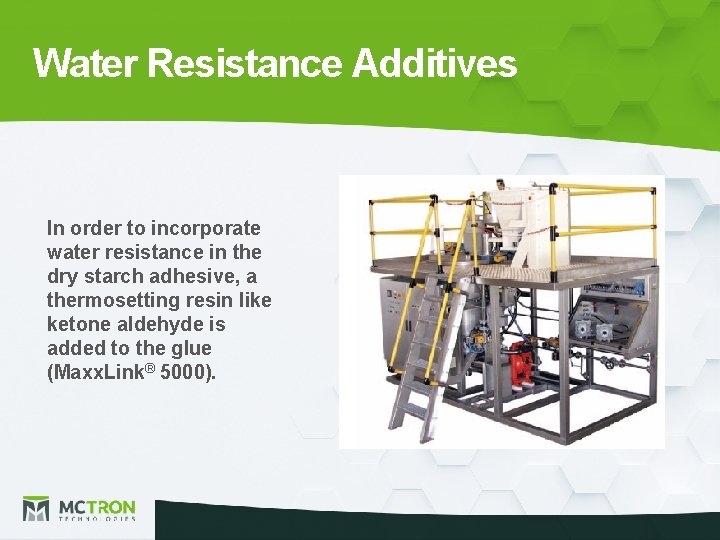
Water Resistance Additives In order to incorporate water resistance in the dry starch adhesive, a thermosetting resin like ketone aldehyde is added to the glue (Maxx. Link® 5000).
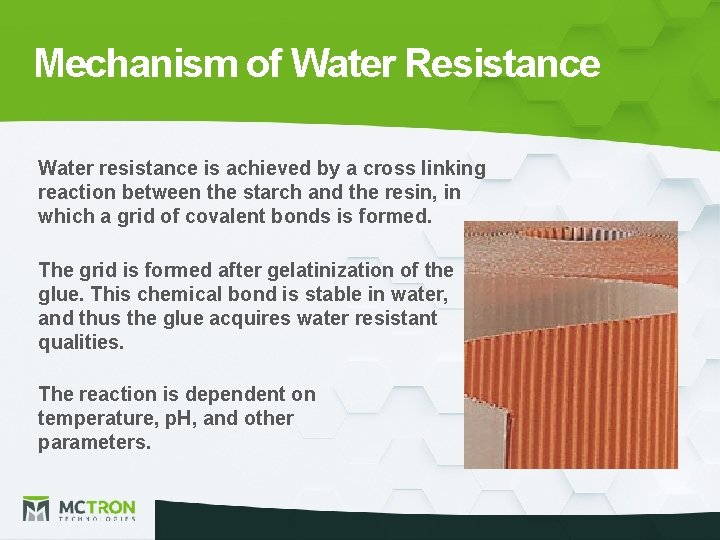
Mechanism of Water Resistance Water resistance is achieved by a cross linking reaction between the starch and the resin, in which a grid of covalent bonds is formed. The grid is formed after gelatinization of the glue. This chemical bond is stable in water, and thus the glue acquires water resistant qualities. The reaction is dependent on temperature, p. H, and other parameters.
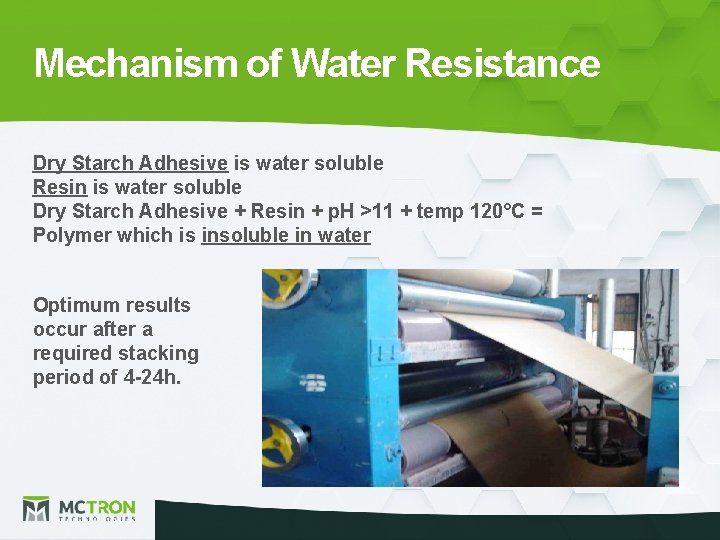
Mechanism of Water Resistance Dry Starch Adhesive is water soluble Resin is water soluble Dry Starch Adhesive + Resin + p. H >11 + temp 120°C = Polymer which is insoluble in water Optimum results occur after a required stacking period of 4 -24 h.
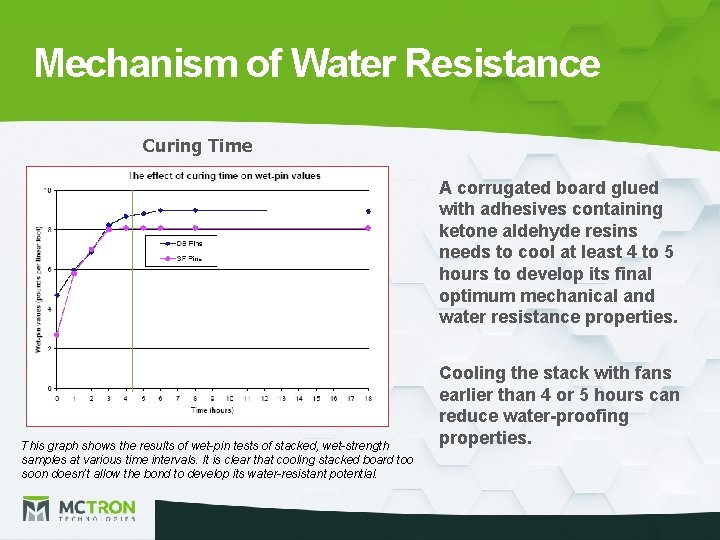
Mechanism of Water Resistance Curing Time A corrugated board glued with adhesives containing ketone aldehyde resins needs to cool at least 4 to 5 hours to develop its final optimum mechanical and water resistance properties. This graph shows the results of wet-pin tests of stacked, wet-strength samples at various time intervals. It is clear that cooling stacked board too soon doesn’t allow the bond to develop its water-resistant potential. Cooling the stack with fans earlier than 4 or 5 hours can reduce water-proofing properties.
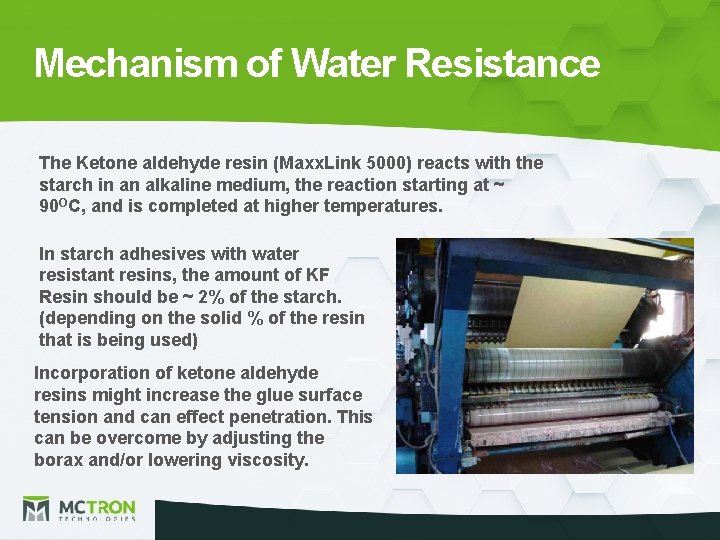
Mechanism of Water Resistance The Ketone aldehyde resin (Maxx. Link 5000) reacts with the starch in an alkaline medium, the reaction starting at ~ 90 OC, and is completed at higher temperatures. In starch adhesives with water resistant resins, the amount of KF Resin should be ~ 2% of the starch. (depending on the solid % of the resin that is being used) Incorporation of ketone aldehyde resins might increase the glue surface tension and can effect penetration. This can be overcome by adjusting the borax and/or lowering viscosity.
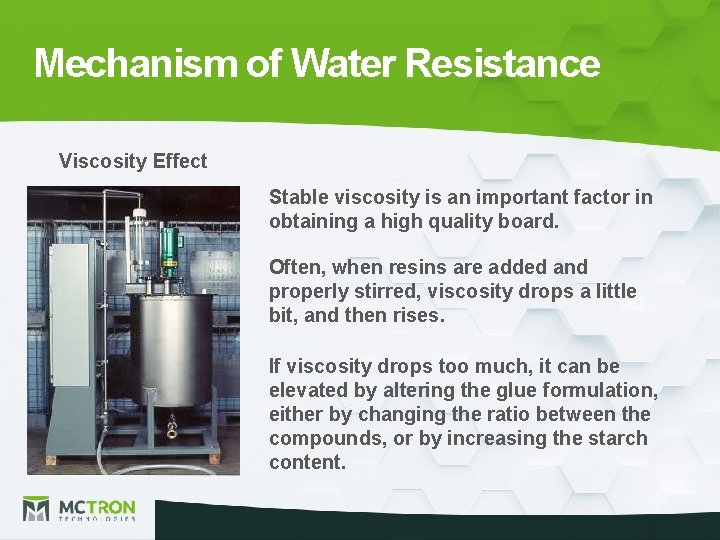
Mechanism of Water Resistance Viscosity Effect Stable viscosity is an important factor in obtaining a high quality board. Often, when resins are added and properly stirred, viscosity drops a little bit, and then rises. If viscosity drops too much, it can be elevated by altering the glue formulation, either by changing the ratio between the compounds, or by increasing the starch content.
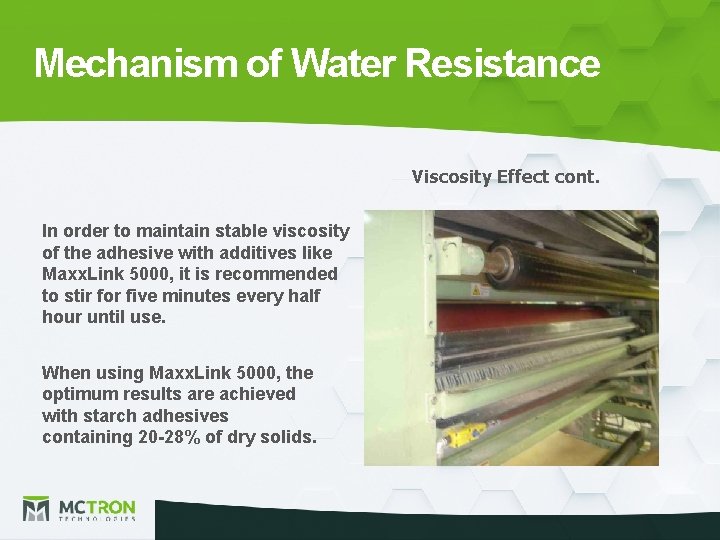
Mechanism of Water Resistance Viscosity Effect cont. In order to maintain stable viscosity of the adhesive with additives like Maxx. Link 5000, it is recommended to stir for five minutes every half hour until use. When using Maxx. Link 5000, the optimum results are achieved with starch adhesives containing 20 -28% of dry solids.
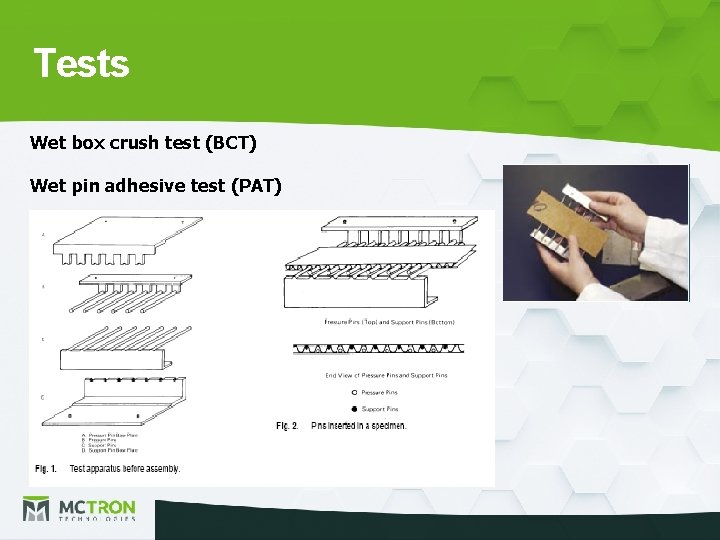
Tests Wet box crush test (BCT) Wet pin adhesive test (PAT)
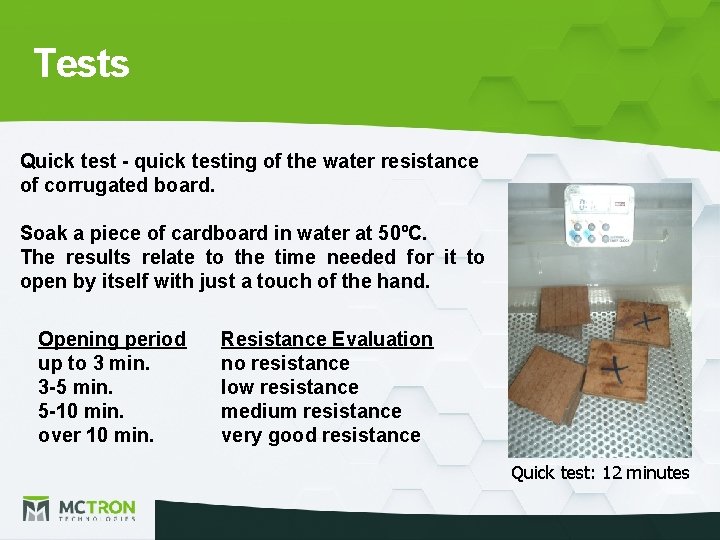
Tests Quick test - quick testing of the water resistance of corrugated board. Soak a piece of cardboard in water at 50ºC. The results relate to the time needed for it to open by itself with just a touch of the hand. Opening period up to 3 min. 3 -5 min. 5 -10 min. over 10 min. Resistance Evaluation no resistance low resistance medium resistance very good resistance Quick test: 12 minutes
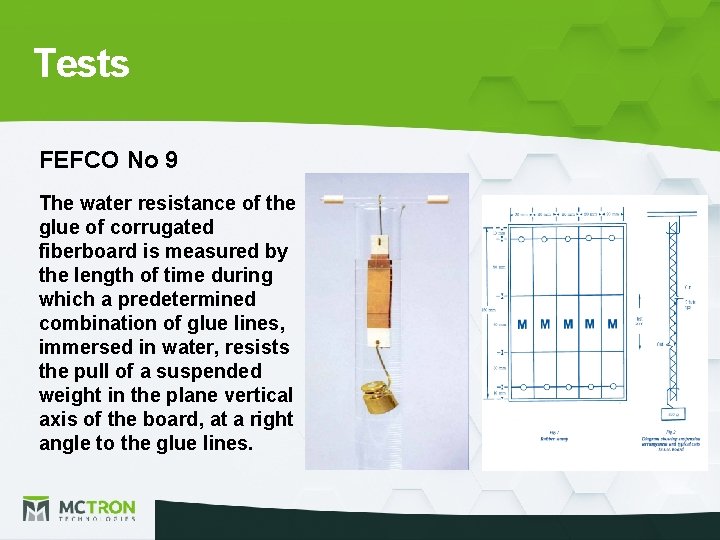
Tests FEFCO No 9 The water resistance of the glue of corrugated fiberboard is measured by the length of time during which a predetermined combination of glue lines, immersed in water, resists the pull of a suspended weight in the plane vertical axis of the board, at a right angle to the glue lines.
Types of Additives By application: Water resistant (Maxx. Link XL-5000 or XL-4000) different levels of water resistant according to resin concentration. Curing time 4 -24 h Green bond (Maxx. Speed 18) – increasing tackiness of the glue to allow higher speed for the corrugator. A combination of water resistance and green bond (Maxx. Link XL 8020) - incorporate water resistance and high speed. • Reduce curing time for optimum results • Early or immediate converting • Green bond increase • Running speed increase
Types of Additives By appearance: Liquid – Can be applied at the kitchen or at the line. Exists in different concentrations from 40%-60% solids (Maxx. Link 4000 to Maxx. Link 6000) To ensure a uniform distribution of the resins in the adhesive, even with slow rotating mixers, it is recommended to pre-dilute the higher concentrated resins. Powder: Maxx. Link OBM – Can be dry blended with starch to create dry mix (OBM – one bag mix). Maxx. Link DB - Can be applied by mixing with the ready adhesive.
Types of Additives free formaldehyde: An important issue in considering additives and resins is the free formaldehyde remaining in the product. International standards for amount of free formaldehyde in the working environment of the corrugators: • ACGIH – American Conference of Governmental Industrial Hygienists • OSHA – Occupational Safety & Health Administration • German standard International standards for amount of free formaldehyde in packaging that is in direct contact with food: • FDA applications (per Regulation 21 CFR 175. 105) • EEC directive
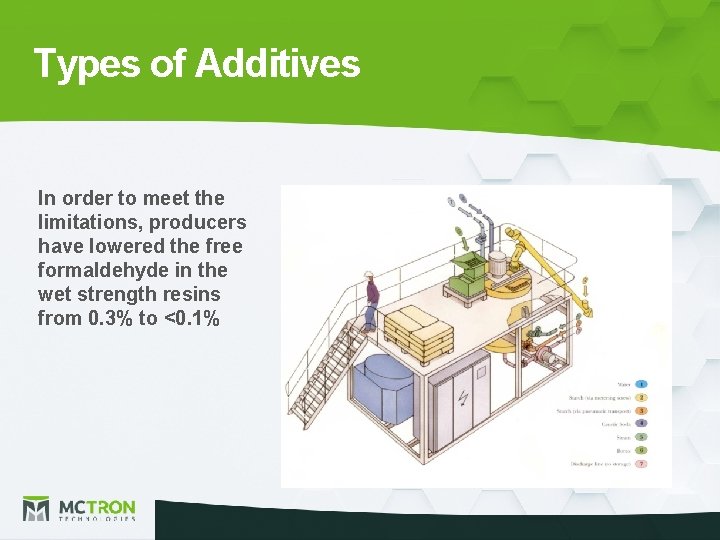
Types of Additives In order to meet the limitations, producers have lowered the free formaldehyde in the wet strength resins from 0. 3% to <0. 1%
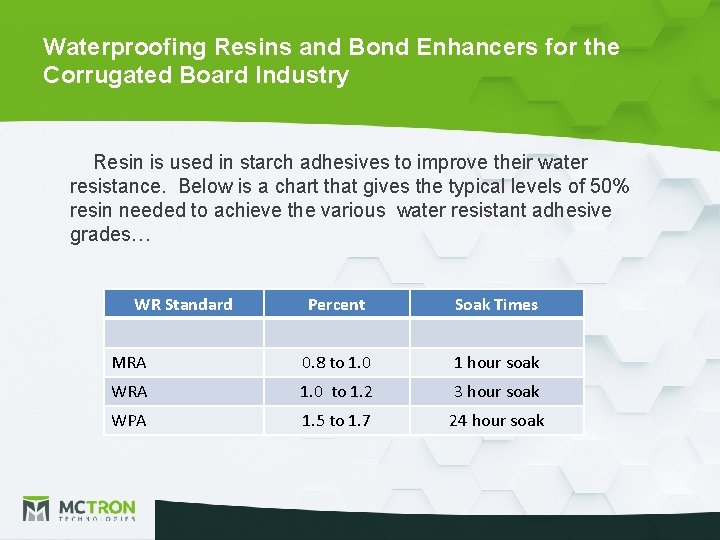
Waterproofing Resins and Bond Enhancers for the Corrugated Board Industry Resin is used in starch adhesives to improve their water resistance. Below is a chart that gives the typical levels of 50% resin needed to achieve the various water resistant adhesive grades… WR Standard Percent Soak Times MRA 0. 8 to 1. 0 1 hour soak WRA 1. 0 to 1. 2 3 hour soak WPA 1. 5 to 1. 7 24 hour soak
MCTRON Corrugating Products Mc. Tron offers a broad range of resins, polymers and additives for corrugating Products Maxx. Link Resins Water Proofing Resins Liquid Borate Bond Enhancers Maxx. Speed Green Tack Additives Maxx. Surf Penetrants Maxx Coat Wax Replacement Coatings Maxxetate & Maxx. Vol PVAc & PVA Adhesives Maxx. Bond Dextrin Laminating Adhesive
Cost The cost of the resins and additives is ~1$ per 1, 000 m 2 of corrugated board. This cost is recovered by gaining: § Improved board quality § Waterproof board § Increased green bond, allowing higher running speed § Higher efficiency and less waste
Maxx. Link® Products Maxx. Link XL-4000 40% solids KF resin Maxx. Link XL-5000 50% solids general purpose KF resin Maxx. Link XL-6000 60% solids KF resin Maxx. Link 7200 72% solids KF resin Wide solids range available Maxx. Link XL-8020 55% solids bond enhanced resin Maxx. Link XLB-3000 Maxx. Vol PVOH Bond Enhancers
Maxx. Link® KF Resins Not all KF Resins are the same Use of low cost fillers will result in lower wet pins Test for total nitrogen Methanol Content (a Poisonous VOC) Maxx. Link is the lowest VOC KF resin available in the market “Formaldehyde Free” resin No such thing as a “formaldehyde free” ketone formaldehyde resin (A pear contains 60 ppm of free formaldehyde) Formaldehyde can be checked down to less than 1 ppm. All products have a detectable level depending on analytical method. Zero Formaldehyde traditionally means not detected. All Maxx. Link products are certified under 1000 ppm Maxx. Link KF Res
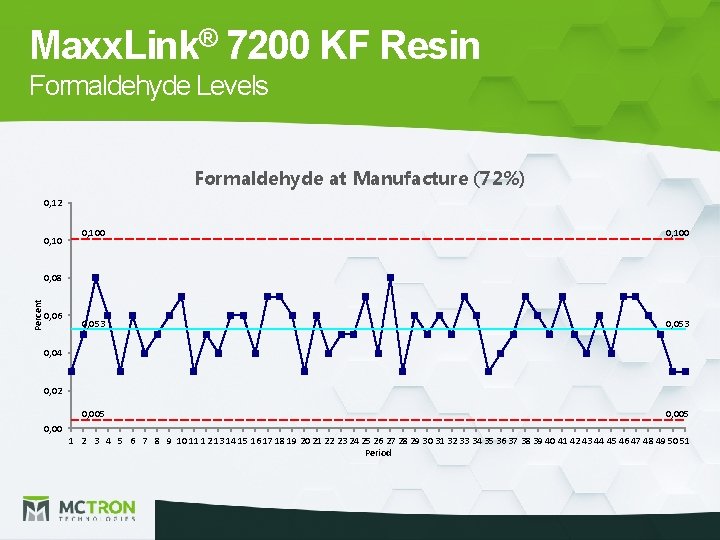
Maxx. Link® 7200 KF Resin Formaldehyde Levels Formaldehyde at Manufacture (72%) 0, 12 0, 100 0, 053 0, 005 Percent 0, 08 0, 06 0, 04 0, 02 0, 00 1 2 3 4 5 6 7 8 9 10 11 12 13 14 15 16 17 18 19 20 21 22 23 24 25 26 27 28 29 30 31 32 33 34 35 36 37 38 39 40 41 42 43 44 45 46 47 48 49 50 51 Period
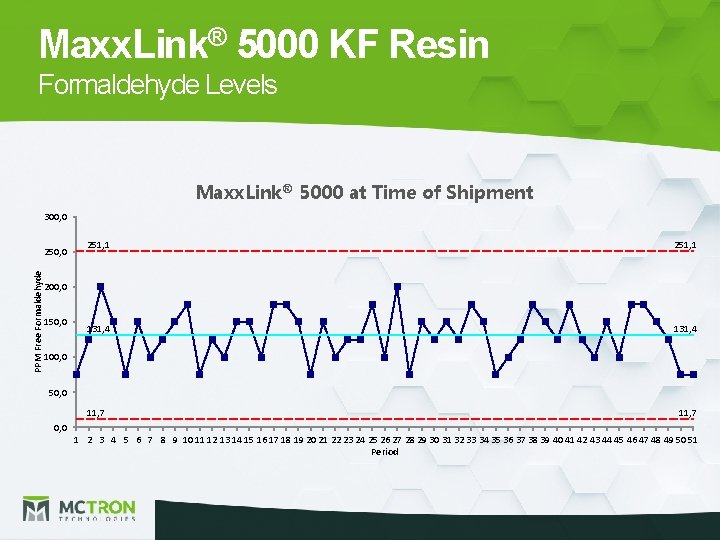
Maxx. Link® 5000 KF Resin Formaldehyde Levels Maxx. Link® 5000 at Time of Shipment 300, 0 PPM Free Formaldehyde 250, 0 251, 1 131, 4 11, 7 200, 0 150, 0 100, 0 50, 0 1 2 3 4 5 6 7 8 9 10 11 12 13 14 15 16 17 18 19 20 21 22 23 24 25 26 27 28 29 30 31 32 33 34 35 36 37 38 39 40 41 42 43 44 45 46 47 48 49 50 51 Period
Maxx. Link® KF Resins MCTRON is committed to supplying resin where all the solids content comes from active waterproofing chemicals. It will not contain low cost fillers. You will see better wet pin adhesion. MCTRON is committed to supplying resin with the lowest methanol levels in the industry using our new process technology. MCTRON is committed to certifying formaldehyde levels as <1000 ppm on all shipments. We invite having our numbers confirmed by outside test labs.
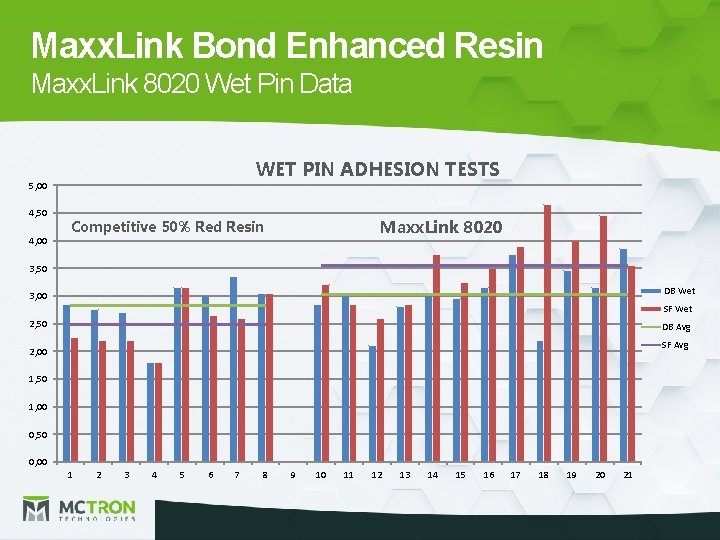
Maxx. Link Bond Enhanced Resin Maxx. Link 8020 Wet Pin Data WET PIN ADHESION TESTS 5, 00 4, 50 4, 00 Maxx. Link 8020 Competitive 50% Red Resin 3, 50 DB Wet 3, 00 SF Wet 2, 50 DB Avg SF Avg 2, 00 1, 50 1, 00 0, 50 0, 00 1 2 3 4 5 6 7 8 9 10 11 12 13 14 15 16 17 18 19 20 21
Maxx. Speed® Maxx. Speed 15 is a green tack additive solution designed to improve machine speed.
Maxx. Surf® Maxx. Surf P 70 is a high solids penetrant used to improve bonding to hard to wet surfaces.
Maxx. Coat® Maxx. Coat WRP Series Coatings Provide The ultimate in repulpable/recyclable water resistant coatings Low Cobb Values Surface Tension for good: Gluing Printing Slide Angle
Maxx. Bond & Maxxetate Adhesive Products Maxx. Bond DLA A dextrin laminating adhesive Maxxetate Polyvinyl acetate adhesives
MCTRON Business Model • Responsive product development • Multiple chemistries • Focused on technology development • Market oriented • R&D at most production sites • On-site QC • Excellent financial position – Strong raw material position • Experienced degreed technologists • Protected Intellectual Property
Quality Management System • Mutually agreed upon specifications • Proven QC Test Methods • C of A as a “Contract” between us and customers • Management of change protocols • Quarterly SQC Charts • Regular Employee Training (records) • Internal audits of our manufacturing sites
Safety & Environment • MCTRON is focused on “Green” chemistries development • New Thermosets Resin Technology • Low VOC alternatives • Strong Safety Programs No lost time incidents ever!
Why Choose MCTRON? • We offer customized solutions to our customers. • We are committed to creating sustainable value. • We strive to exceed customer expectations. • We provide solutions and service that offers competitive advantage for our customers. • Our people offer market knowledge and understand customer needs. • We are open, flexible and collaborative and provide the best products and service possible.
- Slides: 43