
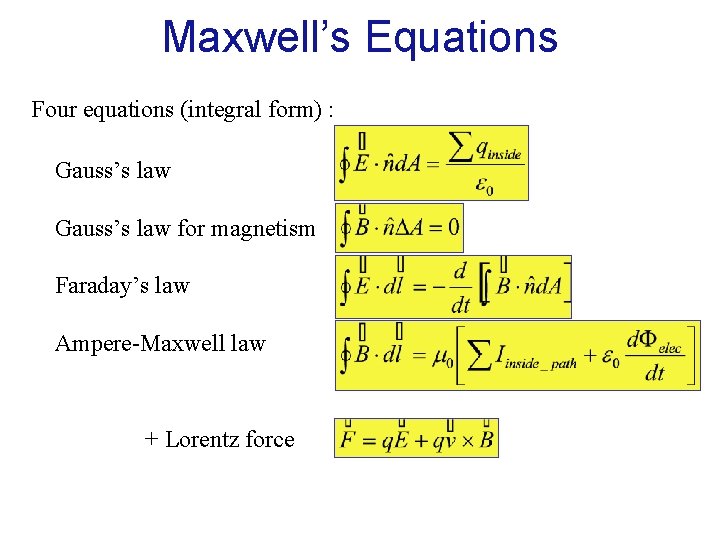
Maxwells Equations Four equations integral form Gausss law
- Slides: 33
Maxwell’s Equations Four equations (integral form) : Gauss’s law for magnetism Faraday’s law Ampere-Maxwell law + Lorentz force
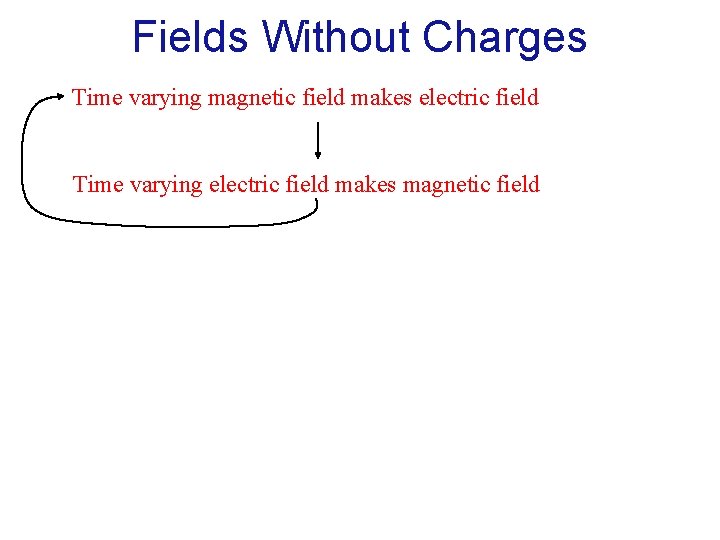
Fields Without Charges Time varying magnetic field makes electric field Time varying electric field makes magnetic field
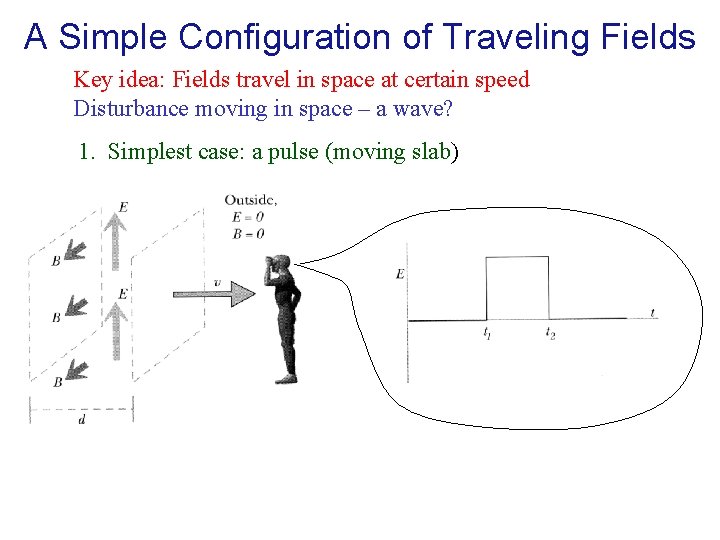
A Simple Configuration of Traveling Fields Key idea: Fields travel in space at certain speed Disturbance moving in space – a wave? 1. Simplest case: a pulse (moving slab)
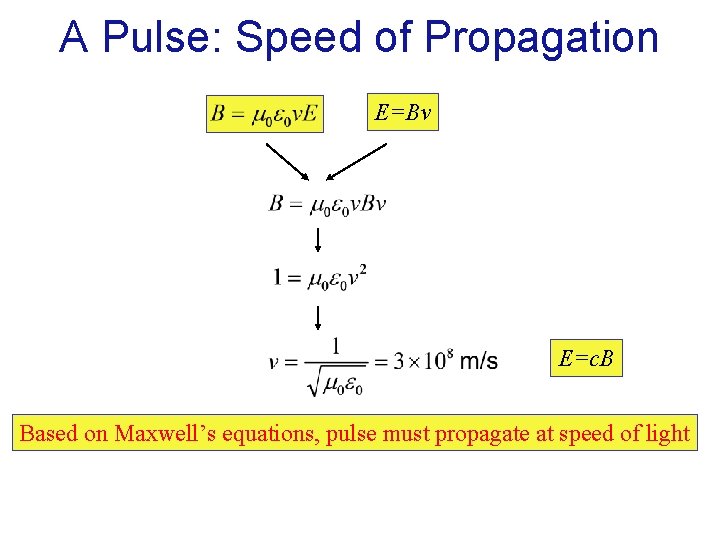
A Pulse: Speed of Propagation E=Bv E=c. B Based on Maxwell’s equations, pulse must propagate at speed of light
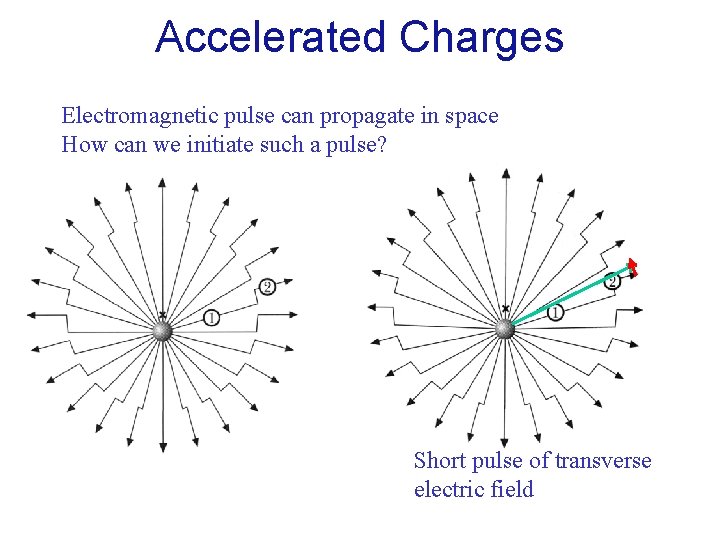
Accelerated Charges Electromagnetic pulse can propagate in space How can we initiate such a pulse? Short pulse of transverse electric field
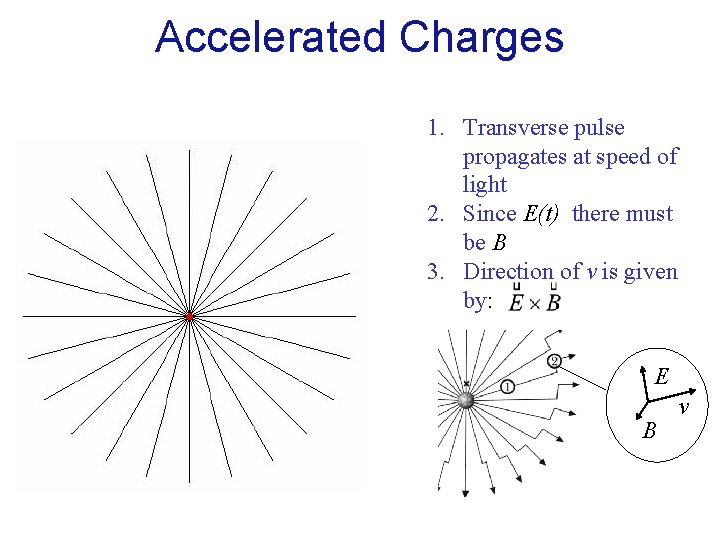
Accelerated Charges 1. Transverse pulse propagates at speed of light 2. Since E(t) there must be B 3. Direction of v is given by: E B v
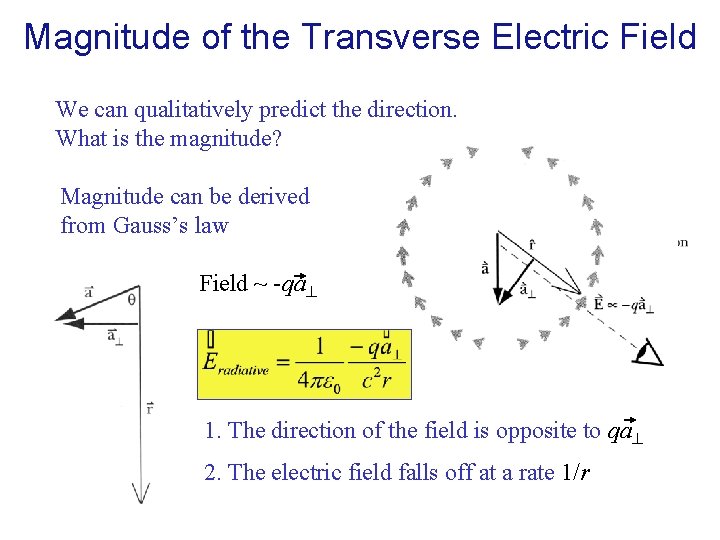
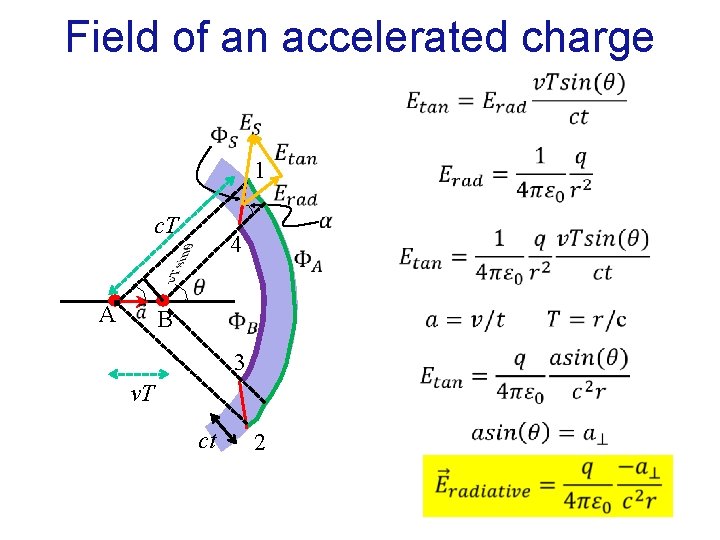
Magnitude of the Transverse Electric Field We can qualitatively predict the direction. What is the magnitude? Magnitude can be derived from Gauss’s law Field ~ -qa 1. The direction of the field is opposite to qa 2. The electric field falls off at a rate 1/r
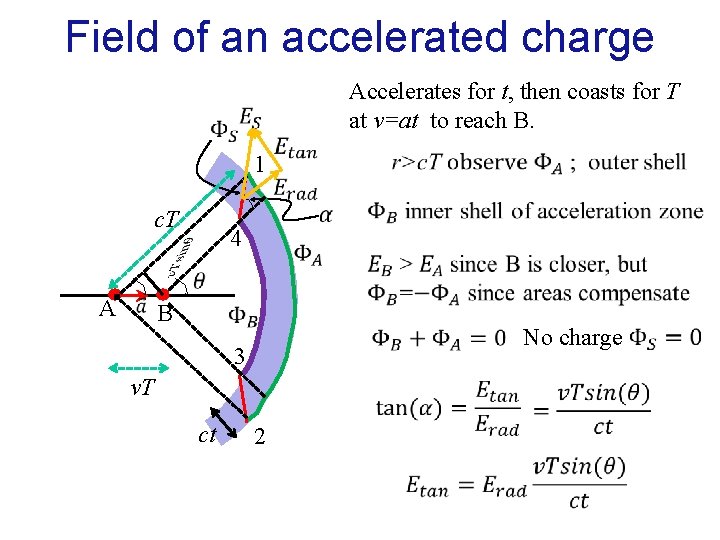
Field of an accelerated charge 1 c. T 3 v. T ct 4 A B Accelerates for t, then coasts for T at v=at to reach B. No charge 2
Field of an accelerated charge 1 c. T 4 A B 3 v. T ct 2
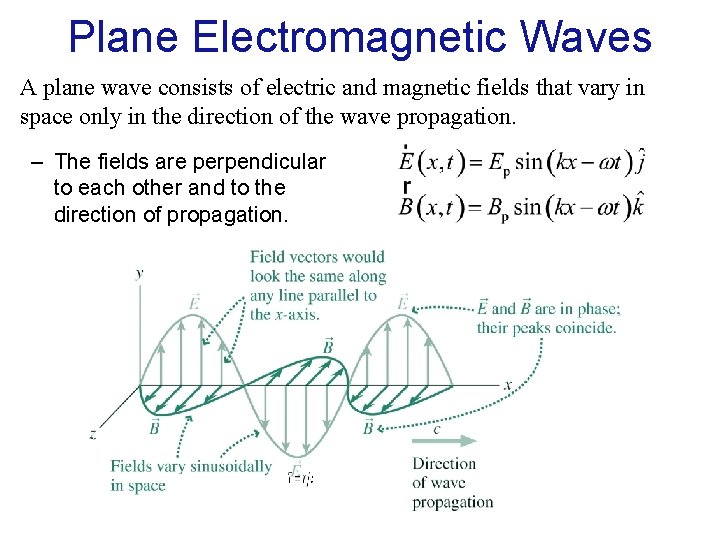
Plane Electromagnetic Waves A plane wave consists of electric and magnetic fields that vary in space only in the direction of the wave propagation. – The fields are perpendicular to each other and to the direction of propagation.
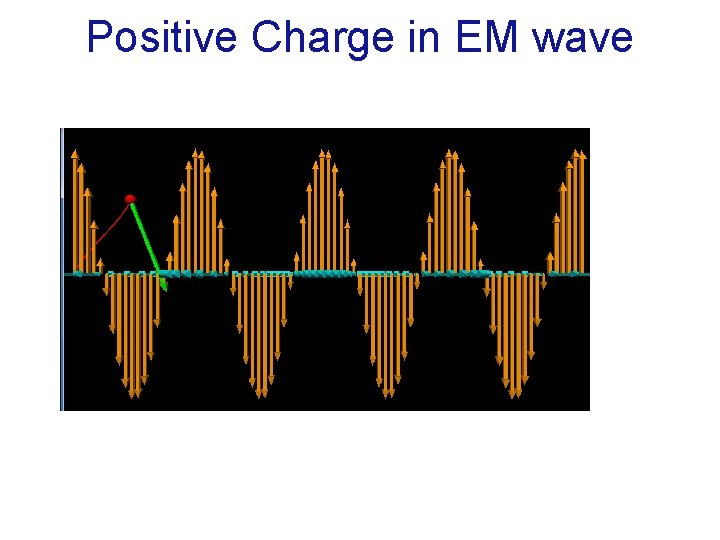
Positive Charge in EM wave
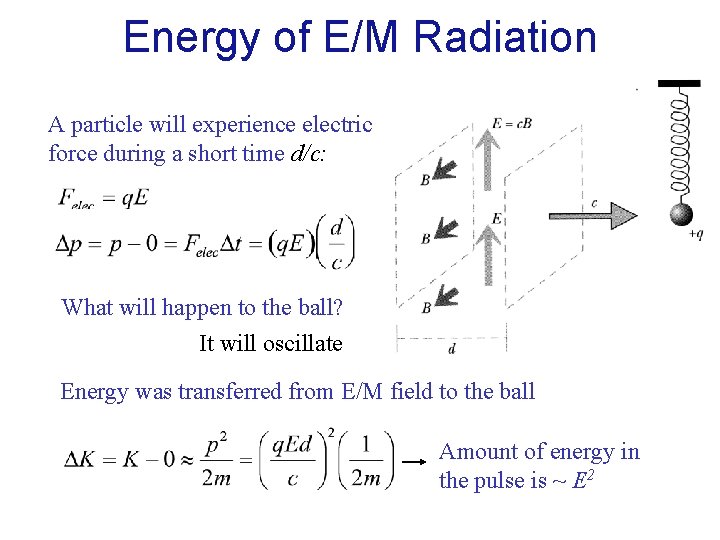
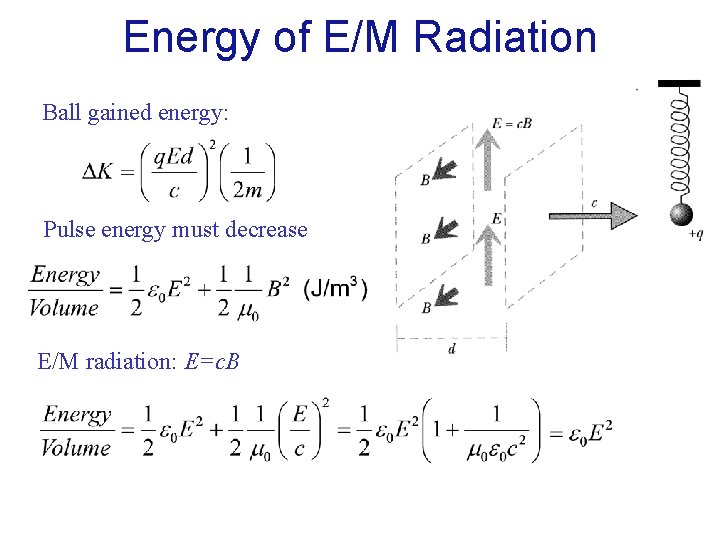
Energy of E/M Radiation A particle will experience electric force during a short time d/c: What will happen to the ball? It will oscillate Energy was transferred from E/M field to the ball Amount of energy in the pulse is ~ E 2
Energy of E/M Radiation Ball gained energy: Pulse energy must decrease E/M radiation: E=c. B
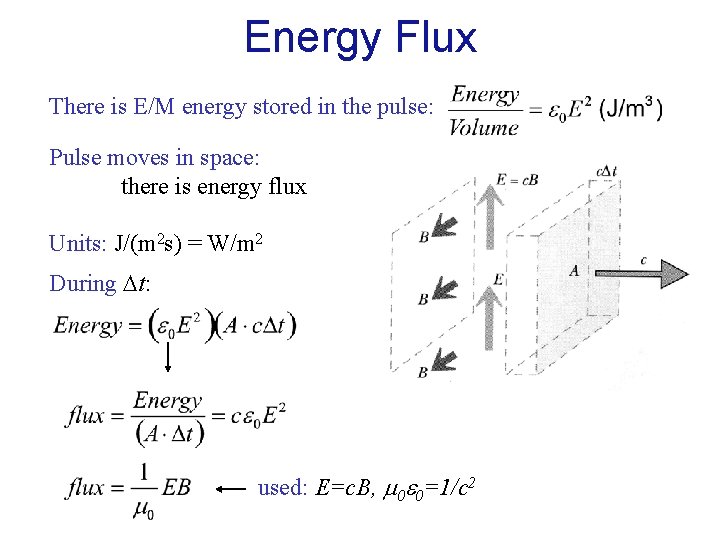
Energy Flux There is E/M energy stored in the pulse: Pulse moves in space: there is energy flux Units: J/(m 2 s) = W/m 2 During t: used: E=c. B, 0 0=1/c 2
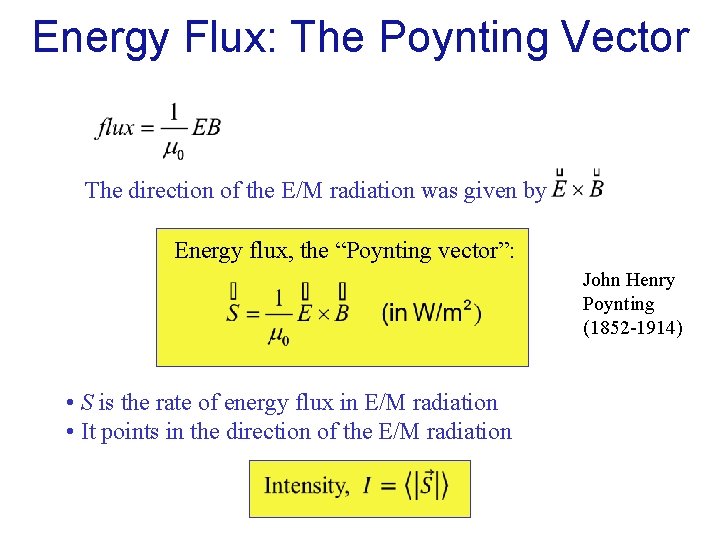
Energy Flux: The Poynting Vector The direction of the E/M radiation was given by Energy flux, the “Poynting vector”: John Henry Poynting (1852 -1914) • S is the rate of energy flux in E/M radiation • It points in the direction of the E/M radiation
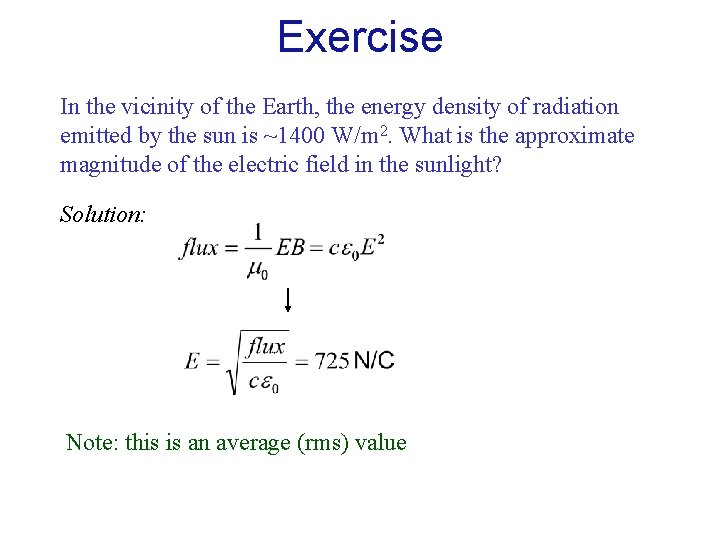
Exercise In the vicinity of the Earth, the energy density of radiation emitted by the sun is ~1400 W/m 2. What is the approximate magnitude of the electric field in the sunlight? Solution: Note: this is an average (rms) value
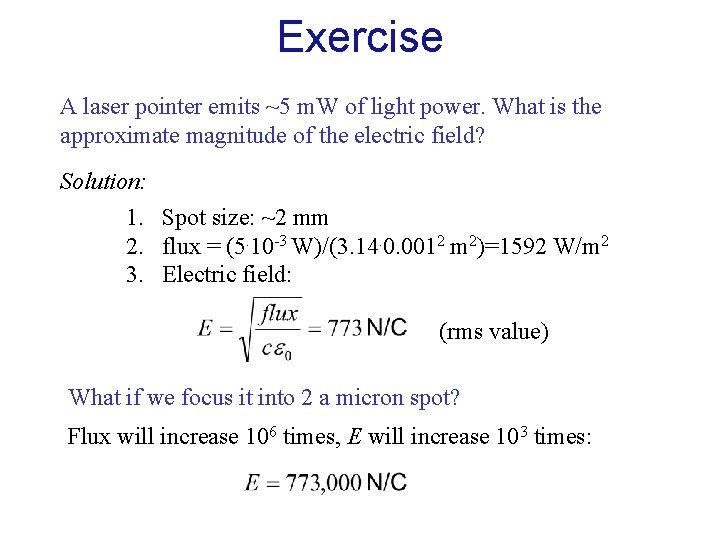
Exercise A laser pointer emits ~5 m. W of light power. What is the approximate magnitude of the electric field? Solution: 1. Spot size: ~2 mm 2. flux = (5. 10 -3 W)/(3. 14. 0. 0012 m 2)=1592 W/m 2 3. Electric field: (rms value) What if we focus it into 2 a micron spot? Flux will increase 106 times, E will increase 103 times:
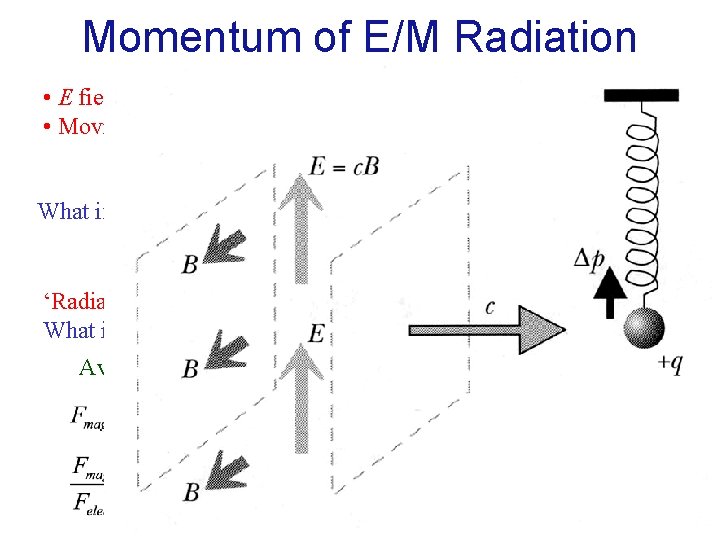
Momentum of E/M Radiation • E field starts motion • Moving charge in magnetic field: Fmag What if there is negative charge? ‘Radiation pressure’: What is its magnitude? Average speed: v/2 Fmag
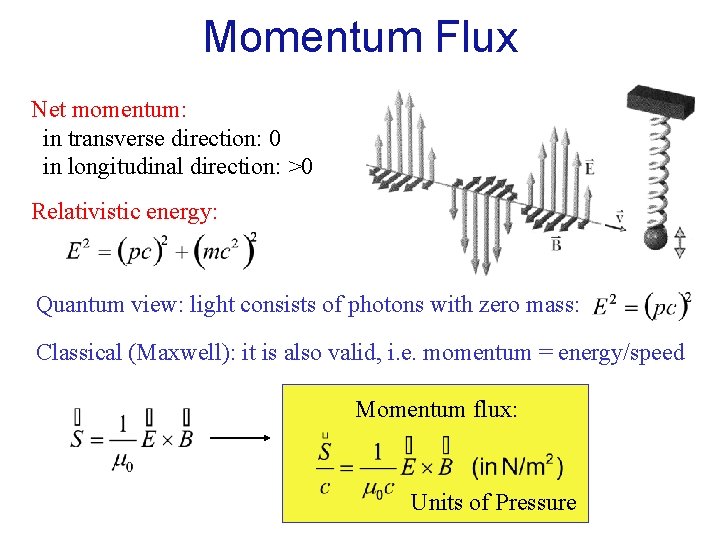
Momentum Flux Net momentum: in transverse direction: 0 in longitudinal direction: >0 Relativistic energy: Quantum view: light consists of photons with zero mass: Classical (Maxwell): it is also valid, i. e. momentum = energy/speed Momentum flux: Units of Pressure
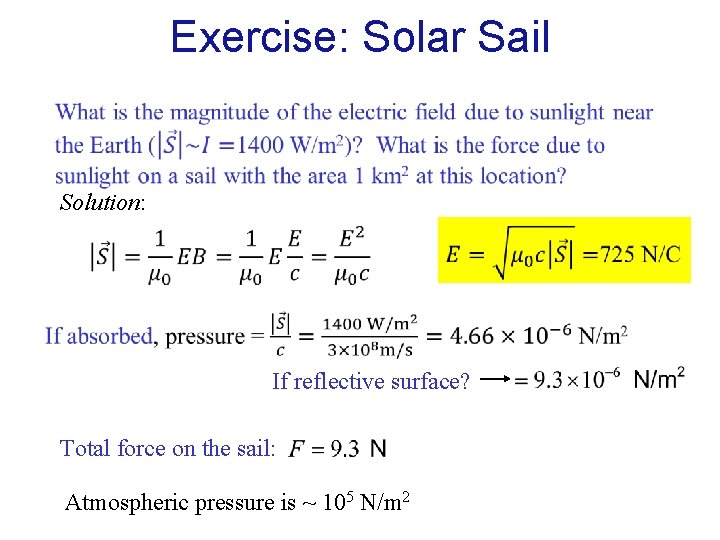
Exercise: Solar Sail Solution: If reflective surface? Total force on the sail: Atmospheric pressure is ~ 105 N/m 2
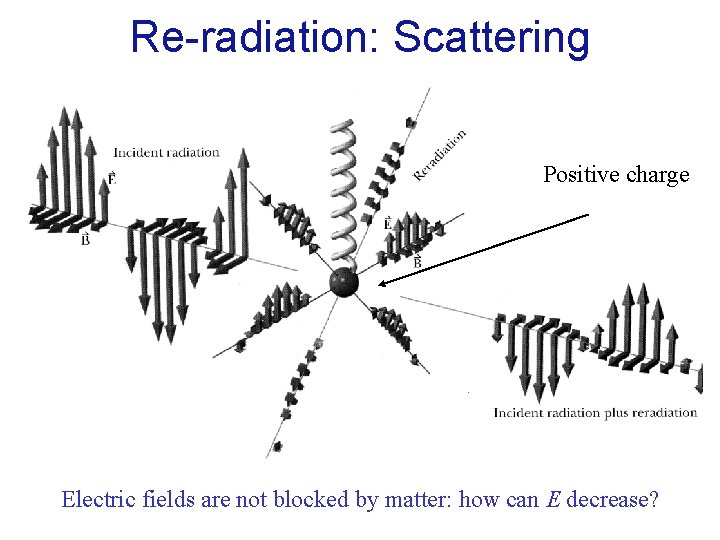
Re-radiation: Scattering Positive charge Electric fields are not blocked by matter: how can E decrease?
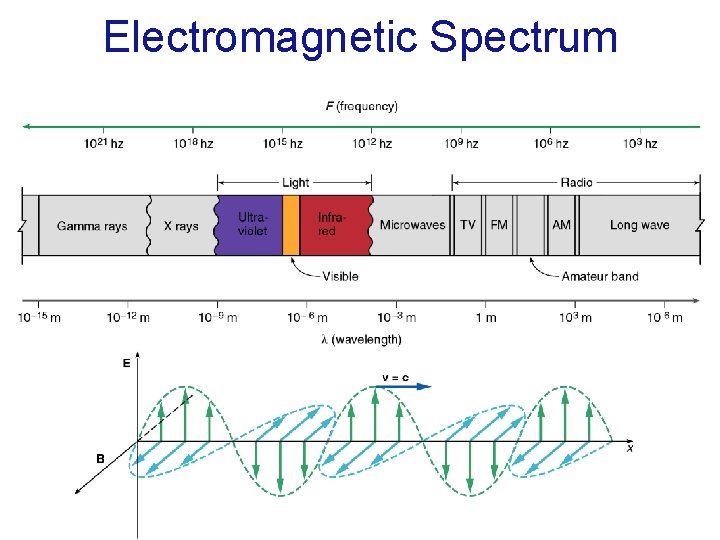
Electromagnetic Spectrum
E/M Radiation Transmitters How can we produce electromagnetic radiation of a desired frequency? Need to create oscillating motion of electrons Radio frequency LC circuit: can produce oscillating motion of charges To increase effect: connect to antenna Visible light Heat up atoms, atomic vibration can reach visible frequency range Transitions of electrons between different quantized levels
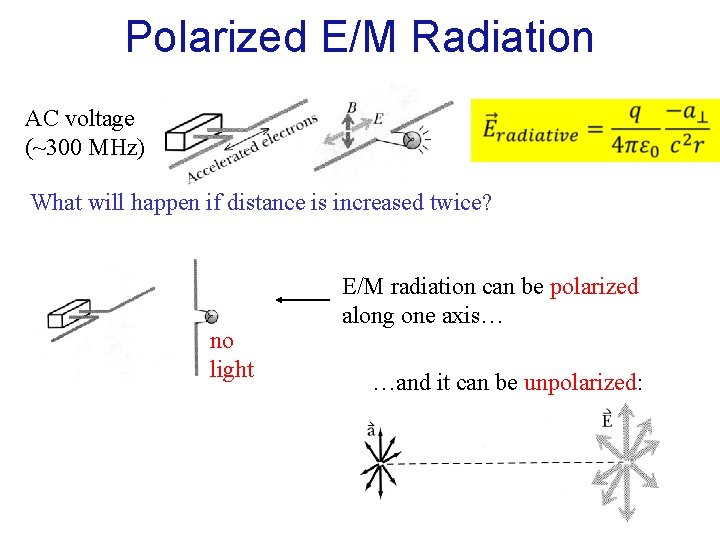
Polarized E/M Radiation AC voltage (~300 MHz) What will happen if distance is increased twice? no light E/M radiation can be polarized along one axis… …and it can be unpolarized:
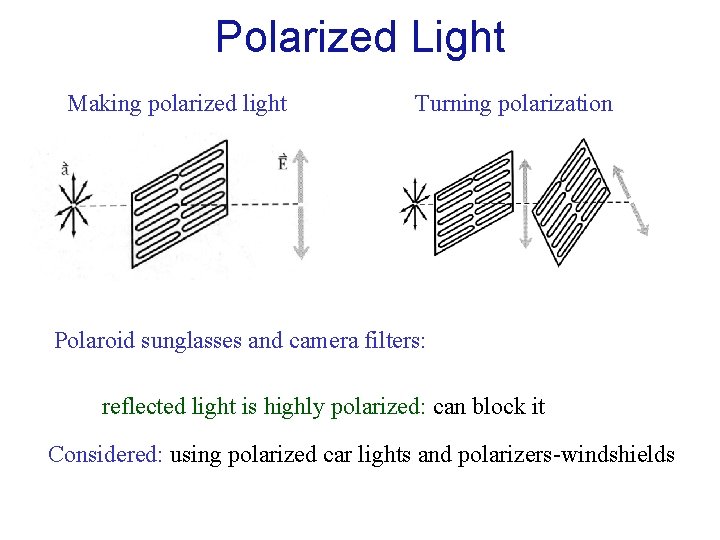
Polarized Light Making polarized light Turning polarization Polaroid sunglasses and camera filters: reflected light is highly polarized: can block it Considered: using polarized car lights and polarizers-windshields
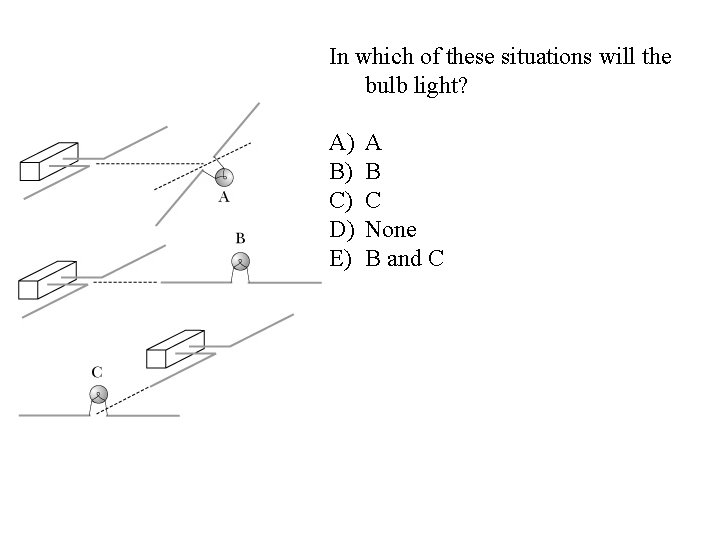
In which of these situations will the bulb light? A) B) C) D) E) A B C None B and C
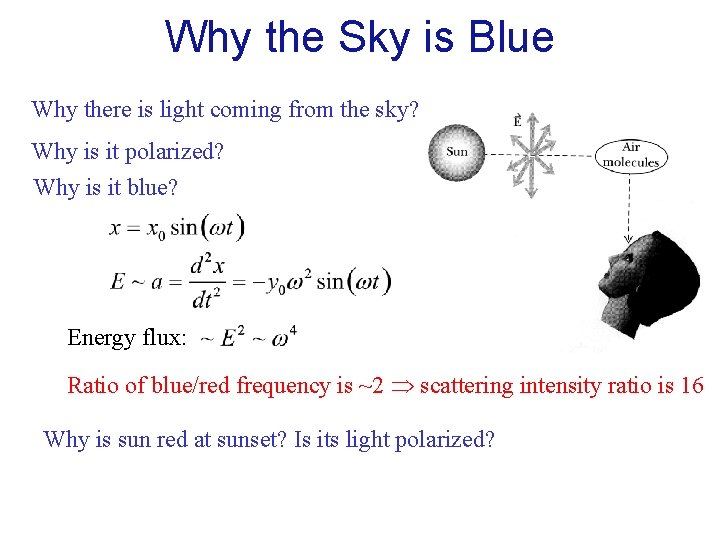
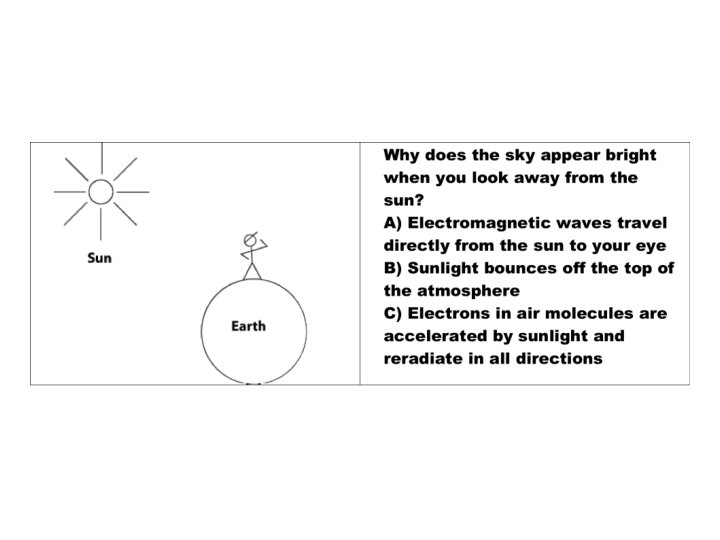
Why the Sky is Blue Why there is light coming from the sky? Why is it polarized? Why is it blue? Energy flux: Ratio of blue/red frequency is ~2 scattering intensity ratio is 16 Why is sun red at sunset? Is its light polarized?
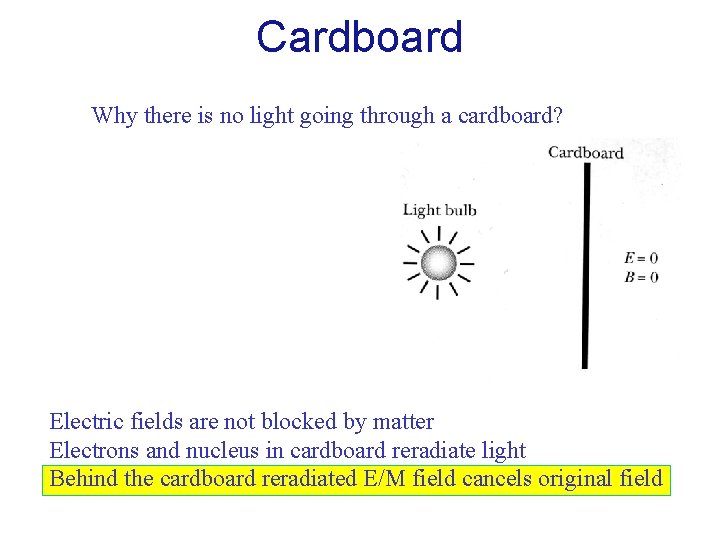
Cardboard Why there is no light going through a cardboard? Electric fields are not blocked by matter Electrons and nucleus in cardboard reradiate light Behind the cardboard reradiated E/M field cancels original field
Effect of E/M Radiation on Matter 1. Radiative pressure – too small to be observed in most cases 2. E/M fields can affect charged particles: nucleus and electrons Both fields (E and M) are always present – they ‘feed’ each other But usually only electric field is considered (B=E/c)
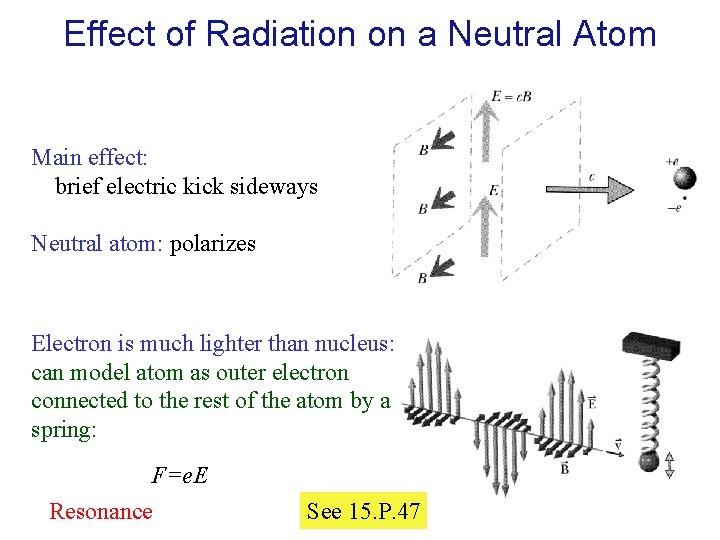
Effect of Radiation on a Neutral Atom Main effect: brief electric kick sideways Neutral atom: polarizes Electron is much lighter than nucleus: can model atom as outer electron connected to the rest of the atom by a spring: F=e. E Resonance See 15. P. 47
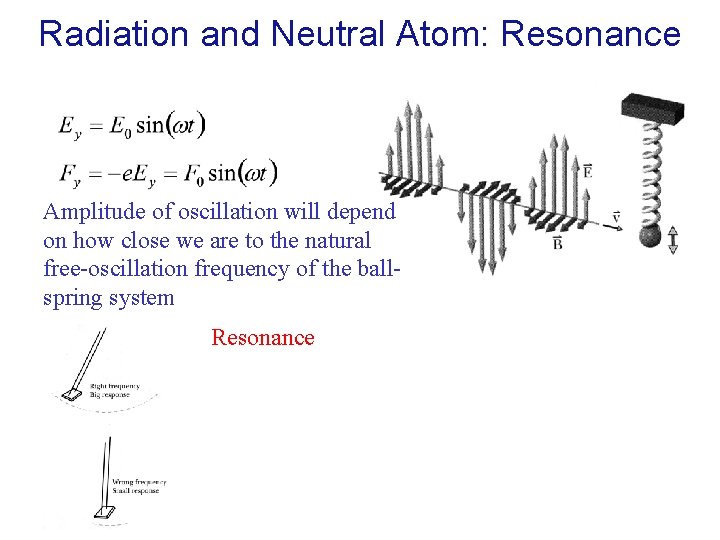
Radiation and Neutral Atom: Resonance Amplitude of oscillation will depend on how close we are to the natural free-oscillation frequency of the ballspring system Resonance
Importance of Resonance E/M radiation waves with frequency ~106 Hz has big effect on mobile electrons in the metal of radio antenna: can tune radio to a single frequency E/M radiation with frequency ~ 1015 Hz has big effect on organic molecules: retina in your eye responds to visible light but not radio waves Very high frequency (X-rays) has little effect on atoms and can pass through matter (your body): X-ray imaging