
Maximum Permissible Dose MPD In This Lecture Revision
Maximum Permissible Dose (MPD)

In This Lecture Revision Radiation Protection Criteria & Exposure Limit ALARA Principle Radiation Protection Philosophy Principles and 10 Commandments of Radiation Protection Radiation warning signs Maximum Permissible Dose (MPD) Risk Factor

Ionizing Radiation Effects STOCHASTIC EFFECTS • Probability of effect occurring is governed by laws of chance • Therefore, greater the dose the greater the probability of effect occurring. • No safe dose limit - ALL doses carries some risk • Severity of effect is not related to dose • Examples: Cancers & Genetic effects. DETERMINISTIC EFFECTS • Severity increases with dose. • Usually threshold below which no effect occurs. • Examples: Erythema, Epilation & Cataract.

Radiation Protection Criteria & Exposure Limit The objective of radiation protection is to balance the risks and benefits from activities that involve radiation. Exposure guidelines keep risks of harm from radiation within the levels that society allows. Specific radiation protection standard recommended by: ICRP: International Commission on Radiological Protection. NCRP: National Council on Radiation Protection and Measurements. Different permissible exposure criteria are applied to different groups of persons: Occupational or “on-site” standards for persons who work with radiation (18 -60) years “Controlled exposure”. Non-occupational or “off-site” guides for general public. Usually 10% of the allowable occupational values “In voluntary exposure”
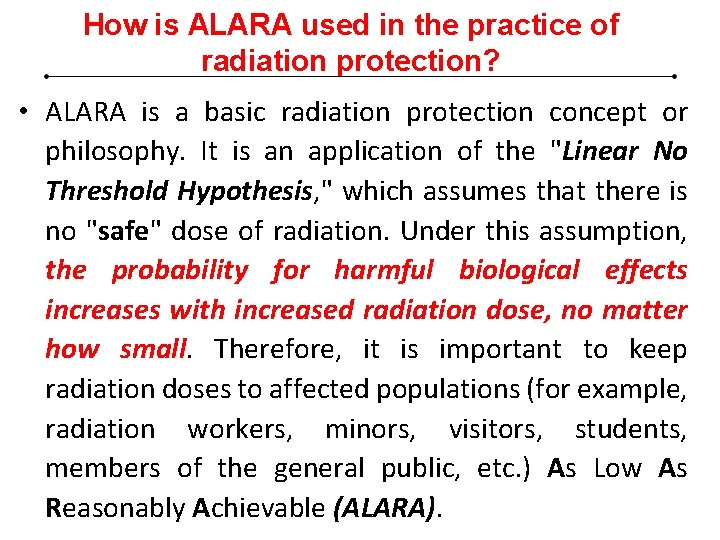
How is ALARA used in the practice of radiation protection? • ALARA is a basic radiation protection concept or philosophy. It is an application of the "Linear No Threshold Hypothesis, " which assumes that there is no "safe" dose of radiation. Under this assumption, the probability for harmful biological effects increases with increased radiation dose, no matter how small. Therefore, it is important to keep radiation doses to affected populations (for example, radiation workers, minors, visitors, students, members of the general public, etc. ) As Low As Reasonably Achievable (ALARA).

Where are ALARA principles utilized? • ALARA principles can be utilized in an infinite number of situations. For example, the proper design of a nuclear facility depends on ALARA considerations (e. g. , can the addition of more shielding to an area be justified in terms of the lower doses it will achieve? ). In addition, designing an x-ray facility for medical applications requires consideration of the amount of shielding needed to ensure that individuals located near the facility (e. g. , on the other side of the wall from the x-ray unit) do not receive any more dose than is really necessary during operation of the x-ray device.

ALARA Principles Source reduction “elimination”. Controlling and containing the radioactivity. Minimizing time in radiation field. Maximizing the distance from radiation source. Using proper shielding. Optimization rule in radiation protection.
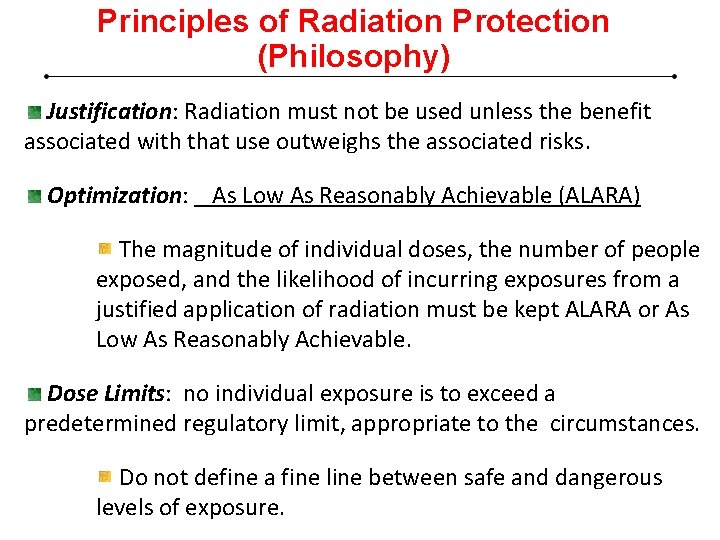
Principles of Radiation Protection (Philosophy) Justification: Radiation must not be used unless the benefit associated with that use outweighs the associated risks. Optimization: As Low As Reasonably Achievable (ALARA) The magnitude of individual doses, the number of people exposed, and the likelihood of incurring exposures from a justified application of radiation must be kept ALARA or As Low As Reasonably Achievable. Dose Limits: no individual exposure is to exceed a predetermined regulatory limit, appropriate to the circumstances. Do not define a fine line between safe and dangerous levels of exposure.
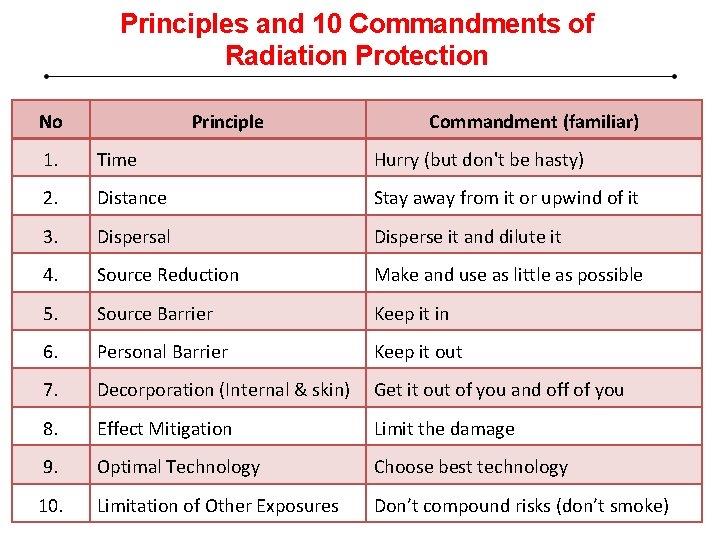
Principles and 10 Commandments of Radiation Protection No Principle Commandment (familiar) 1. Time Hurry (but don't be hasty) 2. Distance Stay away from it or upwind of it 3. Dispersal Disperse it and dilute it 4. Source Reduction Make and use as little as possible 5. Source Barrier Keep it in 6. Personal Barrier Keep it out 7. Decorporation (Internal & skin) Get it out of you and off of you 8. Effect Mitigation Limit the damage 9. Optimal Technology Choose best technology 10. Limitation of Other Exposures Don’t compound risks (don’t smoke)
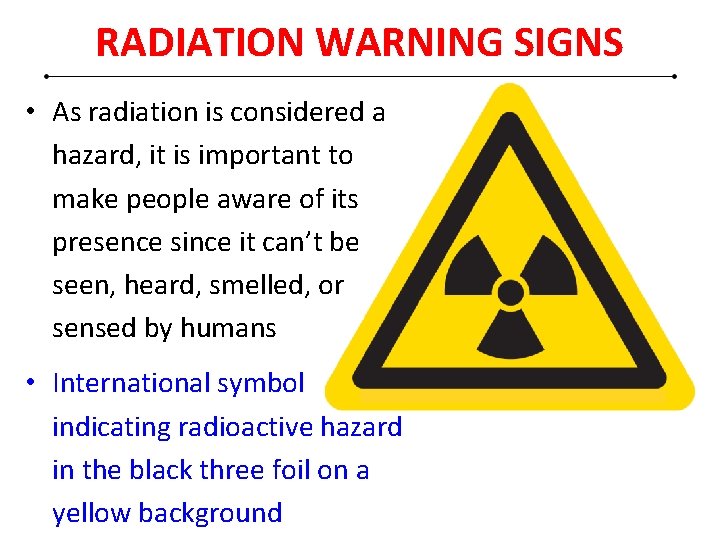
RADIATION WARNING SIGNS • As radiation is considered a hazard, it is important to make people aware of its presence since it can’t be seen, heard, smelled, or sensed by humans • International symbol indicating radioactive hazard in the black three foil on a yellow background
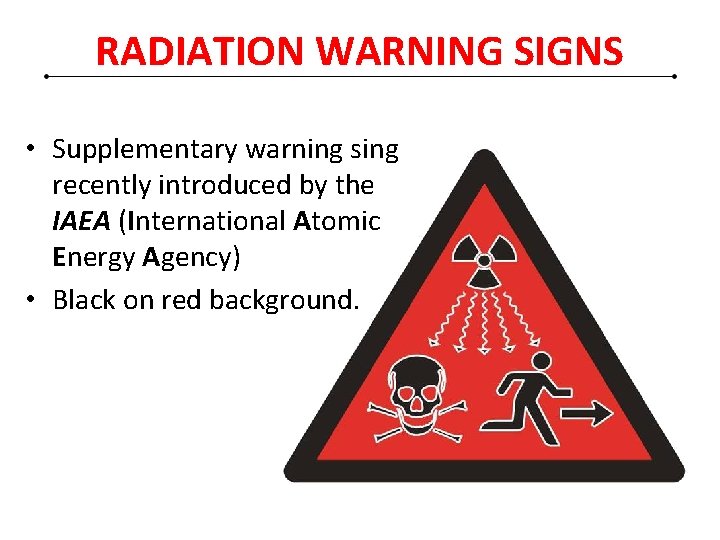
RADIATION WARNING SIGNS • Supplementary warning sing recently introduced by the IAEA (International Atomic Energy Agency) • Black on red background.
Maximum Permissible Dose • Government standards for radiation protection are established by the National Council on Radiation Protection and Measurement (NCRP) and its international counterpart, the International Commission on Radiological Protection (ICRP). Both of these organizations offer recommendations for the maximum permissible dose (MPD) of radiation to which people should be exposed, and those recommendations are generally adopted by various government regulatory agencies like (JAEC) as the maximum limits permitted by law. • Maximum permissible dose (MPD) is affected both by the size of each dose and the rate at which these doses are received.

Maximum Permissible Dose History of Maximum permissible Dose Date 1931 1936 1948 1958 1990 Dose for General Public (m. Sv) 50 30 15 5 1 Dose for Radiation Worker (m. Sv) 500 300 150 50 20
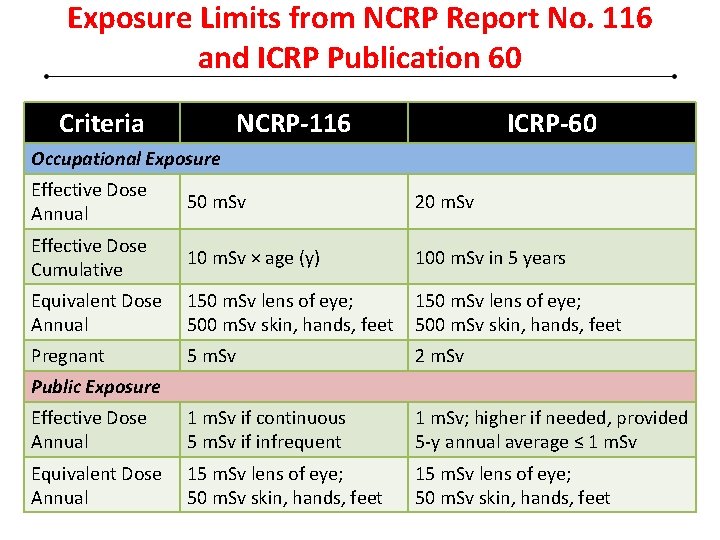
Exposure Limits from NCRP Report No. 116 and ICRP Publication 60 Criteria NCRP-116 ICRP-60 Occupational Exposure Effective Dose Annual 50 m. Sv 20 m. Sv Effective Dose Cumulative 10 m. Sv × age (y) 100 m. Sv in 5 years Equivalent Dose Annual 150 m. Sv lens of eye; 500 m. Sv skin, hands, feet Pregnant 5 m. Sv 2 m. Sv Effective Dose Annual 1 m. Sv if continuous 5 m. Sv if infrequent 1 m. Sv; higher if needed, provided 5 -y annual average ≤ 1 m. Sv Equivalent Dose Annual 15 m. Sv lens of eye; 50 m. Sv skin, hands, feet Public Exposure
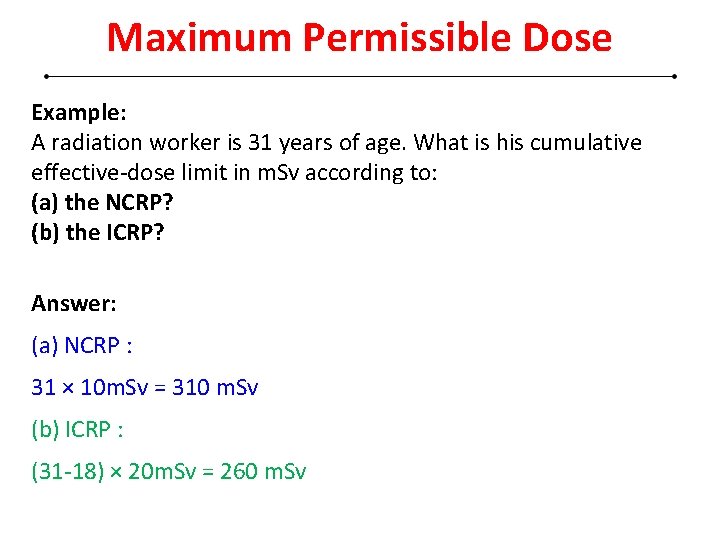
Maximum Permissible Dose Example: A radiation worker is 31 years of age. What is his cumulative effective-dose limit in m. Sv according to: (a) the NCRP? (b) the ICRP? Answer: (a) NCRP : 31 × 10 m. Sv = 310 m. Sv (b) ICRP : (31 -18) × 20 m. Sv = 260 m. Sv

Risk Factor Units: Sv-1
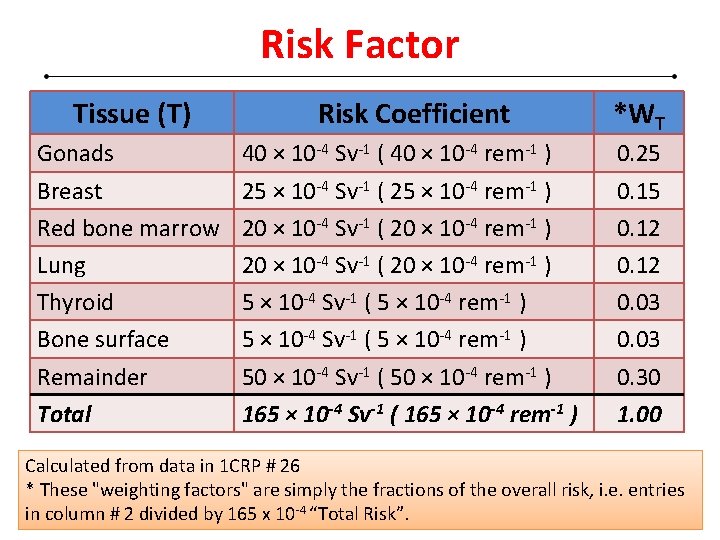
Risk Factor Tissue (T) Risk Coefficient *WT Gonads Breast Red bone marrow Lung Thyroid Bone surface Remainder Total 40 × 10 -4 Sv-1 ( 40 × 10 -4 rem-1 ) 25 × 10 -4 Sv-1 ( 25 × 10 -4 rem-1 ) 20 × 10 -4 Sv-1 ( 20 × 10 -4 rem-1 ) 5 × 10 -4 Sv-1 ( 5 × 10 -4 rem-1 ) 50 × 10 -4 Sv-1 ( 50 × 10 -4 rem-1 ) 165 × 10 -4 Sv-1 ( 165 × 10 -4 rem-1 ) 0. 25 0. 12 0. 03 0. 30 1. 00 Calculated from data in 1 CRP # 26 * These "weighting factors" are simply the fractions of the overall risk, i. e. entries in column # 2 divided by 165 x 10 -4 “Total Risk”.
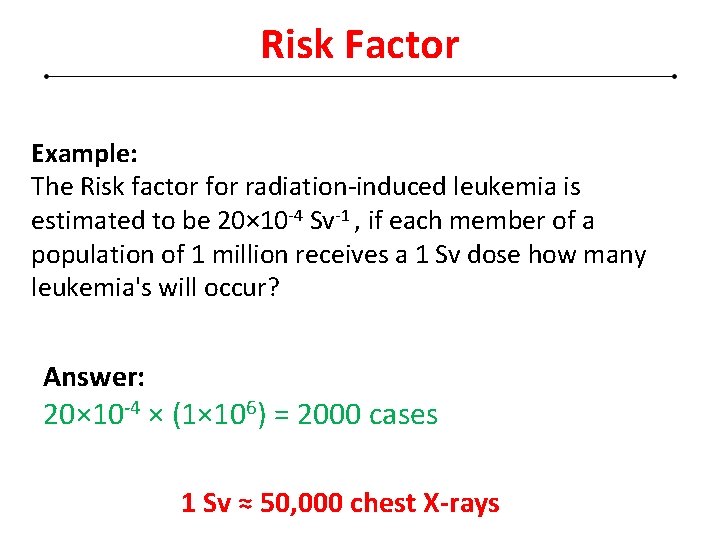
Risk Factor Example: The Risk factor for radiation-induced leukemia is estimated to be 20× 10 -4 Sv-1 , if each member of a population of 1 million receives a 1 Sv dose how many leukemia's will occur? Answer: 20× 10 -4 × (1× 106) = 2000 cases 1 Sv ≈ 50, 000 chest X-rays
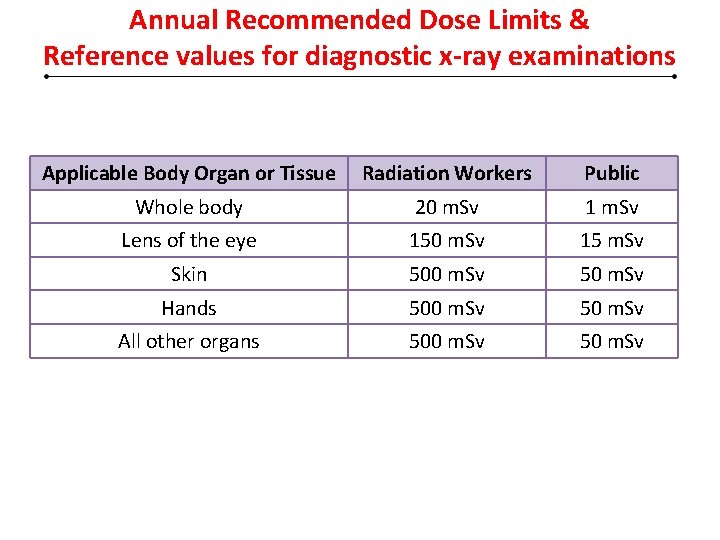
Annual Recommended Dose Limits & Reference values for diagnostic x-ray examinations Applicable Body Organ or Tissue Radiation Workers Public Whole body 20 m. Sv 1 m. Sv Lens of the eye 150 m. Sv 15 m. Sv Skin 500 m. Sv 50 m. Sv Hands 500 m. Sv 50 m. Sv All other organs 500 m. Sv 50 m. Sv
- Slides: 19