
Maximum Likelihood Linear Regression for Speaker Adaptation of
- Slides: 22
Maximum Likelihood Linear Regression for Speaker Adaptation of Continuous Density Hidden Markov Models C. J. Leggetter and P. C. Woodland Department of Engineering, University of Cambridge, Trumpington Street, Cambridge CB 2 1 PZ, U. K. Computer Speech and Language (1995) Present by Hsu Ting-Wei 2006. 03. 16
Introduction Say: “Hello!” Speaker HMM Models • Speaker adaptation techniques fall into two main categories: – Speaker normalization • The input speech is normalized to match the speaker that the system is trained to model – Model adaptation techniques • The parameters of the model set are adjusted to improve the modeling of the new speaker • MAP method – Only update the parameters of models which are observed in the adaptation data • MLLR method (Maximum Likelihood Linear Regression) – All model states can be adapted even if no model-specific data is available 2
MLLR’s adaptation approach • This method requires an initial speaker independent continuous density HMM system • MLLR takes some adaptation data from a new speaker and updates the model mean parameters to maximize the likelihood of the adaptation data • The other HMM parameters are not adapted since the main differences between speakers are assumed to be characterized by the means 3
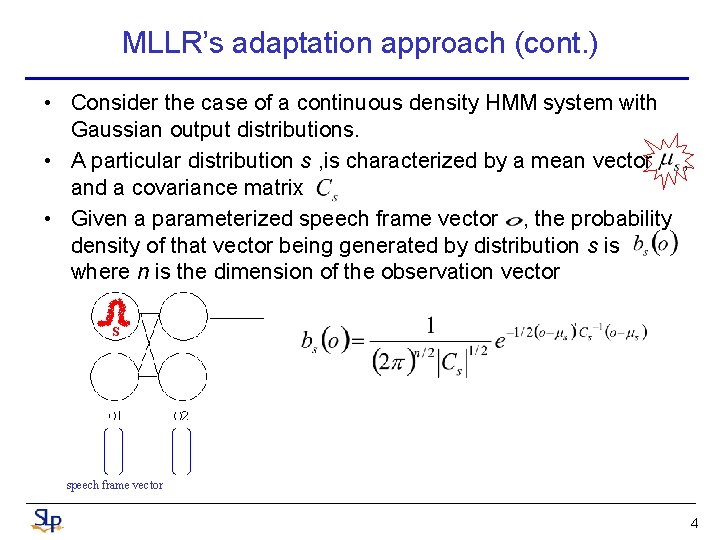
MLLR’s adaptation approach (cont. ) • Consider the case of a continuous density HMM system with Gaussian output distributions. • A particular distribution s , is characterized by a mean vector , and a covariance matrix • Given a parameterized speech frame vector , the probability density of that vector being generated by distribution s is where n is the dimension of the observation vector S speech frame vector 4
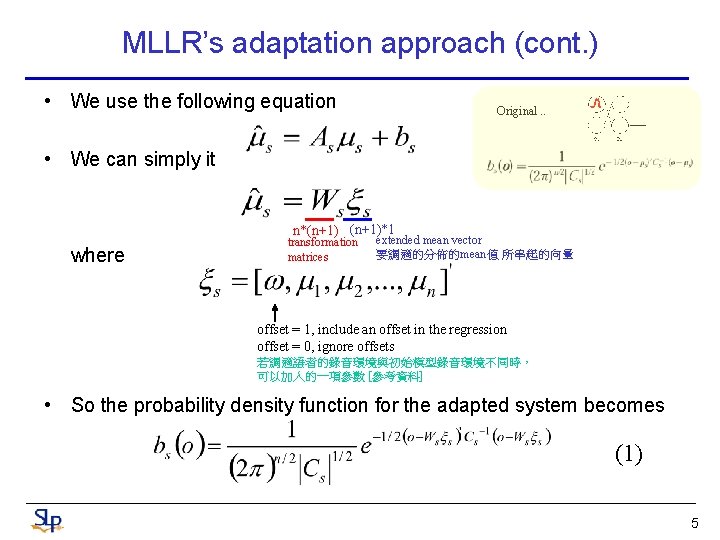
MLLR’s adaptation approach (cont. ) • We use the following equation Original. . • We can simply it n*(n+1)*1 where transformation matrices extended mean vector 要調適的分佈的mean值 所串起的向量 offset = 1, include an offset in the regression offset = 0, ignore offsets 若調適語者的錄音環境與初始模型錄音環境不同時, 可以加入的一項參數 [參考資料] • So the probability density function for the adapted system becomes (1) 5
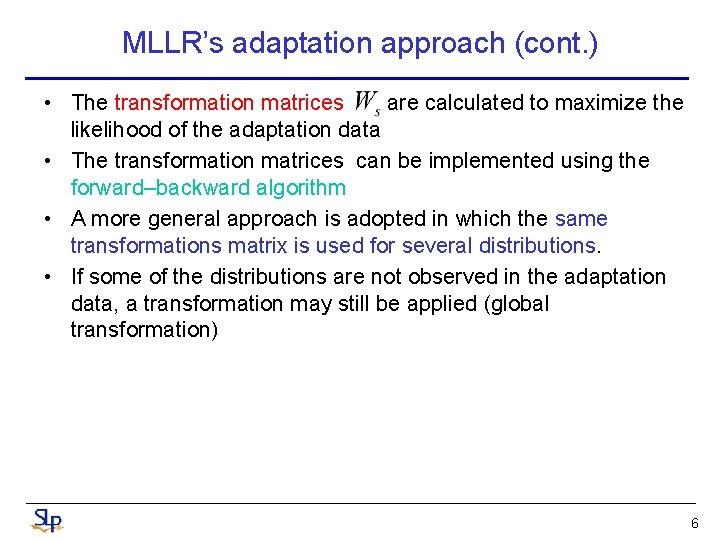
MLLR’s adaptation approach (cont. ) • The transformation matrices are calculated to maximize the likelihood of the adaptation data • The transformation matrices can be implemented using the forward–backward algorithm • A more general approach is adopted in which the same transformations matrix is used for several distributions. • If some of the distributions are not observed in the adaptation data, a transformation may still be applied (global transformation) 6
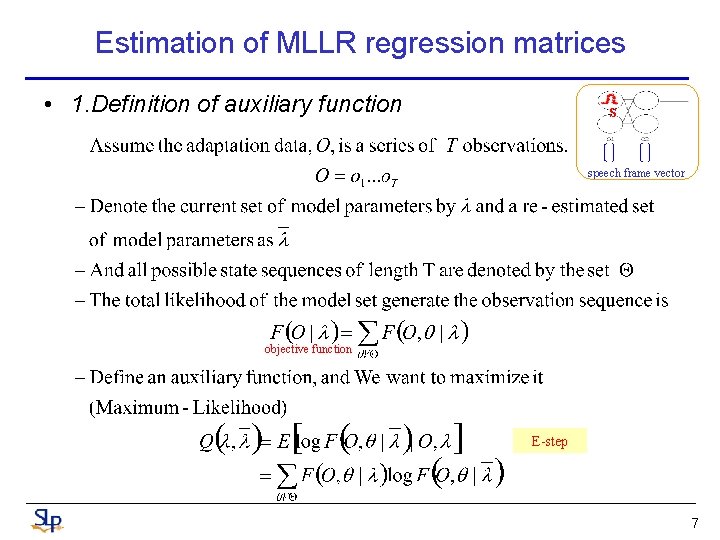
Estimation of MLLR regression matrices • 1. Definition of auxiliary function S speech frame vector objective function E-step 7
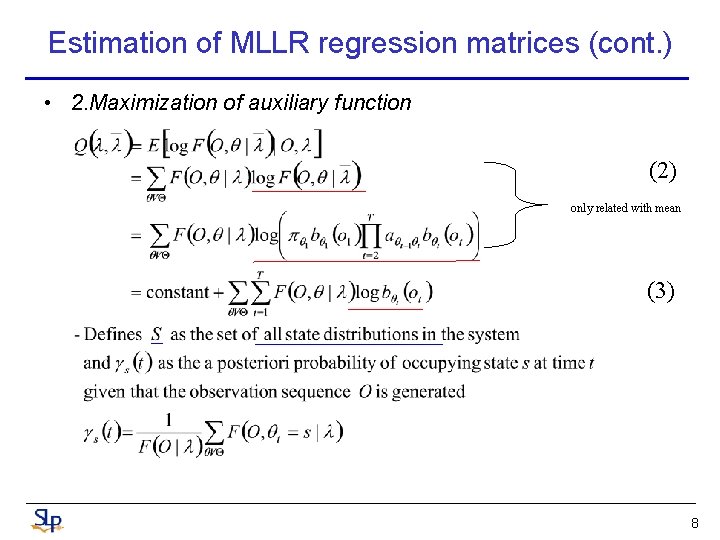
Estimation of MLLR regression matrices (cont. ) • 2. Maximization of auxiliary function (2) only related with mean (3) 8
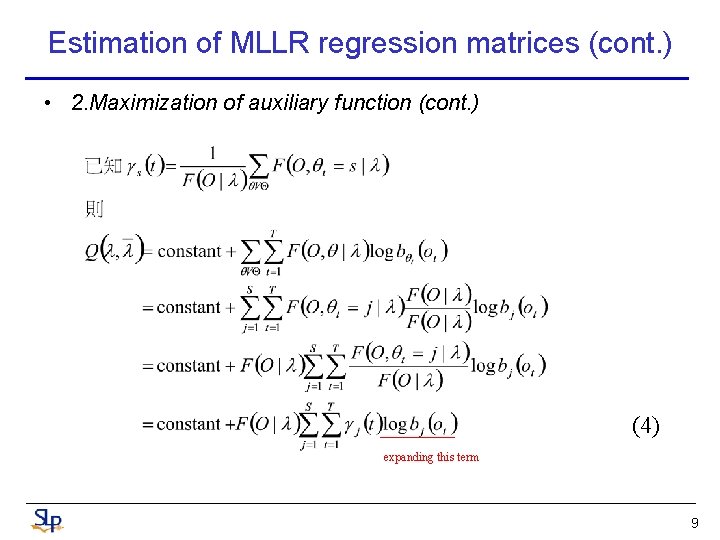
Estimation of MLLR regression matrices (cont. ) • 2. Maximization of auxiliary function (cont. ) (4) expanding this term 9
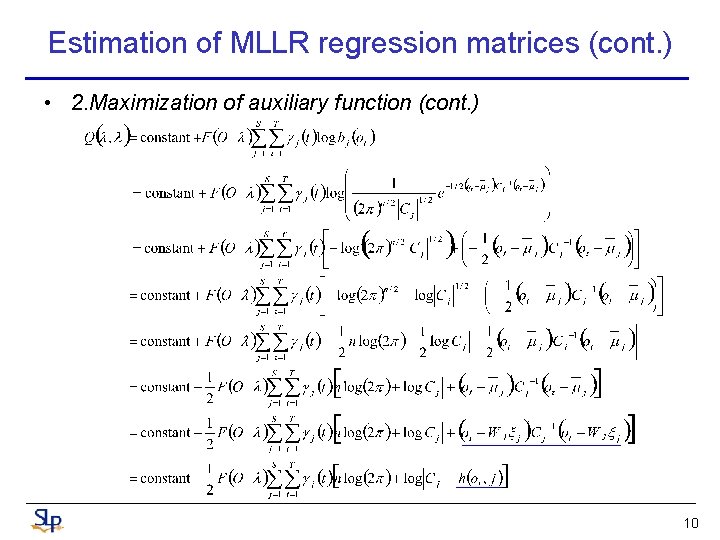
Estimation of MLLR regression matrices (cont. ) • 2. Maximization of auxiliary function (cont. ) 10
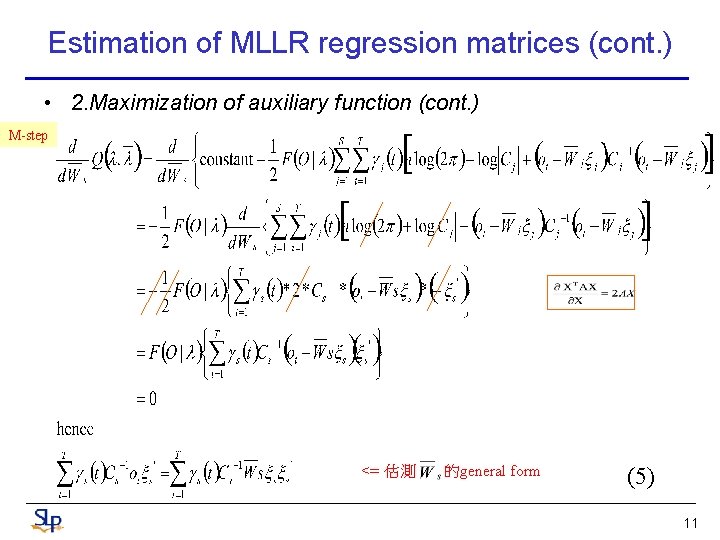
Estimation of MLLR regression matrices (cont. ) • 2. Maximization of auxiliary function (cont. ) M-step <= 估測 的general form (5) 11
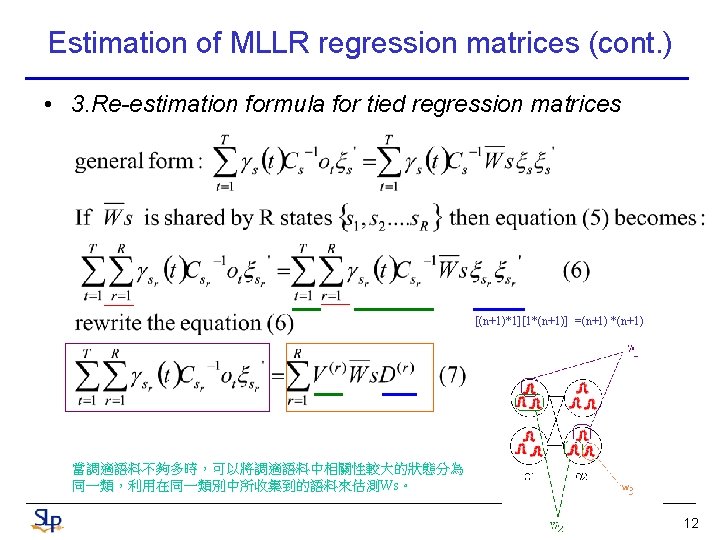
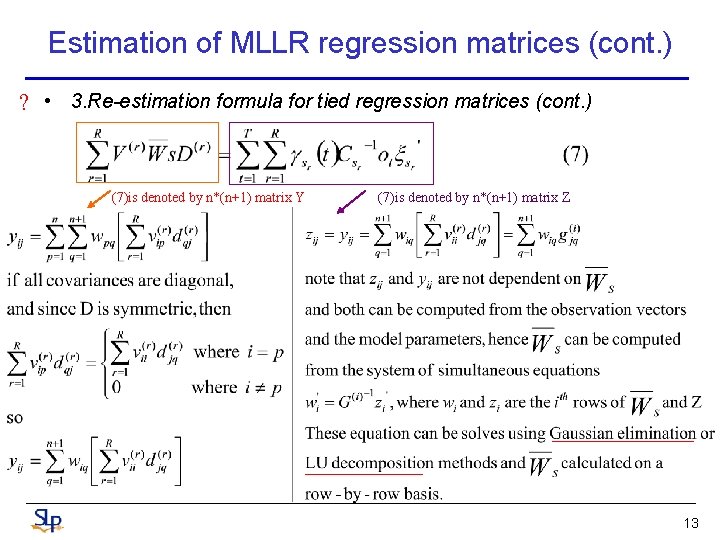
Estimation of MLLR regression matrices (cont. ) • 3. Re-estimation formula for tied regression matrices [(n+1)*1][1*(n+1)] =(n+1) *(n+1) 當調適語料不夠多時,可以將調適語料中相關性較大的狀態分為 同一類,利用在同一類別中所收集到的語料來估測Ws。 12
Estimation of MLLR regression matrices (cont. ) ? • 3. Re-estimation formula for tied regression matrices (cont. ) (7)is denoted by n*(n+1) matrix Y (7)is denoted by n*(n+1) matrix Z 13
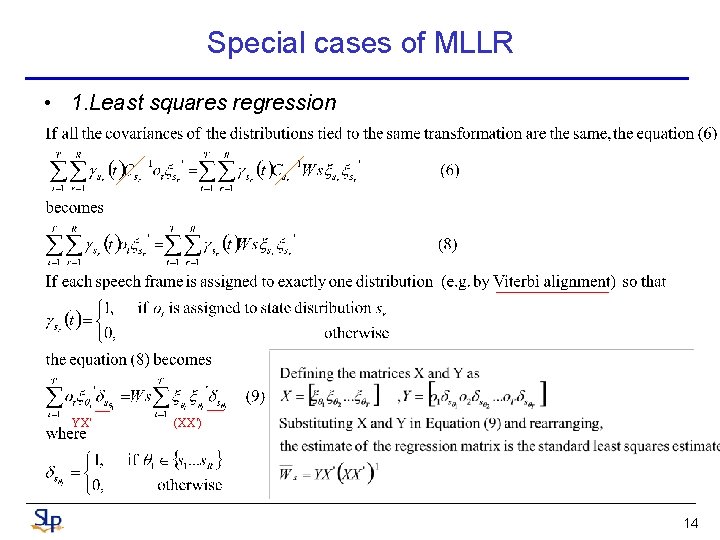
Special cases of MLLR • 1. Least squares regression YX’ (XX’) 14
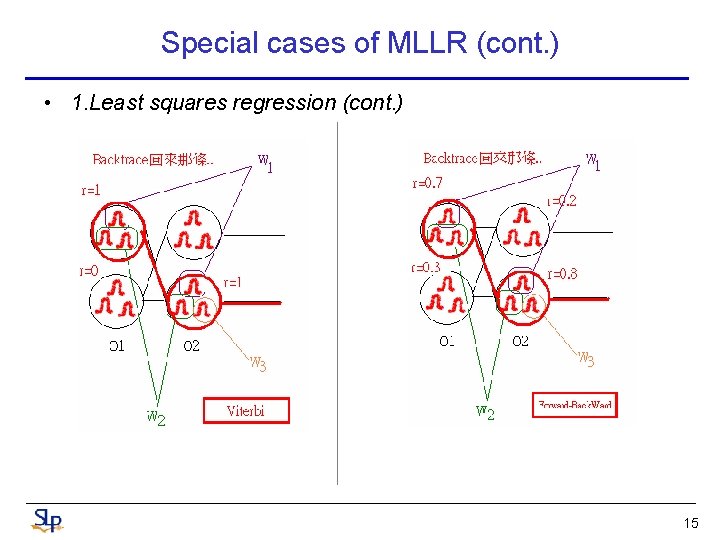
Special cases of MLLR (cont. ) • 1. Least squares regression (cont. ) 15
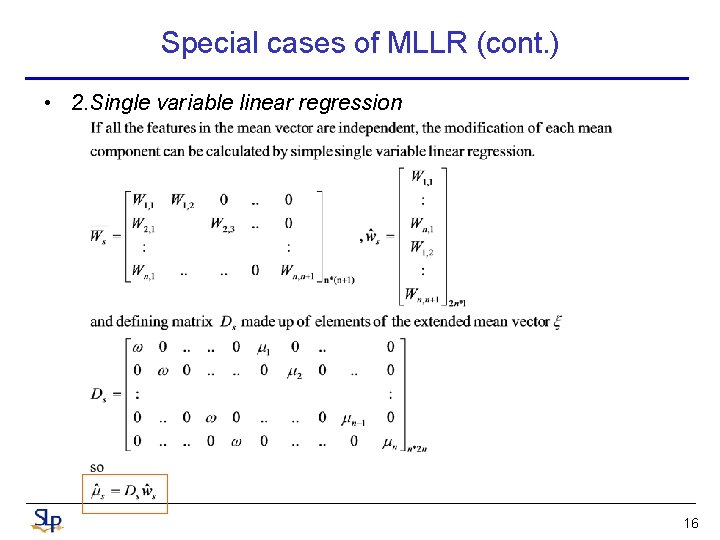
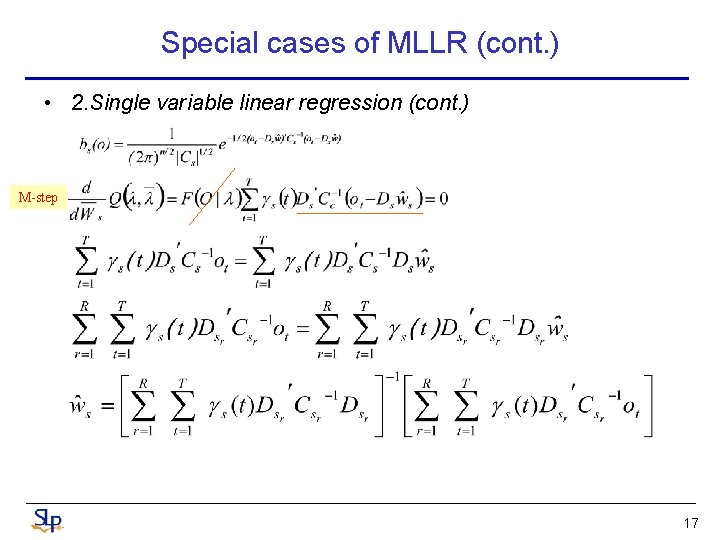
Special cases of MLLR (cont. ) • 2. Single variable linear regression 16
Special cases of MLLR (cont. ) • 2. Single variable linear regression (cont. ) M-step 17
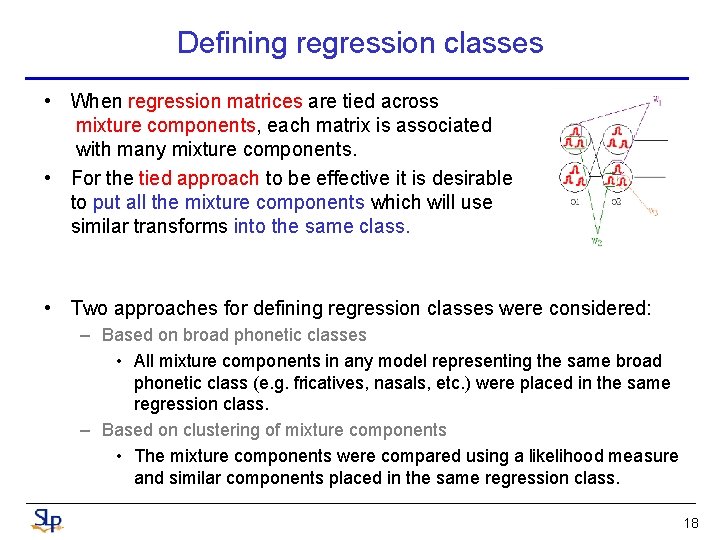
Defining regression classes • When regression matrices are tied across mixture components, each matrix is associated with many mixture components. • For the tied approach to be effective it is desirable to put all the mixture components which will use similar transforms into the same class. • Two approaches for defining regression classes were considered: – Based on broad phonetic classes • All mixture components in any model representing the same broad phonetic class (e. g. fricatives, nasals, etc. ) were placed in the same regression class. – Based on clustering of mixture components • The mixture components were compared using a likelihood measure and similar components placed in the same regression class. 18
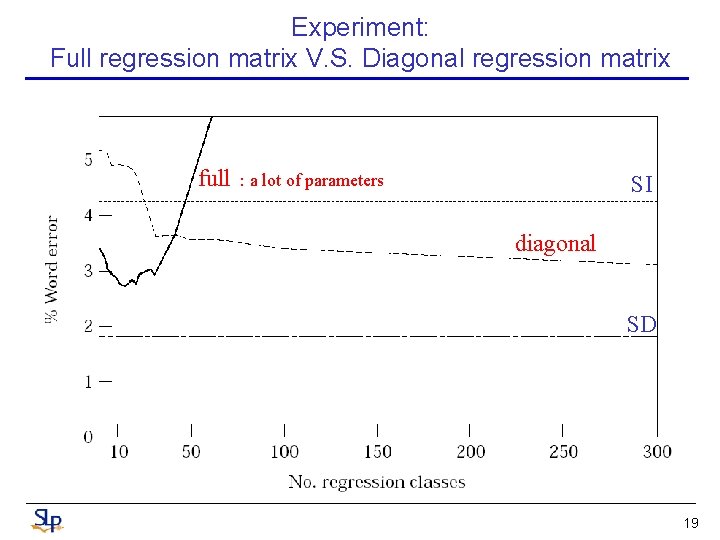
Experiment: Full regression matrix V. S. Diagonal regression matrix full : a lot of parameters SI diagonal SD 19
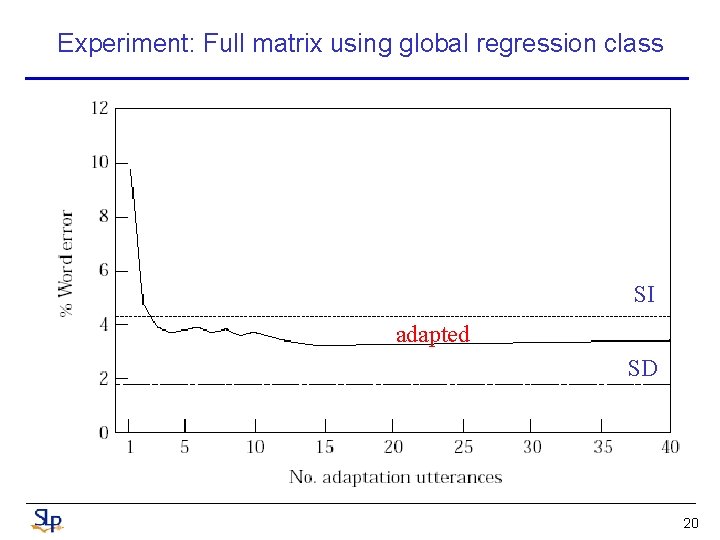
Experiment: Full matrix using global regression class SI adapted SD 20
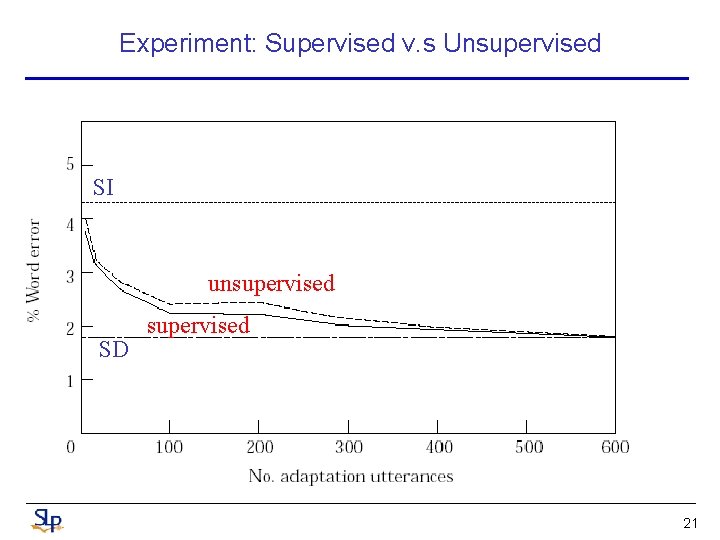
Experiment: Supervised v. s Unsupervised SI unsupervised SD supervised 21
Conclusion • MLLR can be applied to continuous density HMMs with a large number of Gaussians and is effective with small amounts of adaptation data. 22