
Maximo User Group The Interserve Target Operating Model

- Slides: 17
Maximo User Group The Interserve Target Operating Model James Williams Interserve Programme Manager
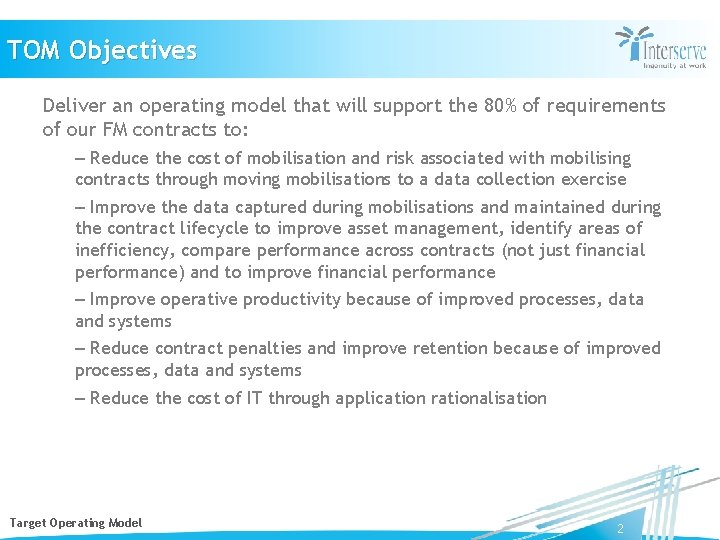
TOM Objectives Deliver an operating model that will support the 80% of requirements of our FM contracts to: – Reduce the cost of mobilisation and risk associated with mobilising contracts through moving mobilisations to a data collection exercise – Improve the data captured during mobilisations and maintained during the contract lifecycle to improve asset management, identify areas of inefficiency, compare performance across contracts (not just financial performance) and to improve financial performance – Improve operative productivity because of improved processes, data and systems – Reduce contract penalties and improve retention because of improved processes, data and systems – Reduce the cost of IT through application rationalisation Target Operating Model 2
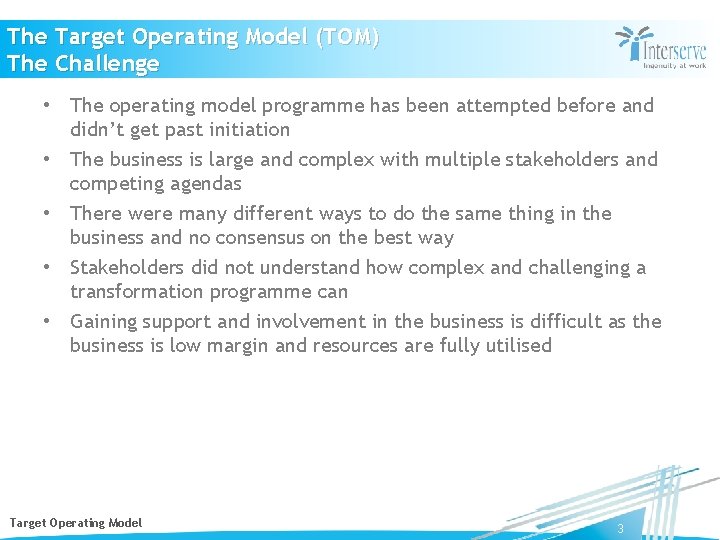
The Target Operating Model (TOM) The Challenge • The operating model programme has been attempted before and didn’t get past initiation • The business is large and complex with multiple stakeholders and competing agendas • There were many different ways to do the same thing in the business and no consensus on the best way • Stakeholders did not understand how complex and challenging a transformation programme can • Gaining support and involvement in the business is difficult as the business is low margin and resources are fully utilised Target Operating Model 3
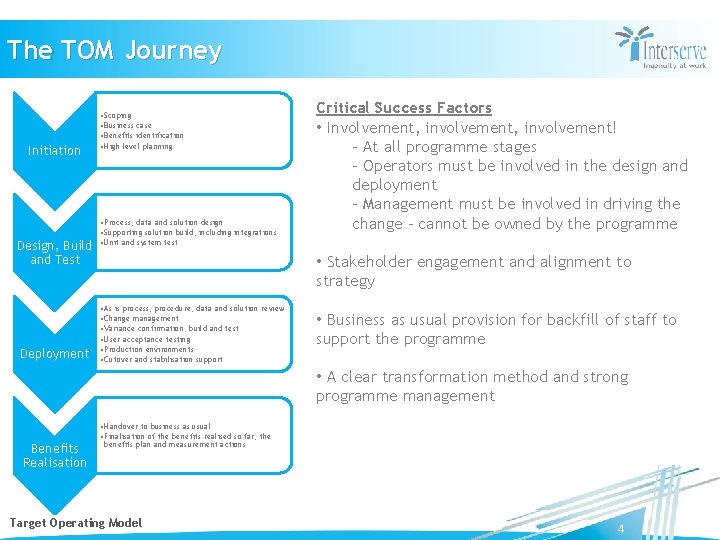
The TOM Journey Initiation Design, Build and Test Deployment • Scoping • Business case • Benefits identification • High level planning • Process, data and solution design • Supporting solution build, including integrations • Unit and system test Critical Success Factors • Involvement, involvement! – At all programme stages – Operators must be involved in the design and deployment – Management must be involved in driving the change – cannot be owned by the programme • Stakeholder engagement and alignment to strategy • As is process, procedure, data and solution review • Change management • Variance confirmation, build and test • User acceptance testing • Production environments • Cutover and stabilisation support • Business as usual provision for backfill of staff to support the programme • A clear transformation method and strong programme management • Handover to business as usual • Finalisation of the benefits realised so far, the Benefits Realisation benefits plan and measurement actions Target Operating Model 4
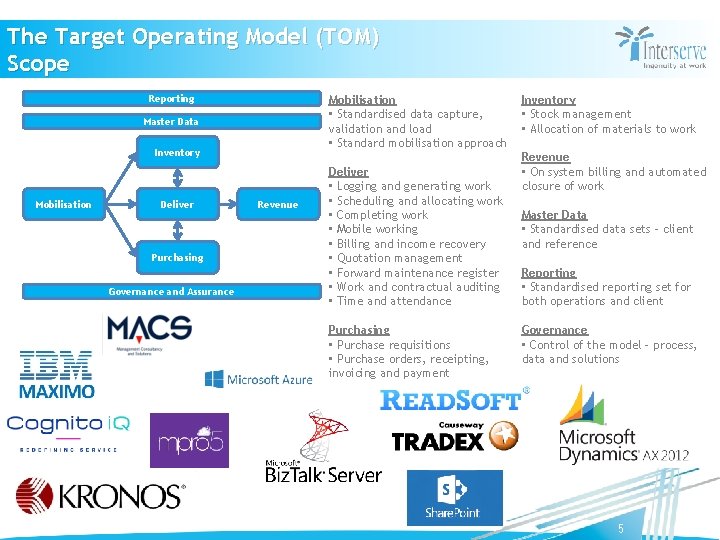
The Target Operating Model (TOM) Scope Mobilisation • Standardised data capture, validation and load • Standard mobilisation approach Reporting Master Data Inventory Mobilisation Deliver Purchasing Governance and Assurance Revenue Deliver • Logging and generating work • Scheduling and allocating work • Completing work • Mobile working • Billing and income recovery • Quotation management • Forward maintenance register • Work and contractual auditing • Time and attendance Purchasing • Purchase requisitions • Purchase orders, receipting, invoicing and payment Target Operating Model Inventory • Stock management • Allocation of materials to work Revenue • On system billing and automated closure of work Master Data • Standardised data sets – client and reference Reporting • Standardised reporting set for both operations and client Governance • Control of the model – process, data and solutions 5
Maximo User Group TOM Service Delivery Peter Mc. Cartney Interserve Maximo Functional Lead
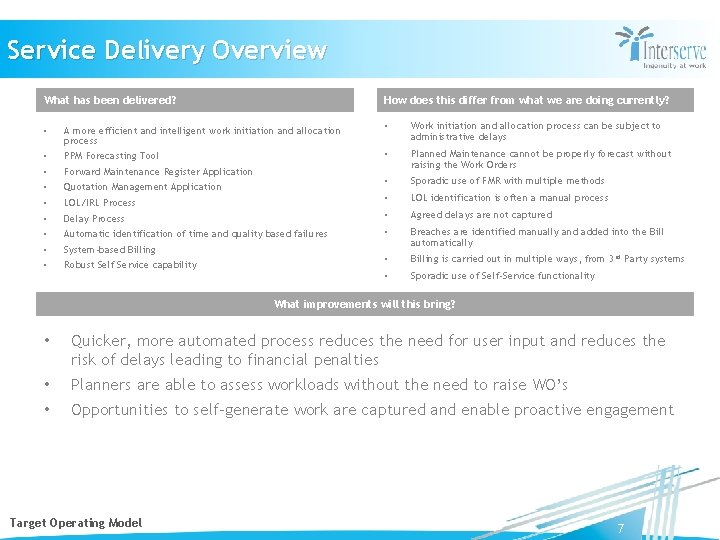
Service Delivery Overview What has been delivered? How does this differ from what we are doing currently? • A more efficient and intelligent work initiation and allocation process • Work initiation and allocation process can be subject to administrative delays • • PPM Forecasting Tool • Planned Maintenance cannot be properly forecast without raising the Work Orders • Sporadic use of FMR with multiple methods LOL/IRL Process • LOL identification is often a manual process Delay Process • Agreed delays are not captured Automatic identification of time and quality based failures • Breaches are identified manually and added into the Bill automatically • Billing is carried out in multiple ways, from 3 rd Party systems • Sporadic use of Self-Service functionality Forward Maintenance Register Application Quotation Management Application System-based Billing Robust Self Service capability What improvements will this bring? • Quicker, more automated process reduces the need for user input and reduces the risk of delays leading to financial penalties • Planners are able to assess workloads without the need to raise WO’s • Opportunities to self-generate work are captured and enable proactive engagement Target Operating Model 7
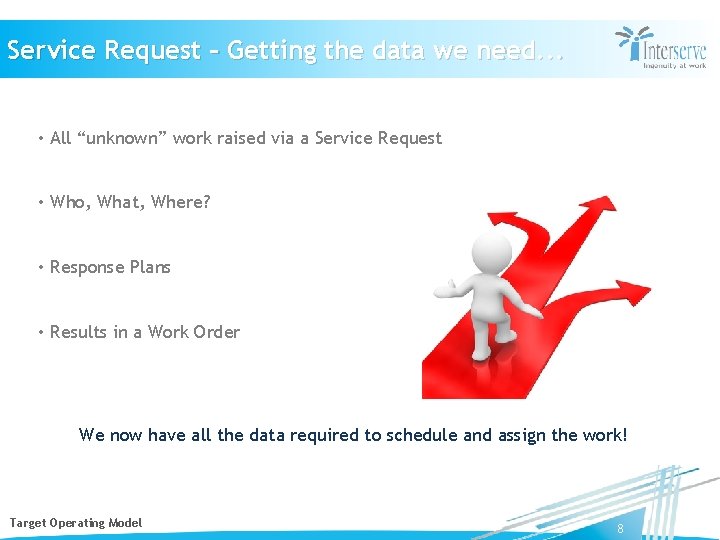
Service Request – Getting the data we need. . . • All “unknown” work raised via a Service Request • Who, What, Where? • Response Plans • Results in a Work Order We now have all the data required to schedule and assign the work! Target Operating Model 8
Automatically Allocating Work • System automatically allocates the work to either an Operative, a Vendor or a Group • Functionality at Service Address level • Auto-Purchase Orders • Configurable at Craft Type and Skill Level • Ranked Allocation choices • Allocation to a Group allows for further work assignment Target Operating Model 9
Service Delivery – Mobile Working • Operatives can log progress, issues and tool/material requirements in real time • Huge Benefits in the right environment: – increased accuracy of management data, allowing for faster and better decision making – reduced administrative overheads – increased efficiency and productivity • Record Locking • Status updates from the User update assignments • Record Non-productive time Target Operating Model 10
Breach Functionality • There is a need to proactively identify breaches • Time-based Breaches • Quality-based Breaches • Automatically identified ‘In-flight’ breaches • Automatically applying Financial Penalties • Approval process (if required) Target Operating Model 11
Service Delivery – Chargeable Works • Works that are ‘In-scope’ but subject to specific budgetary management • Need to get approval before proceeding with the work • Identified by Classification of the Service Request • Utilises Authority Matrix • Could be converted into a ‘Quotation Management’ record Target Operating Model 12
Service Delivery – Limit of Liability • Customers are increasingly utilising a ‘Limit of Liability’ or ‘Inclusive Repair Limit’ within their contracts with us • Limit on how much we should spend on reactive works before seeking approval from the client • Any money spent over that limit, without approval from the Customer, is not billable • Could occur at any stage of the work flow • Threshold Percentage – Proactive response Target Operating Model 13
Service Delivery – Quotation Management • Certain works that we are requested to perform do not form part of the agreed contract scope and therefore should not be carried out unless: – We have authorisation from the relevant customer staff – We are able to charge the value of the works to the customer in addition to the contract fee • Creation of the Quotation Management Application • Processes scalable from small, quick quotes to multi-stage • Operational and Sustainability Appraisal tabs Target Operating Model 14
Service Delivery – Forward Maintenance Register • There is a requirement for the system to facilitate the operation of a Forward Maintenance Register as utilised by several current Interserve contracts • The system will allow for any identified works (project or maintenance) which cannot be funded in the current period to be held in abeyance on a ‘Forward Maintenance Register’. This register should then be searchable by authorised client and contractor personnel to enable them to reinvigorate jobs when funding becomes available • This ensures that opportunities to generate revenue are not forgotten in the case that the customer cannot fund the work immediately and allows the contractor to build up a bank of work which can be revived if funds become available • The FMR records will contain information from the originating Service Request and be related to any preceding QM records. They will each have an Estimated Year of Delivery, an Estimated Cost and a Type allowing for the development of forecasts and work programmes • An FMR record can be sourced from a QM or BCM record and can only result in a QM record Target Operating Model 15
Service Delivery – Building Condition Monitoring • There is a requirement to capture the condition of the assets and buildings maintained under our contracts in order that we can better understand our future work-flow and what impact the work we do has across the estate • In order to facilitate this, the Building Condition Monitoring application has been developed. This allows surveyors to calculate and record the overall condition of a building from the condition of its constituent systems and components. Each of these elements is given a score from 1 -10, a cost to bring the element up to a score of ten and an approximate year of requirement • Each component in the building also has a flag against it to denote whether or not the identified issue is associated with Health and Safety or is critical to operation of the building, allowing the business to prioritise work based on both legislative and business drivers • This information can then be sorted and reported on in order to generate lifecycle maintenance and replacement programmes allowing more intelligent decision making • The collected set of BCM data can be utilised to draw up a ‘Whole Life Cost Model’ for any location or set of locations Target Operating Model 16
Any questions?