
Maximizing the Usage of Value Vocabularies in the
Maximizing the Usage of Value Vocabularies in the Linked Data Ecosystem: The Case for Faceting Ed O’Neill OCLC Research November 5, 2013 ASIS&T Montreal
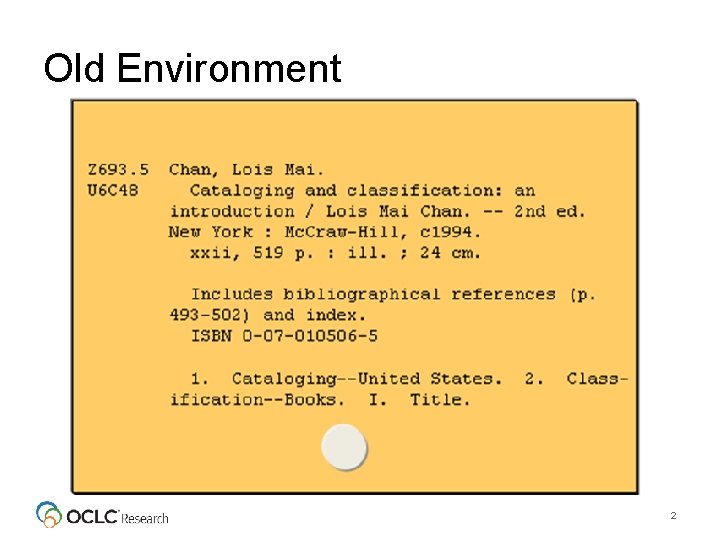
Old Environment 2
FAST q The American Library Association’s ALCTS/SAC/Subcommittee on Metadata and Subject Analysis(1997 -2001) recognized that a new schema is required for Internet resources and other nontraditional materials. q OCLC and the Library of Congress agreed to jointly develop FAST (Faceted Application of Subject Terminology) using the vocabulary from LCSH (Library of Congress Subject Headings). q FAST retains the LCSH vocabulary in eight facets: (1) Personal names, (2) Corporate names, (3) Events, (4) Titles, (5) Chronologicals, (6) Topicals, (7) Geographics, and (8) Form/Genre. q All FAST headings (except chronologicals) are established and linkable.
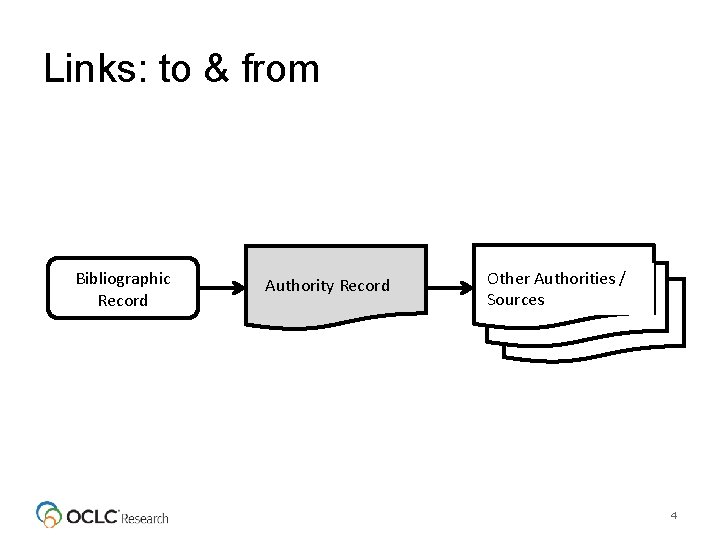
Links: to & from Bibliographic Record Authority Record Other Authorities / Sources 4
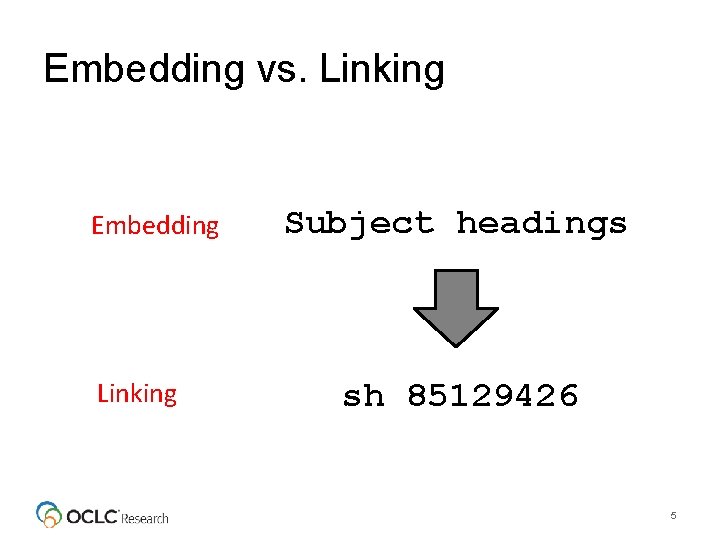
Embedding vs. Linking Embedding Linking Subject headings sh 85129426 5

Linking: Is Full Enumeration Required? Synthetic: Only a set of core headings are established but those terms can be combined or extended following the synthetic rules. (LCSH) Enumerative: All subject headings are established and included in the authority file. (FAST)
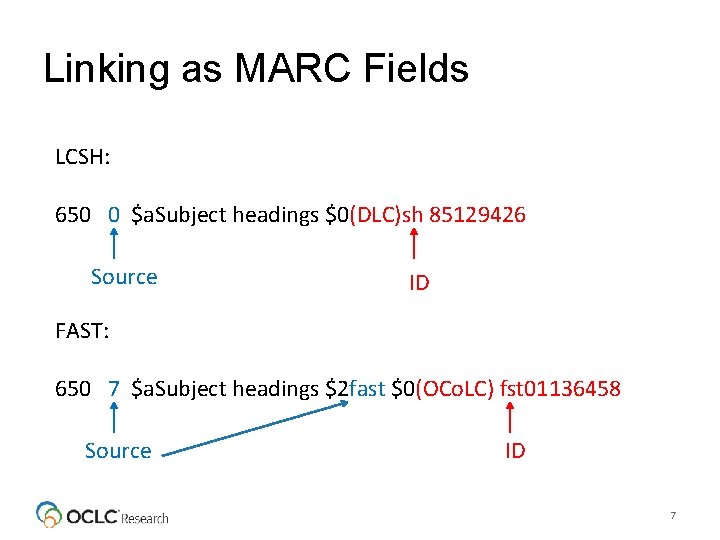
Linking as MARC Fields LCSH: 650 0 $a. Subject headings $0(DLC)sh 85129426 Source ID FAST: 650 7 $a. Subject headings $2 fast $0(OCo. LC) fst 01136458 Source ID 7
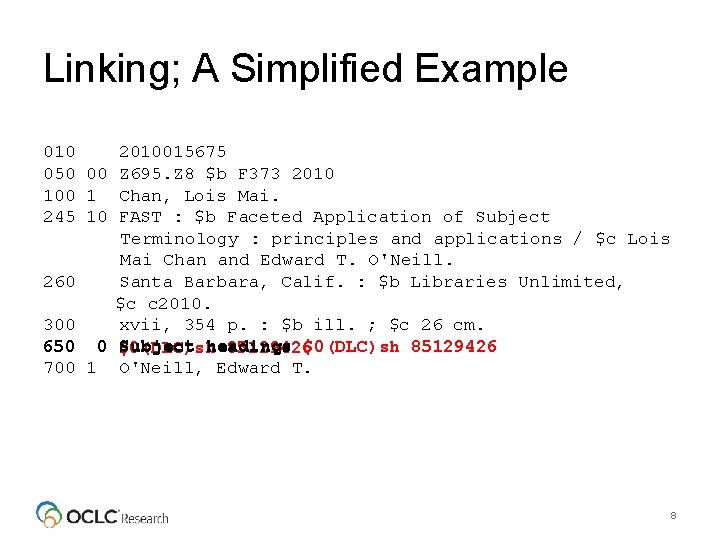
Linking; A Simplified Example 010 2010015675 050 00 Z 695. Z 8 $b F 373 2010 100 1 Chan, Lois Mai. 245 10 FAST : $b Faceted Application of Subject Terminology : principles and applications / $c Lois Mai Chan and Edward T. O'Neill. 260 Santa Barbara, Calif. : $b Libraries Unlimited, $c c 2010. 300 xvii, 354 p. : $b ill. ; $c 26 cm. Subject headings $0(DLC)sh 85129426 650 0 $0(DLC)sh 85129426 700 1 O'Neill, Edward T. 8
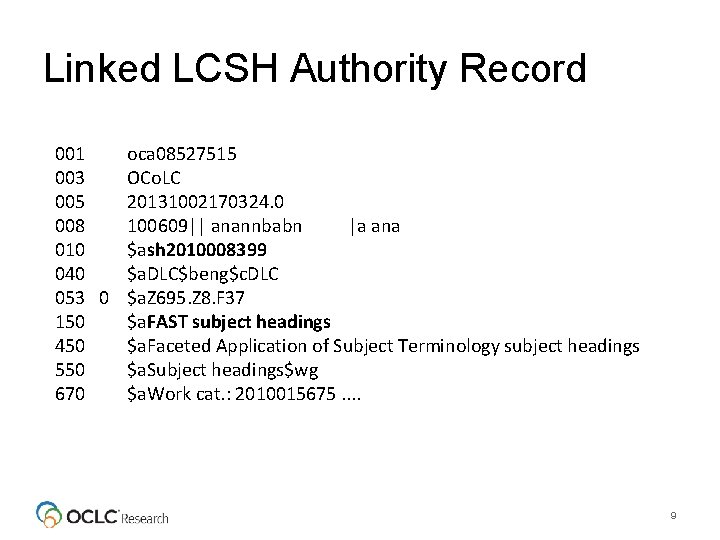
Linked LCSH Authority Record 001 oca 08527515 003 OCo. LC 005 20131002170324. 0 008 100609|| anannbabn |a ana 010 $ash 2010008399 040 $a. DLC$beng$c. DLC 053 0 $a. Z 695. Z 8. F 37 150 $a. FAST subject headings 450 $a. Faceted Application of Subject Terminology subject headings 550 $a. Subject headings$wg 670 $a. Work cat. : 2010015675. . 9
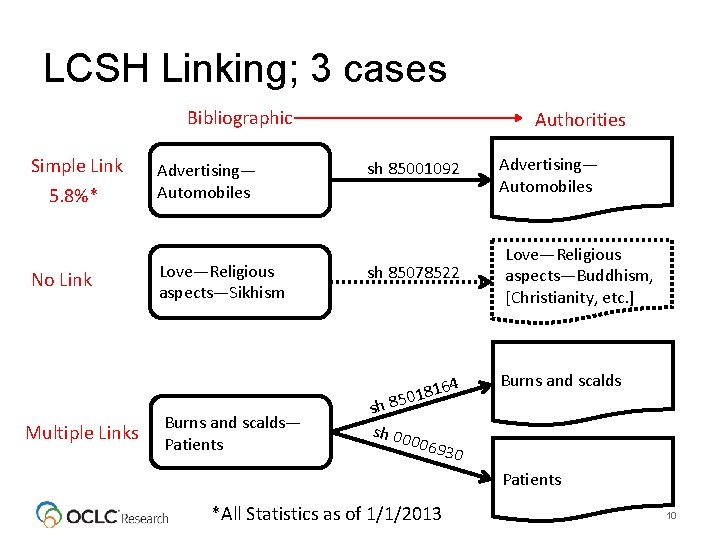
LCSH Linking; 3 cases Bibliographic Simple Link 5. 8%* No Link Multiple Links Advertising— Automobiles Love—Religious aspects—Sikhism Burns and scalds— Patients Authorities sh 85001092 sh 85078522 164 8 1 0 sh 85 Advertising— Automobiles Love—Religious aspects—Buddhism, [Christianity, etc. ] Burns and scalds sh 00 0069 30 Patients *All Statistics as of 1/1/2013 10
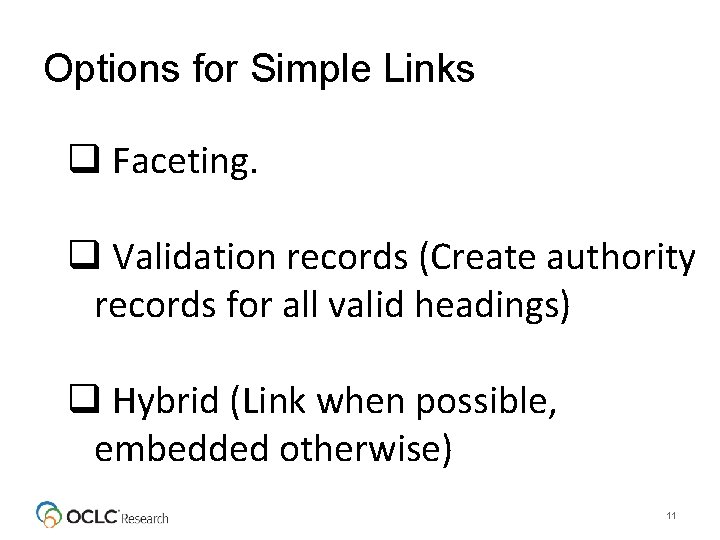
Options for Simple Links q Faceting. q Validation records (Create authority records for all valid headings) q Hybrid (Link when possible, embedded otherwise) 11
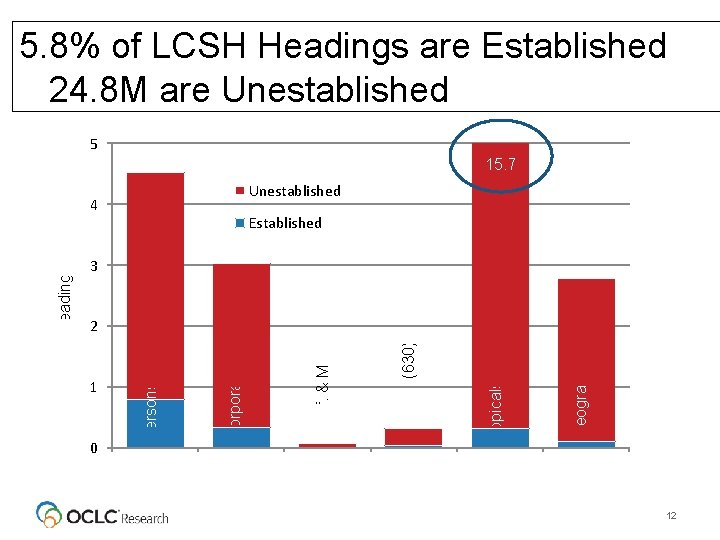
No. of Headings (Millions) 1 0 2 3 Geographics (651) Topicals (650) Titles (630) 4 Conf. & Meetings (611) Corporates (610) Persons (600) 5. 8% of LCSH Headings are Established 24. 8 M are Unestablished 5 15. 7 Unestablished Established 12
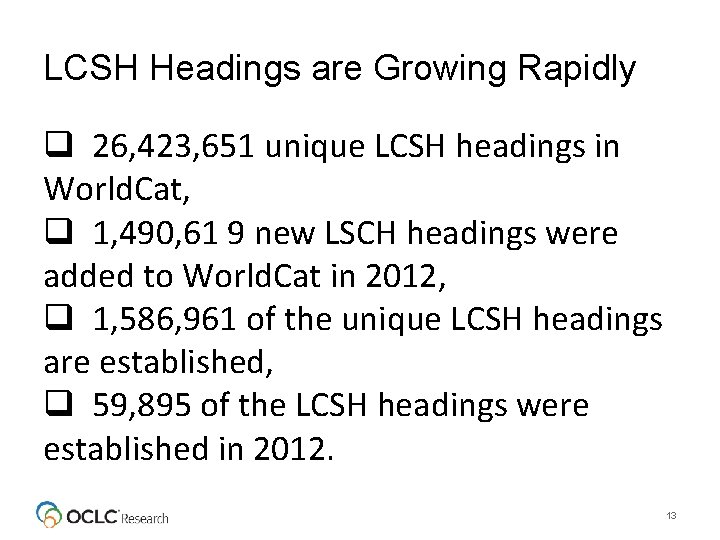
LCSH Headings are Growing Rapidly q 26, 423, 651 unique LCSH headings in World. Cat, q 1, 490, 61 9 new LSCH headings were added to World. Cat in 2012, q 1, 586, 961 of the unique LCSH headings are established, q 59, 895 of the LCSH headings were established in 2012. 13
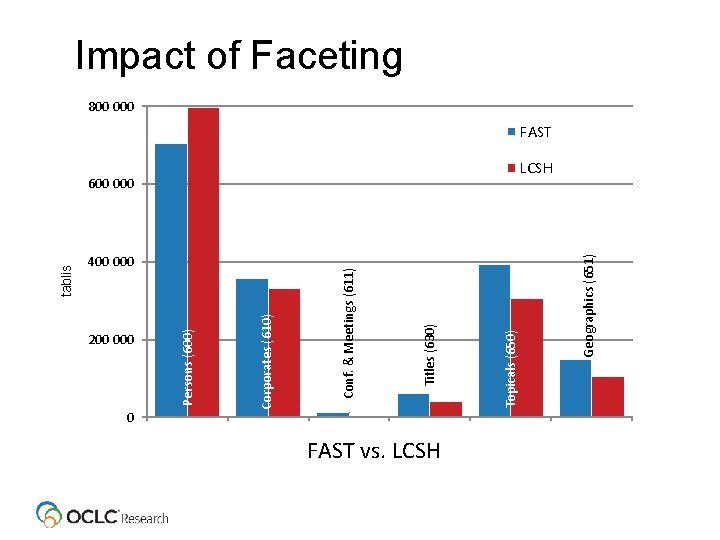
No. of Established Headings 200 000 400 000 FAST vs. LCSH 600 000 Geographics (651) Topicals (650) Titles (630) Conf. & Meetings (611) Corporates (610) 0 Persons (600) Impact of Faceting 800 000 FAST LCSH
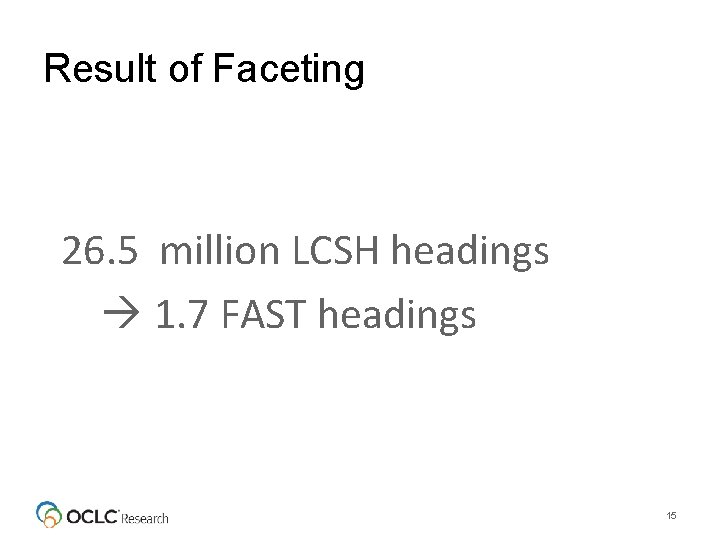
Result of Faceting 26. 5 million LCSH headings 1. 7 FAST headings 15
Maximizing the Usage of Value Vocabularies in the Linked Data Ecosystem: FAST Linked Data Mechanics Jeff Mixter Research Support Specialist, OCLC Research November 5, 2013 ASIS&T Montreal @Jeff. Mixter
Introduction q FAST Linked Data was first published December of 2011 q Derived from MARC q It was developed using SKOS (Simple Knowledge Organization Schema) q Similar to Library of Congresses Linked Data project q SKOS is used to help bridge Controlled Vocabulary terms with conceptual Entities q FAST headings link to their respective Library of Congress heading(s) q FAST Geographic headings are linked to Geo. Names q Allows for services such as map. FAST 17
FAST URIs in MARC Bibliographic Records q. MARC is currently the data standard q Should not prevent libraries from accommodating Linked Data URIs q. There is no way to actually imbed the FAST URIs into MARC q It is possible to add all of the needed information to generate a URI q Use of canonical identifiers q The MARC $0 q Works well with FAST but is sometimes problematic for LCHS 18
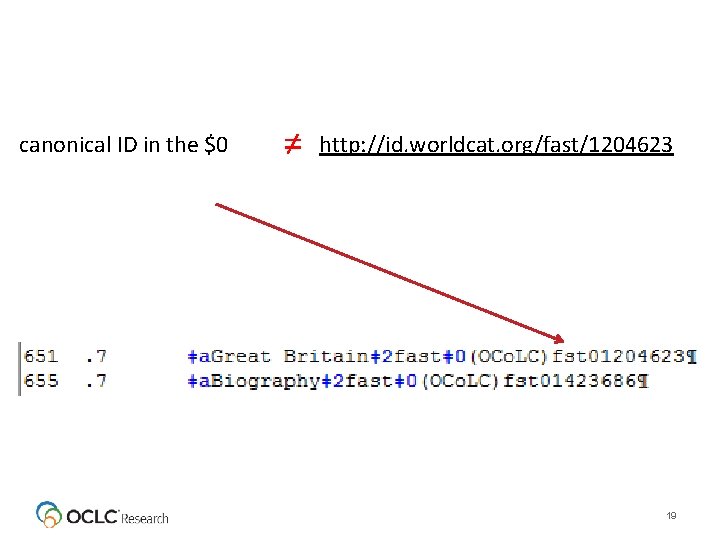
canonical ID in the $0 ≠ http: //id. worldcat. org/fast/1204623 19
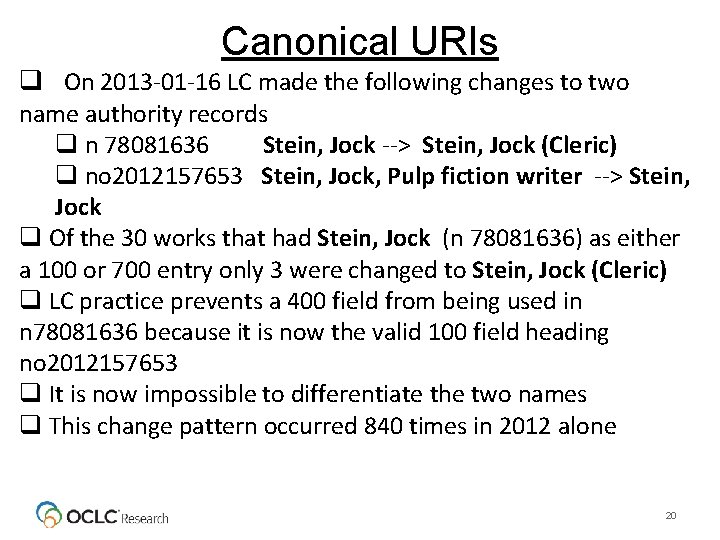
Canonical URIs q On 2013 -01 -16 LC made the following changes to two name authority records q n 78081636 Stein, Jock --> Stein, Jock (Cleric) q no 2012157653 Stein, Jock, Pulp fiction writer --> Stein, Jock q Of the 30 works that had Stein, Jock (n 78081636) as either a 100 or 700 entry only 3 were changed to Stein, Jock (Cleric) q LC practice prevents a 400 field from being used in n 78081636 because it is now the valid 100 field heading no 2012157653 q It is now impossible to differentiate the two names q This change pattern occurred 840 times in 2012 alone 20
21
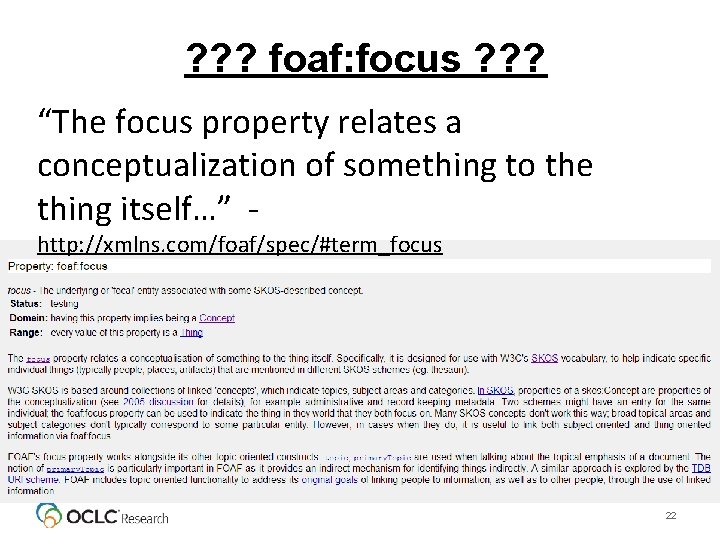
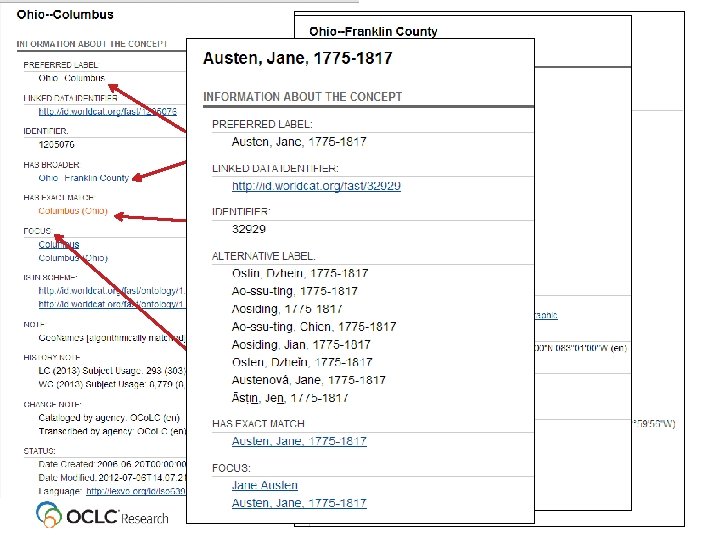
? ? ? foaf: focus ? ? ? “The focus property relates a conceptualization of something to the thing itself…” http: //xmlns. com/foaf/spec/#term_focus q. Unique to the FAST and VIAF vocabulary q. Allows FAST controlled headings to link to resources that represent/describe the real-world thing q. The foaf: focus property highlights the problematic nature incorporating controlled vocabularies in Linked Data 22
Linking a skos: Concept to another skos: Concept q. SKOS is very good at representing Controlled Vocabulary terms as RDF but is falls short when it comes to describing the type of Entity or Entity to Entity relationships q. There is a constraint that prevents owl: same. As from being used q In order to link two skos: Concepts one uses skos: exact. Match 23
Linking a skos: Concept to another skos: Concept q. SKOS was designed with thesauri, controlled vocabularies, taxonomies etc. in mind q It would not be appropriate to say that one skos: Concept is literally the same as another skos: Concept q This would cause confusion as to what the preferred term was q All that can be claimed is that a skos: Concept in one ontology has an exact match that can be identified in another ontology 24
Linking skos: Concept to Real-World Things q SKOS only describes things as concepts that have preferred and alternative labels q This is very effective for describing the provenance of controlled terms BUT… 25
Linking skos: Concept to Real-World Things q. People are People and Places are Places q in order to describe something accurately they need to be labeled as those specific types of Things q foaf: focus allows FAST Controlled Vocabulary terms (skos: Concept) to be connected to URIs that identify real-world entities q. VIAF, Geo. Names and Dbpedia. org (represented as Wikipedia in the MARC record) q Machines can understand (reason) that a FAST controlled term is related to a real-world entity and allows human to gather more information about the entity that is being described 26
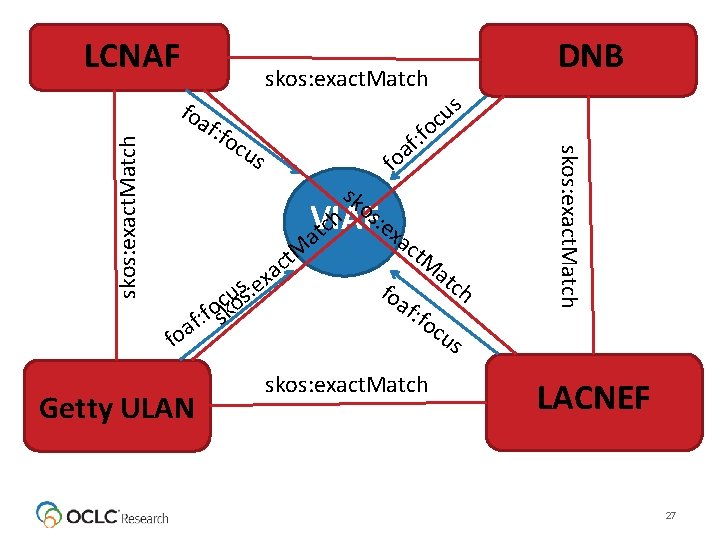
LCNAF f: fo cu s fo us c o : f f a sk os VIAF ch : exa t a ct. M M t c at a x ch ss: e fo u af: cko o fs fo : f cu a o f s Getty ULAN skos: exact. Match foa skos: exact. Match DNB LACNEF 27
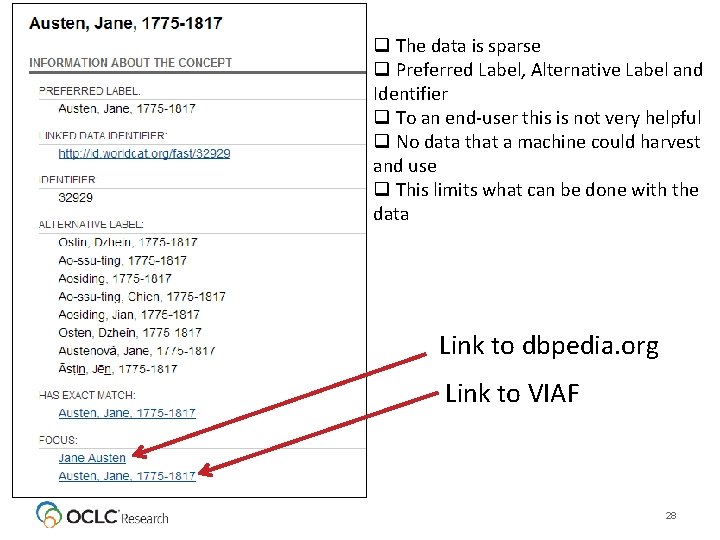
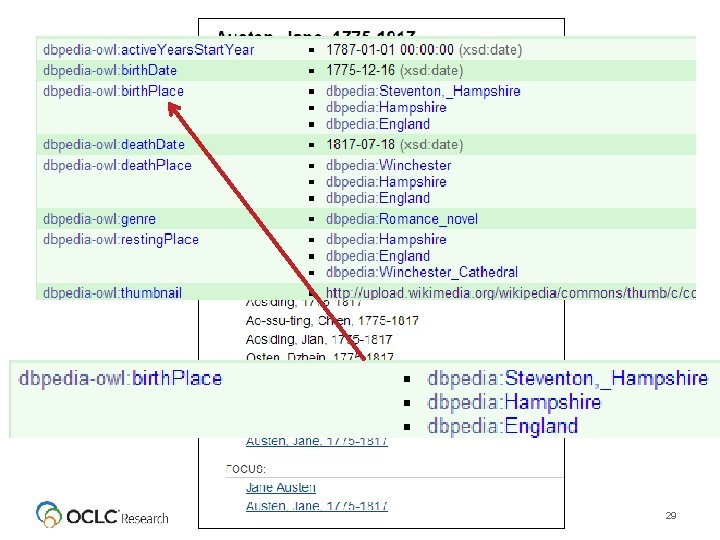
q The data is sparse q Preferred Label, Alternative Label and Identifier q To an end-user this is not very helpful q No data that a machine could harvest and use q This limits what can be done with the data Link to dbpedia. org Link to VIAF 28
29
Use of foaf: focus in FAST q For authority data and bibliographic data, relying on information from sources such as dbpedia. org could be problematic q Accuracy of information q Noise – traditional cataloging practice q Using foaf: focus allows FAST to be used as a traditional Controlled Vocabulary (retain provenance over sting labels) while also allowing machines and humans to infer rich information about the Entity that is related to the skos: Concept 30
Thank You! Ed O’Neill oneill@oclc. org Jeff Mixter mixterj@oclc. org @Jeff. Mixter © 2013 OCLC. This work is licensed under a Creative Commons Attribution 3. 0 Unported License. Suggested attribution: “This work uses content from [presentation title] © OCLC, used under a Creative Commons Attribution license: http: //creativecommons. org/licenses/by/3. 0/” 31
- Slides: 31