
Maximizing the Spread of Influence through a Social


- Slides: 25
Maximizing the Spread of Influence through a Social Network David Kempe, Jon Kleinberg, Éva Tardos SIGKDD ‘ 03
Influence and Social Networks • Economics, sociology, political science, etc. all have studied and modeled behaviors arising from information • Online • Undoubtedly we are influenced by those within our social context
Why study “diffusion” ? • Influence models have been studied for years • Original mathematical models by Schelling (’ 70, ’ 78) & Granovetter ’ 78 • Viral Marketing Strategies modeled by Domingos & Richardson ’ 01 • Not just about maximizing revenue • Can study diseases or contagions (medicine, health, etc. ) • The spread of beliefs and/or ideas (sociology, economics, etc. ) • On the CS side, need to develop fast and efficient algorithms that seek to maximize the spread of influence
Diffusion Models • Two models • Linear Threshold • Independent Cascade • Operation: • Social Network G represented as a directed graph • Individual nodes are active (adopter of “innovation”) or inactive • Monotonicity: Once a node is activated, it can never deactivate • Both work under the following general framework: • Start with initial set of active nodes A 0 • Process runs for t steps and ends when no more activations are possible
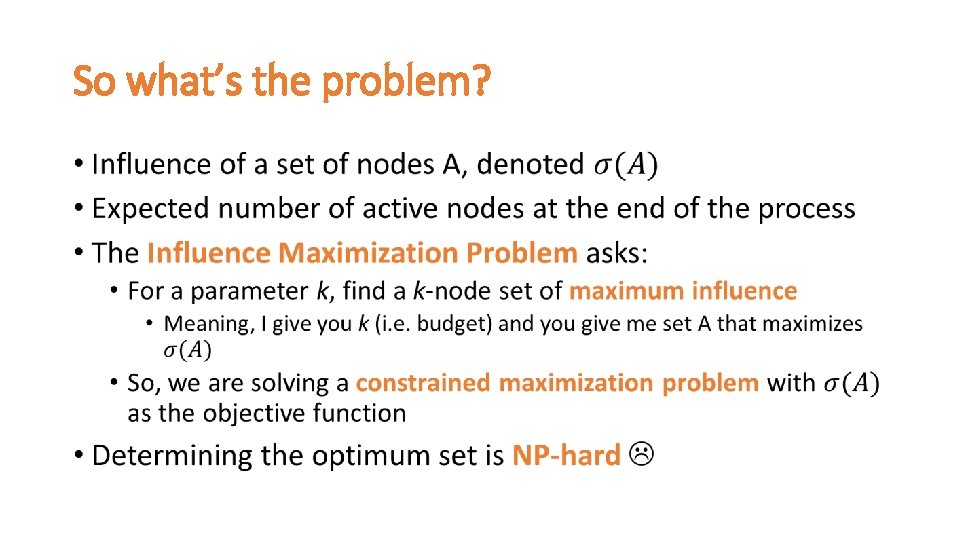
So what’s the problem? •
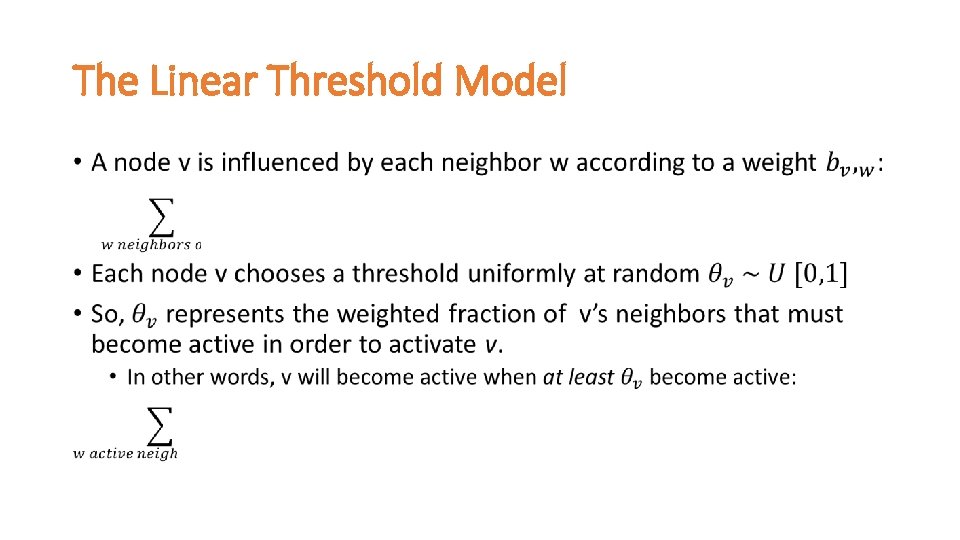
The Linear Threshold Model •
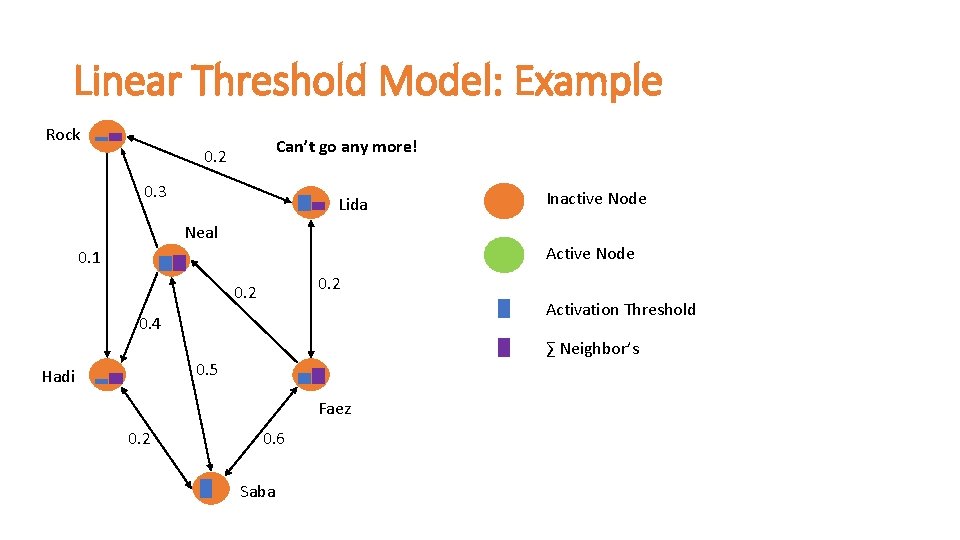
Linear Threshold Model: Example Rock Can’t go any more! 0. 2 0. 3 Lida Neal Active Node 0. 1 0. 2 Activation Threshold 0. 4 ∑ Neighbor’s 0. 5 Hadi Faez 0. 2 Inactive Node 0. 6 Saba
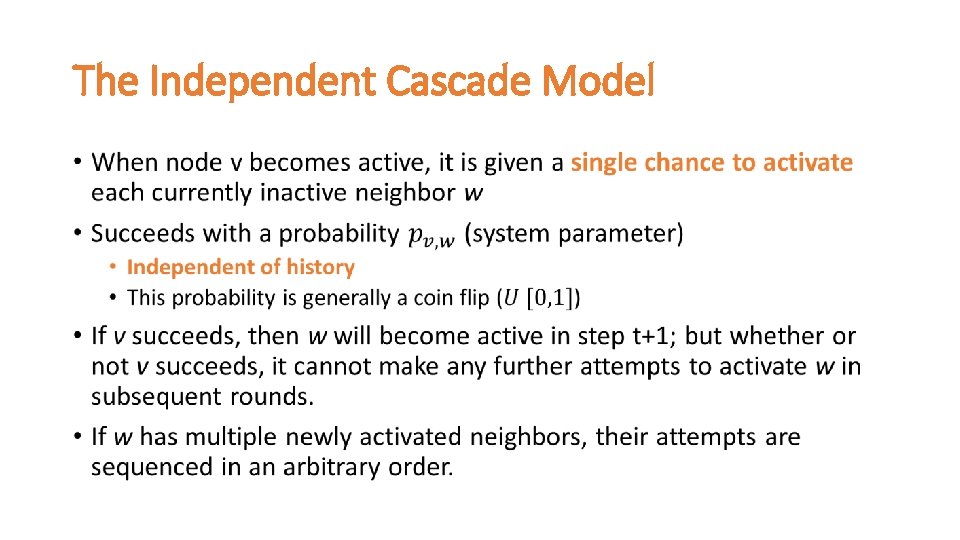
The Independent Cascade Model •
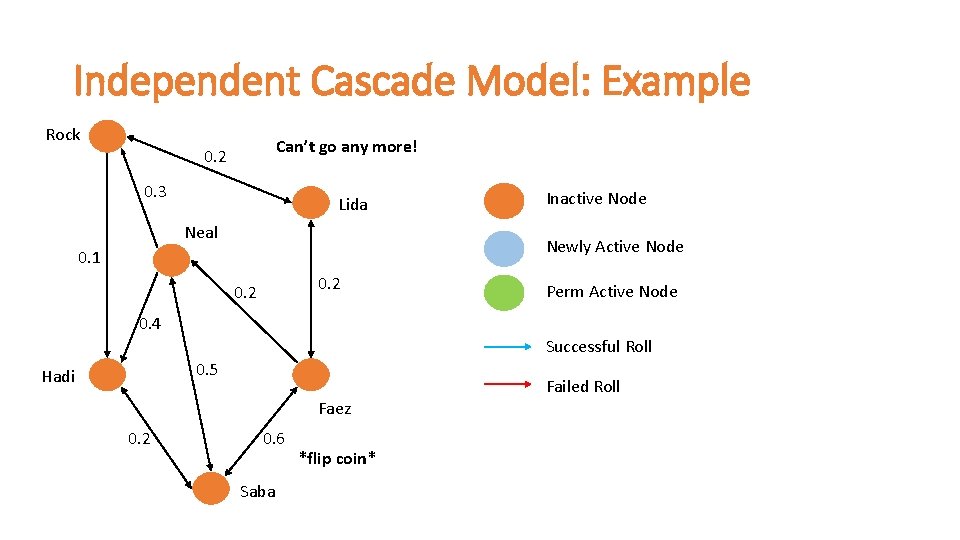
Independent Cascade Model: Example Rock Can’t go any more! 0. 2 0. 3 Lida Neal Inactive Node Newly Active Node 0. 1 0. 2 Perm Active Node 0. 4 Successful Roll 0. 5 Hadi Failed Roll Faez 0. 2 0. 6 Saba *flip coin*
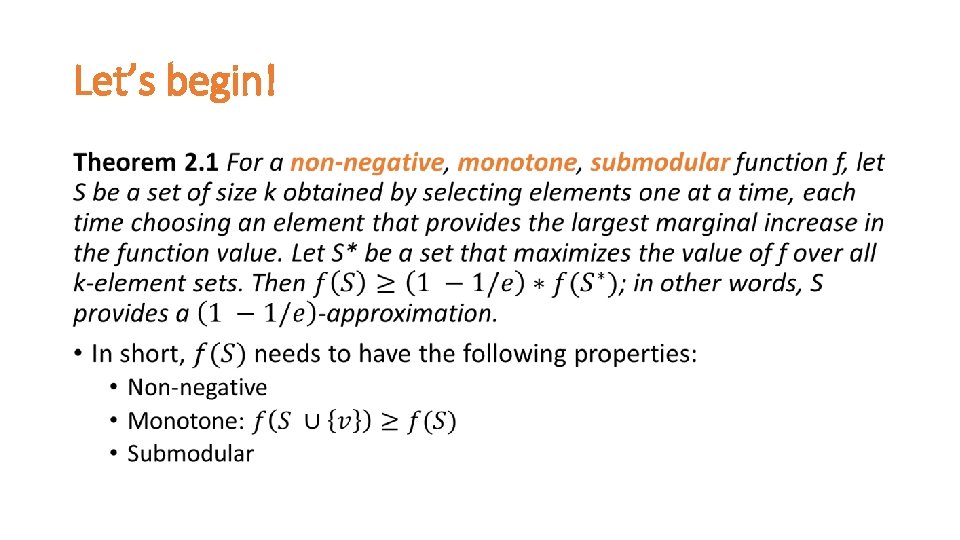
Let’s begin! •
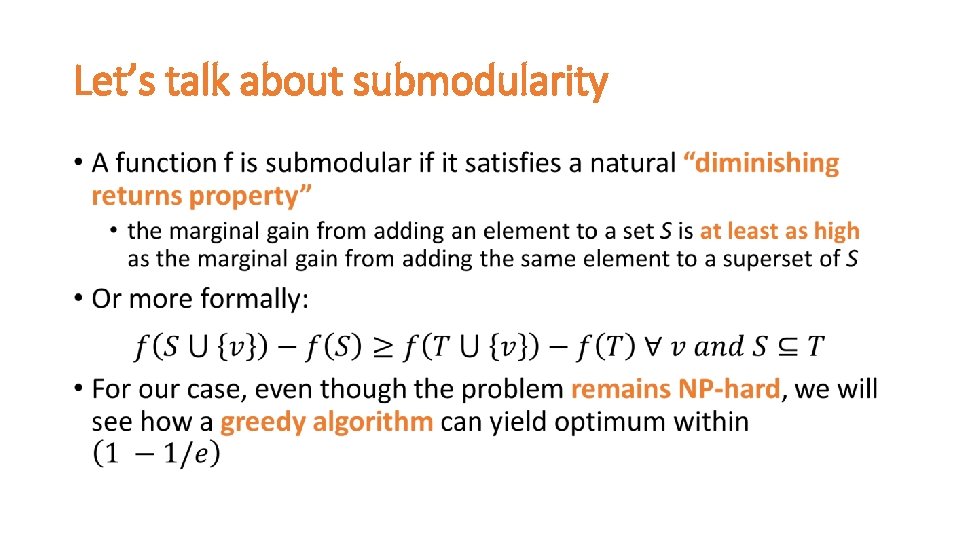
Let’s talk about submodularity •
alt+tab • Refer to: “Tutorial on Submodularity in Machine Learning and Computer Vision” by Stefanie Jagelka and Andreas Krause • More (great) references available at www. submodularity. org • We will look at a short example about placing sensors around a house (and marginal yield)
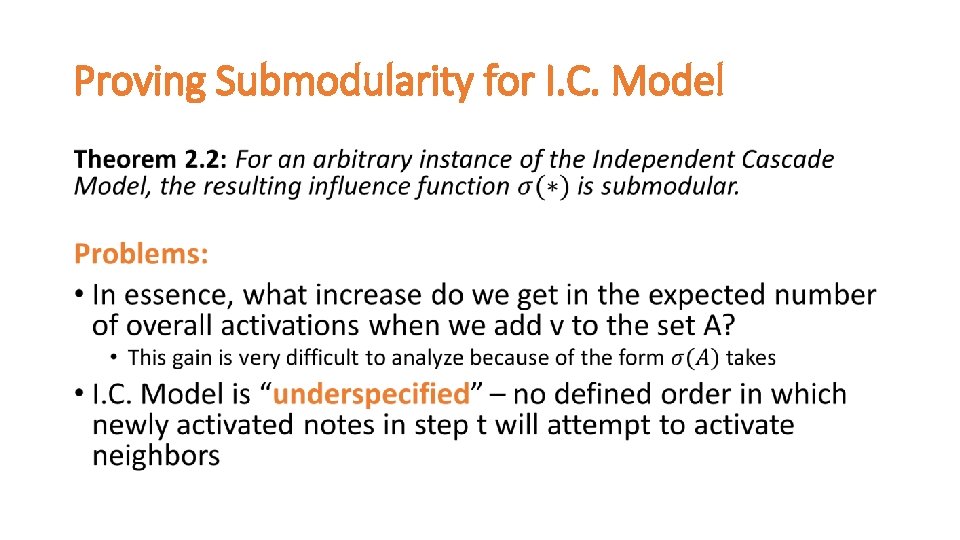
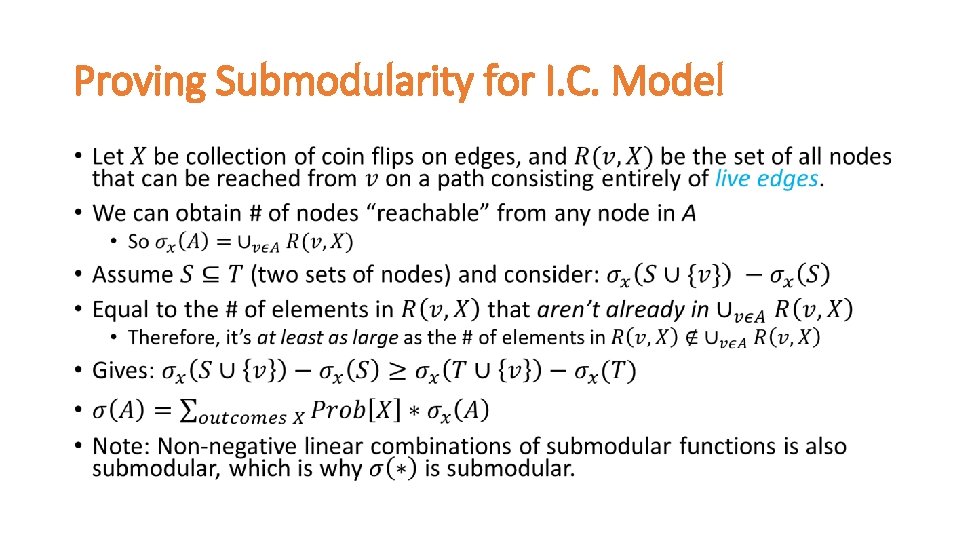
Proving Submodularity for I. C. Model •
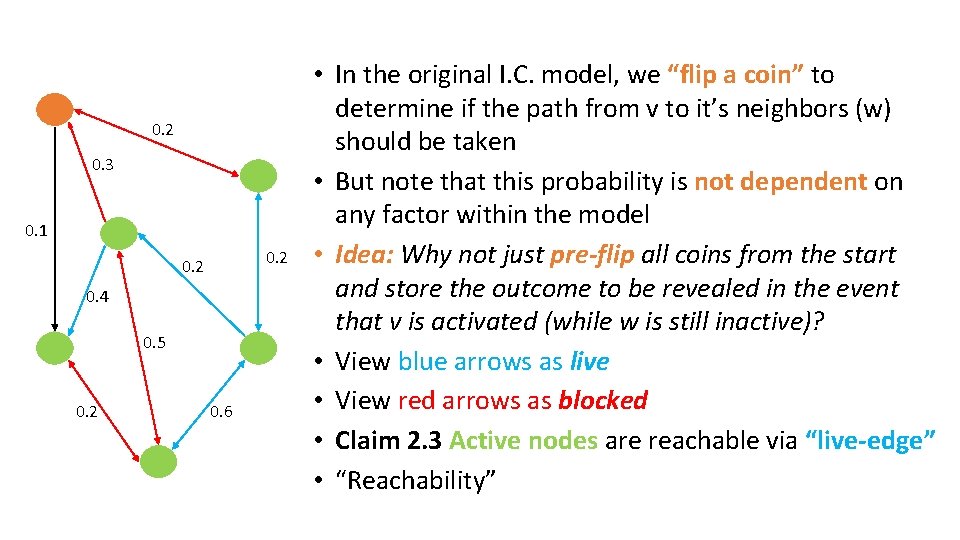
0. 2 0. 3 0. 1 0. 2 0. 4 0. 5 0. 2 0. 6 • In the original I. C. model, we “flip a coin” to determine if the path from v to it’s neighbors (w) should be taken • But note that this probability is not dependent on any factor within the model • Idea: Why not just pre-flip all coins from the start and store the outcome to be revealed in the event that v is activated (while w is still inactive)? • View blue arrows as live • View red arrows as blocked • Claim 2. 3 Active nodes are reachable via “live-edge” • “Reachability”
Proving Submodularity for I. C. Model •
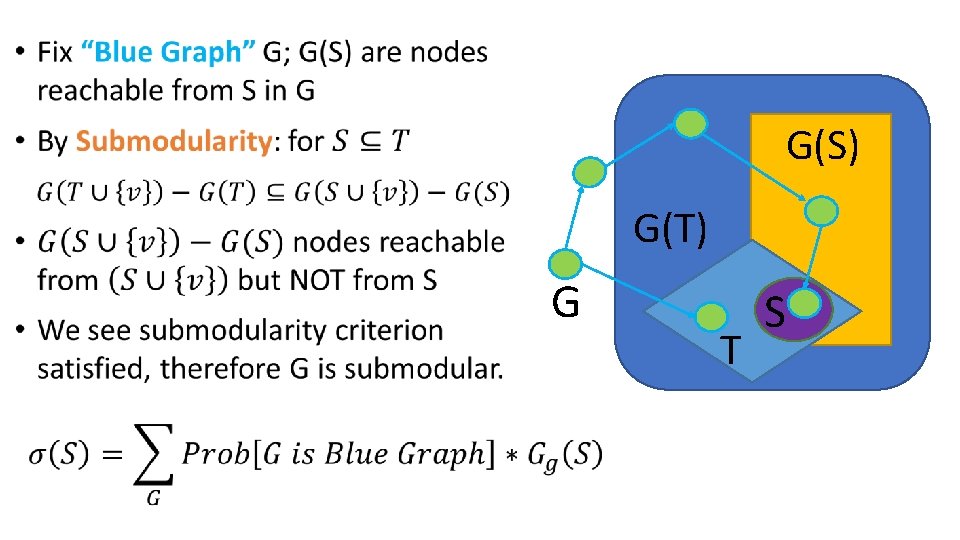
G(S) G(T) G T S
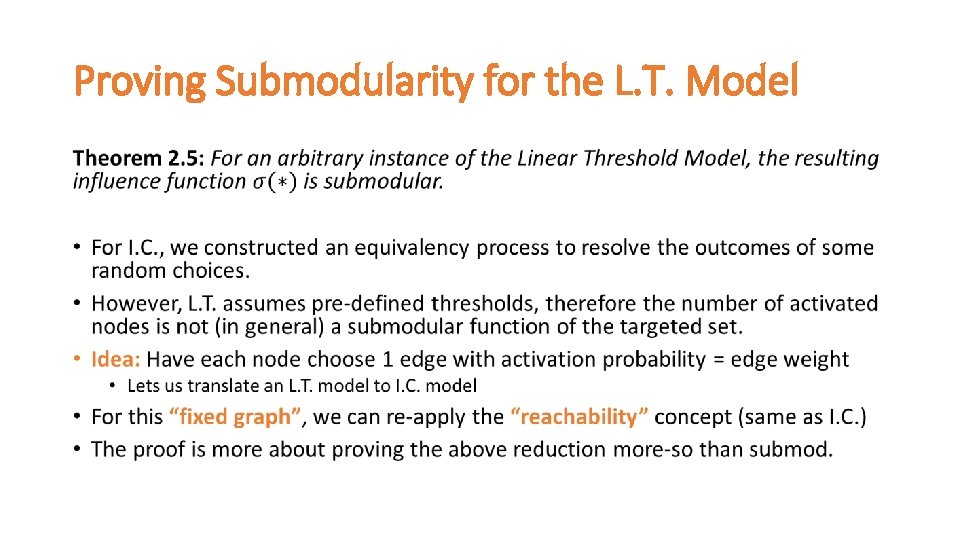
Proving Submodularity for the L. T. Model •
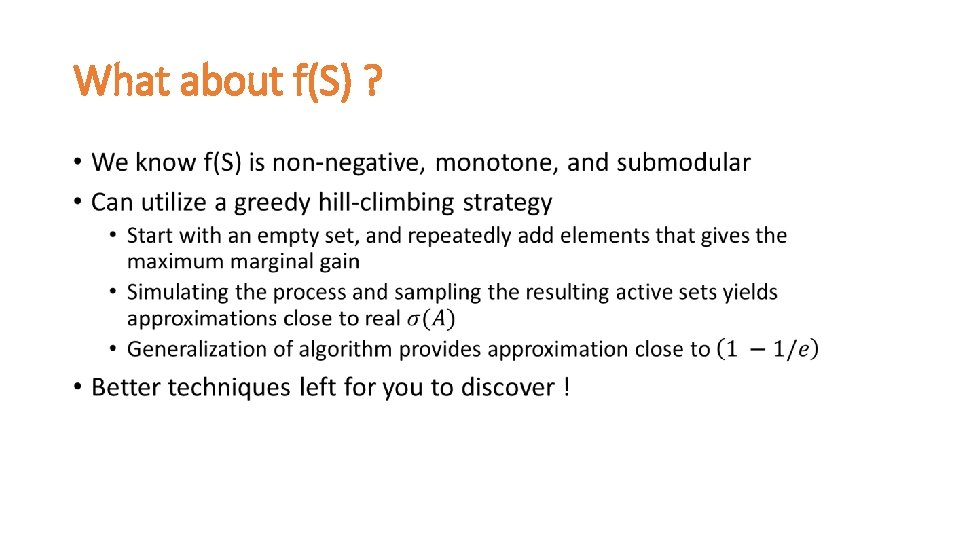
What about f(S) ? •
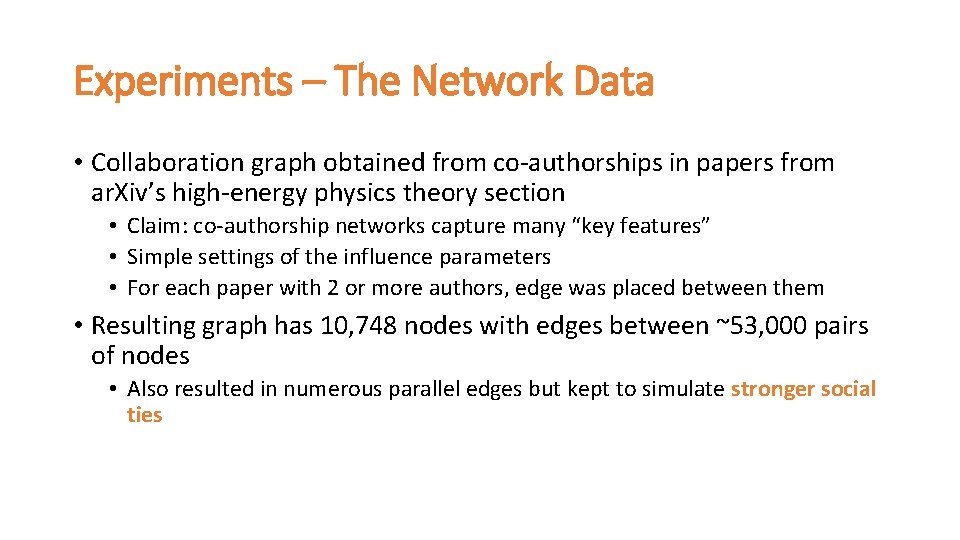
Experiments – The Network Data • Collaboration graph obtained from co-authorships in papers from ar. Xiv’s high-energy physics theory section • Claim: co-authorship networks capture many “key features” • Simple settings of the influence parameters • For each paper with 2 or more authors, edge was placed between them • Resulting graph has 10, 748 nodes with edges between ~53, 000 pairs of nodes • Also resulted in numerous parallel edges but kept to simulate stronger social ties
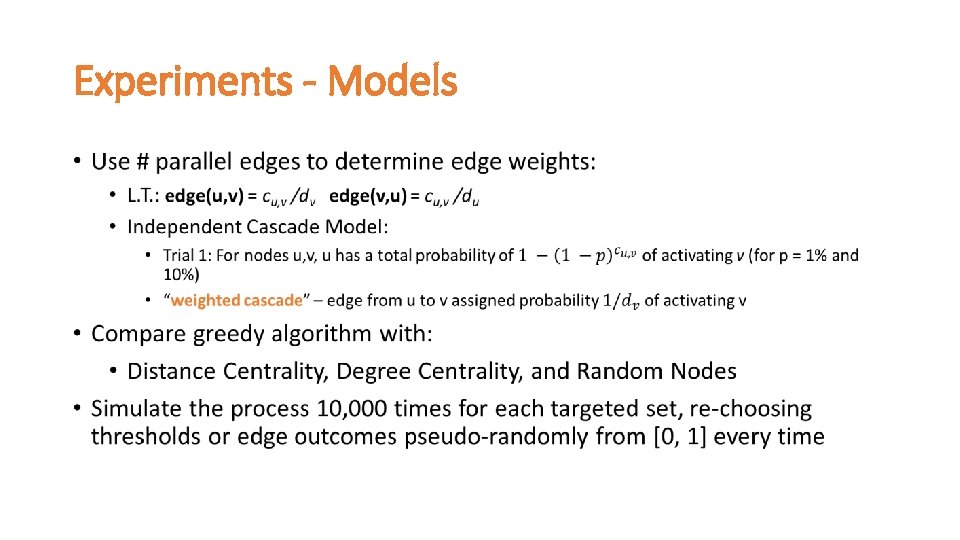
Experiments - Models •
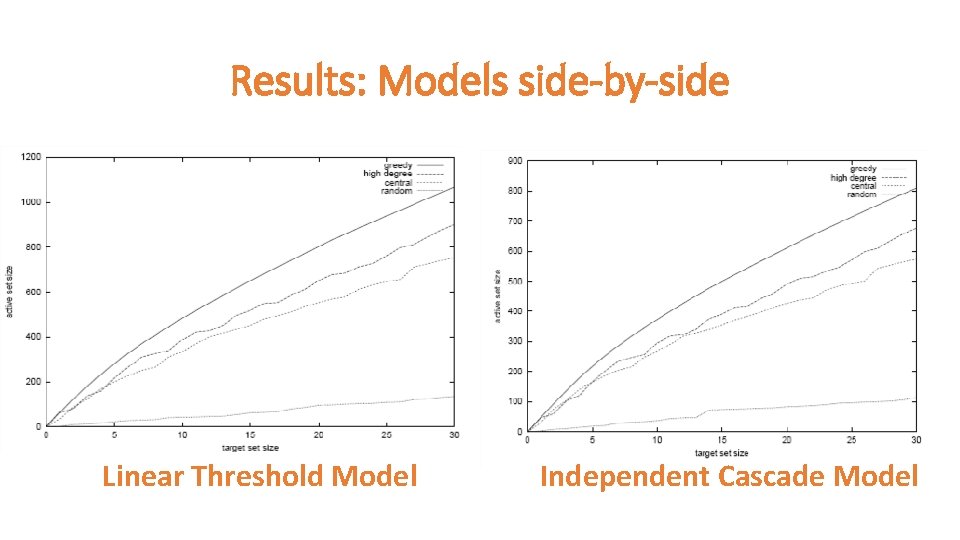
Results: Models side-by-side Linear Threshold Model Independent Cascade Model
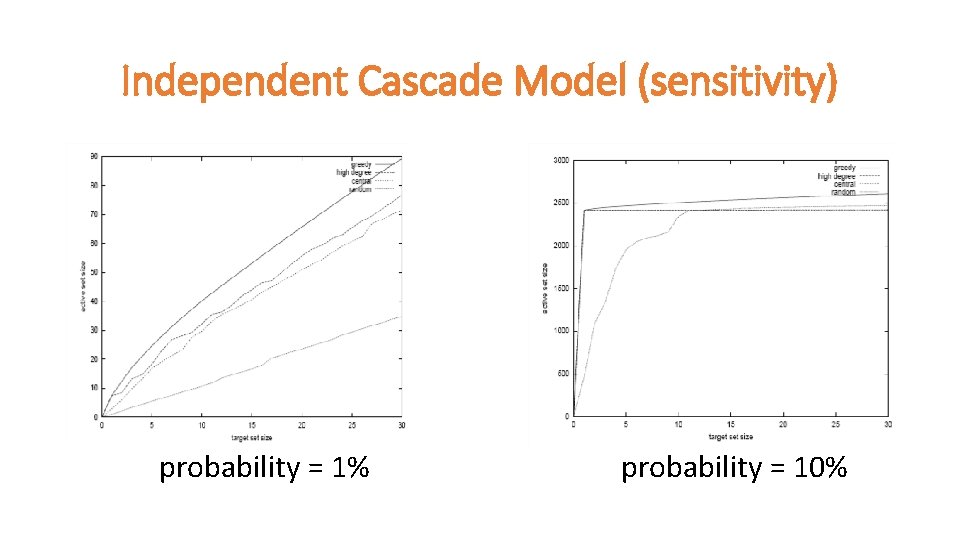
Independent Cascade Model (sensitivity) probability = 1% probability = 10%
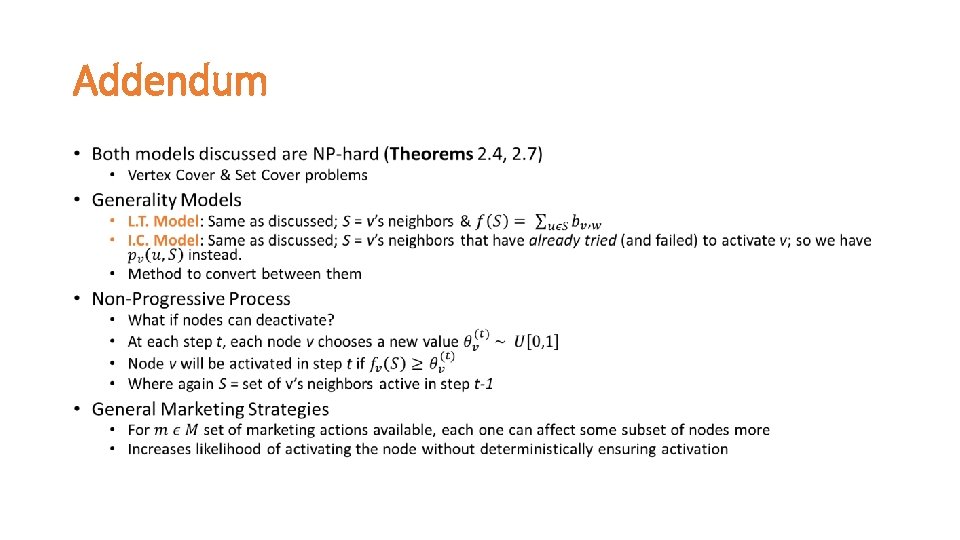
Addendum •
(Some) Releated Works • Mining the Network Value of Customers (Domingos & Richardson) • Efficient Influence Maximization in Social Networks (Chen et. al) • Maximizing Social Influence in Nearly Optimal Time (Borgs et. al) • How to Influence People with Partial Incentives (Demaine, Hajiaghayi et. al)
Thank You!