
Maximizing System Lifetime Data Gathering and Aggregation Problem
Maximizing System Lifetime Data Gathering and Aggregation Problem in Wireless Sensor Network Professor:Frank Y. S. Lin Presented by 文政
Outline l l l Introduction Problem Description Problem Formulation
Introduction
Problem Description l l l Given – The network topology includes node set and link set – The set of data source nodes – The sink node – Capacity for each node evaluated by residual power lifetime – Transmission cost of each link with respect to energy consumption Objective – To maximize the lifetime of the sensor network To determine – The number of times that tree t is used
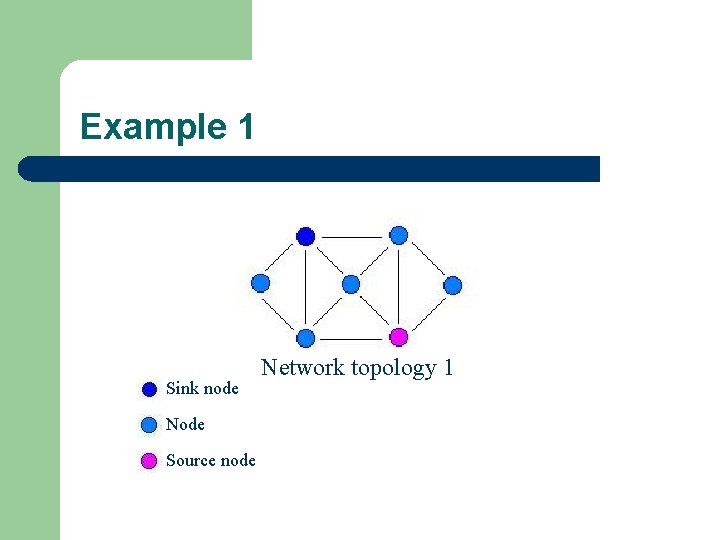
Example 1 Sink node Node Source node Network topology 1
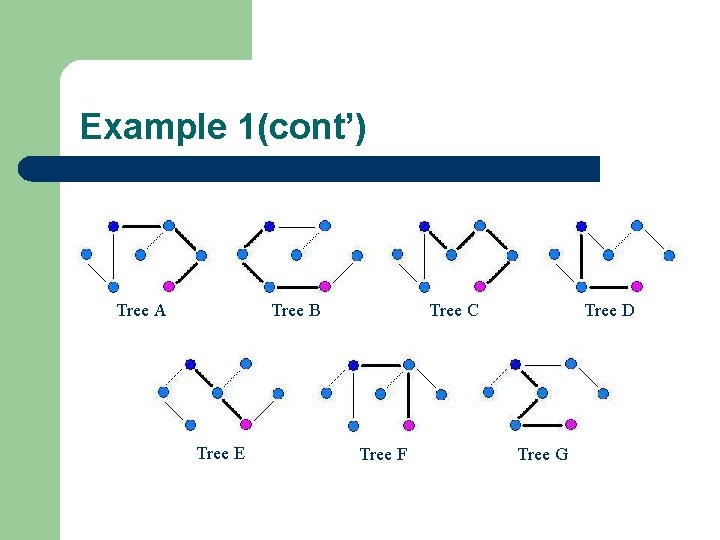
Example 1(cont’) Tree A Tree B Tree E Tree C Tree F Tree D Tree G
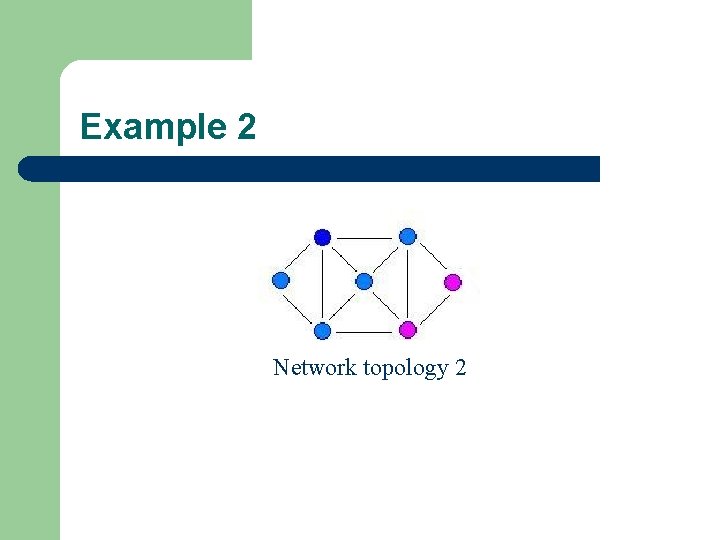
Example 2 Network topology 2
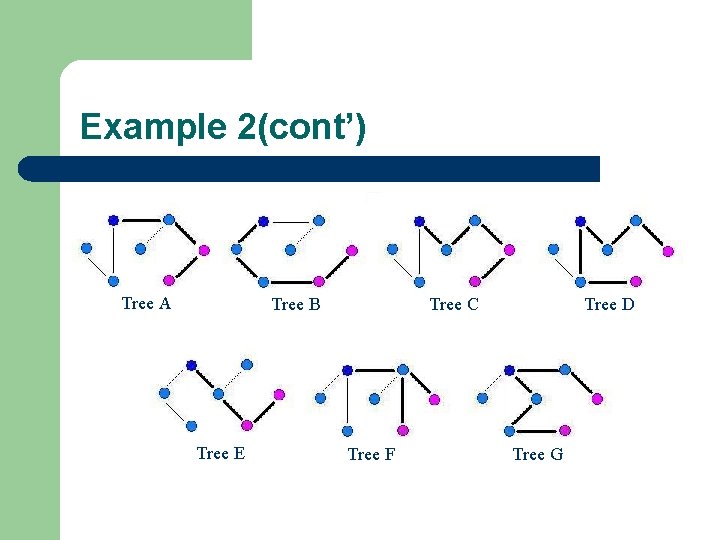
Example 2(cont’) Tree A Tree B Tree E Tree C Tree F Tree D Tree G
Methods l l l Random Exhausted Search Krishnamachari devised three interesting suboptimal aggregation heuristics – – – Shortest Paths Trees Center at Nearest Source (CNS) Greedy Incremental Tree (GIT)
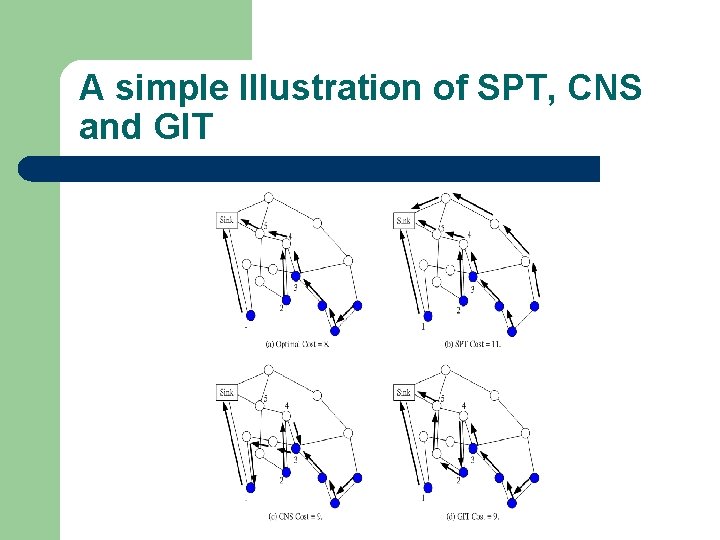
A simple Illustration of SPT, CNS and GIT
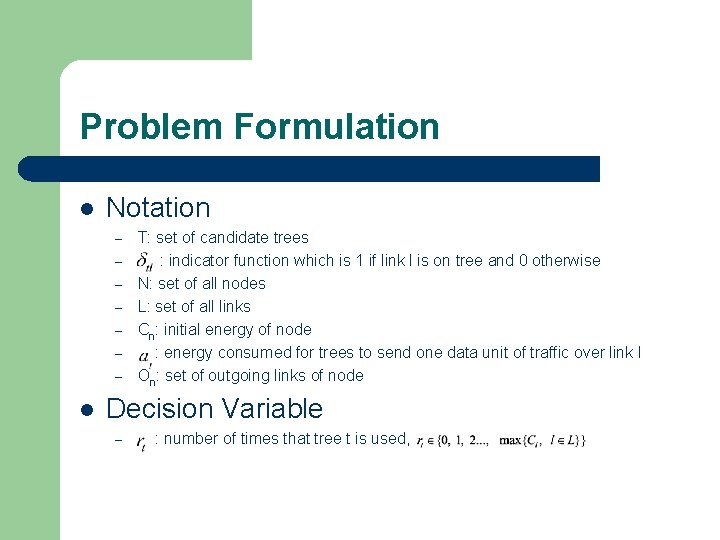
Problem Formulation l Notation – – – – l T: set of candidate trees : indicator function which is 1 if link l is on tree and 0 otherwise N: set of all nodes L: set of all links Cn: initial energy of node : energy consumed for trees to send one data unit of traffic over link l On: set of outgoing links of node Decision Variable – : number of times that tree t is used,
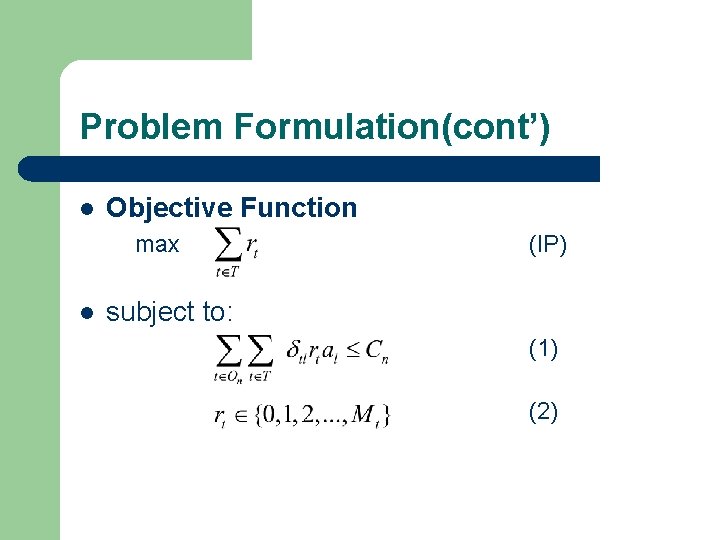
Problem Formulation(cont’) l Objective Function max l (IP) subject to: (1) (2)
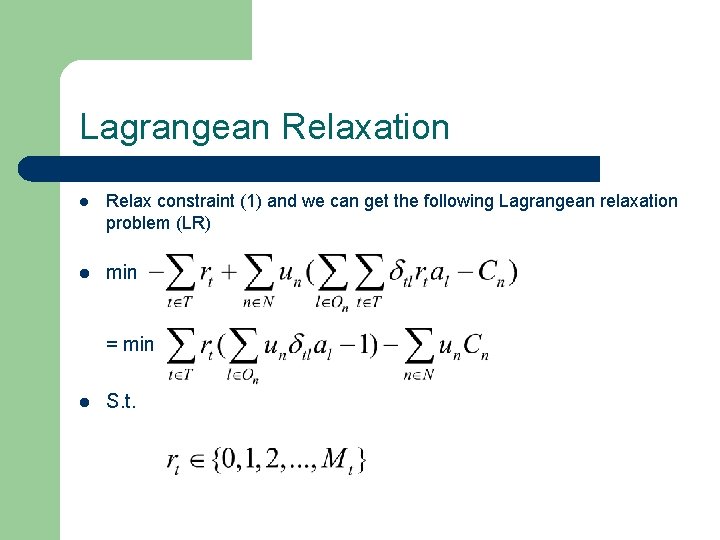
Lagrangean Relaxation l Relax constraint (1) and we can get the following Lagrangean relaxation problem (LR) l min = min l S. t.
Problems l Energy consumption – l How many trees do I need to construct? – l Source? Relay? Distance? trees v. s nodes (or links) How to optimally solve the problem ? – “multiple sessions” method

l Thanks for your listening
- Slides: 15