
Maximizing Speedup through SelfTuning of Processor Allocation Presenter



- Slides: 26
Maximizing Speedup through Self-Tuning of Processor Allocation Presenter : Hyuk-Jing Jeong, Inyong Lee
Contents • Introduction • Experimental Environments • Self-Tuning Algorithms • Multi-Phase Self-Tuning Algorithms • Conclusion
Introduction
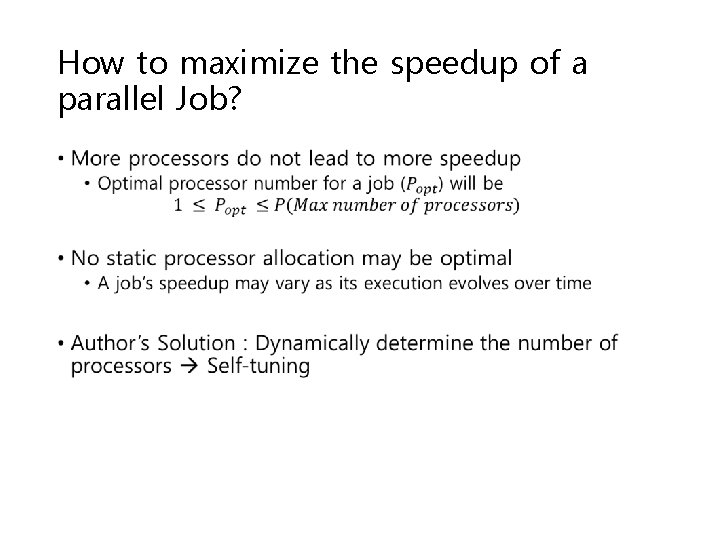
How to maximize the speedup of a parallel Job? •
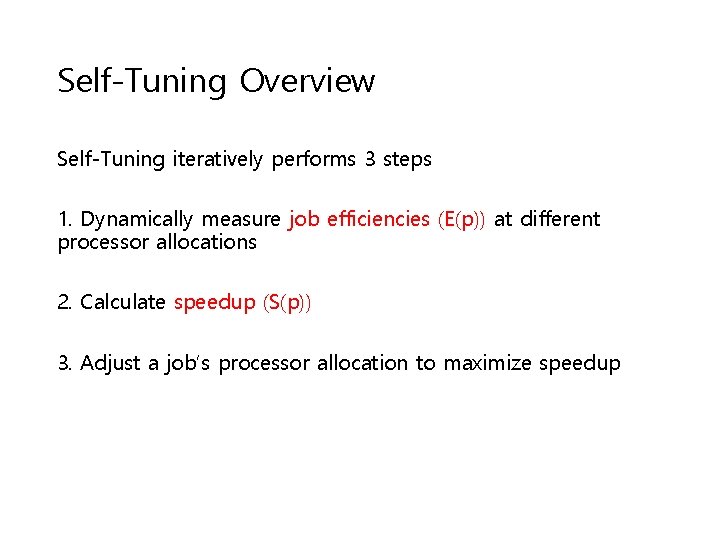
Self-Tuning Overview Self-Tuning iteratively performs 3 steps 1. Dynamically measure job efficiencies (E(p)) at different processor allocations 2. Calculate speedup (S(p)) 3. Adjust a job’s processor allocation to maximize speedup
Experimental Environment
Experimental environment • KSR-2 COMA shared memory multiprocessor (supercomputer) • KSR-2 provides a tool named event monitor which measures runtime information such as, • • Elapsed execution time Accumulated user-mode execution time Accumulated idle time Accumulated processor stall time • 10 parallel applications • Manually instrumented the apps to measure runtime information using the event monitor
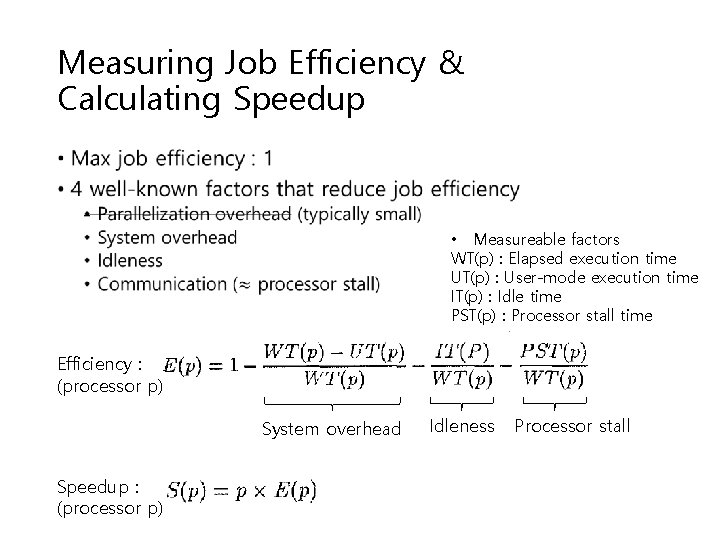
Measuring Job Efficiency & Calculating Speedup • • Measureable factors WT(p) : Elapsed execution time UT(p) : User-mode execution time IT(p) : Idle time PST(p) : Processor stall time Efficiency : (processor p) System overhead Speedup : (processor p) Idleness Processor stall
Self-Tuning Algorithm
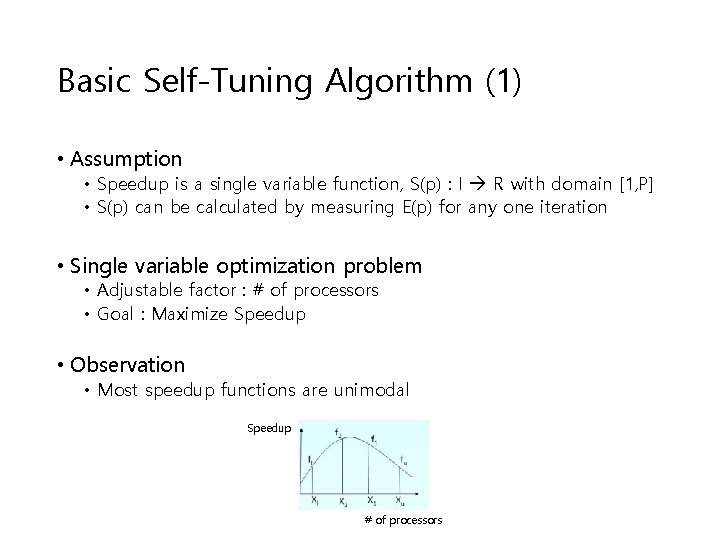
Basic Self-Tuning Algorithm (1) • Assumption • Speedup is a single variable function, S(p) : I R with domain [1, P] • S(p) can be calculated by measuring E(p) for any one iteration • Single variable optimization problem • Adjustable factor : # of processors • Goal : Maximize Speedup • Observation • Most speedup functions are unimodal Speedup # of processors
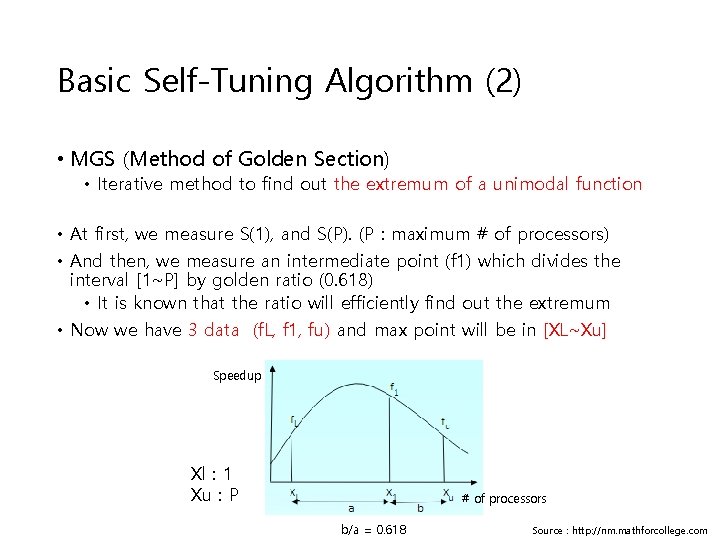
Basic Self-Tuning Algorithm (2) • MGS (Method of Golden Section) • Iterative method to find out the extremum of a unimodal function • At first, we measure S(1), and S(P). (P : maximum # of processors) • And then, we measure an intermediate point (f 1) which divides the interval [1~P] by golden ratio (0. 618) • It is known that the ratio will efficiently find out the extremum • Now we have 3 data (f. L, f 1, fu) and max point will be in [XL~Xu] Speedup Xl : 1 Xu : P # of processors b/a = 0. 618 Source : http: //nm. mathforcollege. com
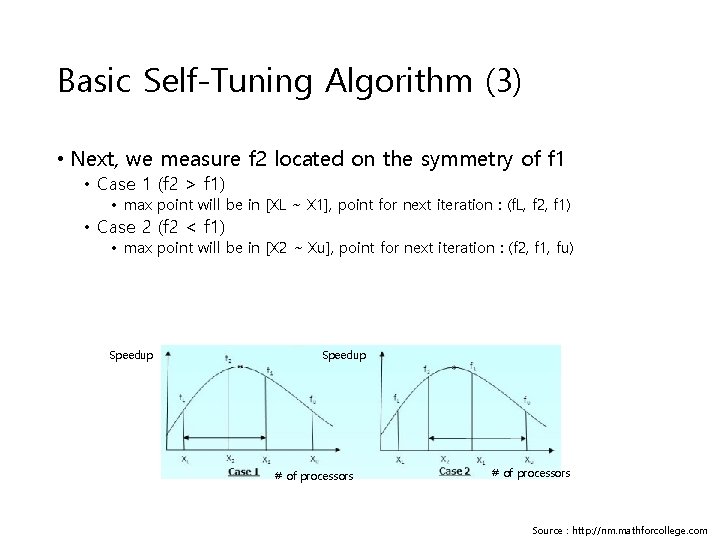
Basic Self-Tuning Algorithm (3) • Next, we measure f 2 located on the symmetry of f 1 • Case 1 (f 2 > f 1) • max point will be in [XL ~ X 1], point for next iteration : (f. L, f 2, f 1) • Case 2 (f 2 < f 1) • max point will be in [X 2 ~ Xu], point for next iteration : (f 2, f 1, fu) Speedup # of processors Source : http: //nm. mathforcollege. com
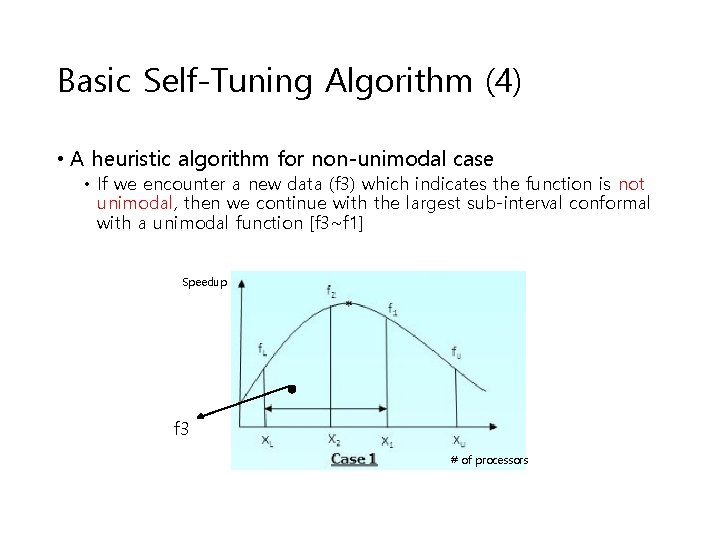
Basic Self-Tuning Algorithm (4) • A heuristic algorithm for non-unimodal case • If we encounter a new data (f 3) which indicates the function is not unimodal, then we continue with the largest sub-interval conformal with a unimodal function [f 3~f 1] Speedup f 3 # of processors
Basic Self-Tuning Algorithm Assumption • Non-unimodal speedup function Case • Heuristic-based extended MGS search procedure will correctly locate global maximum • Speedup assumption • The basic procedure assumes about job’s latter behavior with speedup values at the beginning of execution • But, speedup is independent with time. So allocation found may not be so appropriate in later • Speedup values of successive iterations will vary to some degree
Refined Self-tuning approach • Change-driven self-tuning • Continuously monitors job efficiency and re-initiates the search procedure whenever it notices a significant change in efficiency • Accords to a predefined threshold value • Time-driven self-tuning • Useful when job efficiency changes in the middle of self-tuning search but stabilizes before the search completes • Includes the change-driven approach and rerun the search procedure periodically
Performance
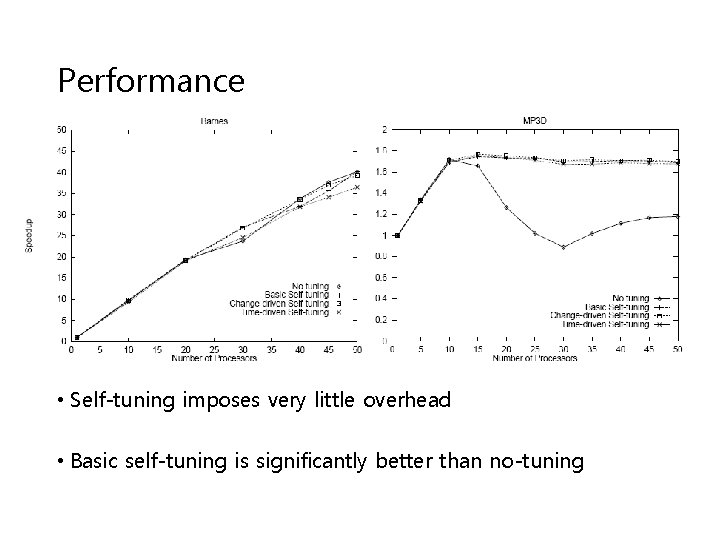
Performance • Self-tuning imposes very little overhead • Basic self-tuning is significantly better than no-tuning
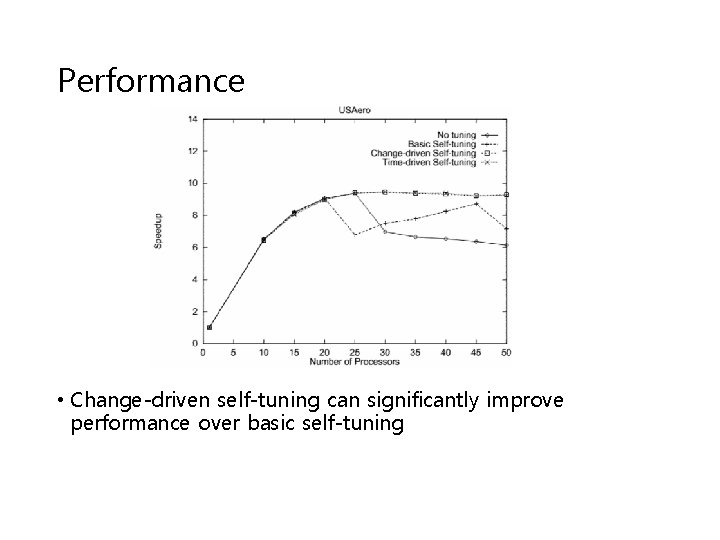
Performance • Change-driven self-tuning can significantly improve performance over basic self-tuning
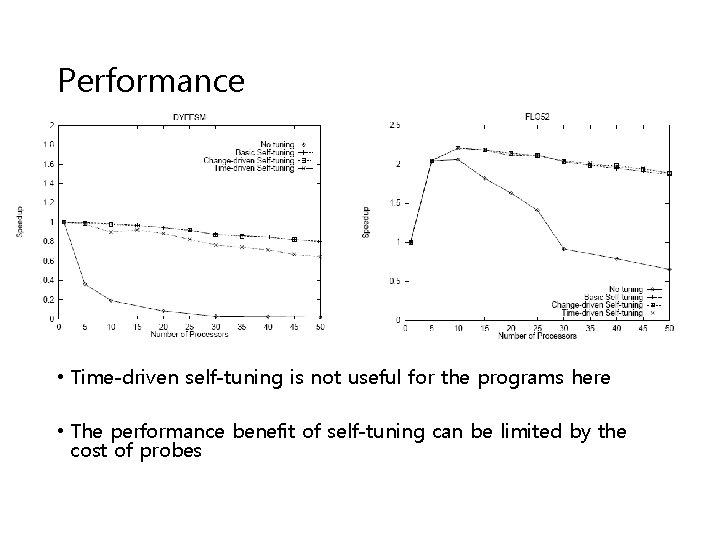
Performance • Time-driven self-tuning is not useful for the programs here • The performance benefit of self-tuning can be limited by the cost of probes
Multi-phase Self-tuning
Problem of refined self-tuning approach • The iterations of some applications are composed of multiple parallel phases • Phase • A specific piece of code • e. g. parallel loop in a compiler-parallelized program • Each phase may be executed or not depending on the outcome of conditional expressions and sequential loop
Problem of refined self-tuning approach • Extension of problem • Assume that on each try to and exit from a phase, the runtime system is provided with the unique ID of the phase • Find a processor allocation vector (p 1, p 2, …, pn) that maximizes performance when there are n phases in an iteration
Multi-phase Self-tuning (1) • Independent multi-phase self-tuning (IMPST) • Merely apply basic self-tuning to each phase independently • Simple • Problem : Performance of each phase ALSO depends on the allocations for other phases.
Multi-phase Self-tuning (2) • Inter-dependent multi-phase self-tuning (DMPST) • Simulated annealing and a heuristic-based approach • Randomized search technique • • Choosing an initial candidate allocation vector Selecting a new candidate vector (random multiplied) Evaluating and accepting new candidate vectors until steady state Terminating the search
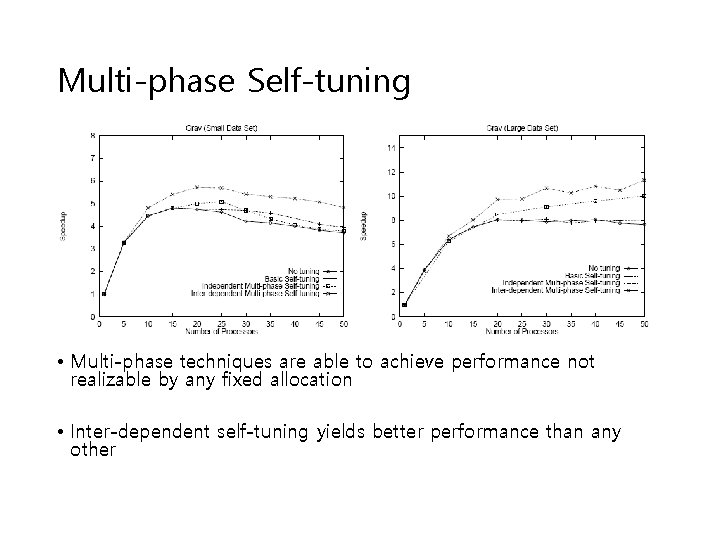
Multi-phase Self-tuning • Multi-phase techniques are able to achieve performance not realizable by any fixed allocation • Inter-dependent self-tuning yields better performance than any other
Conclusion • Maximizing application speedup through runtime, self-selection of an appropriate number of processors on which to run • Based on ability to measure program inefficiencies • Simple search procedures can automatically select appropriate numbers of processors • Relieves the user from the burden of determining the precise number of processors to use for each input data set • Potential to outperform any static allocation