
Maximizing Lipids Productivity of Microalgae for Biofuels Production
Maximizing Lipids Productivity of Microalgae for Biofuels Production and Carbon Recycling Joo-Youp Lee 1 and Jinsoo Kim 1 Chemical Engineering program at School of Energy, Environmental, Biological, and Medical Engineering in the University of Cincinnati 1

Why Microalgae? Microalgae Oil content (% dry wt. ) Botryococcus braunii 25 -75 Chlorella sp. 28 -32 Nitzschia sp. 45 -47 Neochloris oleoabundans 35 -54 v Diminishing petroleum resources → Renewable and carbon neutral liquid transportation fuels v Microalgae-derived biodiesel § Substantial amounts of triacylglycerols (e. g. , 20 -50 % dry cell weight) v Grow faster (~3 times) than terrestrial biomass

Autotrophic Growth of Microalgae v Increasing high concentration of cell density v Enhancing lipid content by using nitrogen deficient condition v Increasing cell density of algae v Increasing Lipid content v Finally, Maximizing total lipid productivity
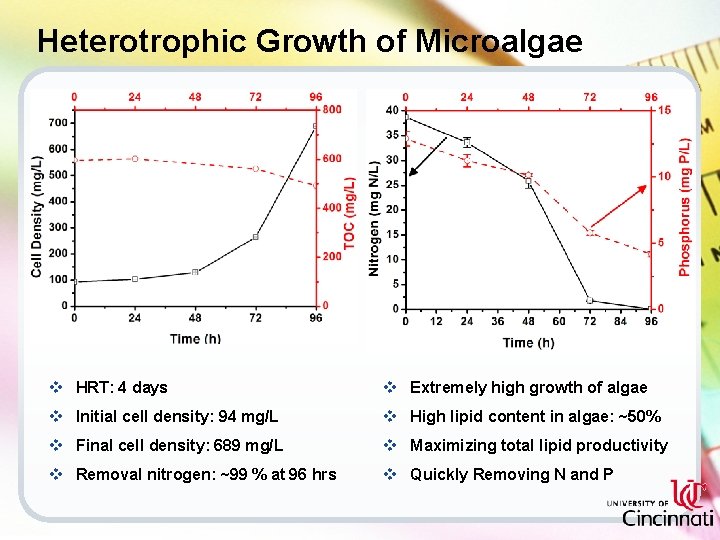
Heterotrophic Growth of Microalgae v HRT: 4 days v Extremely high growth of algae v Initial cell density: 94 mg/L v High lipid content in algae: ~50% v Final cell density: 689 mg/L v Maximizing total lipid productivity v Removal nitrogen: ~99 % at 96 hrs v Quickly Removing N and P
Objective v Increasing microalgal growth by both autotrophic and heterotrophic cultures v Enhancing lipid content in microalgae by controlling nutrients such as nitrogen and carbon v Maximizing total lipid productivity of microalgae for biodiesel production
- Slides: 5