
Maximize the Benefits from Enterprise Applications with a
Maximize the Benefits from Enterprise Applications with a Center of Excellence Optimize your organization’s enterprise application capabilities with a refined and scalable methodology. Info-Tech Research Group, Inc. is a global leader in providing IT research and advice. Info-Tech’s products and services combine actionable insight and relevant advice with ready-to-use tools and templates that cover the full spectrum of IT concerns. © 1997 -2016 Info-Tech Research Group Inc. Info-Tech Research Group 1
ANALYST PERSPECTIVE Organizations need to do more with less. A Center of Excellence (Co. E) can help. Organizations have long realized the benefits of establishing competency-based Centers of Excellence in areas like quality management or customer experience, but this approach has been largely absent in the enterprise applications practice. We propose a vendor-agnostic methodology to optimizing your organization’s most critical applications with an applications-focused Center of Excellence. A Center of Excellence consolidates best practices in a way that is repeatable, scalable, and can be generalized across the organization. It leverages the skills and competencies of talent within the organization to champion standardized practices around critical business applications, underpinned by measurable indicators. Organizations of any size can benefit from establishing a Co. E to enrich business inputs, reducing inefficiency and containing it from re-entering daily operations. Best still, organizations may already have all the required elements in-house to transition from ad hoc operations to a Center of Excellence capability. Fully harness the benefits from your applications by starting your Co. E today. Ilia Maor, Senior Manager, Research and Advisory Info-Tech Research Group 2
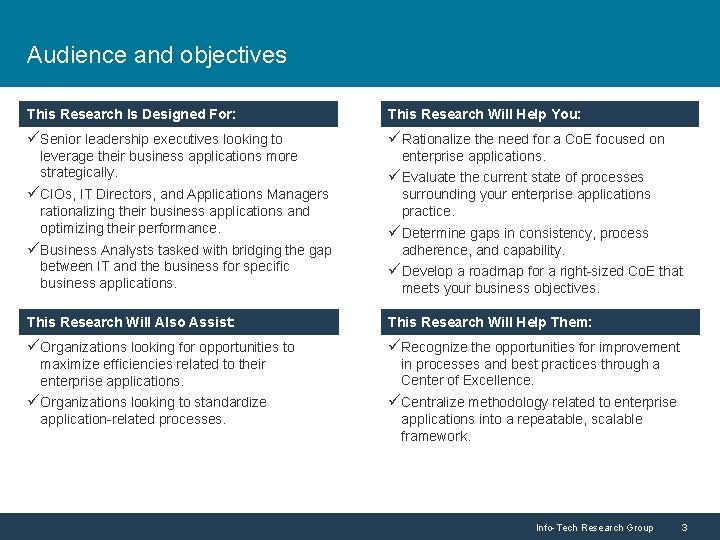
Audience and objectives This Research is Is Designed For: This Research Will Help You: üSenior leadership executives looking to üRationalize the need for a Co. E focused on leverage their business applications more strategically. üCIOs, IT Directors, and Applications Managers rationalizing their business applications and optimizing their performance. üBusiness Analysts tasked with bridging the gap between IT and the business for specific business applications. enterprise applications. üEvaluate the current state of processes surrounding your enterprise applications practice. üDetermine gaps in consistency, process adherence, and capability. üDevelop a roadmap for a right-sized Co. E that meets your business objectives. This Research Will Also Assist: This Research Will Help You: Them: üOrganizations looking for opportunities to üRecognize the opportunities for improvement maximize efficiencies related to their enterprise applications. üOrganizations looking to standardize application-related processes. in processes and best practices through a Center of Excellence. üCentralize methodology related to enterprise applications into a repeatable, scalable framework. Info-Tech Research Group 3
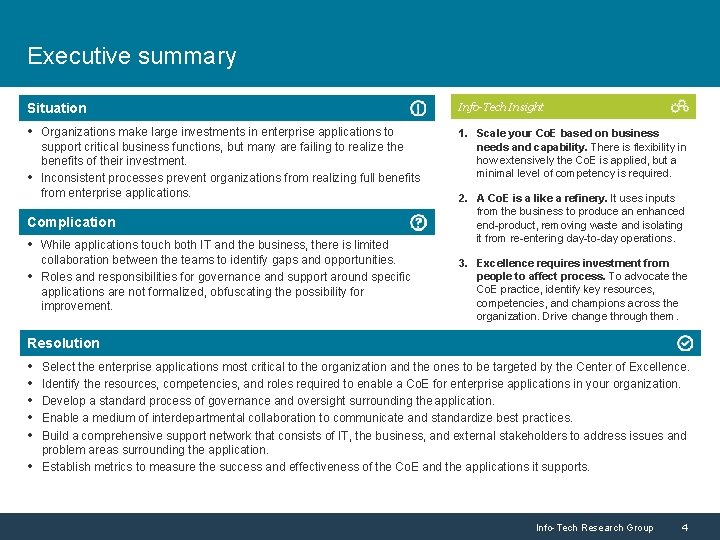
Executive summary Situation Info-Tech Insight • Organizations make large investments in enterprise applications to 1. Scale your Co. E based on business needs and capability. There is flexibility in how extensively the Co. E is applied, but a minimal level of competency is required. • support critical business functions, but many are failing to realize the benefits of their investment. Inconsistent processes prevent organizations from realizing full benefits from enterprise applications. Complication • While applications touch both IT and the business, there is limited • collaboration between the teams to identify gaps and opportunities. Roles and responsibilities for governance and support around specific applications are not formalized, obfuscating the possibility for improvement. 2. A Co. E is a like a refinery. It uses inputs from the business to produce an enhanced end-product, removing waste and isolating it from re-entering day-to-day operations. 3. Excellence requires investment from people to affect process. To advocate the Co. E practice, identify key resources, competencies, and champions across the organization. Drive change through them. Resolution • • • Select the enterprise applications most critical to the organization and the ones to be targeted by the Center of Excellence. Identify the resources, competencies, and roles required to enable a Co. E for enterprise applications in your organization. Develop a standard process of governance and oversight surrounding the application. Enable a medium of interdepartmental collaboration to communicate and standardize best practices. Build a comprehensive support network that consists of IT, the business, and external stakeholders to address issues and problem areas surrounding the application. Establish metrics to measure the success and effectiveness of the Co. E and the applications it supports. Info-Tech Research Group 4

What is an enterprise applications Center of Excellence? A Center of Excellence (Co. E) is a cross-functional methodology promoting collaboration and best practices around enterprise applications. It enables an organization to extract the full benefits out of critical systems. An Enterprise Applications Co. E builds on best practices successfully employed with competency-based Co. Es, but is distinctly catered to optimizing processes related to a single application or multiple applications rather than one competency like quality assurance or data management. The responsibilities of a Center of Excellence can include: • Reporting and Metrics: measure the value derived from the application that the Co. E is supporting. • Governance: coordination and prioritization of the project pipeline. • Knowledge Repository: systematized classification of standards, processes, and methodologies to guide the user community. • Shared Learning: training, certification, and skills assessment. • Process Mastery: standardization and optimization of application-related processes. • Vendor Management: centralized communication with third-party vendors. Maintenance & Upgrades Operational Support Infrastructure Management Center of Excellence Vendor Management & Contracts Change Management Knowledge Management Info-Tech Research Group 5
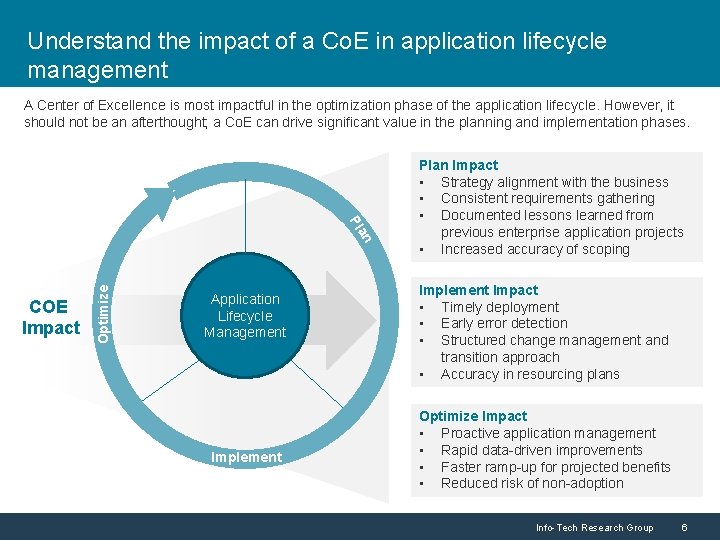
Understand the impact of a Co. E in application lifecycle management A Center of Excellence is most impactful in the optimization phase of the application lifecycle. However, it should not be an afterthought; a Co. E can drive significant value in the planning and implementation phases. Optimize an Pl COE Impact Application Lifecycle Management Implement Plan Impact • Strategy alignment with the business • Consistent requirements gathering • Documented lessons learned from previous enterprise application projects • Increased accuracy of scoping Implement Impact • Timely deployment • Early error detection • Structured change management and transition approach • Accuracy in resourcing plans Optimize Impact • Proactive application management • Rapid data-driven improvements • Faster ramp-up for projected benefits • Reduced risk of non-adoption Info-Tech Research Group 6
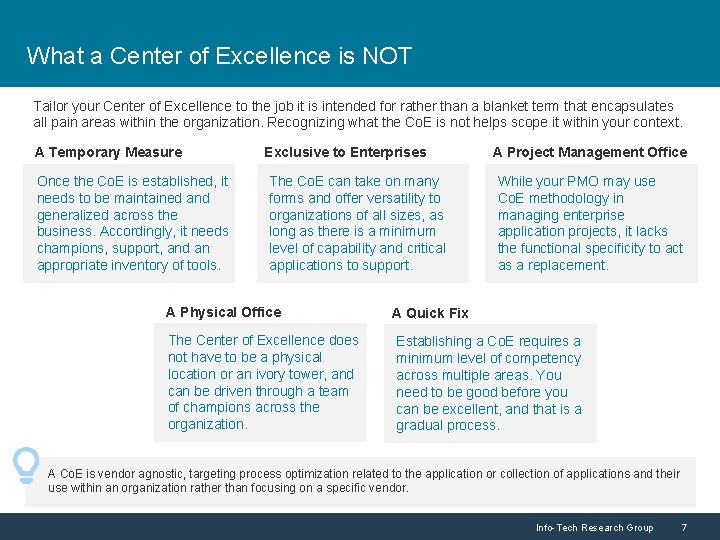
What a Center of Excellence is NOT Tailor your Center of Excellence to the job it is intended for rather than a blanket term that encapsulates all pain areas within the organization. Recognizing what the Co. E is not helps scope it within your context. A Temporary Measure Once the Co. E is established, it needs to be maintained and generalized across the business. Accordingly, it needs champions, support, and an appropriate inventory of tools. Exclusive to Enterprises The Co. E can take on many forms and offer versatility to organizations of all sizes, as long as there is a minimum level of capability and critical applications to support. A Physical Office The Center of Excellence does not have to be a physical location or an ivory tower, and can be driven through a team of champions across the organization. A Project Management Office While your PMO may use Co. E methodology in managing enterprise application projects, it lacks the functional specificity to act as a replacement. A Quick Fix Establishing a Co. E requires a minimum level of competency across multiple areas. You need to be good before you can be excellent, and that is a gradual process. A Co. E is vendor agnostic, targeting process optimization related to the application or collection of applications and their use within an organization rather than focusing on a specific vendor. Info-Tech Research Group 7
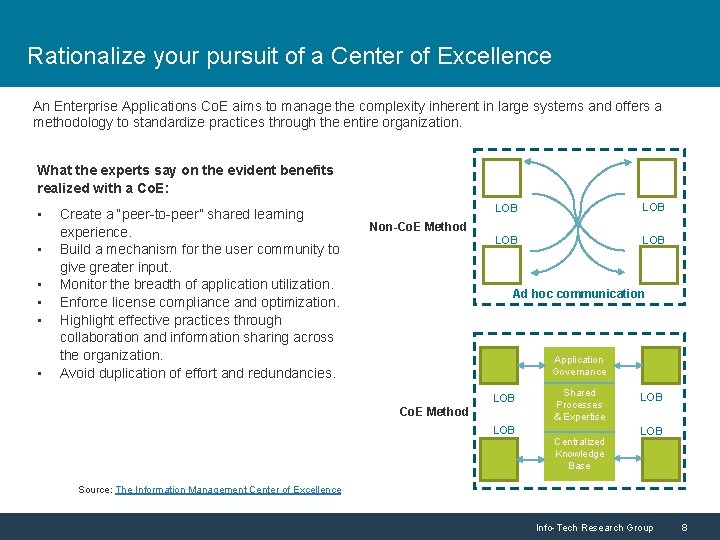
Rationalize your pursuit of a Center of Excellence An Enterprise Applications Co. E aims to manage the complexity inherent in large systems and offers a methodology to standardize practices through the entire organization. What the experts say on the evident benefits realized with a Co. E: • • • Create a “peer-to-peer” shared learning experience. Build a mechanism for the user community to give greater input. Monitor the breadth of application utilization. Enforce license compliance and optimization. Highlight effective practices through collaboration and information sharing across the organization. Avoid duplication of effort and redundancies. Non-Co. E Method LOB LOB Ad hoc communication Application Governance LOB Co. E Method LOB Shared Processes & Expertise Centralized Knowledge Base LOB Source: The Information Management Center of Excellence Info-Tech Research Group 8
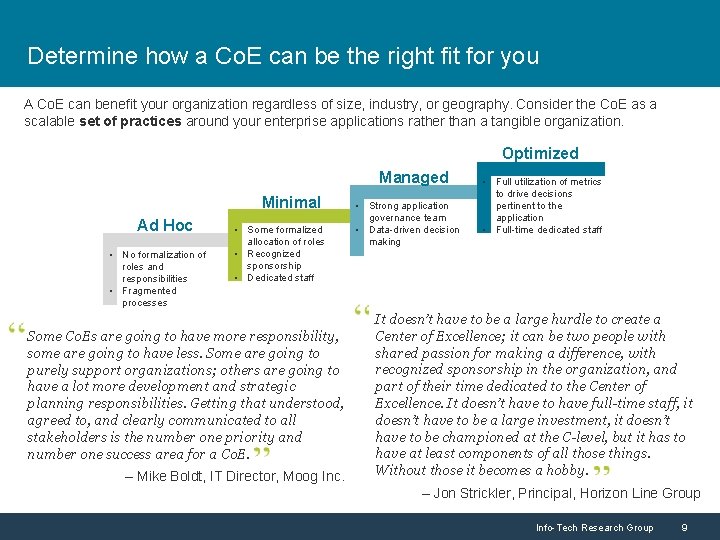
Determine how a Co. E can be the right fit for you A Co. E can benefit your organization regardless of size, industry, or geography. Consider the Co. E as a scalable set of practices around your enterprise applications rather than a tangible organization. Optimized Managed Minimal Ad Hoc • No formalization of roles and responsibilities • Fragmented processes • Some formalized allocation of roles • Recognized sponsorship • Dedicated staff Some Co. Es are going to have more responsibility, some are going to have less. Some are going to purely support organizations; others are going to have a lot more development and strategic planning responsibilities. Getting that understood, agreed to, and clearly communicated to all stakeholders is the number one priority and number one success area for a Co. E. – Mike Boldt, IT Director, Moog Inc. • Strong application governance team • Data-driven decision making • Full utilization of metrics to drive decisions pertinent to the application • Full-time dedicated staff It doesn’t have to be a large hurdle to create a Center of Excellence; it can be two people with shared passion for making a difference, with recognized sponsorship in the organization, and part of their time dedicated to the Center of Excellence. It doesn’t have to have full-time staff, it doesn’t have to be a large investment, it doesn’t have to be championed at the C-level, but it has to have at least components of all those things. Without those it becomes a hobby. – Jon Strickler, Principal, Horizon Line Group Info-Tech Research Group 9
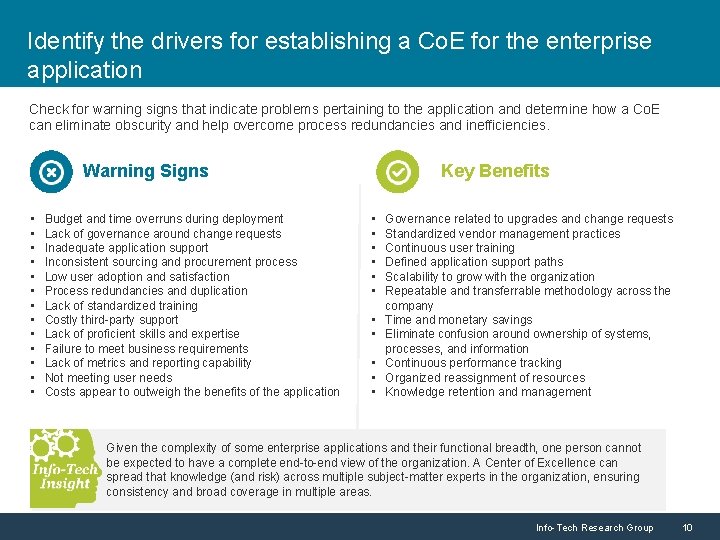
Identify the drivers for establishing a Co. E for the enterprise application Check for warning signs that indicate problems pertaining to the application and determine how a Co. E can eliminate obscurity and help overcome process redundancies and inefficiencies. Warning Signs • • • • Budget and time overruns during deployment Lack of governance around change requests Inadequate application support Inconsistent sourcing and procurement process Low user adoption and satisfaction Process redundancies and duplication Lack of standardized training Costly third-party support Lack of proficient skills and expertise Failure to meet business requirements Lack of metrics and reporting capability Not meeting user needs Costs appear to outweigh the benefits of the application Key Benefits • • • Governance related to upgrades and change requests Standardized vendor management practices Continuous user training Defined application support paths Scalability to grow with the organization Repeatable and transferrable methodology across the company Time and monetary savings Eliminate confusion around ownership of systems, processes, and information Continuous performance tracking Organized reassignment of resources Knowledge retention and management Given the complexity of some enterprise applications and their functional breadth, one person cannot be expected to have a complete end-to-end view of the organization. A Center of Excellence can spread that knowledge (and risk) across multiple subject-matter experts in the organization, ensuring consistency and broad coverage in multiple areas. Info-Tech Research Group 10
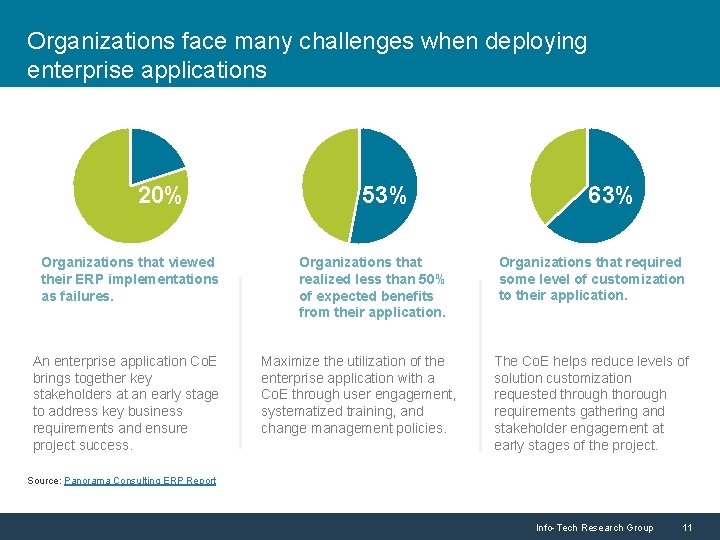
Organizations face many challenges when deploying enterprise applications 20% Organizations that viewed their ERP implementations as failures. An enterprise application Co. E brings together key stakeholders at an early stage to address key business requirements and ensure project success. 53% Organizations that realized less than 50% of expected benefits from their application. Maximize the utilization of the enterprise application with a Co. E through user engagement, systematized training, and change management policies. 63% Organizations that required some level of customization to their application. The Co. E helps reduce levels of solution customization requested through thorough requirements gathering and stakeholder engagement at early stages of the project. Source: Panorama Consulting ERP Report Info-Tech Research Group 11
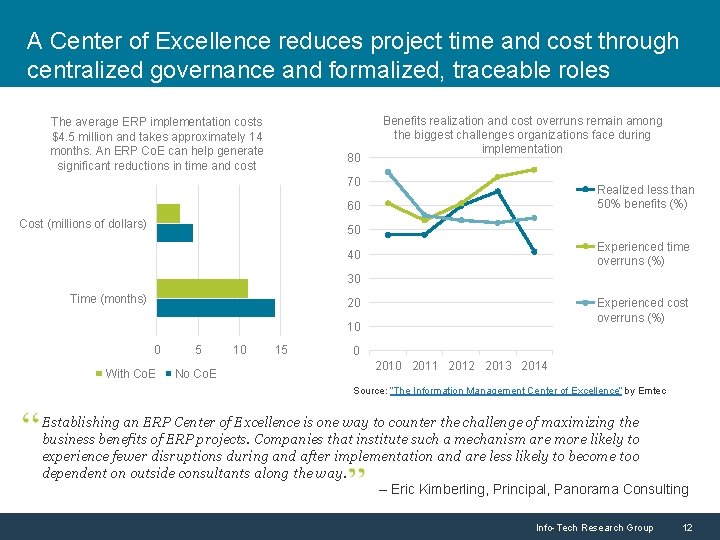
A Center of Excellence reduces project time and cost through centralized governance and formalized, traceable roles The average ERP implementation costs $4. 5 million and takes approximately 14 months. An ERP Co. E can help generate significant reductions in time and cost 80 Benefits realization and cost overruns remain among the biggest challenges organizations face during implementation 70 Realized less than 50% benefits (%) 60 Cost (millions of dollars) 50 Experienced time overruns (%) 40 30 Time (months) 20 Experienced cost overruns (%) 10 0 With Co. E 5 No Co. E 10 15 0 2011 2012 2013 2014 Source: “The Information Management Center of Excellence” by Emtec Establishing an ERP Center of Excellence is one way to counter the challenge of maximizing the business benefits of ERP projects. Companies that institute such a mechanism are more likely to experience fewer disruptions during and after implementation and are less likely to become too dependent on outside consultants along the way. – Eric Kimberling, Principal, Panorama Consulting Info-Tech Research Group 12
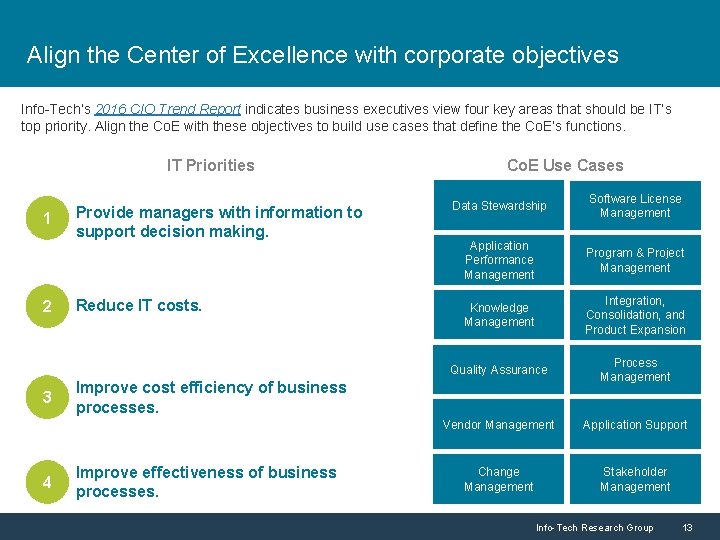
Align the Center of Excellence with corporate objectives Info-Tech’s 2016 CIO Trend Report indicates business executives view four key areas that should be IT’s top priority. Align the Co. E with these objectives to build use cases that define the Co. E’s functions. IT Priorities 1 2 3 4 Provide managers with information to support decision making. Reduce IT costs. Co. E Use Cases Data Stewardship Software License Management Application Performance Management Program & Project Management Knowledge Management Integration, Consolidation, and Product Expansion Quality Assurance Process Management Vendor Management Application Support Change Management Stakeholder Management Improve cost efficiency of business processes. Improve effectiveness of business processes. Info-Tech Research Group 13

Info-Tech’s framework for visualizing the Center of Excellence Visualizing the Co. E framework will help you position it within your organization. A strategic foundation enables the mandate, allowing for the development of a shared methodology to drive practices related to applications. All three layers are required for a successful Center of Excellence. Ow ip rsh ne Shared Methodology E on ati Strategy niz ga Or There should be strategic alignment between the Co. E and the organization’s goals, objectives, and vision. This alignment translates into the Co. E mandate intended to enhance the way enterprise applications enable the business. Delivery Co Build a consolidated approach and standard methodology, based on best practices and performance measurement through key performance indicators, that is used across the organization. This includes setting best practices around application administration, software installation and configuration, and project execution. IT Once a methodology has been established, it still needs to be enacted. Ensure appropriate resources are allocated to the Co. E both from a skillset perspective as well as having the right people involved. The actionable aspect of the Co. E resides with IT transforming business inputs. Info-Tech Research Group 14
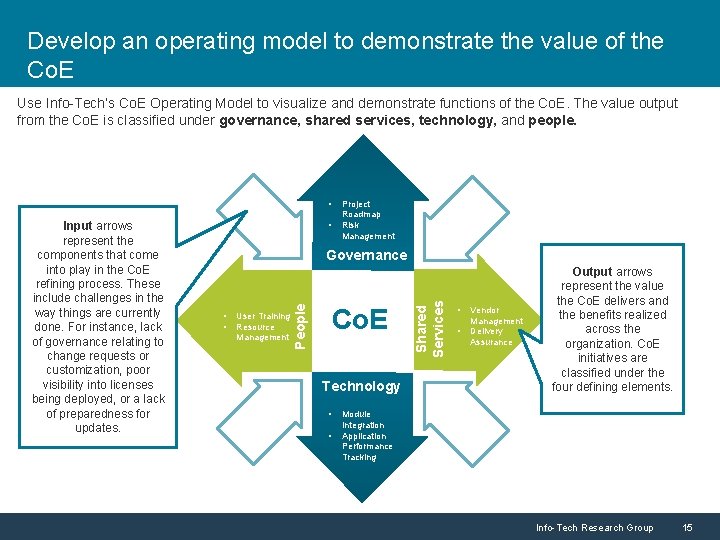
Develop an operating model to demonstrate the value of the Co. E Use Info-Tech’s Co. E Operating Model to visualize and demonstrate functions of the Co. E. The value output from the Co. E is classified under governance, shared services, technology, and people. • • User Training Resource Management Co. E Governance Technology • • Shared Services Governance People Input arrows represent the components that come into play in the Co. E refining process. These include challenges in the way things are currently done. For instance, lack of governance relating to change requests or customization, poor visibility into licenses being deployed, or a lack of preparedness for updates. Project Roadmap Risk Management • • Vendor Management Delivery Assurance Output arrows represent the value the Co. E delivers and the benefits realized across the organization. Co. E initiatives are classified under the four defining elements. Module Integration Application Performance Tracking Info-Tech Research Group 15
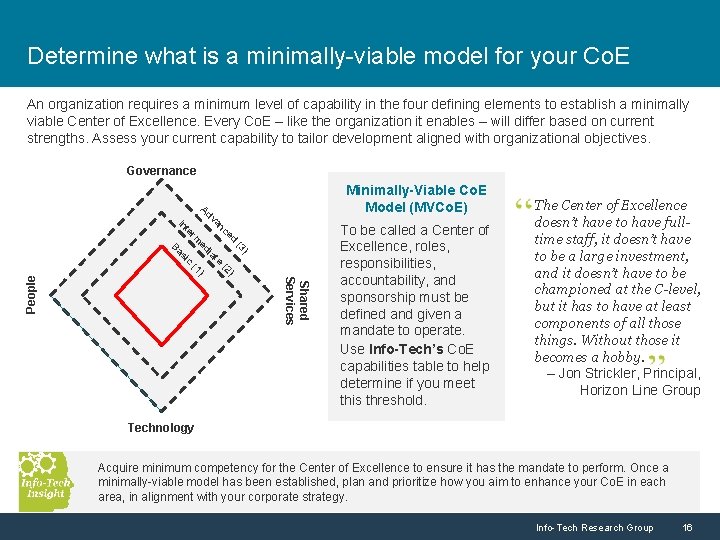
Determine what is a minimally-viable model for your Co. E An organization requires a minimum level of capability in the four defining elements to establish a minimally viable Center of Excellence. Every Co. E – like the organization it enables – will differ based on current strengths. Assess your current capability to tailor development aligned with organizational objectives. Governance d rm te In ce an dv A Minimally-Viable Co. E Model (MVCo. E) (3 ed ) ic te ia as B Shared Services People ) (2 ) (1 To be called a Center of Excellence, roles, responsibilities, accountability, and sponsorship must be defined and given a mandate to operate. Use Info-Tech’s Co. E capabilities table to help determine if you meet this threshold. The Center of Excellence doesn’t have to have fulltime staff, it doesn’t have to be a large investment, and it doesn’t have to be championed at the C-level, but it has to have at least components of all those things. Without those it becomes a hobby. – Jon Strickler, Principal, Horizon Line Group Technology Acquire minimum competency for the Center of Excellence to ensure it has the mandate to perform. Once a minimally-viable model has been established, plan and prioritize how you aim to enhance your Co. E in each area, in alignment with your corporate strategy. Info-Tech Research Group 16
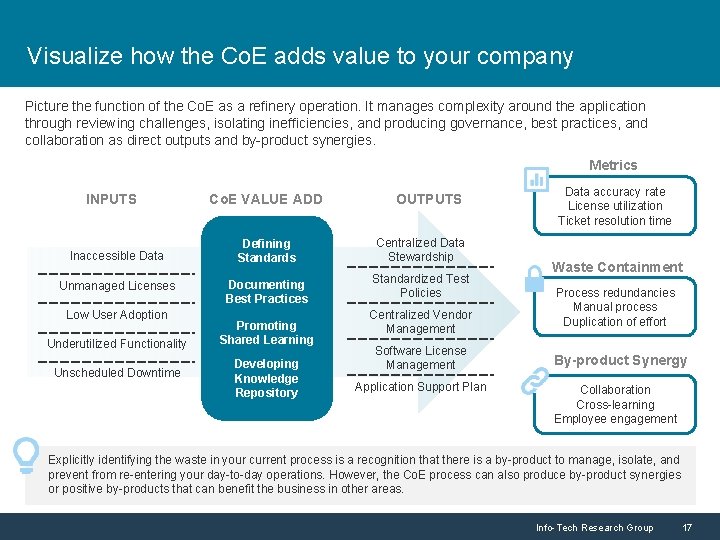
Visualize how the Co. E adds value to your company Picture the function of the Co. E as a refinery operation. It manages complexity around the application through reviewing challenges, isolating inefficiencies, and producing governance, best practices, and collaboration as direct outputs and by-product synergies. Metrics INPUTS Inaccessible Data Unmanaged Licenses Low User Adoption Underutilized Functionality Unscheduled Downtime Co. E VALUE ADD Defining Standards Documenting Best Practices Promoting Shared Learning Developing Knowledge Repository OUTPUTS Centralized Data Stewardship Standardized Test Policies Centralized Vendor Management Software License Management Application Support Plan Data accuracy rate License utilization Ticket resolution time Waste Containment Process redundancies Manual process Duplication of effort By-product Synergy Collaboration Cross-learning Employee engagement Explicitly identifying the waste in your current process is a recognition that there is a by-product to manage, isolate, and prevent from re-entering your day-to-day operations. However, the Co. E process can also produce by-product synergies or positive by-products that can benefit the business in other areas. Info-Tech Research Group 17

Executive Brief case study – Co. E for ERP Ecosystem CASE STUDY Industry Source Film Production and Entertainment Technology Research Interview Background The organization is a multinational entertainment technology company with operations in over 50 countries. Results The value offered by the Co. E came in the following form: • Improved user satisfaction due to increased visibility into the importance of the ERP system. • Staff skill growth due to cross-departmental training and fostering collaboration. • Stronger governance component led to improved systems integration and dependence considerations. Change Management Governance ERP Ecosystem Co. E Solution Delivery Center of Excellence Initiative The organization launched a Co. E project for North American SAP implementations. The purpose was to span key elements of the system across the company. One of the objectives was also to establish a mechanism for project managers to manage the multitude of projects, dependencies, and conflicts pertaining to the ERP solution. The impetus to create the Co. E was in alignment with the IT strategy map. The Co. E team was composed of: • Project Managers • Project Controller • Functional Configuration Analysts • Security Analysts • Database Administrators • Business Relationship Managers IT Program Roadmap Support Other Software Infrastructure Training & Learning Management Disaster Recovery Planning Info-Tech Research Group 18
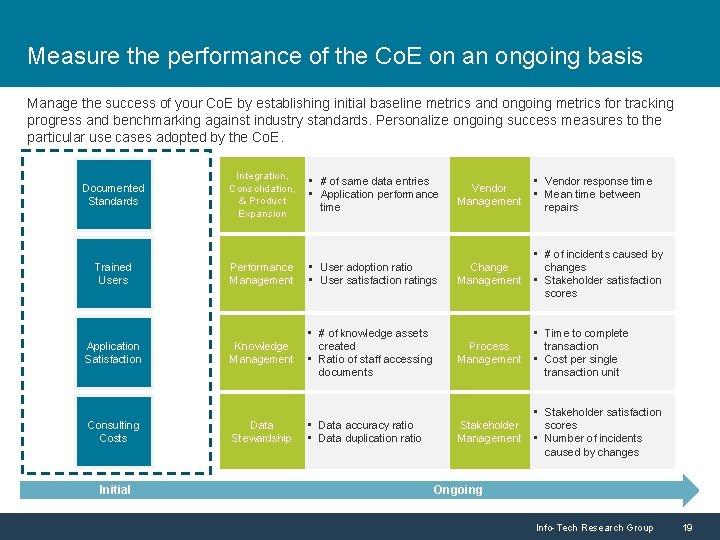
Measure the performance of the Co. E on an ongoing basis Manage the success of your Co. E by establishing initial baseline metrics and ongoing metrics for tracking progress and benchmarking against industry standards. Personalize ongoing success measures to the particular use cases adopted by the Co. E. Documented Standards Integration, Consolidation, & Product Expansion • # of same data entries • Application performance time Vendor Management • Vendor response time • Mean time between repairs Trained Users Performance Management • User adoption ratio • User satisfaction ratings Change Management • # of incidents caused by changes • Stakeholder satisfaction scores Application Satisfaction Knowledge Management • # of knowledge assets created • Ratio of staff accessing documents Process Management • Time to complete transaction • Cost per single transaction unit Consulting Costs Data Stewardship • Data accuracy ratio • Data duplication ratio Stakeholder Management • Stakeholder satisfaction scores • Number of incidents caused by changes Initial Ongoing Info-Tech Research Group 19

Follow Info-Tech’s approach to develop a framework for your Co. E Structure the Project Map Current State • Identify goals and objectives for the Center of Excellence. • Determine project scope. • Identify and map key stakeholders. • Understand the four defining elements of the Co. E Operating Model. • Map current Co. E structure. Outputs Co. E Project Vision Outputs Co. E Current State Model Gather Requirements Develop a Roadmap Map Ideal State • Identify existing practices, templates, and tools that can be recycled for use within the Co. E. • Determine relevant use cases for the Co. E. • Use the refinery model to dive down into expected value. • Map ideal Co. E structure. Outputs Existing Co. E Practices • Classify pain points and opportunities in alignment with the Operating Model. Outputs Classified Requirements Co. E Ideal State Model • Determine potential capabilities under the four defining elements. Outputs Co. E Potential Capabilities • Prioritize Co. E initiatives. • Highlight risks and mitigation efforts. • Monitor and evaluate benefits. Outputs Co. E Initiatives Roadmap • Prepare final presentation to gain stakeholder commitment. Outputs Stakeholder Presentation Info-Tech Research Group 20
Use these icons to help direct you as you navigate this research Use these icons to help guide you through each step of the blueprint and direct you to content related to the recommended activities. This icon denotes a slide where a supporting Info-Tech tool or template will help you perform the activity or step associated with the slide. Refer to the supporting tool or template to get the best results and proceed to the next step of the project. This icon denotes a slide with an associated activity. The activity can be performed either as part of your project or with the support of Info-Tech team members, who will come onsite to facilitate a workshop for your organization. Info-Tech Research Group 21
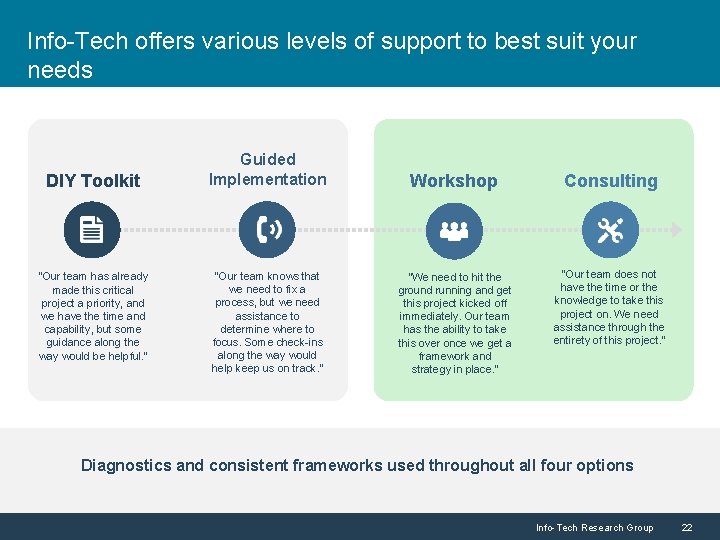
Info-Tech offers various levels of support to best suit your needs DIY Toolkit “Our team has already made this critical project a priority, and we have the time and capability, but some guidance along the way would be helpful. ” Guided Implementation Workshop Consulting “Our team knows that we need to fix a process, but we need assistance to determine where to focus. Some check-ins along the way would help keep us on track. ” “We need to hit the ground running and get this project kicked off immediately. Our team has the ability to take this over once we get a framework and strategy in place. ” “Our team does not have the time or the knowledge to take this project on. We need assistance through the entirety of this project. ” Diagnostics and consistent frameworks used throughout all four options Info-Tech Research Group 22
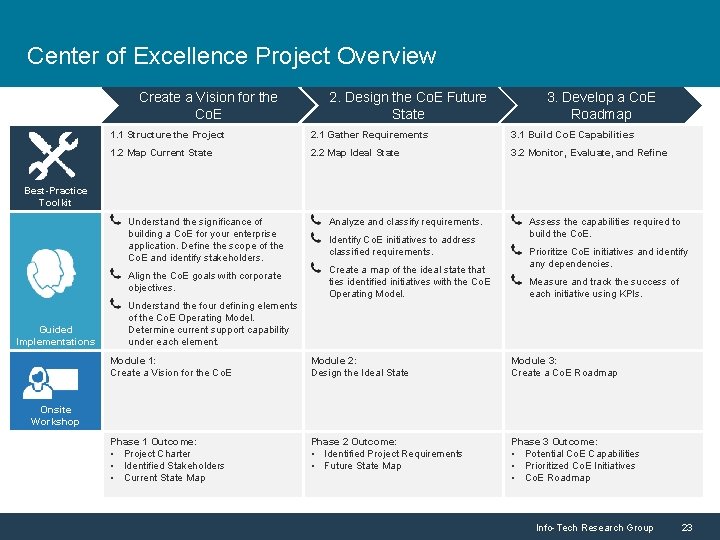
Center of Excellence Project Overview Create a Vision for the Co. E 2. Design the Co. E Future State 3. Develop a Co. E Roadmap 1. 1 Structure the Project 2. 1 Gather Requirements 3. 1 Build Co. E Capabilities 1. 2 Map Current State 2. 2 Map Ideal State 3. 2 Monitor, Evaluate, and Refine Best-Practice Toolkit Understand the significance of building a Co. E for your enterprise application. Define the scope of the Co. E and identify stakeholders. Align the Co. E goals with corporate objectives. Guided Implementations Analyze and classify requirements. Identify Co. E initiatives to address classified requirements. Create a map of the ideal state that ties identified initiatives with the Co. E Operating Model. Assess the capabilities required to build the Co. E. Prioritize Co. E initiatives and identify any dependencies. Measure and track the success of each initiative using KPIs. Understand the four defining elements of the Co. E Operating Model. Determine current support capability under each element. Module 1: Create a Vision for the Co. E Module 2: Design the Ideal State Module 3: Create a Co. E Roadmap Phase 1 Outcome: • Project Charter • Identified Stakeholders • Current State Map Phase 2 Outcome: • Identified Project Requirements • Future State Map Phase 3 Outcome: • Potential Co. E Capabilities • Prioritized Co. E Initiatives • Co. E Roadmap Onsite Workshop Info-Tech Research Group 23
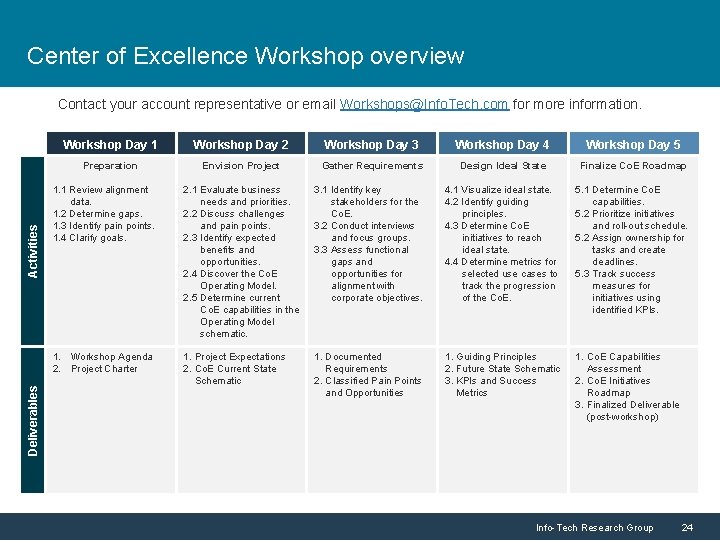
Center of Excellence Workshop overview Deliverables Activities Contact your account representative or email Workshops@Info. Tech. com for more information. Workshop Day 1 Workshop Day 2 Workshop Day 3 Workshop Day 4 Workshop Day 5 Preparation Envision Project Gather Requirements Design Ideal State Finalize Co. E Roadmap 1. 1 Review alignment data. 1. 2 Determine gaps. 1. 3 Identify pain points. 1. 4 Clarify goals. 2. 1 Evaluate business needs and priorities. 2. 2 Discuss challenges and pain points. 2. 3 Identify expected benefits and opportunities. 2. 4 Discover the Co. E Operating Model. 2. 5 Determine current Co. E capabilities in the Operating Model schematic. 3. 1 Identify key stakeholders for the Co. E. 3. 2 Conduct interviews and focus groups. 3. 3 Assess functional gaps and opportunities for alignment with corporate objectives. 4. 1 Visualize ideal state. 4. 2 Identify guiding principles. 4. 3 Determine Co. E initiatives to reach ideal state. 4. 4 Determine metrics for selected use cases to track the progression of the Co. E. 5. 1 Determine Co. E capabilities. 5. 2 Prioritize initiatives and roll-out schedule. 5. 2 Assign ownership for tasks and create deadlines. 5. 3 Track success measures for initiatives using identified KPIs. 1. Workshop Agenda 2. Project Charter 1. Project Expectations 2. Co. E Current State Schematic 1. Documented Requirements 2. Classified Pain Points and Opportunities 1. Guiding Principles 2. Future State Schematic 3. KPIs and Success Metrics 1. Co. E Capabilities Assessment 2. Co. E Initiatives Roadmap 3. Finalized Deliverable (post-workshop) Info-Tech Research Group 24
- Slides: 24