
Maximising MAPA Developing Programme Delivery Situational Application Where

- Slides: 27
Maximising MAPA®: Developing Programme Delivery Situational Application. Where to use it? What’s the value? and How to do it Kevin Southward Global Professional Instructor David Cashmore Global Professional Instructor © 2017
Outcomes • Where Situational Application sits within the MAPA programme • The Values and Benefits of utilizing Situational Application within your training • How to run Situational Applications so that information covered in the programme can be related to real-life work based situations. © 2017 Certified Instructor Conference 2017 2
Where to use Situational Application? Groupwork • Think about the MAPA programme/units and identify where Situational Application is utilised? © 2017 Certified Instructor Conference 2017 3
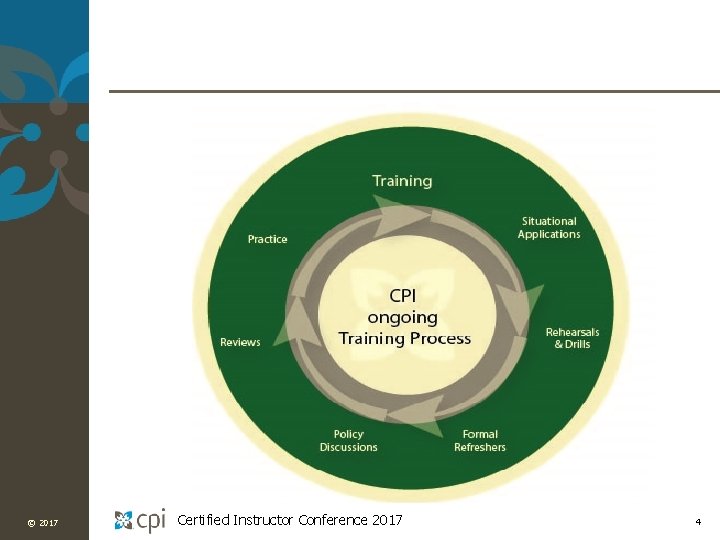
© 2017 Certified Instructor Conference 2017 4
Where to use Situational Application? Groupwork • Where do you currently use SA in your training/ organisation? © 2017 Certified Instructor Conference 2017 5
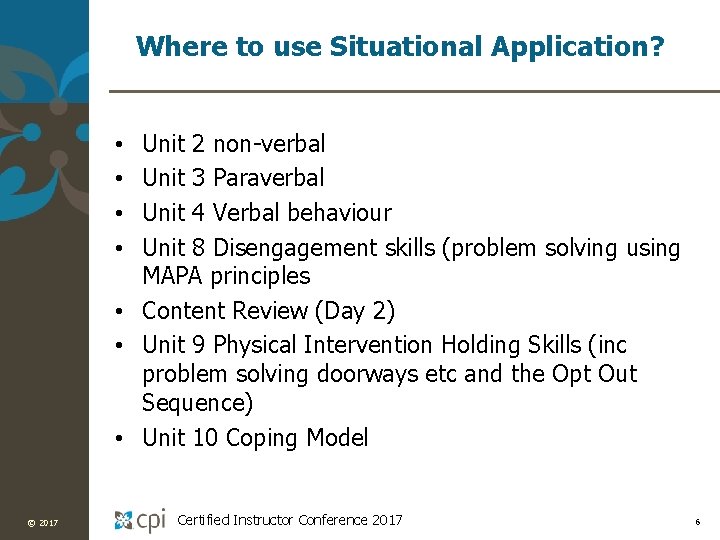
Where to use Situational Application? Unit 2 non-verbal Unit 3 Paraverbal Unit 4 Verbal behaviour Unit 8 Disengagement skills (problem solving using MAPA principles • Content Review (Day 2) • Unit 9 Physical Intervention Holding Skills (inc problem solving doorways etc and the Opt Out Sequence) • Unit 10 Coping Model • • © 2017 Certified Instructor Conference 2017 6
Values Groupwork • What are the reasons and values of utilising Situational Applications in our training? © 2017 Certified Instructor Conference 2017 7
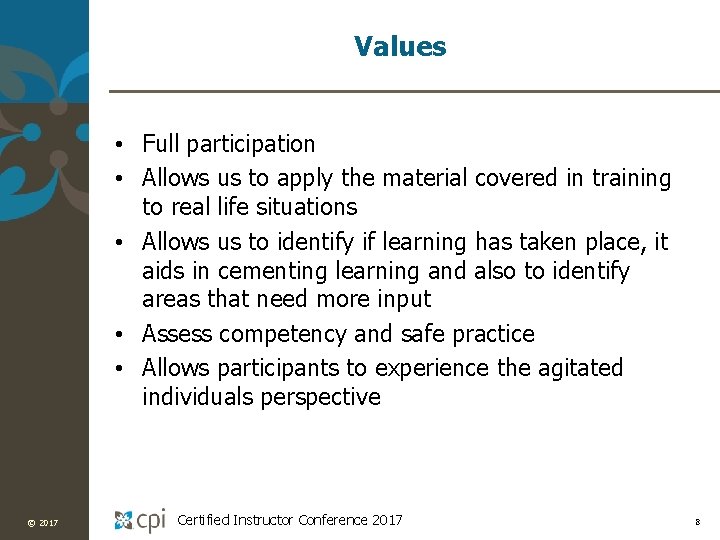
Values • Full participation • Allows us to apply the material covered in training to real life situations • Allows us to identify if learning has taken place, it aids in cementing learning and also to identify areas that need more input • Assess competency and safe practice • Allows participants to experience the agitated individuals perspective © 2017 Certified Instructor Conference 2017 8
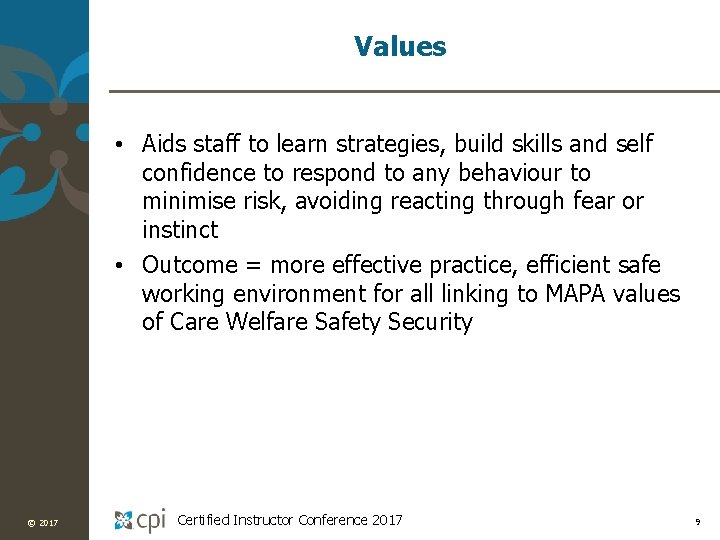
Values • Aids staff to learn strategies, build skills and self confidence to respond to any behaviour to minimise risk, avoiding reacting through fear or instinct • Outcome = more effective practice, efficient safe working environment for all linking to MAPA values of Care Welfare Safety Security © 2017 Certified Instructor Conference 2017 9
Example of a Situational Application © 2017 Certified Instructor Conference 2017 10
How to run Situational Applications (Set-up) • • • © 2017 Bespoke Situational Applications to your participants place of work Take into account service users, environment, staffing and policies & procedures Identify and incorporate targeted principles Certified Instructor Conference 2017 11
A Guide to Running Situational Applications (Set-up) • Identify areas of concern to be practiced (in-line with participant’s needs) supportive-tension reduction • 2 types; Conduct whole Situational Application then debrief or pause and highlight positive contributions throughout (flipchart) • CI to play the role of the service user © 2017 Certified Instructor Conference 2017 12
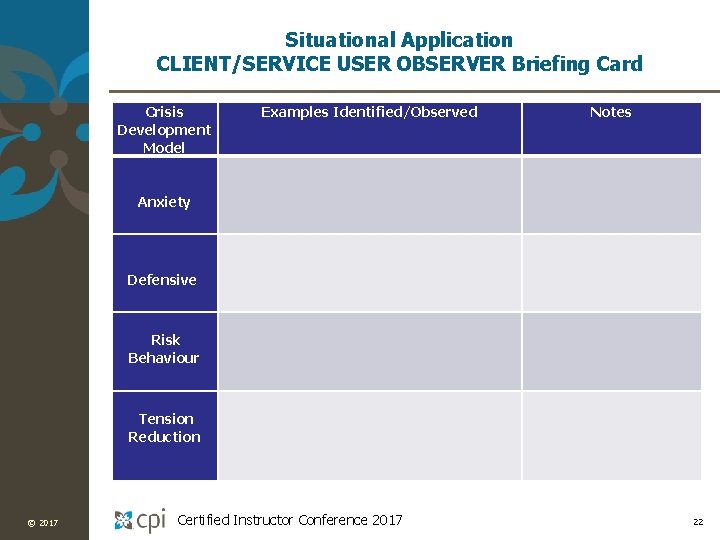
A Guide to Running Situational Applications (Set-up) • Divide the remainder of the group into a staff team and observers • Identify a team leader and brief the staff team and observers on the scenario • Further divide the observers into 2 groups one to observe the staff team and one to observe the service user (tick sheet or questions can aid the observers) • Those observing the service user will be looking for behavior’s with regards to the Crisis Development Model and recording examples © 2017 Certified Instructor Conference 2017 13
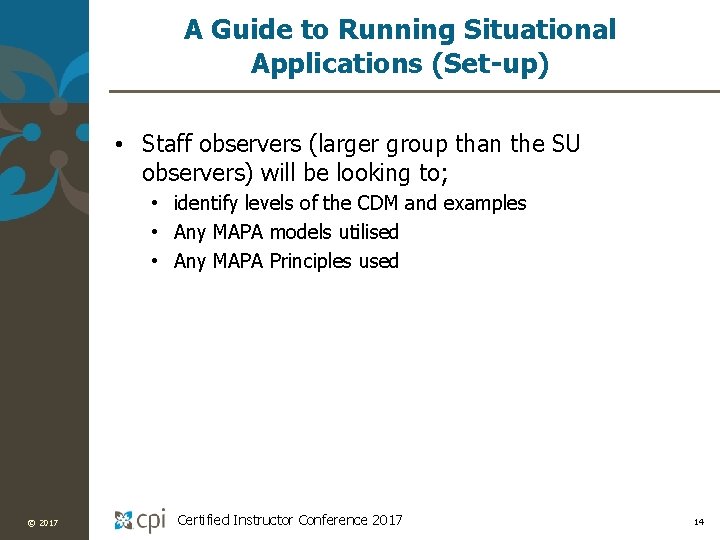
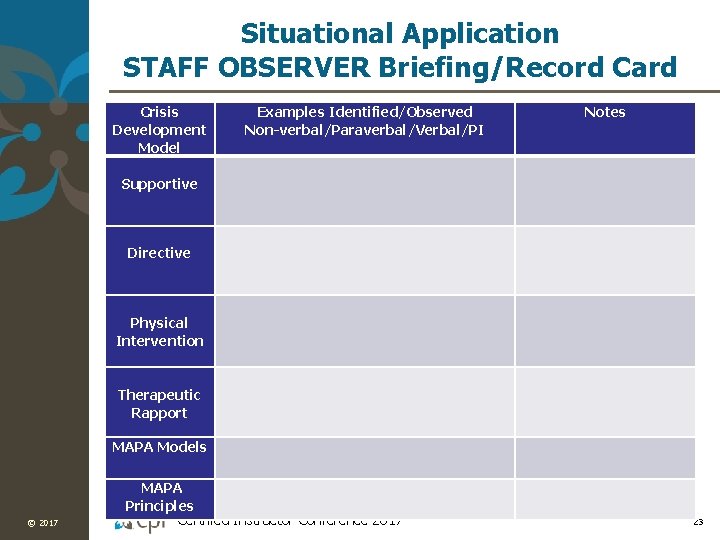
A Guide to Running Situational Applications (Set-up) • Staff observers (larger group than the SU observers) will be looking to; • identify levels of the CDM and examples • Any MAPA models utilised • Any MAPA Principles used © 2017 Certified Instructor Conference 2017 14
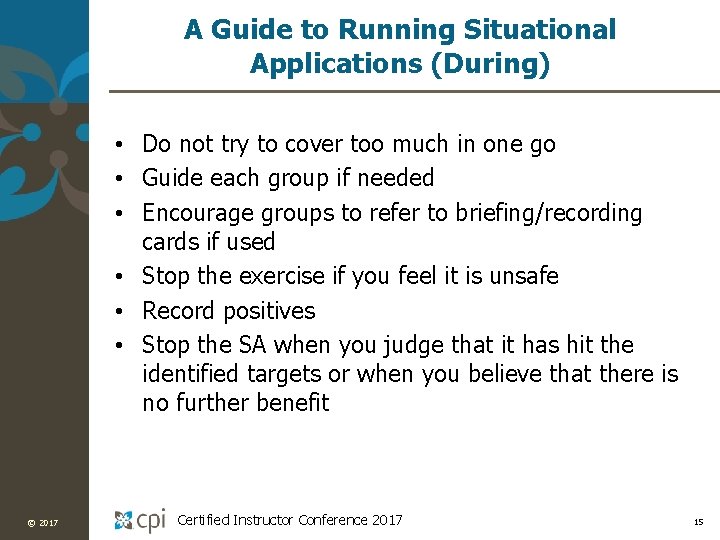
A Guide to Running Situational Applications (During) • Do not try to cover too much in one go • Guide each group if needed • Encourage groups to refer to briefing/recording cards if used • Stop the exercise if you feel it is unsafe • Record positives • Stop the SA when you judge that it has hit the identified targets or when you believe that there is no further benefit © 2017 Certified Instructor Conference 2017 15
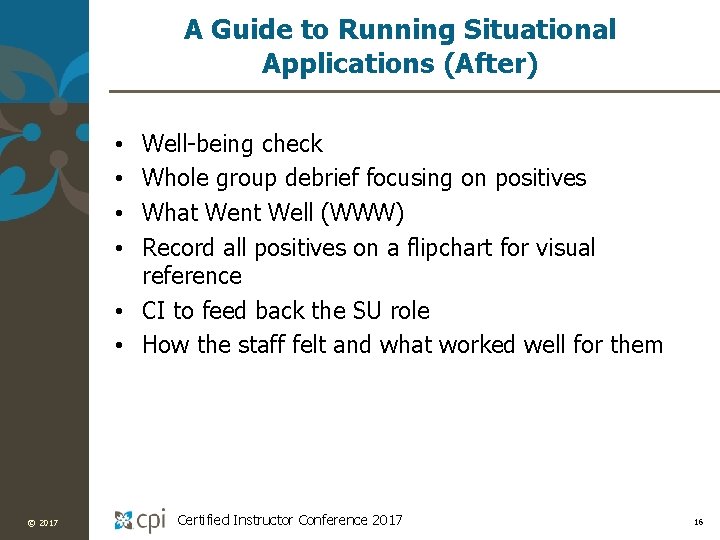
A Guide to Running Situational Applications (After) Well-being check Whole group debrief focusing on positives What Went Well (WWW) Record all positives on a flipchart for visual reference • CI to feed back the SU role • How the staff felt and what worked well for them • • © 2017 Certified Instructor Conference 2017 16
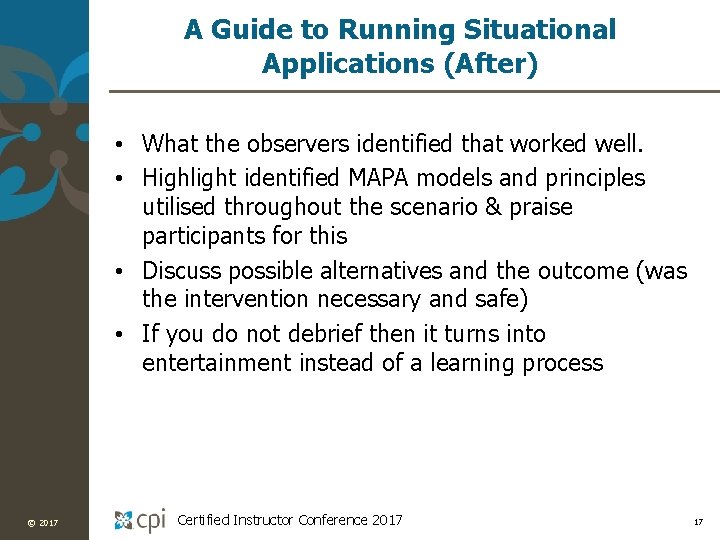
A Guide to Running Situational Applications (After) • What the observers identified that worked well. • Highlight identified MAPA models and principles utilised throughout the scenario & praise participants for this • Discuss possible alternatives and the outcome (was the intervention necessary and safe) • If you do not debrief then it turns into entertainment instead of a learning process © 2017 Certified Instructor Conference 2017 17
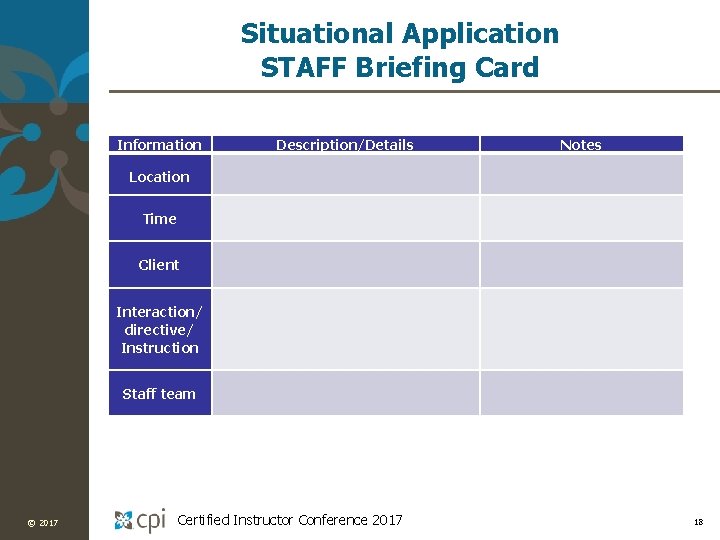
Situational Application STAFF Briefing Card Information Description/Details Notes Location Time Client Interaction/ directive/ Instruction Staff team © 2017 Certified Instructor Conference 2017 18
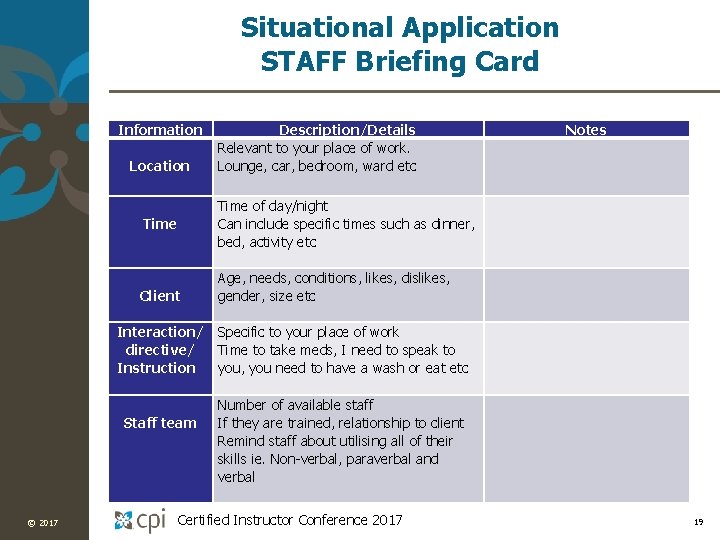
Situational Application STAFF Briefing Card Information Description/Details Relevant to your place of work. Location Lounge, car, bedroom, ward etc Time Client Interaction/ directive/ Instruction Staff team © 2017 Notes Time of day/night Can include specific times such as dinner, bed, activity etc Age, needs, conditions, likes, dislikes, gender, size etc Specific to your place of work Time to take meds, I need to speak to you, you need to have a wash or eat etc Number of available staff If they are trained, relationship to client Remind staff about utilising all of their skills ie. Non-verbal, paraverbal and verbal Certified Instructor Conference 2017 19
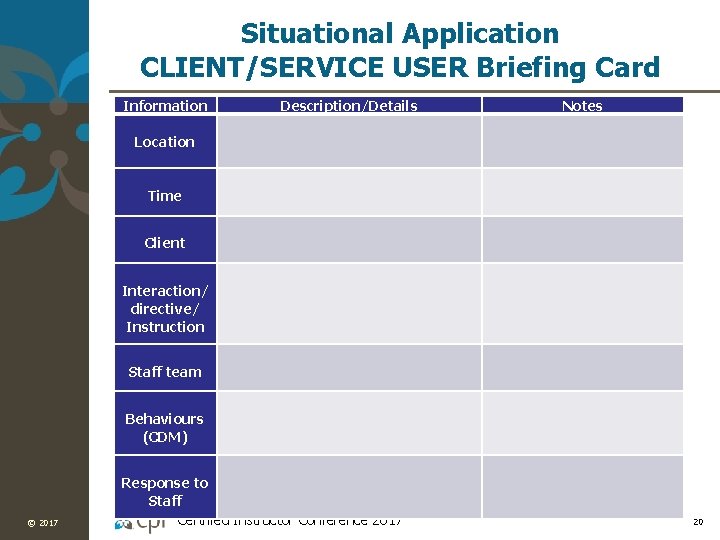
Situational Application CLIENT/SERVICE USER Briefing Card Information Location Description/Details Notes Client Interaction/ directive/ Instruction Staff team Behaviours (CDM) Time © 2017 Response to Staff Certified Instructor Conference 2017 20
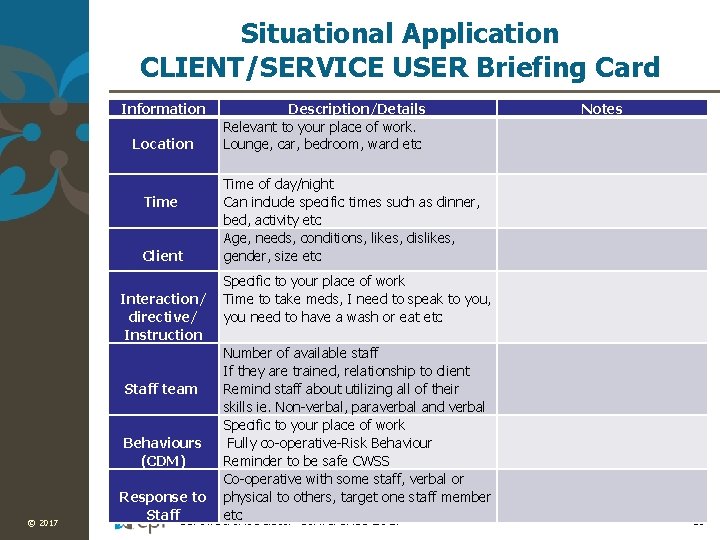
Situational Application CLIENT/SERVICE USER Briefing Card Information Description/Details Relevant to your place of work. Location Lounge, car, bedroom, ward etc Time Client Interaction/ directive/ Instruction Staff team © 2017 Time of day/night Can include specific times such as dinner, bed, activity etc Age, needs, conditions, likes, dislikes, gender, size etc Specific to your place of work Time to take meds, I need to speak to you, you need to have a wash or eat etc Number of available staff If they are trained, relationship to client Remind staff about utilizing all of their skills ie. Non-verbal, paraverbal and verbal Specific to your place of work Behaviours Fully co-operative-Risk Behaviour (CDM) Reminder to be safe CWSS Co-operative with some staff, verbal or Response to physical to others, target one staff member Staff. Certified Instructor Conference 2017 etc Notes 21
Situational Application CLIENT/SERVICE USER OBSERVER Briefing Card © 2017 Crisis Development Model Anxiety Examples Identified/Observed Notes Defensive Risk Behaviour Tension Reduction Certified Instructor Conference 2017 22
Situational Application STAFF OBSERVER Briefing/Record Card Crisis Development Model Supportive Examples Identified/Observed Non-verbal/Paraverbal/Verbal/PI Notes Directive Physical Intervention Therapeutic Rapport MAPA Models © 2017 MAPA Principles Certified Instructor Conference 2017 23
SA Practical © 2017 Certified Instructor Conference 2017 24
Evaluation S E A T © 2017 Certified Instructor Conference 2017 25
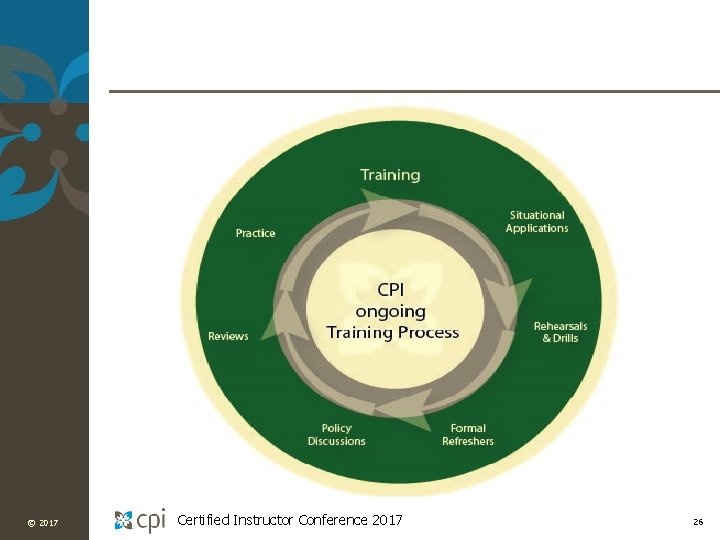
© 2017 Certified Instructor Conference 2017 26
Thank you © 2017