
Maxim Titov UNIVERSITY OF FREIBURG ON BEHALF OF
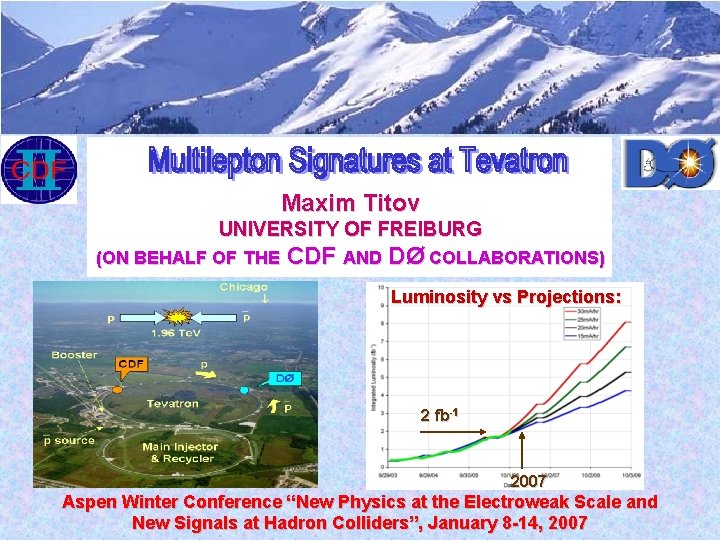
Maxim Titov UNIVERSITY OF FREIBURG (ON BEHALF OF THE CDF AND DØ COLLABORATIONS) Luminosity vs Projections: 2 fb-1 2007 Aspen Winter Conference “New Physics at the Electroweak Scale and New Signals at Hadron Colliders”, January 8 -14, 2007
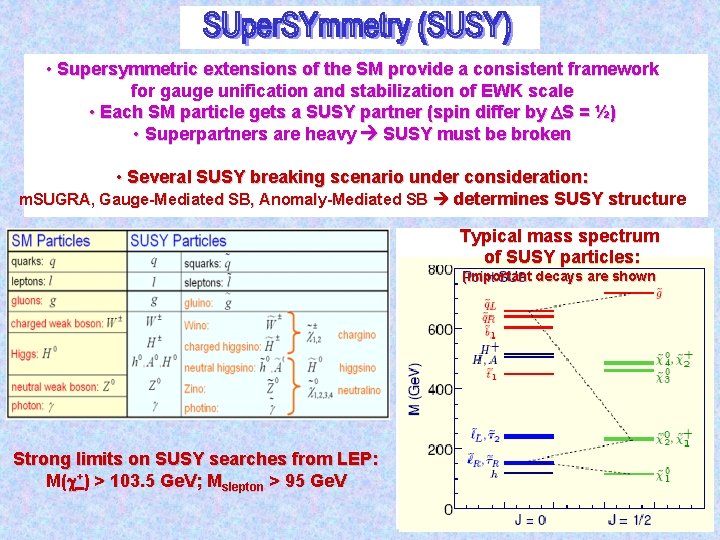
• Supersymmetric extensions of the SM provide a consistent framework for gauge unification and stabilization of EWK scale • Each SM particle gets a SUSY partner (spin differ by S = ½) • Superpartners are heavy SUSY must be broken • Several SUSY breaking scenario under consideration: m. SUGRA, Gauge-Mediated SB, Anomaly-Mediated SB determines SUSY structure Typical mass spectrum of SUSY particles: (important decays are shown Strong limits on SUSY searches from LEP: M( +) > 103. 5 Ge. V; Mslepton > 95 Ge. V
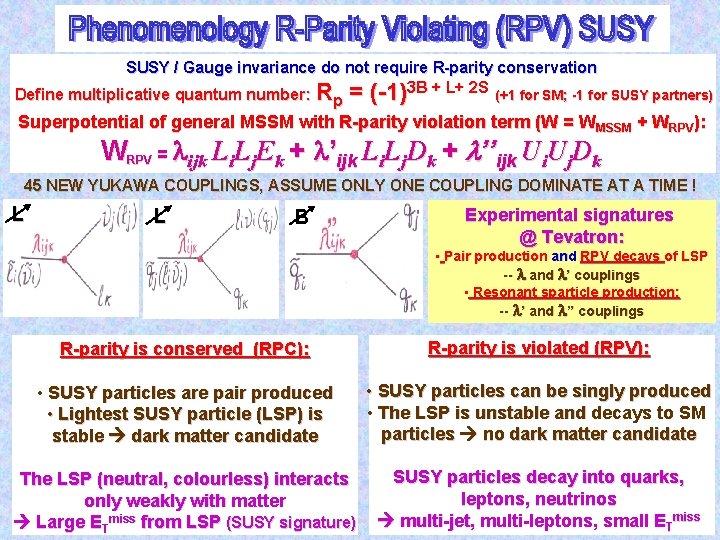
SUSY / Gauge invariance do not require R-parity conservation Define multiplicative quantum number: Rp = (-1)3 B + L+ 2 S (+1 for SM; -1 for SUSY partners) Superpotential of general MSSM with R-parity violation term (W = WMSSM + WRPV): WRPV = lijk Li. Lj. Ek + l’ijk Li. Lj. Dk + l’’ijk Ui. Uj. Dk 45 NEW YUKAWA COUPLINGS, ASSUME ONLY ONE COUPLING DOMINATE AT A TIME ! L L B Experimental signatures @ Tevatron: • Pair production and RPV decays of LSP -- l and l’ couplings • Resonant sparticle production: -- l’ and l’’ couplings R-parity is conserved (RPC): R-parity is violated (RPV): • SUSY particles are pair produced • Lightest SUSY particle (LSP) is stable dark matter candidate • SUSY particles can be singly produced • The LSP is unstable and decays to SM particles no dark matter candidate The LSP (neutral, colourless) interacts only weakly with matter Large ETmiss from LSP (SUSY signature) SUSY particles decay into quarks, leptons, neutrinos multi-jet, multi-leptons, small ETmiss
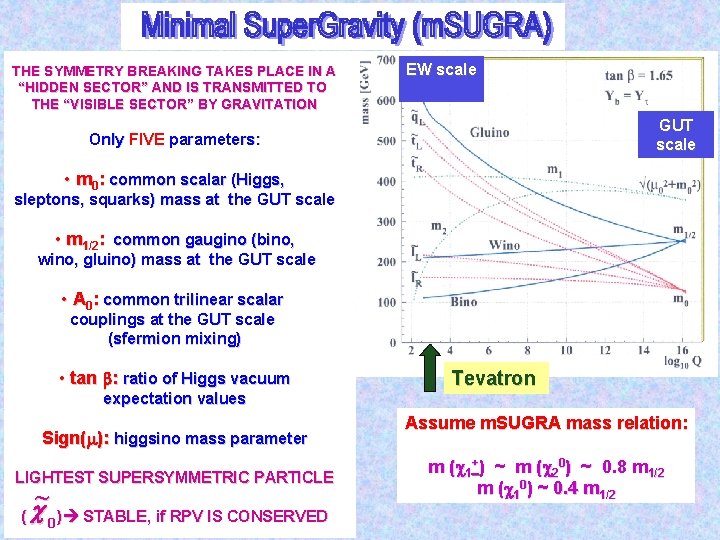
THE SYMMETRY BREAKING TAKES PLACE IN A “HIDDEN SECTOR” AND IS TRANSMITTED TO THE “VISIBLE SECTOR” BY GRAVITATION EW scale GUT scale Only FIVE parameters: • m 0: common scalar (Higgs, sleptons, squarks) mass at the GUT scale • m 1/2: common gaugino (bino, wino, gluino) mass at the GUT scale • A 0: common trilinear scalar couplings at the GUT scale (sfermion mixing) • tan b: ratio of Higgs vacuum expectation values Sign( ): higgsino mass parameter LIGHTEST SUPERSYMMETRIC PARTICLE ~ c ( 0 ) STABLE, if RPV IS CONSERVED Tevatron Assume m. SUGRA mass relation: m ( 1+) ~ m ( 20) ~ 0. 8 m 1/2 m ( 10) ~ 0. 4 m 1/2
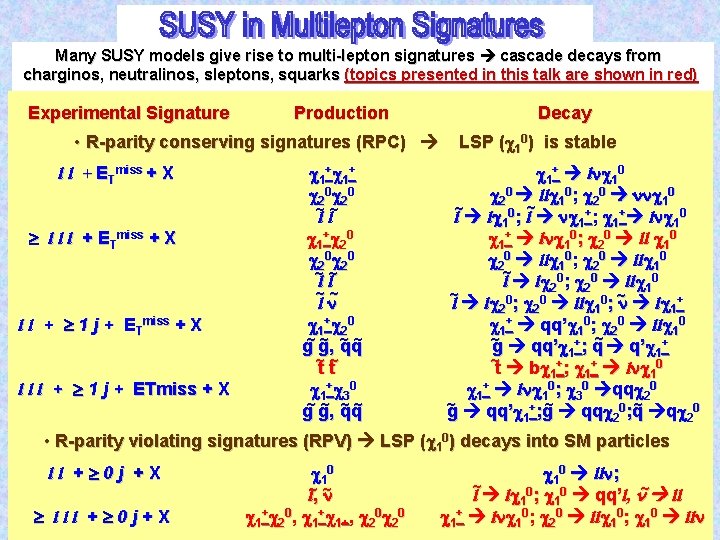
Many SUSY models give rise to multi-lepton signatures cascade decays from charginos, neutralinos, sleptons, squarks (topics presented in this talk are shown in red) Experimental Signature Production • R-parity conserving signatures (RPC) l l + ETmiss + X l l l + ETmiss + X l l + 1 j + ETmiss + X l l l + 1 j + ETmiss + X 1 + 2 0 ~l l~ 1 + 2 0 2 0 ~~ ll ~~ ln 1 + 2 0 ~ ~ g~ g, qq~ ~t t~ 1 + 3 0 ~ qq ~~ g~ g, Decay LSP ( 10) is stable 1+ ln 10 20 ll 10; 20 nn 10 ~ l~ l 10; l n 1+; 1+ ln 10 1+ ln 10; 20 ll 10 ~ l l 20; 20 ll 10; ~n l 1+ 1+ qq’ 10; 20 ll 10 ~ g qq’ 1+; q~ q’ 1+ ~t b +; + ln 0 1 1 1 + 0 0 1 ln 1 ; 3 qq 20 ~ qq’ +; g ~ qq 0; q ~ q 0 g 1 2 2 • R-parity violating signatures (RPV) LSP ( 10) decays into SM particles ll + 0 j +X lll + 0 j+X 1 0 l~, ~n 1 + 2 0 , 1 + , 2 0 10 lln; ~ l l 10; 10 qq’l, n~ ll 1+ ln 10; 20 ll 10; 10 lln
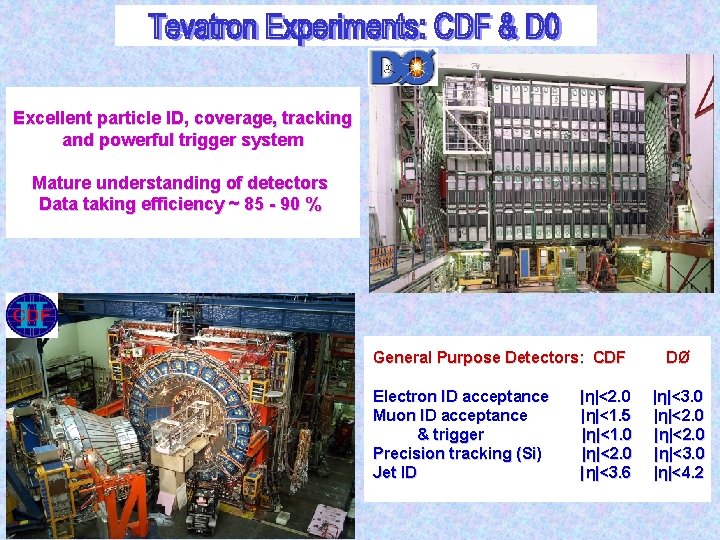
Excellent particle ID, coverage, tracking and powerful trigger system Mature understanding of detectors Data taking efficiency ~ 85 - 90 % General Purpose Detectors: CDF Electron ID acceptance Muon ID acceptance & trigger Precision tracking (Si) Jet ID |η|<2. 0 |η|<1. 5 |η|<1. 0 |η|<2. 0 | η|<3. 6 DØ |η|<3. 0 |η|<2. 0 |η|<3. 0 |η|<4. 2
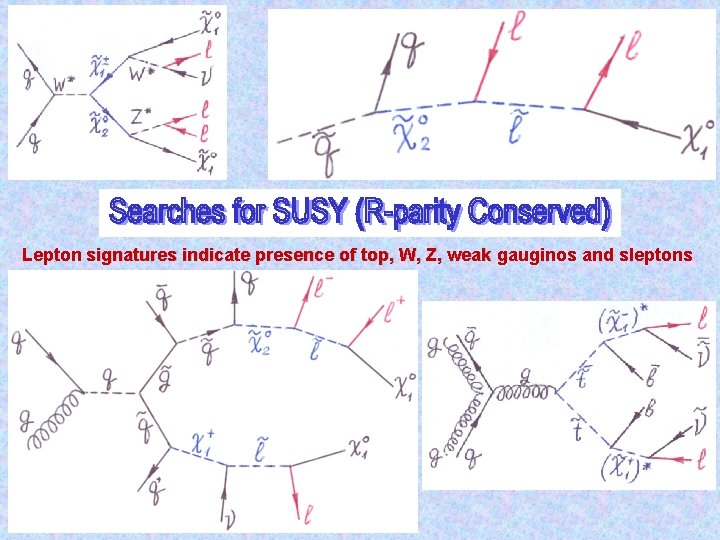
Lepton signatures indicate presence of top, W, Z, weak gauginos and sleptons
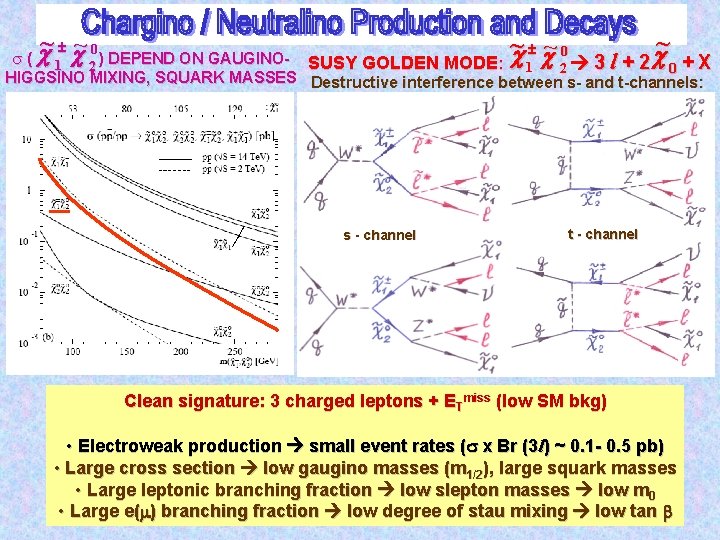
~ c~ 0 c s( 1 2 ) DEPEND ON GAUGINO- ~ ~ c~ 0 c c SUSY GOLDEN MODE: 1 2 3 l + 2 0 + X HIGGSINO MIXING, SQUARK MASSES Destructive interference between s- and t-channels: s - channel t - channel Clean signature: 3 charged leptons + ETmiss (low SM bkg) • Electroweak production small event rates (s x Br (3 l) ~ 0. 1 - 0. 5 pb) • Large cross section low gaugino masses (m 1/2), large squark masses • Large leptonic branching fraction low slepton masses low m 0 • Large e( ) branching fraction low degree of stau mixing low tan b
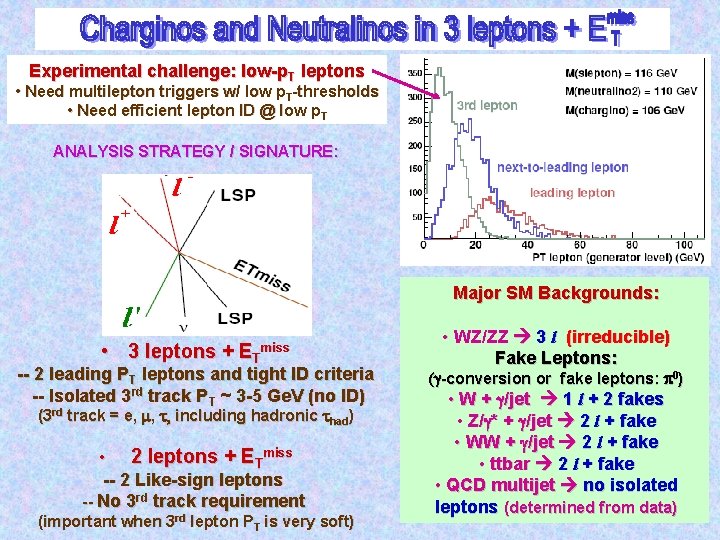
Experimental challenge: low-p. T leptons • Need multilepton triggers w/ low p. T-thresholds • Need efficient lepton ID @ low p. T ANALYSIS STRATEGY / SIGNATURE: Major SM Backgrounds: • 3 leptons + ETmiss -- 2 leading PT leptons and tight ID criteria -- Isolated 3 rd track PT ~ 3 -5 Ge. V (no ID) (3 rd track = e, , , including hadronic had) • 2 leptons + ETmiss -- 2 Like-sign leptons -- No 3 rd track requirement (important when 3 rd lepton PT is very soft) • WZ/ZZ 3 l (irreducible) Fake Leptons: ( -conversion or fake leptons: p 0) • W + /jet 1 l + 2 fakes • Z/ * + /jet 2 l + fake • WW + /jet 2 l + fake • ttbar 2 l + fake • QCD multijet no isolated leptons (determined from data)
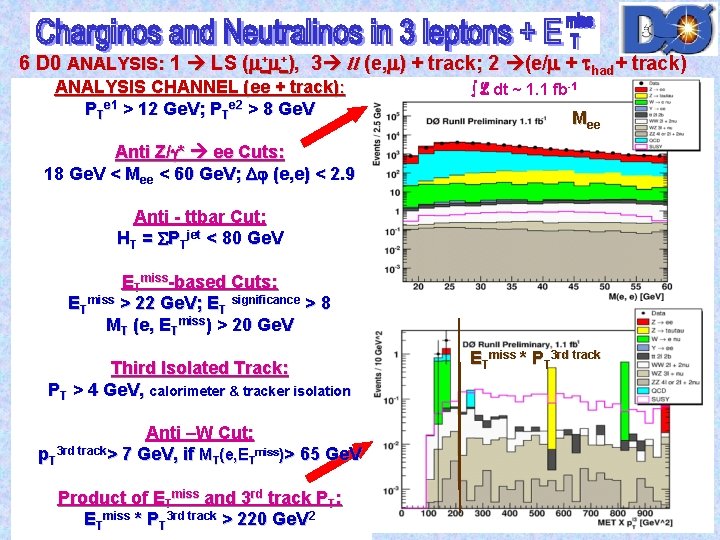
6 D 0 ANALYSIS: 1 LS ( + +), 3 ll (e, ) + track; 2 (e/ + had+ track) ANALYSIS CHANNEL (ee + track): PTe 1 > 12 Ge. V; PTe 2 > 8 Ge. V ℒ dt ~ 1. 1 fb-1 Mee Anti Z/ * ee Cuts: 18 Ge. V < Mee < 60 Ge. V; j (e, e) < 2. 9 Anti - ttbar Cut: HT = SPTjet < 80 Ge. V ETmiss-based Cuts: ETmiss > 22 Ge. V; ET significance > 8 MT (e, ETmiss) > 20 Ge. V Third Isolated Track: PT > 4 Ge. V, calorimeter & tracker isolation Anti –W Cut: p. T 3 rd track> 7 Ge. V, if MT(e, ETmiss)> 65 Ge. V Product of ETmiss and 3 rd track PT: ETmiss * PT 3 rd track > 220 Ge. V 2 ETmiss * PT 3 rd track
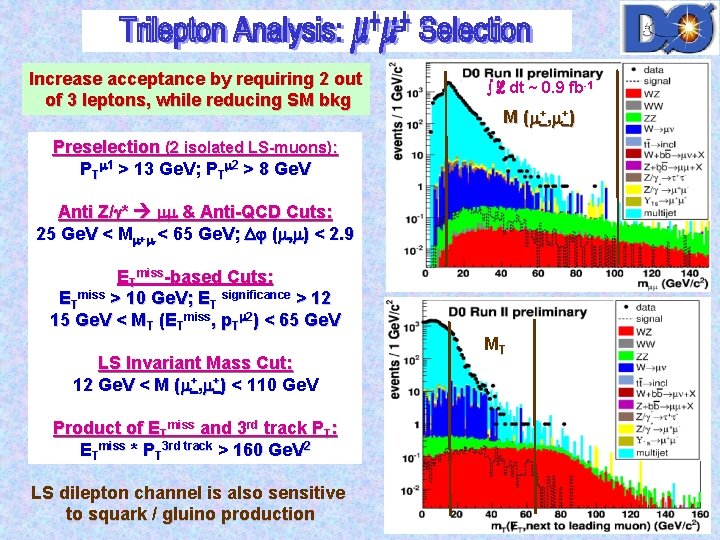
Increase acceptance by requiring 2 out of 3 leptons, while reducing SM bkg ℒ dt ~ 0. 9 fb-1 M ( + , + ) Preselection (2 isolated LS-muons): PT 1 > 13 Ge. V; PT 2 > 8 Ge. V Anti Z/ * & Anti-QCD Cuts: 25 Ge. V < M + -< 65 Ge. V; j ( , ) < 2. 9 ETmiss-based Cuts: ETmiss > 10 Ge. V; ET significance > 12 15 Ge. V < MT (ETmiss, p. T 2) < 65 Ge. V LS Invariant Mass Cut: 12 Ge. V < M ( +, +) < 110 Ge. V Product of ETmiss and 3 rd track PT: ETmiss * PT 3 rd track > 160 Ge. V 2 LS dilepton channel is also sensitive to squark / gluino production MT
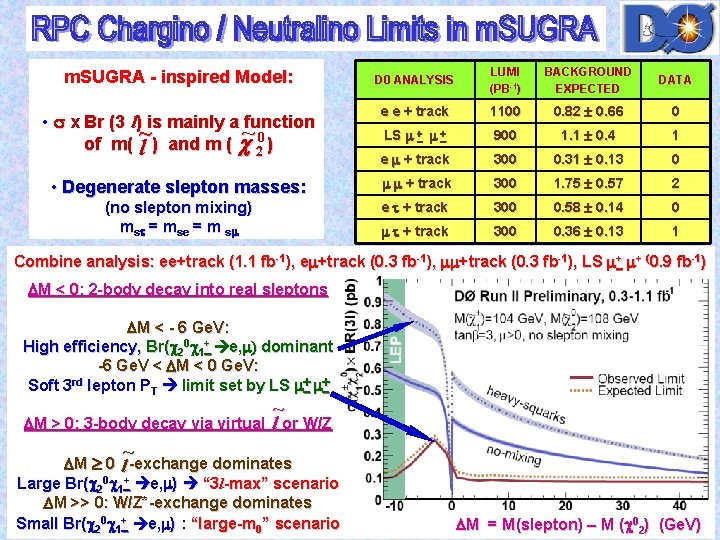
m. SUGRA - inspired Model: D 0 ANALYSIS LUMI (PB-1) BACKGROUND EXPECTED DATA e e + track 1100 0. 82 0. 66 0 • s x Br (3 l) is mainly a function ~ ~ of m( l ) and m ( c 20 ) LS + + 900 1. 1 0. 4 1 e + track 300 0. 31 0. 13 0 • Degenerate slepton masses: + track 300 1. 75 0. 57 2 (no slepton mixing) ms = mse = m s e + track 300 0. 58 0. 14 0 + track 300 0. 36 0. 13 1 Combine analysis: ee+track (1. 1 fb-1), e +track (0. 3 fb-1), LS + + (0. 9 fb-1) M < 0: 2 -body decay into real sleptons M < - 6 Ge. V: High efficiency, Br( 20 1+ e, ) dominant -6 Ge. V < M < 0 Ge. V: Soft 3 rd lepton PT limit set by LS + + ~ M > 0: 3 -body decay via virtual l or W/Z ~ M 0 l -exchange dominates Large Br( 20 1+ e, ) “ 3 l-max” scenario M >> 0: W/Z*-exchange dominates Small Br( 20 1+ e, ) : “large-m 0” scenario M = M(slepton) – M ( 02) (Ge. V)
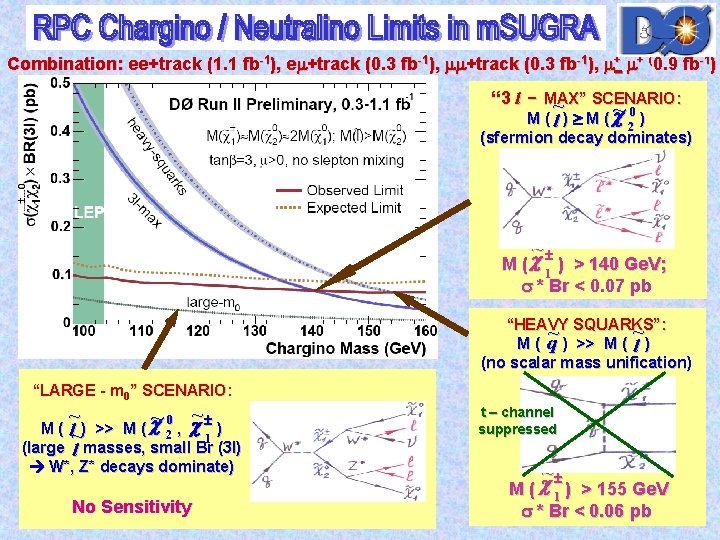
Combination: ee+track (1. 1 fb-1), e +track (0. 3 fb-1), + + (0. 9 fb-1) “ 3 l – MAX” ~ SCENARIO: ~0) M ( l ) M (c 2 (sfermion decay dominates) ~ M ( c 1 ) > 140 Ge. V; s * Br < 0. 07 pb “HEAVY SQUARKS”: ~ ~ M ( q ) >> M ( l ) (no scalar mass unification) “LARGE - m 0” SCENARIO: ~ ~ 0 ~ M ( l~) >> M ( c 2 , c ) 1 (large l masses, small Br (3 l) W*, Z* decays dominate) No Sensitivity t – channel suppressed ~ M ( c 1 ) > 155 Ge. V s * Br < 0. 06 pb
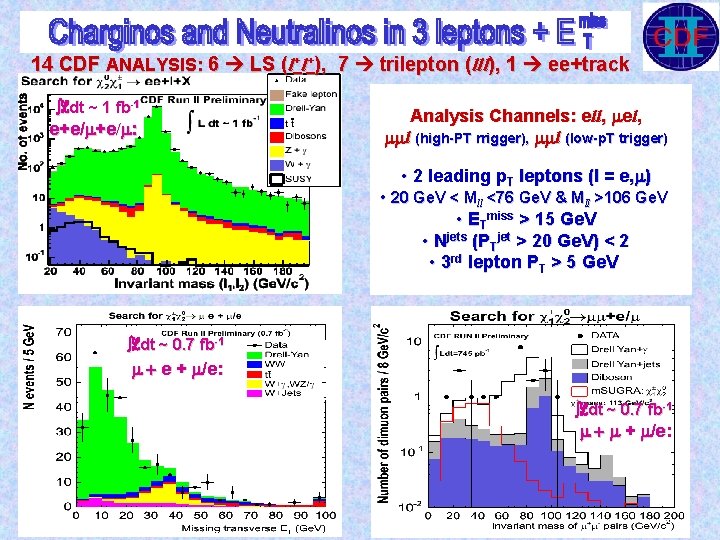
14 CDF ANALYSIS: 6 LS (l+l+), 7 trilepton (lll), 1 ee+track ℒdt ~ 1 fb-1 e+e/ : Analysis Channels: ell, el, l (high-PT rrigger), l (low-p. T trigger) • 2 leading p. T leptons (l = e, ) • 20 Ge. V < Mll <76 Ge. V & Mll >106 Ge. V • ETmiss > 15 Ge. V • Njets (PTjet > 20 Ge. V) < 2 • 3 rd lepton PT > 5 Ge. V ℒdt ~ 0. 7 fb-1 + e + /e: ℒdt ~ 0. 7 fb-1 + + /e:
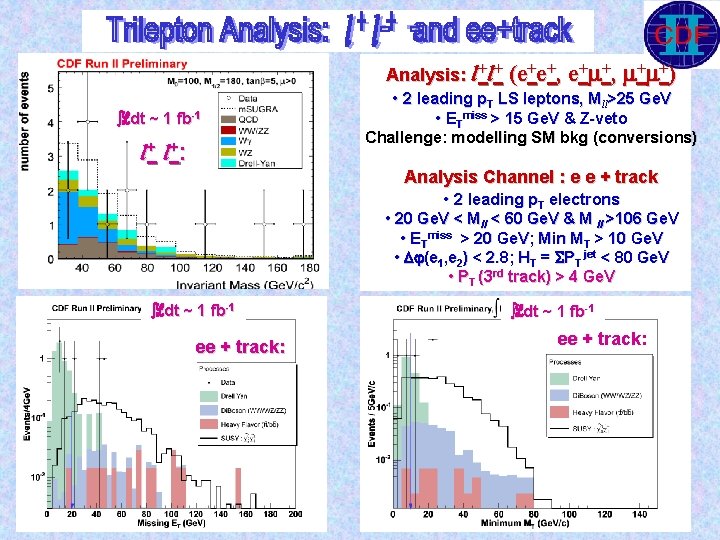
ℒdt ~ 1 fb-1 l+ l+: Analysis: l+l+ (e+e+, e+ +, + +) • 2 leading p. T LS leptons, Mll>25 Ge. V • ETmiss > 15 Ge. V & Z-veto Challenge: modelling SM bkg (conversions) Analysis Channel : e e + track • 2 leading p. T electrons • 20 Ge. V < Mll < 60 Ge. V & M ll >106 Ge. V • ETmiss > 20 Ge. V; Min MT > 10 Ge. V • j(e 1, e 2) < 2. 8; HT = SPT jet < 80 Ge. V • PT (3 rd track) > 4 Ge. V ℒdt ~ 1 fb-1 ee + track:
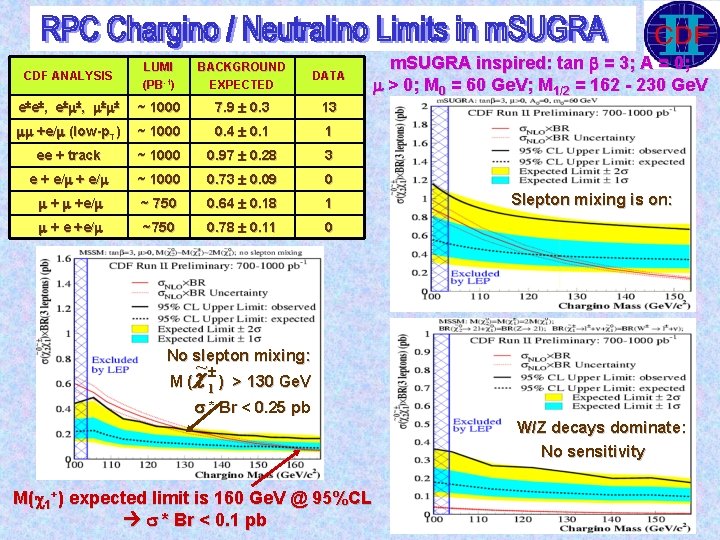
CDF ANALYSIS LUMI (PB-1) BACKGROUND EXPECTED DATA e e , ~ 1000 7. 9 0. 3 13 +e/ (low-p. T) ~ 1000 0. 4 0. 1 1 ee + track ~ 1000 0. 97 0. 28 3 e + e/ ~ 1000 0. 73 0. 09 0 + +e/ ~ 750 0. 64 0. 18 1 + e +e/ ~750 0. 78 0. 11 0 m. SUGRA inspired: tan b = 3; A = 0; > 0; M 0 = 60 Ge. V; M 1/2 = 162 - 230 Ge. V Slepton mixing is on: No slepton mixing: ~ M (c 1 ) > 130 Ge. V s * Br < 0. 25 pb W/Z decays dominate: No sensitivity M( 1+) expected limit is 160 Ge. V @ 95%CL s * Br < 0. 1 pb
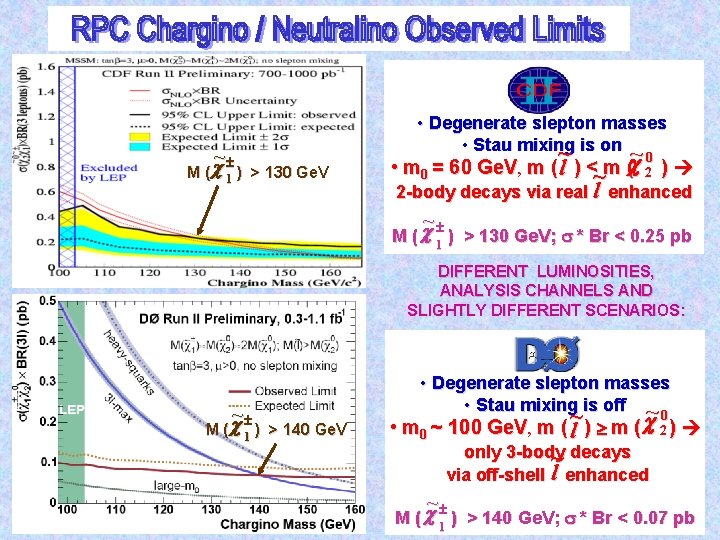
~ ~ M (c 1 ) • Degenerate slepton masses • Stau mixing is on > 130 Ge. V ~ ~0 • m 0 = 60 Ge. V, Ge. V m ( l ) <~m (c 2 ) 2 -body decays via real l enhanced ~ M ( c 1 ) > 130 Ge. V; s * Br < 0. 25 pb DIFFERENT LUMINOSITIES, ANALYSIS CHANNELS AND SLIGHTLY DIFFERENT SCENARIOS: ~ M (c 1 ) > 140 Ge. V • Degenerate slepton masses • Stau mixing is off ~ 0 ~ • m 0 ~ 100 Ge. V, Ge. V m ( l ) m ( c 2 ) only 3 -body ~ decays via off-shell l enhanced ~ M ( c 1 ) > 140 Ge. V; s * Br < 0. 07 pb
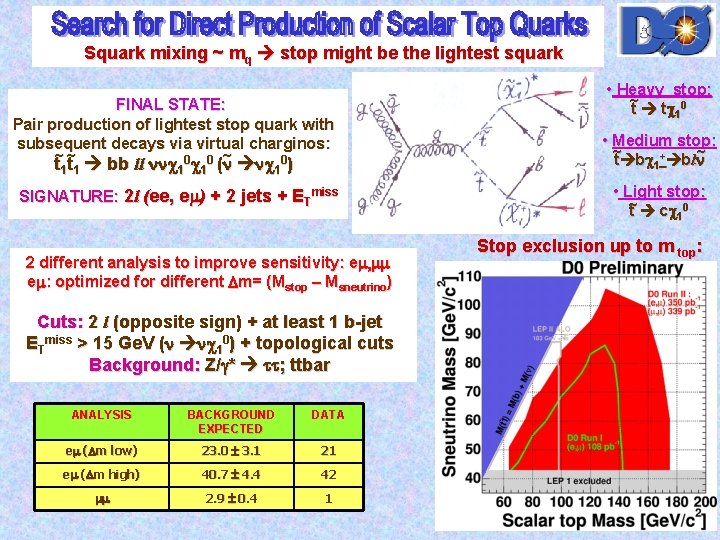
Squark mixing ~ mq stop might be the lightest squark FINAL STATE: Pair production of lightest stop quark with subsequent decays via virtual charginos: ~~ 0 0 ~ 0 t 1 t 1 bb ll nn 1 1 (n n 1 ) SIGNATURE: 2 l (ee, e ) + 2 jets + ETmiss 2 different analysis to improve sensitivity: e , e : optimized for different m= (Mstop – Msneutrino) Cuts: 2 l (opposite sign) + at least 1 b-jet ETmiss > 15 Ge. V (n n 10) + topological cuts Background: Z/ * ; ttbar ANALYSIS BACKGROUND EXPECTED DATA e ( m low) 23. 0 3. 1 21 e ( m high) 40. 7 4. 4 42 2. 9 0. 4 1 • Heavy stop: ~ t t 10 • Medium stop: ~ t b 1+ bln~ • Light stop: ~ t c 10 Stop exclusion up to m top:
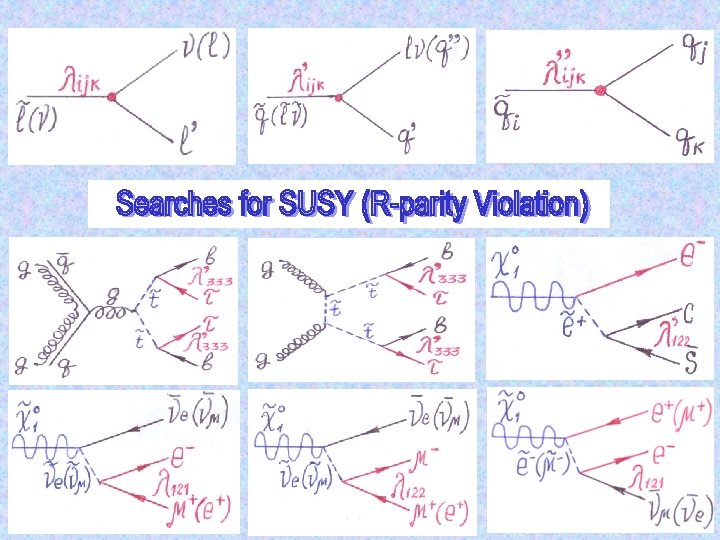
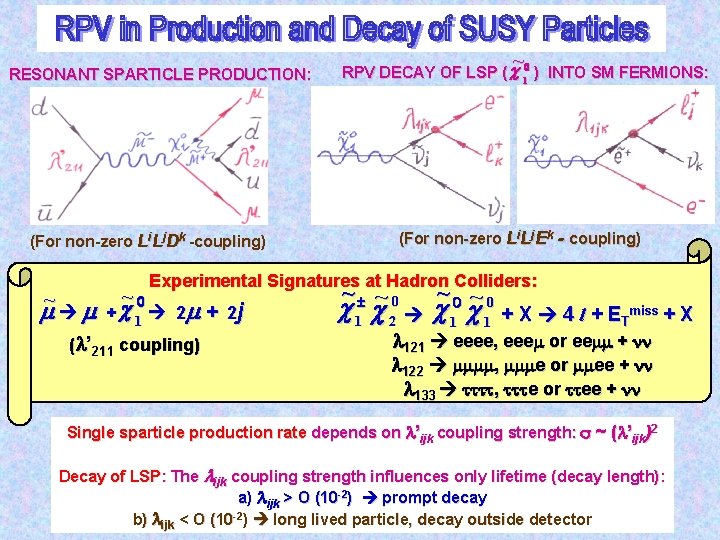
RESONANT SPARTICLE PRODUCTION: (For non-zero Li. Lj. Dk -coupling) ~ ~0 ~ RPV DECAY OF LSP ( c 10 ) INTO SM FERMIONS: (For non-zero Li. Lj. Ek - coupling) Experimental Signatures at Hadron Colliders: m m + c 1 2 m + 2 j (l’ 211 coupling) ~ ~0 ~0 ~0 c 1 c 2 c 1 + X 4 l + ETmiss + X l 121 eeee, eee or ee + nn l 122 , e or ee + nn l 133 , e or ee + nn Single sparticle production rate depends on l’ijk coupling strength: s ~ (l’ijk)2 Decay of LSP: The lijk coupling strength influences only lifetime (decay length): a) lijk > O (10 -2) prompt decay b) lijk < O (10 -2) long lived particle, decay outside detector
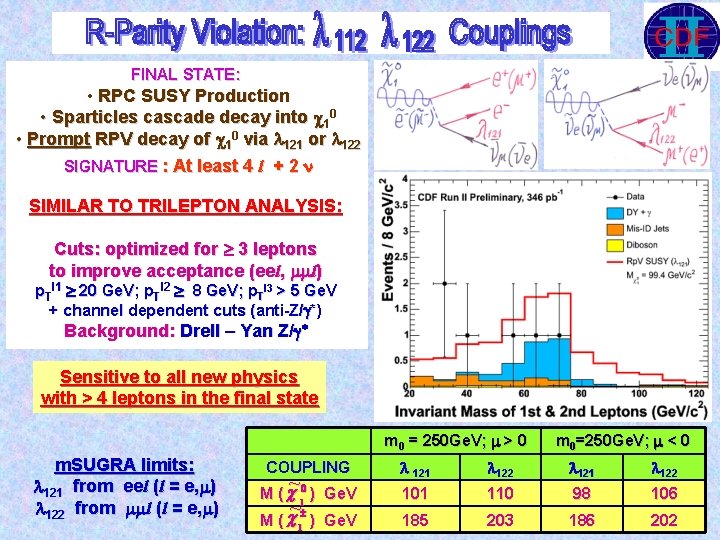
FINAL STATE: • RPC SUSY Production • Sparticles cascade decay into 10 • Prompt RPV decay of 10 via l 121 or l 122 SIGNATURE : At least 4 l + 2 n SIMILAR TO TRILEPTON ANALYSIS: Cuts: optimized for 3 leptons to improve acceptance (eel, l) p. Tl 1 20 Ge. V; p. Tl 2 8 Ge. V; p. Tl 3 > 5 Ge. V + channel dependent cuts (anti-Z/ *) Background: Drell – Yan Z/ * Sensitive to all new physics with > 4 leptons in the final state m 0 = 250 Ge. V; > 0 m. SUGRA limits: l 121 from eel (l = e, ) l 122 from l (l = e, ) COUPLING ~ c~ M ( c 10 ) Ge. V M( 1 ) Ge. V m 0=250 Ge. V; < 0 l 121 l 122 101 110 98 106 185 203 186 202
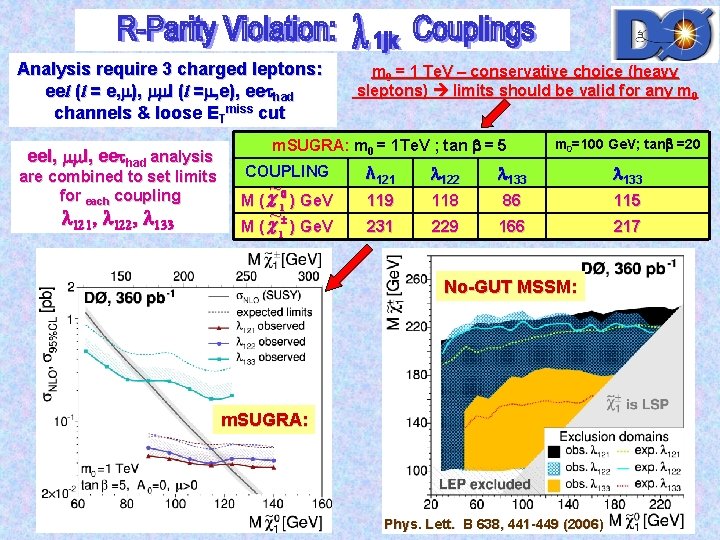
Analysis require 3 charged leptons: eel (l = e, ), l (l = , e), ee had channels & loose ETmiss cut eel, l, ee had analysis are combined to set limits for each coupling l 121, l 122, l 133 m 0 = 1 Te. V – conservative choice (heavy sleptons) limits should be valid for any m 0 m. SUGRA: m 0 = 1 Te. V ; tan b = 5 COUPLING ~0 c~ M ( c 10 ) Ge. V M( 1 ) Ge. V m 0=100 Ge. V; tanb =20 λ 121 l 122 l 133 119 118 86 115 231 229 166 217 No-GUT MSSM: m. SUGRA: Phys. Lett. B 638, 441 -449 (2006)
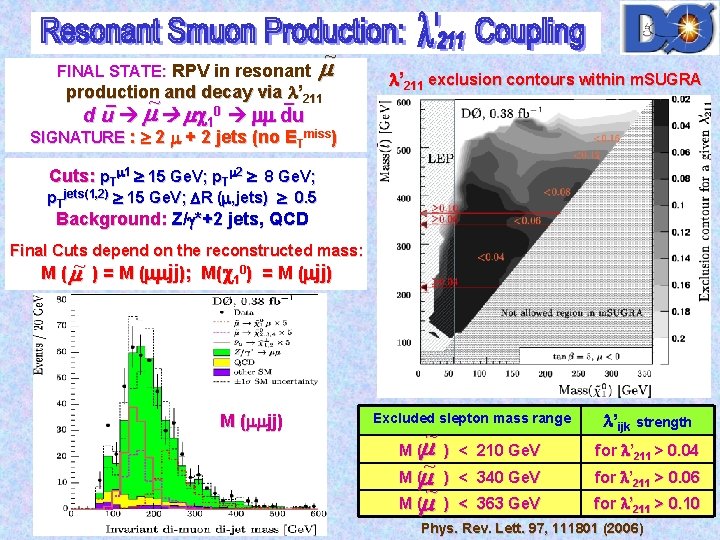
~ ~ m FINAL STATE: RPV in resonant production _ ~ and decay via _l’ 211 exclusion contours within m. SUGRA d u m m 10 du SIGNATURE : 2 + 2 jets (no ETmiss) Cuts: p. T 1 15 Ge. V; p. T 2 8 Ge. V; p. Tjets(1, 2) 15 Ge. V; R ( , jets) 0. 5 Background: Z/ *+2 jets, QCD Final Cuts depend on the reconstructed mass: M ( m~ ) = M ( jj); M( 10) = M ( jj) Excluded slepton mass range ~ ~ M (m ~ l’ijk strength M (m ) < 210 Ge. V for l’ 211 > 0. 04 ) < 340 Ge. V for l’ 211 > 0. 06 M (m ) < 363 Ge. V for l’ 211 > 0. 10 Phys. Rev. Lett. 97, 111801 (2006)

Signature-based Approach: Investigate events by the final state products Quasi-model independent technique
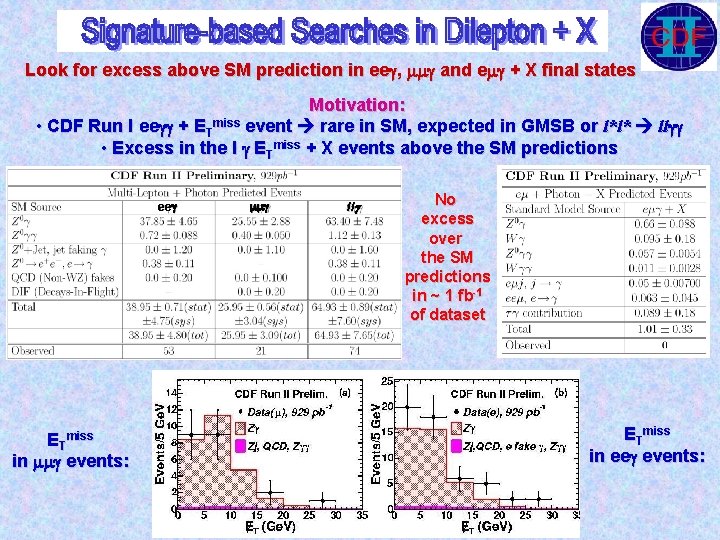
Look for excess above SM prediction in ee , and e + X final states Motivation: • CDF Run I ee + ETmiss event rare in SM, expected in GMSB or l*l* ll • Excess in the l ETmiss + X events above the SM predictions ee ETmiss in events: llg No excess over the SM predictions in ~ 1 fb-1 of dataset ETmiss in ee events:
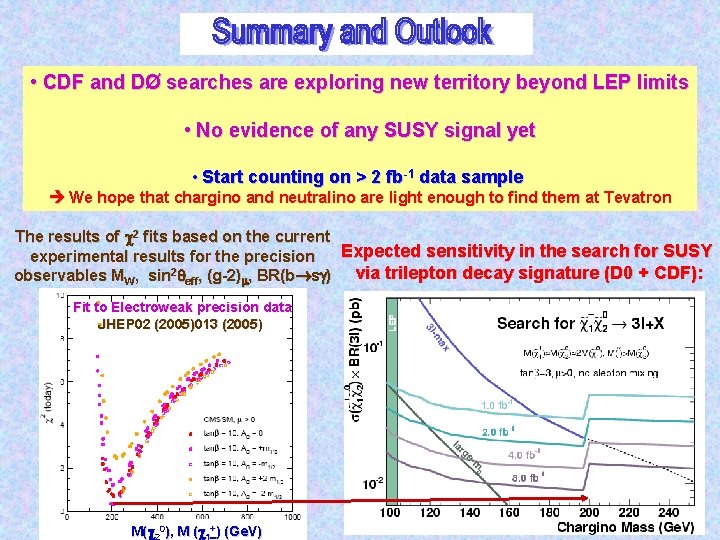
• CDF and DØ searches are exploring new territory beyond LEP limits • No evidence of any SUSY signal yet • Start counting on > 2 fb-1 data sample We hope that chargino and neutralino are light enough to find them at Tevatron The results of 2 fits based on the current Expected sensitivity in the search for SUSY experimental results for the precision observables MW, sin 2 eff, (g-2) , BR(b s ) via trilepton decay signature (D 0 + CDF): Fit to Electroweak precision data JHEP 02 (2005)013 (2005) M( 20), M ( 1+) (Ge. V)
- Slides: 26