
MAX PLANCK INSTITUTE FOR HUMAN COGNITIVE AND BRAIN
MAX PLANCK INSTITUTE FOR HUMAN COGNITIVE AND BRAIN SCIENCES DEPARTMENT OF COGNITIVE NEUROLOGY LEIPZIG Distinguishing between self and other: How shared are shared representations? Marcel Brass 04. 2006 Max Planck Institute for Human Cognitive and Brain Sciences
Observation and execution of action are closely linked • Cognitive psychology – movement observation has a strong influence on movement execution (Brass et al. , 2000, 2001, Stuermer et al. , 2000) • Social psychology – chameleon effect (Chartrand & Bargh, 1999) • Brain imaging – activation of motor related areas by action observation (e. g. Grezes & Decety, 1999) • Neurophysiology – mirror neurons (e. g. Rizzolatti & Craighero, 2004) 04. 2006 Max Planck Institute for Human Cognitive and Brain Sciences
The direct matching hypothesis Action observation leads to an activation of an internal motor representation. 04. 2006 Max Planck Institute for Human Cognitive and Brain Sciences
Open questions • Why don‘t we imitate all the time? • Why don‘t we confuse internally generated and externally triggered motor representations? 04. 2006 Max Planck Institute for Human Cognitive and Brain Sciences
Neuropsychological findings • Luria (1966) – prefrontal patients show echopractic response tendencies • Lhermitte et al. (1986), De. Renzi et al. (1996) – patients with prefrontal lesions show overt imitative behavior 04. 2006 Max Planck Institute for Human Cognitive and Brain Sciences
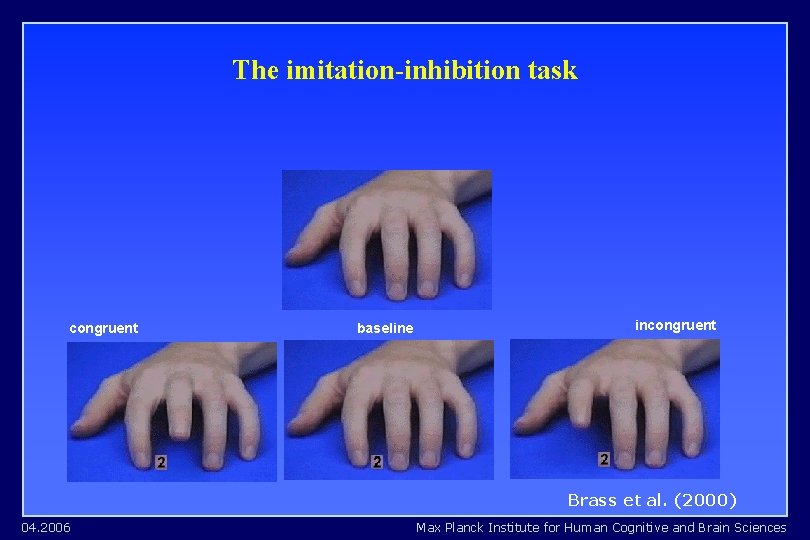
The imitation-inhibition task congruent baseline incongruent Brass et al. (2000) 04. 2006 Max Planck Institute for Human Cognitive and Brain Sciences
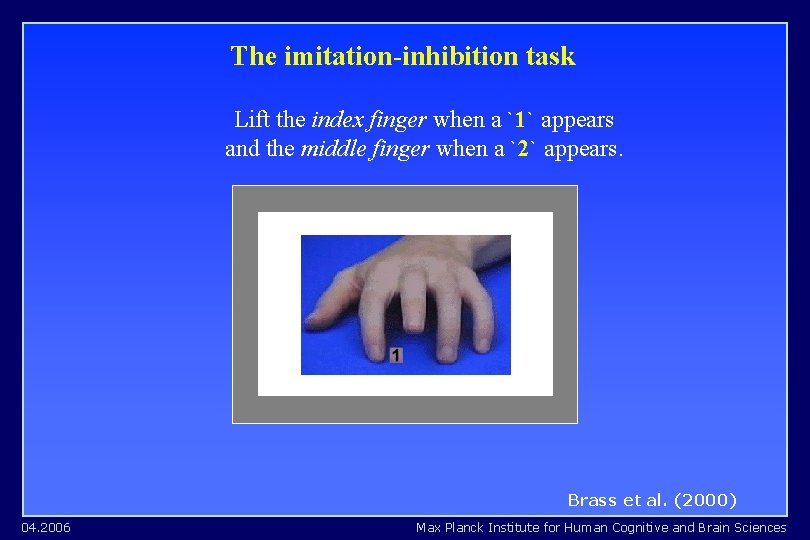
The imitation-inhibition task Lift the index finger when a `1` appears and the middle finger when a `2` appears. ++ Brass et al. (2000) 04. 2006 Max Planck Institute for Human Cognitive and Brain Sciences
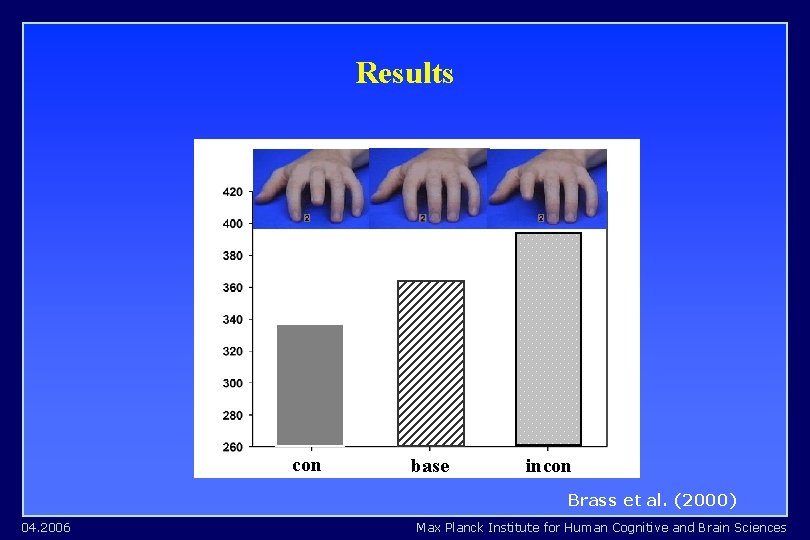
Results con base incon Brass et al. (2000) 04. 2006 Max Planck Institute for Human Cognitive and Brain Sciences
Patients • 16 patients with frontal lesions of different etiology and lesion site • 14 patients with posterior lesions (temporal, parietal) • 16 age-matched controls 04. 2006 Max Planck Institute for Human Cognitive and Brain Sciences
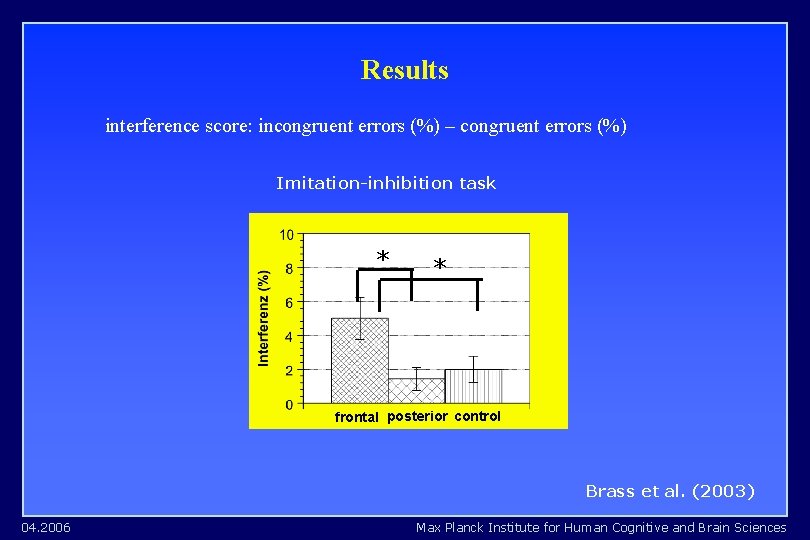
Results interference score: incongruent errors (%) – congruent errors (%) Imitation-inhibition task * * frontal posterior control Brass et al. (2003) 04. 2006 Max Planck Institute for Human Cognitive and Brain Sciences
Conclusions • Patients with frontal lesions have problems to inhibit imitative response tendencies. 04. 2006 Max Planck Institute for Human Cognitive and Brain Sciences
Functional mechanisms involved in the inhibition of imitative behavior • 04. 2006 Hypothesis 1. The inhibition of imitative behavior involves general inhibitory mechanisms. 2. The inhibition of imitative behavior involves specific mechanisms related to the distinction of self-generated and externally triggered motor representations. Max Planck Institute for Human Cognitive and Brain Sciences
Experimental design • ten healthy right handed participants • the imitation-inhibition task • functional Magnetic Resonance Imaging (f. MRI) 04. 2006 Max Planck Institute for Human Cognitive and Brain Sciences
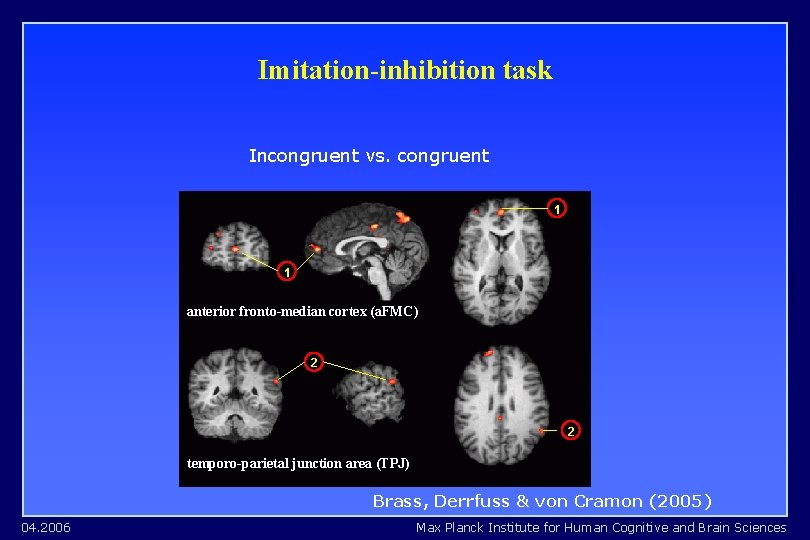
Imitation-inhibition task Incongruent vs. congruent 1 1 anterior fronto-median cortex (a. FMC) 2 2 temporo-parietal junction area (TPJ) Brass, Derrfuss & von Cramon (2005) 04. 2006 Max Planck Institute for Human Cognitive and Brain Sciences
The functional role of the anterior fronto-median cortex and the TPJ 04. 2006 – sense of agency (e. g. Farrer et al. , 2003) – perspective taking (Ruby & Decety, 2001, 2003) – out of body experience (Blanke et al. , 2002) Max Planck Institute for Human Cognitive and Brain Sciences
Conclusions The inhibition of imitative behaviour seems to involve mechanisms related to selfother distinction. 04. 2006 Max Planck Institute for Human Cognitive and Brain Sciences
The mirroring of contextual information • Are environmental constraints mapped onto the observer’s motor representation? 04. 2006 Max Planck Institute for Human Cognitive and Brain Sciences
Prediction Observing a physical restraint in another person should restrain the observer. 04. 2006 Max Planck Institute for Human Cognitive and Brain Sciences
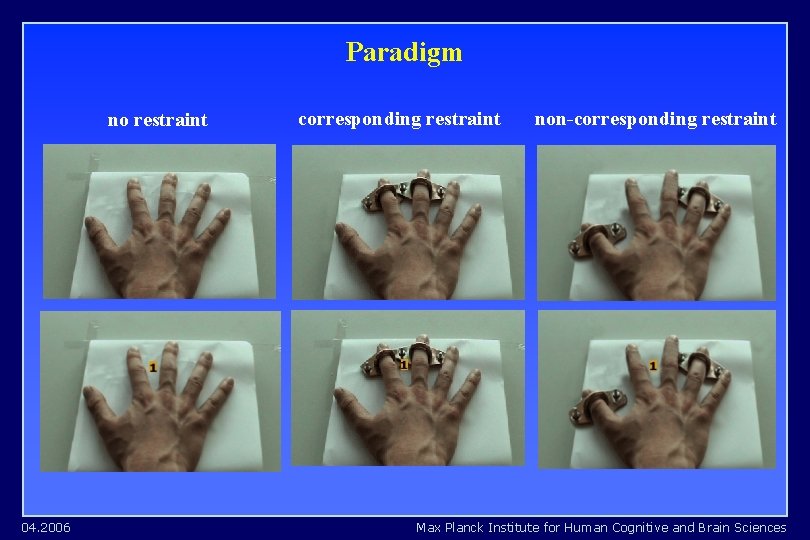
Paradigm no restraint 04. 2006 corresponding restraint non-corresponding restraint Max Planck Institute for Human Cognitive and Brain Sciences
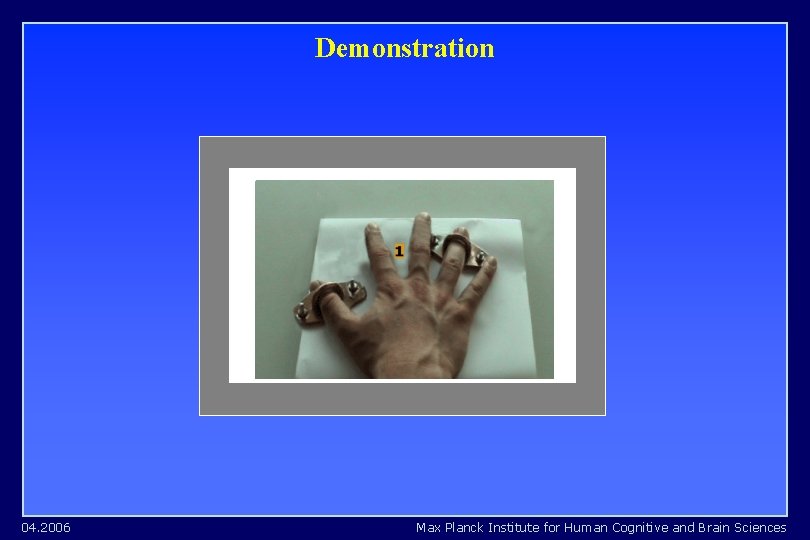
Demonstration 04. 2006 Max Planck Institute for Human Cognitive and Brain Sciences
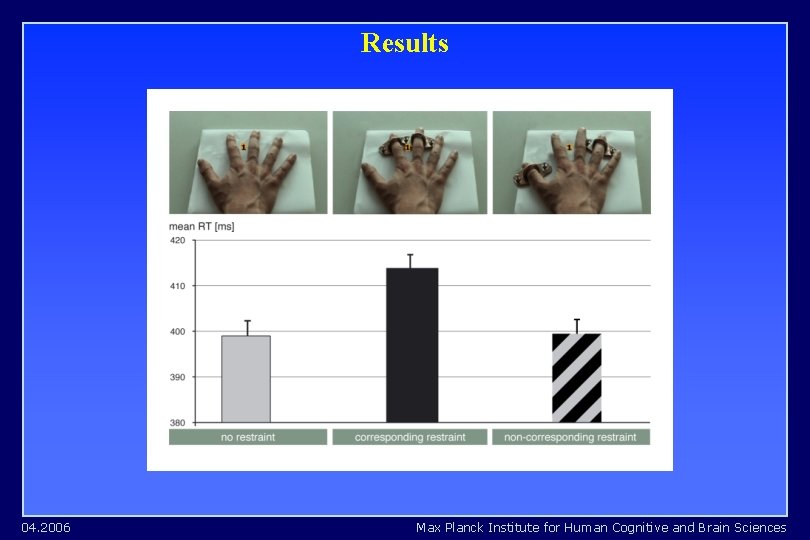
Results 04. 2006 Max Planck Institute for Human Cognitive and Brain Sciences
Alternative hypothesis The slowing effect is due to higher perceptual difficulty in the corresponding restraint condition. 04. 2006 Max Planck Institute for Human Cognitive and Brain Sciences
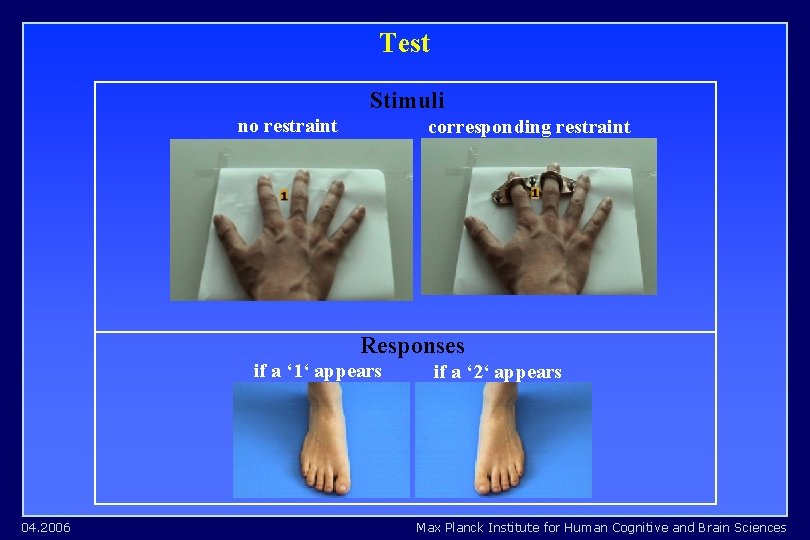
Test Stimuli no restraint corresponding restraint Responses if a ‘ 1‘ appears 04. 2006 if a ‘ 2‘ appears Max Planck Institute for Human Cognitive and Brain Sciences
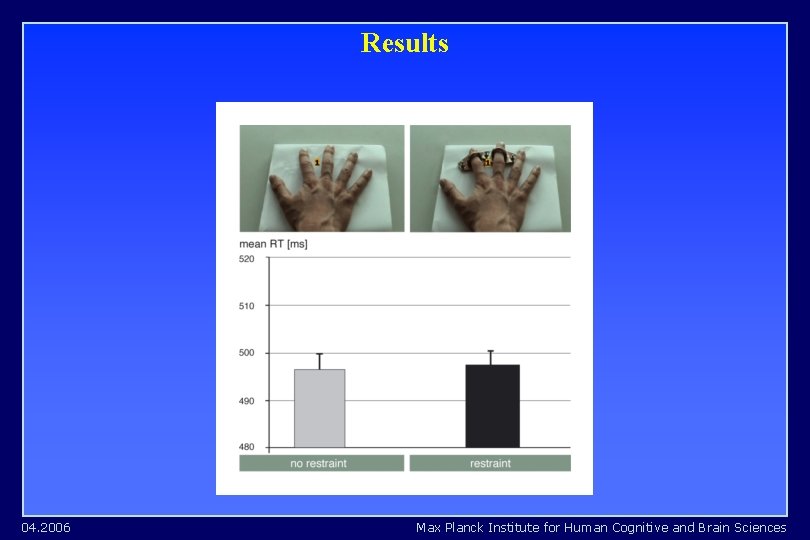
Results 04. 2006 Max Planck Institute for Human Cognitive and Brain Sciences
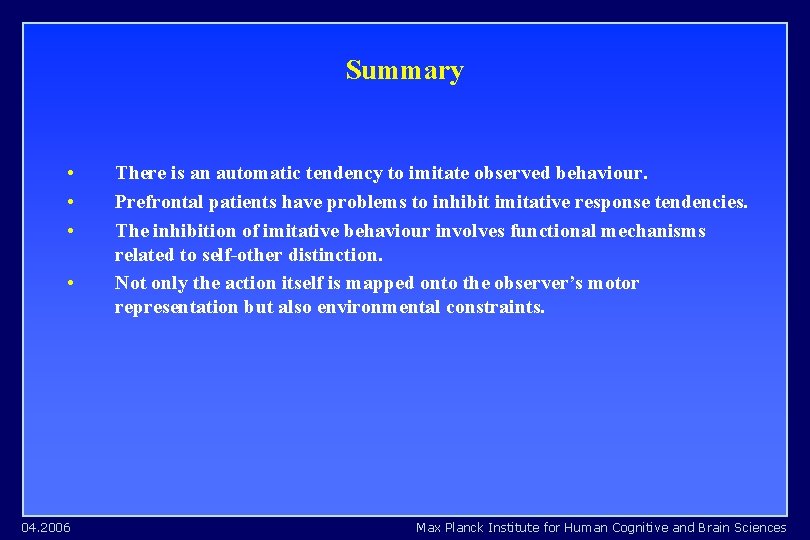
Summary • • 04. 2006 There is an automatic tendency to imitate observed behaviour. Prefrontal patients have problems to inhibit imitative response tendencies. The inhibition of imitative behaviour involves functional mechanisms related to self-other distinction. Not only the action itself is mapped onto the observer’s motor representation but also environmental constraints. Max Planck Institute for Human Cognitive and Brain Sciences
Roman Liepelt Stephanie Spengler Michael Steinborn Harold Bekkering Jan Derrfuss Wolfgang Prinz D. Yves von Cramon 04. 2006 Max Planck Institute for Human Cognitive and Brain Sciences
- Slides: 26