
Max Ice Overhead Conductors Extreme Ice A Utilitys

- Slides: 7
Max Ice™ Overhead Conductors
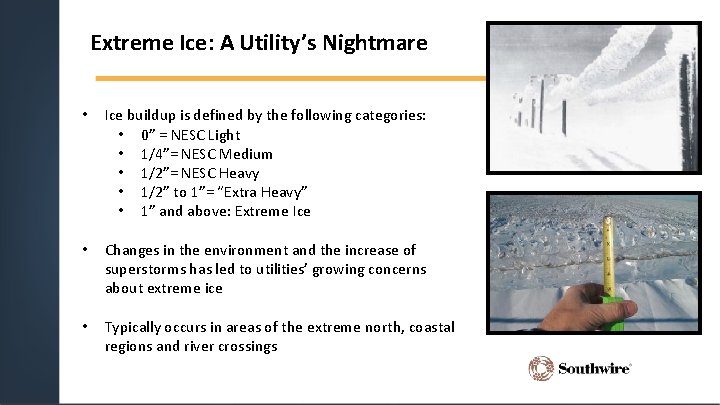
Extreme Ice: A Utility’s Nightmare • Ice buildup is defined by the following categories: • 0” = NESC Light • 1/4”= NESC Medium • 1/2”= NESC Heavy • 1/2” to 1”= “Extra Heavy” • 1” and above: Extreme Ice • Changes in the environment and the increase of superstorms has led to utilities’ growing concerns about extreme ice • Typically occurs in areas of the extreme north, coastal regions and river crossings
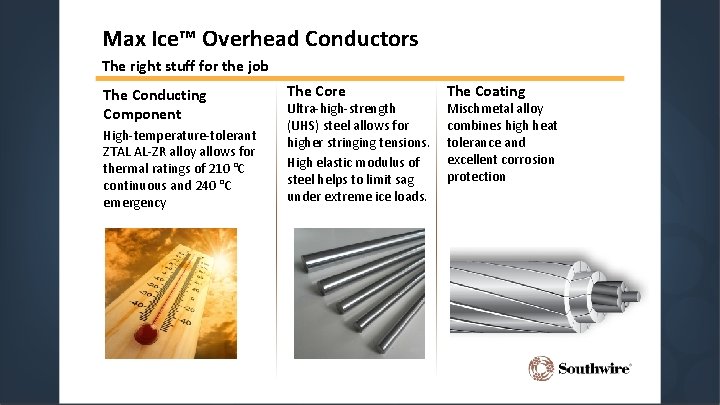
Max Ice™ Overhead Conductors The right stuff for the job The Conducting Component High-temperature-tolerant ZTAL AL-ZR alloy allows for thermal ratings of 210 °C continuous and 240 °C emergency The Core Ultra-high-strength (UHS) steel allows for higher stringing tensions. High elastic modulus of steel helps to limit sag under extreme ice loads. The Coating Mischmetal alloy combines high heat tolerance and excellent corrosion protection
Southwire Tested. Proven Reliable. Max Ice™ Conductors stand up to the stress of extreme ice conditions • • Smaller Conductor Size • Max Ice™ overhead conductors are half the size of the same capacity ACSR conductor • Results in less ice buildup, less sag, and less weight on transmission towers Reduced Tower Height • Tower height and cost can be reduced as a result of less sag under extreme ice conditions than traditional overhead conductors • • • Thermal Rating • 2100 C continuous and 2400 C emergency allows for greater capacity than standard ACSR Same Hardware as ACSS • ACSS hardware and fittings can be used for Max Ice™ overhead conductors Higher RBS with Less Sag • Under extreme ice conditions, Max Ice™ overhead conductors have only reached 70% of its RBS and have 5’ less sag than comparable conductors
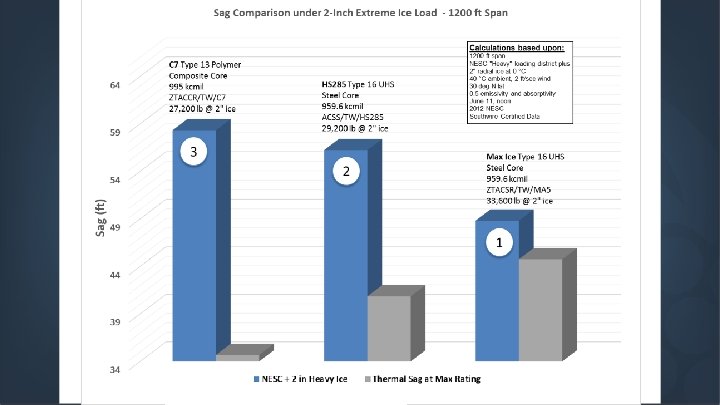
Extreme Ice Performance • In areas where ice loads typically exceed 1”, ice load and sag govern the required structure height • With 2” ice load and 1200’ span, Max Ice™ overhead conductor • Has 5 ft less sag than comparable conductors • Requires 4, 000 lb (13. 5%) greater tension than comparable conductors • Is at 70% RBS with 2” ice weight , versus 80% RBS for the nearest competitor
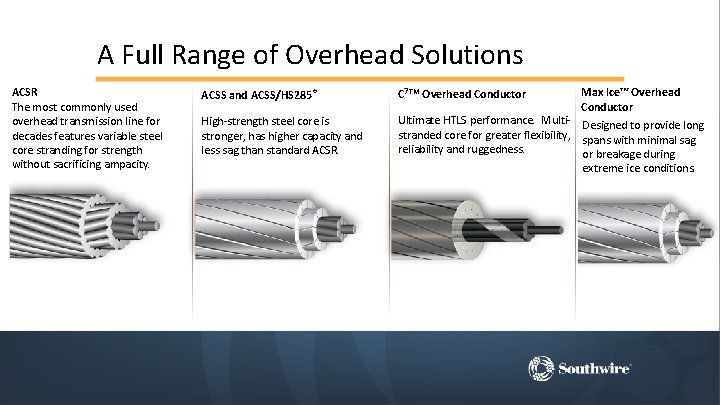
A Full Range of Overhead Solutions ACSR The most commonly used overhead transmission line for decades features variable steel core stranding for strength without sacrificing ampacity. ACSS and ACSS/HS 285® C 7 TM Overhead Conductor High-strength steel core is stronger, has higher capacity and less sag than standard ACSR. Ultimate HTLS performance. Multi- Designed to provide long stranded core for greater flexibility, spans with minimal sag reliability and ruggedness. or breakage during extreme ice conditions. Max Ice™ Overhead Conductor