
Mauve DB Supporting Modelbased User Views in Database
Mauve. DB: Supporting Model-based User Views in Database Systems Amol Deshpande, University of Maryland Samuel Madden, MIT
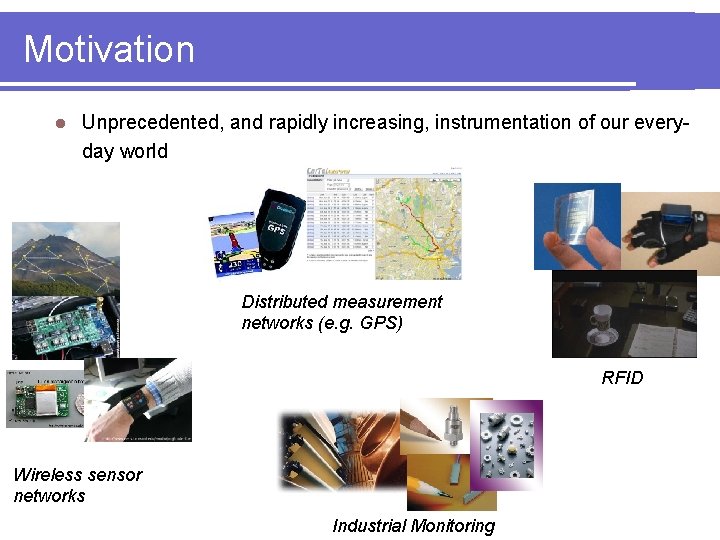
Motivation l Unprecedented, and rapidly increasing, instrumentation of our everyday world Distributed measurement networks (e. g. GPS) RFID Wireless sensor networks Industrial Monitoring
Motivation l Unprecedented, and rapidly increasing, instrumentation of our everyday world l Overwhelmingly large raw data volumes generated continuously l Data must be processed in real-time l The applications have strong acquisitional aspects l l l Data may have to be actively acquired from the environment Typically imprecise, unreliable and incomplete data l Inherent measurement noises (e. g. GPS) and low success rates (e. g. RFID) l Communication link or sensor node failures (e. g. wireless sensor networks) l Spatial and temporal biases because of measurement constraints Traditional data management tools are ill-equipped to handle these challenges
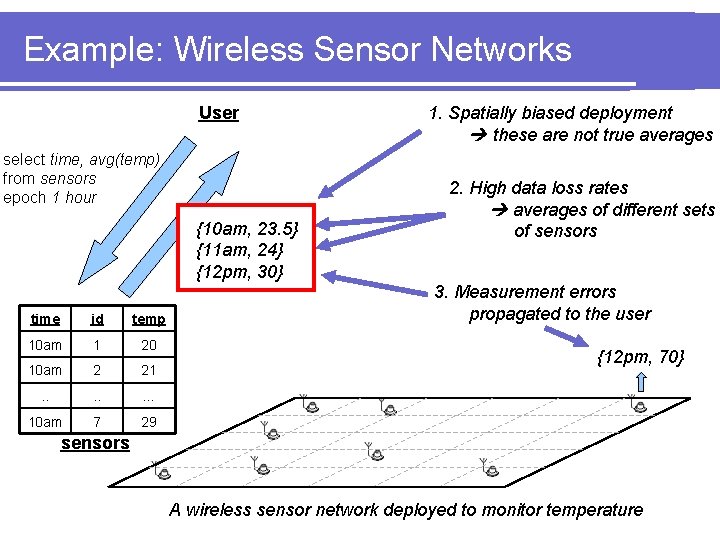
Example: Wireless Sensor Networks User select time, avg(temp) from sensors epoch 1 hour {10 am, 23. 5} {11 am, 24} {12 pm, 30} time id temp 10 am 1 20 10 am 2 21 . . … 10 am 7 29 1. Spatially biased deployment these are not true averages 2. High data loss rates averages of different sets of sensors 3. Measurement errors propagated to the user {12 pm, 70} sensors A wireless sensor network deployed to monitor temperature
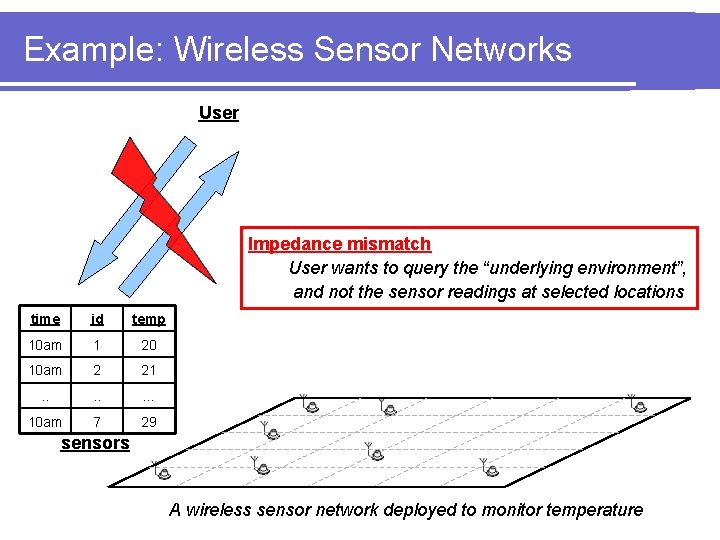
Example: Wireless Sensor Networks User Impedance mismatch User wants to query the “underlying environment”, and not the sensor readings at selected locations time id temp 10 am 1 20 10 am 2 21 . . … 10 am 7 29 sensors A wireless sensor network deployed to monitor temperature
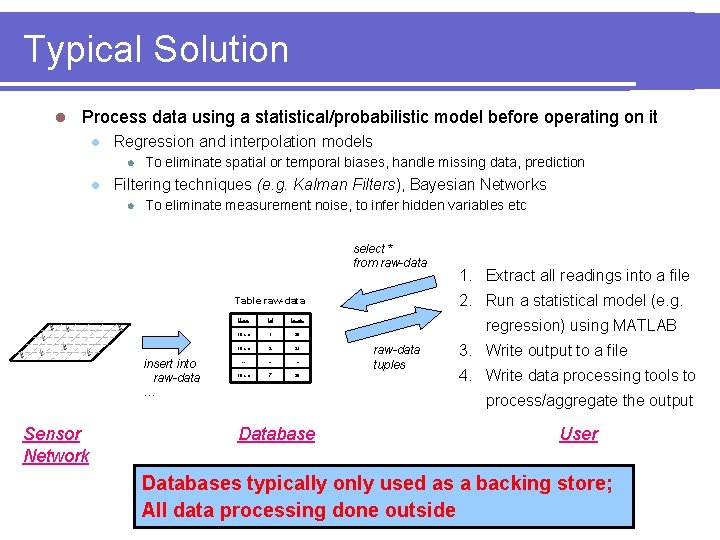
Typical Solution l Process data using a statistical/probabilistic model before operating on it l Regression and interpolation models l l To eliminate spatial or temporal biases, handle missing data, prediction Filtering techniques (e. g. Kalman Filters), Bayesian Networks l To eliminate measurement noise, to infer hidden variables etc select * from raw-data 2. Run a statistical model (e. g. Table raw-data insert into raw-data … Sensor Network time id temp 10 am 1 20 10 am 2 21 . . … 10 am 7 29 1. Extract all readings into a file regression) using MATLAB raw-data tuples 3. Write output to a file 4. Write data processing tools to process/aggregate the output Database User Databases typically only used as a backing store; All data processing done outside
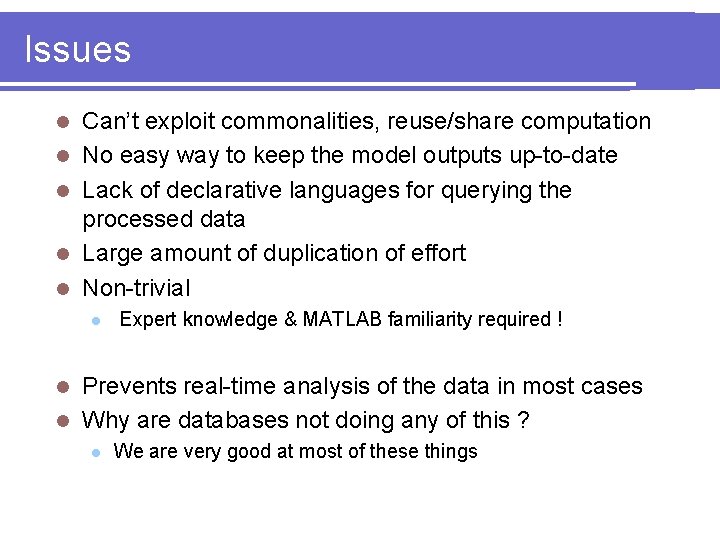
Issues l l l Can’t exploit commonalities, reuse/share computation No easy way to keep the model outputs up-to-date Lack of declarative languages for querying the processed data Large amount of duplication of effort Non-trivial l Expert knowledge & MATLAB familiarity required ! Prevents real-time analysis of the data in most cases l Why are databases not doing any of this ? l l We are very good at most of these things
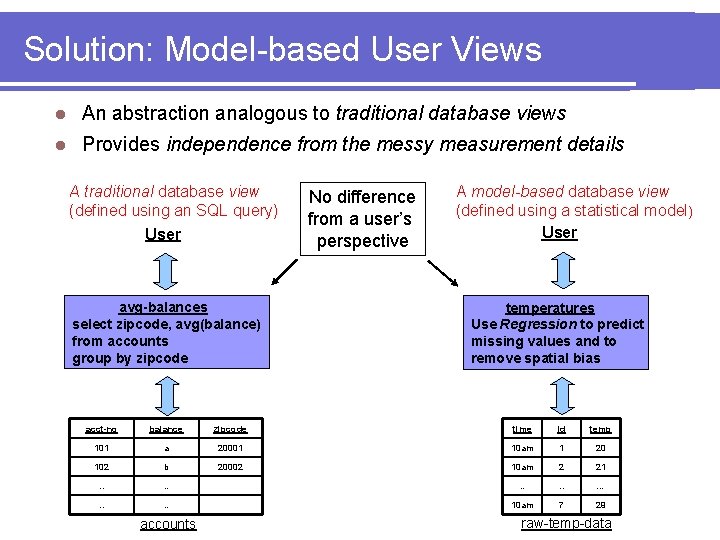
Solution: Model-based User Views l An abstraction analogous to traditional database views l Provides independence from the messy measurement details A traditional database view (defined using an SQL query) User avg-balances select zipcode, avg(balance) from accounts group by zipcode No difference from a user’s perspective A model-based database view (defined using a statistical model) User temperatures Use Regression to predict missing values and to remove spatial bias acct-no balance zipcode time id temp 101 a 20001 10 am 1 20 102 b 20002 10 am 2 21 . . . . … . . 10 am 7 29 accounts raw-temp-data
Mauve. DB System l Supports the abstraction of Model-based User Views l Provides declarative language constructs for creating such views l Supports SQL queries over model-based views l Keeps the models up-to-date as new data is inserted into the database
Mauve. DB System l Supports the abstraction of Model-based User Views l Provides declarative language constructs for creating such views l Supports SQL queries over model-based views l Keeps the models up-to-date as new data is inserted into the database
Outline l Motivation l Model-based l views Details, view creation syntax, querying l Query execution strategies l Mauve. DB implementation details l Experimental evaluation
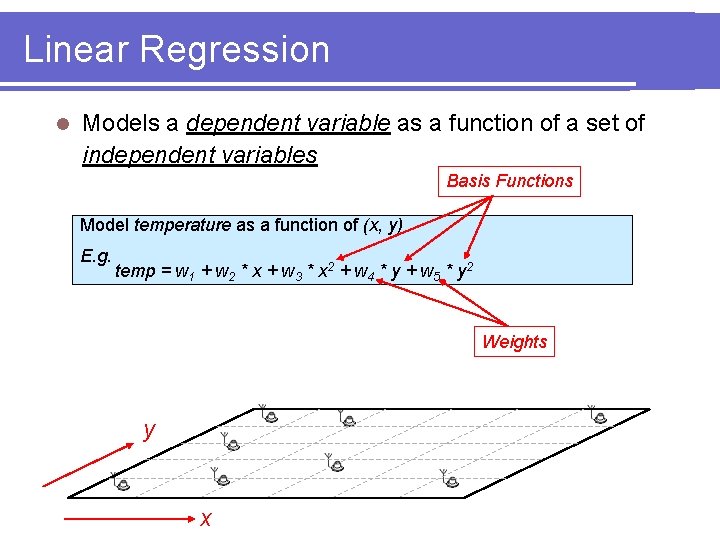
Linear Regression l Models a dependent variable as a function of a set of independent variables Basis Functions Model temperature as a function of (x, y) E. g. temp = w 1 + w 2 * x + w 3 * x 2 + w 4 * y + w 5 * y 2 Weights y x
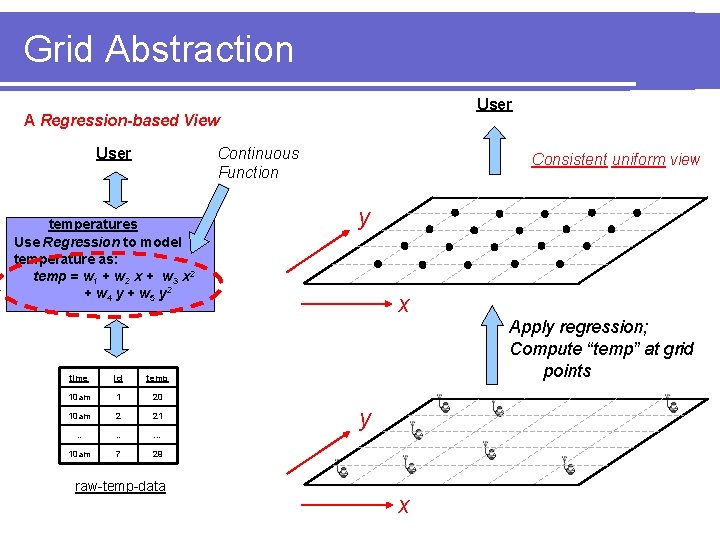
Grid Abstraction User A Regression-based View Continuous Function User temperatures Use Regression to model temperature as: temp = w 1 + w 2 x + w 3 x 2 + w 4 y + w 5 y 2 time id temp 10 am 1 20 10 am 2 21 . . … 10 am 7 29 raw-temp-data Consistent uniform view y x Apply regression; Compute “temp” at grid points y x
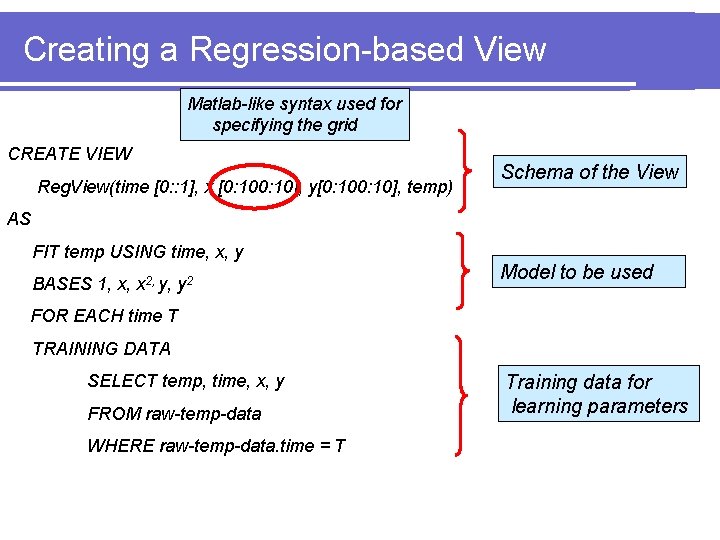
Creating a Regression-based View Matlab-like syntax used for specifying the grid CREATE VIEW Reg. View(time [0: : 1], x [0: 10], y[0: 10], temp) Schema of the View AS FIT temp USING time, x, y BASES 1, x, x 2, y, y 2 Model to be used FOR EACH time T TRAINING DATA SELECT temp, time, x, y FROM raw-temp-data WHERE raw-temp-data. time = T Training data for learning parameters
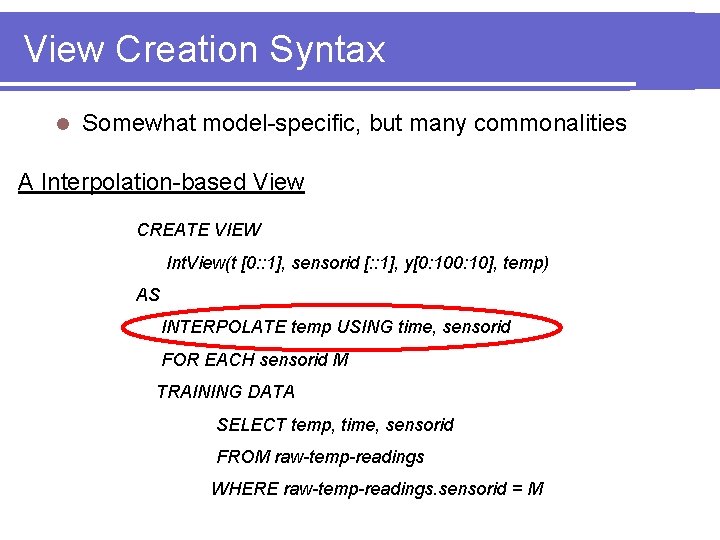
View Creation Syntax l Somewhat model-specific, but many commonalities A Interpolation-based View CREATE VIEW Int. View(t [0: : 1], sensorid [: : 1], y[0: 10], temp) AS INTERPOLATE temp USING time, sensorid FOR EACH sensorid M TRAINING DATA SELECT temp, time, sensorid FROM raw-temp-readings WHERE raw-temp-readings. sensorid = M
Outline l Motivation l Model-based l views Details, view creation syntax, querying l Query execution strategies l Mauve. DB implementation details l Experimental evaluation
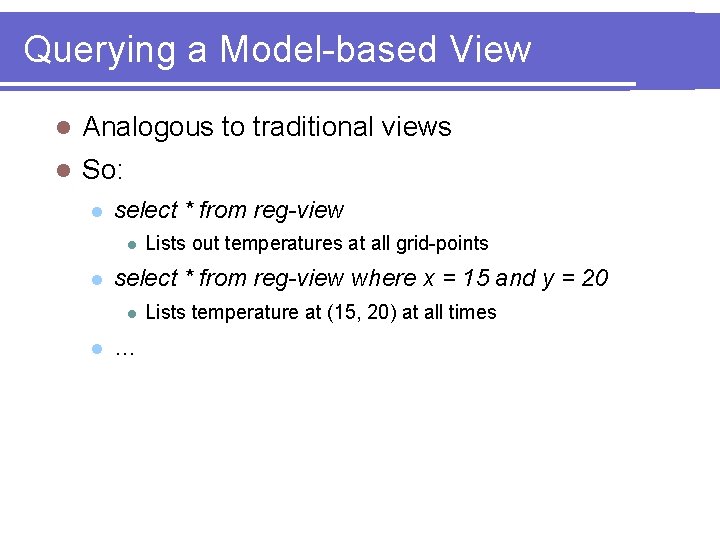
Querying a Model-based View l Analogous to traditional views l So: l select * from reg-view l l select * from reg-view where x = 15 and y = 20 l l Lists out temperatures at all grid-points … Lists temperature at (15, 20) at all times
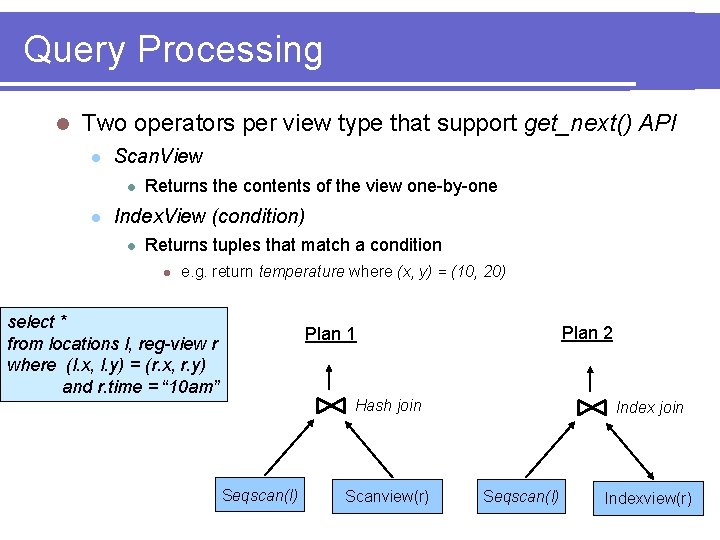
Query Processing l Two operators per view type that support get_next() API l Scan. View l l Returns the contents of the view one-by-one Index. View (condition) l Returns tuples that match a condition l e. g. return temperature where (x, y) = (10, 20) select * from locations l, reg-view r where (l. x, l. y) = (r. x, r. y) and r. time = “ 10 am” Plan 2 Plan 1 Hash join Seqscan(l) Scanview(r) Index join Seqscan(l) Indexview(r)
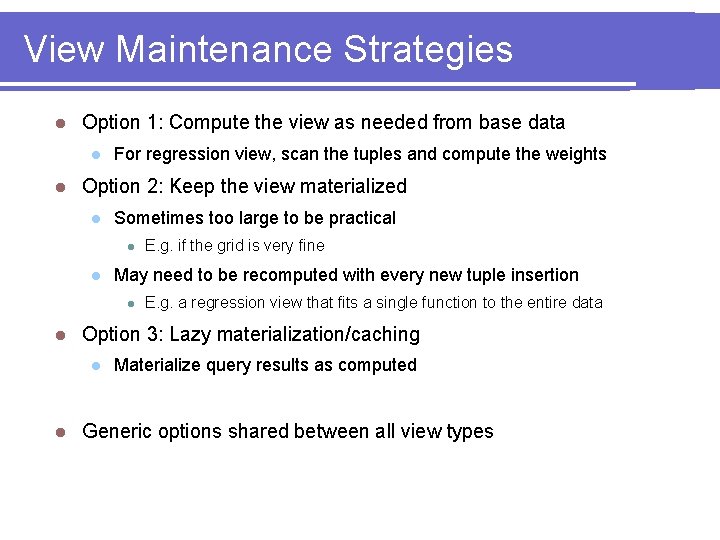
View Maintenance Strategies l Option 1: Compute the view as needed from base data l l For regression view, scan the tuples and compute the weights Option 2: Keep the view materialized l Sometimes too large to be practical l l May need to be recomputed with every new tuple insertion l l E. g. a regression view that fits a single function to the entire data Option 3: Lazy materialization/caching l l E. g. if the grid is very fine Materialize query results as computed Generic options shared between all view types
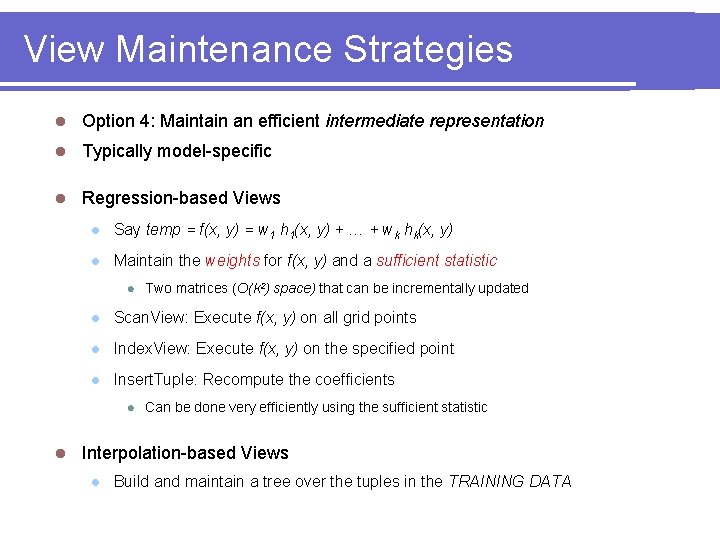
View Maintenance Strategies l Option 4: Maintain an efficient intermediate representation l Typically model-specific l Regression-based Views l Say temp = f(x, y) = w 1 h 1(x, y) + … + wk hk(x, y) l Maintain the weights for f(x, y) and a sufficient statistic l l Scan. View: Execute f(x, y) on all grid points l Index. View: Execute f(x, y) on the specified point l Insert. Tuple: Recompute the coefficients l l Two matrices (O(k 2) space) that can be incrementally updated Can be done very efficiently using the sufficient statistic Interpolation-based Views l Build and maintain a tree over the tuples in the TRAINING DATA
Outline l Motivation l Model-based l views Details, view creation syntax, querying l Query execution strategies l Mauve. DB implementation details l Experimental evaluation
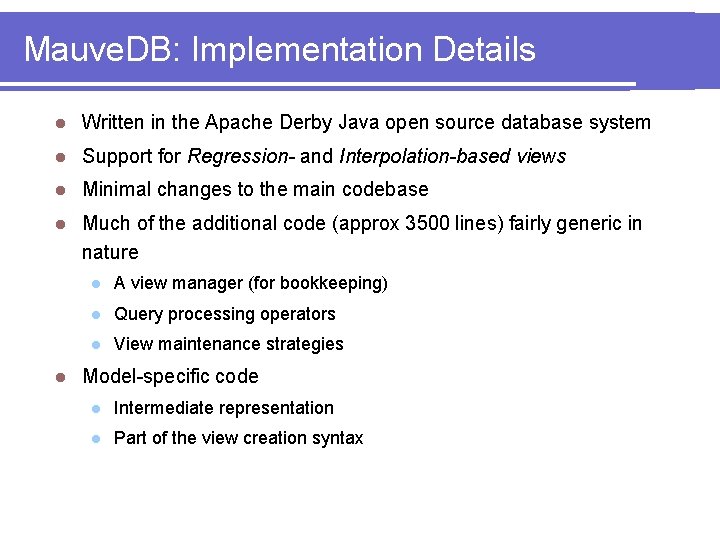
Mauve. DB: Implementation Details l Written in the Apache Derby Java open source database system l Support for Regression- and Interpolation-based views l Minimal changes to the main codebase l Much of the additional code (approx 3500 lines) fairly generic in nature l l A view manager (for bookkeeping) l Query processing operators l View maintenance strategies Model-specific code l Intermediate representation l Part of the view creation syntax
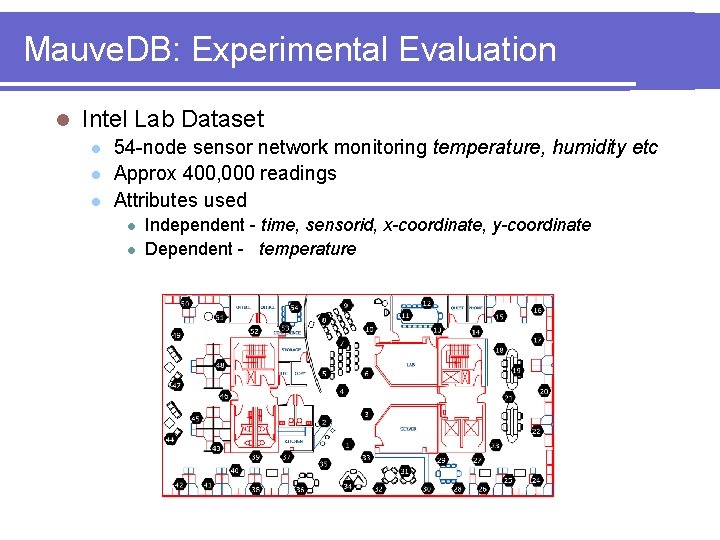
Mauve. DB: Experimental Evaluation l Intel Lab Dataset l l l 54 -node sensor network monitoring temperature, humidity etc Approx 400, 000 readings Attributes used l l Independent - time, sensorid, x-coordinate, y-coordinate Dependent - temperature
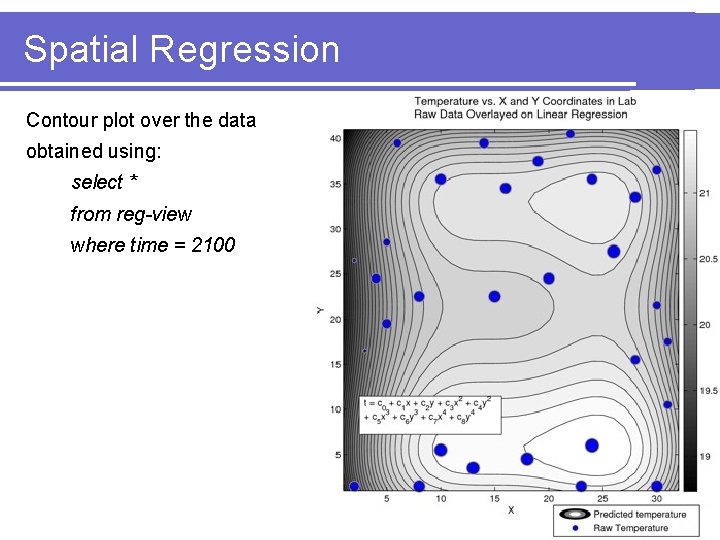
Spatial Regression Contour plot over the data obtained using: select * from reg-view where time = 2100
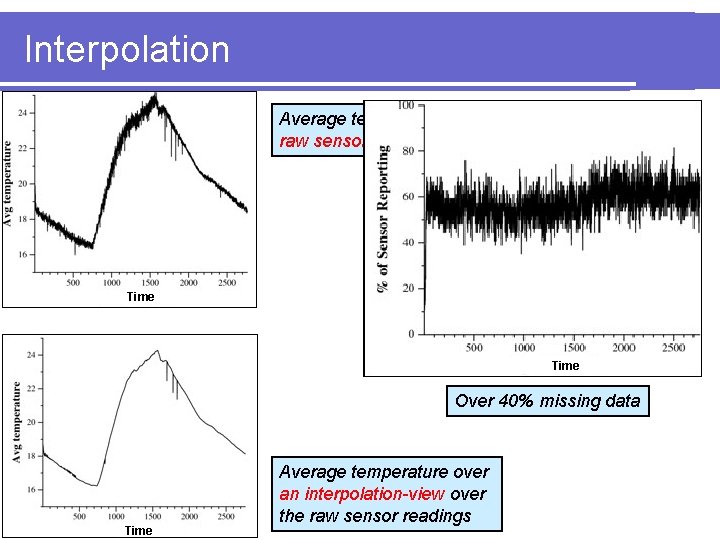
Interpolation Average temperature over raw sensor readings Time Over 40% missing data Time Average temperature over an interpolation-view over the raw sensor readings
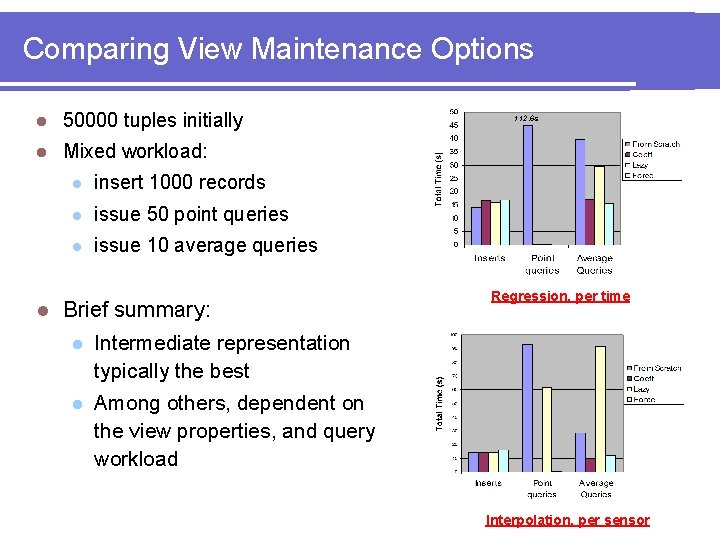
Comparing View Maintenance Options l 50000 tuples initially l Mixed workload: l l insert 1000 records l issue 50 point queries l issue 10 average queries Brief summary: l Intermediate representation typically the best l Among others, dependent on the view properties, and query workload 112. 6 s Regression, per time Interpolation, per sensor
Ongoing and Future Work l l Adding support for views based on dynamic Bayesian networks (e. g. Kalman Filters) l A very general class of models with wide applicability l Generate probabilistic data Developing APIs for adding arbitrary models l Minimize the work of the model developer l Query processing, query optimization, and view maintenance issues l Much research still needs to be done
Conclusions l Proposed the abstraction of model-based views l Poweful abstraction that enables declarative querying over noisy, imprecise data l Exploit commonalities to define, to create, and to process queries over such views l Mauve. DB prototype implementation l Using the Apache Derby open source DBMS l Supports Regression- and Interpolation-based views l Supports many different view maintenance strategies
Thank you !! l Questions ?
- Slides: 29